INTRODUCTION
Forage maize (Zea mays L.) silage has the potential to improve ruminant performance compared with many grass silages (Fitzgerald & Murphy Reference Fitzgerald and Murphy1999; Phipps et al. Reference Phipps, Sutton, Beever and Jones2000; Keady et al. Reference Keady, Lively, Kilpatrick and Moss2007). To fulfil a worthwhile role in commercial farming, this whole-crop silage requires a high starch concentration and thus a high proportion of well-developed cob because the moderate digestibility of the stover component will only support rates of animal performance similar to what would be achieved with average quality grass silage (O'Kiely & Moloney Reference O'Kiely and Moloney1995).
In recent times, the adoption of technologies such as plastic mulch and earlier-maturing cultivars, which help counteract the limitations of unfavourable climatic conditions, has facilitated increases in the achieved yield and quality of forage maize grown in marginal locations (Crowley Reference Crowley1998; Farrell & Gilliland Reference Farrell and Gilliland2011). Despite these developments, there remains a requirement to optimize the forage maize production system in marginal locations in order to avoid low crop yield or poor nutritive value, and to manage the subsequent ensiling process to minimize quantitative or qualitative losses. Finneran et al. (Reference Finneran, Crosson, O'Kiely, Shalloo, Forristal and Wallace2012) reported that whole-crop maize could either be the cheapest or the most expensive home-produced alternative feed to grazed grass, depending on how factors such as climate, soil and management impact on crop yield and nutritive value, and on the efficiency of its conservation.
Whole-crop forage maize production systems typically require high inputs of fertilizer to support the production of large yields of plant biomass (Allen et al. Reference Allen, Coors, Roth, Buxton, Muck and Harrison2003). Previous studies in climates that facilitate high yields of forage maize have reported increased whole-crop and grain yield with increased nitrogen (N) application rates, with optimum inputs in the range 150–200 kg N/ha (Cox & Cherney Reference Cox and Cherney2001; Trindade et al. Reference Trindade, Coutinho, Jarvis and Moreira2009; Masoero et al. Reference Masoero, Gallo, Zanfi, Giuberti and Spanghero2011). However, legislative restrictions detailed in Statutory Instrument 101 (2009) state that the amount of livestock manure applied in a year must not exceed 170 kg organic N/ha which, when spread in the form of cattle slurry, provides c. 49 kg available N/ha. Therefore, up to 0·70 of applied N in a typical maize production system is likely to be in the form of chemical fertilizer, which contributes a significant expense in the production cost of the crop.
Studies investigating the effects of N application rate on the yield and nutritive value of maize grown in climatically marginal locations are not widely available. In addition, previous studies on forage maize grown in Ireland and Britain focused primarily on the effects of crop management factors on whole-crop yield and quality at harvest time, and on the proportion of cob present (Easson & Fearnehough Reference Easson and Fearnehough2000; Keane Reference Keane2002; Keane et al. Reference Keane, Kelly, Lordan and Kelly2003), with little research investigating the impacts they have on the conservation characteristics of ensiled maize. Information on the effects that crop management has on the ensilage of forages is required as this process can alter their nutritional value and may cause qualitative and quantitative losses through effluent production, respiration and fermentation (McDonald et al. Reference McDonald, Henderson and Heron1991). Since the ensiling properties of cob and stover may differ, and with the relative contribution of these two components of the whole-crop varying between cultivars, it is important to understand the impact that factors such as N application rate, harvest date and cultivar selection have on the cob and stover components of the freshly harvested whole-crop and on the silages produced from these components.
The objectives of the present study were to determine the effects of N application rate, harvest date and cultivar on the yield, quality and the subsequent conservation characteristics of whole-crop, cob and stover silages.
MATERIALS AND METHODS
Experimental design
The experiment was organized in a spilt-plot design, with harvest date (15 September, 6 October and 27 October) as the main plot, and a three (maize cultivars: Tassilo, Andante and KXA 7211)×two (N application rate: 33 and 168 kg N/ha) factorial arrangement of treatments as the sub-plot, within three replicate blocks. The three harvest dates represented early, normal and late harvests, respectively, for a midland site in Ireland. Of the three maize cultivars selected, Tassilo and Andante represent conventional cultivars sown by commercial livestock farmers in Ireland, while KXA 7211 is categorized as a high biomass cultivar.
Experimental site, crop production and management
The experimental site (Grange, Dunsany, Co. Meath; 53°30′N, 6°39′W, 83 m asl) had been used to grow maize in 2008 and had previously been in permanent pasture for 30 years. The soil type was from the slowly permeable Ashbourne series of the gley grouping (Finch et al. Reference Finch, Gardiner, Comey and Radford1983).
Cattle slurry was applied to all plots prior to ploughing on 1 April 2009, at a rate calculated to provide 33 kg available N/ha. Inorganic N was applied at two rates (low, 0 kg N/ha; high, 135 kg N/ha in the form of calcium ammonium nitrate (CAN; 275 g N/kg)) 4 h prior to sowing. After seedbed preparation, three replicate blocks, each with 18 four-row plots (individual plots were 20·0×3·81 m) were sown under plastic mulch (1·37 m wide, 6 μm thick film which covered two rows of seed; X-tend transparent photodegradable polythene, I.P Ltd, Gorey, Co. Wexford, Ireland) on 13 May 2009 with a Samco 4 Row 4700 SP seed drill at a depth of c. 50 mm and at a rate of 100000 seeds/ha. The row spacing was 0·85 m between the two central rows, with 0·72 m separating these and the outer rows of a plot. Herbicide (Calaris; Syngenta Crop Protection UK Ltd, Cambridge, UK; 1 litre/ha) was applied at sowing and on 7 July.
Onatrio heat units (OHU) were calculated using meteorological data recorded within 0·5 km of the crop using the instruments and standards described by Fitzgerald & Fitzgerald (Reference Fitzgerald, Fitzgerald, Keane and Collins2004).
Harvesting and ensiling
On each harvest date, the two central rows were cut using a reciprocating blade mower (Agria 5400 KL, Nottingham, UK) at a stubble height of 100 mm and weighed. To determine the proportion of the major plant components harvested, 30 plants were randomly selected, separated into cob (rachis and kernels) and stover (remainder of plant after cob removal) and weighed.
A representative sample of the remaining plants was taken to produce 10 kg of each of whole-crop, and separated cob and stover. Whole-crop and stover samples were subsequently precision-chopped (set to a theoretical chop length of 19 mm; Pottinger Mex VI, Grieskirchen, Austria), while cobs were chopped in a food processor (Müller MTK 204 special, Saarbrücken, Germany). Representative 5 kg sub-samples of each chopped material were ensiled in a laboratory silo (O'Kiely & Wilson Reference O'Kiely and Wilson1991) for 130 days at c. 15 °C. Samples of whole-crop, cob and stover were also taken at pre-ensiling and stored at –20 °C prior to chemical analysis.
Any effluent produced from the laboratory silo was collected and weighed after 3, 10, 35 and 130 days. After 130 days ensilage, the silages were weighed, aseptically mixed and sampled for chemical and microbial analyses.
Aerobic stability
Aerobic stability was determined by placing c. 2·7 kg of each silage into a polystyrene box (250 mm thick; 590×390×220 mm) lined with polythene and loosely covered with a polystyrene lid. A thermocouple was placed in the centre of each silage sample. The temperature of the silage was recorded on an hourly basis over an 8-day period by a data logger (SQ ELTEK 80T; Eurolec Instrumentation Ltd, Dundalk, Ireland). Reference temperatures were obtained from containers of water stored beside the boxes of silage. The indices of aerobic stability and deterioration were expressed as (i) accumulated temperature rise above the reference temperature during 120 h exposure to air and (ii) hours elapsed until the temperature rose more than 2 °C higher than the reference temperature.
Chemical analysis
Samples of whole-crop, cob and stover were homogenized using a food processor (Muller MKT 204 Special Food Processor, Saarbrücken, Germany). The dry matter (DM) concentration of samples pre- and post-ensiling was determined by drying in an oven with forced air circulation at 98 and 85 °C for 16 h, respectively, with the latter values being corrected for loss of volatile components using the procedure of Porter & Murray (Reference Porter and Murray2001). Samples oven-dried at 40 °C for 48 h were ground through a hammer mill (Willey Mill, Athur H. Thomas, Philadelphia, PA, USA) that had a screen with 1 mm apertures prior to chemical analysis. The digestible DM (DDM) content was analysed as described by Tilley & Terry (Reference Tilley and Terry1963), with the final residue isolated by filtration (through Whatman GF A, pore size 1·6 μm; Maidstone, England) instead of by centrifugation. Starch was determined using the Megazyme total starch assay procedure (McCleary et al. Reference McCleary, Solah and Gibson1994). The concentration of cold-water soluble carbohydrates (WSC) was analysed using the automated anthrone method (Thomas Reference Thomas1977) and crude protein (CP; total N×6·25) was determined using a LECO FP-528N analyser (Leco, St. Joseph, MI, USA) by measuring the thermal conductivity of N present in a sample following total combustion at 900 °C, based on the methods of the Association of Analytical Chemists (AOAC) 900-03 (AOAC 1990). Both neutral detergent fibre (NDF; included α-amylase and sodium sulphite) and acid detergent fibre (ADF) were analysed using the ANKOM filter bag technique (ANKOM 2006a,b) based on the analytical method of Van Soest et al. (Reference Van Soest, Robertson and Lewis1991) and were expressed exclusive of ash. Ash concentration was determined by complete combustion in a muffle furnace at 550 °C for 5 h, while buffering capacity (BC) was analysed using the method of Playne & McDonald (Reference Playne and McDonald1966).
Aqueous extracts were removed from silage using a hydraulic press and the pH was obtained using a pH electrode (Hanna Instruments, Leighton Buzzard, UK; HI98127). The volatile fatty acids (VFA) and ethanol concentrations were measured with a gas chromatograph (Shimadzu GC 17-A, Milton Keynes, UK) with a flame ionization detector and fitted with a chromopack column (2·4 m×5 mm (outside diameter) 3 mm (internal diameter) glass with T max 200 °C on chrom WHP 80–100 mesh) using the method of Ranfft (Reference Ranfft1973). Lactic acid concentration was analysed using the SP-Ace Clinical Chemical Analyser (Alfa Wassermann, NJ, USA, and the L-lactic acid UV-method test kit, Roche/R-Biopharm catalogue number 101309084035, Darmstadt, Germany) and D-lactate concentration was determined using the enzyme D-lactate dehydrogenase (Roche/R-Biopharm catalogue number 1016941001). Concentrations of ammonia (NH3) were determined using the SP-Ace Clinical Chemical Analyser and the Thermo Electron Infinity ammonia liquid stable reagent kinetic method (Waltham, MA, USA).
Microbial analysis
Silage samples were initially stored at 4 °C, and isolation of microbes from the herbage commenced within 4 h of silo opening. A 30 g sample of silage was added to 270 ml of peptone water (1 g/l H2O; Oxoid, LP0037) and homogenized for 3 min in a stomacher blender (Colworth stomacher 400, A. J. Seward & Co. Ltd, London), with a subsequent 1 ml aliquot serially diluted in peptone water. Media consisting of De Man, Rogosa and Sharpe agar (MRS, Oxoid, CM361B) and nystatin (20 ml/l, Sigma, N1638) were used for the enumeration of lactic acid bacteria (LAB), while malt extract agar (Oxoid, CM0059B), streptomycin (100 mg/l, Sigma, S9137) and chloramphenicol (100 mg/l, Sigma, C0378) were used to enumerate yeast using the double-layer pour plate method. Following incubation at 30 °C the colony-forming units on each plate were enumerated and the number of micro-organisms per gram of herbage expressed on a log10 basis.
Statistical analysis
Data were analysed as a split-plot design using a model that accounted for replicated blocks and harvest date as the main plot and a three×two factorial arrangement of cultivar and N application rate in the sub-plot and their interactions, using the PROC GLM procedure of the SAS Version 9.1 statistical program (SAS 2002). Treatment contrasts were made using the Fischer least significant differences test.
RESULTS
Yield and DM concentration
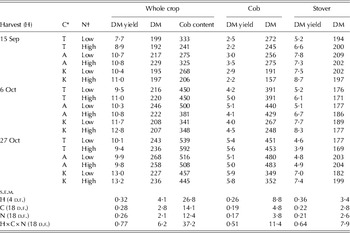
On average, no effect (P>0·05) of N application rate was observed on the DM yield or DM concentration of whole-crop or cob, while the proportion of cob in whole-crop DM was also unaffected (Table 1). Cultivars grown under the high N application rate had a higher (P<0·05) stover DM yield than low N plots.
DM yield (t/ha), DM concentration (g/kg) and cob content of forage maize (g cob/kg whole plant, DM basis) whole-crop, cob and stover at the time of harvest – harvest date, cultivar and N application rate effects

* C=cultivar, T=Tassilo, A=Andante, K=KXA 7211.
† N=nitrogen input, Low=33 kg N/ha, High=168 kg N/ha.
The DM yields of both whole-crop and stover were unaffected (P>0·05) by harvest date, while the cob DM yield of cultivars harvested on 15 September was lower (P<0·01) than at later harvest dates (Table 1). The DM concentration of both whole-crop and cob harvested on 27 October was higher (P<0·01) than on earlier harvest dates, whereas stover harvested on 6 October had a lower (P<0·05) DM concentration than stover harvested on 15 September. The proportion of cob in whole-crop DM increased (P<0·05) with later harvesting.
The cultivar KXA 7211 had a higher (P<0·01) DM yield of whole-crop and stover than the other cultivars, although no significant difference (P>0·05) for whole-crop DM yield was observed between KXA 7211 and Andante harvested on 15 September. The DM concentration of whole-crop and cob was higher (P<0·01) for Andante and lower (P<0·05) for KXA 7211 compared with Tassilo, although there was no difference (P>0·05) between the DM concentration of cob from Andante and Tassilo harvested on 15 September. KXA 7211 had a lower (P<0·01) proportion of cob in whole-crop DM, compared with the other cultivars.
Pre-ensilage chemical composition
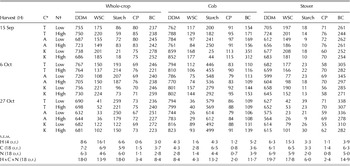
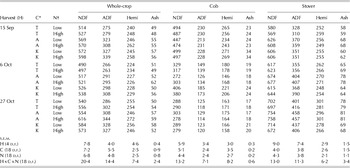
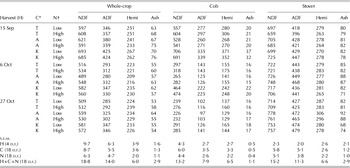
No main effect (P>0·05) of N application rate was observed on the DDM content, or the WSC, starch, NDF, ADF, hemicellulose or ash concentrations of whole-crop, cob or stover. However, cvar Tassilo harvested on 15 September and Andante harvested on 27 October had higher (P<0·05) cob DDM content when grown on plots with a high N application rate (Tables 2 and 3). The CP concentration of whole-crop, cob and stover was higher (P<0·05) and the BC of whole-crop and stover was lower (P<0·01) for crops grown on plots with a high N application rate, although the BC of whole-crop from KXA 7211 harvested on 15 September and 27 October was lower (P<0·05) when grown on plots with a low N application rate.
DDM (g/kg), WSC, starch and CP concentrations (g/kg DM) and BC (mEq/kg DM) of maize whole-crop, cob and stover at the time of harvest – harvest date, cultivar and N application rate effects

* C=cultivar, T=Tassilo, A=Andante, K=KXA 7211.
† N=nitrogen input, Low=33 kg N/ha, High=168 kg N/ha.
Structural carbohydrate and ash concentrations (g/kg DM) of forage maize whole-crop, cob and stover at the time of harvest – harvest date, cultivar and N application rate effects

* C=cultivar, T=Tassilo, A=Andante, K=KXA 7211.
† N=nitrogen input, Low=33 kg N/ha, High=168 kg N/ha.
The DDM content of whole-crop and stover was lower (P<0·05) on 27 October than on earlier harvest dates, while no effect (P>0·05) of later harvesting was observed on the DDM content of cob. The WSC concentration of whole-crop, cob and stover cultivars harvested on 27 October was lower (P<0·05) than earlier harvest dates. The starch concentration of whole-crop and cob increased with later harvesting (P<0·05), with the exception of Andante which did not have a significant increase in starch between 6 and 27 October. Later harvesting decreased (P<0·01) the NDF, ADF, hemicellulose and ash concentrations of cob while the opposite (P<0·05) was observed for stover. The NDF, ADF and hemicellulose concentrations of whole-crop harvested on 6 October were lower (P<0·05) than on other harvest dates, while the ash concentration of whole-crop was unaffected (P>0·05) by harvest date. Whole-crop, cob and stover harvested on 15 September had a higher (P<0·05) CP concentration than on later harvest dates, while the BC of cob and stover harvested on 15 September was higher (P<0·001) and lower (P<0·01), respectively, than on later harvest dates.
Whole-crop, cob and stover from Andante had a lower (P<0·05) DDM content, while whole-crop and stover from Tassilo had a higher (P<0·05) DDM content, compared with the other cultivars. The WSC concentration of whole-crop, cob and stover from Andante was lower (P<0·05) than the other cultivars, although no difference in the WSC concentration of whole-crop or stover was observed between Andante and Tassilo harvested on 27 October. The starch concentration of whole-crop and cob from KXA 7211 was lower (P<0·001) than the other cultivars, while cobs from Andante had a higher (P<0·001) starch content than the other cultivars. The NDF, ADF, hemicellulose and ash concentrations of cob from Andante were lower (P<0·05) than KXA 7211, while the opposite was observed (P<0·01) for stover. The CP concentration of whole-crop was unaffected (P>0·05) by cultivar, whereas whole-crop from KXA 7211 had a higher (P<0·05) BC than the other cultivars. Cobs from KXA 7211 had a higher (P<0·05) CP concentration and BC than the other cultivars, while stover from KXA 7211 had a lower (P<0·001) CP concentration.
Post-ensilage chemical composition (non-fermentation)
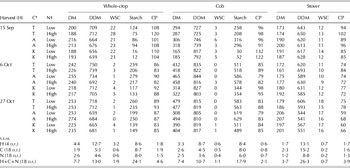
Cob silages produced from crops grown on plots with a higher N application rate had higher (P<0·05) NDF and ADF concentrations. However, the NDF and ADF concentrations of both whole-crop and stover silages and the WSC concentration of both whole-crop and cob silages were unaffected (P>0·05) by N application rate, while the DDM content, starch, hemicellulose and ash concentrations of whole-crop, cob or stover silages were also unaffected (P>0·05) by N application rate (Tables 4 and 5).
DM concentration (g/kg), DDM (g/kg), WSC, starch and CP concentrations (g/kg DM) of forage maize whole-crop, cob and stover silages – harvest date, cultivar and N application rate effects

* C=cultivar, T=Tassilo, A=Andante, K=KXA 7211.
† N=nitrogen input, Low=33 kg N/ha, High=168 kg N/ha.
Structural carbohydrate and ash concentrations (g/kg) of forage maize whole-crop, cob and stover silages – harvest date, cultivar and N effects

* C=cultivar, T=Tassilo, A=Andante, K=KXA 7211.
† N=nitrogen input, Low=33 kg N/ha, High=168 kg N/ha.
Later harvesting did not affect (P>0·05) the DDM content of whole-crop silages, while the DDM content of cob silages from crops harvested on 15 September and stover silages from crops harvested on 27 October were lower (P<0·05) than on other harvest dates. The starch content was lower (P<0·001) and the WSC, NDF, ADF, hemicellulose, CP and ash concentrations were higher for whole-crop and cob silages produced from crops harvested on 15 September compared with later harvest dates. Stover silages produced from crops harvested on 27 October had higher (P<0·05) NDF, ADF and hemicellulose concentrations and a lower (P<0·05) CP concentration compared with earlier harvest dates.
Whole-crop and stover silages produced from Tassilo had a higher (P<0·05) DDM content compared with the other cultivars, while stover silages produced from Tassilo also had lower (P<0·05) NDF and ADF concentrations and a higher (P<0·01) CP concentration than the other cultivars. Whole-crop and cob silages from KXA 7211 had a lower starch concentration (P<0·001) and higher (P<0·05) NDF, ADF and hemicellulose concentrations compared with the other cultivars, while cob silages produced from KXA 7211 and harvested on 15 September or 6 October also had a higher (P<0·001) ash concentration than the other cultivars. Cob silages produced from Andante had a higher (P<0·001) starch concentration and lower (P<0·05) NDF, ADF, hemicellulose and CP concentrations than the other cultivars.
Change in chemical composition (non-fermentation) during ensilage
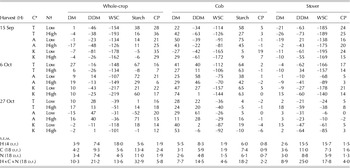
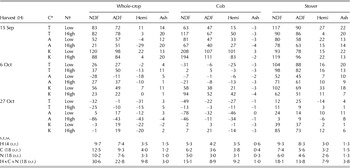
The changes in chemical composition of whole-crop and stover due to ensiling were unaffected (P>0·05) by N application rate. The increase in DM, NDF and ADF concentrations and the decrease in DDM content and ash content due to ensiling were greater (P<0·05) for cobs produced from high N application rate crops than low N application rate crops (Tables 6 and 7).
Absolute changes (silage-fresh crop) in DM concentration (g/kg), DDM (g/kg), non-structural carbohydrate and CP concentration (g/kg DM) of forage maize whole-crop, cob and stover silages – harvest date, cultivar and N application rate effects

* C=cultivar, T=Tassilo, A=Andante, K=KXA 7211.
† N=nitrogen input, Low=33 kg N/ha, High=168 kg N/ha.
Absolute changes (silage – fresh crop) in the structural carbohydrate and ash concentrations (g/kg DM) of maize whole-crop, cob and stover silages – harvest date, cultivar and N application rate effects

* C=cultivar, T=Tassilo, A=Andante, K=KXA 7211.
† N=nitrogen input, Low=33 kg N/ha, High=168 kg N/ha.
The extent of change in DM concentration due to ensiling of whole-crop and cob was unaffected (P>0·05) by harvest date, while the reduction of DM concentration due to ensiling of stover was greater (P<0·05) for crops harvested on 15 September than later harvest dates. For whole-crop, the increase in NDF, ADF, CP and ash concentrations and the decrease in the WSC concentration due to ensiling was greater (P<0·01) for crops harvested on 15 September compared with later harvest dates, while the increase in DDM content and decrease in hemicellulose concentration due to ensiling was of a greater (P<0·01) magnitude for crops harvested on 27 October than at earlier harvest dates. The increase in starch, NDF, ADF, hemicellulose and CP concentrations and the decrease in WSC concentration due to ensiling of cobs was greater (P<0·05) for crops harvested on 15 September compared with 27 October. The increase in NDF, hemicellulose, CP and ash concentrations and the decrease in the WSC concentration due to ensiling of stover were lower (P<0·05) for crops harvested on 27 October compared with earlier harvest dates, while the increase in ADF concentration was greater (P<0·05) on 27 October compared with earlier harvest dates.
The increases in NDF and ADF and decrease in WSC, hemicellulose and DDM concentrations due to ensiling were greater (P<0·05) for whole-crop produced from KXA 7211, compared with Andante. The increases in NDF, ADF and hemicellulose concentrations, and the decreases in WSC concentration and DDM content due to ensiling, were greater (P<0·05) for cobs produced from KXA 7211 than Andante. The increases in ADF and CP concentrations and the decrease in WSC content due to ensiling were lower (P<0·05) for stover produced from Andante than the other cultivars.
Fermentation products
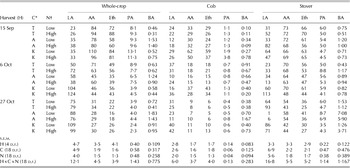
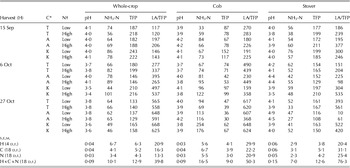
No fermentation product concentrations of whole-crop and cob silages were affected by N application rate, with the exception of a higher (P>0·001) propionic acid concentration for cob silages produced from crops harvested from high N application rate plots on 15 September (Tables 8 and 9). Stover silages produced from crops grown on high N application rate plots had a higher (P<0·05) ammonia-N concentration and pH than crops grown on low N application rate plots.
Individual fermentation product concentrations (g/kg DM) of whole-crop maize, cob and stover due to ensiling – harvest date, cultivar and N application rate effects

* C=cultivar, T=Tassilo, A=Andante, K=KXA 7211.
† N=nitrogen input, Low=33 kg N/ha, High=168 kg N/ha.
LA, lactic acid; AA, acetic acid; Eth, ethanol; PA, propionic acid; BA, butyric acid.
pH, ammonia–N (NH3–N, g/kg N) concentration, TFP (g/kg DM) and proportion of lactic acid in TFP (g lactic acid/ kg TFP) of whole-crop maize, cob and stover silages – harvest date, cultivar and N application rate effects

* C=cultivar, T=Tassilo, A=Andante, K=KXA 7211.
† N=nitrogen input, Low=33 kg N/ha, High=168 kg N/ha.
The total fermentation products (TFP) of whole-crop, cob and stover silages decreased (P<0·05) with later harvesting. The lactic acid concentration of cob and stover silages was unaffected (P>0·05) by harvest date, while whole-crop silages had a lower (P<0·01) lactic acid concentration when produced from crops harvested on 15 September compared with later harvest dates. Acetic acid and ethanol concentrations of whole-crop, cob and stover silages produced from crops harvested on 27 October were lower (P<0·05) than on earlier harvest dates. Propionic acid was higher (P<0·01) for whole-crop and cob silages produced from crops harvested on 15 September compared with on 27 October, while the propionic acid concentration of stover silage was unaffected (P>0·05) by harvest date. The concentration of butyric acid was lower (P<0·001) for cob and stover silages, respectively, produced from crops harvested on 15 September compared with on 27 October, while butyric acid production in whole-crop silages was unaffected (P>0·05) by harvest date. The proportion of lactic acid in the TFP of whole-crop and cob silages increased (P<0·05) with later harvesting, and it was unaffected (P>0·05) by harvest date for stover silages. The ammonia-N concentration of cob silage increased (P<0·05) with later harvesting, while the ammonia-N concentration of whole-crop and stover silages was unaffected (P>0·05) by harvest date. The pH of whole-crop and cob silages produced from crops harvested on 15 September was higher (P<0·05) compared with later harvest dates, while stover silage produced from crops harvested on 15 September had a lower (P<0·05) pH than on later harvest dates.
The TFP concentration of whole-crop, cob and stover silages produced from KXA 7211 was higher (P<0·01) than Andante. The concentrations of lactic acid were higher (P<0·05) in whole-crop and stover silages produced from KXA 7211, compared with the other cultivars. The concentrations of acetic acid, ethanol and propionic acid were higher (P<0·001) for cob silages produced from KXA 7211 compared with the other cultivars, although acetic acid concentrations of cob silages produced from crops harvested on 27 October were unaffected (P>0·05) by cultivar. Cob and stover silages produced from the Andante cultivar had higher (P<0·05) butyric acid concentrations than other cultivars, while the butyric acid concentration of whole-crop silages was unaffected (P>0·05) by cultivar. The proportion of lactic acid in the TFP of whole-crop and stover silages was higher (P>0·05) for KXA 7211 compared with the other cultivars, while the proportion which lactic acid contributed to TFP in cob silages was higher (P>0·01) for Tassilo than the other cultivars. Cob silages produced from KXA 7211 had higher (P<0·01) ammonia-N concentrations than the other cultivars, while the ammonia-N concentration of whole-crop and stover silages were unaffected by cultivar. The pH of whole-crop and stover silages produced from KXA 7211 was lower (P>0·001) than Andante, while the pH of cob silages produced from Tassilo was lower (P>0·05) than other cultivars.
DM recovery and aerobic stability
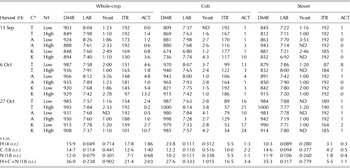
Higher N application did not affect (P>0·05) DM recovery, effluent production, aerobic stability or aerobic deterioration of whole-crop or cob silages (Table 10). Stover silages produced from cultivars grown under the high N application rates had lower yeast numbers (P<0·05) than low application rate plots.
DM recovery (DMR; g silage/kg herbage), LAB and yeast counts Log10(colony forming units/g herbage) and aerobic stability (ITR; interval (hours) until a temperature rise >2 °C) and deterioration (ACT; accumulated temperature (°C) rise after 120 h exposure to air) of whole-crop, cob and stover silages – harvest date, cultivar and N application rate effects

* C=cultivar, T=Tassilo, A=Andante, K=KXA 7211.
† N=nitrogen input, Low=33 kg N/ha, High=168 kg N/ha.
Harvest date did not affect (P>0·05) DM recovery, aerobic stability or deterioration of whole-crop maize silages. Cob silages harvested on 15 September had a lower (P<0·05) DM recovery and higher (P<0·01) effluent production than on later harvest dates, while cob silages produced from crops harvested on 27 October had a higher (P<0·05) accumulated temperature rise after 120 h and underwent a 2 °C rise above ambient temperature in less time (P<0·05) than earlier harvest dates. Stover silages harvested on 27 October had higher (P<0·01) DM recovery than on earlier harvest dates.
Whole-crop silages produced from KXA 7211 had lower (P<0·01) hours to a 2 °C rise above ambient temperature and accumulated temperature rise after 120 h, compared with the other cultivars, while cob silages from KXA 7211 had a lower (P<0·001) DM recovery and (P<0·001) higher effluent production than the other cultivars. Stover silages from Tassilo had lower (P<0·001) hours to a 2 °C rise above ambient temperature and higher (P<0·05) accumulated temperature rise after 120 h than the other cultivars.
DISCUSSION
Yield, agronomy and pre-ensilage chemical composition
The mean (s.d.) whole-crop DM yield of 10·6 (1·42) t/ha and DM concentration of 223 (21·9) g/kg in the present study was low compared with the mean values (15·0–19·8 t/ha; 300–390 g/kg) reported for crops grown under plastic mulch in Ireland by Easson & Fearnehough (Reference Easson and Fearnehough2000), Keane (Reference Keane2002), Keane et al. (Reference Keane, Kelly, Lordan and Kelly2003), Little et al. (Reference Little, O'Kiely, Crowley and Keane2008) and Farrell & Gilliland (Reference Farrell and Gilliland2011). However, the low average yield is more similar to yields of 11·8 (1·71) t/ha obtained at the same site and reported in previous work by Lynch et al. (Reference Lynch, O'Kiely and Doyle2010), and can be partially explained by lower temperatures during the growing season (2312 OHU) compared with temperatures reported by Easson & Fearnehough (Reference Easson and Fearnehough2000; 2554 OHU) and Farrell & Gilliland (Reference Farrell and Gilliland2011; 2814 OHU).
The absence of an effect of higher N application on the DM yield of either whole-crop or cob is in contrast with Muchow (Reference Muchow1998), Cox & Cherney (Reference Cox and Cherney2001) and Masoero et al. (Reference Masoero, Gallo, Zanfi, Giuberti and Spanghero2011), who reported increasing whole-crop and grain DM yield with increasing rates of N application. However, Sheaffer et al. (Reference Sheaffer, Halgerson and Jung2006) reported that the positive response of maize whole-crop and grain DM yield to increased N application was quadratic, whereas the positive response of stover DM yield was linear and in accordance with the findings of the present study. Considering the combination of firstly the relatively high soil organic N content at the experimental site (8·3 g/kg at 50 mm depth; Travers Reference Travers1999) and its likely partial mineralization while the maize crop was growing and, secondly the N provided by the cattle slurry (applied to both N application rate treatments), it is possible that much of N requirements of the crop (particularly of the cob) were met from these sources under the sub-optimal temperature conditions that prevailed. Under such circumstances the response of cob DM yield to the application of additional inorganic N might be expected to be small or absent. In addition, the relatively low temperature during the growing season may have restricted the growth of the plant thereby lowering its optimum N requirement and reducing the capacity of the crop to respond to increased N application.
The lack of an effect of the higher rate N application on the chemical composition of whole-crop, cob and stover, other than the effect on CP concentration, is in accord with Sheaffer et al. (Reference Sheaffer, Halgerson and Jung2006), Lawrence et al. (Reference Lawrence, Ketterings and Cherney2008) and Masoero et al. (Reference Masoero, Gallo, Zanfi, Giuberti and Spanghero2011).
The increase in cob DM yield with later harvesting was similar to the findings of Hunt et al. (Reference Hunt, Kezar and Vinande1989) and Little et al. (Reference Little, O'Kiely, Crowley and Keane2008) and reflected the increasing DM concentration of cobs during grain fill. The lack of an effect of harvest date on whole-crop DM yield was due to the increase in cob yield being counter-balanced by a decrease in stover DM yield. In addition, leaf senescence may have partially explained the lower DM yield of stover when crops were harvested at later harvest dates, while Phipps & Weller (Reference Phipps and Weller1979) observed that the decrease in DM yield of maize stems harvested at later harvest dates was concurrent with the translocation of WSC from the stem to the grain during the reproductive development of the plant.
The main reason for the increase in whole-crop and cob DM concentration with advancing harvest date was the increase in the starch concentration of the cob during grain fill (Phipps & Weller Reference Phipps and Weller1979). The lower stover DM concentration of crops harvested on 6 October compared with other harvest dates is in contrast to previous studies by Russell (Reference Russell1986), Little et al. (Reference Little, O'Kiely, Crowley and Keane2008) and Lynch et al. (Reference Lynch, O'Kiely and Doyle2010), who reported increasing DM concentration of stover with later harvesting. This unexpected effect in the present study was probably influenced by high rainfall (21·2 mm) on the 6 October harvest date.
The lower DDM content of whole-crop and stover at later harvest dates reflects concurrent increases in NDF and ADF concentrations and decreases in CP and WSC concentrations. The absence of an effect of harvest date on the DDM content of cob may be explained by the effects of increasing starch concentration and decreasing NDF and ADF concentrations counter-balancing reductions in WSC and CP concentrations.
The higher whole crop DM yield for the later maturing cultivar KXA 7211 compared with the conventional cultivars appeared to be primarily due to its higher yield of stover DM. This is in accord with Little et al. (Reference Little, O'Kiely, Crowley and Keane2008) and Lynch et al. (Reference Lynch, O'Kiely and Doyle2010), who reported higher whole-crop DM yields despite lower cob proportions in the whole-crop for later maturing compared with earlier maturing cultivars.
The higher DM concentration of the whole-crop and cob produced from Andante on 15 September reflected the higher starch concentration of this earlier maturing cultivar. This agrees with the interaction which occurred between harvest date and cultivar in the present study, where a smaller subsequent increase in starch concentration and no further decrease in NDF or ADF concentration of Andante were observed between 6 October and 27 October.
The lower DDM content for whole-crop, cob and stover produced from Andante resulted from lower CP and WSC concentrations in the cob and higher NDF and ADF concentrations and the lower WSC concentration in the stover, when compared with the other cultivars. In addition, the more advanced maturity of cob starch from Andante may have reduced its DDM content, which would be in accord with Philippeau and Michalet-Doreau (Reference Philippeau and Michalet-Doreau1997) who reported decreasing ruminal starch degradation with increasing grain maturity.
Fermentation dynamics
Whole-crop maize typically encourages good preservation of silage due to adequate concentrations of fermentable substrate and low BC values compared with other common forages (Playne & McDonald Reference Playne and McDonald1966; Allen et al. Reference Allen, Coors, Roth, Buxton, Muck and Harrison2003). The WSC concentrations of whole-crop maize in the present study, expressed on an aqueous phase basis for use as an index of forage ensilability (O'Kiely & Muck Reference O'Kiely, Muck, Cherney and Cherney1998), of 46, 46 and 20 g WSC/l aqueous phase for herbage harvested on 15 September, 6 October and 27 October, respectively, along with the range of low mean BC values (221–278 mEq/kg DM), suggest a forage readily capable of supporting an adequate lactic acid dominant fermentation. Similarly, cob (mean (s.d.); 44 (14·1) g WSC/l; 106–351 mEq/kg DM) and stover (30 (16·1) g WSC/l; 224–345 mEq/kg DM) were both readily ensilable due to low buffering capacities combined with adequate concentrations of WSC.
The mean (s.d.) value of 179 (35·0) g TFP/kg DM was higher and the 0·33 (0·225) g lactic acid/g TFP was lower for ensiled whole-crop silage than the range of values reported in previous work by Walsh et al. (Reference Walsh, O'Kiely, Moloney and Boland2008a,Reference Walsh, O'Kiely, Moloney and Bolandb; 70–93 g TFP/kg DM, 0·61–0·66 g lactic acid/g TFP) and McGeough et al. (Reference McGeough, O'Kiely, Foley, Hart, Boland and Kenny2009; 38–56 g TFP/kg DM, 0·80–0·95 g lactic acid/g TFP), with the higher initial DM concentrations of 300–315 g/kg (Walsh et al. Reference Walsh, O'Kiely, Moloney and Boland2008a,Reference Walsh, O'Kiely, Moloney and Bolandb) and 227–339 g/kg (McGeough et al. Reference McGeough, O'Kiely, Foley, Hart, Boland and Kenny2009) partially explaining the more restricted fermentation in these other studies.
The low proportion of lactic acid in TFP compared with previous studies indicates a predominantly heterolactic fermentation. As the pre-ensiled herbage had a low BC and adequate fermentable substrate to facilitate a mainly lactic acid fermentation, it is likely that the increased heterolactic fermentation was due to differences in the indigenous bacterial composition rather than differences in the pre-ensiling chemical composition of the herbage. Undesirable enterobacterial and clostridial activity was probably minimal, as evidenced by low butyric acid and NH3-N concentrations. In addition, the low BC of the forages probably facilitated a rapid decline in pH at the early stage of the ensilage process, and this restricted enterobacterial and clostridial activity. Yeast populations of silages in the present study were generally low, reflecting high concentrations of undissociated acetic acid (Muck Reference Muck2010). Therefore, the unexpected fermentation dynamics observed in the present study were likely to be a result of differences in the LAB population. A possible explanation for the lower than expected contribution of lactic acid to TFP at the end of the ensiling period may be the utilization of lactic acid during ensilage as a substrate by some LAB, such as Lactobacillus buchneri, and the consequent production of other fermentation products. For example, Driehuis et al. (Reference Driehuis, Oude Elferink and Spoelstra1999) reported that maize silages inoculated with L. buchneri had increasingly lower lactic acid proportions of TFP as the ensiling period was increased up to 200 days. Furthermore, Oude Elferink et al. (Reference Oude Elferink, Krooneman, Gottschal, Spoelstra, Faber and Driehuis2001) reported that L. buchneri converted lactic acid to acetic acid, 1,2-propanediol and ethanol in liquid culture. In addition, other common silage microflora such as some Propionibacterium spp. (Pahlow et al. Reference Pahlow, Muck, Driehuis, Oude Elferink, Spoelstra, Buxton, Muck and Harrison2003) and L. plantarum (Lindgren et al. Reference Lindgren, Axelsson and McFeeters1990) have been reported to ferment lactic acid under certain conditions.
The absence of an effect of N application rate on the fermentation dynamics of whole-crop, cob or stover silages is in accord with the lack of an effect on the pre-ensiled chemical composition.
The restriction of fermentation with later harvesting, as evidenced by the decrease of TFP concentration, reflected the simultaneous increase in DM concentration, and this agrees with Wilkinson & Phipps (Reference Wilkinson and Phipps1979), Johnson et al. (Reference Johnson, Harrison, Davidson, Mahanna, Shinners and Linder2002) and Filya (Reference Filya2004). This decrease in TFP concentration primarily resulted from decreases in the concentrations of acetic acid and ethanol in the silages. However, the increase in the lactic acid concentration of whole-crop and cob silages with later harvesting and the subsequent increase in the contribution of lactic acid to TFP disagrees with these previous studies, which reported decreasing lactic acid concentrations with later harvesting. The increased homolactic character of the fermentation with later harvesting in the present study may reflect a reduced activity of lactic acid utilizing micro-organisms in later harvested crops.
The reduced acetic acid and ethanol concentrations in stover silages harvested at later harvest dates agrees with Russell (Reference Russell1986). However, the simultaneous increase in stover DM concentration and reduction in lactic acid concentration observed by Russell (Reference Russell1986) were not observed in the present study.
The more extensive fermentation recorded with whole-crop and cob silages produced from KXA 7211 than for the other cultivars was due to the combined effects of their lower initial DM concentration, higher WSC concentration and higher BC. This is in accord with Lynch et al. (Reference Lynch, O'Kiely and Doyle2010), who reported higher TFP concentrations for later compared with earlier maturing cultivars.
Post-ensilage chemical composition (non-fermentation)
The smaller reduction in cob DDM content during the ensilage of crops harvested on 15 September for the low rather than the high N application rate, and the corresponding larger increase in cob DDM content during the ensilage of crops harvested on the remaining two harvest dates when the rate of N application was low, is explained by the smaller increase in ADF concentration during the ensilage of cobs from low N application rate plots.
The effects of harvest date on the chemical composition of whole-crop, cob and stover silages were generally similar to the effects on the pre-ensiled herbage. Most of the WSC present in pre-ensiled whole-crop and cob was fermented during the ensiling process and thus harvest date had little effect on silage WSC concentration. Harvesting whole-crop and cob on 28 October rather than 15 September resulted in greater increases in DDM content during ensilage due primarily to a smaller concurrent reduction in the WSC concentration and a higher concentration of starch. The latter is typically not utilized as a substrate by LAB during the production of well-preserved silages (Woolford Reference Woolford1984).
Losses due to ensilage and aerobic exposure
The values for the indices of aerobic stability (97–192 h for silage temperature to increase more than 2 °C above ambient temperature) and aerobic deterioration (1–13 °C accumulated temperature rise during 120 h exposure to air) in the present study indicate that these whole-crop silages were more aerobically stable than the maize silages reported by McGeough et al. (Reference McGeough, O'Kiely, Foley, Hart, Boland and Kenny2009; 13–18 h of aerobic stability, 84–97 °C accumulated temperature rise) and Walsh et al. (Reference Walsh, O'Kiely, Moloney and Boland2008a,Reference Walsh, O'Kiely, Moloney and Bolandb; 38–39 h of aerobic stability, 53–70 °C accumulated temperature rise). The superior aerobic stability in the present study reflected the high concentration of acetic acid inhibiting yeast activity.
No N application rate effects were observed on the DM recovery or the aerobic stability of whole-crop, cob or stover silages due to the lack of effect of N application rate on the fermentation dynamics or chemical composition of these silages.
The effects of harvest date or cultivar on the aerobic deterioration of whole-crop or stover silages were minimal and as the majority of these silages had a high acetic acid concentration and consequently low yeast populations, they were all aerobically stable.
Cob silages made from crops harvested on 15 September rather than later harvest dates had a lower DM recovery. This was primarily due to increased effluent loss associated with their lower DM concentration (Hameleers et al. Reference Hameleers, Leach, Offer and Roberts1999), but also partially due to increased gas production resulting from the more extensive and more heterolactic fermentation in the cob silages. Cob silages produced from crops harvested on 15 September had better aerobic stability characteristics than those made from crops harvested on 27 October, corresponding to their higher acetic acid and propionic acid concentrations which inhibit the growth of yeast (Woolford Reference Woolford1975), the main organisms involved in the initiation of aerobic deterioration (Danner et al. Reference Danner, Holzer, Mayrhuber and Braun2003).
Cob silage produced from cvar KXA 7211 had a lower DM recovery than for other cultivars, primarily due to its lower DM concentration at ensiling resulting in increased effluent production.
In conclusion, increasing the N application rate generally did not confer an advantage to the yield or nutritive value of whole-crop maize grown in marginal climatic conditions or to its individual cob and stover components. The higher N application rate therefore did not impact on the ensiling characteristics or aerobic stability of silages produced from these herbages. This suggests that N fertilizer application rate should be based on site-specific estimations, rather than the maximum application allowed by legislation, in order to reduce un-rewarded expensive inputs in the total maize silage production system. The effects of harvest date on cob and stover were generally contrasting, with later harvesting resulting in a higher yield and nutritive value of cob, and a lower yield and nutritive value of stover. Despite higher whole-crop DM yields, the later maturing cultivar KXA 7211 did not improve the yields or nutritive value of cob silage and also resulted in increased cob DM losses during the ensiling process. Therefore, fermentation losses during ensilage can influence the choice of optimum cultivar and date for crop harvest in a maize silage production system, and future studies investigating the effects of crop management factors on forage maize should discuss the potential impact of such factors on the subsequent ensilage process. In addition, the present study indicated that the contrasting chemical composition and fermentation profiles of the cob and stover, and their relative proportions in the total plant influence the nutritive value and conservation characteristics of whole-crop maize silage.
Funding for this study was provided under the National Development Plan through the Research Stimulus fund administered by the Department of Agriculture, Fisheries and Food (RSF 07 501). The provision of maize seed by Seed Technology Ltd., Ballymountain, Ferrybank, Waterford, Ireland, the input into crop production and ensilage by B. Weldon and Grange farm staff and the chemical analyses undertaken by Grange laboratory staff is also acknowledged.