


Nen (ISO 639–3 code: nqn) is the easternmost language of the Yam (Morehead-Maro) family of Southern New Guinea. This family is one of over forty maximal genetic groupings in New Guinea, and is currently not relatable to any other language family in New Guinea or elsewhere. As with other aspects of their grammar, the phonology of the Morehead-Maro languages differs significantly from those of other Papuan languages. The phonology of Nen is broadly similar to that of other members of the family, except that (like most other members of the Nambu branch, of which it is a member) it lacks the velar nasal phoneme found in more westerly languages, and it has a smaller fricative inventory: other languages of the family include /ɸ ɣ θ/, all absent from Nen.
To date no member of this family has seen a published treatment of its phonetics, a lacuna we fill with this Illustration. See Evans (Reference Evans, Evans and Klamer2012a) for a survey of languages of the area, and Evans (Reference Evans and Schalley2012b, Reference Evans2014, Reference Evans, Malchukov and Comrie2015) for more details on the grammar of Nen.
Nen is also the word for ‘what’, reflecting a standard language-naming practice in the area; other names occasionally used are Nen Ym (‘what is it?’) or Nen Zi (‘Nen language’). It is spoken as the primary language in just one village, Bimadbn (population c. 300). Clan-exogamous marriage based on direct sister-exchange means that many people in the village have married in from other language backgrounds (especially the related language Nmbo and the unrelated language Idi), and conversely there are several score Nen speakers (predominantly out-married women) in adjoining villages. Most people are fluently multilingual, with a repertoire that includes one or more neighbouring languages (most commonly Nmbo or Idi), English, and Hiri Motu. Tok Pisin is not a significant part of the local linguistic ecology. Jimmy Nébni, the individual whose speech is recorded here, is a fluent speaker of Nen (his father's language), Idi (his mother’s), Nmbo (his wife’s), English, and Hiri Motu, with significant knowledge of other local languages as well.
A practical orthography with a one-to-one correspondence between graphemes and phonemes is employed here alongside standard IPA symbols. This orthography has been developed by the first author in consultation with Nen speakers since 2008.
Consonants

* The nasal in the phonemic representation of the prenasalised labial velar stop /
N
 /, not to be confused with the uvular nasal /ɴ/, represents a nasal unspecified for place, prior to homorganic assimilation. Phonetic representations vary from [ᵑ
] ~ [ᵐ
] ~ [
 ].
The list below exemplifies Nen consonant phonemes in word-initial position, except where phonotactically illicit.

Obstruents
Voiceless, voicedFootnote 1 and prenasalised stops occur at four points of articulation: bilabial, alveolarFootnote 2 , velar and coarticulated labial velar. Labial velar stops contrast with both labials and velars; they tend to be tensely articulated and frequently have a labio-velar offglide, though this is not phonemic. Minimal pairs for the labial velar, velar and labial phonemes are presented here in (1)–(5).
-
(1)

-
(2)
-
(3)
-
(4)
-
(5)


The phoneme inventory is somewhat asymmetric, in that while stops do not occur at the palatal place of articulation, a voiced affricate /ʤ/ and a voiced prenasalised affricate / n ʤ/ do. These vary in their articulation from voiced palatal affricates [ʤ] to voiced alveolar affricates [ʣ] to voiced alveolar fricatives [z] and [ n ʣ] and [ n z] for the corresponding prenasalised affricate. These two phonemes utilise the tongue tip as their active articulator in Nen and group with the alveolar/dental series.
The only commonly-used fricative is /s/. A voiceless glottal fricative /h/ is confined to a few deictic and interactional words such as gẽhẽ [gẽ.hẽ] ‘over there’ and [ã.hã] ãhã ‘here you are (handing something over)’, always adjoining a nasalised vowel in such words, plus a few English loan words like hos [h o s] ‘horse’.
Nasals
There are just three nasals: /m/, /n/ and /ɲ/. The first two of these can occur both initially and finally (in word or syllable), whereas /ɲ/ cannot occur word-initially: roots which underlyingly begin with it only manifest the palatal articulation when it has been placed in non-initial position by a prefix, e.g. /n p s/ ‘cut’ [nə.pəs], /wɲp t e/ ‘(s)he cut me’ [wə.ɲəp.t e]. Minimal and near-minimal pairs for the /n/ and /ɲ/ phonemes are offered in (6).
-
(6)

In cases where it is necessary to distinguish the sequence of nasal plus affricate /nʤ/ from prenasalised affricate / n ʤ/, the nasal part of the prenasalised stop tends to be audibly shorter. In Figures 1 and 2, a spectrogramFootnote 3 and waveform are offered to show the relative lengths of the nasals in /næ n ʤi/ ‘a variety of banana’ and /n e nʤi/ ‘the Nen language’.
Length of nasal of / n ʤ/ in /næ n ʤi/ [næn.ʤi] ‘a variety of banana’.

Length of second /n/ in /n e nʤi/ [n e n.ʤi] ‘the Nen language’.

The nasal component of the prenasalised affricate / n ʤ/ of /næ n ʤi/ is 0.10261 seconds long; the nasal /n/ of /n e nʤi/is considerably longer, at 0.1729 seconds.
Further illustration of nasal length is presented below. Figure 3 shows the difference in phonetic realization of the prenasalised affricate in ynzrman /j n ʤr m a n/ [jɪn.ʤɪr.m a n] ‘(s)he was’; Figure 4 shows a sequence of the nasal /n/ followed by the prenasalised affricate / n ʤ/. ynnzrman /j n n ʤr m a n/ [jɪnː.ʤɪr.m a n] ‘(s)he came’.
Length of nasal of / n ʤ/ in /j n ʤr m a n/ [jɪn.ʤɪr.m a n] ‘(s)he was’.

Length of nasal in sequence of /n/ followed by / n ʤ/ in /j n n ʤr m a n/ [jɪnː.ʤɪr.m a n] ‘(s)he came’.

In the case of prenasalised labial velar stops, the nasalisation often displays acoustic and auditory evidence that both nasals are being articulated, beginning with the velar nasal, transitioning to the labial. Figure 5 shows the waveform and spectrogram of /s
a
r
N
/ [s
a.rə.

 ] ‘yam house’. Note the downward transition of F2 and F3, the dark horizontal bands, indicating a movement towards a labial articulation at the end of the nasal and into the following labial velar plosive.
Nasal element of /
N
/ surfacing as [
] in /s
a
r
N
/ [s
a.rə.
] ‘yam house’.

However, if the nasal segment re-syllabifies as the rime of the preceding syllable, it typically manifests as a velar nasal with a shorter duration than its labial velar counterpart. Figure 6 offers an example of the re-syllabified velar nasal. Note that F3 remains relatively even, indicating that there is no labial articulation for this nasal.
Nasal element of /
N
/ surfacing as [ŋ] in /j
i
w
i
N
n
d
n/ [j
i.w
iŋ.
ən.dən] ‘I saw them’.

Voiced and voiceless stops can occur in both initial and final positions, whether defined by syllable or word. Prenasalised stops cannot occur word-initially but occur in all other positions. Evidence from reduplicates (e.g. bermber [b e r.ᵐb e r] ‘share’, brmbr ‘[bər.ᵐbər] ‘soul, spirit’) suggests that historically there has been a loss of the nasal portion in word-initial position and this is confirmed by comparative evidence: in a large number of Nen words initial voiced obstruents correspond to voiced prenasalised obstruents in related languages (e.g. Nen /b a n d/ ‘earth, ground’, Kómnzo /ᵐb a n t/, Nama /ᵐb a n d/; Nen /ʤa p a r/ ‘sky’, Neme / n ʤaɸa r/ ‘sky’).
In (7)–(10) are minimal and near-minimal pairs for the prenasalised labial velar, velar, and labial phonemes.
-
(7)
-
(8)
-
(9)
-
(10)


Liquids and semi-vowels
Nen contrasts /l/ and /r/ phonemically, as well as the semi-vowels /w/ and /j/. Liquids can occur word-initially and as codas: /r aᵑɡa/ ‘pig of middle size’, /k r/ [kər] ‘dead’, [k e r] ‘penis’; [l e l] ‘needle’, [bə.ləm.bəl] ~ [bəl.ᵐbəl] ‘grass type, Dianella ensifolia’. Minimal pairs for /l/ and /r/ and /j/ and /w/ are given in (11) and (12).
-
(11)
-
(12)


Semi-vowels /j/ and /w/ can occur word- and syllable-initially. Where the corresponding sounds occur in coda position after another vowel, speakers prefer to write these as two-vowel diphthongsFootnote
4
(e.g. pupui ‘large riverine swamp’, sao ‘savannah swamp’), but they resyllabify as consonantal onsets before suffixes like the locative /-(a)n/ (e.g. /s
a
w
n/ [s
a.wən] ‘in the savannah swamp’, /p
u.p
u.j
a
n/ [p
u.p
u.j
a
n] ‘in the riverine swamp’) and it is phonologically more appropriate to treat them as semi-vowels in coda position when in citation form (thus /p
u
p
u
j/ [p
u.p
u
 ], /s
a
w/ [s
a
 ]), which resyllabify as onsets before certain affixes.
Vowels
Nen has six full oral vowels, /i e æ a o u/, plus two nasalised vowels of very limited distribution, /ẽ ã/, and two central vowels, /ɪ ə/, which likewise have a limited distribution. These vowels are shown below. Placement of vowels in the trapezoid is based on relative locations of average F1 and F2 taken from 15 tokens for each vowel.
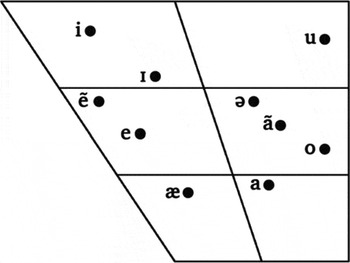

Disposing first of the nasal vowels, as these are a very marginal part of the vowel inventory, each occurs in fewer than half a dozen words. All instances are found in either deictics (e.g. gẽhẽ ‘there’) or interactional words like ãhã ‘here you are’ or ẽ ‘yes’.
Full oral vowels all have unlimited distributions and can occur initially, finally or as a syllable nucleus either as an open syllable as in aragab [a.r
a.ɡa
b] ‘sea’ or followed by a consonantal coda, as in arqan [a
r.
 a
n] ‘tree sp. Acacia mangium’. The distinction between /e/ and /æ/ is always clear in open syllables and available in some closed syllables, and supported by many minimal pairs such as [b
e] ‘2sg oblique’ vs. [bæ] ‘3sg absolutive’ and [m
e
r] ‘good’ vs. [mær] ‘name of village’. However, it is undergoing neutralisation in some contexts so that words like ‘friend’ and ‘day’ vary between [b
u.d
e
r] and [b
u.dær], and [k
e.s
e
r] and [k
e.sær], respectively. This movement towards neutralisation can be seen in the Principle Component Analysis (PCA) vowel chart below in Figure 7. Note the long ellipses for both /e/ and /æ/, indicating variability in vowel height. /a/ also shows a similar variation in vowel height; however, there is no other full vowel nearby with which it neutralises.
Plot of F1 versus F2 PCA plot of approximately 140 vowel tokens, male speaker, JN.

The distinction between /æ/ and /a/ is clearer and supported by numerous minimal pairs, e.g. /j a r a m a n d n/ ‘I gave two’ vs. /jæræm a n d n/ ‘I gave a few’, /d a r s/ ‘to break open’ vs. /dær s/ ‘to poison, splash’. Near-minimal sets or pairs for all oral vowels are presented in (13)–(15).
-
(13)
-
(14)
-
(15)


The central vowels have a more complex phonology. /ɪ/ is shorter, lower and more central than /i/. It can neither begin nor end a word, though it can begin a root, e.g. /-ɪɡɪrᵑɡr/ ‘be away (non-dual)’, as in /jɪɡɪrᵑɡr/ ‘(s)he is away’, where /j-/ is the third person subject prefix. It also counts as a light vowel for purposes of stress assignment. When flanked by a consonantal onset and nucleus, [ɪ] contrasts phonemically with other vowels, as shown in (16)–(19), with minimal pairs contrasting it with /e/, /i/ and the epenthetic [ə].
-
(16)
-
(17)
-
(18)
-
(19)


A voiceless ‘echo’ version of the central vowels is common after monosyllabic stems in which the vowel occurs, if they end in a voiced stop, e.g. /pɪd/ [pɪ.d
 ] ‘end (of something, e.g. a rope)’, /bɪn
b
a/ [bɪ.n
.b
a] ‘with a smile’, /m
N
/ [mə
 w
] ‘house’. Speakers are emphatic about not wanting to write such echo vowels, which are phonologically predictable. Figure 8 provides an example of an echo [ə] in the word /dəᵑɡ/ [dəŋ.ɡ
] ‘piece of wood’.
/dəᵑɡ/ ‘piece of wood’ manifesting as [dəŋ.ɡ
].

It is not the case that all echo vowels are the centralised vowels. Echoes of full vowels may also appear after voiced plosives. Figure 9 is an example of [e] as an echo vowel in the word /
e
b/ [
e.b
 ] ‘next day’.
/
e
b/ ‘next day’ manifesting as [
e.b
].

/ə/ ([ə] ~ [ɐ]) is the most complex vowel analytically. In most cases phonetic schwa results from epenthesis and is not phonemic; essentially, phonetic schwa is used to fill in the nuclei of syllables to which no vocalic segment is linked, e.g. /k p/ [kəp]. However, there are some phonotactic positions in which schwa does not result from epenthetic insertion, preeminently in a couple of open monosyllables (e.g. /mə/ ‘still’).Footnote 5 To deal with such words, we need to retain schwa as a phoneme in its own right, even though the vast majority of phonetic schwas are epenthetic and non-phonemic.
Diphthongs
Most Nen diphthongs can be analysed as transitions between a long vowel and one of the semi-vowels, e.g. /k
a
j/ ‘yesterday’, /p
u
p
u
j/ ‘riverine swamp’, /t
r
o
j/ ‘bamboo sp.’, /w
e
j
w
e
j/ ‘sorry’, /s
a
w/, ‘savannah swamp’, /
æw/ ‘python’, /y
e
w
t
a
n/ ‘they walk’, even though the practical orthography writes them as sequences of two vowels (respectively kae, pupui, troi, weiwei, sao, qäu, yeutan). The only opening diphthong is /eæ/, found just in the word /ɡeæ/ ‘if’.
Normally diphthongs cannot be followed by a consonant in the coda of the same syllable, with the sole exception that diphthongal nuclei are licit before the infinitive suffix -s, as in wakaes /w
a
k
a
j
s/ [w
a.k
a
 s] ‘to see’, naos /n
a
w
s/ [n
a
 s] ‘to enclose’.
Vowel epenthesis
As in some other Papuan languages (Kalam, see Blevins & Pawley Reference Blevins and Pawley2010, and Kanum, see Donohue Reference Donohue2009), the nuclei of many syllables in Nen are epenthetic schwas, e.g. [kə.nəm] for /k n m/ ‘come!’. In the practical orthography, speakers decisively prefer not to write these.Footnote 6
Epenthetic schwas are inserted according to the following procedure:
-
(i) Associate each specified vowel with a syllable nucleus.
-
(ii) In word-final position and some other final positions (of reduplicate elements, compounds, verb stems, and boundaries before case affixes) associate the last consonant with a coda position.
-
(iii) For the remaining segments in the word, maximize onsets, in other words associate as many consonants as possible with onset position. Exception: the clusters /Sr/, /Sl/, / n Sr/ (where S is a stop, and n S a prenasalised stop), /s p/ and /s k/ are syllabified as complex onsets before following associated vowels, e.g. /s pɪl N
/ [s
pɪ.lɪ
] ‘basket’, /s
k
o
p/ [s
k
o
p] ‘eye’, /d
r
o
n
d
r
o/ [d
r
o
n.d
r
o] ‘night carpenter bird’. -
(iv) Likewise, reassociate the nasal element of any NS cluster that is not in word-initial position to the preceding coda. This reassociation of the nasal element of a prenasalised plosive is optional.
-
(v) Fill any unassociated nucleus slots with an epenthetic vowel. If there is an adjacent palatal, /j/ or /ɲ/, the epenthetic vowel manifests as [ɪ]. If there is an underlying or surface [ɪ] already present in an adjacent position in the word, the epenthetic vowel is [ɪ]. Otherwise the epenthetic vowel is [ə].
These principles of epenthesis can be illustrated with the following examples in (20) and (21).
-
(20)
-
(21)


A final quirk of [ɪ] is that it optionally conditions harmonic epenthesis; if a surface [ɪ] is present at some point in the word, other epenthetic vowels can be realised as [ɪ] rather than [ə]. Figures 10 and 11 offer examples of this epenthetic vowel harmony for /j p a l s/ [jɪ.p a.lɪs] ‘truth, true’ and /jɪɡɪrᵑɡr/ [jɪ.ɡɪ.rɪŋ.ɡɪr] ‘(s)he is away’, respectively.
Epenthetic vowel harmony in /j p a l s/ ‘truth, true’, surface form [jɪ.p a.lɪs].

Epenthetic vowel harmony in /jɪɡɪrᵑɡr/ ‘(s)he is away’, surface form [jɪ.ɡɪ.rɪŋ.ɡɪr].

Epenthetic [ɪ] vowel harmony does not propagate in all environments. In Figure 12, the epenthetic vowel in the last syllable /ɡr/ does not surface as [ɡɪr] like in the similar final syllable of Figure 11, but as [ɡər].
Optional epenthesised vowel harmony does not occur: /j t r o mᵑɡr/ surfacing as [jɪ.t r o m.ᵑɡər] ‘it stands (of building)’.

The example in Figure 12 has a full vowel in the syllable following the first epenthetic vowel [ɪ], and moreover the blocking syllable is closed by a bilabial nasal. The authors posit that it is this combination which blocks the harmony; the example from Figure 10, /j p a l s/ [jɪ.p a.lɪs] ‘truth, true’, also has an intermediary full vowel but it occurs in an open syllable.
Prosodic features
Stress is partly conditioned by word-class; there is a ‘basic’ stress pattern found in nouns, adjectives and some types of verbs. There is also a ‘special verbal pattern’, found with ‘ambifixing verbs’ (which take both prefixes and suffixes to index arguments) and ‘positional verbs’ (Evans Reference Evans2014), as well as nominalisations formed from them. In this second pattern, stress placement is sensitive to three main factors:
-
(i) a light–heavy contrast in syllable nuclei, where light nuclei are those filled by /ɪ/ or the epenthetic vowels [ɪ ə] and everything else is heavy;
-
(ii) word-structure (singleton vs. reduplicate, ambifixing or positional vs. other prefixing verb);
-
(iii) morphological structure (in verbs), most importantly the distinction between roots and prefixes.
It is ultimately possible to predict stress placement from interactions of these factors. But before the stress patterns are presented, the acoustic correlates of stress will be explained.
Acoustic correlates of stress
Stress in Nen surfaces as relative syllable prominence due to greater amplitude, increased fundamental frequency, or greater vowel length. When stress falls on the first syllable, higher fundamental frequency tends to be the correlate. Out of 45 tokens measuredFootnote 7 with primary stress on the first syllable, 93% of the data showed higher pitch on the first syllable, 50% indicated greater intensity, and 14% had greater vowel length. First-syllable primary stress is evident in the noun /k aᵑɡa/ [ˈk aŋ.ɡa] ‘bridge’ seen in Figure 13.
Stress on first syllable in /k aᵑɡa/ [ˈk aŋ.ɡa] manifests as higher fundamental frequency.

The first syllable has a pitch measure of 127 Hz and intensity value of 75 dB. The second syllable has a pitch of 115 Hz and intensity of 73 dB. Prominence of the first syllable is marked by higher pitch.
When primary stress falls on the second syllable, increased intensity tends to be the correlate. Of 45 words measured with second syllable stress, 83% of the data showed higher intensity in the second syllable, 67% had longer vowel length, and 50% of the tokens had higher pitch. Second-syllable stress can be seen in Figure 14 in the noun /næt
ræ
N
e/ [næ.ˈtræ.
ʷe] ‘it shone’. In this example, both pitch and intensity were higher in the second syllable than in either the first or third syllables, marking it for prominence.
Stress on second syllable in /næt
ræ
N
e/ [næ.ˈt
ræ.
ʷe] manifests as higher intensity.

Basic stress pattern
The basic pattern is to stress the initial syllable, such as [ˈa.r
a.ˌɡa
b] ‘sea’, [ˈk
a.n
a
m] ‘snake’, [ˈk
aŋ.ɡa] ‘bridge’, [ˈnæn.ʤi] ‘banana’, [ˈʤa.p
a
r] ‘sky’, [ˈp
u.p
u
] ‘riverine swamp’, [ˈs
e.l
e.m
i] ‘clothes’. An example of this initial syllable stress pattern can be seen in Figure 15 in the noun [ˈʤa.p
a
r] ‘sky’.
Basic stress pattern, exemplified by the noun [ˈʤa.p a r] ‘sky’, showing prominence of the first syllable.

But if a sequence of unfilled nuclear slots or the short vowel [ɪ] precedes a full-vowel syllable, it is the first full-vowel syllable which attracts the stress: /jˈp
a
l
s/ [jɪ.ˈp
a.lɪs] ‘truth, true’, /jˈm
a
b
e
m/ [jɪ.ˈm
a.b
e
m] ‘they (ergative)’, /
ˈt
e
r/ [
ə.ˈt
e
r] ‘flying fox’, /bɪ.ˈm
i
s/ [bɪ.ˈm
i
s] ‘mango’, /bˈd
r
e
t
e/ [bə.ˈd
r
e.t
e] ‘wet’. Figure 16 provides an example of this for the word /
ˈt
e
r/ [
ə.ˈt
e
r] ‘flying fox’. As mentioned above, for second-syllable stress, the correlate is higher intensity. The high pitch for the epenthetic vowel [ə] is due to influence from the preceding labial velar plosive.
Stress pattern on /
ˈt
e
r/ [
ə.ˈt
e
r] ‘flying fox’, showing prominence of the second syllable (the first full vowel); stress assignment passes over the epenthetic vowel [ə].

Stress with verbs
Nen makes a basic morphological distinction between ‘prefixing verbs’ and ‘ambifixing verbs’. In prefixing verbs, person agreement is only shown by prefixes – these are essentially a small set of intransitives like ‘be’ or ‘walk’, plus forty or so ‘positionals’ like ‘be sitting’, ‘be immersed’, etc. In ambifixing verbs, argument indexation uses both prefixes and suffixes (see Evans Reference Evans2014, Reference Evans, Malchukov and Comrie2015 for details). Within ambifixing verbs, there is a further important distinction between basic roots (e.g. /w a b/ ‘to count’) and derived roots (e.g. /o w a b/ ‘to talk’), which add a ‘diathetic prefix’ (here o-); prefixes can change valence e.g. from transitive to reflexive/reciprocal, or they may simply modulate the meaning of the verb in other ways. The morphological distinctions between prefixing and ambifixing, and between root and stem, are relevant to stress assignment.
Standard prefixing verbs follow the ‘basic’ pattern of stress assignment, thus /ˈk n m/ [ˈkə.nəm] ‘come (now)!’, /ˈk nᵑɡm/ [ˈkə.nəŋ.ɡəm] ~ [ˈkən.ᵑɡəm] ‘go (now)!’, but /nˈn a m/ [nə.ˈn a m] ‘come (later)!’.
However, ambifixing verbs, as well as the subclass of positional prefixing verbs, follow a different pattern. In these verbs, stress normally falls on the first vowel of the root, passing over argument and directional prefixes but also over diathetic prefixes.Footnote
8
Thus there are various derivatives of a root /p
a
p/ ‘begin’: /o
p
a
p
s/ ‘begin (intr.)’, /w
a
p
a
p
s/ ‘begin (tr.)’, /w
a
w
a
p
a
p
s/ ‘begin for (ditr.), cause to begin, teach’, but their various inflected forms will always place stress on the root: /n
oˈp
a
p
n
d
n/ ‘I began’, /j
aˈp
a
p
n
d
n/ [j
a.ˈp
a.pən.dən] ‘I began it’, /j
a
w
aˈp
a
p
n
d
n/ [j
a.w
a.ˈp
a.pən.dən] ‘I began it for them’, /w
a
w
aˈp
a
p
s
e
r/ ‘teacher’. Further examples illustrating the placement of stress on the first syllable of the root are: [næ.ˈt
ræ.
ʷe] ‘it shone’ (stem /æt
ræ
N
s/, root /t
ræ
N
/), /ˈ
t
a
k
a
t
a/ ‘look at it!’ (root /(w)a
k
a(y)/), [n
o.ˈw
a
b.t
a
n] ‘I speak’ (stem /o
w
a
b
s/, root /w
a
b/), /jˈt
r
o
mᵑɡr/ [jɪ.ˈt
r
o
m.ᵑɡər] ‘it stands (of building)’ (root /t
r
o
m/ ~ /t
r
o
N
/), /w
aˈt
eᵐb
s/ [w
a.ˈt
e
m.bəs] ‘to send’ (stem /w
a
t
eᵐb/, root /t
eᵐb/).
Figure 17 provides an example in which the vowel of the first syllable of the verb is from the verbal root, attracting stress, /j
i
N
n
d
n/ [ˈj
iŋ.
ən.dən] ‘I saw it’ (root /(w)i
N
/).
Example illustrating stress on the verbal root /-(w)i
N
/ in the first syllable of [ˈj
iŋ.
ən.dən] ‘I saw it’.

The next example, in Figure 18, illustrates stress falling on the second syllable, which is the first syllable of the verbal root in this case (3nsgU prefix /y
i-/ plus root /(w)i
N
/), /j
i
w
i
N
n
d
n/ [j
i.ˈw
iŋ.
ən.dən] ‘I saw them’. As with the basic stress pattern, stress placement in verbs is sensitive to the difference between nuclei filled by full vowels and those filled by epenthetic vowels or the short vowel /ɪ/. If the only nuclei are drawn from this set, stress goes on the first syllable of the root, e.g. /ˈn
p
s/ [ˈnə.pəs] ‘to cut’. However, stems where the root-initial nucleus is light but a heavy nucleus precedes (e.g. a diathetic prefix) or follows have the stress on the full vowel: /ˈæɡm
s/ [ˈæ.ɡə.məs] ‘to fight each other’ (root /ɡm
s/, /æ-/ is the reflexive/reciprocal diathetic prefix), /ɡˈn
e
s/ ‘to kiss on the mouth’, root /ɡn
e-/). Note that while stress-attraction by full nuclei over light ones is a property shared with the basic stress pattern, in the case of verbal stress attraction, stress can move either to the left or to the right, whereas in the basic pattern it only shifts it rightwards. Note also that nuclei after the root–suffix juncture are unable to attract stress, so that in e.g. /wˈɲp
t
e/ [wə.ˈɲəp.t
e] ‘(s)he cuts me’ the /e/ in the suffix fails to attract stress.
Example illustrating stress on the verbal root /-(w)i
N
/ in the second syllable of [j
i.ˈw
iŋ.
ən.dən] ‘I saw them’.

There is one final wrinkle with verbal stress. If the root ends in a diphthong such as ay in /ˈw a k a j s/ ‘to see, look at’ or /ˈwæbæj s/ ‘to sew’ (the final /-s/ in both cases is the infinitive suffix), this syllable attracts stress just in case there is further suffixation on the infinitive, e.g. /w a k a j s t/ [w a.ˈk a j.sət] ‘in order to look’, morphologically /w a k a j-s-t/ (look-inf-dat). But if there is no such suffixation the stress falls on the first syllable of the root, in the regular way: /ˈw a k a j s/.
Transcription of recorded passage
Although the story of the North Wind and the Sun is culturally unfamiliar, a careful translation was worked out with the speaker – Pastor Jimmy Nébni (JN), aged 46. The only deviation from the original version was the substitution of ‘cold wind’ (kérbérba kiwil) for ‘north wind’. After several passes improving the translation, the story was taken down by the first author from JN's dictation, then written out longhand in Nen orthography, and the speaker practiced reading it back several times until he was able to do so confidently. The accompanying recording thus represents fluent reading from the Nen orthography given below.
Orthographic
Kérbérba kiwil a kesär
Kérbérba kiwil a kesär bä zi guwyt ebe muyaba pip bä ym.
Ämb är dnnzron ombte selemingama embaesmne.
Zi suri ymabem dene etanzt ebe muyaba pip bä ym,
mnegta yna äräm ebe embaesmne selemiba dnnzron
selemi geä dpträrnga de bä ypalés gämtenga, ebe muyaba bä ym.
Yna kérbérba kiwil muyabas dnapete yta muyaba pip dapete
wnde yna är ebe dnnzron selemingama kor mersraes
gembate. Yta yna kérbérba kiwil gs dapete muyabas
e dene muyapnär nämtewe. Wnde aqa kesär ombtebas
nätrenḡwe, ynamnewans yna ylsär äräm selemi dptrne.
Ynadbnan yna kérbérba kiwil de yäbäretawend ‘bm weiweizi
kowabta’ dene ‘kesär, bm muyaba pip nm.’
Broad phonetic
ˈkɪrˈbɪr b a ˈk i w i l a ˈk e sær
ˈkɪrˈbɪr b a ˈk i w i l a ˈk e sær bæ ʤi ˈɡu jɪt ˈe b e ˈm u j a b a p i p bæ jəm.
æm b ær ˈdənənːʤər o n ˈo m b t e ˈs e l e m iŋɡa m a e mˈb a j s mən e.
ʤi ˈs u r i jɪˈm a b e m ˈd e n e eˈt a nʤɪt ˈe b e ˈm u j a b a p i p bæ jəm,
məˈn eɡt a jɪˈn a ˈæræm e b e e mˈb a j s mən e ˈs e l e m i b a dəˈnənːʤər o n
ˈs e l e m i ɡeæ dəpˈt rærŋɡa d e bæ jɪˈp a lɪs ˈɡæm t eŋɡa ˈe b e ˈm u j a b a bæ jəm
jɪˈn a ˈkɪrˈbɪr b a ˈk i w i l ˈm u y a b a s dəˈn a p e t e jɪˈt a ˈm u j a b a p i p ˈd a p e t e
wənˈd e jɪˈn a ær ˈe b e ˈdənənːʤər o n ˈs e l e m iŋɡa m a k o r ˈm e r s r a j s
ɡe mˈb a t e jɪˈt a jɪˈn a ˈkɪrˈbɪr b a ˈk i w i l ɡəs ˈd a p e t e ˈm u j a b a s
e ˈd
e
n
e ˈm
u
j
a
p
nær ˈnæm
t
e
w
e
wənˈd
e ˈa
a ˈk
e
sær ˈo
m
b
t
e
b
a
s
næˈt
rɛŋ
w
e,Footnote
9
jɪnˈa
mən
e
w
a
nəs
jɪˈn
a ˈjɪl
sær ˈæræm ˈs
e
l
e
m
i
dəpˈtər
n
e.
jɪˈn a dəbəˈn a n jɪˈn a ˈkɪrˈbɪr b a ˈk i w i l d e ˈyæbær e t a w e n d ‘bəm ˈw e iˈw e i ʤi
kŏˈw a b t a’ ˈd e n e ‘ˈk e sær, bəm ˈm u j a b a p i p nəm.’
Acknowledgements
Data presented here was gathered by NE over six fieldtrips, totalling 18 weeks, in 2008–2013, and by JCM during three weeks in 2012 and three weeks in 2013. For financial support of our fieldwork NE thanks the Australian National University (Professorial Setup Grant), the Australian Research Council (Discovery Project ‘Languages of Southern New Guinea’ and Laureate Project ‘Wellsprings of Linguistic Diversity’), and NE and JCM thank the Volkswagen Foundation's DoBeS program (Project: ‘Nen and Tonda’). Most importantly we thank our Nen teachers, particularly Jimmy Nébni who made the recordings heard here, as well as to the whole village of Bimadbn for its hospitality, friendship and great interest in linguistic matters.



