“… men full of cupidity are worse than tigers, bears or lions. Each of them wishes to devour the others; and yet by means of laws and police, these ferocious beasts are so tamed that one draws from them all the human services one might draw from the greatest charity.” —Pierre Nicole in De la Grandeur 1670
I. INTRODUCTION
Many blame greed, avarice, or love of money as the driving force behind the financial and economic crisis that, since 2008, rages around us. After the decades in which greed was propagated as an essential ingredient of material success for the individual and society alike, and almost elevated to a form of art, we now wonder how we ever could have been seduced by ideas that stressed the usefulness of greed. Books pile up to enlighten us,Footnote 1 explaining the rise of an economic and intellectual climate that hailed greed and made us look away from its potential destructive side.
All accounts acknowledge one way or another the shadow of Adam Smith, duly noting the quote about the self-interest of the butcher, the brewer, and the baker,Footnote 2 and the myth that has been build around his invisible hand in turning the selfish pursuit of material gain into a contribution to the common good. By the time Smith published his Wealth of Nations, however, the debate on the serviceability of greed was more or less settled and the fire already gone out. Consequently, it is the age before Smith to which one has to turn in order to understand how human greed was able to develop from one of the most reprehensible vices to an almost indispensable building block of human welfare.
It is this question that Albert Hirschman sought to answer in The Passions and the Interests (1977). The issue may be set against the background of the debate on ‘the rise of the West’ or the question of why some nations grew rich, while others remained poor. Explanations include exploitation (global system theories), a stage model of development (modernization theories), or the protestant ethic of thrift and hard work (Weberian perspective). More relevant to our inquiry is one of the sub-questions of the debate; i.e., why western Europe proved such fertile ground for the development of capitalism. In the most general terms, explanations center on two sets of factors: 1. changes in population, technology, methods, and organization of production, role of government, etc.; and 2. changes in values, attitudes, views, and motivations. Despite the fact that contributions to the debate often seem to put emphasis on one set of factors at the expense of the other, ultimately it is about the specifics of the interaction between ideas and activities (Mokyr Reference Mokyr and Findlay2006, Reference Mokyr2007). David Landes, in his The Unbound Prometheus (1969), with its focus on technology, is an example of the first approach. Hirschman, following Weber, is primarily interested in changes in values and the motivational structure of society. In The Passions and the Interests, he thus retraces the process of ideological transformation in the seventeenth and eighteenth centuries through which the case for the social utility of greed was constructed. In the face of our questions in the aftermath of 2008, it is worthwhile to revisit Hirschman.
Hirschman begins his story with the Renaissance after the breakdown of the chivalric, aristocratic ideal and the downfall of the medieval values of honor and glory. Moralizing philosophy and religious precept were increasingly seen as ineffective to restrain man’s destructive passions. Acknowledging the need to take man ‘as he really is,’ the search for more prolific ways to curb man’s passions inspired three subsequent solutions, resulting in the identification of the lust for money as a force capable of restraining the inherently destructive passions.
The first solution was repression. This solution assumed an authority ex machina that does not share in the same failings in human nature as those repressed, and, as such, is contradictory to its own premises. The second solution was built on the idea of harnessing the passions. With the state as the civilizing medium, the destructiveness of the passions was to be averted by transforming them into a constructive force, working toward the public good (1977, p. 16). The magic of this transformation failed to convince but hinted at a third solution, Hirschman argues, involving the idea of controlling the passions by playing one off against the other: the principle of countervailing passion.
The bold idea of pitting one passion against another to the benefit of man and mankind required the identification of the taming passions and the passions requiring taming. Why did love for money, greed, or avarice fit the bill? Here, the notion of interest proved potent. Developed as a political maxim, interest was increasingly credited with the qualities of predictability and constancy. As, in the seventeenth century, the meaning of interest progressed from ‘the council chambers to the market place,’ as Gunn had it (1969, p. 42), and was applied to individual aspirations and actions, greed became identified with interest. Given the positive attributes of material interest or love of money, avarice came to be acclaimed as a calm and persistent passion, capable of taming the wild passions. This ideological and semantic drift heralded interest as the building block of order and wealth.
This transition in ideas did not imply that greed or avarice was upgraded in a moral sense. Whatever new ideas developed on the serviceability of greed in the seventeenth and eighteenth centuries, there was no change in the assessment of greed as morally objectionable. Indeed, rather than greed itself, it was the backdrop of greed that changed and, in its wake, views on the consequences of greed. This observation raises the question of whether the developments Hirschman describes are adequately explained by reconstructing changes in ideas alone or that such an explanation should allow for the interplay of socio-economic and intellectual change. Given Hirschman’s exclusive focus on the role of ideas, his account is somewhat colored in disregarding the economic environment. This paper aims to touch up the color of Hirschman’s account by arguing that it was the transition from self-sufficiency to an economy geared towards development and growth, rather than the fall of the aristocratic ideal of honor and glory, that paved the way for the idea of the social utility of greed. The point elaborated in this paper is that this transition toward a growth-oriented economy came to tear down the zero-sum conception of society. It is against this change of décor that greed came to be seen as useful, that restraints upon greed were relaxed, and that, once again, questions about the moral permissiveness of the striving for material gain were raised.
In order to describe these developments that turned greed from one of the seven deadly sins into a passion from which society derived social benefits, three stages may be distinguished, each representing a different economic context. In contrasting these three contexts, some characteristics light up while others become faint, distorting the picture of each context, if taken separately. Indeed, any attempt at characterization of an economic context is a rational reconstruction at best, especially over such a lengthy period of time as in the case of the self-sufficient community. Notwithstanding the limitations of the stylization used here, it rather is the differences between the economic contexts, even if represented in their ideal or typical forms, that buttress the story of how attitudes to greed changed with the economic context. The transition from self-sufficiency to a growth-oriented economy may thus be used to differentiate between the first two stages. While sharing the preoccupation with growth, the second stage and third stage differ in the perception of the nature of the economic game. It is only in the third stage that the idea was voiced of trade and commerce as a positive-sum game rather than a zero-sum game. In the three sections that follow, these three stages are presented, bringing out that although greed or avarice is in all stages seen as a personal failing in virtue, each stage differs in its assessment of greed or avaricious behavior because of shifting ideas about the welfare effects of economic activity. A fifth section will present some concluding remarks.
II. THE FIRST STAGE: THE SELF-SUFFICIENT COMMUNITY
In the first stage, ranging from ancient Greek thought and the Church Fathers to the Renaissance, greed is taken as a moral deficiency of the individual with consequences harmful to individuals and community alike. Greed originates in a misconception of the true purpose of wealth. Wealth is a means of satisfying necessary wants, and a surplus, if any, was to be used for the exercise of moral excellence in hospitality, charity, and almsgiving. Money, beyond necessary wants, was to “be used in the service of one’s fellow beings, not to be hoarded, unused,” as Chrysostom put it (Karayiannis and Dodd Reference Karayiannis, Dodd, Lowry and Gordon1998, p. 181). Given diminishing utility of wealth following from this purpose, its pursuit is necessarily limited. As soon as greed or the lust for money appears on the stage, and money making becomes an end in itself, such natural limits are violated at the expense of the individual and the community.
In a small and self-sufficient community, any distinction between the interest of the individual and the interest of other members or the community as a whole is meaningless. People simply share an interest in the continuance of an adequate supply of goods, essential to the survival of the community. In such a community, obviously, efforts that aim at private material gain with a corresponding loss for the other is inherently destructive, and with reason; the community is at the center of conceptions of virtue. Greed clashes with the unity of individual and collective interests, virtue, and reason. In such conditions, the pursuit of individual advantage, gain, or profit at the expense of other members of the community in a static organization of economic life, geared toward reproduction of material well-being, is conceived as irrational and contrary to virtue. Recurring themes in the literature in this first stage of the self-sufficient community, then, are: (1) a theory of limits to the acquisitive passion in a subsistence economy; (2) the negative consequences of greed; and (3) the condemnation of greed on moral and socio-economic grounds.
All these key elements are already present in Greek philosophy. Economic necessity, it is argued, forces men to live together. Aristotle explained that associations are formed to circumvent the individual’s lack of self-sufficiency by establishing bonds of mutual benefit at different levels of social organization (see Aristotle’s Politics book I). The most basic unit of association is the family household, through which the basic necessities of life are provided. Oikonomia, or the efficient management of the household, concerns the just and efficient ways in using available means to safeguard the survival of household and community. The village, the next level of social organization, is a collection of households, serving each other’s reciprocal needs by the exchange of external goods that make life comfortable. The polis is the highest level of association, and it is at this level that ‘goods of the soul’ (such as statesmanship and public service) are produced. Aristotle emphasized the need for limits on the means of acquisition. Such limits are implied in the purpose of wealth “as a means of being able to foster excellence in human beings” (Campbell Reference Campbell and Todd Lowry1987, p. 38). Exchange to provide for basic needs and some comforts of life is natural, bounded as such acquisitive activity is by basic satiation. If these basic needs are satiated, people turn to psychic goods that have infinite utility in building a positive self-image and sense of worth. Given such natural limits on desire, Aristotle argued, the economy is stable. “Plato’s and Aristotle’s economics is not the economics of growth. Their approach is guided by a belief in the desirability of establishing a relatively stationary state of economic activity at a level which ensures the maintenance of a moderate standard of material well-being for the citizenry” (Gordon Reference Gordon1975, p. 27; see also Lewis Reference Lewis1978).
Greed, the unlimited desire for wealth, then, upsets this state of stability and peace. If the art of acquisition is infected by greed (an opportunity offered by money as a store of value) and the disposal of surplus is motivated by the desire for increasing riches, wealth becomes an end in itself. Such misconception of the true purpose of wealth is a moral defect, which elicits disapprobation and shame. Given that the individual’s interest is strictly tied to the interest of the community, such unnatural acquisitive activity is both irrational and inefficient. The search for private gain upsets the stable state of the economy and hurts the quality of communal life from which private happiness is inseparable. This idea of a stable equilibrium or image of balance is essential to Aristotle’s theory of virtue as the golden mean between two opposing extremes. In this vein, greed and avarice are interpreted:
In regard to giving and getting money, the observance of the mean is Liberality; the excess and the deficiency Prodigality and Meanness, but the prodigal man and the mean man exceed and fall short in opposite ways to one another: the prodigal exceeds in giving and is deficient in getting, whereas the mean man exceeds in getting and is deficient in giving” (Nicomachean Ethics, Book II, vii. 4, p. 99).
To keep within the bounds of propriety, it is important to steer by the compass of reason and virtue. Thus, the Roman orator Cicero cautioned in his discourse on obligations that “there are times when one course is likely to appear expedient and another morally right. The appearance is deceptive; for our standard is the same for expediency and for moral rectitude (De Officiis, III, pp. 74–75, 44 BC). Inappropriate behavior in this respect, Seneca argued in his Dialogues (first century), is the result of ignorance and confusion. Anyone who fails to lead a life in accordance with right reason is a fool and will fall victim to confusing passions. In the search for external means of happiness in riches, status, and power, the danger is lurking that the fool will surrender to avarice, lust, and ambition. The wise man conquers his passions by conforming to reason, and finds tranquility of mind and happiness in virtue.
Similar ideas are to be found in the writings of the Greek Church Fathers, who set out to develop a philosophy of Christian thought in the light of Hellenistic philosophy. Equally predisposed against the unlimited pursuit of wealth, Chrysostom (c. 356–407), for instance, drew a distinction between economizing behavior (expenditures for necessary goods and almsgiving) and avaricious behavior, especially of the rich in their use of wealth to purchase luxurious goods, the latter being unnatural, unjust, and irrational. In emphasizing the importance of spiritual and psychic satisfaction over material satisfaction, he reaffirmed Aristotle’s theory of natural limits on desire. No scarcity would exist if everyone restricted consumption to necessary goods and if the surplus would be distributed to the (deserving) poor through charity and almsgiving. Problems of scarcity and poverty stemmed from the unjust accumulation of wealth at the expense of others: “When production levels are constant, a greater share for a few means a smaller share for others” (Karayiannis and Dodd Reference Karayiannis, Dodd, Lowry and Gordon1998, p. 185). The Greek Fathers emphasized the disruptive consequences of greed. Unlimited accumulation of wealth was seen as the main cause of unjust and unfair economic actions, a cause of war, injustice, and slavery, as driving men to pursue and attain false goals, creating economic and social struggles, and leading to the destruction of social peace (ibid., pp. 183–184). By exceeding natural limits in going beyond necessary consumption, greed strikes at the root of self-sufficiency.
Influenced by the Greek Fathers, St. Jerome (c. 340–420) explicitly stated the idea of a zero-sum game in individual efforts to accrue the gains from economic activity, arguing that “one man does not accumulate money except through the loss and injury suffered by another” (quoted in Gordon Reference Gordon1975, p. 101). As a consequence, riches necessarily involved injustice as it results from exploitation. Not everyone was prepared to condemn accumulated wealth in equal, unequivocal terms. Following Plato and Aristotle in arguing that man is driven into civil society to provide for the necessaries of life, St. Augustine, a contemporary of St. Jerome, argued that the accumulation of wealth is to be understood as the means to live a happy life. Wealth is, therefore, to be assessed in terms of its uses and contribution to virtue. As St. Augustine insisted: “Men are not made good by possessing these so-called good things, but, if men have become good otherwise, they make these things to be really good by using them well” (Gordon Reference Gordon1975, p. 104[n]). Augustine’s thought involves the element of time, recognizing the possibility of development and progress towards a more rational organization of economic activity and administration of justice, provided man learns to use wealth well. Augustine’s recognition of the possibility of economic development, however, was neglected when his writings were studied by medieval schoolmen (ibid., p. 109). The same point was made by Heilbroner and Milberg when they wrote: “Medieval economic organization was conceived of as a means of reproducing, but not enhancing, the material well-being of the past. Its motto was perpetuation, not progress” (2009, p. 31). More broadly, Zaratiegui thus characterized traditional (feudal) society in the middle ages:
[T]here is a multiplicity of small communities, including kinship networks and dispersed ethnic groups. Between these communities market interexchange is often restricted and economic life is regulated by local conventions. Markets may exist within such communities, but are embedded in wider systems of non-market relationships, and the behavior of transactors is governed by complex moral codes and informal sanctions (Zaratiegui Reference Zaratiegui1999, p. 210).
Given such hierarchical, feudal relations of (inter)dependence, enveloped by customary rights and obligations, prosperity and poverty were a communal affair; the individual’s material condition was predetermined by the social relations of the community (Rowlands Reference Rowlands and Camera1999). In this setting, trade and markets were seen as morally suspect for a long time (Muller Reference Muller2002). Trade was firmly linked with greed, lucre, lying and cheating, and the breach of rules and regulations. The practice of buying low and selling high without adding any value was designated as sinful and sufficient reason to deny tradesmen entrance to heaven. The logic of buying low and selling high out of considerations of personal gain was seen as detrimental to the logic of moral codes and mutual obligations that tied the fate of the individual firmly to that of the community.
Change arrived with the (first) commercial revolution in the eleventh century as agricultural methods were improved, population grew, and commerce and industry expanded. Money and markets became more important, and a class of merchants emerged. Such developments gradually but increasingly came to change the static and self-sufficient feudal system. The more impersonal nature of economic activities beyond the own community and region, with their possible corrosive, even destructive, effects, invited new ideas on the individual’s opportunities and obligations. Probably because its destructive potential became less personal, avarice was awarded a more prominent place on the list of deadly sins. John of Salisbury thus proclaimed that “There is no worse vice than avarice.” Similarly inclined, Alan of Lille explained near the end of the twelfth century: “Avarice weakens friendship, generates hatred, breeds anger, plants wars, nourishes controversies, and ruptures the bonds of children to their parents” (Little Reference Little1978, p. 36). No wonder that, as Odd Langholm remarked, “very much of scholastic economics consisted in preaching against worldliness and greed” (1987, p. 117). It is no coincidence that Dante, in his Divinia Commedia (1306–1321), described how one of hell’s circles is reserved for squanderers and misers. Virgil explains that these deplorable figures have neglected to keep within bounds in dealing with money. It would take until the seventeenth century before balance in the case of avarice was to shift, but then only because of the idea of good that may be extracted from two bads.
Even though the condemnation of greed remained in full force, in the course of time boundaries with respect to the moral permissiveness of economic activity shifted. In the wake of the (first) commercial revolution, careful attempts were made to find justification for trade and commerce, considering that commerce did not need to be identified (and condemned) with the odious practices of merchants.
This gradual reappraisal of trade and markets went hand in hand with revisions in views and attitudes towards poverty and riches (Wood Reference Wood2002). For a long time, riches was precarious with a view to one’s chances for eternal life, and many moral precepts existed with regard to the treatment of the poor and the importance of charity. Charity was a matter of reciprocity: benevolence and charity in exchange for salvation for the rich. “Why are the Poor given their station in life? So that the rich might earn eternal life through them” (Wood Reference Wood2002, p. 43). During the middle ages, however, the status of poverty and riches changed. Poverty was no longer seen as a sign of devotion, no more than riches implied a ticket to hell. “Wealth and beggary are two extremes. The mean is sufficiency,” Jean de Meun noted in the thirteenth century (ibid.). The exercise of virtue required a certain level of material well-being, but wealth may also intoxicate, luring away from virtuous behavior, breeding cupidity. One needs to strike a balance between wealth and poverty. As St. Thomas Aquinas (1224/5–1274) indicated, avarice is associated with immoderation, with direct and harmful consequences suffered by others:
Covetousness may signify immoderation about external things in two ways. First, so as to regard immediately the acquisition and keeping of such things, when, to wit, a man acquires or keeps them more than is due. In this way it is a sin directly against one’s neighbour, since one man cannot overabound in external riches, without another man lacking them, for temporal goods cannot be possessed by many at the same time (quoted by Viner from St. Thomas’ Summa Theologica, 1978, p. 62).
Riches were not to be desired for their own sake but to serve the use of virtue, a point of view that expressed the priority of the common good over the individual good. Aquinas cautioned against trade because such profit-seeking activity “awakens greed in the hearts of the citizens” and induces “each one to seek his own profit, despising the public good” (Worland Reference Worland and Lowry1987, p. 142). At the same time, Aquinas acknowledged the usefulness of the merchant to state and society, arguing that commerce can be morally justifiable. As Langholm wrote:
Quite literally, in the medieval configurations of vice, avarice was the stem from which all specific economic vices branched off. In a subsistence society, the simplest inference is that one who gratifies his greed will deprive someone else of his bodily sustenance. In exhortations against the avaricious, considerations of the inner and outer aspects pull together; harming his own soul, he harms his neighbour’s body. To the reflecting social philosopher, however, the problem is not that simple. In economic activity, one man’s profit is not always another man’s loss. Avarice is not only a psychological urge, it can sometimes be socially beneficial (Langholm Reference Langholm, Lowry and Gordon1998, p. 446).
Trade and its practitioners performed a useful function for society. Consider, for instance, the necessity of trade in times of scarcity. Neither is trade necessarily a matter of fraud and exploitation. Risk, labor, and transport (from areas of plenty to those of scarcity) were put forward as valid arguments to allow the merchant to sell above cost price and make a profit. Much depended upon the right intentions of the merchant. Not only is the merchant entitled to profit to compensate for work and risk, moderate profit is also justifiable to provide for the needs of his dependents or to contribute to charity and public service.
Another topic of reflection concerned private ownership of productive resources. Surely productive resources, in enlarging possessions, should contribute to the common good, but private ownership implies a powerful incentive for efficiency. Once productive resources were held in private property, however, would owners be prepared to share the fruits of their labor? How to manage the trade-off between the duty to share and the need for incentive with a view to the common good (Langholm Reference Langholm and Lowry1987)? More broadly: to what extent would the growing importance of trade, markets, and profit taking, to generate subsistence and means to support the poor in times of need, erode the significance of moral and religious sanctions with respect to the obligation to charity? Such reflections suggest a clear understanding of the possibility of divergences between individual interest and the interest of the collective as well as an acknowledgment of the fact that ‘one man’s profit is not always another man’s loss.’
Given that individual interest was no longer strictly tied to the interest of the community, justice was key to medieval economic thinking to prevent harm to others. Gray put it most succinctly when he wrote: “No one, under any circumstances, should take advantage of his neighbour. This is the sum and substance of mediaeval economic teaching” (1959, p. 46). That does not mean, however, that profit taking was morally reprehensible in each and every case. With the beneficial potential of trade and markets recognized, and trade no longer condemned as inherently sinful, economic discourse focused on ways to regulate trade and markets to ascertain that their potential was used in a way beneficial to society (Langholm Reference Langholm and Lowry1987). Explorations into the just price, usury, fraud, and deception concerned the rules of the (zero-sum) game as well as the conditions under which one man may profit without corresponding loss for others. It is not all ‘black and white’: greed may come in different shades. Such reflections proved fertile ground for the growth of the notion of the social utility of greed in the second stage.
III. THE SECOND STAGE: THE MERCANTILE STATE
The first commercial revolution ended around 1350 when the Black Death began to spread, ravaging Europe in the fourteenth and early fifteenth centuries. The consequent fall in population and output resulted in a prolonged period of economic depression. It took until 1450 before recovery set in, kicking off the second stage of commercial growth. Economic activity increased. With relations of exchange expanding within and between regions, gradually a network of markets developed. Increasingly, the breakdown of the manorial system, urbanization, and the monetization and commercialization of economic life changed society (Crouzet Reference Crouzet2001).
Growth in a pre-industrial economy, however, was always constrained by the dependence on agriculture, low productivity, and the use of crude technology. In pre-industrial societies, growth was extensive:Footnote 3 real income per capita as the ratio of population to resources (especially land) did not increase much. Eric Jones speaks of ‘static expansion’ (1988, p. 29): neglectable income growth per capita with total output and population increasing at a comparable rate. Nevertheless, markets widened as more goods were traded, networks of trade in Europe were integrated, and interaction among European regions became more frequent. Regions and nations became more dependent upon each other’s produce, and the division of labor increased. Trade, especially foreign trade, was the most dynamic sector of the economy, allowing for capital accumulation, investment, and innovations. Given that growth, by its nature, was constrained, however, such efforts induced protectionism and conflicts over exclusive rights, giving rise to a process of state building to promote self-sufficiency within borders and to achieve a position of strength and power in competition with other countries. Such changing conditions inspired new alliances (of commercial enterprise and state power) and objectives, changing the pre-industrial economy (Wilson Reference Wilson1984) and shifting the focus in economic thought from household management to the management of state and society.
It is generally acknowledged (Wiles Reference Wiles1974, Magnusson Reference Magnusson and Lowry1987, Heckscher Reference Heckscher1994) that in the mercantile age, growth and development became a central objective in political and economic thought. In times of nation building, political and economic success was measured by a nation’s relative wealth and power. Economic growth was promoted to fund geographical expansion and enhancement of state power. Given the prevalent idea of the dependence of the creation of surplus on foreign trade, and the conditions of stagnation that prevailed during much of the seventeenth century, it was quite natural to think of trade and commerce in terms of economic warfare. Economic thought in the second stage, or the mercantile age, struggled with this tension between the objective of growth by foreign trade and the zero-sum notion of trade. In the face of natural, institutional, and geopolitical constraints on expansion and improvement, governments tried to enforce economic policies designed to encourage economic development, especially through the promotion of production and exports. Despite inherent tensions, it was this change of décor that paved the way for a less harsh judgment on greed that stressed its conditional usefulness rather than its unconditional condemnation. This idea of the utility of greed acquired force as (1) it was realized that greed was not irrational in each and every case; (2) a new theory of limits to greed was developed; and (3) economic discourse began to emphasize growth rather than sufficiency, and efficiency and material ends rather than moral and religious ideals (justice, salvation).
Firstly, in a setting of material ends and growth or accumulation, greed looked better. This new setting changed the (ir)rationality of greed. In an economy geared towards self-sufficiency and a static organization of economic life, greed is irrational. It does not make sense to pursue material gain at the cost of others, if they belong to the same community and everyone’s happiness and quality of life are directly linked to that of the others in the same community. The moment this interdependence becomes faint and indirect, and one’s happiness no longer depends on that of the other within the same community, greed does not queer one’s own pitch and is far less irrational. As soon as communality is broken, as soon as separate interests are identified and perceived to exist, the question arises of who (and in what measure) is to gain and who stands to lose. Hirschman observes that “moralizing philosophy and religious precept could no longer be trusted with restraining the destructive passions of men” (1977, pp. 14–15; italics added). He gives no reason but it is plausible that the problem arises once the passion of greed could no longer be depicted as irrational. And if rational, what about its objectionable character? The unity of individual and collective interests, virtue, and reason was broken, creating room for perceptions of differences between individual interest and collective interest, and between reason and virtue, with which new opportunities and combinations presented themselves.
Secondly, if an unlimited desire for wealth is not necessarily harmful to the community and the quality of life, a new theory of limits is required. If greed is not controlled by internal motivations of the individual as stakeholder in the community, limits are to be put in place by an outside force. Given that repressing greed would stifle incentives, the idea developed of harnessing the passions; i.e., channeling man’s self-seeking activities into socially useful directions. Following the timid attempts of the scholastic writers, philosophers started to reflect on the social utility of greed. It wasn’t that greed no longer was seen as an individual moral defect. Rather, increasingly, philosophers toyed with the idea that greed may have positive consequences next to negative ones. The individual sin of avarice may have consequences that serve national or collective interests. In his England’s Treasure by Forraign Trade ([1664] 1959, ch.VII), Thomas Mun thus identified three types of gain: (1) the gain of the state or commonwealth at the expense of the merchant; (2) the gain of the merchant at the expense of the state; and (3) the gain of the king at the expense of both the merchant and the state. The pursuit of riches at the expense of the other is not necessarily against the interest of the state, opening up the possibility (denied by Cicero) of a separation of expediency and moral rectitude. Given the reformulation of objectives in terms of the wealth and power of the nation-state, considerations of expediency took precedence over ethical concerns in economic discourse.
Thirdly, the transition from scholastic economics to mercantilismFootnote 4 signified a change in focus in economic analysis from sufficiency and justice to economic growth. Indeed, in the mercantilist literature, minds are set upon economic development and growth as the goal of economic activity. This shift implied new ideas about economic surplus. In the scholastic literature, surplus—what is available over and above basic needs (in accordance with social status)—was to be used for purposes of charity and almsgiving to help those in need. Such considerations faded away, to be replaced by the idea that resources can be used more productively through investment and accumulation. This should not be taken to imply that with the breakdown of the traditional, self-sufficient community, philosophers no longer believed in the idea that, in exchange, someone’s gain was necessarily the loss of another. This idea was ingrained into the pre-industrial economy in its dependence on low-productivity agriculture and animate (solar-based) sources of energy:Footnote 5
The supplies of food, raw materials, and thermal energy all depended directly on the amount of available land and on the solar energy captures by that land. Moreover, all these uses of land stood in competition with each other. Increasing the area devoted to one use required the contraction of another (De Vries and Van der Woude 1997, p. 719).
Applying this zero-sum notion to national trading within a static view of economic development, mercantilists assumed in one form or anotherFootnote 6 that an increase in the wealth of one nation can be achieved only at the expense of the wealth of other nations. Even if it was recognized that the domestic economy might contribute to growth, attention focused on foreign trade. Given the prevalence of the idea of a fixed quantum of resources or wealth, and the consequent notion that one nation’s gain is another nation’s loss, efforts focused on redistribution and rent seeking to increase the relative share of a nation in the world’s wealth. The best-known policy to promote rent seeking, of course, is protectionism, through which wealth is redistributed from foreigners to the citizens of the country (‘beggar-thy-neighbor’ policies), while aiming at a self-sufficient nation-state to secure provision and evade dependence on rival nations.
It was in this context that the notion of the social utility of greed gained acceptance, at first in particular with respect to efforts to advance national interests at the expense of those of other countries. Several sources contributed to its development. One such source was writings as from Machiavelli and Montaigne, drawing a distinction between the public and private realms in society. Separating the princely interest or raison d’état from individual interest, they argued that different moral standards apply to the private and the public realms. What is more, even with respect to individual motivations, behavior, and outcomes, virtue and vice are not easily distinguished. Apparently virtuous behavior (judged by its appearance or consequences) may be motivated by vicious passions such as greed. Or take Poggio Bracciolini’s De Avaritia (1428), which argued that man’s desire for wealth is natural. In Deux paradoxes de l’amité et d’avarice (1598), Antoine Hotman recommended the pursuit of riches as being both natural (why would nature otherwise have given us so many emotions to acquire wealth?) as well as socially desirable. Greed is part of the basic makeup of people, and, following Francis Bacon’s motto, ‘Nature cannot be conquered except by obeying her,’ the grand design is to build a society that leads such passionate energy into socially useful channels.
Another source of the notion of greed and avarice as a source of social good is the mercantilist literature. Toying with this idea, Antoyne de Montchrétien (1576–1621), in his Traicté de l’oeconomie politique (1615), emphasized the need to harness such passions by the aid of human authority to turn the pursuit of gain to public advantage. He argued that the prosperity of the realm depends on merchants who are motivated by their desire for gain, and that government should encourage them rather that treat them as vicious. As it is pointless to extort public spiritness, why not, aided by customs and human authority, direct individual efforts motivated by ambition and avarice into socially beneficial channels?
Similar views were pursued in Jansenist philosophy.Footnote 7 The underlying belief in Jansenist philosophy is that in the fall of man, God’s world of harmony and charity had been lost, and that man now struggles with himself in futile attempts to regain such unity and harmony. According to Blaise Pascal (1623–1662), the most famous Jansenist, there are three distinctive and separate orders of human life (Pascal Reference Pascal1962). He distinguishes between the order of concupiscence, the order of charity, and the order of reason and intellect. Although human reason is capable of establishing the principles that govern the physical world, as soon as man starts to make judgments on the human design of that physical world, reason is corrupted by the passions. Reason, confronted with so many contradictions in human nature and with all the diversity of life, cannot manipulate the ropes with which to tie the world of concupiscence to the world of charity. Fallen man has set his heart on concupiscence, attractively presented in all the diversions of life, which drown every thought of man’s true calling. In that madhouse, there is no room for true virtue; what passes for virtue is but vice in disguise. Man, unable to escape the domination of his basest needs, has created a sinful equivalent of the lost ideal: “men have devised a bastard morality from concupiscence itself, an inverted version of the order of charity” (Keohane Reference Keohane1980, p. 275).
The writings of another Jansenist, Pierre Nicole (1625–1695; James Reference James1972), feature a certain admiration for the potentially positive consequences of amour-propre, which, in its manifestations, is held in check by the similar self-interested actions of others. Men motivated solely by the desire to maximize their own happiness do so by satisfying the needs of other men, the source and foundation of all commerce among men. To Nicole, greed is a fascinating though corrupt alternative to charity. Enlightened self-interest, Nicole argued in his Essais de morale, is capable of bringing about a well-ordered society meeting human need, presenting an appearance of “complete peace, security, and ease as if one were in a community of saints” (Viner Reference Viner1978, p. 135). Greed even outdoes charity.
What a piece of Charity would it be, to build for another an intire House, furnish it with all necessary Houshold-stuff; and after that to deliver him up the Key? Concupiscence does this cheerfully. What Charity would it be to go and fetch Drugs from the Indies, to submit ones self to the meanest Offices, and serve others in the most abject and painful commands? And this Concupiscence does without ever complaining (Nicole, 1696, vol. II: Of Grandeur, part I, p. 98).
If the consequences of greed and self-interest are indistinguishable from those of charity, and given its beneficial consequences in terms of public prosperity, greed was to be given more room to play. “There is therefore nothing whence Men derive greater benefits to themselves than their own Concupiscence.” Nicole warns, however,
that it [greed] may be disposed to do these Offices, there ought to be something to keep it within compass. As soon as i’ts left to it self, it flies out and keeps within no bounds. Instead of being beneficial to human Society, it utterly destroys it. There is no excess it will not run into, if not held back (1696, vol. II: Of Grandeur, part I, p. 98; spelling as in original).
He points at the necessity of a political order that, supported by fear of punishment, artfully manages cupidity and directs it towards employments beneficial to society (see also Viner Reference Viner1978; Keohane Reference Keohane1974).
The same themes are played by Jean Domat (1625–1696), who argued that divine providence has given self-love, poison of the heart, its own antidote as the multiplicity of needs that self-love creates forces us towards commerce with others. However feeble such a foundation of society is, it works admirably and, however misguidedly, suggests the appearance of virtue. To ensure that the acquisitive passions are kept within the limits of their serviceability to society, the state is called upon to direct economic life by way of laws, regulations, controls, prescriptions, monopolies, and privileges. As Davenant expressed it:
There is hardly a Society of Merchants, that would not have it thought the whole Prosperity of the Kingdom depends upon their single Traffick. So that at any time, when they come to be Consulted, their Answers are dark and partial; and when they deliberate themselves in assemblies, this generally with a byass, and a secret Eye to their own Advantage. … And ‘tis now to be apprehended, That they who stand possess’d of the ready Cash, when they discover the Necessities of other People, will, in all likelihood, prompted by their Avarice, make use of it very destructive to their Fellow-Subjects, and to the King’s Affairs, if not prevented by the Care and Wisdom of the State (Davenant 1698, Discourses, Part I, Discourse I [p. 30] and Discourse II [pp. 45–46]).
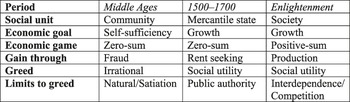
If the first stage is distinguished from the other stages by its focus on self-sufficiency vis-à-vis growth, the second and third stage—in which the notion of the social utility of greed is brought to fruition—differ in their view on the nature of the economic game and in subsequent views on how to restrain greed, while preserving its serviceability to society. Figure 1 above sums up the various differences between the three stages.
The development of views on greed in relation to societal setting.

Given the goal of growth within a setting characterized as a zero-sum game, the literature in our second stage emphasizes the need for public authority to ensure the social utility of greed. Nevertheless, some philosophers already hinted at the existence of some providential or natural order that establishes a balance or equilibrium because of self-enforcing limits that individuals impose on each other’s behavior. This natural order would increasingly appeal to the imagination once it was conjoined with the view of the mutually beneficial nature of trade and commerce. It was these two ideas that set the third and final stage.
IV. THE THIRD STAGE IN GREED’S RISE TO SERVICEABILITY
The idea of a positive-sum game made its appearance towards the end of the seventeenth century (even though it took more than three quarters of a century before it found general acceptance). There is something about the last decade of the seventeenth century. It keeps turning up in descriptions of the transformation of thought as it progressed towards the Enlightenment. In La crise de la conscience européenne 1680–1715, Hazard (1935) argued that all ideas that were to characterize the Enlightenment were already present in rudimentary form at the end of the seventeenth century. Raab (1965, p. 237 [n]) has argued that it was in this last decade of the seventeenth century that the notion of interest acquired an economic meaning, changing the predominance of political objectives in reflections on state and society in favor of economic objectives. The same period is crucial to Wiles’ claim that Heckscher’s static interpretation of mercantilism in his monumental Mercantilism (1935) was inaccurate with respect to the writings of the later English mercantilists. From the last decade of the seventeenth century onwards, increasingly a dynamic view of the economy was adopted, Wiles (Reference Wiles1974, Reference Wiles and Lowry1987) argues, which emphasized the goal of economic development and growth through the mutually advantageous interaction between domestic development and international trade. Whereas Thomas Mun and Josiah Child forcibly argued that “[a]ll trade is a kind of warfare” (quoted in Letwin 1963, p. 44), in 1696 Charles Davenant argued against the beggar-thy-neighbor policy of the Dutch, claiming “That their True Safety and Welfare depends upon the Strength and Prosperity of England” (quoted in Wiles Reference Wiles1974, p. 63). Dudley North, in similar vein, wrote in his Discourses upon Trade:
Now it may appear strange to hear it said, That the whole world as to trade, is but as one nation of people, and therein nations are as persons. That the loss of a trade with one nation, is not that only, separately considered, but so much of the trade of the world rescinded and lost, for all is combined together (1691, Preface).
In many ways, this idea of the mutuality of gains or interdependence given expression here was to become crucial to Enlightenment thinking. After Hazard’s crisis of conscience, thought broke away from a passivity that had dominated the ideas on man and society in the face of wars, famines, and epidemics, and rejected the conviction that such catastrophes represented the inevitable condition of fallen man. This escape from passivity is probably most aptly described as a change in attitude, or, as Gay phrased it, “a recovery of hope” (1977, p. 6).
On two counts, philosophers believed that the future held a better lot in store for mankind. They built their hopes, firstly, around the conviction that Newton had pointed the way to reliable knowledge. If, in the study of man and society, a parallel course was followed, it would become possible to discover the laws of nature that govern social phenomena. Armed with such knowledge, and by adapting his actions and institutions to principles upon which he could rely, man would be able to press the laws of nature into the service of his attempts to better his condition.
Secondly, instead of stressing the imperfections in human nature (an outlook that had led to attempts to persuade man of his duty to God and the state, and to respect institutional constraints on courses of action), the emphasis shifted to man’s sociability as the directive orientation in human conduct. Because man’s sociability was no longer perceived as an enforced artificial device designed to ensure compliance with religious and political imperatives, but rather as being an equally inherent characteristic of human nature, just as selfish inclinations are, a new perspective emerged with which to assess the regulatory structures of society. Although not denying the existence of imperfections in human nature, Enlightenment thinkers deliberately turned away from attempts to remedy those individual defects. Instead, the belief gained currency that the order and perfection of the whole was actually dependent on the imperfections of the parts (Lovejoy 1978, ch. VII). Perhaps the most provocative example of this claim can be found in Mandeville’s Fable of the Bees (1724): “Thus every Part was full of Vice, Yet the whole Mass a Paradise” (1988, p. 24).
Given these two sets of ideas, the key question concerned the mechanism and the (natural) laws that governed its operation through which movements of (economic) agents were mutually adjusted to the good of all. How did this mechanism work so as to create order and wealth in society, not thanks to, but despite, the imperfections of the parts? The search for answers inspired a new perspective on the social utility of greed and a matching theory of limits. This section aims to show how, from the realization of mutual gains from trade, the idea of a system of interrelated parts developed in which the social force of competition was assigned the role of bringing about the harmony of the whole.
Drawing attention to the role of the institutional environment in the rise of the industrial age, Joel Mokyr (Reference Mokyr and Findlay2006) has argued that institutions—as expressed in the prevailing worldview, belief system, attitudes, and formal rules—may be obstructive as well as receptive to change and innovation, and therewith hold back or reinforce economic progress. He emphasizes the importance of Enlightenment ideas and ideals in shaping the institutional reforms that created the susceptibility to technological change and innovations that initiated the industrial revolution. One such belief in the former sense was the zero-sum game between nations to accrue gains from trade and commerce, given that resources or wealth were assumed to be fixed. In breaking away from natural and institutional restraints upon development and growth, overcoming this belief proved crucial to the development of new ideas on the social utility of greed.
Spiegel summed up this static conception of development in mercantilism as follows: “When one country increases its share of [power, trade and/or treasure], another country is bound to suffer a corresponding loss. … What is true of countries also applies at a different level to the economic relations among individuals” (1971, pp. 115–116). In the 1690s, this worldview was challenged with the rise of the idea of trade and commerce as a positive-sum game. Although interests may be opposed, at the same time they are, to a certain degree, mutual in that people in societies characterized by division of labor and specialization depend upon one another in order to realize anticipated gains. As Daniel Defoe (1713) pointedly declared: “The Language of Nations one to another is, I let thee gain by me, that I may gain by thee” (quoted in Wiles, Reference Wiles1974, p. 64).
With the rise of the idea of trade and commerce as a positive-sum game in the 1690s and the concomitant notion of interdependence, profit-seeking activity gradually shifted from rent seeking to productive activity. This development has been used by Ekelund and Tollison (Reference Ekelund and Tollison1981) to characterize mercantilism as a rent-seeking society. The authors distinguish between rent seeking and profit seeking. Profit is taken as a normal economic rent in the sense that its presence signals resource owners where a more profitable allocation of resources is to be had, and, as such, rent seeking or profit seeking are part and parcel of a competitive market order. Rent seeking is understood as “the activity of wasting resources in seeking transfers” (1981, p. 19). The authors argue that, in England, rent seeking was a perfectly rational strategy from self-interested individuals in a monarchy, but that the cost-benefit structure changed with the victory of Parliament in 1688. Transaction costs increased sharply with multiple decision makers, eroding the rate of return to rent seeking in comparison to the ‘profitability’ of productive activities (Mokyr Reference Mokyr and Findlay2006).
Changing ideas about profit in relation to trade and production give further credence to this development. Meek has argued that, in the eighteenth century, competition increased, whereby efforts concentrated on the reduction of production costs rather than on attempts to keep up their monopolistic position in foreign markets. Moreover, it was gradually recognized that net profit on capital was a separate source of income in its own right. With the emergence of the idea of “profit as originating in the process of production and as merely being realised in the act of sale” (1951, p. 53; italics in original), views on the origin of surplus shifted from exchange to production. So, when the rate of return between rent seeking and productive activity changed in favor of the latter, production became the dominant avenue through which gains were pursued. This ties in with the growing need toward the end of the seventeenth century “to expand the domestic market so as to find an outlet for increased production” (Perrotta Reference Perrotta1997, p. 296).
In the decades that followed, more and more reasons were found to argue the mutual advantage of foreign trade.Footnote 8 Thus, it was argued that a country cannot hope to benefit from what it sells to others, without buying things in return to provide those others with money with which they can buy domestic goods. Others started to draw attention to the importance of international specialization.Footnote 9 Given differences in factor endowments between nations, international specialization would further the growth of trade and encourage the spread of inventions and improvements. As such, development is a two-way street: a nation’s advancement towards wealth and prosperity is intimately linked to, and even may be seen to depend upon, the economic development of other countries (Wiles Reference Wiles1974).
The development of this argument in the economic literature of the eighteenth century was coupled with a growing emphasis on the harmful consequences of rent seeking (Mokyr Reference Mokyr and Findlay2006, Reference Mokyr2007). Increasingly, efforts to redistribute wealth and rent seeking—in consequence of distorting incentives, misallocating resources in using resources to obtain privileges rather than productively, which would further economic growth and increasing costs—were seen to lead to inefficiencies, reduce the overall pie, and stifle growth and innovation. Condemning the efforts of merchants to ward off competition and establish a monopoly, Turgot (1773) wrote:
These fools do not see that this same monopoly which they practice … against their own fellow-citizens, consumers of the commodity, is returned to them by these fellow citizens, who are sellers in their turn, in all the other branches of commerce where the first in their turn become buyers … in this balance of annoyance and injustice … there is no advantage to any part; but there is a real loss to the whole of national commerce (Letter to L’Abbé Terray, in Groenewegen Reference Groenewegen and Groenewegen1977, pp. 183–184).
Underneath the practical reasons that were put forward in recognition of mutual gains from trade emerged the idea of a system of interdependence. One of the images of society that captivated many in the eighteenth century was that of a machine or mechanism, composed of interacting parts.Footnote 10 In this mechanical analogy, society was understood as tending toward a state of equilibrium, resulting from the mutual interaction between the self-reliant parts, whose operation is governed by laws of nature. The resulting equilibrium or harmony in society as the outcome of the social mechanism was often presented as the work of providence. As such, the economic universe was seen as a network of economic reciprocity in which providence had arranged differences in factor endowments between nations so that nations may provide for one another’s needs. As Jacob Vanderlint (1734) pointed out: “All Nations of the World, therefore, should be regarded as one Body of Tradesmen, exercising their various Occupations for the Mutual Benefit and Advantage of each other” (quoted in Wiles Reference Wiles1974, p. 64). The ties that bind people together in their economic activities constitute a system of interdependence, a providential or natural order that establishes a finely balanced equilibrium, allowing the economy to thrive. On such views, critical voices grew against government’s intervening in this system of reciprocal relations of exchange to manipulate the distribution of gains and losses in favor of private parties. The resulting ‘strange medly of errors,’ as North had it in his Discourses upon Trade (1691), hurt the public good by its detrimental effects upon trade and wealth. The perception of trade and commerce as a positive-sum game, in which people depended upon one another to secure their gains, challenged the role of public authority to curb greed in order to keep the system stable. Whereas previously, government intervention was deemed necessary to ensure that economic activity was not at the expense of state and society, more and more government interference came to be held responsible for obstructing the mutuality of advantage.
These ideas come together in the thought of the French magistrate BoisguilbertFootnote 11 (1646–1714). Fascinated by this natural balance, Boisguilbert argued that this balance could be upset by government interference or/and attempts (often backed by government) to profit at each other’s expense. Sustaining this natural order and its benign effects required that everyone shares in the benefits.
nature, or Providence, alone can observe this justice ... and this is how she does it. She established in the first place an equal necessity to sell and to buy in all sorts of trade, so that the desire for profit is the spirit of all markets, as much in the seller as in the buyer; and it is by the use of this equilibrium or balance, that one and the other are both equally forced to listen to reason and to submit to it (quoted in Routh Reference Routh1977, p. 60; Hecht Dissertation 1707, p. 992).
Boisguilbert thus argued that the providential order creates the conditions for equilibrium, while this equilibrium, in turn, provides the necessary framework of restraints to advance prosperity and harmony. In his exposition of the Frenchman’s views, Faccarello (Reference Faccarello1999) describes how Boisguilbert takes society as characterized by the incessant movement of the parts of which it is composed. The interaction between individuals engaged in reciprocal relationships brings about a dynamic equilibrium, producing harmony and prosperity. Communication and co-ordination of activities of individuals as the parts in the dynamic operation of the machine, Boisguilbert insisted, however ‘naturally defective’ in themselves, shape up together ‘a very perfect whole’ (quoted in Faccarello Reference Faccarello1999, p. 93), provided that the following three conditions are met. Firstly, reciprocity (by way of the price system) is essential in the establishment of such equilibrium. Given mutual dependence, everyone has a shared interest in the proper functioning of others. Prices must, therefore, be ‘proportionate’ in the sense that both buyer and seller profit from relations of exchange.
If ‘reciprocal utility’ or ‘shared profit’ is the first requirement to equilibrium, the second requirement is that economic agents do not break the chain of exchanges. The trader who does,
destroys the ground beneath his own feet, since not only … will he cause [his neighbor] to perish through ceasing to buy, but he will cause even his own personal loss, by making it impossible for his neighbour to return to his business to shop, which will cause his bankruptcy and close his shop (Boisguilbert, quoted in Faccarello Reference Faccarello1999, p. 96; Hecht Dissertation 1707, p. 986).
Individuals, classes, and professions all depend upon one another, linked together in a ‘chain of opulence’ in which ‘disconnection of a single one makes the whole useless.’ Instead of acting accordingly, “However, through a terrible corruption of the heart, there is no individual who does not try from morning until night and does not employ all his efforts to ruin this harmony, though he has only his happiness to expect from its maintenance” (Boisguilbert, quoted in Faccarello Reference Faccarello1999, p. 98; Hecht Factum 1707, p. 891).
Given that the behavior of economic agents is dictated by cupidity,Footnote 12 Boisguilbert emphasized the prevalence of competition as a third necessary requirement to the fulfillment of the conditions of equilibrium. Hence, Boisguilbert’s call for free play from which privileges and regulations were to be removed to ensure that each may benefit from exchange, providing for incentive as well as meeting standards of justice. Competition is a law of the providential order to which individual interests submit and thereby are subordinated to the general interest. Given that this social mechanism is self-regulating, the political order was to take a step back, its primary function to enforce the conditions for the establishment of equilibrium.
In the eighteenth century, these ideas were knitted together into a doctrine as they were reviewed, refined, criticized, and elaborated in the work of French and British authors. Increasingly, emphasis was given to the idea that the relations of interdependence that frame the natural economic order themselves impose restraints on greed, making human cupidity potentially subservient to human welfare by competition; i.e., balancing passions against one another in three ways:
1. At the level of the individual, greed is held in check by other motives in human nature. In the Newtonian Age, not only the universe but also “man’s inner motives must be balanced and harmonious. To think otherwise negates nature” (Myers Reference Myers1972, p. 174). Balanced against other motives (such as the need for attention, approval, and esteem) and stripped of their sharp edges, greed and avarice are conducive to public welfare.
2. Between competing individuals, each seeking to maximize his or her own gain, greed acts as a counterpoise to itself. The natural order is seen as a mechanical system with some internal regulatory mechanism through which economic activities in society are co-ordinated towards harmony, as a physical law in the social world much like the law of gravitation in the natural world.
3. Passions are also balanced at the level of social classes in society, complementing each other in a functional way, such as the prodigality of landowners and the hunt for profit of merchants (Herlitz Reference Herlitz and Magnusson1993). The division of labor not only between individuals but also between social classes serves the public welfare as they pursue their self-interest by capitalizing on natural differences in skills, aptitudes, and interests.
Although Boisguilbert relied on the self-enforcing power of competition to make private interests concur, he still emphasized how precarious a state of equilibrium was in the face of man’s destructive passions that corrupted the heart. In the Enlightenment, philosophers came to hold a more firm belief, not in the least because of the rehabilitation of the passions with the assumption of man’s natural sociability. As Diderot put it, “people impute to the passions all of men’s pains and forget that they are also the source of all his pleasures” (quoted in Gay Reference Gay1977, p. 188).
Such a more qualified view of the passions also applied to greed and avarice. The want for comforts and conveniences—things over and above the necessary—was applauded as incentive to industry, promoting diligence and productivity, and as a driving force behind technical progress. In the process of dressing up greed as prudential self-interest, ideas thus shifted on the mean, the excess, and the defect with respect to greed. Having been condemned for ages, the desire of gain became rather harmless to the material interests of society in a system of interdependent relations as free play imposed constraints so that exchanges would be of mutual benefit. As Dudley North noted:
The Glutton works hard to purchase Delicacies, wherewith to gorge himself; the Gamester, for Money to venture at Play; the Miser, to hoard; and so others. Now in their pursuit of these Appetites, other Men less exorbitant, are benefitted; and tho’ it may be thought few profit by the Miser, yet it will be found otherwise, if we consider, that besides the humour of every Generation, to dissipate what another had collected, there is benefit from the very person of the covetous Man; for if he labours with his own hands, his Labour is very beneficial to them who imply him; if he doth not work, but profit by the Work of others, then those he sets on work have benefit by their being employed (1691, pp. 14–15).
Tellingly, Adam Smith refashioned the desire of gain and passion of accumulation as the desire of bettering our condition, a passion that does not ignite the same sentiments of moral indignation as greed. Smith also denounced all attempts to equate frugality or saving with avarice. Savings may be loaned at interest or used for purposes of investment, adding to the nation’s stock of capital. Thrift as frugality and the passion of accumulation were to be applauded and carefully distinguished from thrift as the opposite of extravagance. Boundaries were redrawn. Moderate luxury (in contrast to ostentatious waste) was approved as incentive to industriousness and driving force to economic progress. Even if such passions were driven to excess (avarice or extravagance), it would ruin the individual rather than harm the material advance of society.
V. CONCLUSION
It never fails to amaze how the harsh and definite way in which greed, trade, and merchants were condemned earlier was turned around and developed into a new model of society that brought Addison in The Spectator to argue that
[t]here are not more useful Members in a Commonwealth than Merchants. They knit Mankind together in a mutual Intercourse of good Offices, distribute the Gifts of Nature, find Work for the Poor, add Wealth to the Rich, and Magnificence to the Great (Gay Reference Gay1977, p. 49).
Greed had come a long way indeed. Up until the end of the middle ages, avarice or the love of money or gain was presented as ‘the root of all evil’ or the most despicable of vices. It was emphasized that in a setting of self-sufficiency, indulging the passion of greed necessarily harms others.
Views on greed started to change with the breakdown of the self-sufficient community when individual interest no longer was strictly tied to the interest of the community. In this second stage, the payoffs of greed changed. At the same time, the goal of economic activity shifted from self-sufficiency to development and growth. The idea took hold that surplus could be used more productively through investment and accumulation than spent on charity. Somewhere in the resulting matrix of payoffs, there were combinations to be had, in which greed could be useful. In such considerations on the social utility of greed, mercantile and national interests loomed large, given the presumed importance of foreign trade to create surplus at the same time that such a surplus had to be secured at the expense of the relative share of wealth of other nations.
The third stage was set at the end of the seventeenth century when new ideas developed about the means by which greed was to be made beneficial. The rise of the growth-oriented economy brought with it the gradual realization that larger economic units like nations were just as dependent on one another in terms of welfare as the members of a self-sufficient community had been. Thus, the idea arrived of a system of reciprocal relations of exchange, represented as a mechanical system, regulated by providential laws, from which all would benefit. And if this system was allowed free play, competition would ensure that everyone shares in the benefits. The result would be a well-ordered and prosperous society as the outcome of exchange transactions between individuals, in which greed works only when one reckons with, and tries to accommodate, the needs of others.
Our exposition above, to understand the transitions in society and thought by which the notion of the social utility of greed was built into a model of society, underlines Schumpeter’s comment that the “slow disintegration of one of the oldest elements of popular economic thought [the idea that in every exchange one man’s gain is another man’s loss] is one of the most important points to remember concerning the history of analysis in the seventeenth century” (1972, p. 360). If anything (and rather uncharacteristically), Schumpeter still was too modest in his claim, as he might have included the eighteenth century. This paper has shown how crucial this idea was in how greed developed from deadly sin to social benefit, rendering greed socially useful by competition within a frame of interdependence. The internal regulatory mechanism of competition within the economic order balances the acquisitive passions by bringing them into competition with one another, co-ordinates, achieves allocative efficiency, and directs greed into the service of public welfare. In his Wealth of Nations, Smith thus, Todd Lowry asserted (1987, p. 20), “embraced an equilibrium of avarice, with the ‘invisible hand’ of market competition counteracting the destructive tendencies of unrestrained greed by guiding self-interested individuals, almost against their wills, to work for the public good.”
Hirschman (Reference Hirschman1977) has argued that the very qualities of predictability and constancy, for which the concept of interest had been acclaimed, suggested the identification of interest with the love of money. Avarice, whether dressed up as interest or not, was seen to be universal, predictable, and insatiable. Especially its quality as a calm and persistent passion qualified greed as capable of taming the wild passions such as ambition and lust, earning greed or interest a favorable reading, as evidenced by Dr. Johnson’s famous remark that “[t]here are few ways in which a man can be more innocently employed than in getting money” (Hirschman Reference Hirschman1977, p. 58). In this paper, it has been emphasized that the taming qualities attributed to the love of money were ‘forced’ upon this passion in its dependence on the capacity to accommodate the needs of others to work (establishing a positive-sum game) under the restraining influence of competition (sustaining the positive-sum game).
Another part of the explanation of why greed was selected as the countervailing passion to control the destructive potential of the passions, Hirschman wrote, involves the fact that money making and the pursuit of gain in trade and commerce came to be seen in the eighteenth century as a civilizing force that brought improvements in the arts, trade and industry, manners and morals. The rise of consequentialism, or the doctrine that actions are to be judged by their consequences, was most helpful here in absolving the acquisitive passion by its beneficial results. As David Hume put it: “it seems, upon any system of morality, little less than a contradiction in terms, to talk of a vice which is general beneficial to society” (1987, p. 280).
Our emphasis on the importance of the gradual substitution of the idea of a positive-sum game for that of a zero-sum game throughout this paper improves our understanding here as well. As the vision of a natural or providential order in the economy that, if not intervened with, ensured the social utility of greed was shaping up, debate centered on the issue of the moral viability of a commercial society. Greed, even if taken in its mild form as the desire of gain, may bring about order and wealth in society, but what about the moral quality of such an interest-driven society? Drawing on the Jansenist tradition that included Nicole, Domat, and Boisguilbert, Mandeville provocatively presented the fairly common idea that private vices enter into the makeup of public benefits as a zero-sum game between wealth and virtue. It took the better part of the eighteenth century before a battery of arguments had been developed to counter Mandeville’s claim. Smoothing out Mandeville’s paradox and stripping it of its negative consequences, increasingly the positive interdependence of wealth and virtue was emphasized as the belief was embraced that modern commercial society would bring advances in wealth as well as refinements in tastes, manners, and morals.