Introduction
Medullary thyroid carcinoma was first described by Hazard in 1959.Reference Hazard, Hawk and Crile1 This tumour constitutes 3–10 per cent of all thyroid carcinoma and accounts for 13.4 per cent of thyroid carcinoma deaths. Medullary thyroid carcinoma is a calcitonin-secreting tumour of the parafollicular T cells of the thyroid. The majority (85 per cent) of medullary thyroid carcinomas are sporadic, and usually present later and more aggressively than hereditary medullary thyroid carcinomas.Reference Ball, Baylin, De Bustros, Braverman and Utier2 Hereditary medullary thyroid carcinoma is inherited in an autosomal dominant pattern with complete penetrance.
Hereditary medullary thyroid carcinoma usually occurs with other endocrinopathies and is classified in this manner. Multiple endocrine neoplasia type 2a is a syndrome of medullary thyroid carcinoma with potential associations of pheochromocytoma, hyperparathyroidism, cutaneous lichen amyloidosis and Hirschsprung's disease. Multiple endocrine neoplasia type 2b (also known as Gorlin syndrome) is medullary thyroid carcinoma with associations of pheochromocytoma, ganglioneuromatosis of the gastrointestinal tract, Marfanoid habitus and mucosal neuromas. In both kinds of multiple endocrine neoplasia type 2, medullary thyroid carcinoma is the primary manifestation.Reference Easton, Ponder and Cummings3 Medullary thyroid carcinoma in isolation, without other endocrinopathies, is defined as familial medullary thyroid carcinoma. Multiple endocrine neoplasia type 2b is the most aggressive condition, followed by familial medullary thyroid carcinoma and multiple endocrine neoplasia type 2a.
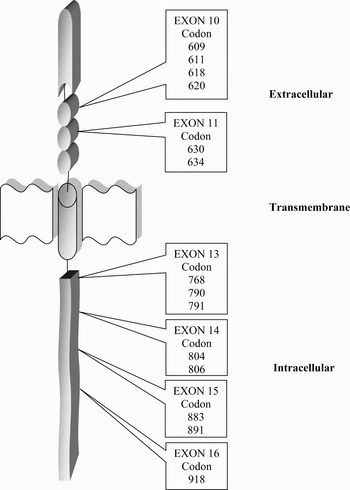
A single mutated gene has been mapped in families with germline medullary thyroid carcinoma. The RET proto-oncogene is a tumour suppressor gene located on chromosome 10q11.2.Reference Mulligan, Kwok, Healey, Eldson, Eng and Gardner4, Reference Donis-Keller, Dou, Chi, Carlson, Toshima and Lairmore5 The exact role of the RET proto-oncogene is not known. However, embryological development is stunted in mice lacking the RET gene.Reference Schuchardt, Dagati, Larsson-Blomberg, Costantini and Pachinis6 Protein analysis shows that the RET protein is a 170 kDa transmembrane receptor-bound tyrosine kinase. Activation of the RET protein is highly regulated. Loci mutations of the gene associated with medullary thyroid carcinoma have been described and are thought to cause over-activity of the RET protein (see Figure 1).Reference Frilling, Weber, Tecklenborg and Broelsch7 Key residues are thought to lie at a cysteine-rich domain which interacts with other signalling complexes.Reference Jing, Wen, Yu, Holst, Luo and Fang8, Reference Trupp, Arenas, Fainzilber, Nilsson, Sieber and Grigoriou9 Therefore, it is not surprising that the most prevalent mutations in patients with hereditary medullary thyroid carcinoma originate from this cysteine region.
Loci of the RET proto-oncogene associated with mutations causing medullary thyroid carcinoma.

Historically, calcitonin has been monitored as a screening tool to detect medullary thyroid carcinoma development. However, medullary thyroid carcinoma has been found in the thyroid tissue of patients with normal calcitonin levels.Reference Wells and Skinner10 This test can produce significant numbers of false positive and false negative results.Reference Eng11
Genetic screening has revolutionised the management of hereditary medullary thyroid carcinoma. It allows gene carriers to be accurately identified prior to the emergence of medullary thyroid carcinoma. Prophylactic thyroidectomy has thus become a plausible management practice, as there is a poor prognosis for treating medullary thyroid carcinoma once calcitonin levels become elevated; in addition, lymph nodes are likely to be involved at this stage. The timing of prophylactic thyroidectomy is a matter of debate; obviously, the morbidity of surgery in the very young must be balanced against the likely onset and aggressiveness of medullary thyroid carcinoma. The clinical course of the disease varies between the mutations, and thus the current recommendations are categorised by the mutations and their corresponding risksReference Brandi, Gagel, Angeli, Bilezikian, Beck-Peccoz and Bordi23 (see Table I).
Recommended genotype-based management of medullary thyroid carcinoma*

* Based on mutations of the RET proto-oncogene. MTC = medullary thyroid carcinoma; mths = months; yrs = years
Case report
An 87-year-old woman presented following investigation for ischaemic heart disease in a routine geriatric clinic. She had no family history of thyroid problems. Blood investigations had incidentally demonstrated hypothyroidism (thyroxine 15.2 mcg/dL; thyroid-stimulating hormone 8.4 mU/L). The patient was asymptomatic at presentation.
Examination of the neck revealed a small, firm, smooth, palpable nodule in the central neck on the left side which was mobile on swallowing.
An ultrasound scan showed a solid, 22 × 13 mm nodule in the left thyroid which was vascular both centrally and peripherally.
Histopathological analysis of a fine needle aspirate of the nodule showed clustered dissociated malignant cells with some atypical spindle cells but mostly eccentric nuclei. The preparation stained heavily for calcitonin, carcinoembryonic antigen and CD56 (neural adhesion molecule). There was no positive staining for thyroglobulin. A tissue diagnosis of medullary thyroid carcinoma was reported. Blood investigation revealed elevated serum levels of calcitonin.
The patient was investigated for the endocrinological features of multiple endocrine neoplasia types 2a and 2b; on examination and investigation, none could be found. Genetic analysis indicated the presence of a mutation of the RET proto-oncogene at codon 620. A formal diagnosis of familial medullary thyroid carcinoma was made. The patient was incidentally found to have a non-functioning parathyroid adenoma.
Use of radio-labelled 31calcitonin demonstrated uptake to central lymph nodes in the left side of the neck. A total thyroidectomy with bilateral lymph node dissection and left superior parathyroidectomy was performed.
The operative risk in this patient was significant due to her existing co-morbidities. There was some discussion on whether thyroidectomy was indicated, owing to the patient's age and the presumed natural course of the disease. A multi-disciplinary thyroid team meeting decided to offer the patient the option of surgery, which she was keen to proceed with.
Fortunately, the patient made a good post-operative recovery. At the time of writing, she had an undetectable calcitonin level and was being monitored routinely in our multi-disciplinary thyroid clinic.
Discussion
In order to appreciate the relevance of this case, we must first examine the genotype–phenotype correlation of the RET proto-oncogene codon 620 mutation and, more specifically, the evidence for the current classification of RET mutations and the recommended timings of prophylactic thyroidectomy.
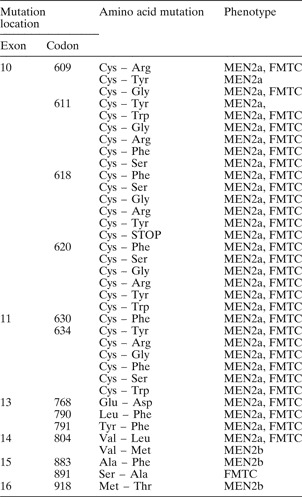
Table II demonstrates the currently identified RET proto-oncogene genotype variants and their phenotypic correlations. Multiple endocrine neoplasia type 2a and familial medullary thyroid carcinoma are, broadly speaking, caused by mutations in the extracellular region of exons 10 and 11. Mis-sense mutations of cysteine to arginine and tyrosine at codon 634 (C634R, C634Y) are the most frequent mutations found in cases of multiple endocrine neoplasia type 2a.Reference Frilling, Weber, Tecklenborg and Broelsch7 Mutations at codons 609, 611, 618, 620 and 630 have been described in multiple endocrine neoplasia type 2a but are less common. Intracellular mutations have been identified in multiple endocrine neoplasia type 2a, most commonly involving codon 790 and, less often, codons 791 and 804.Reference Machens, Niccoli-Sire, Hoegel, Frank-Raue, van Vroonhoven and Roeher12 Familial medullary thyroid carcinoma has also been demonstrated in both intracellular and extracellular regions. The intracellular mutations appear to occur with higher frequency, although no one mutation appears to predominate.Reference Mulligan, Eng, Attie, Lyonnet, Marsh and Hyland13–Reference Bolino, Schuffenecker, Yin, Seri, Silengo and Tocco16 Multiple endocrine neoplasia type 2b is due to a mutation at the intracellular area of codon 918 in 95 per cent of cases.Reference Iwashita, Kato, Murakami, Asai, Ishiguro and Ito17 Mutations at codon 883 have been described in the absence of codon 918, although it has not been confirmed whether this mutation does indeed cause multiple endocrine neoplasia type 2b.Reference Smith, Houghton and Ponder18 The International RET Mutation Consortium analysed 477 unrelated multiple endocrine neoplasia type 2 families.Reference Eng, Clayton, Schuffenecker, Lenoir, Cote and Gagel19 Further to the above, they found associations with specific aspects of multiple endocrine neoplasia type 2a and type 2b. Multiple endocrine neoplasia type 2a with Hirschsprung's disease was exclusive to cases with mutations at codons 618 and 620. Furthermore, pheochromocytoma and hyperparathyroidism were most common in cases with codon 634 mutation.
RET proto-oncogene mutations and resultant RET protein alterations and clinical phenotypesReference Frilling, Weber, Tecklenborg and Broelsch7, Reference Machens, Niccoli-Sire, Hoegel, Frank-Raue, van Vroonhoven and Roeher12

Cys = Cysteine; Arg = Arginine; Tyr = Tyrosine; Gly = Glycine; Trp = Tryptophan; Phe = Phenylalanine; Ser = Serine; Asp = Aspartate; Leu = Leucine; Val = Valine; Met = Methionine; Ala = Alanine; Thr = Threonine; MEN2a = multiple endocrine neoplasia type 2a; FMTC = familial medullary thyroid carcinoma; MEN2b = multiple endocrine neoplasia type 2b
Prophylactic thyroidectomy has been demonstrated to eliminate the risk of medullary thyroid carcinoma.Reference Dralle, Gimm and Simon20 The aim of surgery is to remove the gland before medullary thyroid carcinoma develops and disease progresses to the lymph nodes, as the prognosis significantly worsens once this has occurred.Reference Frank-Raue, Buhr and Dralle21 Patients with established medullary thyroid carcinoma who undergo thyroidectomy and lymph node dissection have a reported 10-year survival rate of 65 per cent.Reference Heshmati, Gharib, van Heerden and Sizemore22
• A case of familial medullary thyroid carcinoma is described in an 87-year-old woman with a RET proto-oncogene codon 620 mutation. Familial medullary thyroid carcinoma has not previously been reported in patients older than 70 years
• The presumed natural course of familial medullary thyroid carcinoma, particularly in the presence of codon 620 mutation, has led to recommendations for prophylactic thyroidectomy before the age of five years. Survival past middle age is thought unlikely without the intervention of thyroidectomy
• This case highlights the possibility that a patient with familial medullary thyroid carcinoma and codon 620 mutation may present incidentally in later life, and may indeed survive to 87 years of age without intervention
The potential for a mutation to initiate thyroid tissue carcinoma is obviously an important consideration in deciding when to initiate prophylactic treatment. The European Multiple Endocrine Neoplasia study group analysed 192 subjects and found earlier disease progression with familial medullary thyroid carcinoma in the extracellular versus the intracellular mutations.Reference Machens, Niccoli-Sire, Hoegel, Frank-Raue, van Vroonhoven and Roeher12 Furthermore, there was a cumulative age-related risk in patients with the codon 634 genotype. In 1999, the Seventh International Workshop on Multiple Endocrine Neoplasia met to publish a consensus statement on the management of hereditary medullary thyroid carcinoma.Reference Brandi, Gagel, Angeli, Bilezikian, Beck-Peccoz and Bordi23 It recommended prophylactic thyroidectomy before the age of five years in cases with high risk mutations (see Table I). Specific mutations and their recommended management were categorised according to risk. These recommendations were verified, in part, by multivariate analysis of 47 patients in one tertiary referral centre. This analysis confirmed the increasing risk of stage III and IV medullary thyroid carcinoma at diagnosis with increased age and elevated risk category.Reference Yip, Cote, Shapiro, Ayers, Herzog and Sellin24 Machens and Dralle analysed and collated published data for the age of medullary thyroid carcinoma onset in numerous RET mutation families.Reference Machens and Dralle25 These data were in agreement with recommendations made by the international multiple endocrine neoplasia workshop, except that codon 609 was elevated to high risk and codon 630 was introduced as high risk. In the case of hereditary codon 620 mutation, analysis has shown that medullary thyroid carcinoma may develop in patients as young as five years of age.Reference Skinner, Moley, Dilley, Ozwar, Debenedetti and Wells26 The youngest patient reported to develop medullary thyroid carcinoma and level one lymph node involvement in the presence of codon 620 mutation was aged 21 years,Reference Gimm, Ukkat and Niederle27 and the mean age for such development is 36 years (95 percent confidence intervals, 16.8–56.2).Reference Machens, Holzhausen, Thanh and Dralle28 The earliest manifestation with advanced disease and distant metastasis in the presence of codon 620 mutation is reported in a 22-year-old patient.Reference Machens, Holzhausen, Thanh and Dralle28 Hence, the international multiple endocrine neoplasia workshop recommended that children with codon 620 mutation should undergo prophylactic thyroidectomy prior to five years of age (see Table I).
Our case, a patient presenting with familial medullary thyroid carcinoma with codon 620 mutation at the age of 87 years, without any prior intervention, conflicts with the international multiple endocrine neoplasia workshop recommendations.
Is our case unique? It is well reported that patients with hereditary medullary thyroid carcinoma do present much earlier than those with the sporadic condition, and often have a better prognosis.Reference Grozinsky-Glasberg, Benbassat, Tsvetov, Feinmesser, Peretz and Shimon29 We found no mention in the literature of any patient with a germline codon 620 mutation who was older than 70 years, although this information may not have been the focus of reporting. Therefore, our case appears to be unique in literary terms. Whether other patients with codon 620 mutations do indeed exist but have remained clinically silent due to an indolent course cannot be answered.
Are clinicians right to recommend such aggressive prophylactic management, in the light of our case? This recommendation is based upon a wealth of cases and statistical analysis, and upon the vast clinical experience of leaders in the field. However, our patient's case does prove that it is possible to become an octogenarian and yet carry a codon 620 mutation, despite the wealth of evidence that this should result in an early and aggressive presentation.