Introduction
Collective responsibility and collective punishment are commonly associated with the penal codes of the Qin and Han dynasties.Footnote 2 While such practices were most probably of ancient origin, the Qin state institutionalized them. When looking at the evidence for such punishments prior to the Qin, scholars tend to focus on transmitted texts.Footnote 3 However, as Susan Roosevelt Weld has observed, we find early references to such practices in the Houma and Wenxian covenant texts, excavated materials dating to the fifth century bc:
The covenant texts themselves can be seen as examples of collective responsibility, insofar as they extend the self-curse to the covenantor's entire shi [氏] and the proscription to the named enemies' descendants, and sometimes specify that the covenantor enforce the covenant on his fellow kinsmen (zongren xiongdi [宗人兄弟]).Footnote 4
In this paper I introduce new materials from the Wenxian covenant texts relevant to this issue, and discuss them alongside the phrases to which Weld refers.
In the first section of the paper I present my analysis of a previously unseen imprecation phrase from the Wenxian materials: “Cause [you] to have no descendants” bǐ wú yǒu zhòuhòu 俾毋有胄後. In the discussion that follows this analysis, I suggest that the covenants provide us with the earliest excavated references to collective punishment and collective responsibility, practices that, while archaic in origin, are generally associated with Qin and later dynasties. I further argue that the term shì 氏, as used in the imprecation clause, referred to a man and his direct male descendants and I consider this point in the context of Mark Lewis's work defining basic social units in the Zhou period. Citing the Houma covenant texts, Lewis discusses how basic organizational units in early China were defined by the intended scope of collective punishments.Footnote 5 He argues that:
… the legalist state legally defined the significant social relations of its subjects through the range of collective punishments which implicated a man's family, neighbors, or colleagues.Footnote 6
In the Houma covenant texts, there are lists of enemies organized by what Lewis terms “households”, which he sees as evidence of the transition from a society in which the basic organizational unit was the lineage to one organized by household:
…in their bans on individual households and the listing of their members [the Houma covenants] reveal a transitional phase in the political history of the family in China, the gradual disappearance of the kin group as a state-like unit and its replacement by the individual household as a unit of economic production and the provision of service.Footnote 7
I will build on this argument to show that the imprecation clauses from the Houma and Wenxian texts provide further evidence of such development. I will discuss the subgroups identified in the enemy lists and imprecation clauses in light of Lewis's later work on the nuclear family as a basic social unit in the Zhou period.Footnote 8
The core of my argument derives from research on the Wenxian covenant texts (Wenxian méngshū 溫縣盟書), excavated in 1980–81 from Wenxian (Wen County) in northern Henan, and the Houma covenant texts (Houma méngshū 侯馬盟書), excavated in 1965 in the city of Houma, in southern Shanxi province.Footnote 9 Both sets of materials are dated to the fifth century bc and consist of covenants organized by the Zhao 趙 and Han 韓 ministerial families of the Jin 晉 state. The covenants were written using brush and ink on stone tablets, which were buried in pits dug into a raised earthen terrace. Covenant tablets were found in forty-three pits at Houma and sixteen pits from Wenxian. Each covenant type includes demands of loyalty to the head of the lineage, along with specific requirements and prohibitions, the majority aiming at the consolidation of the group centred on the lineage and the identification and rejection of named and unnamed enemies. An individualized tablet was prepared for each covenantor, giving the covenantor's name and the text of the particular covenant type. The number of covenantors participating in each covenant ranged from dozens to thousands. The different covenant types all conform to a basic four-clause structure – name clause, stipulations, submission, imprecation – and share many formulaic phrases.Footnote 10 An example is given here, laid out following this four-clause structure and using an interpretative transcription with added punctuation.Footnote 11 The name of the covenantor in this tablet is Qiao 喬.
Tablet WT1K1–3802Footnote 12
I. Fifteenth year, twelfth month, yǐwèi was the first day of the month, [today is] xīnyǒu [the 27th day of the month]. From this day onward, [if] Qiao
II.A dares not ___ly [?]Footnote 13 and loyally serve his ruler,
II.B and dares to join with the enemy as a follower,
III. resplendent Lord Yue, Great Mountain,Footnote 14 attentively and tirelesslyFootnote 15 watching you [i.e. Qiao],Footnote 16
IV. [will] wipe out that [i.e. Qiao's] shì.Footnote 17
I. 十五年十二月乙未朔辛酉。自今以往,喬
II.A 敢不□Footnote 18焉中心事其主
II.B 而敢與賊為徒者,
III. 丕顯岳公大冢,諦極視汝,
IV. 靡夷彼氏。
This article focuses on the last clause, the imprecation, to be triggered if the covenantor violates any of the oath's stipulations. The most common phrase used in the imprecation is that found in this example: “Wipe out that shì 氏” mí yí bǐ shì 靡夷彼氏.Footnote 19 In the current article I introduce a previously unseen imprecation phrase found in two of the Wenxian covenants, but not in the Houma materials. My interpretative transcription for this phrase is bǐ wú yǒu zhòuhòu 俾毋有胄後 “Cause [you] to have no descendants”, or, more literally, “Cause [you] not to have descendants”. This spells out the desired result of the threatened collective punishment: the breaking of the covenantor's patriline. This phrase is written on the excavated tablets in the Jin 晉 script of the fifth century bc, using what are now non-standard characters. It has thus been necessary to carry out a palaeographic and phonological analysis of these graphs in order to identify the words denoted and thus determine the meaning of the phrase.Footnote 20
Analysis of the phrase bǐ wú yǒu zhòuhòu 俾毋有胄後
This phrase is found in two different covenants from Wenxian, one on tablets from pit WT1K2, the other from pit WT4K5. A formal transcription of the phrase gives 卑母又由 .Footnote 21 Examples of these two covenant types are given here, with the phrase left in this transcribed form:
Tablet WT1K2–159
I. If [covenantor's name]
II.A dare falsify publicly-posted notices in Shaoqu,
II.B if [covenantor's name] dare know of the falsifying of notices and does not report this,
III. mighty superior, Lord Yue, attentively and tirelessly watching him,
IV. [will] destroy that [i.e. his] shì, ……………… (卑母又由 ).
I. 所□
II.A 敢偽懸書于少曲者,
II.B 所□敢知偽書不之言者,
III. 皇君岳公,其諦極視之,
IV. 亡Footnote 22夷彼氏,卑母又由 。
Tablet WT4K5–13
I. If [covenantor's name]
II.A dares not to split open [?] his heart [i.e. display true loyalty] in serving his lord Han ___ and his ministers, combining [our] strength as one in order to serve the lord,
II.B and yet dares again to have contact with [enemy name] and [enemy name], coming and going, acting as a pair of listening ears [i.e. a spy] for them,
III. Lord Yue, Great Mountain, watching you [i.e. the covenantor],
IV. ……………… (卑母又由 ).
I. □□Footnote 23自今以往
II.A 敢不剖[?]敷[?]其中心,以事其主韓□Footnote 24 及其嗇夫左右,
索力為一,以固事主,
II.B 而尚敢復通與 戌

 ,Footnote 25 出入為之聽耳者,
III. 岳公大塚,視汝,Footnote 26
IV. 卑母又由 。
My analysis of each graph in the phrase is presented below, followed by a brief discussion of the meaning of the phrase. In each case the identification adopted for the graph is first stated, after which the analysis itself is presented.
Analysis of the individual graphs
Graph 1
The graph is formally transcribed as [卑] bēi and taken to denote the word bǐ {俾} “to cause to”.Footnote 27
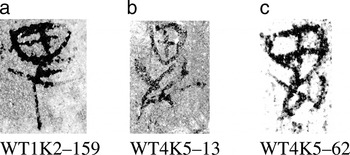
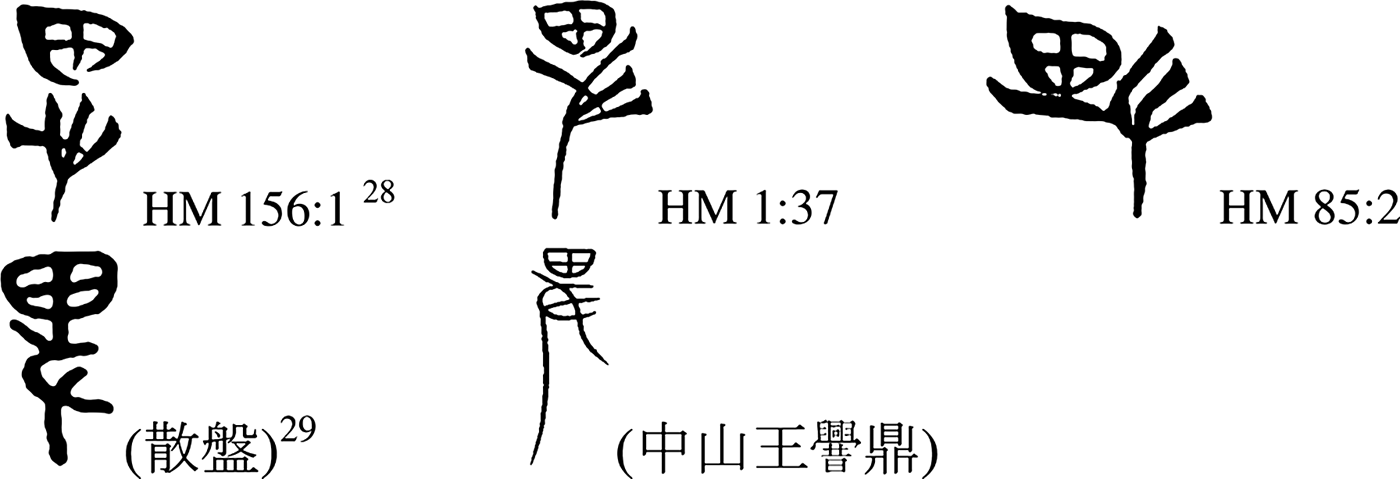
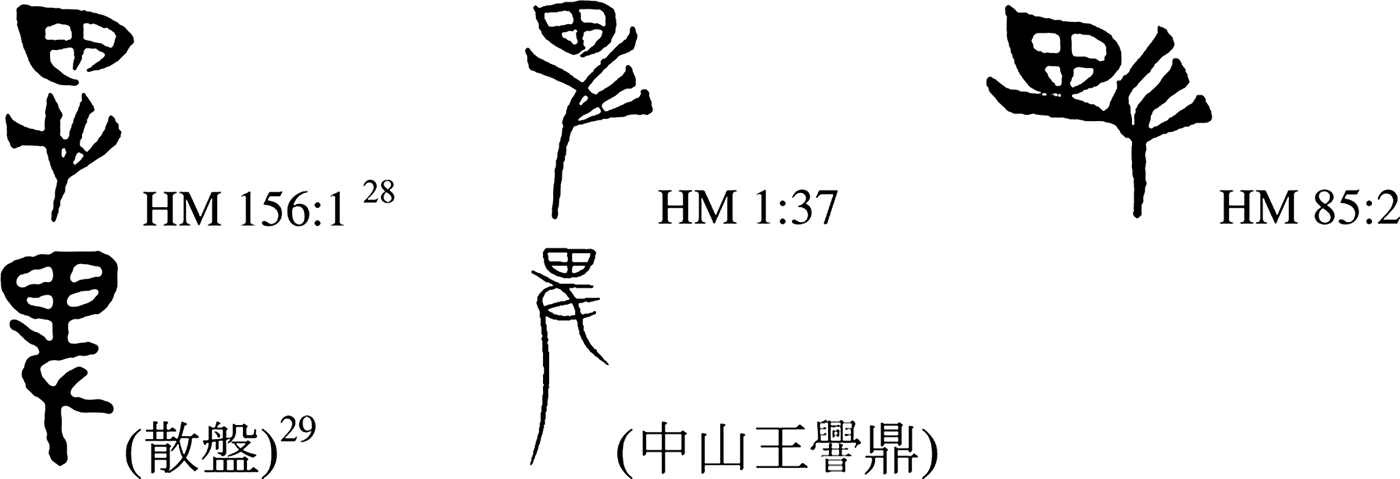
This graph is also found in the Wenxian covenant from pit WT4K11 in the following phrase (the graph replaced here with the symbol “Δ”): “…Δ不利于□之躳身宗家”, “…____ harm the [covenant lord's name]'s person and family”. There are few clearly legible examples of the graph as it appears in the imprecation phrase. Three examples are given in Figure 1. This graph is found in other palaeographic materials including the Houma covenant texts and bronze inscriptions, as shown in Figure 2. The forms are a reasonable match for the small-seal script for [卑] bēi,  .Footnote 30 Context confirms that these graphs should be identified as [卑] bēi, denoting a number of different words that, at a later stage, are differentiated by the addition of various semantic components. In bronze inscriptions and the Houma texts the character commonly denotes bǐ {俾} “to cause to”. This is also the case in the Wenxian WT4K11 covenant: … 俾不利于□之躳身宗家 “ … [dare to] cause harm to [covenant lord's name]'s person and family”. The graph should also be read in this way in the imprecation phrase.
Graph 1, 卑

Further examples of graph 1, 卑
Graph 2
The graph is formally transcribed as [母] mǔ, denoting the word wú {毋}, a negative adverb indicating prohibition.
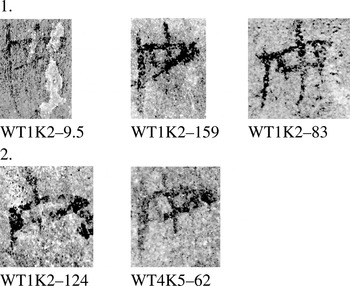
Two variant forms are used for this word in the Wenxian texts as shown in Figure 3. The first variant matches other palaeographic examples of the character [母] mǔ, while the second matches examples of [女] nǚ.Footnote 31 The character [母] mǔ is commonly used in Warring States texts to denote the negative wú {毋}, and this is the correct identification in this case.Footnote 32 The examples that we transcribe as [女] nǚ should be identified as a variant of [母] mǔ and read in the same way. The character [母] mǔ was developed from the character [女] nǚ, which depicts a female form by the addition of two dots representing breasts, thus indicating motherhood. However, from an early stage, this graphic distinction was not always made and there are examples in oracle-bone inscriptions and later texts where [女] nǚ is used to denote mǔ {母} “mother”.Footnote 33 The word mǔ {母}, in turn, could loan for the word wú {毋} and, just as [女] nǚ could be used to denote mǔ {母} “mother”, it could also be used to denote wú {毋}. This usage of [女] nǚ is seen in oracle bones and also in later texts. He Linyi 何琳儀, for example, interprets the graphs [亓女], on a Jin seal, as a double-character surname, Qíwú {綦毋}.Footnote 34
The two variant forms of 母

Graph 3
The graph is formally transcribed as [又] yòu, denoting the word yǒu {有} “to have”.
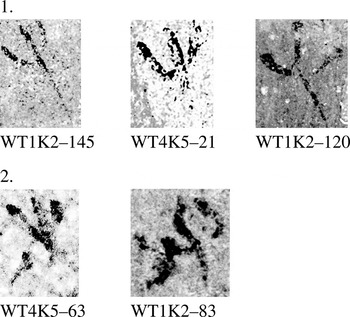
Two main variant forms are found in the Wenxian texts for this graph, as shown in Figure 4. The second form is distinguished from the first by the addition of a slanting stroke under the main component. The first set of forms can be identified with the Shuowen jiezi's small seal form  [又] yòu. Among several words commonly denoted by [又] yòu in palaeographic materials, yǒu {有} “to have” clearly fits the context found in this phrase. This also matches the usage in the Houma texts which in the great majority of cases use [又] yòu to denote yǒu {有} “to have”, although [有] yǒu does occur.Footnote 35
The additional short stroke seen in the second form is common in examples of the graph from the Jin region and should be taken, as He Linyi points out, as a calligraphic variation: it is a decorative stroke which had no semantic or phonetic function.Footnote 36 Although formally equivalent, this variant is not the character [寸] cùn (denoting the unit of measure cùn 寸) which developed later, the earliest examples being found in texts interred during the Qin period.Footnote 37
The two variant forms of 又

Graph 4
The graph is formally transcribed as [由] yóu, and identified as denoting the word zhòu {胄} “descendant/s”.
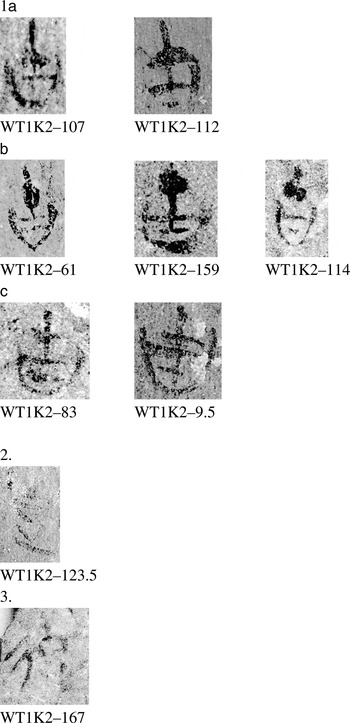
The graph is written with a number of variant forms in the Wenxian texts (see Figure 5). The type 1 examples include a number of common calligraphic variants: type 1b and 1c add either a dot or short stroke to the vertical stroke, type 1a does not, but the top horizontal stroke of the lower part of the form is thickened. Types 2 and 3 are component-level variants: type 2 adds [止] zhǐ below the main component; type 3 adds [彳] chì to the left of this form.Footnote 38
Variant forms of the graph 由

The common component in these graphs can be identified as [由] yóu. This character is not found in the Shuowen jiezi and the example found in the Guwen sisheng yun is not a close match:  .Footnote 39 However, forms of [由] yóu found in graphs from other palaeographic materials clearly match these Wenxian examples (see Figure 6).
Examples of 由 as a component in other graphs

The character [由] yóu commonly denotes the verb yóu {由} “to follow along”, “to go along with”, or the co-verb, “from”. As such, this character and the next, a variant of [後] hòu, would form a verb phrase or co-verb phrase. However, given that the preceding words of the imprecation read “Cause to not have…” 俾毋有, we would expect a noun phrase to follow here. We are, then, justified in considering whether [由] yóu is better understood here as denoting another word. Consulting [由] yóu's xiéshēng 諧聲 series (i.e. the group of characters which share [由] yóu as their phonetic component), we find an appropriate character: [胄] zhòu, denoting zhòu {胄} “descendant/s”.Footnote 43 I argue that this character and the next form a compound, “胄後”, meaning “descendant/s”. Although the use of [由] yóu to denote zhòu {胄} “descendant/s” has not been previously attested, such loan usage would not be surprising given that [由] yóu is phonetic signifier in [胄] zhòu. In fact, the two words may be cognate. The Old Chinese reconstructions for these words are: 由 yóu < yuw < *l[u] and 胄 zhòu < drjuwH < *lrus.Footnote 44 Based on the theory that Old Chinese had a morphology based on roots and affixes, we may conjecture that the root *l[u] > yóu {由} “to proceed from”, “to follow along”, “to go along with”, was suffixed with the nominalizing *-s, and infixed with *<r>, indicating distribution (multiple actions or objects), to give the word *lrus > zhòu {胄} “multiple followers”, and thus “descendants”.Footnote 45
Graph 5
The graph is directly transcribed as [ ] and formally transcribed as [
 ], denoting hòu {後} “descendant/s”.
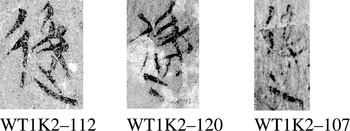
Examples of the graph from the Wenxian texts are given in Figure 7. The graph's several common components can be matched with forms found in the Shuowen jiezi's component table:  (WT1K2–112) matches
 [彳] chì;
 (WT1K2–112) matches
 [止] zhǐ;
 (WT1K2–112) is close to
 , [
 ] yāo; and
 (WT1K2–120) matches
 , [
 ] zhǐ.Footnote 46 This allows us to construct a direct transcription: []. The right hand and lower components [彳] chì and [止] zhǐ frequently occur together and the Shuowen jiezi treats them as a single component [辵] chùo, later simplified to [辶]. Thus a formal transcription of the graph can be given as []. This character is found in the Shuowen jiezi with the small-seal form:
 , given as the “ancient script (gǔwén 古文)” form for [後] hòu.Footnote 47 The same graph is also seen in the Houma tablets, for example:
 HM 3:20Footnote 48
Examples of graph 5, 

In the Houma tablets, the graph denotes hòu {後} “after”, occurring in the phrase: 既質之後 jì zhì zhī hòu “after having pledged”. However, [後] hòu also commonly denotes the noun hòu {後} “descendants” and, as discussed above, I believe that in the Wenxian imprecation phrase this word and the preceding word, zhòu {胄} “descendant/s”, form a previously unseen compound zhòuhòu 胄後 “descendants”. This compound is discussed further in the following section.
Analysis of the complete phrase
The above analysis gives an interpretative transcription for the whole phrase 俾毋有胄後 bǐ wú yǒu zhòuhòu “Cause [you] to not have descendants”. The compound zhòuhòu 胄後 “descendants” is not seen in lexicons, but similar combinations of paired synonyms that include either zhòu 胄 or hòu 後 do occur with this meaning, for example:

The words zhòu 胄, hòu 後 and yì 裔 all occur independently to denote “descendants”, and in the above examples are paired to form compound words with the same meaning. The term zhòuhòu 胄後 from the Wenxian covenants is another example of such a synonym pair, and we can be confident that it too means “descendants”.
The suggested analysis for the phrase finds indirect support from examples of similar language in imprecation clauses from covenants quoted in the transmitted histories. For example:
Zuozhuan Xi 僖 28 (text: fifth–fourth century bc) (event: 632 bc)Footnote 52
… cause his armies to fall, [cause him] not to be able to sacrifice for his state, and, to your most distant grandson, [cause you] to not have aged or young [relatives].
… 俾隊其師,無克祚國,及而玄孫,無有老幼。
The initial bĭ 俾 governs each of the clauses that follow it, including the last, 無有老幼 wú yŏu lăo yòu, giving: [俾]無有老幼. The character [無] wú is an example of the interchange between [無] wú and [毋] wú that is common in received texts: in this example the character should be understood as denoting the prohibitive negative wú {毋}.Footnote 53 Thus the phrase, “Cause [you] to not have aged or young [relatives]” [俾]無(毋)有老幼, is syntactically and semantically almost identical to the Wenxian phrase, “Cause [you] to not have descendants” 俾毋有胄後.
To wish someone to be without a male heir is surely one of the oldest and most common curses in Chinese culture. A version in current use is “break [the line of] sons and grandsons” jué zǐ jué sūn 絕子絕孫. The central importance in Chinese culture of the continuity of the male line, the target of such curses, can be traced back to the ancestor worship of the Shang period. The ancestors need sustenance, which is provided by offerings made by male offspring. Without male descendants to perform this duty, an ancestor would suffer. In Western Zhou bronze inscriptions one of the most common formulaic phrases calls for the inscribed vessel to be used by succeeding generations to make such offerings: “May all [his] [male] descendants, for evermore, treasure and use [this vessel]” 子子孫孫永寶用. Complementary curses directed at male descendants must have come into existence not long after the focus on the lineage and ancestor worship itself began.
Discussion
The phrase 俾毋有胄後 bǐ wú yǒu zhòuhòu, “Cause [you] to have no descendants” is one of two imprecations found in the excavated covenant texts, the other being the more commonly seen mí yí bǐ shì 靡夷彼氏 “Wipe out that shì”. In this section I will make a preliminary appraisal of the significance of these and other relevant phrases from the covenants for our understanding of certain aspects of early Chinese punishment, law, and social organization.
The covenants provide what appear to be the earliest written references from excavated texts to the practice of collective punishment in the form of execution of family members of the offender. This is a practice that, while almost certainly of early origin, is generally associated with Qin, Han and later legal codes. In received texts the group of relatives to be collectively executed is referred to as zú 族, while the term used in the covenants is shì 氏. I conjecture that, in the imprecation phrase, the term shì 氏 refers to the covenantor and his direct male descendants, i.e. sons, grandsons, any great grandsons, and so on. In later legal codes, collective punishment is closely linked to the concept of collective responsibility and it is interesting to see that two of the covenant types from Houma and Wenxian threaten to punish not only one who commits the act prohibited in the oath, but also anyone who knows of this action having been committed by someone else but who does not report it. These findings support and expand on those of Susan Roosevelt Weld and Mark Lewis mentioned in the introduction, showing that the forms of collective punishment and collective responsibility present in the excavated covenant texts are precursors of those of the later legalist state. These points will now be discussed in more detail.
In Qin, Han and later periods, the penal system is well known for its inclusion of punishment, for certain crimes, of not only the convicted individual but also members of his or her family and close social network. This is called lián zuò 連坐, and referred to in English using various terms, for example: “mutual liability”, “linked responsibility”, “coadjudication” (for the synonym xiāng zuò 相坐), and “mutual implication”.Footnote 54 Collective punishment continued to be part of China's legal codes in successive dynasties until the end of the Qing.Footnote 55 In the Qin and Han periods, in the case of “heinous crimes” (dà nì wú dào 大逆無道), that is crimes against the state, the punishment was generally execution of the guilty party along with members of his or her family (known as zú zhū 族誅, yí zú 夷族, miè zú 滅族, etc.).Footnote 56
The transmitted historical texts record cases of group execution from early times. In the Shangshu's “Pan Geng 盤庚”, dated to the later Shang or early Zhou period and concerned with the move of the Shang capital to Yin 殷 (modern Anyang 安陽), the following threat is made:Footnote 57
Shangshu “Pan Geng zhong 盤庚中” (text: later Shang or early Zhou) (event: thirteenth century bc)Footnote 58
If there are [those] who are not good, not principled, who overturn, overstep, not fulfilling their duties, who are deceiving, evil, behaving wantonly within and without, then I will cut them down, destroy and wipe them out, they will not leave descendants, they will not be allowed to spread their kind to the new capital.
乃有不吉不迪,顛越不恭,暫遇姦宄,我乃劓殄滅之,無遺育,無俾易種于茲新邑。
The aim of the punishment here is identical to that of the imprecation phrase analysed above: to leave the violator without descendants. Apart from execution of the transgressor, the threat here implies the collective punishment of, at minimum, his or her direct descendants. The Zuozhuan has many examples of the implementation of collective punishment, for example:
Zuozhuan Xuan 宣 13 (text: fifth–fourth centuries bc) (event: 596 bc)Footnote 59
In the winter, Jin punished [those responsible for] the defeat at Bi and the battle at Qing. The blame was laid on Xian Hu, and he was killed, and his family (zú族) completely wiped out.
冬,晉人討邲之敗與清之師,歸罪於先縠而殺之,盡滅其族。
We may not trust such textual records as precise reports of specific events, but they do suggest that group execution had a long history. Such punishment is rooted in the broader practice of group killing, that is the killing of individuals on the basis of membership, or supposed membership, of some group.Footnote 60 In the case of early China, oracle bones provide examples of group killing in records of large-scale sacrifice of members of the group known as Qiang 羌, in numbers of up to 400 people at a single time.Footnote 61 The ninth-century bc “Yu 禹 ding” bronze inscription records a royal command to attack an enemy and: “not leave any old or young” 勿遺壽幼.Footnote 62 What is significant about the covenant tablets from Houma and Wenxian is that they appear to be the earliest excavated legal texts that threaten collective killing as punishment for non-compliance with given stipulations.
The Shiji records that such collective execution was codified in the Qin state as early as 746 bc: “In Duke Wen's twentieth year, the codes first had the punishment of sān zú [killing of family members along with the guilty]” [文公]二十年, 法初有三族之罪].Footnote 63 However, we have no conclusive evidence of systematized written codes before the third-century bc Qin examples from Shuihudi.Footnote 64 Neither the oracle bones nor Western Zhou bronzes have inscriptions referring to this punishment.Footnote 65 The Zhongshan bronze inscriptions are later than the excavated covenant texts, dating to the end of the fourth century bc, and these do include an imprecation similar to that in the covenants.Footnote 66 This appears as part of a command recorded on a plan of the Zhongshan royal cemetery:Footnote 67
“Zhongshan zhaoyu tu 中山兆域圖” (late fourth century bc)
The King ordered [his minister] Jia to produce the measurements for the linear and spatial dimensions of the cemetery. The responsible officials drew these up [into this plan]. Any who alters [this design for] the cemetery, will die without mercy. Any who does not carry out the King's commands, calamity will reach to his sons and grandsons. One copy of this [plan] will follow [the King in burial], one will be stored in the archives.
王命賈爲兆窆闊狹小大之度。有事諸官圖之。進退兆窆者,死無赦。不行王命者,殃及子孫。其一從,其一藏府。
In the inscription on the ding vessel from this tomb, there is also reference to such punishment:
Zhongshan Wang Cuo ding 中山王 鼎” (late fourth century bc)Footnote 68
And so I bestow this command on him: “Even if he had capital crimes condemning three generations, none [of these crimes] would not be pardoned, …”
是以賜之厥命:“雖有死罪及三世,無不赦,…”
The punishment of collective execution is codified in the Qin and Han laws and appears in excavated legal texts from these periods, for example:
“Ernian lüling – zei lü 二年律令·賊律” slips 1–2 (186 bc)Footnote 69
Any one rebelling and surrendering a city, town or border fortification to a local ruler; any one manning the walls and fortifications who, when a local ruler's men attack and loot, does not keep up his defence but abandons and leaves, as if surrendering; and any planning rebellion: all [such offenders] will be cut in two at the waist. That person's parents, wife and children, and siblings, regardless of age, will all be executed. Any one mutually responsible for one planning rebellion may be arrested wherever located [but] if any such person first reports [the planned rebellion] to an officer, that person will be exempt from the crime of mutual responsibility.
以城邑亭障反,降諸侯,及守乘城亭障,諸侯人來攻盜,不堅守而棄去之若降之,及謀反者,皆腰斬。其父母、妻子、同產,無少長皆棄市。其坐謀反者,能遍捕,若先告吏,皆除坐者罪。
The excavated covenants, then, provide evidence of the threatened use of such collective punishment in a legal document dating two to three hundred years earlier than the Qin and Han codes and one to two hundred years earlier than the Zhongshan bronze inscriptions.
In the covenant texts the group targeted in the imprecation clause is referred to as shì 氏. As David Sena observes, the term shì 氏 “has been used inconsistently since the Eastern Zhou to indicate various types of social groups”.Footnote 70 It is, however, generally equated with the English term “lineage”. Sena defines the early Chinese lineage as: “a named group of individuals … related by virtue of demonstrable descent from a common male ancestor through the male line”; the lineage “refers to an actual functioning group of people … . Members of a lineage maintained ancestral temples … and lineage burial grounds … . Each lineage had a territory associated with it … and at least a portion of the lineage members lived on that territory”.Footnote 71 The term shì 氏 could, then, refer to a very large social grouping. That collective punishment of such extended groups was carried out, or at least sanctioned, is suggested by passages such as this:Footnote 72
Shi ji “Sunzi Wu Qi liezhuan 孫子吳起列傳” (text: second–first centuries bc) (event: 381 bc)Footnote 73
When King Dao died, chief ministers from the ruling lineage rose up and attacked Wu Qi. Wu Qi ran to the king's corpse and took cover. The soldiers attacking Qi, when shooting [arrows] at Wu Qi, also struck King Dao[’s corpse]. After King Dao was buried, the heir ascended to the throne and despatched officials to punish thoroughly those who had shot at Wu Qi and also hit the king's corpse. More than seventy families were executed in the wiping out of lineages collectively punished for the shooting of Qi.
及悼王死,宗室大臣作亂而攻吳起,吳起走之王尸而伏之。擊起之徒因射刺吳起,幷中悼王。悼王既葬,太子立,乃使令尹盡誅射吳起而幷中王尸者。坐射起而夷宗死者七十餘家。
In the case of the excavated covenants, however, the threatened punishment cannot have targeted the covenantor's entire lineage. A large number of the covenantors at Houma and Wenxian were no doubt members of the lineages that organized the covenants, that is Zhao and Han.Footnote 74 If the term shì 氏 in the imprecation clause encompassed the whole lineage, the leaders who organized the covenants would have been effectively cursing themselves. Thus the shì 氏 of the imprecation clause must refer only to a subset of the larger lineage. The following passage from the Zuozhuan provides an example of the use of shì 氏 with a restricted scope:
Zuozhuan Xuan 宣 4 (text: fifth–fourth centuries bc) (event: 605 bc)Footnote 75
Duke Xiang was going to expel the Mu shì 氏 [Duke Mu's sons], but spare Zi Liang. Zi Liang did not approve, saying: “The Mu shì should all remain, that was my original wish. If you will exile them, then exile all [of us], what have I [Quji, i.e. Ziliang] done [to deserve special treatment]? [Duke Xiang] then excused them and made them all ministers.
襄公將去穆氏,而舍子良。子良不可,曰:”穆氏宜存,則固願也。若將亡之,則亦皆亡,去疾何為?”乃舍之,皆為大夫。
Duke Mu 穆's son, Duke Ling 靈, had been killed, after which another son, Zi Liang 子良, had declined the throne in favour of a brother, Gongzi Jian 公子堅, who then became Duke Xiang 襄. The Zuozhuan records that Duke Xiang was going to expel the “Mu shì 穆氏” but spare Zi Liang. Given this context, the “Mu shì 穆氏” by whom Duke Xiang feels threatened must refer to the other sons of Duke Mu, i.e. the new duke's brothers. Thus Zi Liang clearly identifies himself as a member of this group and the members of the group are all in a position ultimately to be made dàfū 大夫 ministers. So, the shì 氏 of this passage is restricted to the sons of an individual. The shì 氏 of the covenant texts must have a similarly restricted usage.
I believe that the shì 氏 used in the imprecation of the excavated covenant texts refers to the covenantor and his direct male descendants, i.e. sons and, where applicable, grandsons, and so on. This is a usage similar to that in the Zuozhuan passage just quoted and evidence from the covenants themselves corroborates this suggestion. Firstly, the imprecation phrase “Cause [you] to have no descendants” 俾毋有胄後, analysed above, makes it clear that the aim of the curse is to break the male line of the covenantor. In the WT1K2 covenant this imprecation directly follows the phrase “Wipe out that shì 氏” 亡夷彼氏, clearly implying that it is extermination of the shì 氏 that will result in the covenantor having no descendants. The shì 氏 must, then, be composed of, at minimum, the covenantor and his male offspring.
Further corroboration for this definition of shì 氏 is provided by the lists of enemies included in many of the covenants. Such covenants list individuals with whom the covenantor is to have no dealings or, in some cases, is to kill if the opportunity arises. Here is part of one such list:Footnote 76
 及其子乙及其伯父、叔父、[兄]弟、子孫,
 及其子孫,

 ,
 之子孫,
 ,
 之子孫,中都
 之子孫,
 之子孫,
 及親昆弟子孫,隥及親昆弟子孫,趙朱及其子孫,趙喬及其子孫,…
The enemies are, for the most part, treated in subgroups of the form: “[name] jí zǐsūn 及子孫” or “[name] zhī zǐsūn 之子孫”, i.e.: “X and his sons and grandsons” or “X's sons and grandsons”. In the latter case, where the father himself is not included as a target, the obvious conjecture is that he had already been killed and that this detail was known to those who composed this text. These groups, then, are limited to an individual along with his sons and grandsons, or the sons and grandsons of a dead individual. If the targeted range is any wider, then this is specifically indicated, as is the case for the first group in the above example: “X and his son Yi and his [Yi's] paternal uncles, [and his] brothers, sons and grandsons”  及其子乙及其伯父、叔父、[兄]弟、子孫.Footnote 77 These lists suggest that the elite organizing the covenants recognized a man and his sons and grandsons as a basic unit, and I believe this is the same unit that they targeted in the imprecation clause. The enemy lists also demonstrate the point that, in the context of these covenants, lineages are not treated as unified groups. This is clear from the many examples of enemies who share the same lineage name (e.g.
 ): it is individuals (along with their direct male descendants) who are targeted, not the lineage as a whole.Footnote 78 Lineages were not targeted as groups because they no longer acted politically as groups: they were factionalized and lineage affiliation did not necessarily correspond to political allegiance.Footnote 79 This, again, is why the term shì 氏, as used in the imprecation clause, must refer to a subset of the lineage group, not the lineage as a whole.
Among the examples of collective punishment from excavated texts discussed above, the group threatened in the “Zhongshan zhaoyu tu” is the transgressor and his “sons and grandsons”, i.e. precisely the group I suggest comprises the shì 氏 unit of the covenants’ imprecation clause.Footnote 80 In contrast, the collective punishment in the Han period “Ernian lüling”, also quoted above, extends to a wider group, the “parents, wife and children, and siblings” of the convicted person. This range of family members is similar to that given in glosses for sānzú 三族, the term used in the Shiji quote given above that refers to the Qin state's early use of such punishment. The Jijie 集解 commentary of Pei Yin 裴駰 (fifth century) quotes two explanations for the term, one equating it with the families (zú 族) of the father, mother and wife (fùzú, mǔzú, qīzú 父族、母族、妻族), the other with “parents, brothers, wife and children” (fùmǔ, xiōngdì, qīzǐ 父母、兄弟、妻子), the latter differing from the “Ernian lüling” only in its use of “brothers” xiōngdì 兄弟 where the Han text has “siblings” tóngchǎn 同產.Footnote 81 Regardless of the precise meaning of this term, this evidence suggests that the group targeted for collective punishment in fifth-century bc Jin and fourth-century bc Zhongshan was, at least in the cases examined here, rather different to that of the later Han-period state.
These differences in the membership of the units targeted for group killing are significant for Mark Lewis's argument, mentioned at the outset, that in delineating the scope of collective punishment those in authority were identifying a politically and organizationally significant unit. Lewis argues that: “the gradual disappearance of the kin group as a state-like unit and its replacement by the individual household as a unit of economic production and the provision of service” was marked “by the shift in the meaning of mie zu [滅族] from a political event approximating the destruction of a state to a form of collective punishment that fixed the legal limits of the individual family”.Footnote 82 Lewis suggests that: “In the range of those included in the punishment of ‘destruction of the lineage’ (mie zu 滅族), the Qin and Han governments marked out the limits of kinship that they regarded as socially or legally significant”.Footnote 83
Lewis, as mentioned earlier, describes the enemy lists in the Houma covenants as made up of “individual households” and takes this as evidence of the transition to a society in which the “household” is the basic social, economic and legal unit. Elsewhere, Lewis states that, throughout the Zhou period, the “household” was based on the “nuclear unit of a couple and their children”.Footnote 84 I am suggesting, however, that the key characteristic of the basic group targeted in the enemy lists, as well as that of the shì 氏 in the imprecation clause, is the direct bloodline relationship between a man and his male offspring. Such a group does not correspond precisely with the basic “household” unit as defined by Lewis, given that it ignores females and would correspond to several households if a man's grown sons lived separately. The group is, rather, the basic patrilineal unit of the larger lineage. This qualification in fact strengthens Lewis's argument for a transition from the lineage as basic social unit to the individual household, providing evidence for a transitional period in which a lineage subset of a man and his male offspring was recognized as a significant unit.
In the period in which the Houma and Wenxian covenants were produced, lineages were highly factionalized and lineage affiliation was of secondary significance to political allegiance. However, in the minds of the elites that created these covenants, it was still the direct male bloodline that defined the most significant relationships in society. Thus the narrowly defined shì 氏 of a man and his sons, grandsons, etc. was conceived of as a basic structural unit within the groups over which they ruled. The elite still assumed strong ties of loyalty within this basic unit, which is precisely why it is targeted in the enemy lists in order to avoid revenge attacks by male offspring of the named enemy, and also in the imprecation clause, in order to coerce the covenantor by threatening those responsible for nourishing him in the afterlife with ancestral offerings. By the Qin and Han periods, the significance placed on lineage-based loyalties had weakened. This was politically expedient given the diverse groups ruled by the Qin and Han states, and also a necessity for their implementation of the collective responsibility system, which is at odds with such loyalties.Footnote 85 Significantly, the excavated covenants provide evidence of the use of collective responsibility in legal texts well before the Qin period.
Collective punishment was based on this concept of collective responsibility, that is, the idea that members of a group are liable for transgressions of others in the group. Collectivity in matters of criminal responsibility and punishment is considered by many anthropologists as an archaic phenomenon, observed in pre-industrial, acephalous (non-centralized) societies.Footnote 86 In China, the highly centralized Qin state continued the practice, setting it down in its codes.Footnote 87 In the Qin and Han systems, collective responsibility required that family and neighbours monitor each other and report on any illegal activity.Footnote 88 Compliance was rewarded, while non-compliance was heavily punished.Footnote 89 In the Houma and Wenxian texts a form of collective responsibility is evident in the following two covenants. The first is the covenant from Wenxian pit WT1K2, discussed above, the second is from Houma pit 67.
Tablet WT1K2–159
I. If [covenantor's name]
II.A dare falsify publicly-posted notices in Shaoqu,
II.B if [covenantor's name] dare know of the falsifying of notices and does not report this,
III. mighty superior, Lord Yue, attentively and tirelessly watching him,
IV. [will] destroy that [i.e. his] shì, [and] cause [him] to have no descendants.
Houma tablet: HM 67:6
I. If [covenantor's name], from today onwards,
II.A dares not to abide by the words of this covenant,
II.B and, furthermore, dares to seize property,
II.C or knows of lineage members who have seized property, but does not apprehend them and turn them in,
III. resplendent Lord Yue, Great Mountain, perspicaciously and tirelessly watching him,
IV. [will] wipe out that [i.e. his] shì.
I. □自今以往,
II.A 敢不帥從此盟質之言,
II.B 而尚敢或納室者,
II.C 而或聞宗人兄弟納室者而弗執弗獻,
III. 丕顯岳公大冢,明極視之,
IV. 靡夷彼氏。
In both examples the stipulations not only prohibit a specific action but also make the covenantor responsible for aiding in the capture of any person the covenantor knows to have committed the prohibited act. In the Wenxian covenant the requirement is to report the person, while in the Houma case the covenantor is expected to apprehend the person and hand him or her over to the authorities. In both covenants, the punishment for not turning in another group member is identical to that for committing the offence oneself, i.e. the extermination of one's shì 氏. These appear to be the earliest excavated Chinese texts that refer to the practice of collective responsibility.
In the Houma example the group over which this collective responsibility extends is clearly stated: the zōngrén xiōngdì 宗人兄弟. I tentatively take this to refer to fellow branch-lineage members of the covenantor.Footnote 90 It may be, as Tsang Chi-hung suggests, that the covenantors in this case were leaders of lineage subgroups and are being required to take responsibility for those under their authority.Footnote 91 In the Wenxian example collective responsibility is required within a geographical location, a place called Shaoqu. Inscriptional materials provide evidence that Shaoqu was a city under Han (韓) control during periods of the Warring States and its prominent mention here suggests that this was already the case at the time of this covenant.Footnote 92
It is significant that these two covenants only require that a transgressor be reported or handed in, i.e. the right of final adjudication is held by the central leadership. This is in contrast to the right granted to covenantors in some of the other covenants to execute certain outsiders.Footnote 93 It implies a wish on the part of the leadership for sole jurisdiction over those under its direct control.
Conclusion
The excavated covenant texts date to the early Warring States period, a time of upheaval and instability during which elites sought to consolidate power over large groups of people. The covenant texts used the threat of collective punishment to coerce the individuals that made up these groups, and this collective punishment was targeted at the individual's direct male descendants. In the commonly found imprecation, “Wipe out that shì 氏”, the term shì 氏 refers to this unit of the covenantor and his son, grandson, and any further direct male progeny. The previously unseen imprecation analysed above, “Cause [you] to have no descendants” 俾毋有胄後, indirectly threatens the same group. The male descent line of this shì 氏 unit reflects the continuing significance of the concept of the patriline, the basic organizing principle of the lineage system. However, in size the shì 氏 unit is small, limited to the male offspring of the individual covenantor. This is evidence of a conscious focus on the individual rather than the lineage, a concern most apparent in the covenants in the use of a personalized tablet for each covenantor. The elites overseeing the covenants acted on the assumption that individuals were not tied by lineage affiliation when choosing political allegiance. The covenants aimed to instil loyalty in large groups of people, regardless of their lineage affiliation.
While the scope of collective punishment was limited to the small shì 氏 unit, the examples of collective responsibility in the excavated covenants involve larger groups. In calling for responsibility for the actions of the zōngrén xiōngdì 宗人兄弟, the lineage system is clearly utilized, perhaps reflecting exploitation of an existing kin-based system of collective responsibility. The requirement for collective responsibility in the area of Shaoqu, in contrast, extends to any person within a specified location, regardless of lineage affiliation. The varying make-up of the groups marked for collective punishment and collective responsibility in the excavated covenants differs to that of the later Qin and Han periods, and reflects a situation in which the lineage system continued to exert a strong influence, even as its relevance was waning in an increasingly fragmented and mobile society.
Abbreviations used in footnotes
- CCZZZ:
Chunqiu Zuozhuan zhu 春秋左傳注. Yang Bojun 楊伯峻. 4 vols. (Rev. ed.). Beijing: Zhonghua, [1990] 1993.
- GWSSY:
Guwen sisheng yun 古文四聲韻. Xia Song 夏竦 [Northern Song], in Li Ling 李零 and Liu Xin'guang 劉新光 (ed.), Han jian, Guwen sisheng yun 汗簡古文四聲韻. Beijing: Zhonghua, 1983.
- HMMS:
Houma mengshu 侯馬盟書. Shanxi Sheng Wenwu Gongzuo Weiyuanhui 山西省文物工作委員會. Houma mengshu 侯馬盟書. Beijing: Wenwu, 1976.
- JWB:
Jinwen bian 金文編. Rong Geng 容庚 (ed.). Beijing: Zhonghua, [1985] 1992.
- SJ:
Shi ji 史記. Sima Qian 司馬遷 [Han]. 12 vols. Beijing: Zhonghua, [1982] 1992.
- SS:
Shangshu 尚書. Lau, D.C. and Chen Fong Ching (ed.), A Concordance to the Shangshu. (CUHK ICS The Ancient Chinese Texts Concordance Series.) Hong Kong: The Commercial Press, 1995.
- SWJZ:
Shuo wen jie zi 說文解字. Xu Shen 許慎 [Han]. Beijing: Zhonghua, [1963] 1992.
- YZJWJC:
Yin Zhou jinwen jicheng 殷周金文集成. Zhongguo Shehui Kexue Yuan Kaogu Yanjiusuo 中國社會科學院考古研究所 (ed.). 18 vols. Beijing: Zhonghua, 1984.
- ZJSHMZJ:
Zhangjiashan Han mu zhujian (247 hao mu) 張家山漢墓竹簡(二四七號墓). Zhangjiashan 247 hao Han mu zhujian zhengli xiaozu 張家山二四七號漢墓竹簡整理小組 (ed.). Beijing: Wenwu, 2001.

 ] are also treated in this way. The phrase originally transcribed as xīn jūn dì 新君弟 is given here with the reading Tsang ultimately adopts of qīn kūndì 親昆弟, which he takes to mean brothers by the same father, in contrast to xiōngdì 兄弟, which he suggests could include male cousins of the same generation.
 半灷量新考

 '合文”, in
 器文字編.