Introduction
Yeasts have been used in animal diets, especially as protein sources. They can be obtained as a by-product from breweries or distilleries or produced industrially. The level of yeast inclusion in diets depends on the species of yeast, nature of substrate on which the yeast was produced, the processing method involved in the preparation of yeast, dietary ingredients and diet composition (Daghir and Abdul-Baki, Reference Daghir and Abdul-Baki1977; Oguntona et al., Reference Oguntona, Neale and Lewis1983; Shyam Sunder et al., Reference Shyam Sunder, Pandey and Sadagopan1988).
Due to the prohibition of meat and bone meal and the shortages of soyabean meal and fish meal in many countries it is important for the feed industry to use yeast as a protein source.
Bakers yeast can be used up to 10% in diets of broilers (Yalçın et al., Reference Yalçın, Önol, Koçak and Özcan1993), 15% in diets of quail up to 35 days (Şehu et al., Reference Şehu, Yalçın and Karakaş1997) and 10% in diets of laying hens (Önol and Yalçın, Reference Önol and Yalçın1995). Shannon and McNab (Reference Shannon and McNab1972) have shown that n-paraffin yeast can be used successfully at levels up to 10% in broiler starter diets and up to 20% in broiler finisher diets. At higher inclusion rates, however, there was a decreased growth rate and poorer performance (Waldroup et al., Reference Waldroup, Hillard and Mitchell1971; Daghir and Abdul-Baki, Reference Daghir and Abdul-Baki1977; Oguntona et al., Reference Oguntona, Neale and Lewis1983). There is no published study about the usage of dried brewing yeast (Saccharomyces cerevisiae) in laying quail diets to our knowledge. Therefore the aim of this study was to determine the effects of the dietary dried brewing yeast (S. cerevisiae) on laying performance, egg traits and blood parameters in quails.
Material and methods
Animals and diets
A total of 240 Japanese quails (Coturnix coturnix japonica) aged 10 weeks with uniform body weight were obtained from the random-bred population of a special farm of quail breeding. They were randomly allocated into one control group and three treatment groups each containing 60 quails. Each group was divided into five replicates as subgroups, comprising 12 quails each. They were placed in cages (20 cm × 45 cm × 48 cm) randomly. Feed and water were provided ad libitum and the diets were offered in mashed form. The quails received a 17L : 7D lighting program and were kept at 23 ± 3°C during the experiment. The experiment was run for 18 weeks. This experiment was conducted at the experimental unit of the Department of Animal Nutrition, Faculty of Veterinary Medicine, Ankara University, between the months of January and June.
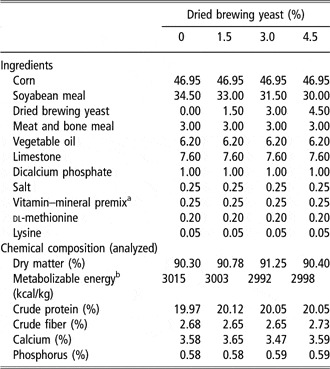
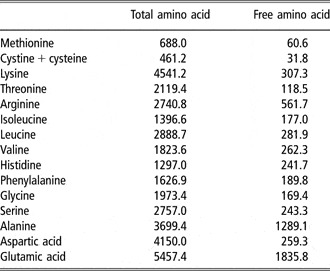
The ingredients and chemical composition of the diets are presented in Table 1. The diets were formulated to be isocaloric and isonitrogenous. The dried brewing yeast (S. cerevisiae) was used at the level of 1.5%, 3.0% and 4.5% in the diets of the first, second and third treatment groups, respectively. Soyabean meal was replaced with dried brewing yeast. The dried brewing yeast had 92.1% dry matter, 44.5% crude protein (CP), 1.3% ether extract, 7.5% crude ash, 0.2% calcium, 1.3% total phosphorus and 2519 kcal/kg metabolizable energy (ME). The amino acid composition of dried brewing yeast is given in Table 2.
Ingredients (%) and chemical composition of the diets in quails

aSupplied the following per kilogram of diet: 12 000 000 IU vitamin A, 2 400 000 IU vitamin D3, 30 g vitamin E, 2.5 g vitamin K3, 2.5 g vitamin B1, 6 g vitamin B2, 4 g vitamin B6, 20 mg vitamin B12, 25 g niacin, 8 g calcium-d-panthotenate, 1 g folic acid, 50 g vitamin C, 50 mg d-biotin, 150 g choline chloride, 1.5 g canthaxanthin, 0.5 g apo-carotenoic acid esther, 80 g Mn, 60 g Zn, 60 g Fe, 5 g Cu, 1 g I, 0.5 g Co and 0.15 g Se.
bMetabolizable energy content of diets was estimated using the equation of Carpenter and Clegg (Leeson and Summers, Reference Leeson and Summers2001).
Amino acid composition of the dried brewing yeast used in the diets of quails (mg/100 g)

Traits measured
Nutrient composition of diets and dried brewing yeast was determined according to the AOAC (2000). The sample of diets and yeast was ashed in a muffle furnace prior to the analysis of calcium (Farese et al., Reference Farese, Schmidt and Mager1967) and total phosphorus (ADAS, 1981). ME levels of diets and dried brewing yeast were estimated using the equation of Carpenter and Clegg (Leeson and Summers, Reference Leeson and Summers2001): ME, kcal/kg = 53 + 38 [(CP, %) + (2.25 × ether extract, %) + (1.1 × starch, %) + (sugar, %)].
Free and total amino acids of dried brewing yeast were determined with modified O-phthalaldehyde (OPA) derivation using the HPLC system of Agilent 1100 series (Agilent Technologies, Waldbronn, Germany).
Quails were weighed individually at the beginning and at the end of the experiment using a precision balance (Model: Kern 440-53N, 1 g sensitivity; Kern and Sohn GmbH, Balingen, Germany). Mortality was recorded as it occurred. Eggs were collected daily and egg production was calculated on a quail-day basis. All the eggs laid during the last two consecutive days of every week were collected and weighed with a precision balance (Model: Kern 440-33N, 1 g sensitivity; Kern and Sohn GmbH, Balingen, Germany) individually to determine the egg weight. Feed intake was recorded biweekly and calculated as g per quail per day. Protein intake was determined using the values of feed intake and CP levels in diets of groups as g per quail per day. The value of feed efficiency was calculated as kg feed per kg egg and kg feed per one dozen egg.
To determine the egg traits, 10 eggs, laid at 0900 to 1200 h were collected randomly from each group (two eggs from each replicate) on the first day of the 2nd, 6th, 10th, 14th and 18th week of the experiment (as a total of 50 eggs per group during the experiment). Individual eggs were weighed with a precision balance (Model: Kern 440-33N). Egg quality evaluation was performed for individual eggs, as it was done in relation to egg weight. The content of the egg was broken onto a glass-top table. Egg shell thickness was measured in three different parts (upper and lower ends and middle) using a micrometer (Mitutoya, No. 1044N, 0.01–5 mm, Kawasaki, Japan). The height of the albumen and the yolk was measured with a tripod micrometer (Mitutoya, No. 2050-08, 0.01–20 mm). The length and width of the albumen and the diameter of the yolk were measured using a digital caliper. By using these values, yolk index, albumen index and Haugh unit were calculated (Card and Nesheim, Reference Card and Nesheim1972). Egg internal quality and shell quality analyses were completed within 24 h of the eggs being collected. At the end of the experiment, 60 eggs per group (12 eggs from each replicate) were randomly chosen to determine yolk cholesterol. Eggs were boiled for 5 min. They were allowed to cool and then broken and their constituent parts were separated and weighed. The shells were weighed after being air-dried for 24 h. The percentage values of shell weight, yolk weight and albumen weight were calculated. Egg yolk was blended with isopropyl alcohol with a volume of 10 ml per g of yolk (Waldroup et al., Reference Waldroup, Ndide and Hellwig1986). Cholesterol content of this extract was determined according to the enzymatic method of TECO (2001). Yolk cholesterol was calculated and expressed as mg per g yolk and mg per yolk.
The fresh excreta samples from each replicate in each group were collected using a plastic tray on the first and second day of the 18th week of the experiment. Care was taken to collect fresh excreta that had no contact with drinking water. All samples were dried in an air-forced oven at 60°C until reaching constant weight, then the moisture of samples was determined according to the AOAC (2000).
At the end of the experimental period, 10 quails from each group (2 from each replicate) were randomly chosen and slaughtered by severing the jugular vein. Protocols used for quails in this experiment were in accordance with Ankara University Committee for Laboratory Animals. Blood samples were collected at the slaughtering time, individually. Serum was collected and stored at −20°C for the determination of serum parameters. Serum concentrations of total protein, triglycerides, cholesterol, uric acid and levels of alanine amino transferase (ALT), aspartate amino transferase (AST) and alkaline phosphatase (ALP) were determined by a Hitachi autoanalyser (Serial no. 1238-23, Hitachi Ltd, Tokyo, Japan) using their accompanying commercial kits (Roche Diagnostics Corporation, Tokyo, Japan).
After slaughtering of quails, digesta of the small intestine were recovered by finger pressure and homogenized. pH of the digesta was measured within 10 min using a pH meter (Orion 420A; Orion Research Incorporated, Boston, USA).
Statistical analysis
Statistical analysis was done using SPSS program (SPSS Inc., Chicago, IL, USA). The normality of data distribution was checked using the Kolmogorov–Smirnov test. One-way ANOVA was used to evaluate the effects of dried brewing yeast on the performance, egg traits and blood parameters of quails among groups, and the significance of mean differences between groups was tested by Duncan. The effect of supplementation on the mortality of quails was evaluated by the χ 2-test (Dawson and Trapp, Reference Dawson and Trapp2001). Values were given as mean ± s.e. All statements of significance were based on a probability of less than 0.05.
Results and discussion
The amino acid analysis of dried brewing yeast indicates that yeast should be a source of good-quality protein (Table 2). Brewing dried yeast contained a high amount of lysine (4.5%), threonine (2.1%), arginine (2.7%), but a low amount of methionine (0.7%). During the experimental period, 3 (5.0%), 4 (6.7%), 3 (5.0%) and 2 (3.3%) quails died in the control group and groups fed with diets containing dried brewing yeast at the level of 1.5%, 3.0% and 4.5%, respectively. All of the mortality in the groups occurred during the 1st week of the experiment. This may be due to transportation and adaptation to new conditions. Mortality rate was not affected by the inclusion of dried brewing yeast (P > 0.05). These data are consistent with the findings of researches involving laying hens (Önol and Yalçın, Reference Önol and Yalçın1995), broilers (Yalçın et al., Reference Yalçın, Önol, Koçak and Özcan1993) and quails (Şehu et al., Reference Şehu, Yalçın and Karakaş1997) fed with diets including yeast (S. cerevisiae).
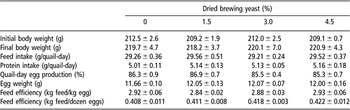
Dietary treatments did not significantly affect body weight, feed intake, protein intake, egg production, egg weight and feed efficiency of quails (Table 3). In agreement with the present study, different types of yeast in the diets of laying hens had no effect on body weight (Önol and Yalçın, Reference Önol and Yalçın1995), feed intake (Vogt et al., Reference Vogt, Stute and Harnisch1974; Bornstein et al., Reference Bornstein, Plavnik and Lipstein1982; Rojas Ramirez et al., Reference Rojas Ramirez, Avila-Gonzalez and Casarin-Valverde1985; Önol and Yalçın, Reference Önol and Yalçın1995), egg production (Vogt et al., Reference Vogt, Stute and Harnisch1974), egg weight (Vogt et al., Reference Vogt, Stute and Harnisch1974; Bornstein et al., Reference Bornstein, Plavnik and Lipstein1982; Richter et al., Reference Richter, Benz, Richter and Hennig1985; Shyam Sunder et al., Reference Shyam Sunder, Pandey and Sadagopan1990; Önol and Yalçın, Reference Önol and Yalçın1995) and feed efficiency (Vogt et al., Reference Vogt, Stute and Harnisch1974; Shyam Sunder et al., Reference Shyam Sunder, Pandey and Sadagopan1990). However, Daghir and Abdul-Baki (Reference Daghir and Abdul-Baki1977) observed a growth depression when one-third of the soyabean meal and all the fish meal were replaced by 10% molasses-grown yeast and this was attributed to the deficiency or poor availability of methionine in the yeast.
The effects of dietary dried brewing yeast on body weight, feed intake, egg production, egg weight and feed efficiency of quails (mean ± s.e.)Footnote *

n = 5 per group.
* No significant differences among groups (P > 0.05).
Waldroup et al. (Reference Waldroup, Hillard and Mitchell1971) also reported that the reduction in body weight of broilers fed diets containing more than 15% yeast was explained by the reduction in feed intake and the reduction in the palatability of diets rich in yeast due to the powdery nature of yeast.
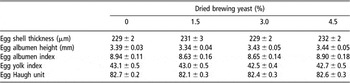
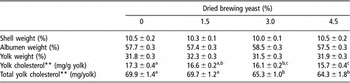
The inclusion of dried brewing yeast in the diet of quails had no significant effect on the mean values of egg shell thickness, albumen height, albumen index, yolk index and Haugh unit (Table 4). The percentages of egg shell, albumen and yolk were also not affected by dietary dried brewing yeast (Table 5). In agreement with the present study, some researchers reported that 5%, 10% and 20% of baker’s yeast (Önol and Yalçın, Reference Önol and Yalçın1995) and 10% inactive dry yeast (Shyam Sunder et al., Reference Shyam Sunder, Pandey and Sadagopan1990) had no significant effect on egg shell thickness. Shyam Sunder et al. (Reference Shyam Sunder, Pandey and Sadagopan1990) reported that the Haugh unit was not affected by 10% inactive dry yeast but the values of albumen index and yolk index were smaller in the group receiving 10% inactive dry yeast than that of the control group.
The effects of dietary dried brewing yeast on egg traits of quails (mean ± s.e.)Footnote *

n = 50 per group.
* No significant differences among groups (P > 0.05).
The effects of dietary dried brewing yeast on relative egg shell weight and interior egg characteristics of quails (mean ± s.e.)

n = 60 per group.
a,b,cMeans within a row followed by the same superscript are not significantly different (P > 0.05).
**P < 0.01.
There was no significant reduction in yolk cholesterol concentration when quails were fed the diet with 1.5% dried brewing yeast (Table 5). However, adding 3% and 4.5% dried brewing yeast to the diet decreased egg yolk cholesterol concentration as mg per yolk and mg per g yolk (P < 0.01).
Mean values of excreta moisture of groups were found to be 72.7%, 72.9%, 72.2% and 72.5%, respectively (P > 0.05). Similar to the results of the present study, excreta moisture was not different among the groups fed diets containing dried yeast (S. cerevisiae) of sugarcane at the levels of 0%, 7%, 14%, 21% and 28% (Maia et al., Reference Maia, Fonseca, Soares, Silva and Souza2001). However, Önol and Yalçın (Reference Önol and Yalçın1995) reported that the addition of 20% baker’s yeast to the diets of laying hens decreased excreta moisture by about 2.2% compared to the control group. In the study of Vogt et al. (Reference Vogt, Stute and Harnisch1974), excreta moisture of hens fed diets containing 17.25% and 23% of whey yeast was 2.3% higher than that of the control group. These differences may be due to the yeast species used, yeast composition, yeast level and diet composition.
The mean values for small intestinal pH of groups were 7.52, 7.53, 7.73 and 7.74, respectively, and they were not significantly affected by the inclusion of dietary dried brewing yeast. However, Nahashon et al. (Reference Nahashon, Nakaue and Mirosh1994) reported that feeding direct-fed microbial to layers decreased the pH of the gastrointestinal tract.
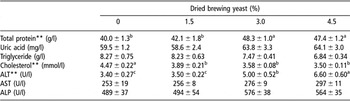
It was observed in the present study that there were no significant differences among groups in the serum levels of uric acid, triglyceride, AST and ALP (Table 6). Serum cholesterol levels were decreased by the usage of dried brewing yeast at the levels of 1.5%, 3.0% and 4.5%. Serum total protein and ALT levels were increased significantly by the addition of dried brewing yeast at the levels of 3.0% and 4.5%. However, performance of quails was not affected by these changes in blood parameters. Therefore, high levels of dried brewing yeast in diets might be studied to evaluate the changes in blood parameters with performance.
The effects of dietary dried brewing yeast on blood serum parameters of quails (mean ± s.e.)

ALT = alanine aminotransferase; AST = aspartate aminotransferase; ALP = alkaline phosphatase.
n = 10 per group.
a,b,cMeans within a row followed by the same superscript are not significantly different (P > 0.05).
**P < 0.01.
The results obtained in this study on uric acid are similar to those reported by Saoud and Daghir (Reference Saoud and Daghir1980) on yeast protein from molasses at the levels of 10%, 15% and 20% in the broiler diets and by Shannon and McNab (Reference Shannon and McNab1972) on n-paraffin grown yeast at 20% in the broiler diets. Yalçın et al. (Reference Yalçın, Önol and Salmanoğlu1995) reported that the values for total protein, uric acid, total lipid and total cholesterol of serum in laying hens were not affected by the inclusion of baker’s yeast in the diets. This reduction of serum and egg yolk cholesterol when yeast was fed to quails could be attributable to the reduced absorption and/or synthesis of cholesterol in the gastrointestinal tract (Mohan et al., Reference Mohan, Kadirvel, Bhaskaran and Natarajan1995). It is also possible that S. cerevisiae could assimilate the cholesterol present in the gastrointestinal tract for their own cellular metabolism, thus reducing the amount absorbed.
Conclusions
The most important result of dietary dried brewing yeast is the significant reduction in egg yolk cholesterol and serum cholesterol concentrations. Further studies will be necessary to evaluate the usage of higher levels of dried brewing yeast in poultry. It is concluded that dried brewing yeast (S. cerevisiae) can be used at the levels of up to 4.5% in the diets of laying quails as a protein source without adverse effects on performance and egg quality.