


The lobbying industry has become a lucrative postgovernment career choice for many US government officials. Moreover, the number of lobbying firms and individual lobbyists has drastically increased over time, as the number of interest groups and their political spending has skyrocketed (Baumgartner et al. Reference Baumgartner, Berry, Hojnacki, Kimball and Leech2009). This robust growth in the lobbying industry has brought about changes to the labor market for members of Congress and their staff regarding their postgovernment careers. Over time, more legislators have chosen the lobbying profession after leaving Congress (Lazarus, McKay, and Herbel Reference Lazarus, McKay and Herbel2016; Maske Reference Maske2017) and a similar pattern has been observed among congressional staffers (Cain and Drutman Reference Cain and Drutman2014; LaPira and Thomas Reference LaPira and Thomas2017).
As this “revolving-door” phenomenon has become a more prominent force in American politics, most of the extant literature has focused on whether revolving-door lobbyists have disproportionate access to members of Congress due to their connections, thereby distorting representation and the policymaking process (Hacker and Pierson Reference Hacker and Pierson2010). Recent empirical articles document that revolving-door lobbyists generate large premiums in lobbying revenues from their political connections (Blanes i Vidal, Draca, and Fons-Rosen Reference Blanes i Vidal, Draca and Fons-Rosen2012; Bertrand, Bombardini, and Trebbi Reference Bertrand, Bombardini and Trebbi2014; McCrain Reference McCrain2018).
Beyond this dominant focus in the literature, one aspect of the revolving-door phenomenon that has received little attention is whether future career opportunities as lobbyists may influence legislative activities while people still serve in the government. Although there is a rich literature on how future career concerns influence the behaviors of regulators (Laffont and Tirole Reference Laffont and Tirole1991; Peltzman Reference Peltzman1976), this literature has yet to be fully applied in the context of Congress (Egerod Reference Egerod2017; Santos Reference Santos2006), despite the fact that Congress is the governmental body that produces the most revolving-door lobbyists.
Understanding how postgovernment career opportunities affect the behaviors of policymakers is important for assessing the normative implications of the private market for representation on democracy, as well as for better assessing the role of the lobbying industry on policy outcomes. In this article, we investigate whether future career concerns affect the behaviors of revolving-door congressional staffers while they are still working in the government. We argue that the existence of the lobbying industry incentivizes congressional staffers to exert greater effort and invest in their legislative skills. However, staffers are incentivized to do so in the issue areas of most importance to the lobbying industry. To test these expectations, we assemble a dataset including every employee who was a personal or committee staffer in Congress from 2001 to 2014. For each staffer, we identify the period during which she worked for personal offices or congressional committees and the compensation she received from each office. We also identify 4,520 staffers who left Congress and became lobbyists. For those who became lobbyists, we track their lobbying activities, including the first year they submitted a lobbying report and the names of their employers.
One important limitation to using congressional staff as subjects to identify the effect of future lobbying careers on present legislative activities is that we cannot link legislative outcomes directly to staffers. Staffers’ efforts and incentives are realized through members’ legislative activities and votes. Although it is true that staffers’ behaviors are constrained by their Congress members’ priorities and agendas, scholars have noted that members delegate substantial autonomy to their staffers due to their own time constraints (Loomis Reference Loomis1988; Romzek and Utter Reference Romzek and Utter1997). Therefore, staffers’ efforts and inputs could have significant impacts on member-level legislative outcomes (Montgomery and Nyhan Reference Montgomery and Nyhan2017) and their perceptions about constituency interests (Hertel-Fernandez, Mildenberger, and Stokes Reference Hertel-Fernandez, Mildenberger and Stokes2019).
Accordingly, we construct a member-level dataset for congressional offices both in the House of Representatives and the Senate from the 107th through the 113th Congresses. We examine a variety of outcome variables to see whether hiring future lobbyists as current staff is associated with behavioral changes in congressional offices. First, we examine members’ lawmaking activities. To do so, we use Legislative Effectiveness Scores (LES), which measure members’ success in moving significant and substantive legislation through Congress (Volden and Wiseman Reference Volden and Wiseman2014, Reference Volden and Wiseman2018). We also examine the types of bills that legislators sponsor in Congress using the Congressional Bills Project (Adler and Wilkerson Reference Adler and Wilkerson2017).
We find that employing a future revolving-door staffer is associated with increased legislative productivity, particularly in the House. Hiring revolving-door staffers correlates with higher LES of members and total numbers of bills sponsored from a member’s office. Importantly, we find that not only does hiring a revolving-door staffer increase legislative productivity overall but also that staffers appear to increase their member’s legislative productivity over and above their already heightened levels in the staffers’ final terms of work in Congress. This suggests that staffers strategically attempt to showcase their legislative skills more visibly immediately before they exit Congress. We also find that employing a future revolving-door staffer is positively associated with bill sponsorship in the issue areas of health, the environment, and domestic commerce, suggesting that staffers who later become lobbyists may direct their efforts toward the most popular issues for the lobbying industry (Zheng Reference Zheng2015).
Moreover, through a variety of robustness checks, we rule out a number of alternative hypotheses and interpretations of our findings. First, by exploiting quasi-exogenous variation in the ability of staffers to strategically exit Congress due to the deaths or unexpected defeats of their member in elections, we show that the “last-term” effect is only observable for staffers who had greater control over their exits from Congress. Second, we estimate staffer-specific fixed effects by exploiting staffers who move between members’ offices. This analysis bolsters our claims that the increased productivity we observe is systematically related to revolving-door staffer effort and not to other member-level factors. We also show that these relationships are not the result of member-staffer matching, where members who are already more productive or more institutionally advantaged hire staffers who later became lobbyists. In addition, we demonstrate that preexisting connections between a member’s office and the lobbying industry through alumni staffers do not drive the results.
In addition to legislative outcomes, we also test for changes in the access-granting habits of congressional offices. Using data from the Foreign Agents Registration Act (FARA) from 2007 through 2010, we find that congressional offices with future revolving-door lobbyists as current employees tend to grant more access to lobbying firms that are the prospective future employers of the departing staffers. This effect is also most consistently observed for personal staff members who later started their lobbying careers in a lobbying firm as opposed to working for an organization as an in-house lobbyist. Importantly, we find that the increased number of meetings between a congressional office and lobbying firms is mainly driven by contacts with the staffers themselves as opposed to direct contacts with members of Congress. We argue that this is best understood as a measurable mechanism of our theory of the impact of career concerns. Staffers can attract the attention of and showcase their skills to lobbying firms through frequent interactions with them, all while gaining valuable but potentially biased policy relevant information for their Congress member.
Our results present a more nuanced and complex picture of the overall impact of the revolving door on congressional policymaking. The revolving door incentivizes staffers to exert greater legislative effort and increase their bosses’ overall legislative productivity. These effects are mostly positive for congressional capacity and lawmaking. However, the revolving door also incentivizes staffers to grant greater access to particular sets of interest groups through meetings with lobbying firms and to develop expertise in the issues of most interest to lobbying firms. In this way, the revolving door may cause the prioritization of the issues of most interest to firms, while leaving other issues ignored (Cotton and Déllis Reference Cotton and Déllis2016).
The policy implications of this research are broadly applicable in all areas where governments consider regulating revolving doors. In the US, 38 states set specific ethics laws regulating mandatory waiting periods before former politicians and bureaucrats may engage in lobbying activities.Footnote 1 Additionally, important revolving-door relationships between central bankers and financial ministers are common in OECD countries (Wirsching Reference Wirsching2018), with many countries adopting regulations on postgovernment employment to avoid corruption risks. However, some argue that stricter bans on revolving doors could be harmful to society because the interchange of skills and experience between the public and private sectors can be beneficial. Our findings highlight yet another potential trade-off: career concerns affect government officials’ incentives in potentially positive ways. Understanding this is important for designing more efficient regulations on revolving doors.
CONGRESSIONAL STAFF AND THEIR CAREER CONCERNS
Congressional staff members play a vital role in policymaking in Congress (Salisbury and Shepsle Reference Salisbury and Shepsle1981; Loomis Reference Loomis1988; Romzek and Utter Reference Romzek and Utter1997). Because of the significant increase in congressional workloads (Curry Reference Curry2015) and perpetual need for fundraising and campaigning during congressional sessions (Lee Reference Lee2016), members’ time for policymaking has become more scarce (Groll and Ellis Reference Groll and Ellis2017). Despite these challenges, the number of congressional staffers has been declining since the early 1990s.Footnote 2 At the same time, congressional staffers’ wages have been stagnant or even have declined in real terms (Petersen et al. Reference Petersen, Chausow, Wilhelm, Guidi, Edwards and Marine2015). In contrast, lobbying firms have begun to pay significantly more to former congressional staff members (Birnbaum Reference Birnbaum2005; Drutman and Furnas Reference Drutman and Furnas2014). Given the stark difference in wages between lobbying firms and Congress and the value given to staffers’ skills by the lobbying industry, it is not surprising that increasing numbers of former congressional staffers exited through the “revolving door” and sought lobbying careers over the last decade (Drutman Reference Drutman2012).
The emergence of the lobbying industry and the “revolving-door” phenomenon generates two primary concerns for policymaking. First, the existence of a market for representation imposes challenges to providing fair opportunities for groups to be represented in the policymaking process. Along these lines, the media and the public often interpret the fact that lobbyists with personal or political connections generate more revenues (Blanes i Vidal, Draca, and Fons-Rosen Reference Blanes i Vidal, Draca and Fons-Rosen2012) as evidence of corruption. However, given that connected lobbyists often tend to have more issue expertise or knowledge of political processes, these higher revenues could also be an indication that connected lobbyists provide valuable information to members through better verification of information or screening of which interest groups to present to members (Ainsworth Reference Ainsworth1993; Groll and Ellis Reference Groll and Ellis2014; Hirsch et al. Reference Hirsch, Kang, Montagnes and You2019). Additionally, connected lobbyists may more efficiently gather political information than their nonconnected peers (Hall and Lorenz Reference Hall and Lorenz2018). Moreover, simple explanations about “connections” mask the fact that revolving-door lobbyists offer political process knowledge, which has become increasingly valuable as Washington politics has become more turbulent (LaPira and Thomas Reference LaPira and Thomas2017). In this way, connected lobbyists also could be valued for reasons beyond simple relationships.
A second and much less understood concern regarding the rise of the revolving-door phenomenon is that the career concerns of congressional staffers could influence their behaviors while they still serve in the government. Regulatory capture scholars argue that policy distortion (i.e., giving favors to regulated firms) can occur while regulators serve in the government due to their career concerns in expectation of rewards such as future job opportunities in regulated firms (Dal Bó Reference Dal Bó2006; Stigler Reference Stigler1971). Indeed, journalists often credit more pernicious versions of these ex ante career effects for the questionable ratings and enforcement practices of financial regulators prior to the Great Recession (Chan Reference Chan2011). We think such direct favors are difficult to imagine in the context of Congress. Whereas an individual regulator may have discretion to grant more patents to a specific firm (Tabakovic and Wollmann Reference Tabakovic and Wollmann2018) or write regulations in a way that benefits a particular actor (Cornaggia, Cornaggia, and Xia Reference Cornaggia, Cornaggia and Xia2016), the collective nature of congressional decision-making limits the potential for this kind of behavior.
In addition, the constraints that congressional staffers face and the types of discretion staffers enjoy might prevent direct quid-pro-quo types of behaviors. Congressional staffers, despite being influential and having some degree of autonomy in their activities (Loomis Reference Loomis1988; Romzek and Utter Reference Romzek and Utter1997; Whiteman Reference Whiteman1995), are not free agents. Although it is true that most individual member’s attention to policymaking has declined as a result of the electoral environment and other factors (Curry Reference Curry2015; Groll and Ellis Reference Groll and Ellis2017; Lee Reference Lee2016), which has increased staffers’ ability to engage in entrepreneurial behavior and affect policymaking (Montgomery and Nyhan Reference Montgomery and Nyhan2017), members’ reelection incentives certainly increase their interest in assuring that policy appearing to give favors to a specific interest group or a lobbying firm is not pursued in their name.
Because of these structural constraints and the limited nature of discretion that congressional staffers have, we argue that the impact of career concerns on the behaviors of congressional staff occurs primarily through the decisions staffers make about the issues on which they invest their time and the amount of effort they exert in the policymaking process. In this way, the existence of a potentially lucrative postgovernment career as a lobbyist incentivizes staffers to exert more effort to enhance their qualifications and increase their market value (Che Reference Che1995).
Additionally, because the lobbying market rewards political-process knowledge (LaPira and Thomas Reference LaPira and Thomas2017), staffers must seek out visible opportunities to display their legislative acumen. Nowhere is this skill more visible and valuable than in demonstrating an ability to get legislation through the legislative process. As a result, we might expect staffers who are considering postgovernment careers in the lobbying industry to exert more effort to improve the overall legislative productivity of their bosses and increase overall bill sponsorship activities.Footnote 3 This seems especially likely to occur in the time period immediately prior to staffers’ exit from Congress, when staffers have greater strategic incentives to market their skills to the lobbying industry.
H1: Hiring a future revolving-door staffer should be associated with increases in member legislative effectiveness and bill sponsorship activity. We expect this effect is more pronounced for staffers who are in their last terms of working for Congress.
Importantly, however, it is likely that the kinds of legislative activities in which the staffers choose to engage or the direction of their increased effort and productivity may be biased toward specific interest groups or future employers (Zheng Reference Zheng2015). Indeed, interest group scholars have long noted that how congressional personnel choose to spend their time and effort is an important way in which interest groups can influence the policymaking process (Hall and Wayman Reference Hall and Wayman1990). As a result, increased productivity may be slanted toward particular interests. For example, given that there are more lobbying clients who care about issues concerning health or commerce than those who care about social welfare (Baumgartner et al. Reference Baumgartner, Berry, Hojnacki, Kimball and Leech2009), increased policy effort could lead to more legislative activity in policy areas of most concern to lobbying interests. As a result, increased effort—presumably a net positive for congressional lawmaking—may slant congressional activity in the favor of well-resourced interests.
H2: Hiring a future revolving-door staffer should be associated with increases in bill sponsorship in issues where lobbying demand is higher.
Beyond lawmaking, staffers interested in the lobbying market ought to seek opportunities to promote their visibility to interest groups and lobbying firms. A key mechanism by which they can do this is their level of interactions with interest groups and lobbying firms. Interest groups collect information on issues of concern to them and they have incentives to disseminate this information to policymakers (Austen-Smith Reference Austen-Smith1993; Lohmann Reference Lohmann1995; Schnakenberg Reference Schnakenberg2017; Wright Reference Wright1990). Interest groups also provide other types of legislative subsidies, such as time and labor, to resource-constrained legislators. These subsidies help legislators achieve their policy goals (Hall and Deadorff Reference Hall and Deadorff2006). In this way, the lobbying industry not only helps its clients but also provides a valuable resource to Congress.
The primary manner in which these benefits (i.e., information) reach members of Congress is through congressional staff. This affords career-minded staffers a vital opportunity to directly signal their worth to the lobbying market. As a result, career concerns may incentivize congressional staffers to grant lobbying firms more access to a member’s office not only to improve their job performance as congressional staffers but also to improve their marketability for the lobbying sector. Here, interest groups and congressional staffers engage in behaviors that are mutually beneficial.
H3: Congressional offices with more future revolving-door staffers should have more interactions with lobbying firms.
DATA AND STYLIZED FACTS
To test these expectations, we start with the list of all congressional staffers who were enrolled in the payroll system in the US Congress between 2001 and 2014. Congress publishes a quarterly statement of disbursements (SODs) that reports all receipts and expenditures for congressional members, committees, and other offices within Congress.Footnote 4 Congress began posting SODs online in 2009 in PDF format; raw data from previous years are not accessible online. Fortunately, Legistorm, an online service providing information about the career histories of congressional staff, assembles congressional staff salary data from the official records of the House and Senate. Additionally, Legistorm supplements the salary data with biographical information for staffers from available sources such as LinkedIn pages.Footnote 5
We purchased congressional staff data from Legistorm, which includes the name and title of each staffer, the name of the congressional office in which she worked, the pay period, and the salary paid during that period. We drop staffers if they were interns, part-time or temporary employees, shared employees, or drivers (based on their staff titles) to measure the number of full-time employees in congressional offices. We also drop the staffers whose total number of days worked per Congress totaled less than 6 months. We aggregate the total salary paid to a staffer from each office by Congress.
Next, we identify staffers-turned-lobbyists from the list of lobbyists provided by lobbying disclosure reports filed with the Secretary of the Senate’s Office of Public Records (SOPR) and compiled by the Center for Responsive Politics.Footnote 6 We examine the lobbying reports for the period between 1998 and 2016. If a lobbyist previously worked for the government in any type of position, the list includes a description of that position. Among those descriptions, we select lobbyists with congressional career histories including experience as both personal and committee staff employees in the House and/or Senate. We use Legistorm to find connected politicians for each lobbyist.Footnote 7 For each politician–lobbyist pair, we collect information on the year a lobbyist began working in a Congress member’s office and the last year that a person worked in that member’s office. This allows us to calculate how many future revolving-door lobbyists worked in a member’s office in a given year.Footnote 8
For each ex-staff-turned-lobbyist in our final sample, we found information about their lobbying activities. Specifically, we collected the first year that a lobbyist appeared in the lobbying data. There were 4,697 unique lobbyists who had prior work experience in Congress and submitted at least one lobbying report between 1998 and 2016; 4,520 lobbyists appeared in the staff data between 2001 and 2014.Footnote 9 Around 82% of ex-staff-turned-lobbyists worked exclusively as personal staff for a Congress member; 10% worked exclusively on congressional committees. The remaining 8% worked both in members’ personal offices and on committees.Footnote 10
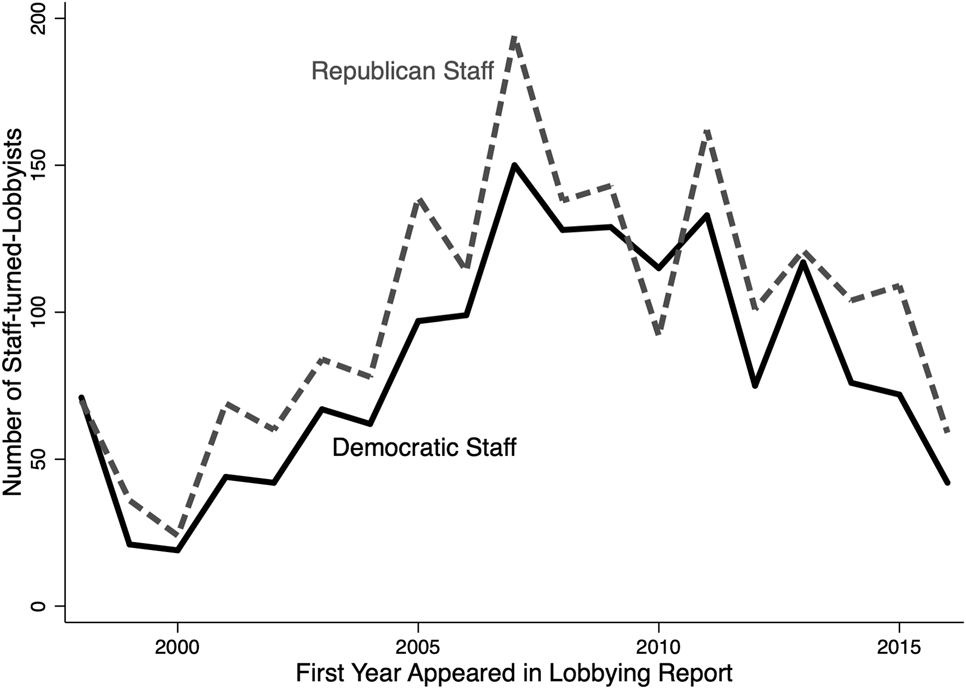
Figure 1 displays the number of ex-staff-turned-lobbyists in each year in terms of the first year they submitted a lobbying report. We divide the personal staffers into Democrats and Republicans based on the party of the member they served during their tenure in Congress and present separate graphs on their first year in lobbying by party.
Number of Congressional Staffers-Turned-Lobbyists, 1998–2016
Notes: This graph shows the number of congressional staff-turned-lobbyists who submitted their first lobbying report in each year. The solid line indicates the trend among staffers of Democratic members and the dashed line indicates the trend among staffers of Republican members. Source: OpenSecrets.org.

A significant increase in 2007 is noticeable and several factors explain this pattern. First, Congress passed the Honest Leadership and Open Government Act (HLOGA) in 2007; the law prohibited ex-staff-turned-lobbyists from contacting their former offices or committees in the House, and any offices in the Senate for a certain period of time (Cain and Drutman Reference Cain and Drutman2014).Footnote 11 Hence, many staffers who had considered lobbying careers may have left their government jobs before the HLOGA passed Congress and started their lobbying activities in 2007. Second, there was an expectation that the party in control in the White House was likely to change in the 2008 presidential election and the Democratic candidate, Barack Obama, promised tougher regulations on revolving-door lobbyists if he were to be elected. Just one day after his inauguration in 2009, President Obama issued an executive order banning federal employees from taking jobs in the lobbying industry for two years after leaving government service.Footnote 12 Because of this upcoming change in the political environment, it is likely that many staffers left their jobs and moved into the lobbying industry proactively.
To explore the impact of hiring future revolving-door staffers on legislative outcomes, we create a member-level dataset for every person who served in the House or Senate from the 107th through the 113th Congresses. We calculate the total number of staffers who worked for a member in each Congress and the staffers’ mean salaries. Based on the career histories of ex-staff-turned-lobbyists, we also calculate the total number of former personal and committee staff who later became lobbyists for each member in each Congress. Most of the staffers who later became lobbyists at the federal level worked in a Washington, DC office as opposed to members’ district or state-offices. They were also much more likely to work in legislative-oriented positions (such as legislative assistants) than staffers who never became lobbyists. By comparing the year staffers finished working for a member and the first year they appeared in lobbying reports, we also calculate the total number of “last-term” personal staff who became lobbyists after a given Congress for each member.
Table 1 presents summary statistics for the Congress members’ staffers and ex-staffers who later became lobbyists. The unit of observation is member × Congress. Members in the House had, on average, 21 staffers on their payrolls during a given Congress. For the Senate, the average number of staffers in members’ personal offices was 52. House members in a given Congress employed 1.7 personal staffers who became lobbyists at some later point. In the Senate, the average number of personal staffers who later became lobbyists in a given Congress was 4.1. Only committee chairs could be connected to committee staff based on our definition, unless Legistorm mentioned a specific Congress member as a connected politician for a committee staffer. For committee chairpersons who were connected to committee staffers, the average number of committee staffers who worked for a member in a given Congress and later became lobbyists was 6.0 in the House and 8.2 in the Senate.
Member-Level Summary Statistics on Staffers

Notes: The unit of observation is member × Congress.
a Mean total compensation during a congressional term (2 years).
b This statistic is only provided for members who served as a committee chair.
We rely on two outcome variables to assess changes in legislative productivity. First, we use the Legislative Effectiveness Score (LES), which measures the “ability to advance a member’s agenda items through the legislative process and into law” for members of Congress (Volden and Wiseman Reference Volden and Wiseman2014, Reference Volden and Wiseman2018). This dataset includes the number of bills that each representative sponsored as well as their LES in each Congress.Footnote 13 Second, we use data from the Congressional Bills Project to examine whether hiring staffers who later became lobbyists is associated with the types of legislation that legislators sponsor in Congress (Adler and Wilkerson Reference Adler and Wilkerson2017). These data track the sponsor of every bill and resolution from the 80th to the 114th Congresses. In addition to sponsorship, the data also categorize all bills into 20 major issue areas. Therefore, we are able to identify whether members with staffers who later became lobbyists tended to sponsor bills on particular topics. This is particularly interesting because lobbying clients are not equally distributed across issue areas.Footnote 14
FUTURE LOBBYIST STAFF AND LEGISLATIVE PRODUCTIVITY
In this section, we examine if hiring a future revolving-door lobbyist is associated with changes in a member’s legislative productivity. The empirical specification is as follows:
 $${y_{it}} = {\alpha _i} + {\alpha _t} + \beta \times Lobbyist\;Staf{f_{it}} + \Gamma {X_{it}} + {\varepsilon _{it}},$$
where i denotes the member and t indicates the Congress. y it is an outcome variable—LES or number of total sponsored bills. Given that all outcome variables have highly skewed distributions, we use log-transformed variables in the estimation. α i is a member-level fixed effect (FE) to capture member-specific time-invariant characteristics such as innate ability in legislating and inherent interest in specific topics. α t is a Congress FE that captures a time trend. Lobbyist Staff is a vector of staff-turned-lobbyist-level variables: the number of future lobbyists who worked as staffers in a member’s office in a given Congress. X it is a vector that includes variables that could affect the legislative activities of members such as their party, institutional position, and overall staff size and compensation level.Footnote 15
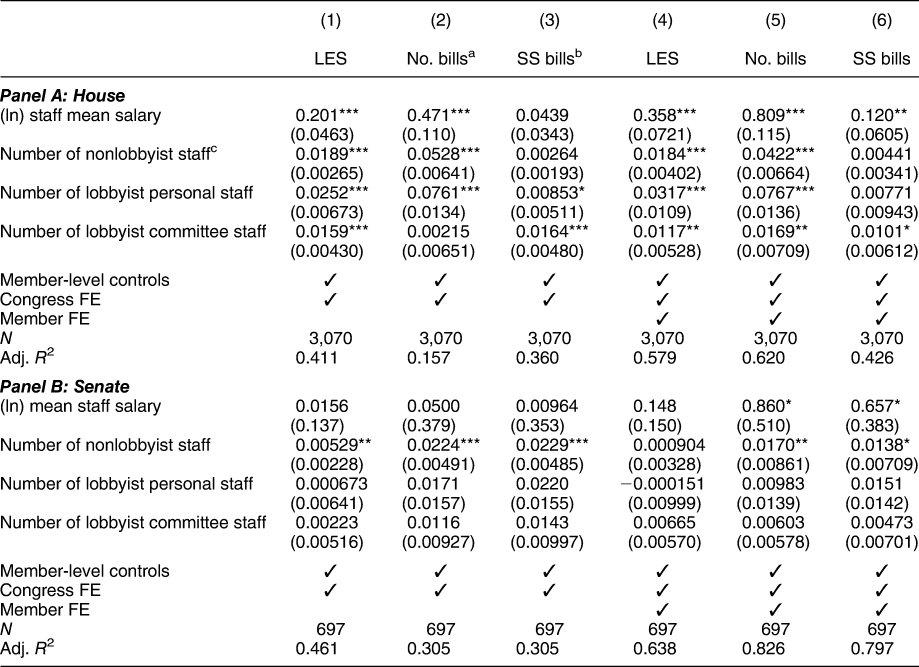
Table 2 presents the results for overall legislative productivity. We present results for the House (Panel A) and Senate (Panel B) separately.Footnote 16 Columns (1) through (3) present the results when a rich set of member-level characteristics are included as control variables; columns (4) through (6) present the results when a member FE is included. First, in the House, employing a personal future-revolving-door staffer is associated with increases in a member’s legislative productivity as measured by their LES, the number of bills the member sponsors, and the number of substantive and significant bills the member sponsors.Footnote 17 These results are robust to including member fixed effects, except the results for sponsorship of substantive and significant bills. What is more, employing a committee staffer who later became a lobbyist is also associated with higher LES and sponsorship of substantive and significant bills.Footnote 18
Future Lobbyists as Staff and Legislative Activities

Notes: The unit of observation is member × Congress. Standard errors are clustered at member-level and reported in parentheses. * p < 0.10, ** p < 0.05, *** p < 0.01. All three outcome variables are highly skewed in the distributions so we use log-transformed variables as outcome measures.
a Total number of bills that a member sponsored in a given Congress.
b Number of significant and substantial bills (Volden and Wiseman Reference Volden and Wiseman2014).
c Number of staffers who worked for a member in a given Congress and did not become lobbyists afterward.
To provide a clearer substantive interpretation of these regression results, we follow Mummolo and Peterson (Reference Mummolo and Peterson2018), who suggest that researchers need to consider the plausible variation in the treatment when fixed effects estimates are used to describe the substantive significance of results.Footnote 19 We find that in our fixed effect framework, one standard deviation (0.34) increase in the number of staffers who later became lobbyists within a member’s office in a given Congress is associated with an increase of 0.35 (= 0.34 × e 0.0317) in the member’s Legislative Effectiveness Score. Given that the average LES is 1.7 in our sample, this suggests that one standard deviation in the number of future lobbyist staff is associated with a 20% increase in an average member’s LES.
Consider an example from the office of Congressman John Carter, a Republican representing Texas’ 31st district since 2003. In the 108th Congress, he had four staffers who later became lobbyists. Among them, two staffers left after the 108th Congress to become lobbyists. The first staffer was Chris Giblin, who became a senior vice president at the Ogilvy Government Relations, one of the prominent lobbying firms in Washington, DC. Giblin’s firm often represents clients from health, commerce, and energy sectors. The other staffer who made the transition was Travis Lucas, who founded his own lobbying firm, Lucas Compton LLC. Lucas’s top industry clients come from the health services industry and health maintenance organizations. After these exits, in the 109th Congress, Representative Carter had only two staffers who later became lobbyists. Although there was no change in the majority party status or a committee chair position between the two congresses for Congressman Carter, his LES moved from 2.23 to 0.17 and the number of bills sponsored moved from seven to four. Our estimates suggest that if he would have kept the two staffers who moved to the lobbying industry, his LES would have stayed at a similar level of his LES in the 108th Congress, ceteris paribus.
Second, in the Senate, the overall staff size is associated with higher LES and the number of bills and substantive bills that senators sponsor. However, the number of future lobbyists on staff is not associated with a member’s overall legislative productivity. One of the reasons we observe these differences between the House and the Senate is that the distribution of the number of future lobbyist staff members in congressional offices differs between the chambers. In the Senate, out of 181 unique members in our sample, only eight members (4.3%) never employed a staffer who later became a lobbyist. In contrast, among 853 unique members who served in the House during the period, 135 members (15.8%) employed no staffers who later became lobbyists. In other words, there was more variation in the number of revolving-door staffers in the House than in the Senate. Additionally, House members displayed more variation in their tenure and experience in Congress than senators, and, therefore, there may be more room for staffer incentives to influence the legislative outcomes. Indeed, if we examine the variance across members and within members for the key outcome variable, there is much more variation in the LES and the number of bills sponsored by members in the House than members in the Senate. Combined, these factors may explain the differences between the chambers.
We also explore whether this effect is driven by a certain type of staffers since employees possess various types of legislative expertise and skills depending on their rank in the hierarchy and their job functions. Based on the employee’s title during their tenure in the Congress, we consider a person with either the title (Deputy) Chief of Staff or (Deputy) Legislative Director to have been a senior-level staff employee; we categorize those with the remainder of titles as junior-level employees. We calculate the total number of senior- and junior-level personal staffers who later became lobbyists for each member in each Congress and examine whether senior and junior staffers who later became lobbyists contributed differently to members’ legislative activities. The results are presented in Table A.7 in the Online Appendix.
We find that both the number of senior and junior staffers who later became lobbyists are positively correlated with the member’s legislative productivity and there is no systematic difference in contributions by senior staff and junior staff. It may be true that senior staffers have more experience and knowledge so the marginal effect of their incentive for legislative productivity could be larger. However, the degree to which the lobbying market influences their incentive to invest in related skills might be weaker than its effect on the incentives of junior-level staffers. For junior-level staffers, there may be more competition to be selected by lobbying firms or other organizations and this might drive changes in their levels of effort. Combined, this may explain why we do not observe a systematic difference between senior and junior staffers.
We have shown that hiring future revolving-door lobbyists as staff members is associated with increases in member legislative effectiveness and bill sponsorship activity, especially in the US House.Footnote 20 We have argued that these outcomes are best understood as the results of how lobbying career concerns incentivize increased legislative effort by staffers, and are actually the product of staffer effort rather than other member-level factors. We investigate each of these assertions with additional tests.
First, if career concerns truly drive increased staffer effort in legislative activities, we should expect that career concerns should be the strongest in the period immediately before the staffer moved to the lobbying industry. A “last-term” effect of this sort would suggest that, in addition to being highly effective over the course of their careers, staffers strategically displayed even more legislative effort directly prior to their exits from Congress. To test for evidence of this career-driven “last-term” effect, we divide staffers who later became lobbyists into two categories—non-last-term and last-term future lobbyist staff—depending on whether the current term is their last term of employment in Congress.
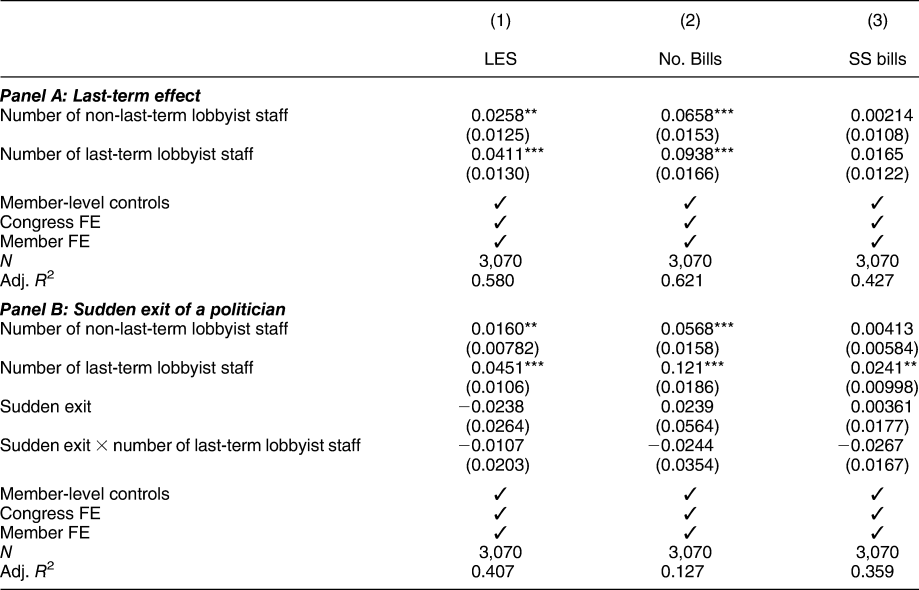
Panel A in Table 3 presents the results for the House. The results suggest that although the increased effort of staffers who became lobbyists is not entirely attributable to last-term effort, offices with more last-term personal staff experience additional increases in LES and bill sponsorship. However, there is no significant statistical difference between non-last-term lobbyist staff and last-term lobbyist staff in terms of their contributions to the legislative productivity of a Congress member.
Future Lobbyists as Staff: Their Last Terms and Sudden Exits (House)

Notes: The unit of observation is member × Congress. Standard errors are clustered at the member level and reported in the parentheses. * p < 0.10, ** p < 0.05, *** p < 0.01.
Of course, not all staffers have control over their exits from Congress. Although some leave voluntarily, others are forced from government employment when the politicians they serve depart Congress. This provides a unique opportunity to examine quasi-exogenous variation in opportunities for staffers to intentionally showcase their skills during their final terms. Compared with staffers who may plan their transition to the lobbying industry, staffers who were forced to leave Congress should not be able to time their heightened legislative efforts in the same way.
Following Blanes i Vidal, Draca, and Fons-Rosen (Reference Blanes i Vidal, Draca and Fons-Rosen2012), we identified staffers who worked in a politician’s office when a politician made an exit from Congress after a given term because the politician was defeated in the primaries or general election, died, sought a federal/state/local post, or resigned due to a scandal. There were 339 cases (11%) of these types of exits in the House between 2001 and 2014. Panel B in Table 3 presents the results. As expected, we do not observe a positive correlation between the last term of staffers who became lobbyists and members’ legislative productivity when the member suddenly exited the Congress. In addition, there is now a statistically significant difference between non-last-term lobbyist staff and last-term lobbyist staff regarding the contributions to legislative productivity among staffers who were able to time their departure. This finding bolsters our claims that career concerns of staffers drive increases in their legislative efforts, especially when they are attempting to strategically exit Congress.
Second, it is possible that the increases in productivity we observe do not result from staffer effort but are instead attributable to some other member-level factors. For example, although we include member fixed effects and time-varying characteristics, it is possible that a person who is considering becoming a lobbyist in the future selects into a member’s office where the member is more likely to be legislatively productive or sponsor bills in certain areas. To examine potential matching between a member and a revolving-door staffer, we examine whether members’ observable characteristics (e.g., legislative outcomes and institutional positions from the previous Congress) predict the number of future lobbyist staffers in a current Congress. Tables A.12 and A.13 in the Online Appendix show that members’ legislative activities and institutional positions, such as committee assignments, do not predict the number of future lobbyist staffers in the current Congress. We also find that sponsorship activities in certain issue areas are not correlated with recruiting future lobbyist staff. This bolsters our claim that we are observing the output of staffer effort and not selection into certain types of offices. Moreover, because most staffers only work within one office for their careers and the congressional hiring process for young staffers appears to be idiosyncratic, it is unlikely that many young staffers have options to choose between offices or select into offices based on policy interests or ability.
Third, another possible explanation for the positive relationship between the number of staffers who later became lobbyists and a member’s legislative productivity is that some members’ offices may already have established connections with particular lobbyists or firms. These connected firms provide legislative subsidies that could make the member’s office more productive. Simultaneously, members who already enjoy good connections with lobbying firms may be more likely to send their staffers into the lobbying industry. Although we include member fixed effects, time-varying characteristics such as the number of alumni staffers as lobbyists could drive the results. To test this alternative mechanism, we calculate the total number of alumni staffers who previously worked in a member’s office but currently work as lobbyists in a given Congress and include this variable as a control.Footnote 21 Panel B in Table A.5 in the Online Appendix presents the results. The number of alumni staffers who became lobbyists is not systematically correlated with the changes in legislative activity we observe and the main results hold after including the number of alumni staffers who became lobbyists as a control variable in the analysis.
Fourth, we conduct yet another test to see whether changes in legislative outcomes are driven specifically by changes in the composition of staff members. We exploit the fact that some staffers move between members’ offices. Following Bertrand and Schoar (Reference Bertrand and Schoar2003), who estimate manager fixed effects from a manager-firm matched panel data, we estimate the role of staffers in a framework from a member-staff matched panel data where we can control for observable and unobservable differences across staffers. Given that staffers do not randomly move among members’ offices and staffers who switch congressional offices could be systemically different from those who stay in one office, we do not argue that our results present a causal effect from staffers on members’ legislative outcomes. Instead, this framework allows us to examine whether the characteristics of staffers themselves, including whether they became lobbyists, are systematically related to staffer-specific fixed effects. The full details of this test and the full results of the model can be found in Online Appendix C. Using this method, we find that staffers who later became lobbyists tend to have higher staffer fixed effects. This provides further evidence that hiring future revolving-door lobbyists is related to the legislative productivity of members.
FUTURE LOBBYIST STAFF AND SELECTIVE ATTENTION TO LEGISLATIVE AGENDA
The analyses in the previous pages demonstrate that employing future revolving-door lobbyists is associated with increased member productivity. That is say, the existence of a lobbying market for former government employees seems to incentivize greater legislative effort and skill development. Generally, this is a normatively positive finding for individuals who desire a more productive and capable Congress. However, and potentially less normatively pleasing, we also argued that the career concerns of staffers should influence the types of bills to which members allocate time and energy. For example, given that there are disproportionately more clients in the lobbying process who care about health issues than public welfare (Baumgartner et al. Reference Baumgartner, Berry, Hojnacki, Kimball and Leech2009), it is possible that staffers’ career concerns could prioritize lawmaking in some issue areas over others if accumulating knowledge in those areas will help staffers in their postcongressional careers in the lobbying industry.
To test for this type of an effect, we estimate the following model:
 $$\eqalign{{y_{ijt}} = \,\,{\alpha _i} + {\alpha _j} + {\alpha _t} + \beta \,\times \,{\rm{Future}}\;{\rm{Lobbyist}}\;{\rm{Staf}}{{\rm{f}}_{it}} \cr+ \Gamma {X_{it}} + {\varepsilon _{ijt}},$$
where i, j, and t denote member, committee assignment, and Congress, respectively. y ijt is a log-transformed number of bills sponsored by a member i in each issue area. Given that committee assignment plays a significant role in the types of bills that members introduce, we include a committee fixed effect (α j).Footnote 22 We also include the total number of bills a member introduces in each Congress as a control variable.
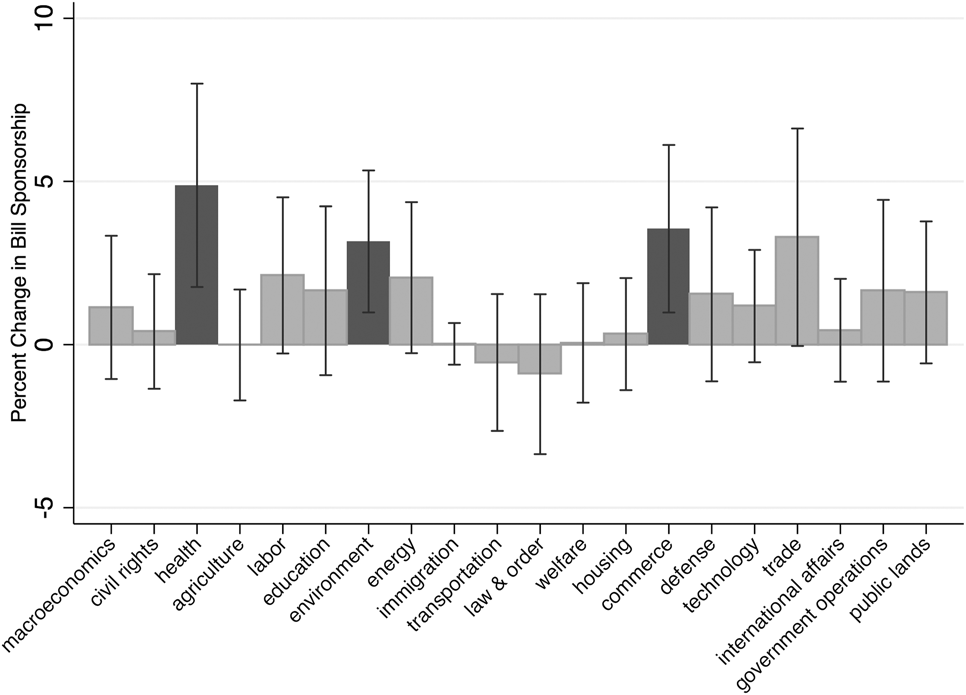
In Figure 2, we present the results of a series of analyses that aim to determine if hiring a future revolving-door lobbyist is associated with increased sponsorship of particular kinds of bills in the House. Each bar indicates how hiring one additional staffer who later became a lobbyist changes the bill sponsorship of members in 20 different issue areas from the baseline propensity to sponsor a bill in each issue area.Footnote 23 The figure shows that employing personal staff who later became lobbyists is associated with increased sponsorship of bills on health, the environment, and domestic commerce.Footnote 24 These issue areas tend to be the areas of most focus by lobbying firms.
Future Lobbyist Staffers and Bill Sponsorship Changes by Issue
Notes: Each bar indicates the regression coefficient from 20 separate regressions of the (log) number of bills in 20 major issue areas defined by Adler and Wilkerson (Reference Adler and Wilkerson2017) in the House of Representatives. Each regression includes Congress, committee, and member fixed effects, as well as other time-varying member characteristics. Darker bars indicate the statistically significant results either at the 1% or 5% level and solid lines indicate 95% confidence interval.

These findings suggest that although the revolving door incentivizes legislative productivity, it does so in a way that prioritizes productivity in the policy areas most important to the lobbying industry. In Figures A.2 and A.3 in the Online Appendix, we document the number and ratio of bills introduced to Congress regarding issues of Health and Social Welfare—two contrasting examples in terms of lobbying clients’ issue interests—during the period from 1947 through 2014. It is clear from the graphs that although the number of bills and the proportion of bills that members of Congress sponsored in Health and Social Welfare were similar until the late 1980s, a divergence has started around the late 80s and early 90s—the same time that the lobbying industry started to expand. Although it is true that the health industry has grown significantly over time and we do not provide causal evidence of the effect of the existence of the lobbying industry on politicians’ attention, the stark contrast between attention given to bills on Health and bills on Social Welfare is noteworthy. By prioritizing lobbying industry-centric policy areas, we show that the existence of a lobbying market for congressional staff has the potential to bias the amount of attention that particular social problems receive by Congress (Cotton and Déllis Reference Cotton and Déllis2016). In this way, even a more productive Congress could privilege the interests of those who are organized and the well resourced.
FUTURE LOBBYIST STAFF AND ACCESS GRANTED TO LOBBYING FIRMS
Building on the previous section, we examine whether offices with more future revolving-door staffers grant increased access to lobbying firms. Meetings with congressional staff afford interest groups vital opportunities for information transmission in Congress. As we have argued, these meetings also offer staffers an opportunity to display their legislative acumen and increase their exposure to potential future employers. Thus, access granting may play an important mechanistic role in the relationship between the number of staffers who later became lobbyists in a given office and the member’s legislative activities. A significant challenge to testing whether particular member’s offices tend to grant more access to lobbying firms is the lack of comprehensive information on lobbying contacts.
We take advantage of a novel dataset on lobbying contacts with congressional offices from filings mandated by the Foreign Agents Registration Act (FARA). Unlike domestic lobbying reports regulated under the Lobbying Disclosure Act (LDA), FARA requires that lobbyists representing foreign entities submit a semi-annual report detailing all lobbying contacts, including information on who, when, why, and how those contacts were made (Hirsch et al. Reference Hirsch, Kang, Montagnes and You2019). While the data on lobbying contacts concern interactions between policymakers and lobbying firms representing foreign entities, among the 93 lobbying firms in our data, 61 firms represented domestic clients in addition to their foreign clients (i.e., they were registered by both the LDA and FARA). This suggests that the results of our study should have general implications for the interactions between congressional offices and lobbying firms in the US.
We study the lobbying activities of foreign governments, as opposed to foreign businesses.Footnote 25 We focus on lobbying firms’ activities regarding legislative issues between 2007 and 2010, covering two Congresses (the 110th and the 111th Congresses).Footnote 26 To do so, we analyze all lobbying reports that include congressional contacts via phone calls or in-person meetings.Footnote 27 In these reports, we identify 20,606 records of contacts between lobbying firms and others, consisting of contacts to members of Congress or congressional committees (73.5%), the executive branch of the federal government (18.8%), the media (2.9%), and others (4.8%) such as members of think tanks, labor unions, firms, universities, and nonprofit organizations. We do not consider emails or social encounters as contacts, since they are most likely to be one-sided. In total, there are 676 reports of lobbying activities reported by 98 lobbying firms on behalf of 70 foreign governments in the data.Footnote 28
We focus on lobbying contacts made to congressional offices. Another advantage of the FARA lobbying contact data is that it allows us to observe staff-level outcomes. FARA reports indicate whether contacts were made directly with members or with staffers. Based on this information, we can examine whether a staffer gave more access to the lobbying firm that became her future employer, not just the total number of contacts given to all lobbying firms present in the data. In the House, there were 8,030 contacts with lobbying firms and 68% of them (5,420) were made directly with staffers as opposed to Congress members. In the Senate during the same period, there were 3,663 contacts made to Senate offices and 81% were contacts with staffers.Footnote 29
We estimate the following model:
 $${y_{ijt}} = {\alpha _j} + {\alpha _t} + \beta \,\times \,{\rm{Lobbyist}}\;{\rm{Staf}}{{\rm{f}}_{ijt}} + \Gamma {X_{ijt}} + {\varepsilon _{ijt}},$$
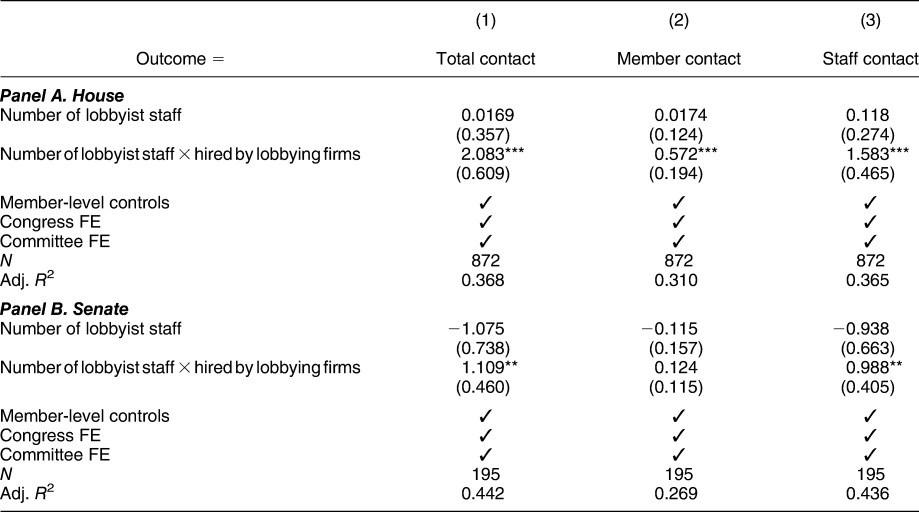
where i, j, and t denote member, committee assignment, and Congress, respectively. X ijt include member-level characteristics such as committee assignment, leadership position, and party. y ijt is an outcome variable that indicates the frequency of contacts with lobbying firms. α j and α t indicate committee FE and Congress FE, respectively.Footnote 30 Given that we use data on access granted to lobbying firms, we include an interaction term between the number of staffers who later became lobbyists and whether any of them started their first lobbying career in a lobbying firm (No. Lobbyist Staff × Hired by Lobbying Firms).Footnote 31
Table 4 presents the results.Footnote 32 Panels A and B present the results for House staff and Senate staff, respectively. Panel A shows that hiring an additional staffer who later became a lobbyist and started her career in a lobbying firm increased the total amount of access that office granted to lobbying firms. In particular, the total number of contacts between lobbying firms and staffers—presumably a behavior over which staffers have more discretion—significantly increased if a member’s office had a staffer who later became a lobbyist. Indeed, the effect of employing a staffer who was later hired by a lobbying firm was 2 times larger for staffer contacts than for member contacts. In Panel B, we observe similar results in the Senate, but the size of the relationships is considerably smaller.
Future Lobbyists as Staff and Access to Lobbying Firms

Note: The unit of observation is member × Congress. Standard errors are clustered at the member level and reported in parentheses. * p < 0.10, ** p < 0.05, *** p < 0.01.
In total, these findings suggest that staffers who desire future careers in the lobbying industry may transmit or display their legislative expertise through interactions with lobbying firms. Granting access appears to be an important mechanism by which career-minded staffers showcase their skills to prospective future employers. In turn, lobbying firms also benefit from staffers’ career incentives, through the increased ability to share valuable information with congressional offices.
CONCLUSION
In this article, we study the relationship between employing congressional staffers who later became lobbyists and behavioral changes in the activities of congressional offices in terms of legislative outcomes and the amount of access granted to lobbying firms. Our findings show that hiring a future lobbyist as a current staffer is associated with increased legislative effectiveness, more sponsorship of bills on health, the environment, and commerce–policy areas that are particularly important to the lobbying market–and the granting of greater levels of access to lobbying firms. We have argued and have provided rigorous empirical evidence that these changes are best understood as the product of staffer behavior, driven by their postgovernment career incentives.
The manner in which these types of postgovernment career concerns affect incentives for human capital accumulation and job performance are complex. As Che (Reference Che1995) argues, job markets in private sectors for ex-government officials have two distinctive effects: ex ante effects on human capital accumulation, such as investment in skills and knowledge; and ex post effects on using acquired human resources for public versus private purposes. Our findings shed light on these distinct effects. Staffers who go through the revolving door appear to invest in their own legislative skill development and political process knowledge. However, these skills are, in turn, used for the benefit of lobbying firms after and even before the staffers leave Congress.
Our work also has important implications for the role of connections in the rich literature on the revolving door in Congress. Scholars have demonstrated that connections are valuable in the lobbying sector and that connections tend to translate into better access to policymakers. One could easily interpret this literature as evidence that whom you know matters more than what you know (Bertrand, Bombardini, and Trebbi Reference Bertrand, Bombardini and Trebbi2014). However, as other scholars have noted, connections mask a great deal of issue expertise, information gathering quality, and political process knowledge (Ainsworth Reference Ainsworth1993; Groll and Ellis Reference Groll and Ellis2014; Hall and Lorenz Reference Hall and Lorenz2018; Hirsch et al. Reference Hirsch, Kang, Montagnes and You2019; LaPira and Thomas Reference LaPira and Thomas2017). In line with these findings, our results support notions that even when staffers know the same politicians, they are rewarded in the lobbying market for their legislative skill, whether their efforts focused on the issues of interest to lobbying firms, and the amount of access they granted to firms.
When we consider these pre-exit effects of the revolving door, the public policy implications and normative connotations of the revolving door are less straightforward. Our findings suggest that policy remedies to the revolving-door phenomenon must consider balancing the positive and negative consequences of the existence of the lobbying industry on the incentives of congressional personnel. Positively, the revolving door seems to incentivize greater legislative productivity and lawmaker effectiveness due to increased staff effort. In this way, having a well-paying private sector—where the skills and expertise that staffers accumulate during their tenure in the Congress are highly valued—might be good for congressional capacity. While other scholars have noted that the revolving door is probably a net negative for congressional capacity (Drutman Reference Drutman2015) due to the negative effects associated with staff turnover, we demonstrate that the existence of a well-paying private sector market for congressional staff also has positive effects on human capital accumulation.
Less positively, Congress members and congressional staff face increasing workloads and intense demands on their time. As a result, the tailored productivity that the lobbying market incentivizes necessarily means that the issues of organized interests receive more attention than those of the nonorganized. If the priorities of the organized are not aligned with those of the public, important problems may be ignored by even a productive Congress. In this way, increased congressional capacity does not necessarily imply a more responsive Congress or a Congress that is better suited to handle the pressing problems of the country.
Beyond this, we believe that our work also highlights aspects of the revolving door that should receive more focus in the future. Although we document a meaningful and robust relationship between the composition of congressional offices in terms of the number of future revolving-door lobbyists and their legislative behaviors, additional work is needed to discover more concrete policy outcomes that career concerns might influence. For example, do staffer career concerns shape both the content and the types of policies pursued by congressional offices? Moreover, further work is needed to examine the effect of the lucrative lobbying industry and revolving-door regulations on characteristics of individuals who work in the government. Options available after working in the government affects selection into the public sector (Law and Long Reference Law and Long2012). Understanding how career concerns effect recruitment and retention in the public sector will make our understanding of the revolving door more complete.
SUPPLEMENTARY MATERIAL
To view supplementary material for this article, please visit https://doi.org/10.1017/S0003055419000510.
Replication materials can be found on Dataverse at: https://doi.org/10.7910/DVN/IN6SFG.





Comments
No Comments have been published for this article.