Introduction
Bipolar disorder (BD) is a common, recurrent, and highly disabling illness characterized by fluctuations in mood state and energy. It affects up to 4% of the world population,Reference Merikangas, Akiskal and Angst1 while causing a lifelong burden in affected individuals.Reference Grande, Berk, Birmaher and Vieta2
Major depressive episode (MDE), the most frequent presentation of BD with patients spending three times more of their lives in a depressed than in manic/hypomanic state,Reference Baldessarini, Salvatore and Khalsa3 significant influences the course of the disorder and the individual global functioning.Reference Altshuler, Gitlin, Mintz, Leight and Frye4, Reference Rosa, Reinares, Michalak, Bonnin, Sole and Franco5 Furthermore, subthreshold depressive symptoms are very common and contribute to increase the risk of relapse and of illness duration.Reference Rosa, Reinares, Michalak, Bonnin, Sole and Franco6 Despite the high prevalence and the devastating impact of this condition, the short- and long-term treatments of bipolar depression are less studied and less optimized in clinical practice than those of mania or hypomania.Reference Judd, Schettler and Akiskal7, Reference Liu, Zhang, Fang, Liu, Liu and Li8 In particular, one of the main unresolved questions in the pharmacological management of bipolar depression concerns the short- and, even more, the long-term use of antidepressants (ADs). International guidelinesReference Berkol, Balcioglu, Kirlioglu, Ozarslan, Islam and Ozyildirim9, Reference Fountoulakis, Grunze and Vieta10 and expert consensusReference Yatham, Kennedy and Parikh11 suggest limiting their use only for the acute treatment and as augmentation of mood stabilizers (MS) (lithium, valproate, carbamazepine, and lamotrigine), and/or of some second-generation antipsychotics (SGAs; cariprazine, lurasidone, quetiapine, and olanzapine combined with fluoxetine) in patients who fail to respond to MS and/or SGAs. After the full MDE remission, ADs should be discontinued in 3 to 8 weeks. However, unlike the advice of guidelines and experts, 50% to 80% of acute bipolar depressions are treated with ADs in everyday clinical practice.Reference Pacchiarotti, Bond and Baldessarini12-Reference Tundo, Calabrese, Proietti and De Filippis15 as augmentation to MS/SGAs or as monotherapy.Reference Rhee, Olfson, Nierenberg and Wilkinson16 Furthermore, although discouraged by guidelines and experts for scant and inconclusive findings on their efficacy and safety, up to 40% of patients with BD in the real world take ADs as maintenance treatment to avoid the persistence of subthreshold depressive symptoms and to prevent further depressive episodes.Reference Lyall, Penades and Smith17-Reference Altshuler, Post and Hellemann19 Generally, the reasons for the ADs use are the inadequate effectiveness and/or the poor tolerability of the alternative treatment, MS and SGA.Reference Altshuler, Post and Hellemann19
In any case, some controlled and observational studies showed that short-term AD treatment is more effective than placebo and that it is as effective for treating bipolar depression as for unipolar depression.Reference Carta, Aguglia and Balestrieri14, Reference Grande, De Arce and Jiménez-Arriero20-Reference Tondo, Baldessarini, Vázquez, Lepri and Visioli23 A meta-analysis (11 randomized controlled trials) reported that long-term ADs, in combination with MS or in monotherapy, were more effective compared with placebo in preventing depressive episodes without increasing the risk of mania/hypomania.Reference Judd, Schettler and Akiskal7 However, other controlled and observational studies led to opposite conclusions.Reference Tundo, Musetti and Del Grande24-Reference Sidor and MacQueen26 Similarly, there is conflicting evidence about the adverse events of ADs in bipolar depression such as switch to (hypo)mania, cycle acceleration up to the rapid cyclicity, and suicidality.Reference Yatham, Kennedy and Parikh11, Reference McGirr, Vöhringer, Ghaemi, Lam and Yatham27
Some authors reported that the risk of AD-emerging switch is only associated to AD monotherapy, whereas others noted that adding MS weakly diminishes this risk.Reference Yerevanian and Choi28, Reference Sachs, Nierenberg and Calabrese29 Furthermore, the vulnerability to switch seems to be different for the different AD classes, being higher for tricyclics (TCAs) than for selective serotonin reuptake inhibitors (SSRIs) and bupropion.Reference Sachs, Nierenberg and Calabrese29, Reference Tondo, Vázquez and Baldessarini30 Moreover, it seems to depend on the diagnosis: patients with BD of type I (BD-I) show a higher risk than patients with BD of type II (BD-II),Reference Post, Altshuler and Leverich31 and some short-term studies suggested that in the latter ADs are safe also in monotherapy.Reference Bond, Noronha, Kauer-Sant’Anna, Lam and Yatham32-Reference Amsterdam, Lorenzo-Luaces, Soeller, Li, Mao and DeRubeis34
Moreover, the role of ADs in inducing cycle acceleration/rapid cyclicity remains uncertain, and it is unclear whether the risk is limited to TCAs or to all classes of ADs and to their use as monotherapy or as MS augmentation.Reference Altshuler, Sugar and McElroy35, Reference Gitlin36
Finally, the risk/benefit ratio of ADs seems to be associated with the subtype of bipolar depression, as the presence of mixed features is related to poor outcomes, low rates of remission, poor tolerability, and higher risk of suicidality and suicide attempts.Reference Beyer37, Reference Rosenblat and Mcintyre38
We argue that the conflicting evidence on this topic can be ascribed to the heterogeneity of BD and that ADs can be effective and safe only in a specific subgroup of bipolar depressed patients. Therefore, it seems necessary to identify more homogeneous phenotypes of patients with bipolar depression based on treatment outcome.
Therefore, the primary aim of this multicenter study was to identify the demographic and clinical characteristics of patients requiring AD-augmentation to MS and/or SGAs for the treatment of bipolar depression in the clinical practice. The secondary aim was to evaluate the short- (12 weeks) and long-term (12 months) effectiveness and safety of AD-augmentation in these patients.
Materials and Methods
Participants
The study sample included patients consecutively recruited at the section of Psychiatry, Department of Clinical and Experimental Medicine, University of Pisa, Italy and at the Istituto di Psicopatologia in Rome, Italy from January 2015 to January 2016 and followed up for 15 months. Participants were self-referred (70%), and referred by general practitioners (20%), or by other medical specialists and psychiatrists (10%). Inclusion criteria were: (a) age 18 to 75; (b) meeting The Diagnostic and Statistical Manual of Mental Disorders, Fifth Edition (DSM-5) diagnostic criteriaReference Stahl, Morrissette and Faedda39 for BD-I or BD-II; (c) meeting DSM-5 criteriaReference Stahl, Morrissette and Faedda39 for a current MDE; and (d) a total score of 21-item Hamilton Rating Scale for Depression (HDRS21) ≥14.40 Exclusion criteria were mood disorders induced by medical or neurological conditions. The patients taking an AD at study entry were not excluded and the ongoing AD was discontinued, changed, or continued (in the same or in different dosage) according to clinical judgment of the senior investigators.
Written informed consent for the anonymous use of clinical records was collected routinely at patients’ first visit. The procedure was approved by the local ethical committee and in accordance with the Helsinki declaration of 1975 as revised in 2013.
Assessments
All participants were clinically interviewed using the Structured Clinical Interview for DSM-5 (SCID-5)Reference Hamilton41 and the presence of specifiers “with anxious distress, melancholic, psychotic, mixed and atypical features, peri-partum onset, and seasonal pattern” was assessed. Mixed depression was evaluated by Koukopoulos’s criteriaReference First, Williams, Karg and Spitzer42 validated by Sani et alReference Koukopoulos and Koukopoulos 43 Koukopoulos’s criteria recognize the presence of three or more of the following symptoms during a MDE: (a) psychic agitation or inner tension; (b) racing or crowded thoughts; (c) irritability or unprovoked feelings of rage; (d) absence of retardation; (e) talkativeness; (f) dramatic description of suffering or frequent spells of weeping; (g) mood lability and marked emotional reactivity; and (h) early insomnia.
The semi-structured Interview for Mood Disorder (SIMD)Reference Sani, Vöhringer and Napoletano44 was used to collect patients’ demographic and retrospective clinical data. Whenever possible, secondary clinical data, including information from other informants as well as medical records, were used to support patient information.
Brief TEMPS-M temperament questionnaireReference Cassano, Musetti and Perugi45 was used to assess temperament (cyclothymic, hyperthymic, anxious, irritable, and dysthymic).
Depressive symptoms were evaluated using HDRS21,40 suicidality with HDRS21 item 3 (score ≤ 1 absent and score ≥ 2 present), (hypo)manic symptoms with Young Mania Rating Scale (YMRS)Reference Erfurth, Gerlach, Hellweg, Boenigk, Michael and Akiskal46; clinical status with Clinical Global Impression of Severity (CGI-s) and of Improvement (CGI-i) scales,Reference Young, Biggs, Ziegler and Meyer47 the overall assessment of functioning with Global Assessment of Functioning (GAF).Reference Guy48 The rating scales were administered by E.C., C.D.G., R.d.F., C.F., L.P., and S.B., six psychiatrists experienced in mood disorders and not involved in the treatment.
Patients were evaluated at baseline and every 4 weeks during the first 3 months (short-term treatment) and every 8 weeks during the following 12 months (long-term treatment). For this study, we analyzed data of baseline (T0), 12 weeks (T1), and 15 months (T2).
Treatments
Treatment was chosen by the senior clinicians (A.T. and L.M.) according to the international guidelines for treatment of bipolar depressionReference Yatham, Kennedy and Parikh11, Reference Jones, Thornicroft, Coffey and Dunn49 and to their own clinical experience, taking into account the index episode, previous course features, and response to previous treatments.
Specifically, all patients received an MS and/or an SGA.
AD-augmentation was prescribed to patients with previous depressive episode(s) not or partially responder to MS and/or SGA and to patients with previous depressive episode(s) effectively and safety treated with AD. Since the study was naturalistic, the two senior authors have not a ranking list to choose from and have not to agree on an AD before it was started. Usually, SSRI was the first choice and serotonin and noradrenaline reuptake inhibitor (SNRI) or TCA, the second choice for patients who partially or nonresponded to SSRI. The dose of any AD was started at the lowest effective and was titrated to the maximum tolerated only if necessary. If a patient did not tolerate an AD received an AD of the same or of a different class. There was not a limit in the number of ADs allowed to try.
During the follow-up, patients with subthreshold depressive symptoms in previous or actual course or with prevalent depressive recurrences continued taking AD-augmentation. Among patients with an index episode meeting the Koukopoulos’s criteria for a broadly defined mixed depression only those in which previous treatment with MS and/or SGA cured the (hypo)mania but not depressive symptoms received the short-term AD-augmentation. This prescribing pattern is in line with that suggested by Stahl et alReference Rosenblat and Mcintyre38 and is justified by the observation that ADs could worsen the agitation and increase the risk of suicide and (hypo)manic switch in patients with mixed depression until the mania-like symptoms are present.Reference Yatham, Kennedy and Parikh11, Reference Rosenblat and Mcintyre38, Reference First, Williams, Karg and Spitzer42
Patients with rapid cycling courseReference Stahl, Morrissette and Faedda39 or with previous AD-emerging switchReference Yatham, Kennedy and Parikh50 did not receive short- or long-term AD-augmentation.
Temporary use of adjunctive anxiolytics or sleeping pills was permitted during the short- and long-term treatment.
For the purpose of this study, we split the total sample into two groups: patients treated with MS/SGA and AD-augmentation (MS/SGA + AD) and patients treated with MS/SGA without AD-augmentation (MS/SGA).
Outcome measures
Short-term effectiveness outcomes were remission, response, improvement, and the temporal trend of HDRS21 total score over the 12 weeks of treatment. Remission was defined as a HDRS21 total score < 7 after 12 weeks of treatment maintained for further 4 weeks, response as a ≥ 50% reduction of baseline HDRS21 total score at T1 maintained for further 4 weeks; improvement as CGI-i score ≤ 2 (“much improved” or “very much improved”) at T1 maintained for further 4 weeks. The choice to use sustained remission, response and improvement as outcomes is in line with the recommendations of ISBD Task Force report on the nomenclature of course and outcome in BD.Reference Yatham, Kennedy and Parikh50
Short-term safety outcomes were suicidality (defined as HDRS21 item 3 ≥ 2 at any following-up visit), the rate of hospitalization and of AD-emerging switchReference Yatham, Kennedy and Parikh 50 (defined as a manic or hypomanic episode—DSM-5 criteria—occurring within 8 weeks from the beginning of AD treatment), and the temporal trend of YMRS total score over the 12 weeks of treatment.
The long-term effectiveness outcomes were index episode remission, absence of relapse (ie, no emergence of a new (hypo)manic, mixed (hypo)manic, depressive episode according to the DSM-5 criteria, or of a new mixed depressive episode according to Koukopoulos’s criteria), the latency of the first relapse, the number of depressive, hypomanic, manic, mixed depressive and total relapses, and time spent ill during the 12 months of follow-up. Long-term safety outcomes were the number of hospitalizations, suicide attempts, and of patients developing a rapid cycling course.
Statistical analysis
Patients with and without AD-augmentation were compared on demographic and clinical characteristics at baseline, on treatment type and dosage, and on outcomes at T1. Comparisons were performed using chi-square test or Fisher’s exact test for categorical variables and t-tests or Mann–Whitney test for continuous variables when appropriate.
The latency of the first relapse, the number and duration of the recurrences, the total number of episodes, the time spent ill, the total number of hospitalizations, suicide attempts, and of patients developing a rapid cycling course during the follow-up were compared in patients with and without AD-augmentation using Wilcoxon paired-sample test.
A linear mixed model was used to compare the time trend of HDRS and YMRS scores between MS/SGA + AD and MS/SGA.
Statistical analysis was conducted using IBM SPSS statistic version 21. All tests were two-tailed and significance level was set at P < .05.
Results
Demographic and clinical characteristics of patients with and without AD-augmentation
The study sample included 120 patients, 88 (73.3%) female and 32 (26.7%) male, with a mean age of 47.7 ± 13.6 years. Thirty-two (26.7%) patients had a diagnosis of BD-I and 88 (73.3%) of BD-II.
At the study entry, 86 (71.7%) patients received MS/SGA with AD-augmentation and 34 (28.3%) had did not. The rate of AD-augmentation was significantly higher in patients with BD-II than in those with BD-I diagnosis (81.8% and 43.7%, respectively; χ 2 = 14.9, P < .001).
Since a preliminary analysis showed no difference between the two centers on study variables, we merged the data from the two centers.
The MS/SGA + AD and MS/SGA groups did not significantly differ on gender composition (72.1% and 76.5% female and 27.9% and 23.5% male, respectively; χ 2 = 0.239; P = .625), years of education (12.4 ± 4.3 and 13.2 ± 4.4 years, respectively; t-test = 0.989; P = .324), the percentage employed (41.9% and 50.0%, respectively; χ 2 = 0.655; P = .418), and age at onset (30.4 ± 12.2 and 29.3 ± 10.2 years, respectively; t-test = −0.425; P = .617). The percentage of married individuals (69.8% and 47.1%, respectively; χ 2 = 5.411, P = <.05) and age at intake (50.7 ± 13.0 and 45.5 ± 13.0 years, respectively; t-test = −1.790; P = .051) were higher in the first than in the second group, although only the first comparison was significant.
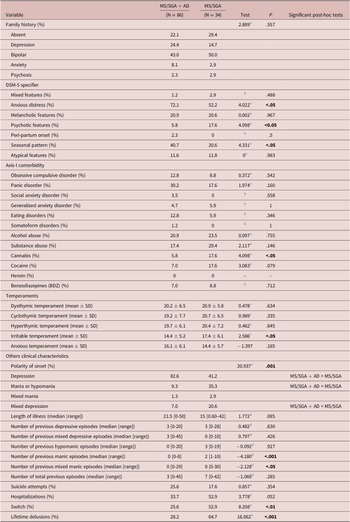
Table 1 shows the clinical characteristics of MS/SGA + AD and MS/SGA patients. With regard to the index episode, patients of the MS/SGA + AD group had more frequently a seasonal pattern and anxious features than those of MS/SGA group and less frequently psychotic features DSM-5 specifier. The percentage with attenuated mixed depression (Koukopolous’ criteria) was lower in MS/SGA + AD than in MS/SGA group (48.8% and 67.6%, respectively), although the difference was not significant (χ 2 = 3.473; P = .062). The median duration of the index episode did not differ significantly between MS/SGA + AD and MS/SGA (8.5; range 1-135) and 7 weeks (range 1-288) respectively; Mann–Whitney test = 0.782; P = .434).
Clinical Features of Patients Treated with Mood Stabilizer/Second Generation Antipsychotic Plus Antidepressant (MS/SGA + AD) and without Antidepressants (MS/SGA)

Abbreviations: DSM-5, The Diagnostic and Statistical Manual of Mental Disorders, Fifth Edition; SD, standard deviation.The bold values refer to statistical significance p<0.05
a Chi-square test.
b Fisher test.
c t-Test.
d Mann–Whitney test.
Patients of the MS/SGA + AD group significantly differed from those of the MS/SGA group on irritable premorbid temperament (lower), cannabis abuse comorbidity (lower), onset polarity (more frequently depression and less frequently mania, hypomania and mixed depression), number of previous pure and mixed manic episodes (lower), lifetime delusions (lower), and (hypo)manic switch (lower). The hospitalization rate was lower in MS/SGA + AD than in MS/SGA group, although the difference did not reach significance (P = .052).
At study entry the two groups did not differ on HDRS21 total scores (19.52 ± 4.38 and 20.32 ± 4.94, respectively; t-test 0.841; P = .402), CGI-s scores (5.10 ± 2.84 and 4.81 ± 0.718, respectively; t-test = 0.452; P = .65), and on GAF scores (50.65 ± 6.83 and 49.29 ± 5.80, respectively; t-test 0.98; P = .33). Patients in MS/SGA + AD group, compared with patients in MS/SGA group, had a significantly lower YMRS total score (1.66 ± 2.30 and 3.19 ± 3.59, respectively; Mann–Whitney test −2.242; P = .025) and HDRS21 item 3 score (0.15 ± 0.36 and 0.35 ± 0.49, respectively; Mann–Whitney test −2.39; P = .017).
Short-term treatment
In the short-term, all patients received at least one MS or SGA. Patients of the MS/SGA + AD group, compared with those of the MS/SGA group, received significantly less frequently valproate/carbamazepine (48.8% and 70.6%, respectively; χ2 = 4.658; P < .05) and SGAs (33.7% and 97.1%, respectively; χ 2 = 39.144; P < .001). The rate of lithium (32.6% and 50.0%, respectively; χ 2 = 3.163, P = .075) and lamotrigine (8.1% and 0, respectively; Fisher test, P = .189) did not significantly differ between the two groups. In MS/SGA + AD group, SSRIs were prescribed in the short-term in 60.5% of patients (median dosage of fluoxetine equivalent: 28 mg/day), TCAs in 36% (median dosage 75 mg/day), and SNRIs in 14% (median dosage of venlafaxine equivalent: 131.35 mg/day). Furthermore, a combination of two ADs was prescribed in 29.1% of patients, an AD-aripiprazole augmentation in 12.8%, and an AD-pramipexole augmentation in 2.3%.
Long-term treatment
During the follow-up (12 months), 45 out of 57 (79%) patients received AD- augmentation. There were no statistically significant differences between MS/SGA + AD and MS/SGA group in the long-term use of lithium (75% and 54.5%, respectively; χ 2 = 1.694, P = .193), carbamazepine or valproate (75% and 45.5%, respectively; χ 2 = 3.440, P = .064), and lamotrigine (16.7% and 14.5%, respectively; χ 2 = 0.035, P = .852). The use of SGA was significantly lower in MS/SGA + AD than in the other group (49.1% and 91.7%, respectively; χ 2 = 7.274, P < .007).
Short-term effectiveness and safety
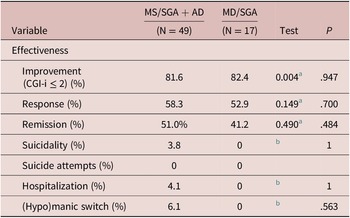
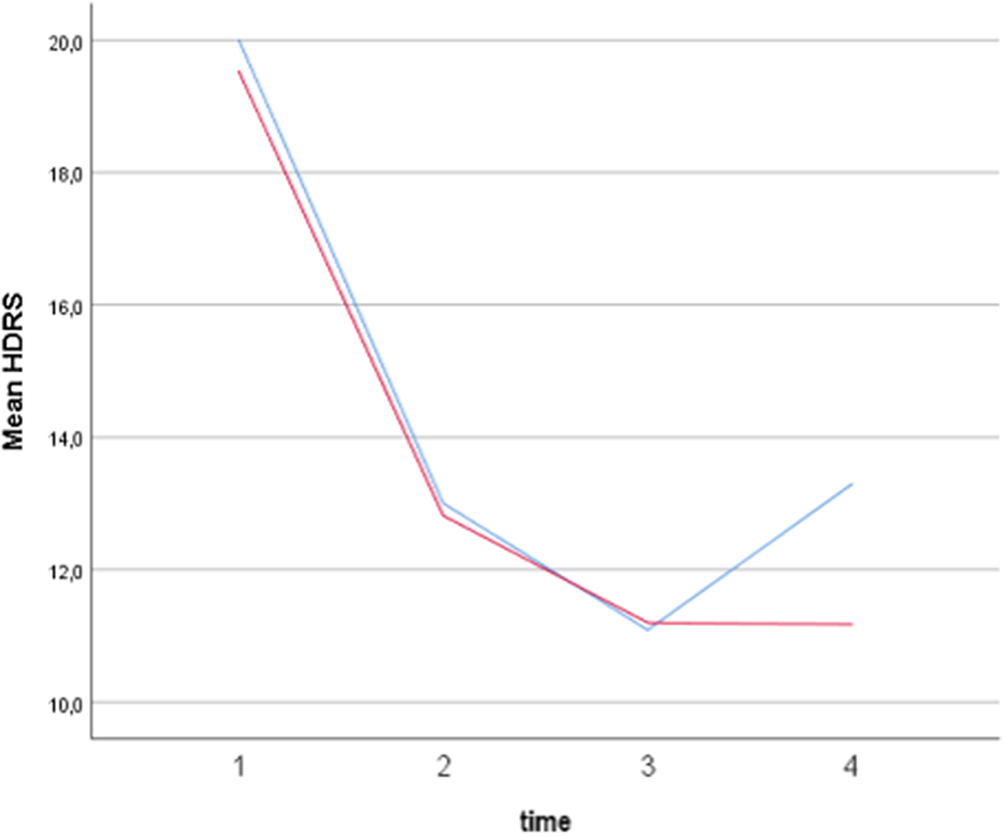
The total number of patients completing the 12 weeks short-term treatment was 66, 49 in MS/SGA + AD group, and 17 in MS/SGA group. The percentage of drop-out (43% and 50%, respectively; χ 2 = 0.479, P = .489) and of treatment adherence ≥75% (89.9% and 100%, respectively; χ 2 = 1.877, P = .877) did not differ significantly between the two groups. Table 2 shows the short-term effectiveness and safety outcomes. Patients of the MS/SGA + AD and MD/SGA groups did not differ significantly in remission (51% and 41.2%), response (58.3% and 52.9%), and improvement (81.6% and 82.4%) rate. The trend of HDRS21 total score over the 12 weeks of treatment was similar between MS/SGA + AD and MD/SGA (Figure 1).
Outcomes at 12 Weeks of Treatment in Patients Treated with Mood Stabilizer/Second Generation Antipsychotic Plus Antidepressant (MS/SGA + AD) and without Antidepressants (MS/SGA)

Abbreviation: CGI-I, Clinical Global Impression of Improvement.
a Chi-square test.
b Fisher test.
Trend of the HDRS21 over the 12 weeks of treatment in patients with (mood stabilizer/second generation antipsychotic plus antidepressant [MS/SGA + AD], red line) and without (MS/SGA, blue line) antidepressant. Results from mixed‐effects linear regression. Time 1 = baseline assessment (T0); Time 2 = 4 weeks (T1); Time 3 = 8 weeks (T2); and Time 4 = 12 weeks (T3). The interaction between time and diagnosis is not significant. Abbreviation: HDRS21, Hamilton Depression Rating Scale.

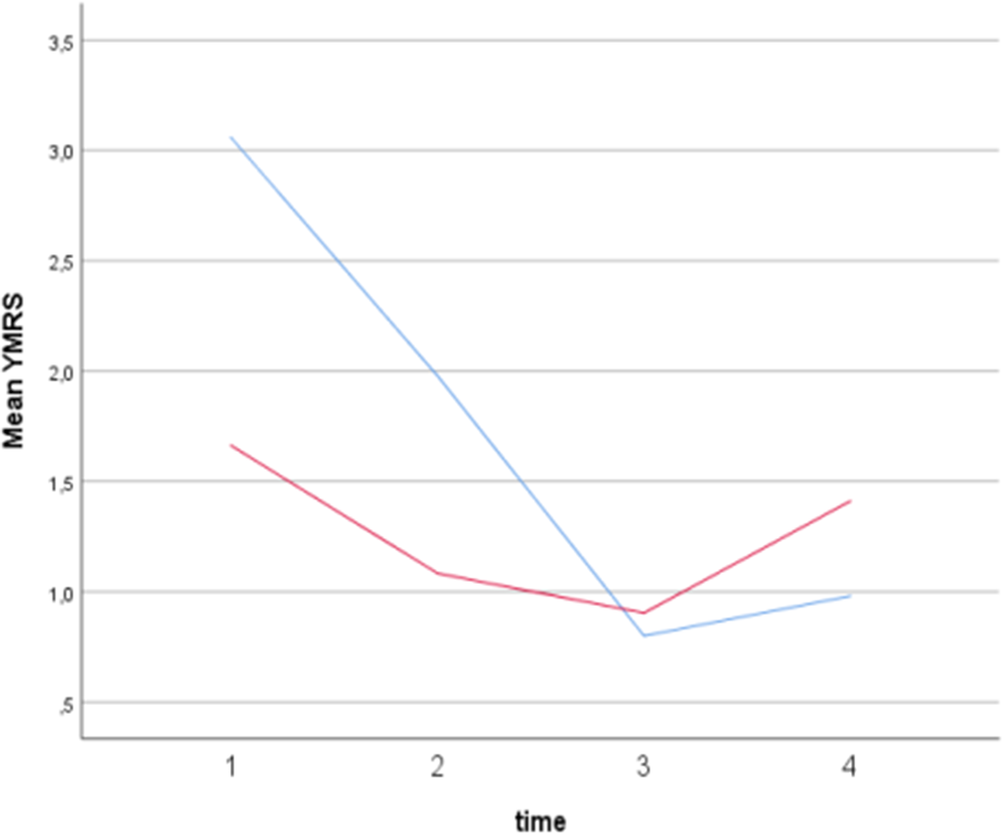
Similarly, patients of both groups did not differ significantly in suicidality (3.8% and 0), suicide attempts (0 and 0), hospitalization (4.1% and 0), and (hypo)mania switch (6.1% and 0) rate. The trend of YMRS total score over the 12 weeks of treatment was similar in the two groups (Figure 2).
Trend of the YMRS score over the 12 weeks of treatment in patients with (mood stabilizer/second generation antipsychotic plus antidepressant [MS/SGA + AD], red line) and without (MS/SGA, blue line) antidepressant. Results from mixed‐effects linear regression. Time 1 = baseline assessment (T0); Time 2 = 4 weeks (T1); Time 3 = 8 weeks (T2); Time 4 = 12 weeks (T3). The interaction between time and diagnosis is not significant. Abbreviation: YMRS, Young Mania Rating Scale.

Long-term effectiveness and safety
The total number of patients completing the follow-up was 57, 45 in the MS/SGA + AD group, and 12 in the MD/SGA group. The percentage of drop-out from 12 weeks to 12 months (18% and 29.0%, respectively) and of treatment adherence ≥75% (91.7% and 90.9%, respectively) was similar in the two groups.
During the follow-up 92.7% of patients in MS/SGA + AD group and 91.7% of patients MS/SGA group remitted from index episode, with no significant differences.
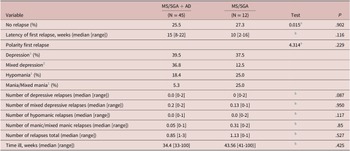
Table 3 shows the long-term effectiveness and safety outcomes.
Outcomes at 12 Months of Treatment in Patients Treated with Mood Stabilizer/Second Generation Antipsychotic Plus Antidepressant (MS/SGA + AD) and without Antidepressants (MS/SGA)

1 DSM-5 criteria.Reference Stahl, Morrissette and Faedda39
2 Koukopoulos criteria.Reference First, Williams, Karg and Spitzer42
a Chi-square test.
b Mann–Whitney test.
No differences between MS/SGA + AD and MS/SGA group were found in absence of new episode, latency of first relapse, number of depressive/hypomanic/manic/mixed depression recurrences, total number of recurrences, time spent ill. The rate of hospitalization did not significantly differ in the two groups (10.9% and 16.7%), no patient attempted suicide or developed a rapid cycling course. The polarity of first relapse in patient with MS/SGA + AD, compared with those in MD/SGA, was more frequently mixed depression (36.8% and 12.5%, respectively) and less frequently mania (5.3 and 25.0%, respectively) or hypomania (18.4% and 25.0%, respectively), although the difference did not reach the significance.
Discussion
To the best of our knowledge, this is the first multicenter prospective study aimed to identify the demographic and clinical characteristics of bipolar depressed patients who require AD augmentation, and to evaluate the short and long-term effectiveness and safety of this therapeutic strategy. The topic has been generally poorly investigated or neglected although, it is very important for both patients, as depression is the most frequent presentation of BD with a high impact on functioning, and for clinicians (often with no information to predict if ADs could improve or worsen the clinical condition).
Our findings showed that 70% of our patients received AD augmentation to MS/SGA for short-term treatment, and 80% of patients who did not drop out for long-term treatment. The rate of short-term AD augmentation results within the range of those reported in previous observational studies,Reference Pacchiarotti, Bond and Baldessarini12-Reference Tundo, Calabrese, Proietti and De Filippis15, Reference Tohen, Frank and Bowden51 while confirming that clinicians in the real-world deem this augmentation necessary for several of their bipolar patients. Long-term AD continuation in patients acutely treated with this drug has been reported in the past.Reference Judd, Schettler and Akiskal7, Reference Joffe, MacQueen, Marriott and Young18, Reference Bond, Noronha, Kauer-Sant’Anna, Lam and Yatham32
In our clinical practice, the patients receiving AD-augmentation had a mean age of 50 years, were mostly married, did not use cannabis, had a BD-II diagnosis, a premorbid temperament different from irritable, a depressive polarity at onset, a small number of previous (hypo)manic switches, and of manic (pure or mixed) and psychotic episodes. At study entry, they had often a depressive index episode with anxious features or seasonal pattern, a low risk of suicide attempts (as measured by item 3 of HDRS21) and a low number of concurrent (hypo)mania symptoms (as measured by the Y-MANIA total score). Furthermore, our patients with rapid cycling course or with previous AD-emerging switch did not receive AD augmentation, while patients with mixed depression, according to Koukopoulos’ criteria, received AD-augmentation only if the previous treatment with MS and/or SGA resolved the (hypo)mania but not depressive symptoms. Our results are consistent with those of two previous studies carried out in patients with bipolar depression, showing the association between ADs use and high age at intake,Reference Tohen, Frank and Bowden51, Reference Forester, Ajilore, Spino and Lehmann52 as well as the absence of a closer association between AD use and education, age at onset, illness duration, number of previous depressive episodes, and severity of current depression.Reference Oostervink, Nolen and Kok53
Due to the limited number of studies on the topic, we were unable to directly compare the other findings of the present study with previous ones. However, some considerations are possible. Our patients treated with AD augmentation were those that, in line with the available literature, had high probability to respond and less risk for dangerous consequences. They were married, reflecting the evidence that a less severe BD allows a more stable family situation, they were suffering from BD-II disorder, more effectively and safety treatable with Ads,Reference Yatham, Kennedy and Parikh11, Reference Altshuler, Sugar and McElroy35 and showed a seasonal pattern of course and a depressive polarity at onset, both more frequent in BD-II.Reference Lorenzo, Vázquez, Zaratiegui, Tondo and Baldessarini54-Reference Subramanian, Sarkar and Kattimani56
Conversely, according to the published data, our patients not treated or less frequently treated with AD augmentation were those with a high risk of dangerous consequences or of worsening of mood instability/recurrences. The group with high risk of dangerous consequences include patients with BD-I diagnosis and with more manic episodes in the past, who have a high risk of mood elevation under AD treatmentReference Yatham, Kennedy and Parikh11, Reference Altshuler, Sugar and McElroy35 with full mixed depression, less responsive to and potentially worsened by ADsReference Rosenblat and Mcintyre38 with irritable temperament, in reason of the possible connection with a “mixity”Reference Tundo, Musetti, Benedetti, Berti, Massimetti and Dell’Osso57 and with psychotic episodes, with an increased risk of new psychotic episodes onset under AD treatment.Reference Vazquez and Gonda58
In the group with a high risk of worsening of mood instability/recurrences there were patients prone to (hypo)manic switch or with rapid cycling course in which ADs could increase the risk of new switches and of further cycle acceleration.Reference Yatham, Kennedy and Parikh11, Reference Altshuler, Sugar and McElroy35 Patients with cannabis abuse comorbidity, who have a high risk of manic/mixed or psychotic episode and of rapid cycling course,Reference Fountoulakis, Grunze and Vieta10 fall under the groups with a high risk of dangerous consequences and of worsening of mood instability.
As regards the secondary aim of the study, our findings indicate that ADs, combined with MS and/or SGA, were short- and long-term effective and safe for bipolar depressed patients selected as above reported. Indeed, after 12 weeks of treatment 82% of our patients receiving ADs improved, 58% responded and 51% remitted, 3.8% had suicidal thoughts or projects, 6.1% had (hypo)manic switch, and 4.1% needed hospitalization. During the following 12 months 92% of them remitted from index episode, 25.5% did not relapse and 11% needed hospitalization. During the observational period no patient attempted suicide or developed a rapid cycling course. The rate of mixed depression first-relapse polarity was higher (albeit without reaching the statistical significance) in patients receiving AD than in the others. This finding provides additional evidence for the hypothesis that ADs could increase the risk of manic-like symptoms onset in a subset of depressed patients.
According to the selection criteria (see “Treatment” section in “Materials and Methods”), patients with AD-augmentation, compared with those without AD-augmentation, were disadvantaged in the acute phase (often with previous depressive episode(s) with a partial or no response to MS and/or SGA) and in the prophylactic phase (with subthreshold depressive symptoms persistence or with prevalent depressive recurrences in previous course). Despite this disadvantage, the two groups did not significantly differ on any outcome as well on adverse events in the short- and long-term treatment.
Our results on short-term effectiveness are in agreement with those of two previous studies based on same patients’ selection criteria and treatmentReference Carta, Aguglia and Balestrieri14, Reference Tondo, Baldessarini, Vázquez, Lepri and Visioli23 and with those of some observational ones comparing the effectiveness of ADs in unipolar and bipolar depression. However, they are in contrast with those of a number of other studies, mostly RCTs comparing the efficacy of AD and MS or SGA in bipolar depression.Reference Tondo, Baldessarini, Vázquez, Lepri and Visioli23 The possible reason for these differences is the treatment heterogeneity. Indeed, in the studies showing the efficacy/effectiveness of ADs, including the present, all classes of ADs at standard clinical dosages were used, while in those showing the inefficacy/ineffectiveness of ADs, mainly SSRIs and bupropion often at low dosage were used. Our results on short-term safety are in line with those of two previous studies based on the same patients’ selection criteria and treatment,Reference Carta, Aguglia and Balestrieri14, Reference Tondo, Baldessarini, Vázquez, Lepri and Visioli23 but in contrast with those of most available studies showing a higher rate of switch in patients treated with Ads.Reference Tondo, Baldessarini, Vázquez, Lepri and Visioli23 The selection criteria, with the exclusion of patients with high risk of worsening of mood instability/recurrences, and the use of ADs in combination with MS and/or SGA in all bipolar patients in the present and in the two Tundo’s studiesReference Carta, Aguglia and Balestrieri14, Reference Tondo, Baldessarini, Vázquez, Lepri and Visioli23 and but not in the others, might perhaps explain these differences.
Interestingly, our findings on long-term effectiveness and safety are consistent with those of three previous observational studiesReference Altshuler, Suppes and Black60 Reference Lyall, Penades and Smith17, Reference Bowers, McKay and Mazure59, Reference Altshuler, Kiriakos and Calcagno60 and of a recent meta-analysisReference Judd, Schettler and Akiskal7 showing that a subgroup of patients with BD responding to MS AD-augmentation in acute phase could benefit from AD long-term augmentation (reduction of depressive recurrences) with no increase in the rate of (hypo)manic switch.
Limitations
The main limitation of the study is the high drop-out rate during the short-term treatment leading to a reduction of the sample size included in the follow up. However, the drop-out rate was similar in the MS/SGA and MS/SGA + AD groups, so that this limitation does not affect the comparisons. Yet, despite this limitation, the study provides useful information for clinicians in a very problematic area of unmet clinical needs that is the use of ADs in patients with bipolar disorder.
Conclusion
In conclusion, this study describes the clinical characteristics of the subgroup of patients with BD who need AD-augmentation to MS/SGA to resolve depressive episode (short term), to avoid the persistence of subthreshold depressive symptoms and to prevent further depressive episodes (long-term treatment). Furthermore, the study shows that in this subgroup of patients the short and long-term AD-augmentation is effective and safe. Taken together, the findings of this pragmatic clinical study confirm that BD is a heterogeneous illness and that the question is not whether ADs should or should not be used, but in which patients they should be used.
Author Contributions
Conceptualization: L.M. and A.T.; Data curation: A.T.; Formal analysis: A.T.; Investigation: L.M. and A.T.; Methodology: L.M. and A.T.; Project administration: L.M. and A.T.; Supervision: D.M. and L.D.; Writing-original draft: L.M., R.d.F., and A.T.; Writing-review & editing: D.M., C.D.G., C.G., L.M., L.D., L.P., S.B., A.T., and E.C.
Funding
This research received no specific grant from any funding agency, commercial or not-for-profit sectors.
Disclosures
Laura Musetti, Antonio Tundo, Erika Cambiali, Claudia Del Grande, Rocco de Filippis, Caterina Franceschini, Luca Proietti, Sophia Betrò, Donatella Marazziti, and Liliana Dell’Osso do not have anything to disclose.