On November 21, 1902, newspapers throughout the American Northeast reported that Philadelphia's police had “run to earth” an organized syndicate of white slavers who specialized in importing girls from major cities in Europe to the brothels of the City of Brotherly Love. The police raided over twenty disorderly houses and arrested more than 100 girls—most of whom were foreign-born and Jewish.Footnote 2 Unable to hold a majority of those who had been arrested, prison officials released them a week later.Footnote 3 Progressive reformers concerned about the rise of sex trafficking looked at the Philadelphia incident and saw an international immigration tragedy unfolding. They grew frustrated by the inability of local officials to detain the girls. Margaret Dye Ellis, one of these reformers, led the legislative department of the Woman's Christian Temperance Union (WCTU).Footnote 4 She decided to look into how the girls arrested in the Philadelphia raid had arrived in the city. Her investigation led her to Ellis Island, where she discovered what she thought was a hole in the fence constructed to keep prostitutes and white slaves out of the United States—the first- and second-class cabins of steam ships.Footnote 5
Ellis quickly formulated a solution: the use of women boarding inspectors to interview, examine, and protect vulnerable girls in first- and second-class cabins. Accompanied by a representative from the American Purity Alliance, Ellis met with President Theodore Roosevelt in early 1903 to discuss her plan of introducing women boarding inspectors to the Immigration Bureau. Ellis found a receptive audience in Roosevelt. He ordered a ninety-day experiment into the efficacy of women boarding inspectors.Footnote 6
The women would join the team of twelve male boarding inspectors and assistant inspectors and five doctors who routinely boarded incoming passenger ships. These inspectors examined the ship's manifest, questioned the first- and second-class passengers, separated U.S. citizens from noncitizens, and confirmed that none landing had communicable diseases. According to William Williams, immigration commissioner for the Port of New York from 1902 to 1905 and again from 1909 to 1913, “Theoretically the cabin inspection is identical to that of the steerage immigrants” who faced scrutiny at Ellis Island.Footnote 7 However, in 1902 he remarked, “Of course, cabin passengers do not require the same careful inspection as the steerage.”Footnote 8 It was this type of casual inspection that worried Ellis and her allies.
Anti-white slavery activists pushing for the new position of women boarding inspectors asserted that protecting the moral health of passengers fell under government purview because the principle of protecting steamship passengers’ physical health had long been acknowledged. If unaccompanied female immigrants were vulnerable to immorality, then the government had the responsibility to provide protection. For those women who were traveling without the guidance of their family patriarchs, the government could and should step in to ensure that young immigrant women made it to their final destinations safely and honorably. Ellis argued that the provision in the immigration law that protected immigrants from fraud and loss conceded that “the United States [should] sustain a paternal relation of protection toward immigrants coming to these shores.”Footnote 9 Ellis conceived of the role of women boarding inspectors to encompass a new assertion of government authority—paternal protection. Still, ironically she believed women inspectors were best suited to aid female immigrants.
Ellis articulated a new role for women when she asked that they represent federal governmental authority by joining the Immigration Bureau's boarding inspectors. Women's influence on civil society had expanded throughout the late nineteenth century as women began joining clubs, reform groups, and civic organizations in larger and larger numbers. Historians Paula Baker and Michael McGerr among many others have described how women's entry into the public sphere was premised on the argument that women's moral superiority would have a civilizing and domesticating effect on municipal order.Footnote 10 Within the gendered public sphere of the late nineteenth and early twentieth centuries, middle-class men and women appeared to be responsible for different aspects of public life. Men were held to be responsible for the dirty and corrupt business of governance, including the key role of enforcing the law and operating the justice system. Women, in contrast, were encouraged to channel their energies into philanthropic work, such as outreach work in settlement houses and the distribution of charitable aid.Footnote 11
The ability to represent government authority is what separated these two tracks of public service. Throughout the Progressive Era, women would transition from volunteer and civic forms of service to governmental positions in order to enact reform. However, those seeking to uphold traditional gender roles in the public sphere repeatedly contested this broader trend.Footnote 12 When Margaret Dye Ellis convinced President Roosevelt to endorse the experiment of placing women among the all-male staff of the immigration boarding inspectors at the Port of New York, she traversed the divide between men's and women's roles within civil society. The women inspectors trespassed into male authority and consequently ran into opposition from male inspectors and Immigration Bureau officials. Furthermore, the fact that these women represented the government publically, in open air, by greeting potential citizens distinguished their type of embodiment of government authority from other positions of authority women held in 1903. Prior to this time, women had represented governmental authority through their roles as primarily police matrons, health and factory inspectors, or statisticians and researchers for the federal government, work that was mostly inside, frequently in offices.Footnote 13 Additionally, female inspectors faced resistance from the women passengers they questioned who resented being judged by another woman.
The authority to appraise, interview, and adjudicate was gendered in the early twentieth century. The controversy over the women inspectors devolved into two gendered arguments. The first revolved around men's and women's respective ability to appropriately perceive and police immorality. The second centered on whether the government should devote its resources to protecting unchaperoned women or detecting unwanted and potentially dangerous immigrants. In both cases, however, the underlying issue was the exercise of governmental—and fundamentally patriarchal—authority by women through the role of immigration inspectors.
White Slavery as an Immigration Issue
Stories of white slavery had captured American reformers’ attentions since the late nineteenth century. In 1885, British journalist W.T. Stead published an extended exposé of the “international slave trade in girls” that enjoyed significant distribution in U.S. journals and newspapers.Footnote 14 From this point on, American reform organizations such as the WCTU and the New York Committee for the Prevention of the State Regulation of Vice (later the American Purity Association) embraced the issue of white slavery and sought to eradicate sex trafficking in all its forms. Reformers in these organizations defined white slavery as the luring, tricking, coercing, or forcing of innocent girls and women into a life of debauchery or prostitution. They believed that an extended international network of sex traffickers preyed on innocent girls and profited from their sexual servitude. In the United States, reformers frequently linked the issue of white slavery with immigration. They argued on the one hand that friendless immigrant girls composed an especially attractive target for traffickers and on the other hand that immigrant men dominated the trade in women.Footnote 15 The Philadelphia case emphasized to these reformers the vulnerability of foreign-born girls.
American policy makers and immigration restrictionists had long been concerned about the invasion of immorality from foreign lands. This concern prompted the 1875 Page Law. Intended to block the immigration of Chinese prostitutes, the law made it illegal to import women for immoral purposes.Footnote 16 The 1903 Immigration Act reasserted and fortified the Immigration Bureau's duty of protecting the moral borders of United States by allowing for the deportation of prostitutes and their procurers (pimps) within three years of entry.Footnote 17 Anti-white-slavery activists fully expected the Immigration Bureau to protect the country from the scourge of sex trafficking, and they turned to their political contacts to ensure this happened.
Ellis had joined the WCTU in the 1870s and soon took up temperance work first in California and then in New Jersey. She became the WCTU's full-time lobbyist in Washington, when in 1885 she was appointed legislative superintendent for the national WCTU. Every winter from 1896 to 1917, Ellis and her husband, a New York City businessman, relocated to Washington for the span of the congressional session.Footnote 18 As a pioneer of emerging interest-group politics, she was well positioned to mend the hole in the immigration fence. She took her concerns to a man known to have a sympathetic ear to the cause—President Theodore Roosevelt.
Active in the New York City reform milieu of the 1890s, Theodore Roosevelt admitted to being “greatly interested” in the issue of white slavery whenever it was brought before him.Footnote 19 At the instigation of members of the American Purity Alliance, Roosevelt, while governor of New York, introduced a law that would punish pimps who lived from the earnings of prostitutes. Roosevelt found regulated prostitution to be abhorrent, noting that it made his “blood boil.” He detested white slavery and other crimes against women. He saw women as vulnerable and in need of governmental protection, particularly because, in his words, “she has no direct voice in government.”Footnote 20 After he moved into the White House, Roosevelt remained friendly with reformers like Josephine Shaw Lowell and Grace Dodge, both of whom regularly brought the issue of white slavery before him.Footnote 21
Ellis preferred women to men in the task of protecting female immigrants, because, in her view, women had special ways of perceiving feminine distress, confusion, and vulnerability. She argued, “under certain conditions only women should deal with women.”Footnote 22 From this gendered perspective, questioning by male officials about sensitive issues related to sexuality and paternity might add to a female immigrant's distress. Consequently, Ellis contended that the paternal protection offered immigrant women should be furnished by women members of the Immigration Bureau's boarding team. By arguing that women were best suited to police other women due to their shared sex and innate sense of nurturance, Ellis adopted a maternalist rationale for women's public activism that characterized much of the Progressive Era. As Sonya Michel and Seth Koven state, maternalism celebrated the features of domesticity—nurturance, morality, care—while at the same time “legitimizing women's public relationships to the state, to community, workplace, and marketplace.”Footnote 23 Though Ellis envisioned women's special skills of emotional perception as aiding female immigrant inspectors in their efforts to perceive distress, she also believed that they would be able to recognize dissemblance and consequently offer punishment. In Ellis's thinking, the women immigrant inspectors would bring to the job women's special talents to be the maternal handmaidens of paternal (protective and punitive) governmental authority.
Selecting the Inspectors
From its very onset, the ninety-day experiment faced the bitter opposition of the commissioner-general of immigration in Washington, Frank P. Sargent, and the immigration commissioner of New York, William Williams. The two men rejected the idea of women inspectors, even though the Immigration Service had used women in other capacities.Footnote 24 The Immigration Service at the Port of New York had employed women since the opening of Ellis Island in 1892, and in early 1903 seven matrons worked at the station.Footnote 25 Women regularly served as matrons and nurses (technically employed by the Public Health Service) assisting inspectors and doctors in their examinations of steerage-class female passengers.
Typically a steam liner arriving in New York would first stop at quarantine pending permission to land. Here, in accordance to the 1903 Immigration Act, the ship would be boarded by medical and immigration inspectors who would briefly examine the manifest and passengers in the first- and second-class cabins. Inspectors confirmed the full name, age, sex, and marital status of each passenger. They noted the passengers’ literacy, nationality, race, recent address, final destination, and occupation. Finally, they checked whether passengers had thirty dollars, whether they were joining relatives or friends, whether they had ever been to the United States, and whether they had been incarcerated in a prison or mental institution or were polygamists or anarchists.Footnote 26 After each passenger had been scrutinized, the ship would berth at a pier in Manhattan or New Jersey, and each of the first- and second-class immigrants who had passed inspection and all of the U.S. citizens would disembark. Then the ship would travel to Ellis Island where all of the steerage (third-class) and any questionable first- and second-class passengers would disembark and face the intense inspection of the Immigration Service.Footnote 27
Ellis and her allies at the American Purity Alliance were confident that women and girls in steerage who could be in danger of being entrapped into white slavery would be protected by the rigorous review at Ellis Island. Furthermore, the presence of Travelers’ Aid Societies and ethnic aid organizations such as the Council of Jewish Women assured Ellis that immigrant girls at Ellis Island had access to the help or protection they might need.Footnote 28 Believing that no similar protection existed for the first- and second-class passengers, Ellis's group hoped that appointing women inspectors to the crew of immigration officials who boarded ships would be an important step in combating sex trafficking.
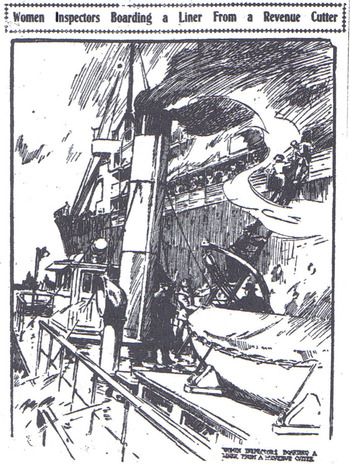
Williams and Sargent both expressed hostility to the plan because of the confluence of their sexism and classism. First, they argued that men were better equipped to detect immoral women “for obvious reasons.” Of course, what those reasons were they left unsaid. Next, they doubted that the women who could perceive immorality would be an appropriate class of women for the government to employ. Additionally, Williams argued that passengers “readily submit” to inspection by male inspectors but would object to being “singled out” by women inspectors and therefore potentially becoming the “centre of attention.”Footnote 29 Finally, they repeatedly worried to the press that women inspectors would be physically incapable of climbing the fifteen- to thirty-foot ladders necessary to board the ocean liners from the revenue cutters (see Figure 1). These concerns were often interwoven to produce observations that “women who can go down in a revenue cutter at all hours of the day or night, and can clamber up the ship's ladder without embarrassment, will not have the proper mental and moral qualifications rightly to perform their otherwise delicate duties.”Footnote 30 Apparently the willingness to climb a ladder in the dark set any potential women inspectors into a morally ambiguous caste of women.
Interest in the spectacle of women inspectors boarding the incoming ships via ladders suspended between the ocean liner and revenue cutters remained strong as late as 1907. Source: “Women Inspectors Boarding a Liner from a Revenue Cutter,” Fort Wayne Sentinel, November 16, 1907, 1.

Ellis, the Immigration Bureau, and the Civil Service struggled over the type of qualifications that the new position would require. Because the women would be working with various incoming steamships filled with all types of foreign nationals, the women inspectors would need to be polyglots—proficient in at least three European languages. Also, to get onto the ships the inspectors would need to climb the ladders, so some degree of physical prowess was necessary.
New York Immigration officials favored limiting the job to those who had passed the civil service exam, but Ellis persuaded Immigration Bureau officials in Washington to set aside the exam for the moment. Without Ellis's intervention, there would have not been enough viable candidates from which to choose. She argued that the “moral qualification” was more important than any civil service exam, but the most important qualification was that the candidates for the position be charming and kind enough to gain the trust of young immigrant women.Footnote 31 One boarding inspector declared, “What we really want . . . is a gentlewomen, intelligent, dignified, tactful women, who can combine the ability of a detective with the sympathy and good sense of a mother.”Footnote 32 For this rare combination, each woman would earn $1,200 a year (if the experiment extended beyond its ninety-day limit), a substantial wage at the time.
As it began to implement the plan, the Immigration Bureau announced that there would be job openings for five female boarding inspectors. Within one day, more than 150 women descended on Commissioner Williams's office to personally drop off their applications. One woman claimed that her previous experience as a trapeze artist in a circus qualified her for the post. Another noted that she had extensive sailing experience after working as a stewardess for many years and could easily “skin up to the masthead in a jiffy.”Footnote 33 Most of the women who applied for the position were over the age of forty, including one woman who shared that she was fifty-nine years old, though the immigration official who interviewed her told a reporter that she “would have hit the mark better if she'd reversed the figures.”Footnote 34 The same official admitted that he had found interviewing women to have “its humorous side.” One restaurateur from the Lower East Side claimed that she had “had to do with more of them raw Irish than you could shake a stick at.” She felt that her experience serving immigrant customers had given her the skill set to join the Immigration Service. Most of the applicants had worked as nurses, although salesladies, laundresses, and sewing machine operators were represented as well.Footnote 35 These working-class women were most likely just the class of women that Williams feared would apply for the job.
Ellis proposed a list of five women who had backgrounds in social work in New York City settlement houses. Each had been college-educated and spoke several languages.Footnote 36 Most importantly, these young women seemed to be just the type of upper middle-class gentlewoman that the bureau desired. However, Williams, perhaps motivated by some disdain for voluntary organizations or perhaps not wanting to give Ellis the satisfaction of guiding the project more than she already had, rejected most on Ellis's list. Dismissing the WCTU lobbyist's claims of expertise, Williams would later describe her as a well-meaning woman who was either ignorant of actual conditions or was intent on having the government enter charitable work.Footnote 37
Willliams decided to offer the job to two of the women on Ellis's list, Josepha Lassoe and Margaret Batchelder. He hired two other women who had applied for the position, Mathilde Wichmann and Sarah Harrison. These women would be led by an established matron at Ellis Island, Helen A. Taylor (who would not last the ninety-day experiment due to an injury she sustained a few weeks into the experiment).Footnote 38
The Experiment
In implementing the ninety-day experiment, the Immigration Bureau tested Ellis's ideas that women would be better able to detect female dissemblance and distress and protect vulnerable girls. However, as the women inspectors began their work they encountered obstacles from both passengers and fellow immigration officials. Even with these challenges, the women inspectors and their supporters declared their work a success. They pointed to the many young immigrant women whom the inspectors had protected from seduction, the aid they gave to confused and lost passengers, and the immoral conditions they discovered on several ships. Representing the Immigration Bureau and all of the governmental authority that the Immigration Bureau badge implied allowed the women inspectors to accomplish much. Regardless of their claims of success, the women inspectors and the experiment would not be able to surmount the bureaucratic opposition to women wielding a government badge.
The term of ninety days formally began on February 12, 1903, when the “petticoat inspectors,”Footnote 39 one of the many derisive terms coined by the press for the women, reported for work at the Barge Office in Battery Park. A bevy of reporters came out to comment on their clothing and watch the women climb the ladders in their skirts. This issue bore heavily on the male immigration officials who, when it was time for the women to board the steamship Ivernia, decided that instead of having the women climb the long ladder, as the men did, a short ladder would be provided and the gangway of the ship would be opened for the women. Upon discovering that this change in procedure had occurred to accommodate them, the women protested and noted that climbing the ladder was no more difficult or dangerous than hanging curtains.Footnote 40 Time and again the issue of the safety and capability of women climbing the ladders would be raised by the male immigration officials. Tellingly, the women often compared the activity to some form of domestic labor that women routinely undertook, like hanging curtains.Footnote 41
Once upon board the women were given almost no instructions as to their duties.Footnote 42 According to a reporter, the women gathered together and watched the chaos that was inspection unfold. When they had initially been hired, Commissioner Williams had told them that for the first few weeks they should only watch the male inspectors work and follow their guidance. Shadowing the male inspectors was complicated by the obvious disdain that most male inspectors felt toward the women.
Although memoirs of male inspectors are rare, the average male immigration official shared his bosses’ dislike of the plan. Many male boarding inspectors predicted that the women would not stay in the position once they faced the daunting task of boarding a ship in storm conditions. Another, without any sense of irony, foresaw that the immoral conditions the women found onboard would certainly drive them from the job.Footnote 43 On the first day of the experiment, the men, or “real inspectors” as they had dubbed themselves, mocked the women by implying that because their dresses had no pockets it would be likely that the women would not be able to bring along their lunches. The women assured them that they had prepared for this eventuality and that they would eat when the men took their lunch.Footnote 44 However, the most common dismissal of the women inspectors centered on the issue of how they questioned the passengers. Male immigration officials believed the women lacked tact.
Most of the male inspectors predicted the first- and second-class passengers would resent being questioned by a female inspector. One declared:
I don't believe any good will come of the scheme. The women Inspectors are expected to go about among the saloon passengers and ask all sorts of embarrassing questions. They are sure to arouse the ire of some person before they get through. Suppose a man comes over with his wife and these new Inspectors begin to ask her impertinent questions while he is not in sight? Or suppose, they inquire into any respectable woman's business? Do you think folks are going to stand for that?Footnote 45
By mingling with and interviewing the passengers, the women inspectors were essentially questioning the legitimacy of the passengers’ social relations and in doing so they threatened both patriarchal and class privileges. For example, on the very first ship the women inspected, one of the women spied a young girl accompanied by a “burly individual.” The female inspector asked the girl a series of questions—“Is no other woman with you?” “Where is your mother?” “And your father?”—to which the girl timidly shook her head. This interview prompted a male inspector to intervene and establish that the “burly” man was the girl's father. According to the newspaper reporter witnessing the exchange, “the novice retired without a find.”Footnote 46 Trying to establish whom young female immigrants traveled with and then judging the appropriateness of said relationship caused the women boarding inspectors to step over the prescribed lines of patriarchal privilege.
Assumptions and challenges of class underpinned much of the plan to install women boarding inspectors, as well as much of the opposition to the plan. In the context of immigration (or any interaction a woman had with the state), a freedom from questions of sexual morality constituted a very distinct class privilege. As historians Martha Gardner and Eithne Luibhéid have documented, immigration officials routinely posed “impertinent” questions to the women of steerage on Ellis Island.Footnote 47 However, with higher class came higher presumptions of respectability and its twin—morality. The way that respectability, gender, class, and sexuality intertwined demonstrate how of each of these traits reinforced one another, and more particularly how class became gendered.Footnote 48
Class conflict could emerge between the female inspectors and the women being inspected. First, as scholar Val Marie Johnson has argued, native-born women used protective work as a strategy to articulate female citizenship. Women, such as Margeret Ellis Dye and the individual inspectors, reified “hierarchies among women by deploying moral and racialized vocabularies.”Footnote 49 The separation of the respectable women from the immoral women served to heighten the authority of the immigration inspector—whether male or female. Acting as a representative of the state could be a heady experience for the women inspectors. For example, a few years later one matron reported that she could “tell at a glance” which women were respectable and which were not.Footnote 50
Notions of the appearance of respectability emerged as a key indicator of sexual morality or immorality and were imbued with corresponding codes of race, gender, and class. One of the initial concerns that inspired Ellis and other middle-class reformers was the fear that the first- and second-class cabins were being used by procurers to smuggle prostitutes into the country—essentially that immoral, low-class women were passing as upper-class (read, moral) women.Footnote 51 When inspectors throughout the country evaluated the eligibility of entry of the wives of Chinese (and later Japanese) merchants, ideals of white middle-class domesticity infused their notions of respectability and class.Footnote 52 Similarly, the women boarding inspectors’ assumptions of respectability influenced their conduct. However, unlike the scrutiny that inspectors imposed on Asian women, when examining first- and second-class passengers (most of whom were northern European), the women inspectors could not as easily fall back on race privilege when their questions overstepped a passenger's tolerance.Footnote 53
To complicate the politics of class further, most of the women employed as inspectors were unmarried and needed employment. One admitted that most of them supported other members of their families.Footnote 54 Even with a middle-class background and college education, these women needed paid work, while many of the women they questioned lived in a higher class and resented any intrusion into their class privilege.Footnote 55 Having to negotiate the turbulent waters of class politics with no training, some of the women inspectors quickly caused scandal. On one of the first ships they boarded, one woman, who was traveling alone in a first-class cabin, showed them an address for her final destination located on the West Coast. The inspector believed it to be a false address and began to ask increasingly personal questions. The line of inquiry the inspector followed upset the woman, causing her to become “hysterical” and to lodge a complaint.Footnote 56 Investigation revealed the woman was the wife of a sea captain on her way to meet him in Seattle.
According to the women inspectors, complaints like this one were rare. They argued that the vast majority of women and girls they spoke with appreciated their presence and were “eager and grateful for assistance and advice.”Footnote 57 They saw their work as primarily protective. Sarah Harrison celebrated the effectiveness of her “U.S. badge and the right of protection it assured.”Footnote 58 The work of the women fell into several categories that can all be subsumed under the umbrella of paternal protection, characterized by protection, detention, and potential punishment (deportation). Most frequently, they offered aid to travelers, but they also provided moral security to vulnerable young girls and reported immoral conditions that they discovered.
The women boarding inspectors most commonly provided assistance and advice to uncertain and confused immigrants. They helped women find their relatives, negotiate with railroad representatives, and access the aid of New York City's charitable organizations. For example, Inspector Sarah Harrison discovered a young Hungarian immigrant on the docks who spoke no English and had an uncertain address of a friend. Harrison escorted the girl to the address but found it did not exist. The young immigrant had another address for a different friend, which they located, but this place was a saloon “in which men and women were sitting at tables and playing cards.” As a result, Harrison took the young girl to the Hebrew United Societies who pledged to obtain appropriate lodging and to track down the girl's acquaintances. In telling her story of escorting this young girl through Manhattan, Harrison emphasized that the girl, though poor, was “industrious and courageous,” and she implied that without her aid, the girl would have been forced to stay several nights in disastrous, immoral conditions.Footnote 59
In the urban landscape of Progressive Era New York City, reformers believed friendlessness, poverty, and vice-infused surroundings could tempt the most “industrious and courageous” of girls into debauchery. Young women in unfamiliar environs could fall prey to vibrant vice world of New York, where coercion and consent could collapse into one another, leaving women vulnerable to seduction or assault. One should not forget that though much of the anti-white-slavery reformers’ rhetoric was overdrawn and infused with middle-class anxieties about migration, race, and class, human trafficking and other forms of coercive prostitution did take place. New York City was home to groups such as the New York Independent Benevolent Association, an organization devoted to health care and burial needs for its Jewish members, most of whom were pimps, brothel owners, or prostitutes. The existence of such an organization for Jewish “white slavers” convinced many that although an international syndicate may not exist, pimps and procurers were still well organized and active, regularly operating under protection from police and politicians.Footnote 60 Harrison's recognition of the girl's predicament on the docks, extension of friendship (symbolized by their shared language), negotiation of the urban landscape, and navigation of the available social services saved the girl from potential ruin.Footnote 61
Four of the five women inspectors reported this type of dedicated aid; but the vast majority of their duties consisted of helping passengers find railroad agents or family members. Margaret Batchelder reported that on each ship she boarded she assisted four to five girls in this manner. The other women inspectors echoed this observation, noting that this type of assistance did not make it into their official reports submitted at the Barge Office.Footnote 62 Considering that the inspectors boarded 140 ships in the ninety days of the experiment, they helped over 500 women and girls find their final destinations.Footnote 63
The women inspectors also offered moral protection to female immigrants by preventing seduction and encouraging the legitimization of sexual relations that had occurred during the transatlantic voyage. They questioned the reliability of friendships and relationships struck up during the two-week trip across the Atlantic. They believed unchaperoned young girls to be vulnerable to seduction, a crime that Ellis believed to be covered by the protection against “fraud and loss” section of immigration law.Footnote 64 The fraud and loss at issue were the responsibilities of potential paternity that the men might evade by abandoning any seduced girl. When they uncovered these unreliable relationships, they quickly stepped in to intervene. For example, Ellis reported:
A girl whose destination was Idaho arrived on a French ship. She wished to stop in New York with a friend of her cousin, a man of whom she knew nothing. It was night when the ship docked and the man was to take her with him to a hotel.
A young girl with no friends whatever in this country travelled with a young man not related to her in any way. They intended going to the same house upon reaching New York.
A young domestic was enticed away from her employers by a “first cabin gentleman” whom she met on board ship and who planned to take her with him to a hotel.
A vessel that docked at 8:30 p.m., brought two young girls in transit for the West, who could not get a train that night. A man tried to persuade them to go with him into the city.Footnote 65
In most of these cases, these girls were detained on board the ship or at Ellis Island for the evening until more suitable arrangements could be made.
The issue for the women inspectors was whether or not the young girls really knew their ship acquaintances. They assumed that friendships developed in the transitory conditions of travel were unreliable because the men's backgrounds, their reputations in their communities, and their true intentions could not be confirmed. Also, the stated intention of taking a girl to a New York City hotel alarmed the women inspectors, who were undoubtedly aware that after the city enacted the ill-conceived Raines Law in 1896, New York City hotels had replaced brothels as the primary site of prostitution.Footnote 66 Consequently, the women inspectors treated these instances as if they were standing in for the girls’ fathers. They closely policed these casual relationships, drawing on their authority to detain girls they believed to be making ill-informed decisions.
For girls who had already fallen to seduction during the course of the voyage, the women inspectors stepped in and insisted the couples legitimize their sexual union through marriage. Inspector Mathilde Wichmann personally oversaw ten weddings. Couples who had lived as “man and wife” were expected to actually be man and wife upon arrival to U.S. shores. In cases of shipboard seduction, Wichmann insisted on holding the men responsible for their potential (or actual) paternity, with a civil marriage offering a degree of protection to the wife.Footnote 67 Women who refused to wed their paramours faced deportation on the grounds of immoral behavior.Footnote 68
Finally, women inspectors reported immoral conditions they discovered aboard steam ships. In one case, an inspector discovered that the ship's doctor was attempting to convince a young woman to meet him in the city.Footnote 69 Another inspector learned that a ship's steward from the S.S. Pretoria had made it a habit to seduce female passengers traveling alone.Footnote 70 Mathilde Wichmann reported, “I boarded a great many German European steamers, and discovered the most flagrant and most persistent condition of immorality. . . . Many passengers complain that the second cabin of that ship [the Pretoria] is not better than a house of ill repute.”Footnote 71 By drawing attention to these conditions on ships, the women inspectors added to the pressure building on European steamship companies to regulate the moral conditions aboard their ships.Footnote 72
In several instances the women inspectors unearthed women whom they believed to be prostitutes. Inspector Josepha Lassoe found a French couple who claimed to be married but were bound for a well-known brothel. She reported that a Board of Special Inquiry (the bureaucratic mechanism of deportation) agreed with her assessment and deported the couple.Footnote 73 Another inspector found a sixteen-year-old music hall dancer who was traveling to the United States with an older woman who had purchased expensive clothes for her. She held the girl so that she could appear in front of the Board of Special Inquiry on Ellis Island.Footnote 74 Ellis celebrated the women inspectors’ successes at detecting incoming prostitutes. She pointed to these examples (and others) to claim the experiment a success and to urge the Immigration Bureau to augment the existing force of immigration inspectors with “women officials with like standing and authority as men officials of the same rank, who, in co-operation with the men inspectors, shall increase the effectiveness of the service in protecting the United States” from immoral women and in protecting immigrant women from immoral men.Footnote 75
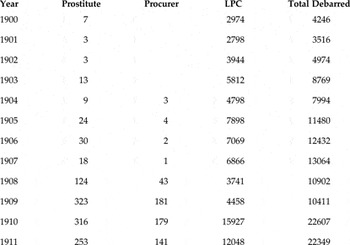
Commissioner Williams countered the women inspectors’ claims that they had prevented the entry of prostitutes and white slaves. He suggested that any immoral women they had discovered would have been uncovered by the male inspectors, and, consequently, the appointment of women boarding inspectors had resulted in not stopping one case of white slavery.Footnote 76 This claim should be doubted, because as of 1903 the number of prostitutes barred from entering the country began to rise, though, as Martha Gardner and Deirdre Moloney have shown, the Immigration Bureau showed a marked preference for labeling women they suspected of immorality as “likely to become public charges,” because the burden of proof required by the Boards of Inquiry for these exclusions was notably lighter (see Table 1).Footnote 77 Nonetheless, Williams and his boss, Secretary of the Treasury Leslie M. Shaw, declared the experiment a failure within only four weeks.Footnote 78 They ordered the women not to discuss the situation with the press, and Williams told reporters that he had no criticism with the individual work of the women; rather he doubted that the scheme could accomplish any distinct goals.Footnote 79
Prostitute, Procurers, and LPCs Excluded from Entry, 1900–1911. Source: Annual Reports of the Commissioner General of Immigration, 1904–1911

The bulk of the women inspector's work was protective, and consequently, Williams argued, it fell outside the scope of government authority. Yet the women inspectors were only able to “protect” so many young immigrant girls because their position gave them governmental authority to interview recalcitrant passengers and detain suspicious individuals. In other words, though the women's protective work seemed like the exercise of private maternal duty, to perform this work required government status, which gave them paternal authority. By declaring protective work as outside of the Immigration Bureau's purview, Williams denied the need for women to exercise such authority, which provided a pretext for removing women from the Immigration Bureau's boarding teams at the Port of New York.
Campaign to Rescue the Experiment
Ellis and her allies who had worked to implement the plan responded to Williams's announcement with alarm. First, Ellis contacted President Theodore Roosevelt, who was touring the West at the time and received confirmation that the plan would not be abandoned before the end of the ninety days, which more or less coincided with his return to Washington.Footnote 80 Ellis then put together a committee composed of leaders of other organizations who would cooperate in the fight to retain the women inspectors. The committee was composed of herself, representing the WCTU, Sadie American of the National Council of Jewish Women (NCJW), Josiah Strong of the American Institute of Civil Service, and Florence Kelley of the National Consumers’ League.
In 1903, Sadie American of the NCJW coordinated the Jewish American response to white slavery. Most sensational media stories about white slavery identified the phenomenon with Jewish pimps and procurers. As a result, in the 1880s the Jewish community in London organized against white slavery in part to contain anti-Semitism. From London, anti-white-slavery Jewish activism spread to Germany and by the late 1890s to New York, where Sadie American became involved. American attended the 1899 international conference on white slavery in London, and by 1902 she had focused the agenda of the New York branch of NCJW on the topic.Footnote 81
Whereas in England the fight against the anti-Semitism surrounding the white slavery issue had been taken up by both men's and women's groups, in the United States, Jewish men's organizations remained uncomfortable with the topic of prostitution. They saw it as beyond the boundaries of respectability. Thus American and the NCJW's activities formed an important part of middle-class Jewish women's activism, and their work at Ellis Island composed the “first link in a ‘complete chain of protection’ for vulnerable Jewish immigrants.”Footnote 82
In April, Ellis's committee held two public conferences in New York City with attendees representing thirty-eight organizations to discuss the plight of the women inspectors. Commissioner Williams attended these meetings and laid out his arguments. To the audience of reformers, his case boiled down to claims that the type of work the women inspectors were doing was more akin to charity work and that the Immigration Service did not have the statutory right nor bureaucratic structure to perform such work.Footnote 83 Williams refused to answer aggressive questions about the lack of training the women had received.Footnote 84 From all accounts of the meeting, both sides—Williams representing the Immigration Bureau and those advocating for the inspectors—walked away unsatisfied.
The restructuring of the Immigration Service, which was scheduled to pass from the Department of the Treasury to the Department of Commerce and Labor on July 1, 1903, aided advocates of the women inspectors.Footnote 85 Secretary of the Treasury Shaw had been “full of objections” to the plan, whereas Secretary of the Department of Commerce and Labor George Cortelyou was more accommodating to the reformers.Footnote 86 Benefiting from the timing of the transfer, Ellis and her allies secured a hearing with Cortelyou, where they outlined their arguments. Ellis contended that the women inspectors, after a mere four weeks on the job, had not been given a “fair chance” before their work was declared a failure. She reminded the secretary that the purposes of appointing women inspectors were to detect immoral women and to “protect the innocent and unwary.” To her, the protection work was as important as the detection work, and on that standard, the women inspectors had been an unmitigated success. Ellis also countered Williams's charge that protection work fell within the purview of missionary work, noting that “no representatives of an outside society could do this work, as they would have no authority to hold a passenger for special inquiry nor be allowed to board vessels.”Footnote 87 The power to detain suspicious or vulnerable women constituted the most important governmental right for the reformers, and it formed an important part of their protection work. The immigrant inspectors often mentioned that they detained young girls whom they deemed vulnerable to seduction, compelling them to stay on the ship until they could be placed with a charitable organization that would aid their future travel or help them locate family, friends, or suitable accommodations.Footnote 88
Woven throughout Ellis's defense of the experiment, along with that of the fired female inspectors themselves, was the assertion that women were better suited than men to perceive the distress of immigrant girls. Inspector Mathilde Wichmann suggested that women were a necessary complement to male inspectors for two reasons. She noted that frequently the women inspectors engaged in conversation with female passengers “where it is obviously improper that a man, unless he be a physician, should have anything to say in the matter.”Footnote 89 These cases most commonly involved seduction and pregnancy. Additionally, Wichmann thought that because the male inspectors’ time was occupied verifying the ship's manifests, they had no opportunity to mingle with the passengers and “make personal investigations.” Without the women boarding inspectors, she implied, the men would only focus on the immediate task of checking the manifest, and women passengers would be left vulnerable.
For example, while conducting this type of personal investigation, inspector Josepha Lassoe encountered a seventeen-year-old girl who traveled across the Atlantic with her much older adoptive brother. The brother had spent the entire voyage drunk. He had abused her, taken her money, and repeatedly insulted her. According to Lassoe, the girl “begged me not to leave her.” Lassoe spirited her away from the man and found employment for the girl as a maid, for which “she was so happy and grateful.”Footnote 90 Ellis celebrated this anecdote as an example of how women inspectors were a necessary complement to the work of the men, because the women were able to mingle among the passengers and, with their compassionate, female eyes, discern trouble.Footnote 91
Further countering Williams's claims that the protection work of the women inspectors exceeded the Immigration Service's statutory power, Sadie American, like Ellis, argued that such activity fell under the section of immigration law that protected immigrants from fraud and loss. She added that the “principle of protection to immigrant women is already conceded by the installment of matrons on Ellis Island.”Footnote 92 She urged that the same principle be extended to the first- and second-class passengers. Indeed, some of the first national immigration legislation, dating to the 1840s, dealt with protecting immigrant passengers from unhealthy conditions aboard steamships.Footnote 93 For American, the leap from looking after immigrant women's physical health to overseeing their moral health was obvious and logical.
Josiah Strong, the one male member of the committee, testified against the many arguments posed by Williams and Sargent that women were not especially qualified for inspection work. He suggested that Williams was primarily motivated by sexism: “The appointment of women to offices formerly monopolized by men is an innovation against which there is always much prejudice.” He pointed to the fact that the same arguments had been made against police matrons and women factory inspectors. Strong accused Williams of poisoning the experiment from its launch and suggested that because Williams opposed the protection work and would not allow male inspectors to do it, if the female inspectors were not retained, then all protection work would cease.Footnote 94
Secretary Cortelyou sought a solution to the clash between the reformers and the immigration officials that would appease both sides. He convinced Commissioner Williams to create a position for women on the Immigration Service's boarding team, thereby attempting to satisfy reformers who saw women as critical for combating white slavery at the point of entry. However, he allowed Williams to define the scope of duties for the women and the civil service qualifications, thereby assuring Williams of his own authority and of the authority of men over women more generally. The first thing Williams specified was that the women would not be “inspectors,” but “matrons.” Essentially the women would act in a maternal sense and thus would be returned to their proper place. More importantly, they would be subordinate to the male inspectors and would have no power to detain immigrants.Footnote 95 As a result of the civil service requirements, the four women who had worked as inspectors from February to May were disqualified from the new matron position and were replaced by women whom Williams appointed.Footnote 96 For Williams, even conceding to the establishment of matrons on boarding teams felt like defeat, and he remained opposed to the existence of such positions.
Matrons’ duties were limited to assisting male inspectors. Their job was to care for female immigrants, especially those who had young children or had been held for medical examination.Footnote 97 In this capacity of helpmate to male officials, they had no authority to detain suspicious passengers, though certainly they could use their power of persuasion to prompt their male colleagues to detain suspicious individuals. As historian Thomas Pitkin explains, “They were to act in an advisory capacity only [and according to Williams], ‘leaving the final determination of all doubtful matters to the judgment of the [male] boarding inspectors.’”Footnote 98 With their limited authority, the boarding matrons lacked the influence that women in nongovernmental organizations like the NCJW had at Ellis Island. Johnson notes that the NCJW could “detain women” and “even prevent immigrants from being held by officials or from being deported.”Footnote 99 By so severely restricting the authority of the boarding matrons, the Immigration Bureau restored the privileges of class, ensuring that first- and second-class passengers would be free from inappropriate scrutiny by inappropriate representatives of governmental power. Even with continued hostility from Williams, who in 1904 complained that the work remained too dangerous for women, boarding matrons inspected 326 ships between November 1903 and April 1905.Footnote 100
The matron's loss of power constituted a bitter blow to Ellis. She later complained that the actions of the matrons remained constrained by sexism within the immigration service and that matrons might otherwise serve as valuable weapons against white slavery.Footnote 101 According to Ellis, the immigration commissioner's response to the boarding matrons’ work had been “utter indifference.”Footnote 102 One of the new boarding matrons reported that because they were aware that the women inspectors “got into a row” with the male inspectors, the matrons developed an unspoken policy of being “too modest.”Footnote 103 At one point the head of the boarding division at New York stopped allowing the matrons to board the revenue cutters because he deemed it unsafe to travel through the bay with women on board.Footnote 104
Progressive Era feminists appreciated the political significance of women working for the federal government, and they followed the story closely in The Women's Journal.Footnote 105 Pro-suffrage publications throughout the country celebrated women's work for the government in all capacities as proof of the growing support for equal rights. Years later activist Grace Abbott would note that lack of training kept the matrons largely ineffective in protecting incoming girls vulnerable to seduction, fraud, or coercion. She described the position of matrons as a “cross between a housekeeper and a chaperon,” but due to unequal pay and a lack of training they could not really provide the aid that immigrant girls needed.Footnote 106 The demotion of the women boarding inspectors did not silence calls for the Immigration Bureau to employ women for the protection of female passengers. In 1908 Frances Kellor asked, “Has our government any matrons . . . who make it impossible for the procurer [of prostitutes], who wishes to travel steerage of second cabin for the purpose of meeting her, to accomplish his purpose?”Footnote 107
The Immigration Bureau occasionally hired women to conduct undercover investigations into immigrant conditions. For example, in 1907, Helen Bullis was dispatched to the streets of New York City to investigate potential cases of white slavery. Her work was conducted largely in private, or with one male official, and she reported directly to the immigration commissioner. In other words, her work was clandestine, and she had no authority over co-workers nor immigrants.Footnote 108 Similarly, the U.S. Immigration Commission, popularly known as the Dillingham Commission, dispatched Anna Herkner to pose as an immigrant so that she could investigate the moral conditions in steerage. Her report excoriated the steamship companies and led to a 1909 law that limited the number of people on transatlantic voyages, reforming the crowded conditions in steerage but leaving the first- and second-class cabins untouched.Footnote 109 The Immigration Commission also made use of women as undercover agents in its white slavery report.Footnote 110 Thus, women could be valuable as invisible investigators in special reports, but they could not retain authority and a permanent position as representatives of the state.
Williams left his position as immigration commissioner of New York in January 1905 but returned in May 1909. At that time, he quickly took advantage of the fact that the coalition that had worked to retain the women inspectors had evaporated, and he abolished the position of boarding matrons entirely.Footnote 111
The Progressive Era was characterized in part by the growth of women's influence in politics. However, women's influence occurred primarily through philanthropic channels or through the activism of organizations like the Woman's Christian Temperance Union. Mary Dye Ellis of the WCTU used her personal relationship with the president to advocate for a new role for women in the Immigration Service. She intended the ninety-day experiment to confirm that women, with their gendered ability to perceive the dissemblance of other women, were well suited to help protect the nation from immoral women while also protecting vulnerable immigrant women from calculating men. As the WCTU and its allies tried to carve out a space for women within the Immigration Bureau, they ran into the obstacle of William Williams, who took a dismissive view of women reformers and their goals, a gendered view of who could wield governmental authority, and a disingenuously narrow view of government responsibility toward immigrants.
One should not, however, dismiss this episode as merely revealing two conflicting visions about the appropriate role of government. Roosevelt appointed Williams to clean up corruption and waste at the Port of New York, and one area that he especially targeted was the cheating of immigrants by the various businesses on Ellis Island. This campaign to clean up corruption and “swindling” depended on his belief that the government had a duty to protect immigrants. Williams proclaimed, “It is the duty of all Government officials to go out of their way to protect immigrants against every kind of imposition.”Footnote 112 However, for Williams the ability to “protect” was coded as male. Women boarding inspectors' activities of protection did not, in his eyes, constitute real protection. They were not “real inspectors,” and their work was not “real” protection. Instead it was a type of social work.
Throughout the Progressive Era, women's rights activists and publications celebrated women's expanded opportunities in the public sphere—particularly new roles in government service. By 1920, women had their own bureau in the Department of Labor, and they led and staffed the Children's Bureau. In localities across the country, women acted as state inspectors, members of school boards, and police matrons. Still, the 1903 experiment of implementing women boarding inspectors illustrates that the ability of women to represent and exercise governmental authority was both highly gendered and vigorously opposed in the early 1900s. It highlights the perseverance of activists who sought positions for women in civil service, a continuing goal throughout the twentieth century and a central concern of the 1963 President's Commission on the Status of Women.Footnote 113 It suggests that every new role for women in public life was gained by intense struggle and that victory could never be assured.
The Immigration Bureau's emphasis on detecting and policing morally suspicious women over protecting potentially vulnerable immigrant girls recalls that as the bureau faced a rising tide of immigration, it deferred to gendered habits of mind that saw women as either embedded in patriarchal families as wives or daughters or as potential prostitutes. The women inspectors argued for their position based on their belief that maternal instincts would help them protect the boundaries of the nation by policing the boundaries between respectability and immorality. In demanding the badge, the power to detain, and the right to possess governmental authority, they traversed the boundary between acceptable and unacceptable female exercises of authority, while also crossing from maternalism to paternalism.