INTRODUCTION
Acartia tonsa Dana, 1849, an abundant and widely known cosmopolitan, estuarine copepod, generally inhabits environments of low salinity—close to 20 (e.g. Tester & Turner, Reference Tester and Turner1991; Cervetto et al., Reference Cervetto, Gaudy and Pagano1999; Calliari et al., Reference Calliari, Andersen, Thor, Gorokhova and Tiselius2006) and high-food availability (Paffenhöfer & Stearns, Reference Paffenhöfer and Stearns1988). However, this species also occurs during periods and zones with higher salinities within eutrophic estuaries such as Bahía Blanca Estuary (chlorophyll-a maximum around 40 µg.l−1; Gayoso, Reference Gayoso1998) where it reaches high abundances (Hoffmeyer, Reference Hoffmeyer, Ferrari and Bradley1994, Reference Hoffmeyer2004). Eurytemora americana Williams, 1906, a low abundance estuarine copepod in northern hemisphere estuaries (Deevey, Reference Deevey1960; Jeffries, Reference Jeffries1962; Heron, Reference Heron1964; Bousfield et al., Reference Bousfield, Filteau, O'Neill, Gentes and Cronin1975; Avent, Reference Avent1998) is adapted to cold-intermediate temperatures such as those registered during winter in the Sandy Hook Bay area (from <1 to 15ºC) (Sage & Herman, Reference Sage and Herman1972). It is also adapted to intermediate salinities and to those approaching marine values ranging between 10 and 33 in the deep marine layer of the Dwamish River Estuary (Avent, Reference Avent1998) or around an average of 24 or less (Sage & Herman, Reference Sage and Herman1972).
These copepods use resting egg production as a survival strategy (Zillioux & Gonzalez, Reference Zillioux, Gonzalez and Battaglia1972; Marcus et al., Reference Marcus, Lutz, Burnett and Cable1994; Marcus, Reference Marcus1996) for greater resilience to seasonal and interannual changes (Katajisto, Reference Katajisto2006). Acartia tonsa frees eggs immediately to the seawater (broadcasting spawner) whereas E. americana preserves them in a sac until they hatch (egg-carrying spawner) (Kiørboe & Sabatini, Reference Kiørboe and Sabatini1994). Acartia tonsa produces resting eggs with arrested development which hatch when environmental conditions become suitable (Grice & Marcus, Reference Grice and Marcus1991; Holmstrup et al., Reference Holmstrup, Overgaard, Sorensen, Drillet, Hansen, Ramlov and Engell-Sorensen2006; Katajisto, Reference Katajisto2006). Eurytemora americana most likely adopts a similar strategy to that of E. affinis, which produces true diapause eggs (Ban & Minoda, Reference Ban and Minoda1990; Katajisto, Reference Katajisto2006). A comparative analysis of the seasonal cycles and recruitment strategies of A. tonsa and E. americana provides interesting and relevant data on which to base further studies.
In Bahía Blanca Estuary the two copepods under study are key species within the holoplanktonic fraction of mesozooplankton (Hoffmeyer, Reference Hoffmeyer2004). Acartia tonsa inhabits throughout the year with maximum abundance values in late summer and autumn (February–April) and minimum ones in winter (June–August). Overwintering appears to occur in the form of resting eggs which subsequently give rise to the first post-winter offspring (Sabatini, Reference Sabatini1989). Eurytemora americana on the other hand is a recent invader in this estuary, supposedly introduced via ballast water (Hoffmeyer, Reference Hoffmeyer, Ferrari and Bradley1994; Hoffmeyer et al., Reference Hoffmeyer, Frost and Castro2000). Each year it develops a planktonic pulse beginning in June and lasting until October, during which period this species coexists with A. tonsa. Thereafter the species abruptly disappears from the water column and is thought to remain for the rest of the year as diapause eggs in bottom sediments (Hoffmeyer, Reference Hoffmeyer2004). Over approximately the last twenty years this invading species has become the most abundant calanoid copepod in the estuary from August to October, causing a temporal exclusion of A. tonsa (Hoffmeyer et al., Reference Hoffmeyer, Frost and Castro2000; Hoffmeyer, Reference Hoffmeyer2004; M.S. Hoffmeyer, unpublished data). Just like E. velox and E. affinis, which have extremely high adaptation capabilities enabling them to invade different habitats (Lee, Reference Lee1999), E. americana has demonstrated its potential as an invasive organism able to make more efficient use of the resources and conditions of the study environment (Hoffmeyer & Prado Figueroa, Reference Hoffmeyer and Prado Figueroa1997). This species has also apparently been found as an invader in some bays of the Beagle Channel, Argentina (Fernández Severini & Hoffmeyer, Reference Fernández Severini and Hoffmeyer2005; Biancalana et al., Reference Biancalana, Barría de Cao and Hoffmeyer2007).
Acartia tonsa and E. americana co-occur with other holoplanktonic copepods in several habitats such as the Sandy Hook Bay area within New York Bay (Sage & Herman, Reference Sage and Herman1972). However, to our knowledge there are as yet no reports in the literature on the coexistence of these copepods in other sites around the world, adding particular importance to the observance of this phenomenon in the Bahía Blanca Estuary. The population dynamics of these copepods is relatively well known in this estuary (Sabatini, Reference Sabatini1989; M.S. Hoffmeyer, unpublished data). Nevertheless, no data are available to date on the seasonal cycle of these two species in parallel with the environmental variability along the entire coexistence period. Similarly, no evidence is available as yet on the main environmental factors involved and how they regulate the development of these two populations in the Bahía Blanca Estuary.
The aim of this study was therefore to examine the seasonal variation of A. tonsa and E. americana populations in relation to environmental variability during the coexistence period. Owing to the particular environmental features, this period of coexistence is of crucial importance for the development of both copepod populations.
MATERIALS AND METHODS
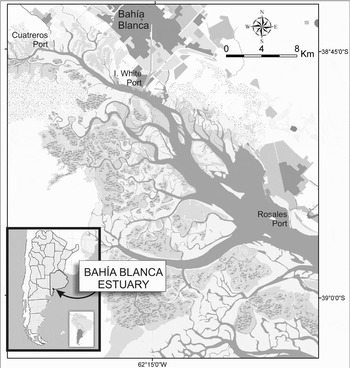
Bahía Blanca Estuary (39º S 62ºW) is a mesotidal, plain, temperate and turbid estuary, located in the south-western Atlantic Ocean. This study was performed at Cuatreros Port, which is located in the innermost zone of this estuary (Figure 1). At this site, water depth is approximately 10 m at high tide and the tidal range is close to 4 m.
Map of the Bahía Blanca Estuary and location of Cuatreros Port.

Sampling was carried out at Cuatreros Port under high-tide conditions twice a month from 15 April to 27 November 2002. No attempt was made to sample from December to March since the focus of this study is restricted to the coexistence period of the two species. Temperature (Temp) and salinity (Sal) were registered in surface water using a Horiba electronic multiparameter sensor. Water samples were collected for pigment analysis from the surface (0.5 to 2 m depth-water) using a 2 l Van Dorn bottle. Chlorophyll-a (Chl) and phaeopigment concentrations (Pha) were determined with a spectrophotometer according to Lorenzen (Reference Lorenzen1967). Solar irradiation was registered in situ by means of a total incident radiation sensor located in the sampling site, offering readings every 10 minutes throughout the study period. Based on these incident solar radiation data, accumulated radiation (AR) was calculated from the sum of daily radiation values during fifteen days before each sampling date, and daily irradiation (DI) was calculated from the sum of all 10 minute values obtained for each sampling date. The photoperiod (Pho) was taken as the number of light hours on a same day.
Each mesozooplankton sample was obtained by means of 20 vertical hauls by hand from a depth of 4 m up to the surface and subsequent concentration. A 200 µm-mesh, 0.30 m diameter plankton net was used at a speed close to 1 m per second. Samples were preserved in 4% buffered formalin. Water samples were collected from the same depth stratum using a Van Dorn bottle. Samples were preserved in Lugol solution to study the egg and nauplius larvae content of both copepods. Copepodites I to V, females and males, and nauplii of both A. tonsa and E. americana and A. tonsa eggs found in bottle samples, were identified according to Grice (Reference Grice1971), Heron (Reference Heron1964), Hoffmeyer et al. (Reference Hoffmeyer, Berasategui, Piccolo, Fernandez Severini, Menéndez and Biancalana2003) and Sabatini (Reference Sabatini1990). No E. americana eggs were found in the samples since they quickly hatch to nauplius larvae as soon as they are mature. All developmental stages were quantified according to the overall mesozooplankton abundance in the samples either by counting several aliquots or by total counting. Abundance values of each stage were calculated taking into account the corresponding sample volume (bottle–net) and expressed in number per cubic metre.
Time series data of all variables (N = 16) were analysed using the direct gradient analysis from the CANOCO software package. A canonical correspondence analysis (CCA) (ter Braak, Reference ter Braak1986) was applied to environmental variables without standardization and to log-transformed (log X + 1) abundance data of the different development stages of the two copepods. This ordination method was selected to determine the relationships between environmental and biotic variable matrices and sampling dates (ter Braak & Verdonschot, Reference ter Braak and Verdonschot1995; Lepš & Šmilauer, Reference Lepš and Šmilauer2003). Although generally applied to spatial data, some studies such as Antunes et al. (Reference Antunes, Abrantes and Gonçalves2003) and Dejen et al. (Reference Dejen, Vijverberg, Nagelkerke and Sibbing2004) report the successful application of this technique to time series data. CCA permits the extraction of synthetic gradients from the biotic and environmental matrices, which maximize the niche separation among species and are quantitatively represented by arrows in biplots or triplots (ter Braak & Verdonschot, Reference ter Braak and Verdonschot1995). The length of the arrow indicates the degree of importance of the explanatory variable in the ordination, and the direction of the arrow indicates positive or negative correlations. Firstly, this test was applied to all variables but in a second step daily irradiation (DI) and accumulated radiation (AR), two redundant and highly inter-correlated variables, were removed from the data set to achieve higher statistical power. Although the focus of this study is mainly observational, the Monte Carlo permutation test was also used to explore the probable significance of the relation between biotic and explanatory variables (ter Braak, Reference ter Braak1986; ter Braak & Verdonschot, Reference ter Braak and Verdonschot1995).
RESULTS
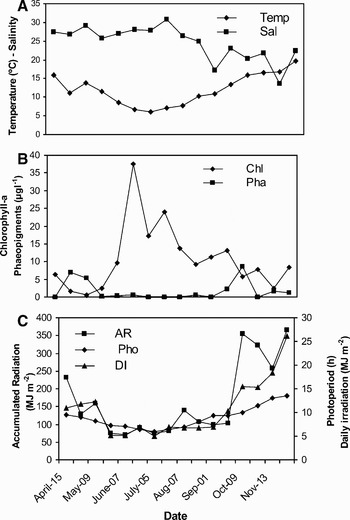
The seasonal variability of physical and chemical variables analysed in this study are shown in Figure 2. Temperature, photoperiod and radiation displayed minimum values in winter (July) whereas chlorophyll-a showed maximum values in this season. Salinity, on the other hand, displayed the lowest values in spring and values higher than usual during autumn–winter.
Environmental conditions during the study period. (A) Temp, temperature and Sal, salinity; (B) Chl, chlorophyll-a and Pha, phaeopigments; (C) DI. daily irradiation and Pho, photoperiod and AR, accumulated radiation.

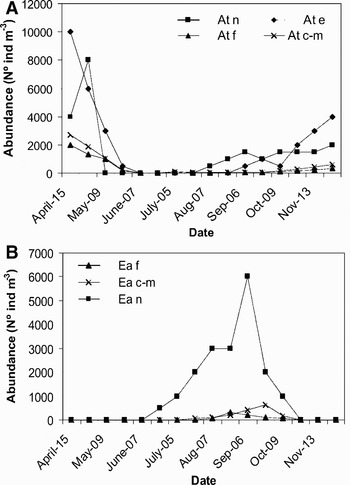
Acartia tonsa eggs and nauplii (At e and At n) decreased from 10,000 and 8000 m−3 respectively in April–May to almost total absence between June and September (Figure 3A). This decrease coincided with a remarkable decrease in females (At f), copepodites and males (At c-m) from a maximum 2698 m−3 in April to only 12–60 m−3 from June to August. Later, the number of eggs and nauplii increased to approximately 4000 and 2000 m−3, respectively, whereas females, males and copepodites increased up to 599 m−3 at the end of November. Eurytemora americana nauplius larvae (Ea n) in bottle samples at the end of June (Figure 3B) were the first developmental stage observed in this species, all the other stages being absent both in bottle and net samples. From this moment onwards, nauplii (resulting from subitaneous egg hatching) increased to a maximum of 6000 m−3 at the beginning of September, diminishing to 1000 m−3 at the beginning of October. These larvae were immediately preceded by a female peak of which more than 50% was ovigerous (Ea f). Between the beginning of July and mid-October, copepodites and males (Ea c-m) showed a peak of 235 ind m−3 at the end of September, thereafter diminishing until completely disappearing together with females and nauplii from the plankton.
Abundance of Acartia tonsa (A) and Eurytemora americana (B). (A) At e, eggs; At n, nauplii; At f, females and At c-m, copepodites and males. (B) Ea n, nauplii; Ea f, females and Ea c-m, copepodites and males.

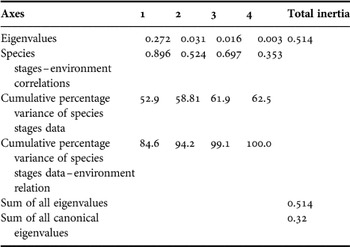
According to the results of the canonical correspondence analysis (Table 1), eigenvalues ranged from 0.272 for axis 1 to 0.005 for axis 4. The first eigenvalue (axis 1) was high whereas those for axes 2, 3 and 4 were low (i.e. <0.05). Species–environment correlations were high for all four axes, ranging from 0.896 for axis 1 to 0.353 for axis 4. The combined sum of canonical eigenvalues (0.32) equalled 62.26% of that for the unconstrained eigenvalues (0.514). The cumulative percentage of species variance accounted for by the CCA added up 62.5% for the first four axes. However, the cumulative percentage of the species–environment relation added up 100% for these axes. Because the first two axes explained 94.2% of the cumulative percentage of the species–environment and 100% were accounted for by the first four axes, the latter two axes were not interpreted further.
Results of the canonical correspondence analysis.

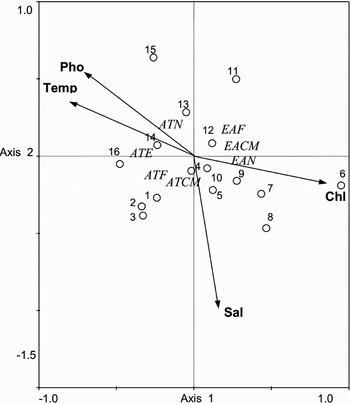
The triplot constructed with axes 1 and 2 (Figure 4) shows the main features of environmental gradients, each one with a vector length indicating the magnitude and an arrow indicating the direction of the increase. The plot also displays the position of the chronologically numbered sampling dates and biotic variables associated with the gradients representing the correlations. It can be observed that the gradients of temperature and photoperiod show a similar trend, increasing to the left and top of the graph. These variables were also highly intercorrelated. The chlorophyll-a gradients and salinity gradients show the opposite trend, towards the right and bottom, respectively, of the same quadrant of the graph. The strongest gradients were observed for chlorophyll-a, photoperiod and salinity, followed in order of magnitude by temperature. Figure 4 also shows two well-defined groups of variable points and dates. The first group, seen on the left, is made up of sampling dates in April (1–2), May (3–4), the end of October (14) and November (15–16) and the different development stages of A. tonsa: eggs (ATE), nauplii (ATN), females (ATF) and copepodites-males (ATCM). A positive correlation is seen with temperature (Temp) and photoperiod (Pho), and a negative correlation with salinity (Sal) and chlorophyll-a (Chl). The second group, on the right, shows sampling dates from June, July, August, September and the beginning of October (5–13) and the different developmental stages of E. americana: nauplii (EAN), females (EAF) and copepodites-males (EACM). In this case, a positive correlation is seen with chlorophyll-a and salinity, and a negative correlation with temperature and photoperiod.
CCA ordination diagram with axes 1 and 2. Developmental stages of the two copepods: circles, chronologically numbered sampling dates; and arrows, explanatory variables.

The Monte Carlo permutation test showed that the only significant relationships between biotic and environmental variables were those with chlorophyll-a (F 8.96, P 0.002 **) and salinity (F 3.82, P 0.032 *).
DISCUSSION
From April onwards the A. tonsa population developed mainly through the hatching of subitaneous eggs, recruiting nauplius larvae and copepodites up to July, when water temperatures range between 6 and 7.2ºC. These stages came from the maximum population peak of adults in the estuary at the end of summer–beginning of autumn (February–March), after which the overall abundance slowly declined as temperatures decreased. In October and November as well, recruitment was based mainly on larvae hatched from subitaneous eggs. The latter demonstrates once more that the A. tonsa population is positively affected by increases in temperature (Conover, Reference Conover1956; Uye & Fleminger, Reference Uye and Fleminger1976; Landry, Reference Landry1983; Ambler, Reference Ambler1985; Sabatini, Reference Sabatini1989), photoperiod and radiation as well as by decreases in salinity. The observed peak of nauplii during August and September, occurring before the subitaneous eggs peak, and the sparse number of females from June to August clearly indicate that the origin of these larvae is the reserve of resting mud eggs. The hatching of resting eggs that emerged in August is a direct consequence of the temperature increase to 8ºC and higher. This finding is supported by the studies of Katajisto (Reference Katajisto2006) and Katajisto et al. (Reference Katajisto, Viitasalo and Koski1998) on A. tonsa in the northern Baltic Sea, where this species shows a small peak produced by resting egg hatching only at the end of summer–autumn (with temperatures between 8 and 14ºC). In that area the species disappears for the rest of the year when temperature decreases, giving rise to a short-term planktonic pulse mainly because of the colder annual temperature range. Conversely, along the temperate coasts of South America, where the temperature range is higher, A. tonsa persists in the plankton all year round as occurs in Bahía Blanca Estuary (Hoffmeyer, Reference Hoffmeyer, Ferrari and Bradley1994, Reference Hoffmeyer2004). For eggs in the bottom mud, the mid-winter conditions in this estuary resemble those reported by Holmstrup et al. (Reference Holmstrup, Overgaard, Sorensen, Drillet, Hansen, Ramlov and Engell-Sorensen2006) to achieve the best storage conditions (around 5ºC, intermediate salinity and anoxia). It can thus be assumed that these conditions contribute to maintaining the eggs in a resting state in the bottom mud, corroborating the findings of Sabatini (Reference Sabatini1989) that the first generation of A. tonsa in this estuary after winter is composed of larvae hatched from resting eggs. This has also been reported by Uye & Fleminger (Reference Uye and Fleminger1976) for A. tonsa in California. These new recruits likely act as a seasonal link between the two periods (autumn–winter and late spring–summer) in the annual cycle of A. tonsa, whereby the hatching of resting eggs becomes a crucial element in the development of its population.
In the case of E. americana, the total absence of development stages and egg sacs in net and bottle samples in mid-June, when only larvae were observed in bottle samples, indicates that the planktonic pulse of this population directly derives from the hatching of diapause eggs emerging from the bottom mud. Though this assumption is based only on field data, it is supported by similar observations on samples collected from the surface and deep strata at other points within the innermost estuarine zone (close to the estuary head) all along the distribution area of E. americana during the winter of 1990 (Hoffmeyer, Reference Hoffmeyer, Ferrari and Bradley1994) and 1998 (Hoffmeyer, unpublished results). This finding is also in agreement with observations reported by Sage & Herman (Reference Sage and Herman1972) on the spatial and seasonal pattern of this species in Sandy Hook Bay USA, where E. americana occurs in the period extending from February to April between minimal winter temperatures (< 1ºC) and those around 15ºC; and with the diapause behaviour of the congeneric species E. affinis in Lake Ohnuma (Ban & Minoda, Reference Ban and Minoda1990), though in this case, the timing of the planktonic pulse is quite different (May to November).
Our results show that the abundance of E. americana nauplii in June is mainly associated with the highest chlorophyll-a and salinity values and also the lowest temperature and photoperiod-radiation values. It would therefore appear that these conditions trigger the hatching of diapausal eggs, favouring the onset of the planktonic pulse. Furthermore, temperature data from surface bottom sediments (1–5 cm deep) registered in Cuatreros Port during 2003 and 2004 show a significant positive correlation with surface water temperature (Hoffmeyer & Beigt, unpublished data). In both years, the bottom sediment temperature values decreased abruptly at the end of autumn, and water temperature values decreased from 18ºC at the end of May to 13ºC at the beginning of June. Although we have no similar data for 2002, a comparable decrease could have occurred. It can therefore be surmised that this thermal drop triggers the E. americana plankton pulse by directly inducing the hatching of diapausal eggs when they leave the sediment. A similar process may occur in the habitats of origin of E. americana in waters of intermediate latitudes such as those in California or the east coast of the USA. Resting eggs of Acartia hudsonica in Rhode Island (USA) also have the ability to hatch in cold waters (Sullivan & McManus, Reference Sullivan and McManus1986). Findings by Katajisto (Reference Katajisto1996) on E. affinis are quite different, coinciding with those of Ban & Minoda (Reference Ban and Minoda1990) on the same species and showing that diapause eggs hatch at higher temperatures but require prior chilling. It can be assumed that E. americana eggs also need a refractory period before they are able to hatch.
Recent findings on E. americana in Ushuaia and other northern bays of the Beagle Channel (Tierra del Fuego) all year round (Fernández Severini & Hoffmeyer, Reference Fernández Severini and Hoffmeyer2005; Biancalana et al., Reference Biancalana, Barría de Cao and Hoffmeyer2007) provide additional information on its life cycle in that area. The annual temperature ranges from approximately 5ºC in winter to 10ºC in summer. These low temperatures would permit to this species population inhabiting the plankton on the basis of subitaneous egg production.
In this study, after the appearance of the first nauplius larvae, the development of the population of E. americana occurred mainly through the recruitment of larvae from subitaneous egg hatching associated with low-to-intermediate temperatures (8 to 17ºC), an increase in radiation, and a gradual decrease in chlorophyll-a and salinity (from August to October). The unusually high salinities (Freije et al., Reference Freije, Asteasuain, Sagua de Schmidt and Zavatti1981) found in this estuary during winter also seem to have contributed to the development of this population. The E. americana pulse lasted from mid-June to mid-October, in agreement with observations from 1990 and 1998 (Hoffmeyer, unpublished results). However, in 2005 the sporadic presence of a small number of copepodites I–III was observed in net samples from Cuatreros Port and also from Villarino Viejo (a neighbouring site located towards the head of the estuary) at the end of April and May (M.C. Menéndez & M.D. Fernández Severini, personal communication). These more recent observations appear to indicate the onset of the E. americana planktonic pulse, suggesting an interannual variation in timing and possibly in the duration of this species' pulse. This interannual variation could be due to differences both in the timing and range of magnitude of the optimal environmental conditions (chlorophyll-a, salinity, photoperiod and temperature) and possibly to other factors not considered in this study.
Eurytemora americana, classed as herbivorous on the basis of its oral field and cephalic appendices (Hoffmeyer & Prado Figueroa, Reference Hoffmeyer and Prado Figueroa1997; Hoffmeyer et al., Reference Hoffmeyer, Frost and Castro2000), must take advantage of the winter–spring phytoplankton bloom. This winter–spring scenario, coupled with low-to-intermediate temperatures, appears to provide the optimal conditions for development of this invader species, allowing it to make full use of phytoplanktonic resources at the precise moment when abundance of A. tonsa is very low, as has been observed in recent years. Besides the trophic competition between E. americana and A. tonsa (Hoffmeyer & Prado Figueroa, Reference Hoffmeyer and Prado Figueroa1997), other biotic factors such as selective predation by fish larvae–ctenophore (Sardiña, Reference Sardiña2004; L. Tejera, personal communication) seems to contribute to the A. tonsa decrease during winter and spring.
The Canonical Correspondence Analysis was successful to determine the features and patterns of environmental gradients and their relation with the two groups of biotic variables. However, the low number of observations used in this study could have diminished the statistical power of the test. On the other hand, when the number of environmental variables was reduced, a better result was obtained: a discernible increase was observed in the cumulative percentage variance between environmental and biotic variables.
On the basis of our results it can be concluded that gradients of the main environmental factors likely give rise to a certain niche separation facilitating the coexistence of the two copepod populations within the period studied. Furthermore, resting eggs not only appear to be important for A. tonsa overwintering but are also indispensable for triggering the E. americana plankton pulse. Since the current study is of a basically descriptive nature, the causal relationships behind the observed patterns discussed above constitute mere hypotheses to be addressed in future work.
ACKNOWLEDGEMENTS
We thank E. Dos Santos, L. Kaufman, B. Ferlito, and A.Vitale for their help with sampling and all the staff of the Instituto Argentino de Oceanografía for their collaboration in carrying out this research. Financial support to M.S. Hoffmeyer (PIP 3003/00, CONICET, PICTR090/02, ANPCyT) and M.C. Piccolo (PICT 07-12421, ANPCyT) is also acknowledged. Thanks are also due to T. Katajisto for her comments on the first version of the manuscript, M.W. Palmer for his suggestions on statistical procedures to improve the data analysis and three anonymous referees.