

1. INTRODUCTION
The relationship between demography and crime has been emphasized by many economists, sociologists, psychologists, and criminologists, showing that individual demographic characteristics such as age, gender, and race are important factors influencing the probability of a subject being involved in criminal activities, at both individual and macro-level of analysis. However, demographers have devoted even more attention to the possible correlations between father and child crimes, given the importance of the “family” for the development of criminal and other problem behaviors among young people [Turney (2017)]. It is often stated that crime tends to run in families, which drives the underlying mechanism of the intergenerational transmission of crime,Footnote 1 and there is an extensive empirical literature showing a significant relationship between the criminal behaviors of fathers/parents and their children.Footnote 2
One of the most important recent studies was that of Farrington et al. (Reference Farrington, Coid and Murray2009), a longitudinal survey of 411 males living in London who were followed from the age of 8 to 50. The authors found that offending was highly concentrated in families, with intergenerational transmission of criminal behavior over generations, particularly for same-sex family components such as father–son. However, the above authors did not establish the precise mechanisms of the genetic and environmental factors in determining crime rates. Another European empirical study in the Netherlands was carried out by van de Rakt et al. (Reference van de Rakt, Nieuwbeerta and De Graaf2008), who analyzed official data from the Criminal Career and Life Course Study of 8,085 convicted men and their children over four decades. The results confirmed that the number of convictions of fathers was substantially related to the number of convictions of their children, even after controlling for age and gender. Children whose fathers belonged to the more persistent trajectory group in their offending also had a higher chance of belonging to such a trajectory group of offenders. Even much larger data set was used by Hjalmarsson and Lindquist (2012) in Sweden to investigate how much of the intergenerational crime relationship can be explained. The results show that controlling for parental human capital and parental behaviors can account for most of the observed intergenerational crime correlation as well as the importance of fathers as role models.Footnote 3
Significant intergenerational transmission of antisocial behavior has been reported in other longitudinal studies conducted in the United States. The widely cited study of Farrington et al. (2001), analyzing 1,395 boys from Pittsburgh aged 8, 11, or 14, showed that the most important relative in predicting a boy’s delinquency was his father, independently of all other relatives who had been arrested. Thornberry (Reference Thornberry2009) also analyzed the problem of intergenerational continuity in antisocial behavior from a life-course perspective study using the Rochester Intergenerational Study (RIGS). They found that high-contact adolescent drug use and delinquency of fathers was significantly associated with their children’s criminal behavior.
There are several explanations of the role of fathers (or parents) on their children’s crimes. Farrington et al. (Reference Farrington, Jolliffe, Loeber, Stouthamer-Loeber and Kalb2001) summarize the traditional mechanisms discussed in the literature. Apart from genetic predisposition, children’s criminal activities may be related to processes of imitation of antisocial behavior, driven by a deficiency in human capital investment and worsened by a very unfavorable social environment. Thus, living in deprived neighborhoods or in a state of poverty may explain some of the criminal behavior transmitted from one generation to another. If imitation (or learning) is the causal mechanism underlying the transmission of criminal behavior, then we would expect that (at least) part of the correlation between the convictions of siblings would affect the extent of that correlation. This gives rise to speculation as to whether the absence of the father from the family leads to benefits or costs in terms of the criminal activities of their children, since the cause of the father’s absence may worsen or enhance their criminal careers [Barbarino and Mastrobuoni (2014)].
This paper examines the role of paternal crime on the recidivism rates of young criminals, a cohort of adolescents convicted of crimes in Italy. Several studies have shown that criminality among family members is a strong predictor, not only of first-time offending but also of recidivism. The meta-analysis of Cottle et al. (2001) identified the risk factors which best predict juvenile recidivism and showed that family and social variables, such as being raised in a single-parent home or in one with severe family problems, were significantly associated with recidivism. Thus, better understanding of the dynamic risk factors correlated with recidivism rates may be useful for policy-makers to identify strategies to reduce persistent criminal conduct and allocate resources for interventions affecting juveniles or adults. We focus on the development of the criminal careers of young people from 2001 (when the children were 14 years of age, until they were under 18) using a longitudinal and nationally representative data set administered by the Italian Department of Juvenile Justice (DJJ). This data set was unique and particularly suited to our purpose, because it records convictions and variables, at both individual and family level, of young criminals representative of the Italian cohort of 1987. Following their criminal careers, we merged this juvenile crime data set with that of the Italian Department of Prison Administration (DPA) which registered crimes from 2005 to 2011, following criminal histories in adults aged up to 24 (i.e., the latest records, in 2011). Measures of the recidivism rates of young criminals, distinguishing types of crime as well as indicators regarding fathers (or parents) involved in crime were built to test their correlation from a statistic viewpoint.
This work adds information to the literature in several ways. This is the first time that it has been possible to estimate consistently the father(parent)-offspring relationship and its underlying mechanisms for Italy, in view of the difficulty in collecting sparse data from juvenile and adult judicial systems and the cost of collecting information from noncomputerized registers. As noted above, this is a topic widely discussed in the United States, UK, the Netherlands, and Scandinavia, but less so in other European countries. More importantly, our research improves upon the limited body of research on the criminal careers of juvenile offenders (recidivism), analyzing the father’s role in a cohort of young criminals in Italy which is generally less studied [van de Rakt et al. (Reference van de Rakt, Murray and Nieuwbeerta2012)]. Although recidivism is the more usual criterion used internationally to define criminal careers, it is very difficult to find its outcome, because it requires collating the (confidential) records from juvenile courts with those of adult courts. This allows us to answer the main question of interest for policy-makers: Is it possible to identify a risk factor for juvenile criminals in the paternal component of the family, in order to prevent children to continue their problematic path into adulthood? We extend this research question by empirically testing the father’s role on groups of crimes which are more frequent in nonadult age, distinguishing theft, and drug-related offenses.
Our basic finding is that fathers with criminal records do contribute to their children’s criminal activities, and this is equally important both when the number of recorded offenses over time is applied and when the probability of committing a new crime is examined. By controlling for other fathers’ transmission mechanisms, including a set of observable individual and family variables, our regression estimates indicate that some part of the father–child correlation is not explained by the controls. These findings do not change when we extend our approach to the parent–child relationship. By analyzing the father–child association for fathers in prison, the estimated correlation shed some light on the unobservable transmission of crime. Adding the large set of controls to proxy various kinds of individual and family confounding, the coefficient estimating father–child transmission of crime mechanisms, is generally significant, irrespective of type of crime committed from young criminals. However, a greater correlation left unexplained in “theft and drugs” indicates that for these crimes the absence of the father may be a potential channel for his child’s criminal career.
This paper is organized as follows. Section 2 introduces some specific characteristics of the juvenile penal system and some basic statistics on crime records in Italy and other countries, and Section 3 presents basic theory on the correlation between the antisocial/criminal behavior of fathers and their children. Section 4 describes data. In particular, we discuss the survey design, which allows us to extract a representative sample of criminal youth cohorts, and to list the baseline descriptive characteristics of our sample. Section 5 presents raw estimates of father–child criminal associations, and the inclusion of individual and family variables sheds light on the underlying mechanisms of the father as role model – in particular, linked to his absence in the family circle due to his being in prison. Section 6 concludes.
2. BACKGROUND: JUVENILE PENAL SYSTEM AND CRIME IN ITALY
Justice systems for young people over the World are not homogeneous. In general, policies on justice for young people must accommodate to the sociopolitical and cultural background of the country and the specific regional and local context, although the recent history of the juvenile penal system has indicated a return to more correction-oriented interventions in several countries such as the United States and Australia. Also, some European countries, such as Finland or Belgium, weakened over time special judicial measures to protect juvenile offenders from the more severe consequences of adult justice.
However, the trends in other countries did not affect the Italian Juvenile Justice system maintaining and strengthening the Procedural Reform Act, approved in 1988 which was addressed to delinquent juveniles between the ages of 14 and 17 years. The application of specific laws tended to avoid giving prison sentences and significantly expanded alternative measures to incarceration for juveniles (house arrest, probation, nonsuit judgments, pardons for juvenile criminal offenders) in order to guarantee the normal process of education and inclusion in social life of juvenile offenders [Meringolo (2012)].
The results for juvenile criminality were evident. Italian juvenile courts have considerably reduced prison sentence orders over time: From more than 7,000 entries each year before the year 2000, the numbers fell to 1,200 in 2009 and to 992 in 2014 [Ministry of Justice (2015)]. Only youths convicted of serious crimes were sent to juvenile detention centers. Nelken (2006) argued that the statistics of the rates of juvenile incarceration were very low compared with those of Anglo-American culture, and suggested that the underlying tolerance displayed toward juvenile offenders in Italy may be due to the important role played by the Catholic Church in guiding Italian criminal juvenile policies.
Other statistics allow us to build a picture related to juvenile criminality in Italy in terms of first offenses and recidivism. The number of juvenile offenders in Italy was historically lower with respect to some other European countries: Only 2.6% of reported offenders were minors compared with 23.9% in the UK, 21% in France, 12.9% in Germany, and 5% in Spain [Maffei and Merzagora Betsos (2007)].
This comparative criminal picture is also sustained by the sparse and often local statistics on the recidivism rate in Italy, extremely low when compared with Europe or the United States. The estimates tell that 2 or 3 years after that a penal measure was applied (or young criminal was charged by DJJ), about 4% of juveniles were involved in new crimes in Parma [Scivoletto (1999)], and less than 15% in Bari [Colamussi and Mestitz (2012)]; a reoffending rate of 22–30%, after 5 years that young criminal was charged by DJJ, was found in a national representative sample calculated collating the confidential records from a cohort of young criminals with those in adult age [Ministry of Justice (2015)]. Instead, recidivism rates in the United States during a period of 3–5 years were between 50% and 85% [see, for example, Trulson et al. (2005)], in line with those of England and Wales [Nelken (2015)] and Germany [Entorf (2012), Pichler and Romer (2013)]. The evidence that comparatively far fewer children end up in the Italian penal system, and that many young criminals have the opportunity to go forward into adulthood with no criminal record, does not reduce the importance of correctly estimating the magnitude of recidivism rates and their key predictors.
3. FATHERS’ ANTISOCIAL BEHAVIOR AND CRIMINAL CAREERS OF CHILDREN
Several theories of development and life-course criminology apply to the description of transmission mechanisms. In the spirit of Farrington et al. (Reference Farrington, Jolliffe, Loeber, Stouthamer-Loeber and Kalb2001), one explanation of father–child criminal transmission is a process of imitation and learning of the father’s antisocial behavior. Children learn criminal behavior by observing and modeling their own behavior on that of their parents. This mechanism, which is mainly unobserved by researchers, is known as “specific transmission” in the relevant literature [e.g., Van de Rakt et al. (2009)] or “role model” in the demographic context [Duncan et al. (Reference Duncan, Kalil, Mayer, Tepper, Payne, Bowles, Gintis and Groves2005)]. One version of specific transmission is linked to the fact that parents and children commit crimes collectively [Weerman (Reference Weerman2012)].
Another explanation presumes that a biological father may have some genetic predisposition toward criminal behavior, a situation which is then transmitted to the younger generation. This explanation was formalized in the works of Becker and Tomes (Reference Becker and Tomes1986) and Moffitt and Mednick (Reference Moffitt and Mednick1988), and shown empirically by Kaufman and Zigler (Reference Kaufman, Zigler, Gelles and Loseke1993). The last authors highlighted that monozygotic twins show more similar criminal behavior than bizygotic twins. However, this study, and those that use twins, have always small samples, limiting the generalization of results. Also, the criminology literature does not totally disregard genetic characteristics as a means of determining who will commit crimes, but they do believe that “a genetic disorder may predispose an individual to aggressive behavior, although cannot cause that individual to commit a crime” [Evansburg (2001)]. More in general, Hjalmarsson and Lindquist (Reference Hjalmarsson and Lindquist2013) examined the role of inherited characteristics (prebirth characteristics) versus postbirth environments by looking at the intergenerational crime correlation for both adoptive and biological parents: They found that, at the intensive margins, although prebirth factors did have importance, postbirth factors appeared to dominate.
Partly because it is difficult to test the genetic transmission of father–child antisocial behaviors empirically, an alternative approach based on personality formation in childhood years may explain the propensity to commit crimes over the lifespan [e.g., psychological theory, Gottfredson and Hirschi (Reference Gottfredson and Hirschi1990)].Footnote 4 This also provided the name of “general static transmission” given to this kind of transmission of crime. As an example, problems encountered by children at primary and secondary school may be seen as the result of insufficient control and punishment of deviant behavior in childhood by fathers (or parents), which gives rise to a lack of self-control. The theory interprets this stock of low self-control as the expression of a long delinquent career (e.g., higher recidivism rate).
There are also theories which explain the transmission of fathers’ criminal behavior as due to changes in life circumstances (sometimes called “general dynamic transmission”). These theories use the family and nonfamily environments in which children are brought up to explain the father–child relationship in criminal activities, and hypothesize that they are the result of the poor circumstances in which father and child live (e.g., poor social capital). Matching the prediction of Coleman (Reference Coleman1988), the lack of a father’s investment in his children’s human capital may limit this transmission and subsequent access to qualified social and professional networks. Both generations have lower opportunity costs, associated with criminal activities and incarceration.
More specifically, when analyzing the mechanisms of the antisocial behavior of fathers (or parents) toward their children, the structure of the family, and any changes which occur in it, must be viewed as important circumstances. For example, first are the consequences of divorce and the absence of one parent on the well-being of children, factors which have been extensively researched in the last few decades. See, for example, Juby and Farrington (Reference Juby and Farrington2001). Children from broken homes display more problematic and criminal behavior and they commit fewer crimes when raised in families with married parents [Amato and Gilbreth (Reference Amato and Gilbreth1999), Farrington et al. (Reference Farrington, Jolliffe, Loeber, Stouthamer-Loeber and Kalb2001), Veenstra et al. (Reference Veenstra, Lindenberg, Verhulst and Ormel2009)]. In addition, if the reason for the absence of the father is due to his being in prison, significant increases in aggressive behavior among children has generally been identified, a condition which may enhance crime over the lifespan of young and adolescent children [Geller et al. (2012)]. However, this antisocial behavior of children with criminal fathers is not generalizable. Another strand of literature points out that less contact or exposure to a criminal father, for example, because of parental divorce, may decrease children’s antisocial behavior and criminality [Farrington et al. (Reference Farrington, Barnes and Lambert1996), Thornberry (Reference Thornberry2009)]. Second, according to Junger et al. (Reference Junger, Greene, Schipper, Hesper and Estourgie2013), fathers with criminal records have a greater likelihood of marrying and procreating with women who also have criminal records (i.e., assortative mating). These women will be less suited to raising children – especially if the father has a criminal record – putting them at risk and increasing the chance that they too may become involved in crime. A third point concerns the number of children in a family. It seems reasonable to expect that children in large families experience less parental control than children in smaller ones, thus increasing, coeteris paribus, the probability of a delinquent career [van de Rakt et al. (Reference van de Rakt, Nieuwbeerta and Apel2009)]. Fourth, and linked with the previous point, sibling similarity in crime may have implications in the father–child relationship, since some criminal capital may be transmitted through siblings [Rowe and Gulley (Reference Rowe and Gulley1992), Fagan and Najman (Reference Fagan and Najman2003), Eriksson et al. (Reference Eriksson, Hjalmarsson, Lindquist and Sandberg2016)].Footnote 5
It is worth noting that these mechanisms of fathers (or parents) in affecting the criminal careers of their children may differ if they are associated with first-time delinquency or recidivism. Since we concentrate here on the role of the father on the recidivism of a cohort of criminals, who were first convicted as juveniles, we base our study on a more homogeneous sample of adolescents already identified as delinquent, instead of on samples of juveniles prior to their identification as delinquent. The purpose of this distinction lies in the possibility of comparing the population which includes initial offenses and recidivism in children, implying that the variables associated with reconviction behavior are not necessarily useful in initially distinguishing between adolescents who will or will not become delinquents.
We also study the influence of a criminal father on child recidivism in the categories of theft and drugs, much more frequent in juvenile age and with a higher persistence of recidivism rates even in adulthood. We hypothesize that the role of a father involved in crime may have different and significant reconviction effects on his child’s theft or drug-taking. As noted earlier, fathers involved in crimes may cause their children to experience stigma, possibly contributing to the development of a criminal career. That is, a father’s influence on his children’s delinquent behavior in committing crimes may be channeled by the processes of labeling and social learning which favor changes in personal identity and subduing family conflicts.
4. DATA AND METHODS
4.1. Survey Design
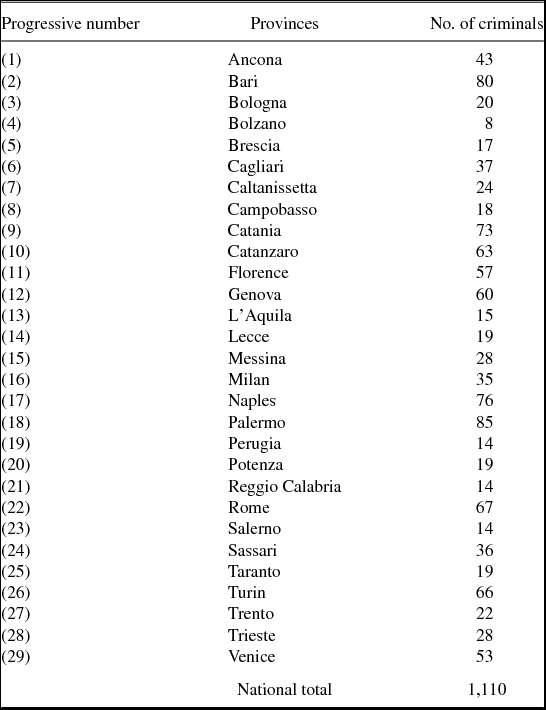
Our analysis used an administrative data set of the Italian Ministry of Juvenile Justice to build a representative sample of young criminals born in 1987. We extracted randomly from the population of 7,599 young criminals, who had committed their first crime at ages between 14 and 17.Footnote 6 This sample without repetition, at the sampling rate of 15%, is stratified by the subnational administrative competences of the DJJ offices. Appendix A shows the numbers of young criminals listed over the 29 macro-provinces of Italy.
The data set of 1,100 young criminals collects information exploiting the noncomputerized registers compiled by social workers and maintained by the DJJ. We extracted information from the narrative reports, so that the sampling rate was the difference between the need to obtain a large representative sample and its costs.Footnote 7 By way of illustration, we divide individual criminal data into two main sections as follows:
• Personal and socioeconomic status and household characteristics.
• Records of minors’ criminal history.
The first section contains personal characteristics (gender, date and place of birth, place of residence, and nationality), as well as information on whether young criminals are at school or work, their schooling, drug-related offenses, use of leisure time, any psychological or psychiatric problems, and involvement in organized crime or crimes committed with other peers. A specific part is devoted to the family, focusing on the working status of father and mother, number of family members and siblings, and any other family members involved in crimes or networks of organized crime. It should be noted that criminal records excluded the presence of multiple siblings. Although we do not know the type of offense or number of sentences of the father (or other family members), we do know if he (and/or she) was in prison at the time when the young criminal was in the charge of the DJJ. This also implies that fathers (or family members) committed their own crimes before their children did.
The second section identifies the records of young criminals taken into charge by the DJJ and followed during the trial and sentence, if any. Data include type, date and place of crimes, any complicity, and judicial decisions against young offenders. Particular attention is given to data regarding the initial steps of the proceedings, distinguishing cases into complaints or arrest, detention, any application of precautionary measures, and reports made by the minor’s social worker during the trial. Information on the outcome of the proceedings was also collected and, if the minor was convicted, what type of measure was implemented (custodial or noncustodial).
To investigate the father’s influence on recidivism rates, we merged individual records of criminals from the juvenile data set with those of the DPA, which registers criminal histories in adult age. This new data set has an important advantage over the typically sparse cross-sectional data of juvenile crime in Italy – that of allowing criminal analysis over time. In particular, the 1987 cohort of offenders was listed in the juvenile data set from 2001 and 2004 (criminals aged 14–17) and then followed criminal histories in adults from 2005 to 2011 (until age 24). With respect to the juvenile data set, the DPA data set omits variables regarding changes in the family from 2005 to 2011, although it still records precisely the type of crime(s), whether the individual was merely detained or not, the steps of the judicial process, and the sentence.
4.2. Empirical Model: Outcomes of Interest and Baseline Covariate Characteristics
This unique Italian data set allows us to create variables of interest regarding recidivism in the form of intensity and repetition of crimes committed by young criminals. The intensity of crime is measured as the number of recorded offenses over time of the cohort member, who has at least one offense recorded. The recidivism rate is measured as the status of a young criminal again involved in crime (second offense), irrespective of whether this new crime was committed in young or adult age. We propose two indicators of recidivism rate: (i) overall recidivism rate, which records if the individual is newly involved in crime or not; (ii) 6-year recidivism rate, which combines the potential for committing a new crime for each young criminal over the same time-span, starting from when the DJJ took the young criminal in charge. This definition of recidivism is in line with that proposed by the Bureau of Justice Statistics [Maguire and Pastore (Reference Maguire and Pastore2003)], suggesting that at least a 3-year period should be applied to evaluate an individual with a past involvement in criminal activities. Aiming to examine the heterogeneous effects of fathers’ criminality over young people’s development, we also used the same outcomes of interest for theft and drug-related offenses.
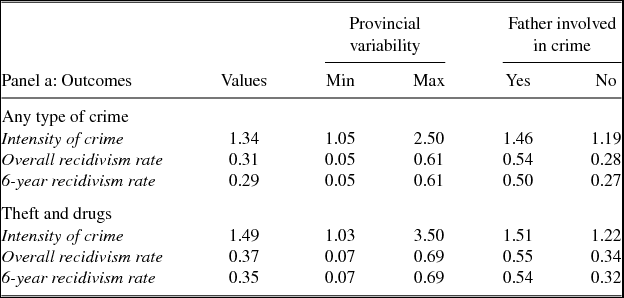
Table 1 lists the descriptive statistics of the criminal cohort outcomes of our sample. On the whole, investigating the intensity of crime, 34% of new crimes were counted with respect to the first offense (e.g., 1.34, in column 1). This result varies across macro-areas of Italy; for example, urbanized areas are known to undergo and attract greater youth criminality. The statistics confirm the large variability across the 29 macro-provinces in which young criminals are in charge to the decentralized DJJ (min = 1.05; max = 2.50).
Descriptive statistics of key variables of juvenile crime

Note: Provincial variability calculated for 29 macro-provinces of 1987 cohort of young criminals. Sample used to calculate descriptive statistics for “any type of crime” is 1110; for young criminals convicted for “theft and drugs,” it is 735.
When we use the recidivism rates as outcomes of crime, we find a slight increase in each outcome of the propensity to commit specific crimes such as “theft and drugs.” The percentage of recidivism ranges from 29%–31% in ”any type of crime” to 35%–37% in “theft and drugs.”Footnote 8 The result was expected, since “theft and drugs” are more frequent and persistent in juvenile age, together with higher persistence in committing nonviolent crimes, whereas the rate of recidivism decades quickly falls for the other categories of crime [Bartolucci et al. (2007)].
Table 1 also lists the recidivism rate conditionally to the father being involved or not in criminal activities. The figures indicate that the presence of a criminal father greatly increases the probability of the child being convicted again, irrespective of the type of crime or outcome used. Italian survey data suggest an almost double rate of recidivism of young criminals with fathers involved in their crimes (columns 4 and 5).Footnote 9
Empirically, the role of fathers on their children’s criminal behavior is estimated by an equation which correlates the criminal activities of both. Formally,
 $$\begin{equation}
Y_{{\rm child}} = \alpha _{0} + \alpha _{1}Y_{{\rm father}} + \eta _{{\rm child}},
\end{equation}$$
in which Y child and Y father represent measures of criminal outcomes and ηchild is the error term. The parameter of interest is α1, which measures the association in terms of criminal activities between father and child. Note that α1 includes the observable and unobservable mechanisms of crime transmission which empirical researchers aim to clarify. To reduce the evident variability across provinces, which emerges from Table 1, we include n−1 dummy variables (e.g., provincial fixed effects).
Model (1) is enriched with controls for several family characteristics related to fathers, as well as to their possible negative health behavior, for example, drug abuse (X father). In the commonly estimated equation (1), we also include a vector of individual characteristics (X child), to reduce possible correlations between individual children’s characteristics and unmeasured individual-level variables (e.g., ηchild). Equation (2) is given as
 $$\begin{equation}
Y_{{\rm child}} = \alpha _{0} + \alpha _{1}Y_{{\rm father}} + \alpha _{2}X_{{\rm father}}+\alpha _{3}X_{{\rm child}}+ \eta _{{\rm child}},
\end{equation}$$
assuming that the estimate of α1, after the inclusion of family and father’s factors and child controls, represents a measure of the effect of the criminal father on his child’s recidivism.
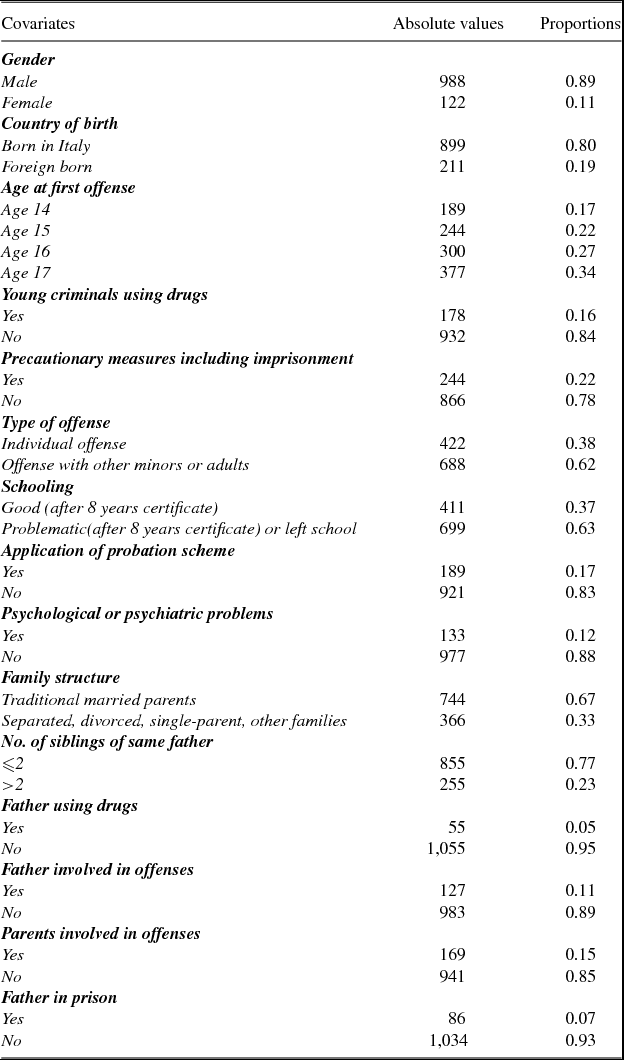
Thus, we use proxies of the mechanism argued above (Section 2) to estimate their importance, and report extensive descriptive statistics of the Italian cohort of young criminals, fathers, and family variables listed in Appendix B.
Although the sample is composed of individuals whose main characteristics are being male (89%), Italian (80%), with substantial problems at school (63%), and age at first offense between the ages of 16 and 17 (61%), there are a few young criminals who received alternative rehabilitation schemes based on probation (17%). It is worth nothing that, as regards our aim, this alternative rehabilitation program may allow the development of children and the rapid maturity of young criminals, replacing the role of fathers which the family probably cannot ensure. In addition, many crimes turned out not to have been committed individually, and some of the young people involved used drugs or had psychological or psychiatric problems. In about two-thirds of our sample, the parents were married and 23% of the young criminals had more than two siblings. While 5% of fathers had negative health behavior through self-reported use of drugs, a consistent number of the fathers of young criminals were in prison when the juvenile penal system charged them (i.e., 86 out of 127). Imprisonment may significantly affect the recidivism rate, at least in the short term, by the incapacitation effect, which mechanically removes highly crime-prone individuals from the community.
5. RESULTS
5.1. Baseline Estimates
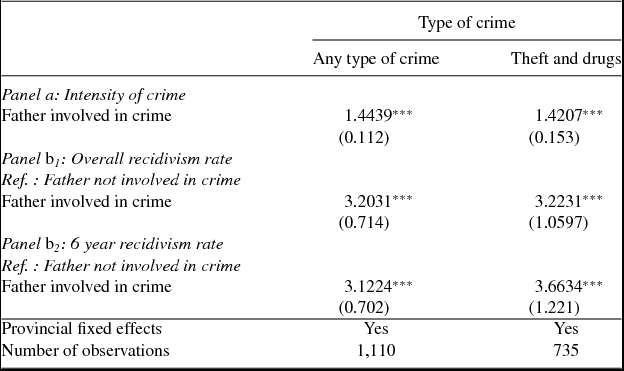
Table 2 lists estimates of correlations between the criminal activities of fathers and their children according to equation (1). In view of the geographical variability of juvenile crime in our sample, we also controlled for provincial fixed effects, estimating robust standard errors with a clustered regression disturbance term at macro-provincial level. Each cell of Table 2 lists the coefficient of a separate regression, the dependent variable being identified by row and column headings. Panel (a) measures the intensity of cohort member crime, according to the number of crimes over time. Panel (b) lists the measure of antisocial activities of young criminals, according to whether they committed new offenses from ages 14 to 24 or not. Column 1 of Table 2 lists “any type of crime” and column 2 lists “theft and drugs.” It should be noted that the father’s crime variable in each specification is measured according to whether any sentence was recorded. This limits the possibility of testing the degree to which the specificity of children’s criminal activity is linked with that of their fathers. All intensities of crime specifications are estimated with Poisson regressions and incidence rate ratios (IRR) are listed; the outcomes of recidivism rates were estimated by logistic regressions and odds ratios (ORs) were used for interpretation.
IRR and odds ratio estimates of raw father–child relationship

Notes: Huber robust standard errors in brackets. Regression disturbance terms cluster at macro-provincial level.
*Significantly different from zero at 90% confidence. **Significantly different from zero at 95% confidence. ***Significantly different from zero at 99% confidence.
The results shown in column 1 of Panel (a) indicate that children whose fathers have received at least one conviction increases the expected number of children’s offenses by 44% (i.e., IRR = 1.44). The propensity of offending again [panel (b)] is largely affected by fathers involved in crime. Both estimates for overall and 6-year recidivism rates indicate that young criminals with criminal fathers have more than three times higher odds of being involved in new offenses (i.e., overall recidivism rate: OR = 3.203; 6-year recidivism rate: OR = 3.122).Footnote 10
Column 2 lists the estimates for the same criminal outcomes, restricted to theft and drug offenses. For children involved in these crimes, there is an increase of 42% if their fathers had received at least one conviction (IRR = 1.42). The OR of the overall recidivism rate calculated for children involved in theft and drug offenses indicates the same high probability of their being affected by their fathers’ antisocial behavior (OR = 3.20), with respect to the sample including “any type of crime.” When the recidivism rate is restricted to 6 years, the point estimate and the consequent OR increase slightly (OR = 3.66).
Summarizing, children are significantly more likely to develop criminal careers if they have fathers involved in crime, irrespective of the type of recidivism indicator used. In addition, the confidence intervals extracted from the standard error below the point estimate indicate that the magnitude of estimated recidivism is always largely significant.
5.2. Investigating Father–child Criminal Correlations
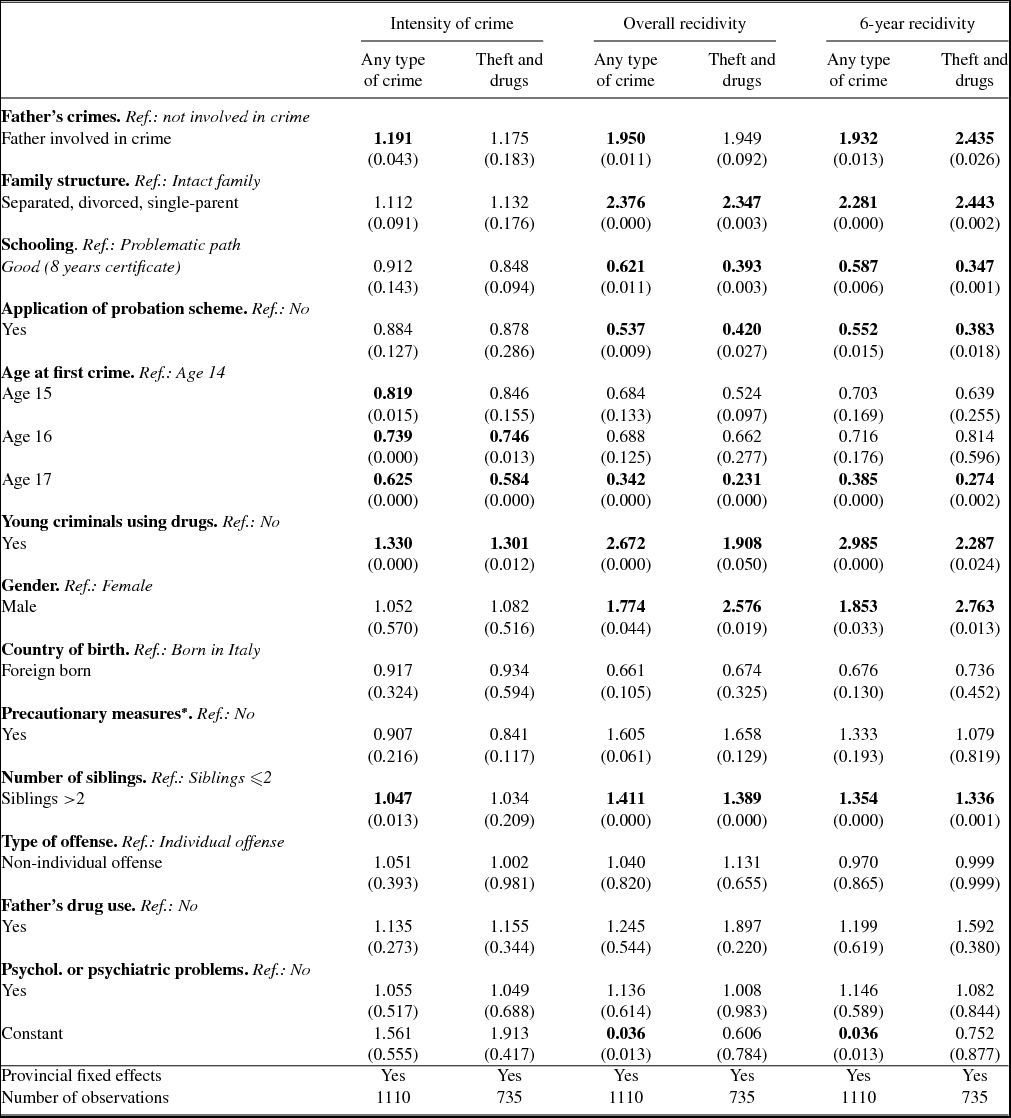
There are a number of mechanisms which may give rise to the father–child correlations of criminal behavior discussed in Section 2. Here, we estimate criminal equation (2) for intensity of crimes and recidivism rates, which includes the observable proxies of these channels, separately for “any type of crime” and “theft and drugs” (Table 3).Footnote 11
IRR and odds ratio estimates of father–child relationship

Notes: p-values in brackets; values derived from Huber robust standard errors, in which regression disturbance terms cluster at macro-provincial level. In bold, coefficients significantly different from zero at 95% confidence.
Precautionary measures include imprisonment.
Column 1 lists the Poisson regression estimates for the sample comprising “any type of crime.” The IRR of 1.19 is significant and indicates that a criminal father increases the expected number of his children’s offenses by 19%. When we compare this result with that shown in Table 2, in which the IRR was 1.44, we find that about 43% of the father–child association is not explained (i.e., 0.19/0.44). When the IRR, extended for covariates which proxy the mechanisms discussed above, is estimated for “theft and drugs,” not only is the IRR reduced (IRR = 1.17) but, more importantly, it is not statistically significant. This implies that the main channels in explaining the correlation of father–child criminal activities in these categories of crimes are significantly explained by the inclusion of observable controls.
This evidence is also important when we measure the role of fathers on the probability of their children being recidivists. Columns 3 and 4 list the results based on the overall recidivism rate. As a baseline result of logistic regressions for “any type of crime” (column 3), adding family and individual controls, children whose fathers have at least one conviction decreases the OR to commit a new crime from 3.2 to 1.95. The estimated marginal effects are 26.7 and 11.0 percentage points, respectively. This implies that about 42% of the association between fathers and children is not explained, and this result is similar to those obtained for the sample “theft and drugs” (column 4).Footnote 12
The patterns of the 6-year recidivism rate are different, according to type of crime. For the subsample “any type of crime” (column 5), juvenile criminals whose fathers have been convicted at least once have almost two times higher odds of having criminal records themselves (OR = 1.93) and a marginal effect of the estimated parameter of 10.5 percentage points. In contrast, we estimate the OR of the raw relation in Table 2 at about 3.12, with a corresponding marginal effect of 21.1 percentage points. This means that including family and individual controls leaves about 43% of these correlations unexplained. Conversely, the OR of juvenile criminals involved in theft and drug crimes with convicted fathers are higher. Even when we include individual and family variables, the size of the OR (OR = 2.43) is not reduced. Although this result was expected, because individuals commit more intensive “theft and drug” crimes when juveniles, the large difference in this outcome also reflects the lower ability of observable variables to control correlations, leaving more than 50% of the logistic regression variability unexplained. Thus, our observable controls are imperfect proxies of the crime correlation (see Section 2), so that part of the unobserved father–child relationship may be imputed to the transmission of role model.
We now summarize some explanations about the estimated associations of the observable variables listed in Table 3. The use of drugs by young criminals is highly correlated with the probability of being newly involved in related crimes, as shown by the significant coefficients in each specification. This antisocial behavior appears to be a strong predictor for criminal careers in adult age, irrespective of type of crime, as argued by Cottle et al. (2001).
While the type of juvenile offense (i.e., individual or not) or the application of precautionary measures does not change the intensive margins of these young criminals and the recidivism rates, it is important to note that the application of probation schemes reduces the probability of young criminals becoming recidivists by about 50%. While this implies that probation leads to positive resocialization of juvenile offenders involved in tailored educational programs, the small nonsignificant reduction in the intensity of crime also suggests that only wider application can consistently reduce criminal careers. These results support the application of the recent Italian law (no. 67 of April 28, 2014), which extends probation into adulthood.
Age at the moment of committing the first crime are crucial for assignment to juvenile law and the development of a criminal career. The recidivism rates are reduced significantly only for juveniles who committed crimes at age 17. Instead, not statistically significant differences in criminal career outcomes emerge from the records of young criminals with psychological or psychiatric problems, and from “country of birth.”
More directly, our findings match the theory that children from broken homes commit more crimes with respect to families with traditionally married parents. As noted in Section 2, research suggests that this type of family can alter offending trajectories and reduce the likelihood of crime. Our estimates show that separated, divorced, single-parent families of young criminals have a more than double likelihood of seeing a child convicted again irrespective of the outcome used (e.g., ORs = 2.28 in the outcome 6-year recidivism rate for “any type of crime”).
In addition, the significant coefficient of number of siblings of the same father on recidivism indicates that the father–child correlation in criminal activities may partly be explained by lower parental control of children in large families and/or by the fact that it may be transferred through siblings. Last, we find significant ORs in reducing new crimes when young criminals do not reveal problems at school. This variable proxies the above-mentioned mechanism, by means of which children’s educational outcomes are partly affected by those of their fathers (or parents). Subjected to parents’ investment in their children’s human capital, young criminals with fewer problems at school will commit fewer crimes because, at least, their presence in school reduces the available time for new crimes.Footnote 13
We also examine whether the father–child relationship partly depends on the mother’s criminal behavior. We build our key crime variables by recording the criminal behavior of the mother of a criminal child who, at least once, was convicted of a crime, added to that of the father. Although mothers’ and fathers’ antisocial behavior may be correlated, for example, by the greater likelihood of marrying each other, the strength of this correlation may hide a significant channel of the family–child transmission of crime, in that a mother’s criminality may be an important unobservable variable.
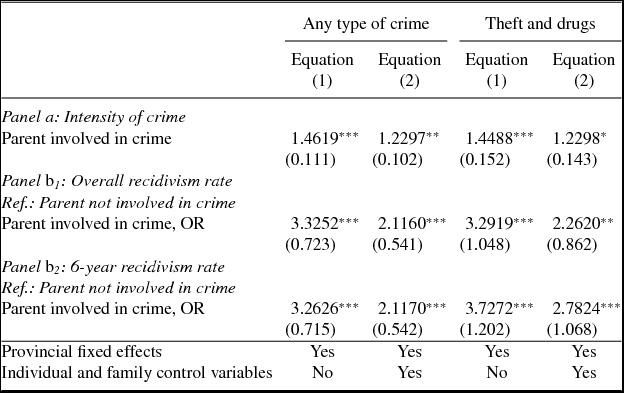
Table 4 shows the point estimates of the relationship of parent–child criminal activities, which are slightly larger than in the case when only the father brings crime into the family. Considering “any type of crime,” we find that a convicted parent, father, or mother, increases the expected number of their children’s offenses by 23% (IRR = 1.229). More importantly, when we focus on theft and drug offenses, we find an OR close to that concerning “any type of crime,” recouping statistical significance at 5% of the estimated coefficient with respect to the coefficient estimated and listed in Table 3 (IRR = 1.1759; p-value = 0.18). This suggests that a mother’s criminal status may represent one transmission channel of interest in juvenile age, when individual criminals are more greatly influenced by their parents.
Robustness of IRR and odds ratios of parent–child intergenerational relationship

Notes: Huber robust standard errors in brackets. Regression disturbance terms cluster at macro-provincial level. Number of observations: 1,110 and 735 for “any type of crime” and “theft and drugs,” respectively.
*Significantly different from zero at 90% confidence. **Significantly different from zero at 95% confidence. ***Significantly different from zero at 99% confidence.
Similar patterns of criminality appear when we use recidivism rates as the criminal response for “any type of crime.” Estimates for “any type of crime” indicate that the probability of children being involved in new crimes is more than twice as high for those with convicted fathers or mothers (OR = 2.116), slightly greater of the benchmark case in which only the fathers are involved (OR = 1.950 in Table 3). These findings do not change when we homogenize the recidivism rate to 6 years (OR = 2.117).
Instead, the ORs differ when we consider theft and drug crimes. In this case, the probability after 6 years is 2.78 higher for a child with convicted parents with respect to a reference child with noncriminal parents. These results indicate that, for these specific juvenile crimes, the presence of the mother involved in crime may enhance juvenile criminality, although the standard error appears to be quite large in yielding a nonquestionable conclusion. Quantifying the marginal effects of the parent–child relationship of crime, we note that part of this association is unexplained, irrespective of the criminal indicator used. The magnitude of these unexplained associations is even more important in theft and drug crimes, suggesting that, although the inclusion of mothers with convictions controls this source of criminal heterogeneity, other unobservable sources arise in criminal correlation.
5.3. Effect of Father’s Imprisonment
In this subsection, we estimate the father–child association for fathers in prison when the child was in the charge of the DJJ, by interacting “father crime” (yes/no) with “father prison” (yes/no). Since the absence of the father was caused by the fact that he was in prison, here we assess whether this absence leads to positive or negative externality in the child’s criminal path. Sanctions imposed on fathers, as a result of their criminal activity, can reduce children’s participation in crime, causing children to change their beliefs about the expected relative cost of crime, and/or increasing the needs-adjusted family income (if the father in prison was not a net contributor). Conversely, incarcerating the father can, for instance, lower the needs-adjusted family income if that parent is a net contributor, give rise to stigma and decrease supervision for a child, and generally could be a disruptive, traumatizing event which may lead to an increase in a child’s criminal activity.
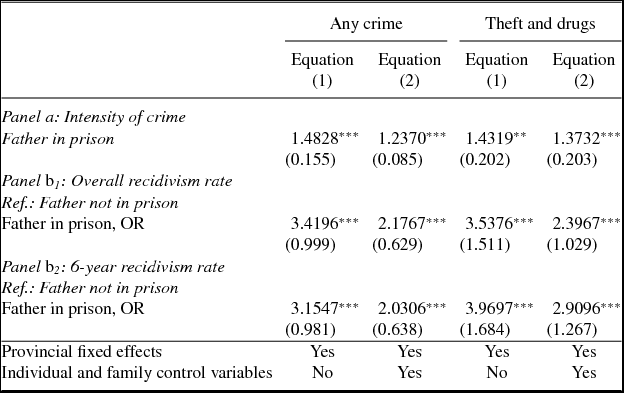
Table 5 lists the estimates of equations (1) and (2), without including or including individual and family control variables, respectively, for “any type of crime” and “theft and drugs.” The first result is that the magnitude of the raw intergenerational correlation, measured through IRR and OR (Table 5, columns 1 and 3), is slightly larger in this sample than in the estimate of Table 2. As an example, logistic regression for the sample which includes “any type of crime” (column 1 in both tables) estimates an OR = 3.21 in the benchmark model, whereas this increased to OR = 3.42 in the specification which includes the father in prison. In addition, the inclusion of the family and individual controls leads to reductions in estimate points and the corresponding IRR and OR are statistically significant at the usual 5% level.
IRR and odds ratio robustness of intergenerational relationship of crime for fathers in prison

Notes: Huber robust standard errors in brackets. Regression disturbance terms cluster at macro-provincial level. Number of observations: 1,110 and 735 for “any type of crime” and “theft and drugs” specifications.
*Significantly different from zero at 90% confidence. **Significantly different from zero at 95% confidence. ***Significantly different from zero at 99% confidence.
It is worth noting that when we compare these results in terms of unexplained correlation between father–child, this proportion is substantially similar to the benchmark model for any type of crime, confirming that a part of this correlation is explained by the inclusion of observable controls (the estimates of the unexplained correlation of crime range from 49% in the IRR to 47%–48% in the ORs). Instead, these estimates are enough different for “theft and drugs.” A criminal father who was in prison when the young criminal was in charge to the DJJ increases by 43 percentage points the child probability to commit a crime (Table 5, column 3), although a small correlation father–child is controlled by including observable controls. The unexplained correlation ranges for these types of crimes from 55% to 64%.Footnote 14 This means that including observable individual and family control variables in juvenile crimes as “theft and drugs” are not able to explain sufficiently the development of criminal behavior and the life-course criminology of children. In other words, the forced absence of their fathers who are in prison could therefore suggest a role model for fathers – as well a set of unobserved criminogenic traits that are not controlled for – as a potential channel for the child’s criminal path.
6. CONCLUSIONS AND LIMITATIONS
In this paper, we examined the influence of fathers on their children’s criminal careers, using an Italian cohort of juvenile criminals followed to adulthood and their fathers. Our empirical strategy was to decompose the raw correlation between fathers and children involved at least once in criminal activities between the ages of 14 and 17, controlling for other underlying channels of crime transmission, according to several theories. We used the number of recorded offenses and the probability of young criminals recorded in second offenses as a measure of raw recidivism rate, irrespective of whether they were juveniles or adults, until the age of 24. Our conclusions follow from regressions in which we separately estimate the effects for “any type of crime” and “theft and drugs,” the latter mainly characterizing crimes in juvenile age.
In the baseline estimates, we find that having a convicted father increases the expected number of his children’s crimes by more than 40%, while the same children have about three times higher odds of committing new offenses. For prevalently juvenile theft and drug crimes, we also find evidence of a positive and significant raw correlation between convicted fathers and their children’s crimes: This result is emphasized in the outcome 6-year recidivism rate.
After controlling for observable channels, the large sets of both individual and family factors turn out to be important for children’s crime outcomes. The relative contributions of these controls fluctuate slightly and sometimes lose significance. The marginal effects of unexplained crime transmission are similar in father–child specifications and range from 42% to 45%. Last, the extension of tests to the parent–child relation increases children’s criminal responses, irrespective of criminal outcome, although the point estimates are not statistically different from those of the contribution of fathers only. We find significant evidence that fathers who are in prison increase the fathers’ influence on juvenile crime and the corresponding unexplained correlation, suggesting that their absence may be a determinant of the reoffending rates of young criminals even as adults.
What are the implications of these findings? We provide evidence that both family and individual observable variables and fathers’ criminal activities are important components. This implies that any theory, which aims at explaining the role of father on children criminality, must incorporate both individual and family factors together with proxies for genetics and role models. It is worth noting that fathers’ influence on their children’s crimes at the intensive margin which we find from the estimated points is very similar, for example, to that reported by Hjalmarsson and Lindquist (Reference Hjalmarsson and Lindquist2012) in Sweden. The weighted mean of each additional sentence of the father increased in Sweden the expected number of sons’ convictions by 32% and daughters’ convictions by 53%. These estimates are close to the magnitudes of the relationship estimated in Italy (42%) and fairly robust across the types of crimes. Although this result may appear surprising, since the social welfare systems of Italy and Sweden are very different, like specific laws focusing on juvenile crimes, it also confirms the existence of common drivers of intergenerational delinquency which we attempted to identify through our individual and family variables.
Although we used a hitherto unexploited data set for Italy, our work does have some limitations, which arise from the administrative source of information and the lack of father’s (parent’s) variables in comparison with the current crime literature. The first key limitation implies that we can only study the intensive margins of crime. We decompose the analysis into specifications which examine the number of convictions and those which examine recidivism, although we cannot make any statements about exactly how a father’s criminal record is related to the likelihood that his child will begin a criminal career. Nor do we have any information about the type of offense and number of sentences of the fathers, but only that they committed crimes before their children did. This leaves open the possibility that fathers’ influence depends on the timing of their record and imprisonment, relative to their children’s age. However, in the sensitivity analysis, we clarify that the absence of fathers (parents) when the young criminal was in the charge of the Italian DJJ is a good proxy for identifying and indirectly testing the role model hypothesis and its effects on a child’s crime lifecycle. Nevertheless, we believe there is promise in investigating how extensive margins of crime, such as the type of crimes committed by fathers and their timing, can help us understand how transmission of crime arises.
Sample distribution of juvenile crime by province.

Baseline characteristics of young criminal cohort in Italy.