

1 Introduction
Speech sounds have two functions (Trubetzkoy Reference Trubetzkoy1939): they encode lexical contrasts (their distinctive function) and they express information about the location of prosodic domains (their delimitative function). Focusing on the second of these functions, it has been argued that knowing where prosodic domains begin and end allows hearers to segment the speech stream more efficiently (Peters Reference Peters and Slobin1985: 1037). It may also benefit infant language learners as they build their lexicon (Mattys & Jusczyk Reference Mattys and Jusczyk2001). For spoken language to perform this delimitative function, certain segments must provide boundary-marking cues that help hearers to locate the edges of prosodic domains such as the foot, the prosodic word and the phonological phrase.
Consonants which function as boundary markers show a relatively high degree of salience or prominence as compared with their realization in non-boundary-marking positions. According to one view, this is achieved through the use of exaggerated articulatory gestures (e.g. Fougeron & Keating Reference Fougeron and Keating1997) such as more extreme lip rounding, greater linguopalatal contact, or stronger aspiration. An alternative view suggests it is acoustic salience that characterizes boundary markers, where the relevant segments show a greater modulation of the carrier signal than is found either in their equivalent non-boundary-marking realizations or in neighbouring sounds (Ohala Reference Ohala, Ziolkowski, Noske and Deaton1992: 325; Traunmüller Reference Traunmüller1994; Harris Reference Harris2006, Reference Harris2009).
This paper adopts the latter, acoustics-based view, arguing that boundary-marking consonants achieve their maximum effect by being as acoustically distinct as possible. In Element Theory terms (Harris & Lindsey Reference Harris and Lindsey1995, Cyran Reference Cyran2010, Backley Reference Backley2011) this means they should contain |H| or |ʔ|,Footnote [2] as these two elements are inherently voiceless – they stand apart from all other elements, which are spontaneously voiced. In general, languages prefer segments with |H| or |ʔ| at prosodic domain boundaries (Nasukawa & Backley Reference Nasukawa, Backley and De Dominicis2015a).
Most languages place consonant boundary markers at the left edge rather than the right edge of prosodic domains (Fougeron & Keating Reference Fougeron and Keating1997: 3728). However, languages such as Kaqchikel (a Mayan language spoken in central Guatemala) challenge the universality of this generalization, since they show a clear bias towards right-edge marking. In Kaqchikel the boundary-marking property is the element |H|, which represents intense or prolonged noise; it is realized phonetically as aspiration or frication, and not – as acoustic analysis confirms – merely as voicelessness. This produces a pattern of alternation between the fricatives [ɬ ʂ ɸ c¸] in domain-final position and, respectively, the sonorants [l ɾ w j] in non-final positions. There is also an alternation between aspirated [ph th kh qh] word-finally and non-aspirated [p t k q] elsewhere (OKMA 2003).
Behaviour like this suggests that domain boundary marking is parametric rather than universally fixed: although left-edge marking may be more beneficial to speech processing than right-edge marking, we cannot rule out the possibility that at least some languages show right-edge marking instead. After all, if the grammar can refer to a left boundary then it should also be able to refer to a right boundary. Below it will be argued that Kaqchikel is one instance of a right-edge-marking language.
Several proposals have been made for representing boundary markers in phonological representation – see, for example, Chomsky & Halle (Reference Chomsky and Halle1968), Selkirk (Reference Selkirk1984), and Scheer (Reference Scheer2004). Here we develop an analysis based on the Precedence-free Phonology or PfP model of melodic representation set out in Nasukawa (Reference Nasukawa2014, Reference Nasukawa, van Oostendorp and van Riemsdijk2015, Reference Nasukawa2016) and Nasukawa & Backley (Reference Nasukawa and Backley2017). PfP differs from other approaches in assuming that precedence relations among segments and empty positions are not overtly specified in representations. It also assumes that the basic units of segmental structure – features or elements – may function not only as contrastive properties but also as boundary markers (Backley & Nasukawa Reference Backley and Nasukawa2009a: 51).
In the PfP approach, phonological heads are like heads in syntax, in that they play an important structural role but are relatively unimportant in terms of lexical (i.e. contrastive) information. By contrast, dependents are structurally unimportant but are rich in lexical information. And this difference impacts on the phonetic realization of phonological structures: dependent elements are more prominent than head elements in terms of the size of their modulated carrier signal (Nasukawa Reference Nasukawa2016, see also Harris Reference Harris2006).
On this basis we can expect the lowest (i.e. the most deeply embedded) element in a structure to be the most prominent of all (see Cinque Reference Cinque1993: 245). We argue that this means two things for the element in question: first, it is associated with a high degree of phonetic prominence, and second, it can function as a domain boundary marker. This will be illustrated using examples from Kaqchikel, in which a low (i.e. deeply embedded) |H| element not only displays phonetic salience but also marks the location of prosodic domain boundaries. What is unusual about Kaqchikel, however, is that this |H| boundary marker is located at the right edge of prosodic domains, rather than at the left edge. We argue that the difference between left-edge and right-edge marking should be expressed by a parameter in the phonetic interpretation mechanism of a language’s phonological structure.
The discussion is organized as follows. Section 2 introduces elements and describes their roles in representations, one of which is to demarcate prosodic domains. Section 3 begins by describing a general preference for marking the left edge of prosodic domains rather than the right edge. It then goes on to analyse segmental distribution patterns in Kaqchikel, a language with right-edge domain boundary marking. Section 4 considers how prosodic boundaries should be formally represented, while Section 5 provides a summary and further remarks.
2 The dual role of features: Lexical contrasts and prosodic domain marking
2.1 Distinctive function
The primary role of features is to encode lexical contrasts (e.g. Jakobson, Fant & Halle Reference Jakobson, Fant and Halle1952, Clements Reference Clements1985, Davenport & Hannahs Reference Davenport and Hannahs1998, Duanmu Reference Duanmu2016); this is their ‘distinctive’ function (Trubetzkoy Reference Trubetzkoy1939: 273). For example, the contrast between English [m]oan and [b]one is expressed by the presence or absence of the nasality feature in the initial consonant. But features also have another role, to be developed in Section 2.2 below, which is to help listeners to locate the edges of prosodic domains. In Trubetzkoy’s terms, this is their ‘delimitative’ function. When listeners parse running speech, they must break up the continuous speech stream into word- or morpheme-sized chunks. It is only after they have identified these chunks that they can match the words or morphemes they hear with items stored in their mental lexicon. Listeners pay attention to the delimitative properties of features during the initial stages of the parsing process.
Various theories of segmental structure have been developed to capture the distinctive function of speech sounds, each employing different kinds of features: distinctive features (Jakobson et al. Reference Jakobson, Fant and Halle1952, Chomsky & Halle Reference Chomsky and Halle1968, Clements Reference Clements1985), elements (Kaye, Lowenstamm & Vergnaud Reference Kaye, Lowenstamm and Vergnaud1985, Harris & Lindsey Reference Harris and Lindsey1995, Backley Reference Backley2011), components (Anderson & Jones Reference Anderson and Jones1974, Anderson & Ewen Reference Anderson and Ewen1987, van der Hulst Reference van der Hulst1995), particles (Schane Reference Schane1984, Reference Schane and Goldsmith1995) and gestures (Browman & Goldstein Reference Browman and Goldstein1989, Reference Browman and Goldstein1992). This paper adopts an element approach to representations, elements being unary (single-valued) units of melodic structure which, unlike distinctive features, can be phonetically interpreted individually, i.e. they need not be combined with other elements in order to be pronounced (Rennison Reference Rennison1984; Harris Reference Harris1990; Charette Reference Charette1991; Cyran Reference Cyran1997; Kula Reference Kula2002; Botma Reference Botma2004; Scheer Reference Scheer2004; Nasukawa Reference Nasukawa2005, Reference Nasukawa2016; van der Hulst Reference van der Hulst2005; Pöchtrager Reference Pöchtrager2006; Backley Reference Backley2011; Botma, Kula & Nasukawa Reference Botma, Kula, Nasukawa, Kula, Botma and Nasukawa2011).
In triangular systems of vowel representation, the elements |A|, |I| and |U| (see below) are individually realized as the vowels [a], [i] and [u], respectively. This approach, which can be traced back to Anderson & Jones (Reference Anderson and Jones1974), has been developed in various representational models such as Dependency Phonology (Anderson & Ewen Reference Anderson and Ewen1987), Government Phonology (Kaye, Lowenstamm & Vergnaud Reference Kaye, Lowenstamm and Vergnaud1985, Reference Kaye, Lowenstamm and Vergnaud1990; Harris Reference Harris1990), Particle Phonology (Schane Reference Schane1984, Reference Schane and Goldsmith1995), Radical CV Phonology (van der Hulst Reference van der Hulst1995, Reference van der Hulst2005), Strict CVCV theory (Scheer Reference Scheer2004), GP 2.0 (Pöchtrager Reference Pöchtrager2006) and Precedence-free Phonology (Nasukawa Reference Nasukawa2016, Nasukawa & Backley Reference Nasukawa and Backley2017). For summaries of the triangular approach, see Harris & Lindsey (Reference Harris and Lindsey1995) and Backley (Reference Backley2011).
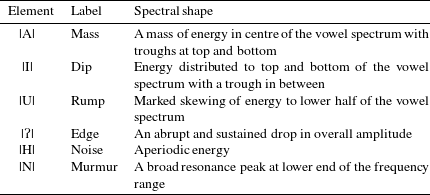
In this paper, language sounds are represented using elements which, following Harris & Lindsey (Reference Harris and Lindsey1995), are identified in terms of their acoustic properties (cf. standard features, which are typically associated with properties of articulation). Thus, in phonetic terms the element-based approach is concerned with speech perception rather than with speech production – a view which is further developed in Nasukawa & Backley (Reference Nasukawa and Backley2008), Backley (Reference Backley2011), Nasukawa (Reference Nasukawa2016) (see Jakobson et al. Reference Jakobson, Fant and Halle1952, Jakobson & Halle Reference Jakobson and Halle1956).Footnote [3] In the element approach used here, all distinctive properties of melody are represented by the six elements described in Table 1, which are shown with their respective acoustic signatures (Nasukawa & Backley Reference Nasukawa and Backley2012: 15; see also Nasukawa Reference Nasukawa2016).
Elements and their associated acoustic properties.
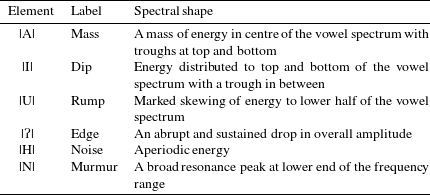
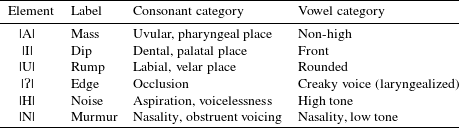
A clear difference between elements and features lies in their distribution. In standard feature systems, most features capture either consonantal properties (e.g. [strident], [continuant]) or vocalic properties (e.g. [high], [round]). But in the case of elements, it is usual to find the same element appearing in both vowels and consonants. An element can represent different (albeit related) phonological properties depending on whether it is in a consonant or vowel structure (Nasukawa Reference Nasukawa2016, Nasukawa & Backley Reference Nasukawa and Backley2008), as shown in Table 2.
Elements and phonological categories.
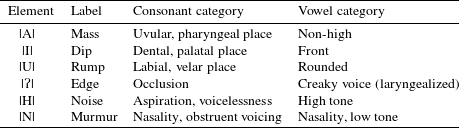
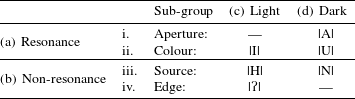
The first three elements |A|, |I| and |U| naturally form a group of ‘resonance’ elements, which are associated with place properties in consonants and vowels. The remaining ‘non-resonance’ elements |ʔ|, |H| and |N| refer to laryngeal/source properties such as occlusion, aperiodicity (noise) and pitch/tone.Footnote [4] In general, |A|, |I|, |U| are associated with vocalic characteristics (Table 3, (a)) and |ʔ|, |H|, |N| with consonantal characteristics (Table 3, (b)), although this is not an absolute division.
Element groupings.
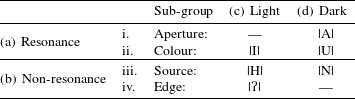
The element groupings (a) and (b) in Table 3 are further divided into sets. The resonance group in (a) divides into an aperture set containing just |A| and a colour (timbre) set comprising |I| and |U| (Nasukawa & Backley Reference Nasukawa, Backley, Kula and van de Weijer2005: 83; see also Schane Reference Schane1984, Reference Schane2005). Similarly, the non-resonance group in (b) splits into two sets: the elements |H| and |N| form the source set while the edge set contains just |ʔ| (Nasukawa & Backley Reference Nasukawa, Backley, Kula and van de Weijer2005).
The elements may also be classified according to their acoustic-perceptual properties, in which case they divide into ‘light’ and ‘dark’ (Backley & Nasukawa Reference Backley and Nasukawa2009b; Backley Reference Backley2011: 200ff.), labeled (c) and (d) in Table 3. |I|, |H| and |ʔ| in (c) are grouped together as light elements because their acoustic energy is distributed across a wide spectral range; this produces a bright, thin, sometimes hissy phonetic effect. By contrast, |A|, |U| and |N| in (d) form the group of dark elements because their acoustic energy is concentrated at the lower end of the spectrum, giving them a warm and mellow sound quality.
Since elements are single-valued, lexical contrasts are expressed in terms of the presence or absence of a given element. The representations in (1) show a vowel contrast involving resonance elements, where the contrast itself is expressed by the presence or absence of |A|:

Contrasts are also encoded using non-resonance elements, as shown in (2).

In consonants, the occlusion element |ʔ| defines the class of stops, as shown in (2a), the absence of |ʔ| indicating a continuant sound as in (2b, c). Meanwhile, the |H| element corresponds to audible friction (aperiodic noise), which is realized as the release burst in stops (2a) or as the prolonged period of frication in fricatives (2b). The absence of |H| indicates a sonorant segment, as in (2c). In this way, the light non-resonance elements |ʔ| and |H| operate at the segmental level to distinguish strong obstruent-like segments from other, more resonant segment types.
As an alternative to standard features, elements play a key role in the description of segmental patterning. This is demonstrated in Section 3.2 below, where it is shown how |H| serves the melodic function of distinguishing obstruents from sonorants and also the prosodic function of marking the right edge of prosodic domains. For further discussion of the use of elements in representations, the reader is referred to Nasukawa & Backley (Reference Nasukawa and Backley2008) and Backley (Reference Backley2011).
2.2 Delimitative function
In addition to their distinctive function, elements have a delimitative function which helps listeners to pick out words and morphemes in running speech. It is predominantly the light non-resonance elements |ʔ| and |H| which serve this function, operating at prosodic levels to mark acoustically prominent positions at the boundaries of prosodic domains (e.g. foot, word) and morphemic domains. Acoustic prominence is achieved by producing significant modulations of the baseline speech signal.
The elements |ʔ| and |H| make a natural grouping since both are inherently voiceless (cf. the remaining elements |I|, |U|, |A|, |N|, which are spontaneously voiced). When pronounced individually, |ʔ| and |H| are realized as the glottal consonants [ʔ] and [h], which can function as epenthetic consonants when a (silent) prosodic boundary needs to be audible. For example, to satisfy the onset requirements of a language (e.g. Kahn Reference Kahn1976), epenthetic [ʔ] or [h] may be used to fill an empty onset position and thus provide an audible left boundary for the syllable domain. To illustrate, Hare Slave (an Athabaskan language spoken in Canada, Northwest Territories) in (3) has epenthetic [h] as a realization of the element |H|, while Pisaflores Tepehua (a Totonac-Tepehua language spoken in Mexico) in (4) has epenthetic [ʔ] as a realization of the element |ʔ| (Nasukawa & Backley Reference Nasukawa, Backley and De Dominicis2015a: 64).


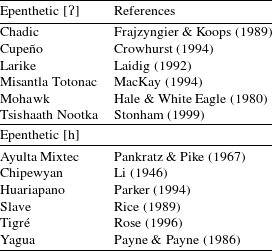
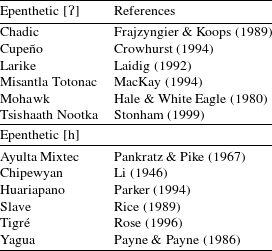
Like the syllable domain, the prosodic word domain is also regularly marked by the presence of |H| or |ʔ|. This is often to satisfy the general requirement that a word-initial onset be audible – in other words, that it contain melodic structure (i.e. an element expression) of some kind. The crudest phonetic cue to the presence of a word boundary is an audible initial consonant, typically a glottal or an obstruent of some kind; it is noteworthy that some languages allow onsetless syllables in any position except word-initially, where an onset consonant must be pronounced. For example, in Arapaho all words begin with a consonant; if none is present lexically then the phonology must create one, usually via epenthesis. In languages like Arapaho the epenthetic consonant is regularly a glottal – that is, [ʔ] (the realization of |ʔ|) or [h] (the realization of |H|). Following Nasukawa & Backley (Reference Nasukawa, Backley and De Dominicis2015a: 67), Table 4 lists some examples from the survey of languages with epenthetic consonants given in de Lacy (Reference de Lacy2006: 79ff.).
Epenthetic consonants.
The preference for glottals, which is discussed in de Lacy (Reference de Lacy2006: 107ff.), is generally cast in terms of a universal markedness statement, the assumption being that the least marked place of articulation (i.e. glottal) should serve as the default choice for an epenthetic consonant. On this basis, prosodic boundaries are typically associated with the inherently voiceless elements |ʔ| and |H|. (Recall that voiceless |ʔ| and |H| are distinct from the resonant group comprising |I|, |U|, |A|, |N|, which are all produced with spontaneous vocal fold vibration.)
This difference between voiceless and voiced is significant here because human speech is predominantly voiced (Backley Reference Backley2011: 149; Nasukawa & Backley Reference Nasukawa, Backley and De Dominicis2015a). This makes the voiceless glottals [p] and [h] immediately distinctive – which is exactly how a consonant must be if it is to function effectively as a domain boundary, i.e. it must be sufficiently distinct in perceptual terms from neighbouring sounds (usually vowels or sonorant consonants). Thus, in the absence of a lexical consonant in an initial (i.e. syllable- or word-initial) onset, |ʔ| and |H| are realized as the glottal segments [ʔ] and [h], respectively, which serve as cues to the left boundary of a prosodic domain.
The use of |ʔ| and |H| also explains another characteristic of boundary-marking consonants – namely, a general preference for acoustically salient segments such as stops and fricatives. These segment types are characterized by significant modulations of the carrier signal, as described in Harris (Reference Harris2009: 30ff.) and Nasukawa (Reference Nasukawa2017) (see Ohala Reference Ohala, Ziolkowski, Noske and Deaton1992, Traunmüller Reference Traunmüller1994, Schwartz Reference Schwartz, Szpyra-Kozłowska, Guz, Steinbrich and Święciński2014). Stops are maximally distinct from vowels, and in addition, they may be accompanied by a strong laryngeal cue such as aspiration or ejective release. Meanwhile, voiceless fricatives are also acoustically prominent, thanks to their strong and prolonged noise component. The noise component in fricatives can also encroach on neighbouring sounds. For example, in (5), the sororant
 $l$
in fly
 devoices after a voiceless
 $f$
.

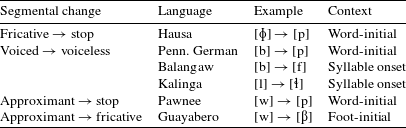
There is another way in which prosodic boundaries reveal their identity. In some languages, boundary segments increase their prominence by acquiring |ʔ| or |H| through fortition (i.e. strengthening), which renders them more obstruent-like (i.e. more salient in terms of the size of carrier signal modulations) than they would otherwise be. To illustrate this, the fortition effects in Table 5 are taken from surveys of strength-related processes reported in Lavoie (Reference Lavoie2001) and Smith (Reference Smith2005) (see Nasukawa & Backley Reference Nasukawa, Backley and De Dominicis2015a: 69).
Strength-related processes.
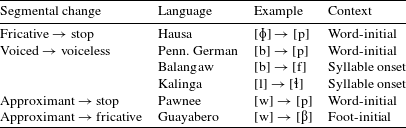
Although the processes in Table 5 are not identical, they all conform to one of two general patterns: either a sonorant becomes an obstruent, or an obstruent becomes more salient in terms of how much it modulates the carrier signal (i.e. it occupies a stronger position on the lenition trajectory: Harris Reference Harris2006, Reference Harris2009). In both cases the relevant segmental change involves the introduction of |ʔ| or |H|, as illustrated in Table 6.
Fortition processes.

For example, in (a) the fortition process [ɸ]
 $\rightarrow$
[p] in Hausa introduces |ʔ| word-initially (Kraft & Kraft Reference Kraft and Kraft1973; Lavoie Reference Lavoie2001: 42; see also Dunstan Reference Dunstan1969), while in (b) [l]
 $\rightarrow$
[ɬ] in Kalinga requires the addition of |H| syllable-initially (Lavoie Reference Lavoie2001: 43; see also Reid Reference Reid1971). In (c), the [w]
 $\rightarrow$
[p] process in Pawnee (Lavoie Reference Lavoie2001: 42; see also Parks Reference Parks1976) calls for both |ʔ| and |H| to be introduced word-initially (Nasukawa & Backley Reference Nasukawa, Backley and De Dominicis2015a: 69). Given that all these changes take place at the left boundary of a syllable, foot or word, they highlight the role played by |ʔ| and |H| in marking domain edges.
So, languages show a preference for employing |ʔ| and |H| as consonantal boundary markers because these are the only elements that display inherent voicelessness. This makes them acoustically distinct, which allows them to be easily perceived as cues to domain edges. Phonetic scope is another factor in the explanation for why glottals are preferred as domain markers. The acoustic cues for |I|, |U|, |A| and |N| extend over wide temporal domains that encompass neighbouring sounds and even whole syllables (Harris Reference Harris2012). By contrast, the obstruent cues discussed above tend to be more localized to single segments (Bye Reference Bye, van Oostendorp, Ewen, Hume and Rice2011: 1418). Once again, this kind of difference is well suited to the role of marking domain boundaries, since listeners must locate boundaries at specific points in the phonological string when they process speech. In summary, the evidence points to a phonetic motivation for the use of glottals as default boundary consonants – the choice is apparently not a random one.
3 Consonantal domain markers
3.1 Preference for left-edge domain markers
As described above, there is a clear tendency for languages to mark the left edge rather than the right edge of domains – a fact which goes hand in hand with the generalization that listeners instinctively pay closer attention to domain-initial consonants than to domain-final ones. And certainly, cross-linguistic patterns of segmental distribution in syllables and words appear to support this, where left edge (onset) consonants are typically more acoustically distinct from their surroundings than right edge (coda) consonants (see Pierrehumbert & Talkin Reference Pierrehumbert, Talkin, Doherty and Robert Ladd1992, Redford & Diehl Reference Redford and Diehl1999, Cho & Jun Reference Cho, Jun, Okrent and Boyle2000, Cho & Keating Reference Cho and Keating2009). Speech production differences in gestural coordination between onset and coda consonants are also documented (Browman & Goldstein Reference Browman and Goldstein1989, Fougeron & Keating Reference Fougeron and Keating1997).
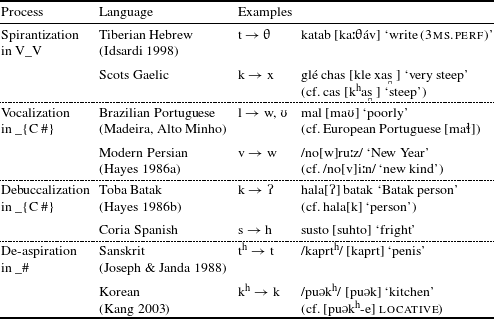
There are other differences between onsets and codas which are similarly consistent with this preference for left boundary marking. Most obviously, there are many languages in which onsets are obligatory whereas codas are either optional or disallowed. At the foot level too, we see a bias for marking the left edge of the domain (Harris Reference Harris1994, Reference Harris2012). In addition, many languages show an asymmetry in the distribution of consonants, where (word-)initial onsets support a wide range of consonant contrasts whereas non-initial positions allow just a subset of these contrasts (Harris & Gussmann Reference Harris and Gussmann1998, Reference Harris and Gussmann2002; Nasukawa Reference Nasukawa2004). This asymmetry is directly related to a position’s (in)ability to resist lenition effects: positions which resist lenition – and which may even show fortition effects – are generally regarded as prosodically strong, while positions that regularly undergo lenition are seen as weak (Honeybone Reference Honeybone and de Carvalho2008, Ségéral & Scheer Reference Ségéral, Scheer and de Carvalho2008, Szigetvári Reference Szigetvári and de Carvalho2008, Harris Reference Harris2009). It is usually the initial position in a domain which is strong (i.e. syllable onsets, foot-initial and word-initial C positions), while all other consonant positions (i.e. syllable codas, foot/word-internal intervocalic C positions and foot/word-final C positions) are weak and therefore potential targets for lenition. Some examples of lenition processes are given in Table 7, while a comprehensive survey can be found in Gurevich (Reference Gurevich2004).
The lenition effects in Table 7 all involve a reduction in strength in one or more of the ways described in (6).

Lenition processes.
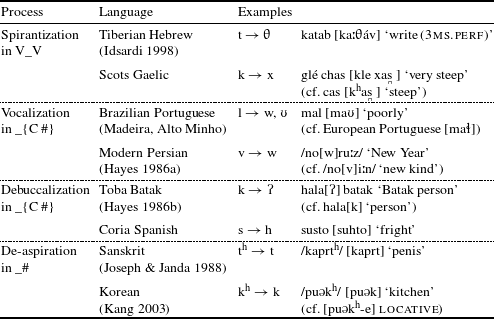
Spirantization can produce either (6a) or (6b). On the other hand, the remaining kinds of lenition in Table 7 all involve a single type of reduction in strength: vocalization, debuccalization and de-aspiration produce the effects in (6a), (6b) and (6c) respectively. It is apparent that all cases of lenition naturally occur in intervocalic, final or pre-consonantal position.Footnote [5] By contrast, initial position (i.e. the left edge of a domain) typically resists lenition of any kind.
These observations reinforce the point that languages show a preference for making the left edge of a domain prominent. Yet from these same observations it does not follow that left edge prominence applies universally, i.e. we cannot automatically exclude the possibility that some languages may show right edge prominence instead. It is an empirical question as to whether any languages display right edge marking, and below we review data which indicate that this is indeed an option. To strengthen the case for right boundary marking as a genuine typological possibility, and to challenge the assumed universality of left edge consonantal prominence, Section 3.2 describes the facts of Kaqchikel, a language which makes extensive use of |H| as a right edge domain marker.
3.2 Right-edge domain markers in Kaqchikel
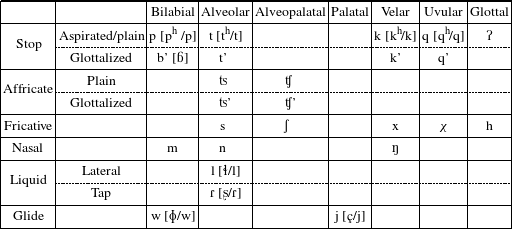
Kaqchikel, a K’iche’an language of the MayanFootnote [6] family, is typologically marked in that it employs domain markers at the right edge of prosodic domains. The property which functions as a domain marker is |H| rather than |ʔ|. Before discussing how |H| operates as a domain marker, we introduce the consonant inventory of KaqchikelFootnote [7] in Table 8.
Consonants in Kaqchikel.
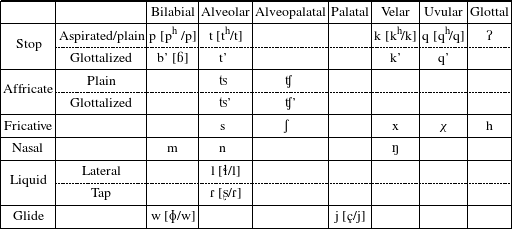
Kaqchikel has no voicing contrast in obstruents, but among stops and affricates there is a distinction between ejectives (glottalized [b’ t’ k’ q’ ʦ’ ʧ’]) and non-ejectives (plain [p t k q ʦ ʧ]). In addition, there are five contrasting fricatives [s ʃ x
 $\unicode[STIX]{x1D712}$
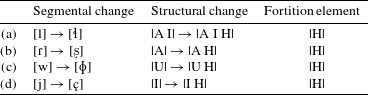
h]. More conventionally, the language has three nasals [m n ŋ], two liquids [l ɾ] and two glides [w j]. Note that the symbols shown in square brackets in Table 8 indicate phonetic values, e.g. the bilabial ejective is phonetically realized as an implosive [ɓ]. Note also that when two sounds are separated by a slash, each appears in a different phonological environment. For example, an alveolar tap is realized as [ʂ] in syllable-final or word-final position (see (7a) below) and as [ɾ] in all other contexts. The other sonorants show a similar pattern: [ɬ], [ɸ] and [c¸] occur domain-finally and pre-consonantally, as in (7c, d) while [l], [w] and [j] appear in domain-initial and word-medial pre-vocalic positions, as in (7a, b).

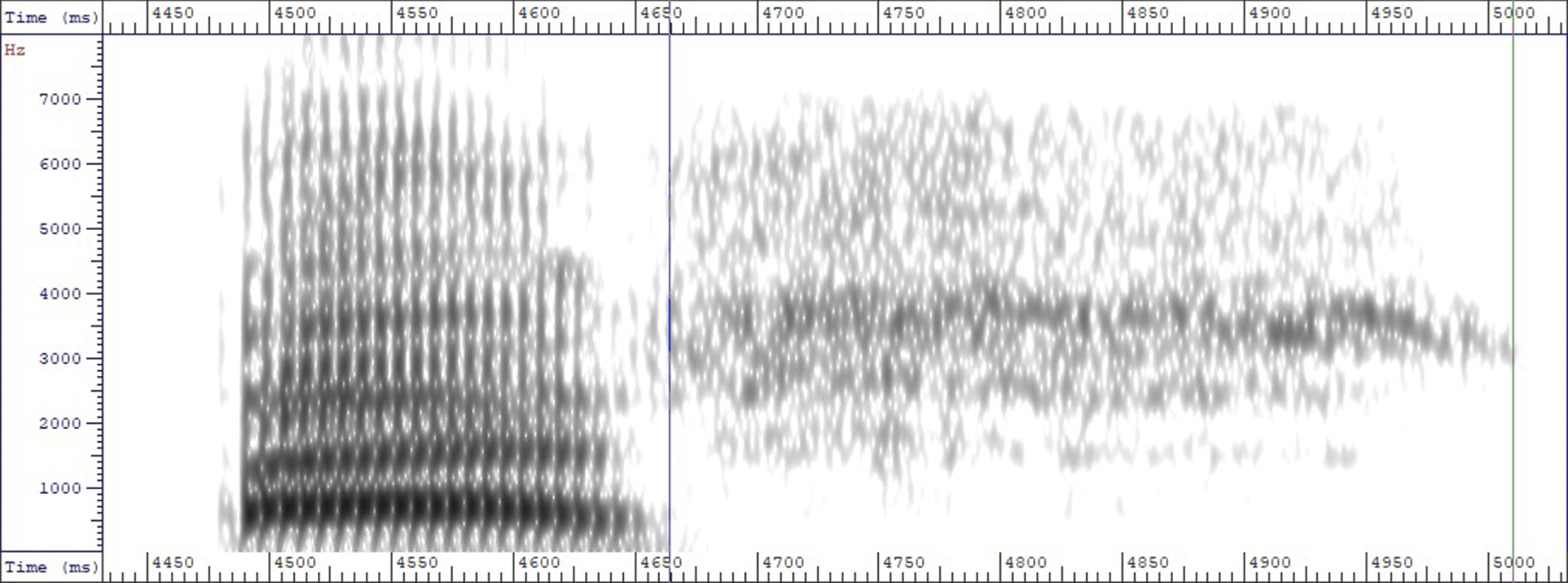
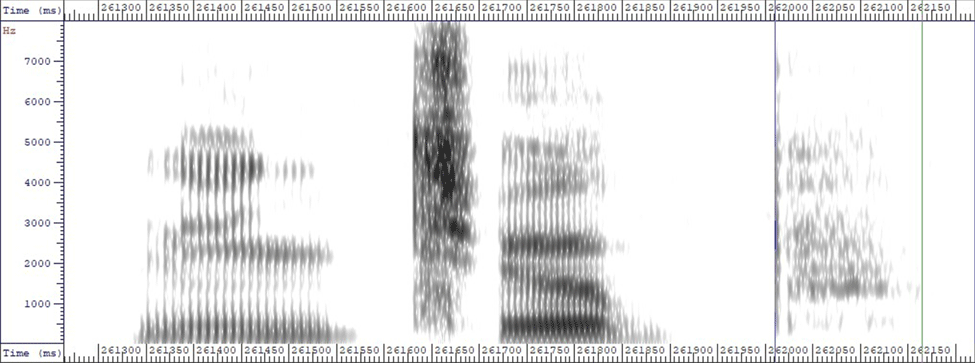
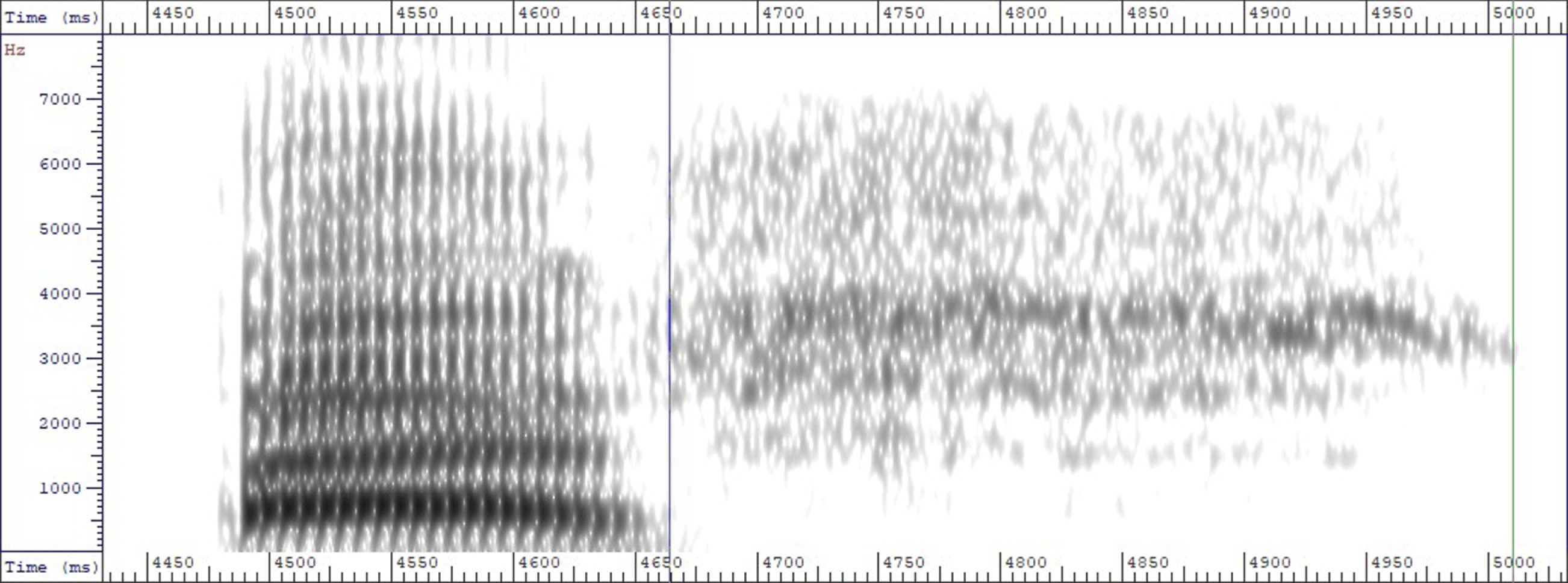
The term ‘sonorant spirantization’ seems appropriate for capturing the pattern in (7), as it involves a domain-final effect in which the sonorants /l ɾ w j/ are realized as the fricatives [ɬ ʂ ɸ c¸], respectively. The fricative quality of these sounds is confirmed in Figure 1, which shows the acoustic shape of word-final (ʂ), its energy pattern pointing unambiguously to that of a spirant: it has the long, distinctive period of noise that typifies fricatives, despite there being some degree of overlap with the preceding vowel.Footnote [8] In Figures 1–6, the x-axis shows time in miliseconds (ms) and the y-axis shows frequency in Hertz.
Word-final Kaqchikel [ʂ] in [paʂ] /paɾ/ ‘skunk’ (346 ms).
Interestingly, domain-final stops in Kaqchikel also have a strong noise (i.e. aspiration) component, as shown in (8c, d). This distinguishes them from the plain stops in (8a, b) which occur only in word-initial and syllable-initial positions.

The domain-final pattern in (8c, d), in which the stops /p t k q/ are realized as aspirated [ph th kh qh], is also found at morpheme boundaries. This is shown in (9) below, where C
 $_{\text{1}}$
in an internal C
 $_{\text{1}}$
.C
 $_{\text{2}}$
sequence is produced with a strong noise component when syllable-final, e.g. [kh] in (9ai). By contrast, the same consonant appears in its non-aspirated form if vowel epenthesis separates the two adjacent consonants, e.g. [k] in (9aii). The same pattern can be seen in (9b).

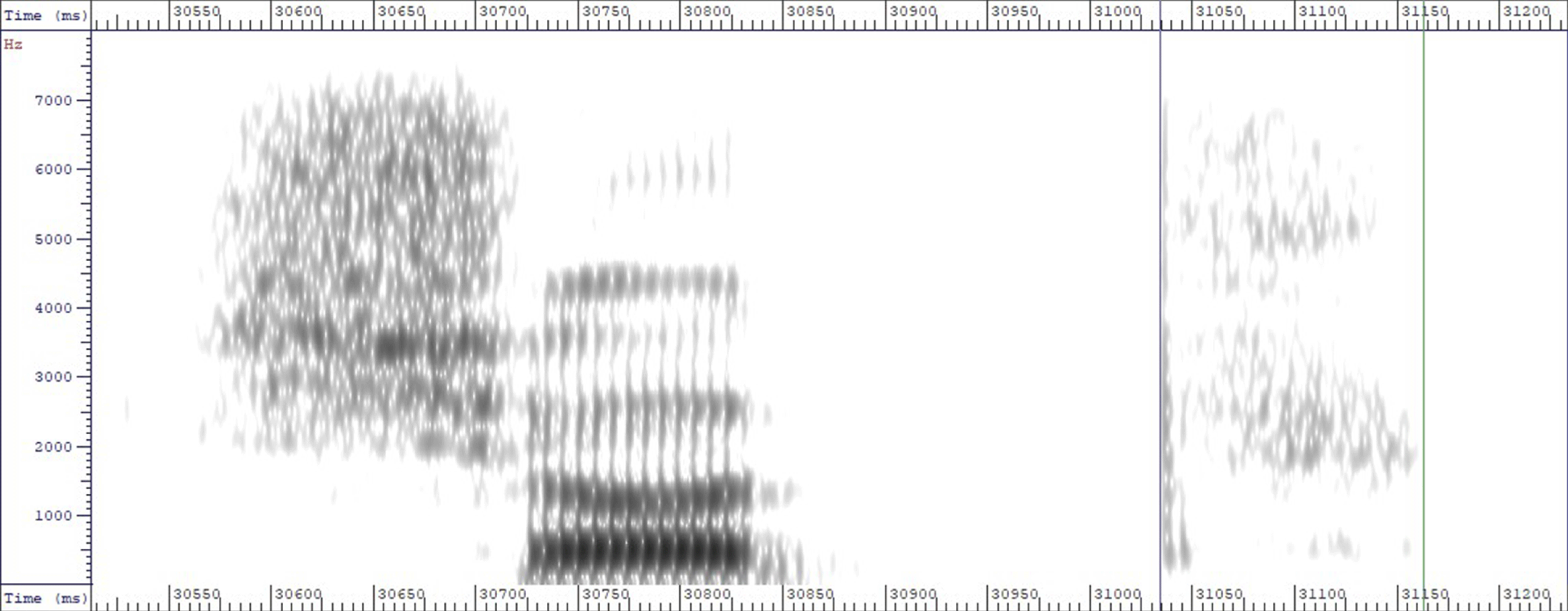
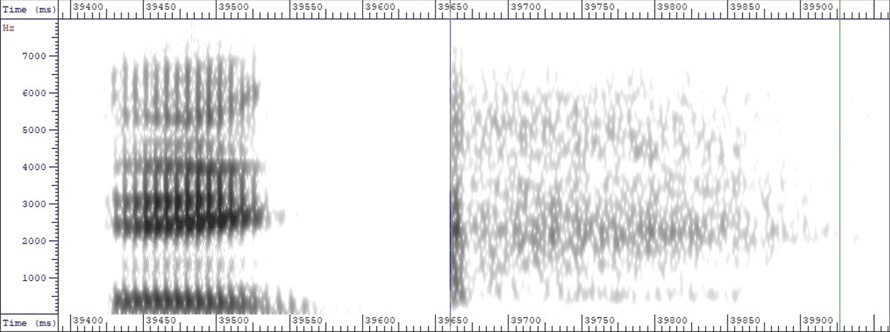
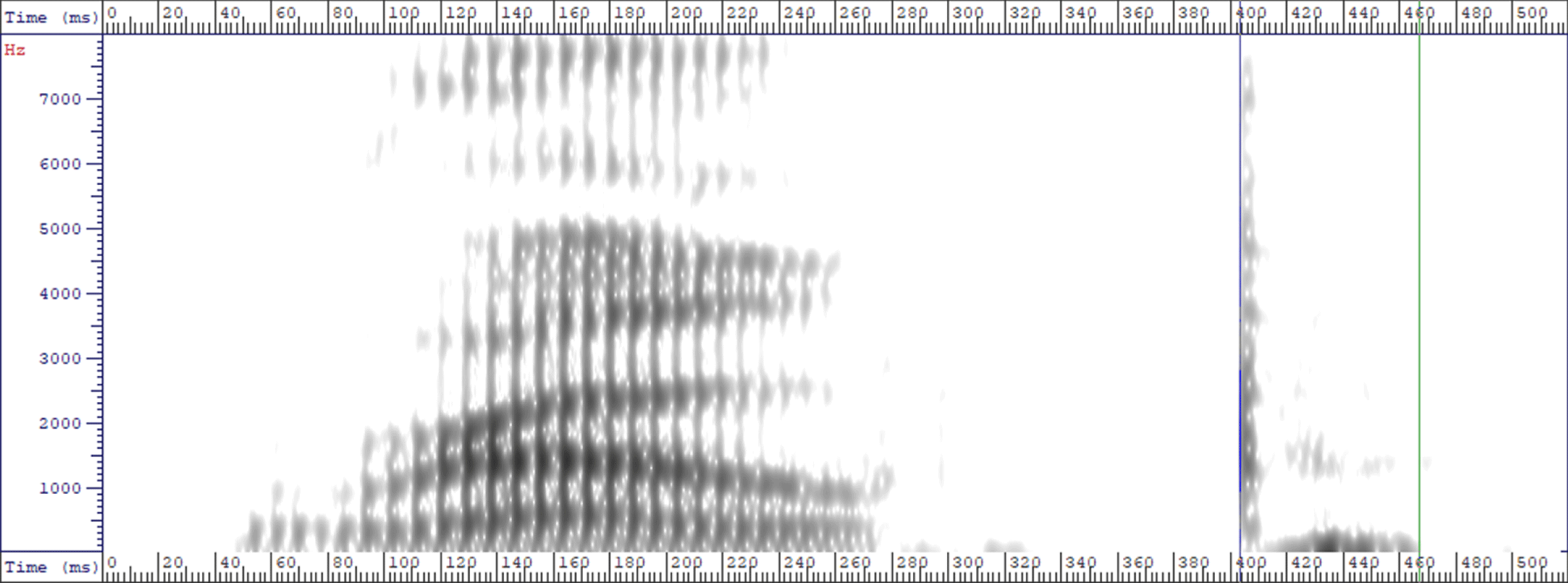
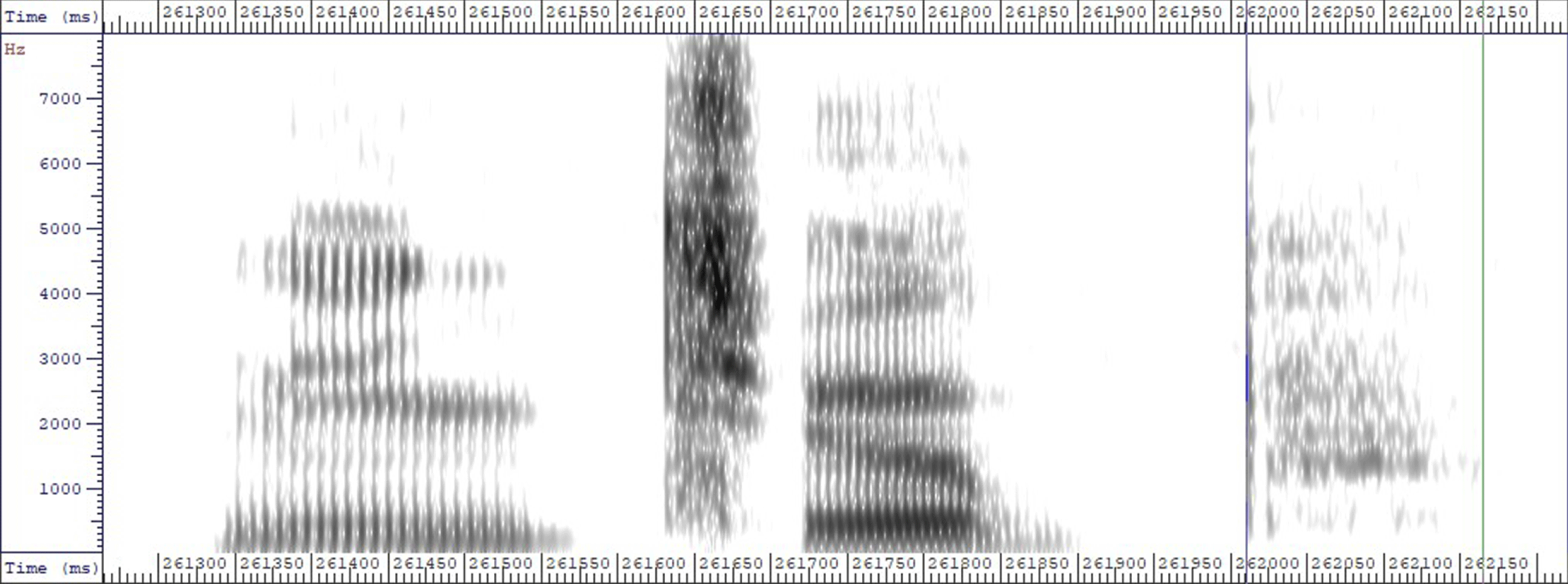
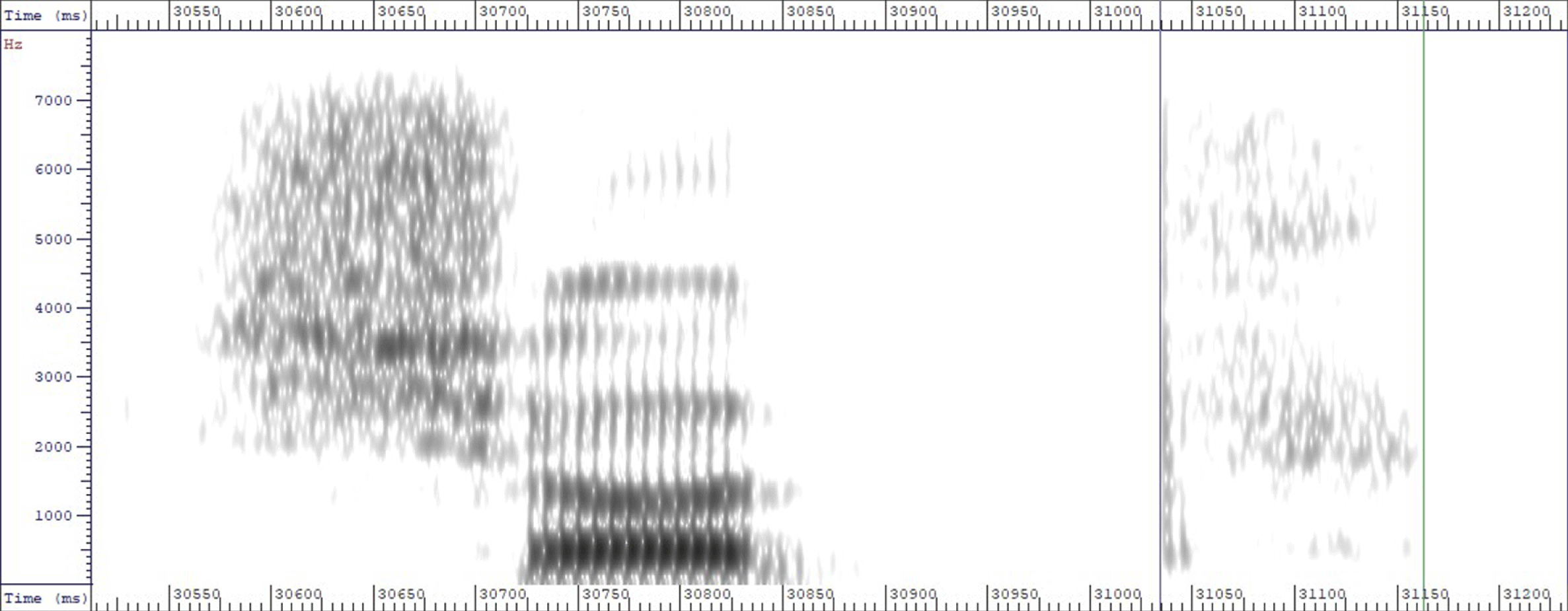
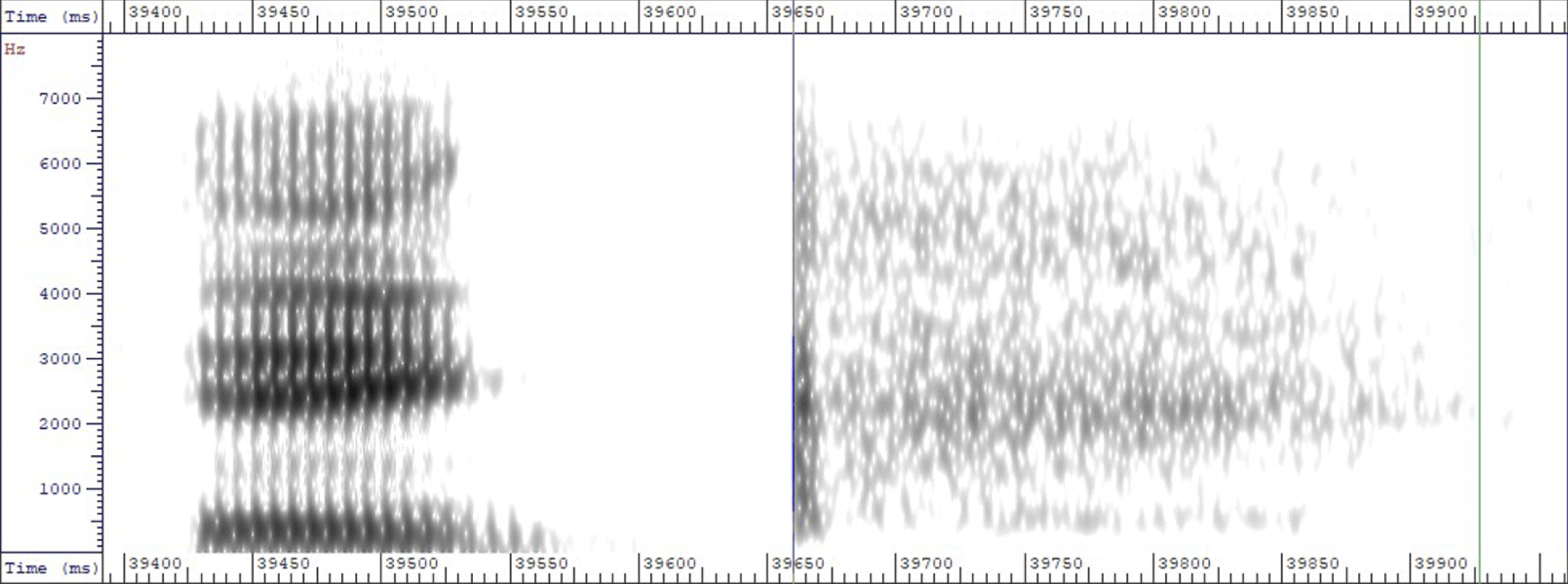
A question that arises here concerns the identity of this domain-final noise component: is it a manifestation of aspiration or devoicing? The spectrographic analysis of word-final stops reveals that the noise phase which follows stop release is much longer in Kaqchikel than in languages that have been analysed as having word-final devoicing. The relevant spectrographic patterns are shown below. As illustrated in Figures 2–4, word-final stops in Kaqchikel have a prolonged noise component: 154 ms in
 $p$
, 129 ms in
 $t$
, and 266 ms in
 $k$
.
Word-final Kaqchikel [ph ] in [ninʧ’oph ] /nich’op/ ‘pineapple’ (154 ms).
Word-final Kaqchikel [th ] in [ʃoth ] /ʃot/ ‘griddle’ (129 ms).
Word-final Kaqchikel [kh ] in [ikh ] /ik/ ‘chili’ (266 ms).
A comparison between the Kaqchikel word-final
 $p$
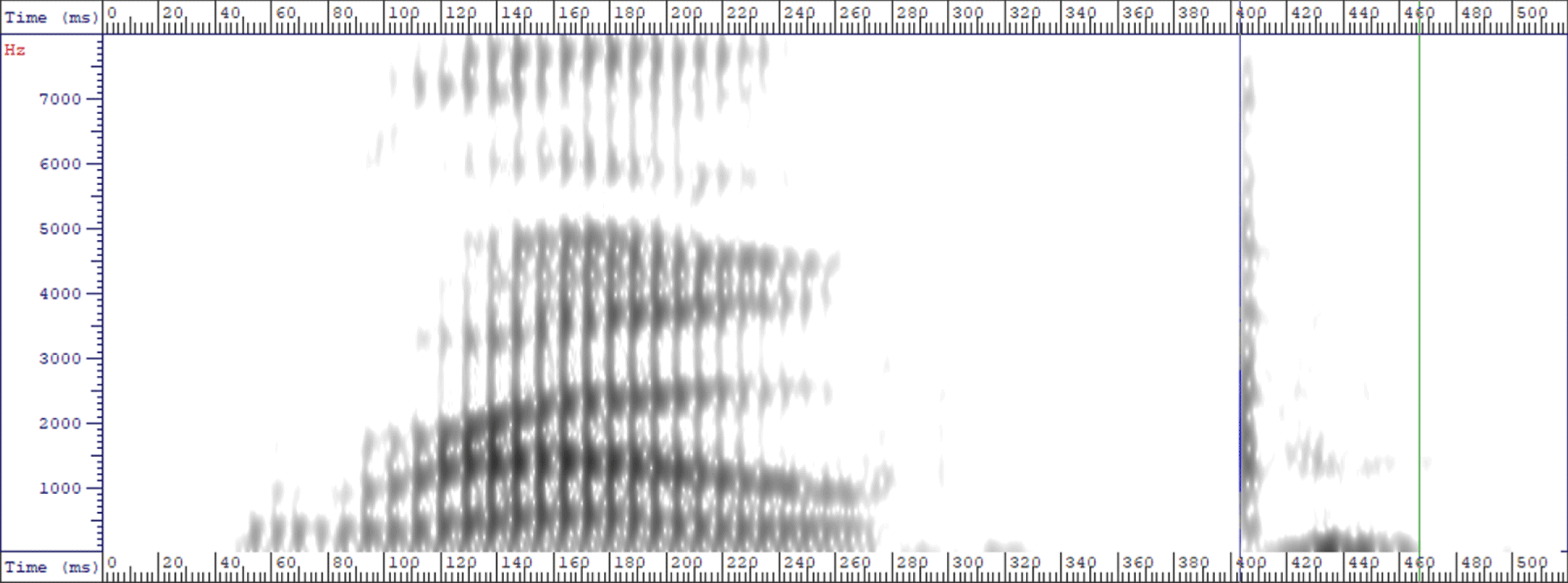
in Figure 2 and the equivalent English stop in Figure 5 below suggests that, even in citation form, the noise phase associated with word-final stops in Kaqchikel should be treated as aspiration rather than as devoicing. Having said that, the issue here is not about choosing the ‘correct’ formal label for describing the pattern. Rather, the point is that the noise component in Kaqchikel word-final stops is much stronger than that in English word-final stops.
Word-final English [p] in [roʊp] rope ‘rope’ (62 ms).
The pattern of strong aperiodic noise in Kaqchikel, which appears as sonorant frication in Figure 1 and as stop aspiration in Figures 2–4, may be understood as having the function of a prosodic boundary marker.Footnote [9] In terms of element structure it is represented by the ‘noise’ element |H| which, in its role as a boundary marker, attaches itself to the right edge of the domain.
Recall from Section 2.2 above that in some languages boundary segments gain prominence by acquiring |ʔ| or |H| through a strengthening process, giving them a more obstruent-like character. Fortition effects of this kind are observed in Kaqchikel, as shown in (10).

Below it will be argued that all the segmental changes in (10) are brought about by the introduction of |H|. First, consider the pattern in (10a), in which an approximant is reinterpreted as a voiceless fricative. The change from [l] to [ɬ], for example, requires an additional |H|, which can be seen by comparing the two structures in example (a) of Table 9. (Recall that the same left-edge process was described for Kalinga in Table 4 above.) The remaining changes in (b), (c) and (d) come about in the same way.
Domain-final sonorant spirantization in Kaqchikel.
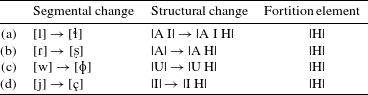
From Table 9 the following generalization emerges for Kaqchikel: voiceless fricatives are realized domain-finally through the addition of |H|.
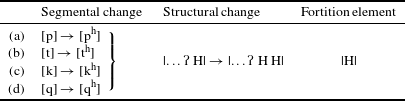
Consider now the changes in example (10b) above. These may be viewed as instances of fortition too, since they also require the addition of a strong noise/aspiration component. We therefore extend the above generalization concerning the addition of |H| to include the pattern in (10b). The relevant structural changes are shown in Table 10.
Domain-final stop aspiration in Kaqchikel.
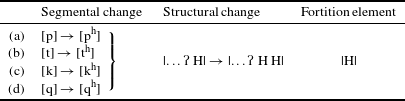
Note that not all versions of Element Theory allow multiple tokens of an element in an expression. For example, Harris (Reference Harris1994) represents the standard Element Theory view that only one token of an element is possible in a single structure. However, Harris’s model does distinguish between the headed (strong) and non-headed (neutral) forms of an element, which can express contrasts such as aspirated (with headed |H|) versus voiceless non-aspirated (with non-headed |H|). Recently, this approach has been called into question for the reason that the difference between headed and non-headed appears to be represented by a diacritic (i.e. underlining) rather than by a true structural distinction. Here we follow Backley (Reference Backley2012), Nasukawa (Reference Nasukawa2016) and Nasukawa & Backley (Reference Nasukawa and Backley2017) in rejecting the traditional headed/non-headed bifurcation, and instead allow an element to appear more than once in a structure. This view has been adopted and extended in the PfP approach (see Section 1), where each expression is represented as a network of local head-dependency relations holding between elements.
In the representations in Table 10, noise is relatively prominent owing to the presence of an additional |H|, this extra token of |H| having the effect of enhancing the basic noise properties of an existing single |H|. In other words, prominence derives from structural complexity: two tokens of an element result in a stronger and perceptually more salient phonetic realization of that element. In the PfP model of Element Theory, complexity is determined by simple element counting: the more elements in an expression’s representation, the greater its complexity (and thus, the more prominent its phonetic characteristics).
To illustrate how structural complexity affects the pronunciation of an expression, consider the difference between single |H| and double |H|. When an expression contains a single |H| it is typically realized with constricted airflow and an open glottis, resulting in the aperiodic noise energy and voicelessness associated with fricatives and also with the release burst in stops. But if two |H|s are present, airflow is more rapid and speakers produce a more intense noise energy pattern at higher frequencies together with prolonged voicelessness known as voicing lag. This suggests that voiceless fricatives and aspirated stops are represented as in Table 11, each with two tokens of |H|.Footnote [10]
Realizations of the element |H|.

Consider now the distribution of segments with a double |H|. In many languages, aspirated stops and/or fortis fricatives may only appear at the left edge of a syllable, foot or word, i.e. in positions that are generally regarded as being prosodically strong. In Swedish, for example, stops are aspirated word-initially but unaspirated elsewhere (Petrova et al. Reference Petrova, Plapp, Ringen and Szentgyörgyi2006), which indicates that aspiration in Swedish could function as a cue to the beginning of a word domain. Moreover, this pattern suggests that melodic strength (double |H|) aligns with prosodic strength (domain-initial position). Lavoie (Reference Lavoie2001) reports similar patterns in Sanuma, where [p
 $^{\text{h}}$
] occurs word-initially and [p] elsewhere, and in Guayabero, where syllable onsets support [p
 $^{\text{h}}$
t
 $^{\text{h}}$
k
 $^{\text{h}}$
] but codas allow only [p t k]. Note that melodic strength (double |H|) and prosodic strength (domain-initial position) are also associated with greater phonetic strength (Fougeron Reference Fougeron1999), typically in the form of exaggerated articulatory gestures.
In contrast to the pattern just described, Kaqchikel only allows stops with double |H| in syllable-final or word-final position, as was shown above in Table 10. This suggests that in Kaqchikel syllable/word-final positions – the contexts associated with strong frication or aspiration and the presence of |H H| – must be considered strongFootnote [11] while all other consonant positions are weak. Crucially, these weak positions all lack a prosodic marker. This is expressed as the distributional statement in (11).

Further aspects of the segmental phonology of Kaqchikel are described in (12a, b) to support the claim that in this language the right edge of a domain is prosodically strong.

The stress assignment pattern in (12a), in which a vowel followed by a domain-final aspirated consonant receives primary stress by default, reinforces the point that the right edge of the word domain is prominent, i.e. domain-final VC] in Kaqchikel is a strong context. Note how this compares with languages such as English and Swedish, in which left-edge dominance means that primary stress usually falls on domain-initial syllables.Footnote [12]
Further evidence may be gleaned from (12b), in which domain-final consonants in Kaqchikel tend to resist the effects of weakening processes whereas domain-initial positions regularly undergo weakening. The forms in (12b) show how non-domain-final consonants have been targeted historically by phonological processes, leading to alternations in the modern language. All the processes in (12b) may be regarded as forms of weakening. Overall, then, Kaqchikel displays phonological regularities which are the reverse of those found in most languages. Behaviour like this strongly suggests that domain boundary marking is parametric rather than universally fixed.
4 Representing boundary markers: How and where?
This section describes the location of the boundary marker |H| and how it is represented. In the SPE tradition the symbols ‘#’ and ‘
 $+$
’ represent strong and weak boundaries, respectively, where these symbols are assumed to exist independently of morpho-syntactic hierarchical organization. On this basis, boundary markers such as |H| ought to be considered as properties of the same symbols, as shown below.

However, in Scheer (Reference Scheer2004) the validity of ‘#’ and ‘
 $+$
’ is questioned on the grounds that the status of ‘floating’ structural units has yet to be formalized in a convincing way. Instead, Scheer argues that an empty CV sequence functions as a domain boundary when it appears at the beginning or end of a segmental string. This idea is supported by cross-linguistic evidence from phenomena such as vowel-zero alternations and segmental lengthening. In (14) the example forms from (13) are recast as structures containing an empty CV sequence: in (14a) the English form [phɪt] pit has an initial empty CV corresponding to left-edge aspiration, while in (14b) the Kaqchikel form [toph] ‘crab’ has right-edge aspiration represented as a final empty CV.

In contrast, PfP (Nasukawa Reference Nasukawa2014, Reference Nasukawa, van Oostendorp and van Riemsdijk2015) departs from both the SPE approach and the empty CV approach by assuming that precedence relations (i.e. linear ordering) between segments and empty categories are not formally specified in representations. In Backley & Nasukawa (Reference Backley and Nasukawa2009a) it is argued that the features/elements that function as boundary markers are not ‘floating’ (see Chomsky & Halle Reference Chomsky and Halle1968) and do not form constituents by themselves (see Scheer Reference Scheer2004). Rather, they belong to the set of regular elements, which are organized in such a way that they are phonetically interpreted as ‘segments’. Here we extend this argument with the aim of shedding light on the matter of how and where domain boundary markers are formally expressed in phonological representations.
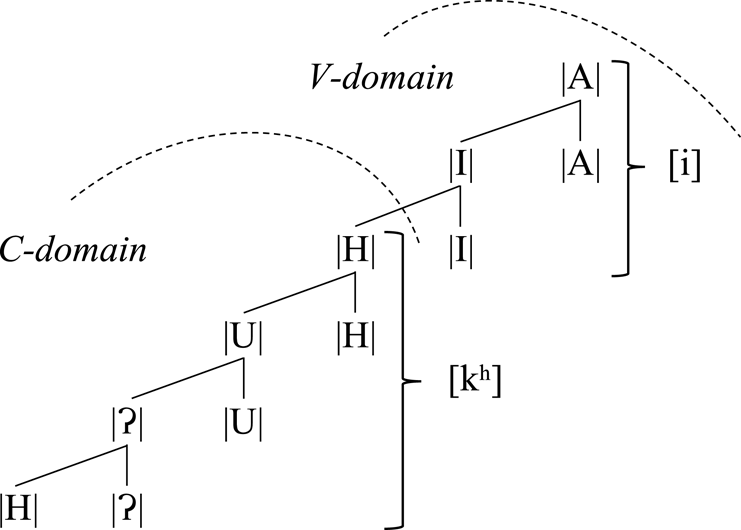
In the PfP approach, phonological heads are thought to be similar to syntactic heads in that they are structurally important but lexically and informationally unimportant. On the other hand, dependents are just the opposite – they are structurally unimportant but lexically and informationally important (Nasukawa & Backley Reference Nasukawa and Backley2015b). This is reflected in the phonetic realization of elements: dependent elements are more prominent than heads in terms of the size of their modulated carrier signal (Nasukawa Reference Nasukawa2016; see also Harris Reference Harris2006). As a result, the most deeply embedded dependent in a structure is also the most prominent. This means that, in addition to being lexically informative (i.e. phonetically prominent) like other dependents, it functions as a domain boundary marker. This is illustrated in Figure 6 below, where the domain boundary marking property |H| occupies the most deeply embedded position in the inter-segmental structure.
Phonological structure of [kh i].

The claim is that right-edge marking languages such as Kaqchikel also locate boundary marking elements in the most deeply embedded part of a domain, and that the difference between left-edge and right-edge marking is expressed as a difference in the setting of a parameter which controls the mechanism responsible for the phonetic interpretation of phonological structure. In PfP, the ultimate head of a CV structure is the highest |A|. If this head has no dependent elements, it is phonetically realized as the default vowel [ə] (i.e. the ‘acoustic baseline’ or carrier signal). In Figure 6, however, this head |A| does have a dependent, so the phonetic realization of the vowel structure changes. In this example the element |I| is a dependent of |A|, and because dependents (cf. heads) provide lexical/melodic information, the acoustic signature of dependent |I| masks or overrides that of the head |A|. The |A|-headed expression |A I| is then phonetically realized as [i]. (For an explanation of other vocalic expressions, see Nasukawa Reference Nasukawa2016.)
Moving one structural level down in Figure 6, |I| is now a domain head and takes |H| as a dependent. The presence of the noise element |H|, which represents voicelessness or obstruency, indicates that the structure from this point downwards has the characteristics of an obstruent. Note that this lower (|H|-headed) consonant domain cannot be realized simultaneously with the upper (|A|-headed) vowel domain because the two domains refer to segment types which involve different (i.e. incompatible) articulatory gestures. In [khi] the element |H| takes |U| as a dependent, where single |U| represents velar resonance (Nasukawa Reference Nasukawa2016; see also Backley & Nasukawa Reference Backley and Nasukawa2009b). Then at the next level down, |U| takes the edge element |ʔ| (defining occlusion) as a dependent. Up to this point, the consonant structure [[ʔU]
 $_{\text{U}}$
H]
 $_{\text{H}}$
is phonetically realized as a plain velar stop [k].
However, the structure for [khi] also has a second token of the noise element |H| which, as a dependent of |ʔ|, is positioned in the most deeply embedded part of the structure, resulting in  . By occupying the lowest position in the structure, |H| maximizes its ability to carry linguistic information – recall that dependents are structurally unimportant but informationally rich. This means that this second |H| is realized in its exaggerated or prominent form, i.e. as aspiration. The domain headed by |H| is therefore interpreted as an aspirated velar plosive [k
 $^{\text{h}}$
]. Coupled with the vocalic structure above it, the entire expression in Figure 6 is realized as the CV-sized unit [k
 $^{\text{h}}$
i]. This outcome is determined by a phonetic interpretation mechanism which follows the Type A (general) principle of precedence in (15).

The Type A principle is observed in the vast majority of languages, including English. Described in terms of carrier signal modulation, it is the structure associated with the greater degree of modulation (C, typically an obstruent) which precedes the structure with the lesser degree of modulation (V).
On the other hand, Kaqchikel has a mechanism of phonetic realization that is the exact reverse of the pattern used in most languages. This means that in Kaqchikel the structure in Figure 6 has a VC outcome rather than a CV outcome. Presumably, then, this language follows a different principle of precedence, shown as Type B in (16).

In terms of carrier signal modulations, we expect Kaqchikel to conform to a pattern which is the opposite of the Type A pattern. In the Type B pattern, the structure associated with the greater degree of modulation (C, typically an obstruent) follows the structure with the lesser degree of modulation (V).Footnote [13]
The parametric difference just described follows Nasukawa (Reference Nasukawa, van Oostendorp and van Riemsdijk2015, Reference Nasukawa2016) in assuming that (i) the same hierarchical melodic structure is present in all languages, (ii) this structure is defined only by head–dependency relations between elements, and (iii) cross-linguistic variation is limited to whether a language chooses V-final or V-initial precedence when phonological structure is phonetically realized. This variation may be formalized as a parametric choice between (15) and (16). Note that, while the PfP approach predicts both Type A and Type B precedence, it does not express the fact that one is typologically more widespread than the other. Clearly, there is a general preference for (15) over (16), but we suggest that this has as much to do with physiological and psychological factors as with linguistic factors. At present it remains an open question, and future research will be needed to fully understand the general preference for the CV pattern over the VC pattern.
5 Summary and further remarks
This paper has challenged the universality of the assumption that listeners focus on the left edge of prosodic domains when parsing incoming speech. By observing aspects of the phonology of Kaqchikel – the distribution of prosodic boundary markers (domain-final noise), primary stress assignment (on the domain-final vowel) and segmental weakening (typically domain-initial) – it has concluded that in this language the right edge of prosodic domains is marked by |H| in its strong form. Although there remains a clear bias for left edge boundary marking cross-linguistically, the pattern in Kaqchikel indicates the need for a typological parameter to set the position of a domain marker in a particular system: languages choose between left and right boundary marking.
To develop this idea further, future research will need to establish whether the preference in Kaqchikel for right edge marking extends to higher levels of the prosodic hierarchy such as phrasal and utterance-level domains. If the same type of consonantal boundary marker is found at higher prosodic levels, then attention must begin to focus on whether any differences in the degree of aperiodic noise (frication/aspiration) can be discerned between these different levels, or alternatively, whether some other boundary cue may be functioning in larger domains (see Dehé Reference Dehé, Campbell, Gibbon and Hirst2014 on a related study of Reykjavík Icelandic).
At the same time, future research must also focus on smaller domains such as the syllable: in particular, it must be determined whether the syllable onset is universally more prominent (stronger) than the coda, or whether this is also subject to parametric variation. In relation to this point, Breen & Pensalfini (Reference Breen and Pensalfini1999) challenges the primacy of the CV syllable in their analysis of prosodic and morphological phenomena in Arrernte, an Aboriginal language of central Australia. Their claim is that the vowel-initial syllable VC is the basic syllable type in this language, a view which is further supported by the way post-vocalic consonants are syllabified.Footnote [14] Tabain, Breen & Butcher (Reference Tabain, Breen and Butcher2004) strengthen the argument for the primacy of the VC syllable over CV in Arrernte by providing not only phonological evidence but also phonetic insights too. Sommer (Reference Sommer1970, Reference Sommer and Goyvaerts1981) also reports in favour of the primacy of the VC syllable by analysing the sound system of Kunjen, a language of Northern Queensland. In neither study is there any discussion of the identity of the prosodic domain marker which is active in the languages concerned, however. So, to determine whether prosodic characteristics similar to those in Kaqchikel may also exist in Arrernte and Kunjen, further investigation is needed in this direction. Our attention will be focused on the issue of how parametric control can be incorporated into syllable-sized and higher-level structures.