Introduction
Stress and distress are closely linked to natural disasters. Selye defined stress as “the body’s uncertain response to any demand placed on it.”Reference Selye and Serban 1 A person’s perceived ability to cope with a stressor can affect the degree of stress experienced and its physiological consequences.Reference Fink and Fink 2
It is becoming increasingly evident that disasters are becoming a more significant risk to human life on a daily basis.Reference Koçak 3 , Reference Koçak, Çaliskan, Kaya, Yavuz and Altintas 4 In the aftermath of natural disasters, traumatic problems are more likely to arise in affected individuals.Reference Cushing and Braun 5 A variety of short- and long-term mental health problems can occur in individuals who experience trauma.Reference Bell and Folkerth 6 –Reference Gillies, Maiocchi, Bhandari, Taylor, Gray and O’Brien 9 Since the 20th century, it has been emphasized that it is important to protect physical and mental health, improve mental disorders.Reference Chen, Lan and Yang 10 Also fires are natural disasters that negatively affect human health. Fires are not only limited to material losses but also deeply upset the social structure due to their psychological effects after the disaster.Reference Brown 11 Witnessing a fire can have a greater impact than being directly exposed to a disaster, because individuals can suffer not only physical but also emotional and psychological harm.Reference Silveira, Kornbluh, Withers, Grennan, Ramanathan and Mishra 12 Women who witness a fire may be more vulnerable to such disasters and are often more emotionally affected.Reference Brémault-Phillips, Pike, Olson, Severson and Olson 13
Major disasters such as fires often affect women’s gender roles and lives more deeply.Reference Bradshaw 14 In addition, the impact of social support systems after a disaster can directly affect women’s recovery processes. Since women have more care and support responsibilities after a disaster can complicate women’s psychological recovery processes.Reference Clissold, Westoby and McNamara 15
In recent years, increasing research aimed at better understanding the effects of disasters on women has revealed that the traumas experienced by women after disasters can directly affect the overall recovery process of society. For example, a study conducted by Macleod et al.Reference Macleod, Heffernan and Greenwood 16 found that women exposed to the 2019–2020 bushfires in Australia exhibited higher rates of depression and anxiety symptoms than men.Reference Macleod, Heffernan and Greenwood 16 Wigg (2019) examined the impact of women’s social roles after a disaster on the recovery process and showed that the challenges they face in the postdisaster recovery process become more complex, since women are generally in caregiving roles.Reference Wiig 17
This study aims to understand the psychological, emotional, and social effects women experience when witnessing a major fire.
Methods
Research Design
In the study, the qualitative research method was preferred, since it reveals perceptions and events in a more realistic and holistic way within a natural environment. The in-depth interview method was preferred in the study because it is a frequently used method to obtain information about the experiences, feelings, and convictions of participants.Reference Yıldırım and Şimşek 18 The consolidated criteria for reporting qualitative research checklist were followed while planning the research.
Participants
The study sample consisted of 10 women who were evacuated from their homes following the forest fire that occurred in Izmir (Turkey) in August 2024. It was emphasized that the sample size cannot be calculated for qualitative studies, that the purpose of qualitative studies is not to generalize the results to the entire population, and that 1 or 2 cases (e.g., individuals, groups) are sufficient.Reference Onwuegbuzie and Leech 19 , Reference Collins, Onwuegbuzie and Jiao 20 Women who were over 18 years old, volunteered for the study, and evacuated were included in the study. The snowball sampling method was used in the study. After the first interview, the participant was asked to refer another acquaintance. Data collection was carried out between October 1 and November 1, 2024.
Data Collection Form
To examine the subject in depth during the interview, data were obtained using a semi-structured interview form created in accordance with the purposes of the study. The interview form included 3 questions in the demographic characteristics section and 10 open-ended questions created for the purpose of the study. This form was created by researchers making use of the literature.Reference Brémault-Phillips, Pike, Olson, Severson and Olson 13 , Reference Danielsson and Eriksson 21 , Reference Lidskog 22 In the sociodemographic section, participants were asked about their age, occupation, and marital status. The fire experience section included questions on how the fire was learned, emotional responses, local government intervention, types of assistance received, and gender-specific roles. Ten open-ended questions were developed based on a review of national and international literature and similar interview studies.
Analysis
A qualitative data analysis was carried out using the MAXQDA software, version 24.1.0, as from the start of the study. Each interview transcript was read 3 times to identify hidden concepts in the statements of participants. After the initial codes were extracted, the codes were divided into categories. Codes with similar meanings were grouped together. This analysis continued until the main themes and sub-themes emerged. Data were analyzed using Valle and King’s 7-step content analysis method as described below.Reference Valle and King 23
Ethical Statement
The study was approved by the ethics committee of Gazi University Scientific Research and Publication Ethics Committee (Date: 10.09.2024 & No: 1409). This study was conducted in accordance with “the principles of the Declaration of Helsinki.”
Results
All study participants were women aged 18 to 65, with a mean age of 40. Four participants were farmers, and most were married. The sample also included an academic, a teacher, a medical representative, a retired nurse, and a medical secretary (Table 1). This diversity offers valuable insights into women’s varied roles in post-fire disaster management across different professions.
Demographic data of participants

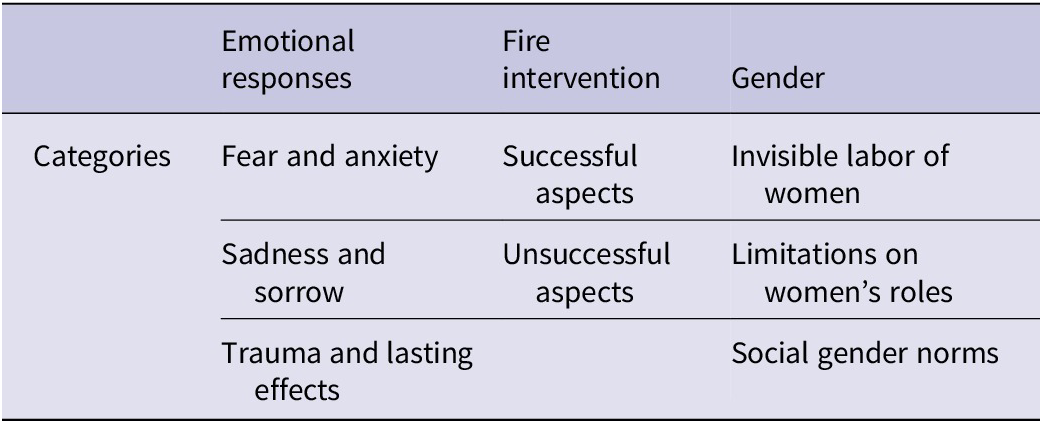
In total, 5945 words were transcribed after approximately 2 hours of interviews. The average interview duration was 20 minutes and 28 seconds, while the average text length was 594 words. As a result of the thematic analysis, the data were coded into 3 main themes and 8 categories (Table 2).
Themes and categories regarding the experiences of participants

Emotional Response Theme
Based on participants’ responses, three subcategories emerged under this theme: Fear and anxiety, Sadness and sorrow, and Trauma and lasting effects (Figure 1). Female participants were asked how they felt upon realizing the magnitude of the fire and its proximity to their homes. Most reported intense fear and anxiety—manifesting as physical symptoms like tension, restlessness, and increased blood pressure—mainly due to fears of losing pets, valuables, livelihoods, and access to shelter. Additionally, many expressed deep sorrow over the loss of nature, forest destruction, and air pollution caused by the fire.
“We had crops and bees in the field. We also had jewelry that we left at home. We only thought of our property, not our lives. All our income was formed by these. We were very tense” (K4).
“I have asthma, and diabetes. I was afraid that I would get respiratory problems. I feared that my blood sugar levels would rise. I had to leave the house so that I would not have to go to the emergency room.” (K9)
“Animals that survived the fire were taking shelter in our homes. What a pity, some animals had brought their babies. I was affected a lot when I saw them.” (K2)
“Everywhere was green behind our house, when I would take a walk. After the fire, it has become pitch black now. This situation affects me deeply every moment and will continue to affect me for a long time. Ash is still falling into our house, and this constantly reminds me of the fire ….” (K8)
“A fox tried to enter my uncle’s house. What a pity, the animal got scared and threw itself into people’s houses in desperation. I swear, I can’t eat when I remember seeing them. I lost my appetite. I don’t even feel like having breakfast ….” (K3)
Emotional responses theme: categories and subcategories.

Fire Intervention Theme
Two subcategories were identified regarding fire response: Successful aspects and Unsuccessful aspects (Figure 2). Most participants highlighted shortcomings such as delayed response, limited information, inadequate local capacity, and slow external support. Additional issues included logistical deficiencies, poor coordination, lack of training, restricted healthcare access, and insufficient psychosocial support.
“…Because we don’t know how to put out a fire. Everyone has done what they could do and what they thought was right. If we knew, if we had drilled, if we had learned it at school, we would have acted more consciously.” (K5)
“… The reason for this was that fires broke out in many surrounding cities at the same time … We saw it both on social media and with our own eyes, the fire brigade teams were not able to put out the fire on their own. The fire was still being fought with the three helicopters, as I counted … Due to the inadequacy of the fire brigade, the public was also trying to put out the fire themselves.” (K6)
Fire intervention theme: categories and subcategories.

However, some participants expressed issues such as rapid evacuation, the presence of voluntary and individual aid, rapid shelter support, and social assistance as successful aspects.
“The Red Crescent and ‘afad’ immediately started providing aid, they distributed food, thank God… The metropolitan municipality provided water distribution … Civil society organizations such as ‘ahbap’ immediately rushed to our aid.” (K3)
“… People communicated on social media to save the animals and came. Motorcycle couriers carried water, food and buttermilk to the area. These were the own initiatives of people ….” (K10)
Gender Theme
Three gender-related subcategories were identified: Invisible labor of women, Limitations on women’s roles, and Social gender norms (Figure 3). Some participants noted that women played roles equal to men in firefighting efforts, including carrying water to extinguish the fire. Others emphasized that gender did not create any particular advantage or disadvantage during the disaster.
“… Women also did the fire extinguishing work. For example, there was a fire a short distance away, we, women and men, put it out together. We also carried water, and we even extinguished some of the fire here before the fire brigade arrived.” (K1)
“Both men and women carried water and tried to extinguish the fire ….” (K3)
Gender theme: categories and subcategories.

However, gender-based inequalities, such as women’s invisible labor, were evident during the fire. Some participants stated that they were unable to engage in the fire response due to childcare duties and were confined to domestic roles. During evacuation and resettlement, women bore primary responsibility for the care of children, the elderly, and the sick.
“… I had my grandchild and cat at home. Of course, I quickly thought about how I could get them out of this area …” (K9)
“… My mother had dementia, so I first prepared my mother’s belongings and medicines. If we were to go somewhere else, my mother would need special care …” (K6)
Women were generally directed to indirect support duties and were kept away from the fire area as individuals who needed protection. This shows that women felt the need to stay in the background for safety reasons rather than directly intervene in the fire.
“I couldn’t intervene in the fire because the children were young… But the children were very scared. I calmed them down and was there for them …” (K5)
“I took my cat and grandchild from home and had to leave.” (K9)
“… We proposed to carry water and throw sand to prevent the fire from reaching the village. No, the police and gendarmerie didn’t let us …” (K4)
Limitations
Although this study is conducted for the first time in Turkey, it has an important limitation. This study was carried out with women living in only 1 local area. For this reason, generalization is impossible. Another important limitation is the snowball sampling method. Snowball sampling carries certain limitations that may impact research validity. Since participants usually refer people from their own social networks, the sample can become homogeneous and lack diversity. This limits the generalizability of the findings. Additionally, the nonrandom nature of the method reduces control over the sampling process and may lead to biased results. It can also be difficult to reach individuals outside of established social circles, especially marginalized groups. As a result, the data collected may not fully represent the target population.
Discussion
Forest fires not only damage the environment but also expose gender-based inequalities. Women are affected differently due to their social roles throughout the disaster process. This study explored women’s experiences and perspectives on forest fires, structured under three main themes and eight categories.
Emotional Response Theme
In a large qualitative study involving 125 disaster survivors across Europe, participants recalled their reactions to traumatic events. The most commonly reported responses were fear, panic, and a sense of high risk.Reference Grimm, Hulse, Preiss and Schmidt 24 Similarly, in this study, it is seen that the highest emotional load is fear and anxiety. Participants reported that fear was triggered by thoughts of safety, shelter, and loss of pets, especially when they learned about the magnitude of the fire and saw the fire approaching their home. Our findings are supported by the study conducted by GüzelReference Güzel and Arafat 25 and Massazza et al.Reference Massazza, Joffe, Hyland and Brewin 26 on the emotions and thoughts of victims during disasters. Many of the participants reported that their first emotional reaction was fear, and in addition, they reported that the biggest reason for fear was the fear for the safety of their loved ones.Reference Massazza, Joffe, Hyland and Brewin 26
Research shows that women are generally more prone than men to post-traumatic stress and anxiety disorders. For example, in a study conducted by Lambrou et al.,Reference Lambrou, Kolden, Loukaitou-Sideris, Anjum and Acey 27 it was found that women reported higher levels of stress due to lack of social support during the post-fire reconstruction process. A study conducted by Knez et al.Reference Knez, Willander, Butler, Sang, Sarlöv-Herlin and Åkerskog 28 with victims of a forest fire in Sweden showed that the majority of participants had feelings of anxiety, anger, and emotional strength, both in the first hours of the disaster and 1 year later.Reference Knez, Willander, Butler, Sang, Sarlöv-Herlin and Åkerskog 28
Besides fear, the most reported emotion was emotional strength. Participants expressed sadness over the loss of nature, forest destruction, and resulting air pollution. According to the research findings by Massazza et al.,Reference Massazza, Joffe, Hyland and Brewin 26 sadness, helplessness, and emotional pain were emotions and behaviors commonly associated with loss that occurred following the realization of the death of friends, family members, and acquaintances.Reference Massazza, Joffe, Hyland and Brewin 26
In addition, the loss of traditional jobs such as beekeeping, viticulture, and gardening caused participants to experience a sense of loss culturally and economically. Similar results were found in a study conducted by BrownReference Brown 11 among postfire victims. This was explained by the connection established between the residents of the neighborhood and the physical environment or the sensitivity of participants to the environment.Reference Brown 11 On the other hand, when considering the importance of location, it follows that changes in landscapes have consequences that reverberate beyond the physical space. However, the symbolic roles of home and location are often replaced by material concerns following a disaster.Reference Cox and Perry 29 In this context, images of destruction may have triggered the concerns of participants about material loss.
Fire Intervention
Fires threaten both nature and human life. Effective local response and interprovincial support are vital, fostering social solidarity and environmental sustainability. For successful firefighting, local governments and surrounding provinces need to work in a coordinated manner.Reference Akyüz and Başaran 30 Participants were asked about the role and effectiveness of local governments and surrounding provinces during the fire, based on their experiences. The majority reported significant shortcomings, such as delayed response, limited local capacity, insufficient information flow, poor coordination, inadequate training, and lack of psychosocial and healthcare support. Delayed assistance from neighboring provinces was often attributed to communication problems and lack of preparedness, as local authorities had never faced a fire of such scale before. Despite these challenges, some participants emphasized positive aspects of the response. Rapid evacuation efforts, voluntary aid from individuals, quick establishment of shelters, and timely delivery of food and water were seen as strengths. Social media played a key role in mobilizing help and distributing resources efficiently. Overall, while the fire response revealed notable deficiencies in disaster preparedness and inter-agency coordination, the solidarity and active involvement of individuals and surrounding communities helped to ease the crisis and provided important lessons for future disaster management.
Gender
Participants were asked whether gender provided any privilege during the fire. Some stated that women took just as active a role as men, even helping extinguish the fire by carrying water alongside them. This highlights that women contributed equally to community safety, challenging traditional gender roles in crisis situations.
According to a study conducted by Danielsson and ErikssonReference Danielsson and Eriksson 21 with women who were sent out after wildfires, a woman volunteering through a company described how women also had to deal with the emotional load. Women reported that it was often women who coordinated activities at assembly points to ensure that firefighters and rescue workers were fed, cared for, and had a place to sleep.Reference Danielsson and Eriksson 21 Similarly, some participants reported taking on childcare and caregiving duties during evacuation. Women were mainly responsible for the care of children, the elderly, and the sick, as well as ensuring the safety of household members and animals, often struggling with these burdens.
The experiences of women in wildfires are often defined through their caregiving roles. Research shows that women assume primary responsibility for ensuring the safety of children, the elderly, and other family members in disasters.Reference Eriksen 31 In disaster situations, women often take on traditionally assigned gender roles. In the study, many women couldn’t directly intervene in the fire due to caregiving responsibilities, especially for children. They were typically directed to support roles and kept away from danger as individuals needing protection. This reflects how gender norms and perceptions of physical strength shape disaster responses. While men were seen as active responders, women’s caregiving duties limited their participation, highlighting how traditional roles restrict women’s involvement during emergencies.
Conclusion
As a result, 3 main themes emerged from the in-depth interviews. Participants experienced intense sadness and anxiety due to many factors resulting from the forest fire. Most participants found the activities by local governments inadequate. We recommend that a disaster management strategy be developed in which women have as much say as men in every phase of disasters and gender equality is ensured.
Data availability
Analyses available upon request.
Author contribution
AT, İÇ, ADK—concept. İÇ, AT—design. ADK, AT—supervision. AT—references. İÇ, AT, ADK—materials. AT—data collection and/or processing. ADK—analysis and/or interpretation. AT, ADK—literature review. AT, İÇ, ADK, CC—writer. AT, ADK, CC—critical review.
Funding statement
None.
Consent to participate
Not applicable.
Consent to publication
All authors consent to having this information published.