INTRODUCTION
In the last decades, many new species of Dorvilleidae have been described worldwide (Eibye-Jacobsen & Kristensen, Reference Eibye-Jacobsen and Kristensen1994), especially from recently sampled environments, such as deep-sea methane seep sediments (Thronhill et al., Reference Thronhill, Struck, Ebbe, Lee, Mendoza, Levin and Halanych2012). Moreover, interstitial species living in shallow marine environments have still been discovered year after year (e.g. Åkesson, Reference Åkesson1973, Reference Åkesson1976; Brito & Núñez, Reference Brito and Núñez2003).
The genus Ophryotrocha is one of the largest dorvilleid genera (~70 species), and traditionally has been classified as opportunistic, with some commensal species of decapods and holothuroids (Martín & Britayev, Reference Martín and Britayev1998), being abundant also in polluted sediments (Rouse & Pleijel, Reference Rouse and Pleijel2001; Paxton & Davey, Reference Paxton and Davey2010). Thus, it has been considered a target genus in monitoring assessment studies, being classified as a species resistant to pollution (Borja et al., Reference Borja, Franco and Pérez2000). However, several recently described species of this genus have been recovered from pristine environments, from the US Atlantic slope and rise (Hilbig & Blake, Reference Hilbig and Blake1991), and deep-sea whale- and wood-falls (Wiklund et al., Reference Wiklund, Glover and Dahlgren2009, Reference Wiklund, Altamira, Glover, Smith, Baco and Dahlgren2012). Even some species from experimental monoculture studies have been identified as new taxa after a detailed examination of their jaw structure (e.g. Åkesson & Paxton, Reference Åkesson and Paxton2005), as well as, genetic analysis (Heggøy et al., Reference Heggøy, Schander and Åkesson2007), which showed the presence of sibling species (Paxton & Åkesson, Reference Paxton and Åkesson2010, Reference Paxton and Åkesson2011).
Eight Ophryotrocha species have been recorded from Iberian Peninsula waters (Campoy, Reference Campoy1982; Martín et al., Reference Martín, Abelló and Cartes1991; Paxton & Åkesson, Reference Paxton and Åkesson2007, Reference Paxton and Åkesson2010, Reference Paxton and Åkesson2011). However, new records are expected in the near future from field surveys carried out on deep-sea bottoms and biodiversity hotspots, such as volcanic marine caves. The new species Ophryotrocha cantabrica sp. nov. has been collected in circalittoral waters, 70–100 m deep, in the Cantabrian Sea, and their diagnostic characters are well developed antennae and palps, parapodia with long dorsal cirrus, sub-triangular acicular lobes and inferior chaetal lobe well-developed, as well as the presence of P-type maxillae and bifid mandibles slightly tagged.
MATERIALS AND METHODS
The material studied was collected during the research cruise ‘Fauna II’ of project ‘Fauna Ibérica’ in the Bay of Biscay, in the summer of 1991. Samples were collected from circalittoral seabeds (70–100 m depth) by means of a Bou de varas grab. Samples were fixed with 10% formaldehyde in seawater, and the specimens were transferred to 70% ethanol. Some specimens were mounted whole in permanent microscopic slides in glycerine jelly; examination was made by means of a compound microscope provided with differential interference contrast optics (Nomarski). Drawings were made to scale with a camera lucida drawing tube. Specimens were photographed with a digital camera (Olympus DP70) coupled to a stereomicroscope (Olympus SZX12).
The type material is deposited at the Museo Nacional de Ciencias Naturales de Madrid (MNCN).
RESULTS
SYSTEMATICS
DORVILLEIDAE Chamberlin 1919
Ophryotrocha cantabrica sp. nov.
(Figures 1–3)
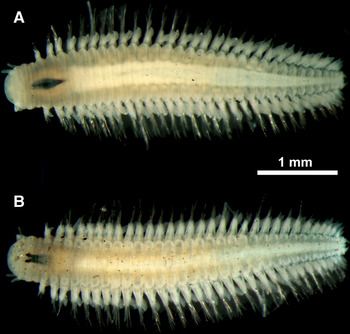
Ophryotrocha cantabrina sp. nov.: (A), complete specimen, dorsal view; (B) complete specimen, ventral view.

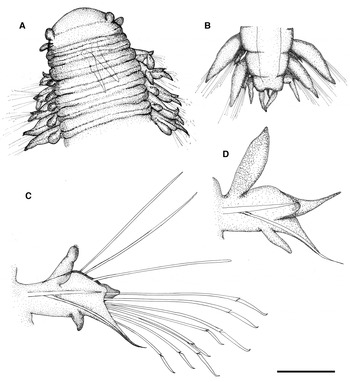
Ophryotrocha cantabrina sp. nov.: (A) anterior end, dorsal view; (B) posterior end, dorsal view; (C) anterior parapodia, lateral view; (D) middle parapodium without chaetae, lateral view. Scale bars: A, 370 µm; B, 320 µm; C,D, 77 µm.

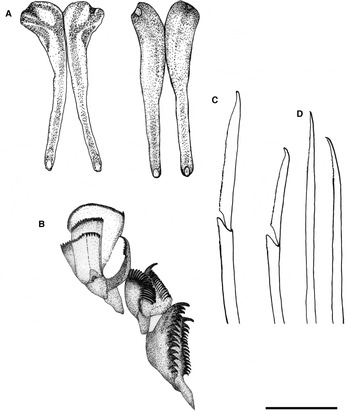
Ophryotrocha cantabrina sp. nov.: (A) mandibles; (B) P-maxillae; (C) heterogomph falciger chaetae; (D) simple chaetae. Scale bars: A, 100 µm; B, 89 µm; C,D, 24 µm.

TYPE MATERIAL
‘Fauna II’, Station 114A, 15 June 1991, Gijón (Asturias), initial coordinates 43°37.71′N05°37.59′W, final coordinates 43°38.36′N05°39.78′W, 72–74 m deep, muddy sandy seabed, holotype (MNCN 16.0/14704) and 38 paratypes (MNCN 16.01/13633); Station 150A, 22 June 1991, Zumaya (Guipúzcoa), initial coordinates 43°22.18′N02°15.00′W, final coordinates 43°23.14′N02°15.21′W, 93–101 m deep, sandy seabed with shells, 7 specimens (MNCN 16.9/13680).
DESCRIPTION
Body shape elongated, of generally uniform width, from the middle part of the body they gradually taper posteriorly (Figure 1). Holotype complete, 4.2 mm long, 0.6 mm wide (without parapodia) for 28 chaetigers, other complete specimen (paratype) 2.5 mm long, 0.5 mm wide for 22 chaetigers. Colour in alcohol opaque white. Prostomium rounded without discernible eyes, a pair of ovoid to digitiform dorsal antennae and a pair of ventro-lateral palps similar to antennae (Figure 2A). Two peristomial achaetous segments, twice as long as the following chaetigers, both rings circumscribed by a ciliary band (Figure 2A). Mandibles long and slender (143–280 µm long), distally slightly bifid without serration in anterior part edge (Figure 3A). Maxillary apparatus of P-type only, maxillae composed of a posterior large piece with teeth (forceps) and seven anterior free denticles on either side (Figure 3B); denticles on each side in two closely situated, with small dorsal teeth, denticles of outer row with an additional larger and strong lateral tooth. Forceps of adult specimens with distal fang and 13–15 teeth, distal fang not much larger than other teeth; D1 similar to forceps with larger teeth, D2–D3 with distal fang and cutting edge coarsely serrated, D4–D7 with uniform serrated edge (Figure 3B).
Setigers circumscribed by a ciliary band. Parapodia uniramous with dorsal and ventral cirri (Figure 2C, D); dorsal cirrus more or less developed, of ovoid in anterior part to foliose in the rest of the body (Figure 2D), ventral cirrus short (Figure 2C). Two conical chaetiger lobes, with strong aciculum, and one ventral (sub-acicular), longer pointed lobe, with a thinner supporting aciculum protrudes from tip of lobe, similar to simple chaeta (conical chaetal lobe) (Figure 2C, D). Chaetae long, divergent and forming a fan. Three to seven supra-acicular simple chaeta smooth with hooked unidentate distal parts (Figure 3D), eight to nine sub-acicular heterogomph compound chaetae, unidentate blades with slight serration and hooked tips (Figure 3C), gradation blade length of 48 µm dorsal chaeta to 32 µm ventral most chaeta, shaft also with slight serration; the sub-acicular conical chaetal lobe holds one simple chaeta (Figure 2C, D).
Pygidium wider than long, with terminal anus and two laterally digitiform anal cirri, and an unparied conical appendage attached ventrally (median stylus) (Figure 2B).
Some specimens had eggs with a maximum diameter of 80–100 µm beginning about chaetiger 4 to 11 (female with 19 chaetigers).
ETYMOLOGY
The specific named refers to the type locality geographical distribution (Cantabrian Sea).
DISTRIBUTION
North-east Atlantic Ocean, Cantabrian Sea, Bay of Biscay (Asturias and Guipúzcoa).
DISCUSSION
Ophryotrocha cantabrica sp. nov. differs from the remaining Ophryotrocha species by having the following characteristics: well-developed antennae and palps, lacking eyes, parapodia with long dorsal cirrus, sub-triangular acicular lobes and inferior chaetal lobe well-developed, supported by inferiormost chaeta, and the presence of bifid mandibles and P-type maxillae. Ophryotrocha longidentata Josefson, Reference Josefson1975 (Josefson, Reference Josefson1975) and O. lobifera Oug, Reference Oug1978 (Oug, Reference Oug1978) are two species that more closely resemble O. cantabrica sp. nov. in body shape and the morphology of the parapodia; both species have palps biarticulated, while in O. cantabrica sp. nov. are simple. Ophryotrocha lobifera differs in having prominent dorsal and ventral thickenings to parapodia. In the parapodia of O. cantabrica sp. nov. the dorsal cirrus is much more developed, especially in the posterior part. The shape of the mandibles differs greatly among the three species, in O. longidentata has expansions wing with smooth edge and without teeth, while O. lobifera has the serrated edge and O. cantabrica distally slightly bifid without serration in the anterior part of the edge.
In relation to reproduction, we found only one ovigerous female, whereas we have not observed sperm in any of the studied specimens. The egg size ranges from 50 µm in O. longidentata to 120 µm in O. lobifera, being intermediate in O. cantabrica sp. nov. (100 µm).
The three species inhabit soft substrates at circalittoral depths (50–100 m), O. longidentata inhabits muds and fine sands, O. lobifera in black muds with sulphide and O. cantabrica sp. nov. in muddy sandy and sandy substrates with shell fragments. The three species are considered meiofauna because of their body sizes and habitats.
ACKNOWLEDGEMENTS
We are grateful to all researchers and staff of the National Museum of Natural Sciences (MNCN-Madrid) involved in oceanographic surveys where the Ophryotrocha specimens were collected.
FINANCIAL SUPPORT
This work is a contribution of the Project ‘Fauna Ibérica X, subproject CGL 2010-22267-C07-03’ funded by the Research Supreme Council.