Introduction
Albendazole (ABZ) is an antihelminthic drug of the benzimidazole compound group, with a broad spectrum of activity against helminth parasites. Although the detailed mechanisms of action are unclear, it is believed that the final common pathway of the metabolic disruption is the inhibition of beta-tubulin polymerase, causing disruption of cytoplasmic microtubule formation. It also acts against immature forms, inhibiting the synthesis of glycogen at intestinal level and the enzyme fumarate reductase (Bogan & Marriner, Reference Bogan and Marriner1980; Horton, Reference Horton2000). ABZ sulphoxide is the therapeutically active form of the drug and, in sheep, there is complete clearance of the drug from blood and body within 96 h after oral administration (Dayan, Reference Dayan2003).
ABZ produces the loss of cells of the tegument through the destruction of cytoplasmic microtubules and lesions in the microtrichias, observed through electronic microscopy. In hydatid cysts (HC) these lesions hinder the metabolism of the germinative membrane and protoscolices, leading to an involution process of the HC characterized by size reduction, degeneration and cyst calcification, resulting in reduced probability of infection when ingested by a dog (Saimot et al., Reference Saimot, Cremieux, Hay, Meulemans, Giovanangeli, Delaitre and Coulaud1983; Franchi et al., Reference Franchi, Di Vico and Teggi1999; Pawlowski et al., Reference Pawlowski, Eckert, Vuitton, Ammann, Kern, Craig, Dar, De Rosa, Filice, Gottstein, Macpherson, Sato, Todorov, Uchino, von Sinner, Wen, Eckert, Gemmell, Meslin and Pawlowski2001). Saimot et al. (Reference Saimot, Cremieux, Hay, Meulemans, Giovanangeli, Delaitre and Coulaud1983) and Horton (Reference Horton1997) mentioned that ABZ is capable of causing this involution process. Using ultramicroscopy, Morris et al. (Reference Morris, Richards, Clarson and Taylor1990) and Richards & Morris (Reference Richards and Morris1990) identified lesions in cystic membranes and protoscolices after treating humans and sheep with ABZ.
Although most authors have used ABZ at doses of 10 mg/kg body weight, in series or not, it was suggested that lower doses act mainly on small cysts during early development (Morris et al., Reference Morris, Richards, Clarson and Taylor1990).
Since 1980, ABZ has been the most frequently used antihelminthic drug for the treatment of sheep nematodes in Uruguaiana county, western part of Rio Grande do Sul state, next to the Argentinean border. The manufacturers recommend oral doses of 7.5 mg/kg body weight. However, due to the high sheep concentration and parasite resistance to the antihelminthic, farm owners normally use 15 mg/kg body weight, administered orally at an average interval of 36–45 days, from the first weeks of life throughout the animal's life (Tassinari dos Santos, Reference Tassinari dos Santos1985; Fagundes dos Santos et al., Reference Fagundes dos Santos, Tassinari dos Santos and Moreira1991). In parallel with the disseminated use of benzimidazole, a reduction in infection of sheep with the larval stage of Echinococcus granulosus has been observed. The observed reduction of hydatid cyst frequencies in slaughterhouses with official meat inspection dropped from 8.4% in 1990 to 3.2% in 1998, in Rio Grande do Sul state (Brazilian Agricultural Ministry, 2007).
The purpose of the present study was to test the action of ABZ in sheep experimentally infected with eggs of E. granulosus, at the dose recommended by the manufacturers and that normally used by farmers in this region for treatment against gastrointestinal nematodes. This ABZ activity could influence HC prevalence in sheep.
Materials and methods
Forty-five sheep of a flock of 600 animals (females of the Corriedale race, from 4 to 5 months of age) were infected orally with 2.0 ml of a solution containing 244 eggs/ml of E. granulosus in physiological salt solution. Eggs were obtained from proglottids of 75 parasites collected from naturally infected dogs in five rural properties of Uruguaiana County, by arecoline bromohydrate purging (Sigma, St. Louis, Missouri, USA). In all of these farms, sheep breeding and rice production were the predominant activities.
The sheep were randomly separated into three groups of 15 animals each and they received the following treatments for 12 months: Group 01, control, without treatment; group 02, 7.5 mg/kg of ABZ, orally (manufacturer's recommended dose); group 03, 15.0 mg/kg of ABZ, orally (dose used by farmers in the region for treatment of sheep).
A group of 5 sheep were maintained as tracers (not experimentally infected with E. granulosus eggs), to check if they could be naturally infected. They were necropsied when the study finished.
ABZ was administered every 36/45 days. During the treatment period the sheep were maintained with the original flock and received the same handling practices and treatment frequency against verminosis as the remaining flock.
Twelve months after the experimental infection, the sheep were necropsied and the search for cysts was accomplished by inspection, palpation and incision through the organs' parenchyma. Lesions were dissected and measured at their larger diameter. Cysts were classified as hyaline, degenerate and calcified, according to Pawlowski et al. (Reference Pawlowski, Eckert, Vuitton, Ammann, Kern, Craig, Dar, De Rosa, Filice, Gottstein, Macpherson, Sato, Todorov, Uchino, von Sinner, Wen, Eckert, Gemmell, Meslin and Pawlowski2001).
This project was registered with the Animal Welfare Committee of the Federal University of Santa Maria, under the process number 9699/2007-69.
Results and discussion
The decrease of hydatid cyst prevalence in sheep since the late 1980s (Brazilian Agricultural Ministry, 2007) in the Rio Grande do Sul state, southern Brazil, could be explained by: (1) access to electricity, which allows greater amounts of meat in farms to be refrigerated; (2) a reduction in sheep flocks due to the decrease in the price of wool; and (3) easy access to benzimidazole compounds to control parasites, as these could influence the biology of E. granulosus.
Six months after the experimental infection one sheep was necropsied to verify the presence of hydatic cysts (HC) and three sheep died during experiment. Necropsy of the five tracer animals was performed to check for any undesirable or natural infection, but no hydatid cysts were found. This aspect allows us to infer that external factors related to infection probably did not influence the number of cysts found in each evaluated sheep.
G1 and G5 strains of E. granulosus have been reported previously in the state of Rio Grande do Sul (Haag et al., Reference Haag, Araujo, Gottstein, Siles-Lucas, Thompson and Zaha1999; de la Rue et al., Reference de la Rue, Dinkel, Mackenstedt and Romig2006), but as parasites were obtained from different neighbouring farms in which sheep breeding was predominant at that time, it is supposed that a single species/strain of Echinococcus was involved in the experiment.
After 12 months the remaining animals were necropsied. A total number of 463 HC were observed and 373 (80.5%) were found in the lungs, 87 (18.7%) in the liver, 2 (0.43%) in the kidneys and 1 (0.21%) in the spleen. Reports from the Meat Inspection Service of the Brazilian Agricultural Ministry (2007) showed an average sheep cyst localization of about 58% in liver and 33% in lungs (slaughterhouse report 2004–2006) after the necropsy of 370,000 animals, between 1 and 3 years of age. However, Meldrum & McConnell (Reference Meldrum and McConnell1968) reported that the younger the sheep, the higher the occurrence of HC in the lungs, probably due to the larger relative size of lymphatic vessels in young animals. This aspect could influence oncosphere spread, allowing direct access of the parasite to the lungs instead of the hepatic barrier in the animals used at the beginning of this experiment.
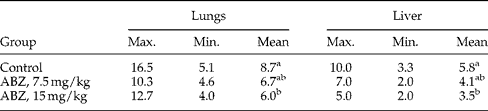
The largest average size reduction in HC was observed in group 03 (ABZ dose 15.0 mg/kg) (table 1), while the dose of 7.5 mg/kg (group 02) presented an intermediate reduction, allowing us to deduce that increasing the dose results in a more significant action of the drug on HC, as mentioned before (Taylor et al., Reference Taylor, Morris and Richards1988; Wen et al., Reference Wen, Ping-Li, Fan and Wen1989). Reduction of the mean size of HC in groups 02 and 03, was significantly higher (P < 0.05) when compared to the averages of group 01 (control) for liver and lungs. The mean size reduction of HC observed in liver and lungs was probably due to ABZ action, considering that in the control group, kept under the same conditions apart from adminstration of ABZ, no size reduction was observed.
Variation in hydatid cyst size (mm) in the lungs and liver of sheep treated with albendazole (ABZ), 7.5 mg/kg and 15.0 mg/kg body weight, 12 months after being experimentally infected with Echinococcus granulosus eggs in Uruguaiana County, RS, Brazil.
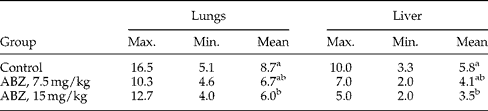
a,b,ab Different letters within a column indicate significant differences among treatments at P < 0.05.
Degenerate HC showed dense laminar and germinative layers, and rigid, caseous and lardaceous infiltrate that easily separated from the adventitial layer. The hydatid fluid was thick, caseous and purulent, when present. Calcified HC demonstrated loss of their structures and the remaining membranes were retracted in the cystic cavity and enveloped with a necrotic exudate of dark coloration, hard and intensely calcified. Similar results have been observed and lesions which compromise germinal layer functions and protoscolice viability have been detected using electronic microscopy, before histopathological and macroscopic lesions could be observed in HC of humans and other animals, after treatment with ABZ (Al-Dabagh et al., Reference Al-Dabagh, Al-Moslih, Verheyen, Shafik, Al-Janabi, Al-Rawas, Ismail, Fawzi, Al-Ani and Rassam1981; Morris et al., Reference Morris, Richards, Clarson and Taylor1990; Deger et al., Reference Deger, Hokelek, Deger, Tutar, Asil and Pakdemirli2000; Paksoy et al., Reference Paksoy, Ödev, Mahin, Dik, Ergül and Arslan2003).
The percentage of 17.3% of calcified HC (table 2), found in the control group, was probably due to their spontaneous degeneration in sheep (Fagundes dos Santos et al., Reference Fagundes dos Santos, Tassinari dos Santos and Moreira1991). Doses of 7.5 mg/kg and 15.0 mg/kg ABZ promoted degenerative lesions and calcification of HC (in 152 (87.3%) and 103 (75.7%) HC, respectively; P < 0.01) in experimentally infected sheep, thus indicating an inhibitory action of ABZ on these cysts. In this work, the long period of treatment could produce higher reduction and degeneration of HCs when compared with other studies (Saimot et al., Reference Saimot, Cremieux, Hay, Meulemans, Giovanangeli, Delaitre and Coulaud1983; Morris et al., Reference Morris, Richards, Clarson and Taylor1990). Njoroge et al. (Reference Njoroge, Mbithi, Wachira, Gathuma, Gathura, Maitho, Magambo and Zeyhle2005) used ABZ at a dose of 30 mg/kg body weight and were able to obtain a reduction in protoscolice viability after 4 weeks. This could indicate that ABZ acts very quickly and that the longer the treatment period, the more destructive the effect on the cysts. It was also suggested that ABZ, when used in small doses for short intervals and over a long period of time, is capable of promoting the suppression of HC, mainly in small cysts or in early developing stages (Saimot et al., Reference Saimot, Cremieux, Hay, Meulemans, Giovanangeli, Delaitre and Coulaud1983; Morris et al., Reference Morris, Richards, Clarson and Taylor1990; Pawlowski, Reference Pawlowski1994).
Macroscopic presentation of hydatid cysts in sheep treated with albendazole (ABZ), 7.5 mg/kg and 15 mg/kg body weight, after administration of Echinococcus granulosus eggs in Uruguaiana County, RS, Brazil.

Cal.+Deg., Calcified and degenerated cysts.
a,b Different letters in the same column indicate significant differences among treatments at P < 0.01.
Albendazole was capable of promoting macroscopic alterations, size reduction, degeneration and calcification of hydatic cysts in sheep infected experimentally with E. granulosus eggs, when doses of 7.5 mg/kg and 15.0 mg/kg body weight were used orally, for 12 months, at intervals of between 36 and 45 days. These alterations are compatible with the suppression and impairment of infective capacity of cysts, which leads to inhibition of the parasite's biological cycle when ingested by dogs.
Therefore, the reduction of hydatic cysts observed in slaughterhouses in the endemic area of the Rio Grande do Sul state, supervised by official meat inspection, could be due to the use of ABZ in higher doses and higher frequency than recommended by the manufacturers.