On May 24, 1704, at about ten in the morning, Agnes Catherina Schickin, a thirty-year-old serving woman from the town of Schorndorf in Württemberg arrived at the village of Krumhard. After asking for and receiving a glass of milk from a local peasant woman, Agnes was on her way out of the village when she saw four, in her words, “beautiful little boys”Footnote 1 playing together by the roadside. She approached the children and asked for directions to Schorndorf. When one of the boys, Hans Michael Furch, the seven-year-old son of the local cowherder, said he knew the way, she offered him a gift and asked him to walk with her. The three other boys wanted to come along, too, but she dissuaded them. Agnes and the seven-year-old walked off into the forest alone.
Over the course of the day, Agnes took the boy deep into the forest, where they encountered several passers-by, who would later testify that they saw them walking, talking, and sitting down together. At four in the afternoon, a passing messenger saw the boy sitting down while she knelt before him delousing him. But this affectionate intimacy would come to an abrupt end. When the boy wanted to return home in the evening, she threw him violently to the ground. Begging for mercy, the boy tried to appease her by reciting his prayers, the “Our Father,” and the Creed among them. This was repeated three times. Twice his prayers moved her. She even helped the trembling boy to his feet, but the third time, she felt “embittered.” Throwing the boy to the ground again, she drew a knife and cut his throat so deeply that, as she later described, she could “look down into his neck.” As his “bright blood” flowed, she said to him, “May God protect you, you sweet angel, you are an angel before God.” Leaving him to die, she returned to Schorndorf where she told the first people she met about the murder and was taken into custody. Asked how she could justify killing an innocent child, she answered that the child was now “saved,” she had only done it so that she herself could “leave the world” as well; “now the hangman would surely dispatch her.”Footnote 2
The details of this dramatic murder narrative, drawn from Agnes' unsolicited and voluntary confession, conform to a particular cultural pattern; the crime unfolded according to a specific liturgy. This case was an example of what eighteenth-century German jurists came to call “indirect suicide” (mittelbarer Selbstmord),Footnote 3 but one might call suicide by proxy. The perpetrators of suicide by proxy committed murder with the intention of bringing about their own death by execution and thus avoiding the eternal damnation that befell direct suicides. Sometimes such suicidal individuals also committed other capital crimes, such as arson, or confessed to crimes they had not committed, usually classic infanticide, i.e., the murder of a newborn infant by its unwed mother,Footnote 4 or bestiality.Footnote 5 The most frequent form of suicide by proxy, however, involved murder. The perpetrators typically chose children as their victims because, as the eighteenth-century jurist Carl Ferdinand Hommel explained, they believed that the “child they murdered, having not yet sinned, would also attain salvation and be spared the damnation it might have earned at an older age.”Footnote 6 Often after a series of unsuccessful suicide attempts, perpetrators of suicide by proxy arrived at the decision to commit a murder. Sometimes they selected a specific child as their victim; at other times they chose a victim quite at random—killing “the next best child” that crossed their path.Footnote 7 Immediately after the deed, they presented themselves at the local jail or the town hall and alerted the startled authorities to the murder. As in Schickin's case, their confessions were spontaneous and uncoerced. Unlike in other capital crimes, such as classic infanticide, for example, judicial torture was not applied in cases of suicide by proxy. The perpetrators made the motive of the killings explicit and explained why they chose murder over suicide. For example, in 1746 when Johanna Martauschin, an inmate in the prison-workhouse at Spandau, turned herself in for the beating death of the small child of a fellow inmate, she confessed, “She committed the murder due to weariness with life, she murdered a child and not herself, because she believed that the child would now surely be saved, whereas she as a suicide would have gone to the devil, but now she could still be converted.”Footnote 8
***
The conviction that suicides went to the devil originated with St. Augustine's assertion that the fifth commandment “Thou shalt not kill” applied to suicide as well as murder. Catholics considered suicide a “mortal sin,” and since suicides could not be absolved through the sacrament of confession, they were consigned to eternal damnation. Suicides were denied sacraments and sacramentals, such as a funeral mass and burial in consecrated ground, since such “means of grace” were pointless in their case. If suicides were mistakenly buried in consecrated ground, the remains had to be removed and reburied elsewhere. The graveyard had to be reconsecrated.Footnote 9
Lutherans rejected the category of mortal sin. Distinguishing between greater and lesser sins was beside the point since all sin was the expression of human nature utterly corrupted by the fall and would result in damnation unless God forgave the sinner.Footnote 10 The suicide died unrepentant in the act of sinning, so it was likely that he or she died an unjustified sinner outside the state of grace. Unlike the Catholic Church, however, the Lutheran Church made no definite pronouncements on the fate of the suicide after death.Footnote 11 Catholics expected believers to be able to be able to resist diabolical temptations to suicide, but Lutherans placed greater emphasis on the power of Satan. “I do not agree,” Luther wrote, “that those who kill themselves are simply damned, for this reason, that they do not do it gladly, but are rather overpowered by the power of the devil, like one who is murdered in the woods by a robber.” Describing suicides more as Satan's victims than willing accomplices, Luther held out the possibility that God had forgiven them and they might yet be saved. God's judgment in these matters was inscrutable. Luther did not want his lenient views on suicide to become public knowledge, however. “Common people should not be told [that suicides do not necessarily go to hell], so that Satan is not given the chance of causing a bloodbath, and I approve of the strict observance of those political ceremonies by which [the body] is dragged through the threshold, etc.” Here Luther was endorsing the rites of desecration to which bodies of suicides were traditionally subjected by secular authorities (hence “political ceremonies”), but he viewed such measures as a means of deterrence rather than as a statement of the suicide's spiritual status.Footnote 12 Lutherans did refuse to bury suicides in graveyards; however, they regarded funeral ceremonies an aid for the living rather than for the dead, who were beyond human help. Lutherans no longer consecrated cemeteries, a rite they abolished along with all other sacramentals. Therefore, exclusion from the graveyard did not constitute a denial of the “means of grace” as it did for Catholics; rather, it was an honor punishment and measure of church discipline.Footnote 13
In both Catholic and Protestant regions the disposal of the suicide's remains was the responsibility of secular authorities, a task they conferred upon the dishonorable professions of executioner and skinner. In Bavaria the executioner or skinner buried suicides “at a secluded place where neither man nor beast treads”; other options were cremation, disposal in a river, or burial beneath the gallows.Footnote 14 In Augsburg suicides of both confessions were nailed into a barrel and cast in the river Lech.Footnote 15 In Württemberg the executioner or skinner buried the suicide either in a desolate location or, if the suicide had a particularly bad reputation in life, underneath the gallows.Footnote 16 In Schleswig and Holstein the executioner buried suicides in a field or with animal carrion. The transport of the body to the burial site sometimes involved additional apotropaic measures designed to prevent the suicide's return as a malicious revenant. To prevent the suicide from finding his or her way home, the body was removed through a hole dug underneath the threshold rather than through the door, a procedure ecclesiastical and secular authorities tolerated though they did not officially authorize it.Footnote 17 In Nuremberg the bodies of suicides were lowered out of windows.Footnote 18
Not all suicides were subjected to these penalties by church and state. These measures applied only to “willful,” “intentional” suicides, not to the “melancholy” and mentally ill. Canon Law exempted from church penalties suicides who were mentally disturbed in the late twelfth century, a policy the Lutheran Church continued.Footnote 19 Secular authorities generally followed suit. Catholic Bavaria, Lutheran Württemberg, and the Lutheran free imperial cities of Nuremberg and Augsburg all followed an essentially identical policy. The authorities conducted an investigation into the suicide's prior circumstances and motives, interviewing his or her priest or pastor, family, neighbors, and witnesses. If they concluded that the suicide was mentally infirm at the time of the deed, he or she received a Christian burial within the graveyard, although usually in the form of a “quiet” burial at night without funeral procession or tolling of bells.Footnote 20
By granting a Christian burial to melancholy suicides, however, secular authorities sometimes provoked popular uprisings in which common people took up arms to prevent the burial of the suicide in the local graveyard. Such graveyard revolts occurred in Catholic and Lutheran areas in the seventeenth and eighteenth centuries. Riots occurred in Catholic Bavaria and Upper Austria, in Lutheran Württemberg and the Reformed Principality of Lippe, posing a significant challenge, as David Lederer observes, to “the authority of the state both judicially and in terms of the sovereign monopoly of violence.”Footnote 21 The distinction between melancholy and willful suicide that determined how church and state judged a suicide was irrelevant to common people, who feared that the presence of any suicide in the churchyard would bring disaster to their community in the form of hail storms and the destruction of crops.Footnote 22
These ritual pollution beliefs associated with the bodies of suicides undoubtedly strengthened the notion that suicides were damned. And the denial of Christian burial and the rites of desecration suicides were subjected to apparently had the deterrent effect that Luther had intended, although with consequences he did not envision. Despite the reluctance of Lutheran theologians to make judgments about the spiritual status of suicides, Lutheran perpetrators of suicide by proxy were convinced, as were their Catholic counterparts, that suicides went to hell. They were hardly alone in this conviction. In his Praxis Rerum Criminalium (1554), a handbook on criminal law, Joos de Damhouder, a Flemish Catholic jurist observed, “He who kills himself sins far more than he who kills another; for in the latter case he only kills his neighbor's body, but cannot harm his soul. But he who kills himself indisputably loses both body and soul.” Damhouder's dictum is reprinted verbatim and without comment in the 1743 article on suicide published in Zedlers Universal-Lexikon,Footnote 23 produced in the Protestant publishing house of August Hermann Franke's Hallische Stiftungen. So it was not altogether outlandish that suicidal individuals believed they might avoid the eternal damnation that followed from suicide by committing murder.
The logic of the crime was based upon the role public execution played in popular imagination. Condemned criminals were known as “poor sinners.” After their sentencing, they were intensely ministered to by clergymen, who heard the poor sinner's confession, granted absolution, and offered the Eucharist. This procedure did not vary significantly among Catholics and Lutherans. Though officially shorn of sacramental status in Lutheran theology, participating in the ritual of confession and absolution remained a prerequisite to partaking of the Eucharist,Footnote 24 and Lutheran parishioners continued to experience absolution as an opus operatum,Footnote 25 theological objections notwithstanding. Confession and absolution remained central to the dramaturgy of executions in Protestant and Catholic lands. Catholic and Lutheran clergymen encouraged poor sinners to believe that if their repentance was genuine and heartfelt, Christ's grace would not be denied them. No matter how heinous the crime, repentance brought absolution. This religious framing of the execution ritual meant that the poor sinner's death was a good death, even a blessed death in Christian eschatology. The poor sinner entered eternity cleansed of sin, unlike regular Christians who had to fear a hasty and untimely death. This cultural context explains how murder could become an instrument of salvation for suicidal individuals.Footnote 26 The perpetrators of suicide by proxy committed not just any murder, however; they murdered a child, a particularly innocent and helpless victim. Child murder was a crime often attributed to the worst enemies of Christendom, Jews and witches.Footnote 27 Murder pamphlets highlighted the particularly “gruesome,” “inhuman,” and “bestial” nature of such killings.Footnote 28
Unlike the mythical child killings associated with Jewish ritual murder,Footnote 29 and unlike the familiar subject of classic infanticide,Footnote 30 the child murders associated with suicide by proxy have gone more or less unnoticed by historians.Footnote 31 The first recent work on this subject focuses not on Germany but on Sweden. In From Swords to Sorrow (1998), a study of homicide and suicide in early modern Stockholm, Arne Jansson finds that “suicidal murders” became frequent after 1670, at the same time that “direct suicide” rates increased dramatically, while manslaughter and other forms of interpersonal violence underwent a significant decline.Footnote 32 Jansson presents a classic Durkheimian argumentFootnote 33 that modernization (urbanization, declining integration within the family and occupational groups, increased literacy—and Protestantism) led to increased “individuation” and social isolation, which in turn contributed to a rise in suicidal acts of all kinds. Suicide and homicide were inversely related. “As a general rule,” Durkheim wrote, “where homicide is very common it confers a sort of immunity against suicide,” and vice versa.Footnote 34 Within the cultural climate of orthodox Lutheranism and Pietism, these “suicidal murders” in early modern Sweden constituted a “transitional phenomenon” in a long-term process in which people increasingly focused aggression and violence on the self rather than on others.Footnote 35 Within German territories, Vera Lind discusses such killings in her magisterial study of suicide in early modern Schleswig and Holstein (published in 1999). She defines these killings as “concealed suicides” and interprets them as a form of religious sacrifice,Footnote 36 an idea this essay will expand upon. In his essay “Freitod durch die Hand des Henkers” (2000), Jürgen Martschukat shows that such killings featured prominently in enlightened debates about criminal justice reforms and led to concrete changes in the procedure of public execution in late eighteenth-century Hamburg.Footnote 37 The only scholar to address the question of religious confession is Tyge Krogh, who surveys cases from Denmark, Sweden, and northeastern Germany in his essay “The Fascination with Execution” (2004). Krogh suggests that suicide by proxy was mostly limited to these areas, because the practice derived from a Protestant understanding of sin and salvation.Footnote 38 In the latest contribution, Craig Koslofsky and Dana Rabin extend the geographic boundaries of suicide by proxy beyond the regions outlined by Krogh, identifying a number of cases from eighteenth-century England, where historians had previously not observed this phenomenon, viewing them alongside Swedish and German cases identified by Jansson and Lind. In all of these regions, Koslofsky and Rabin argue, “capital punishment suicide” confronted the early modern state with the “fundamental limits” of its power over its subjects.Footnote 39
These recent publications have begun to outline some contours of suicide by proxy. But it is clear that basic questions have yet to be answered, or are contested: How often did such murders actually occur? Were they sensational yet isolated cases? When and where did they take place? And crucially, given the significance of confession in German history, what role did the religion of the killers play? Is Krogh correct to suggest that suicide by proxy was a Protestant crime? What role did gender play? Finally, and most importantly for the purposes of this essay, what meaning did the killers attach to their act, and how did secular and religious authorities respond? This article will sketch out some preliminary answers to these questions on the basis of a sample of 116 cases of suicide by proxy that took place in various regions within the Holy Roman Empire between 1612 and 1839. The cases are drawn from criminal interrogation records, execution sermons, shocking ballads and chapbooks, collections of medical and legal consilia, as well as a number of late eighteenth-century legal, medical, and psychological periodicals.
***
Protestants began to observe cases of suicide by proxy earlier and more frequently than Catholics. The earliest case I have discovered dates from 1612, when a peasant woman in Württemberg, a Lutheran territory, murdered her twelve-year-old daughter “seeking her own death and punishment.”Footnote 40 For the time being, however, such killings remained isolated occurrences. In Stockholm an early case was recorded in 1621, but suicide by proxy did not emerge as a pattern before the mid-seventeenth century. The Catholic French scholar Pierre-Daniel Huet, who would later serve as tutor to the Dauphin under Louis XIV and as bishop of Avranches, was a visitor at the court of Queen Christina of Sweden in 1652 when the execution of one such murderer took place. His incredulous reaction gives the impression that suicide by proxy was indeed unheard of before this time. Huet recorded in his memoirs: “… it will not be unwelcome to the reader to report on a new crime that would hardly be believable, if it were not supported by the credibility of numerous witnesses from whom we heard about it, and that occurred not long before our arrival in this place.” He related the case of a Swede of sound mind and good reputation who stabbed a four-year-old boy in the neck as he was playing in front of his parents' house. Huet reported the man's confession: “I know very well that there is no surer way to achieve eternal salvation than if the fully conscious soul exits a strong body …, and is carried upward to God by the pious prayers of people of faith…. I realized it would be impossible to die this way unless I committed a capital crime, so I thought it would be easiest… if I killed a boy not yet corrupted by this life.” The man, Huet reported, went to his death “joyfully, loudly singing sacred hymns.”Footnote 41
These murders were a novelty for Protestants as well, as illustrated by an entry in the Theatrum Europeaum, a multi-volume chronicle of world history produced in the Protestant publishing house of Matthäus Merian. The chronicle reported on a Stockholm murder from 1651, the year before Huet's visit: a German journeyman goldsmith who had immigrated to Stockholm from Nuremberg years earlier, shot to death a baby sleeping in its crib and then turned himself in to the magistrates. The authorities initially turned him away, taking his confession for a “fantasy.” Only when the man persisted and pleaded with resident German clergy for rapid prosecution, “because he…did not want to live any longer,” was the murder confirmed and he was finally arrested.Footnote 42 Apparently, the magistrates were not yet familiar with the practice of suicide by proxy. News of the Nuremberg goldsmith's shocking deed found its way back to his hometown. The Nuremberg city archive contains a small scrap of paper dated only 1651 on which is written, “A child of Nuremberg, a journeyman of the goldsmith trade, tired of his life and wanting to die, working in Stockholm in Sweden, took a pistol and shot a child in its crib. He confessed the deed, asked for mercy, and was executed with the sword.”Footnote 43
By 1670 suicide by proxy had become commonplace in Stockholm. Over the next century the city experienced sixty-two cases of this kind.Footnote 44 In German territories the onset of these murders happened somewhat later. The earliest cluster of such cases occurred, perhaps not coincidentally, in Nuremberg, a Lutheran free imperial city of about 25,000 inhabitants. The city experienced at least eight such murders between 1691 and 1745. The city's Malefizurteilsbuch, a book of judgments in capital cases between 1686 and 1743, records six murders beginning in 1691.Footnote 45 The first murder in this series deviated from the standard script of suicide by proxy. The killer, Maria Helena Längin, an orphaned daughter of a local citizen, who was imprisoned in the house of correction for her “immoral life,”Footnote 46 chose an adult victim instead of a child, perhaps because a more suitable victim was not available to her. On June 7, 1691, she bludgeoned a deaf fellow inmate to death with a brick: she had formed the “evil intent” to “lay a murderous hand” upon her fellow prisoner “out of impatience over her lengthy imprisonment and miserable life.”Footnote 47 Less than four months later, the next murder conformed once again to the standard victimology. On September 26, 1691, Maria Magdalena Wolf, the orphaned daughter of a local citizen and furrier, appeared at the gates of the city dungeon, announced she had murdered a child, and demanded to be let in. Earlier that day, she had twice attempted to drown herself in the river Pegnitz beyond the city walls, but each time she had “repented” at the thought that this “desperate” act of suicide would cost her salvation. Returning to the city, she abducted an unknown child in the market square—as it turned out, this was the eight-month-old baby girl of a local soldier—carried her outside the walls and strangled her with her handkerchief.Footnote 48 After a pause of ten years, the murders resumed in November 1701, when a local citizen's daughter drowned her six-month-old baby sister in a fishpond, “out of impatience and weariness with her life.”Footnote 49 Immediately after the deed she appeared at city hall to turn herself in. The following March, a spurned lover, the only male perpetrator of suicide that I have been able to identify in Nuremberg, decided to shoot himself, but then “out of fear of eternal damnation, he changed his mind,” and shot his lover instead.Footnote 50 Fourteen months later, in June 1703, a beggar woman turned herself in after throwing her baby in the river Pegnitz. She had made several attempts to drown herself with the baby, but the thought of eternal damnation prevented her. She finally threw her child into the river, “so that this way she would be killed as well.”Footnote 51 In 1709 a butcher's daughter turned herself in after decapitating a nine-year-old girl with a butcher's knife. She confessed “that for no legitimate (rechtmässig) reason she developed a weariness of her life and decided to attack and kill the next child that crossed her path.”Footnote 52 When the deed was done, she felt repentance, so she picked up her prayer book at home before turning herself in at city hall. No further proxy murders were recorded in Nuremberg's Malefizurteilsbuch, which ends in 1743, and after this date the sources become fragmentary. Nonetheless, it was possible to identify two additional murders, both by female perpetrators. In June 1744 a local notebookmaker's wife drowned her nine-month-old son in a bucket,Footnote 53 and in 1745 the widow of a journeyman tailor abducted a five-month-old girl and drowned her in the Pegnitz.Footnote 54
Other cities had similar experiences. In Augsburg, a biconfessional city of approximately 30,000 inhabitants, five proxy murdersFootnote 55 and one attempted proxy murderFootnote 56 took place between 1740 and 1783. There were four additional likely cases,Footnote 57 and in a related phenomenon, two people accused themselves of child murder, but the authorities were not persuaded by their confessions.Footnote 58 In Berlin (mostly Lutheran), contemporary publications mentioned twelve proxy murders that took place between 1753 and 1794.Footnote 59 In Vienna (Catholic) at least nine people were executed for suicide by proxy between 1744 and 1769.Footnote 60 In Hamburg (Lutheran), Jürgen Martschukat has identified seven proxy murders between 1772 and 1786.Footnote 61 The phenomenon of suicide by proxy was not limited to cities or towns, but occurred in the countryside as well. Vera Lind has uncovered twenty-three cases of “concealed suicide” in the mostly rural Lutheran territories of Schleswig and Holstein between 1600 and 1820.Footnote 62 Württemberg peasants committed at least seven such murders between 1612 and 1723.Footnote 63 Cases of suicide by proxy occurred in villages in Brandenburg (Lutheran),Footnote 64 Silesia (confessionally mixed),Footnote 65 Saxony (Lutheran),Footnote 66 Swabia (confessionally mixed),Footnote 67 Bavaria (Catholic),Footnote 68 in upper and lower Austria (Catholic),Footnote 69 and many other regions within the Holy Roman Empire. Such murders are also documented for France in the early nineteenth century.Footnote 70
It is clear that the incidence of suicide by proxy extended well beyond Scandinavia and northeastern Germany, and that Catholics as well as Protestants engaged in the practice. The nine people executed for suicide by proxy in Vienna were, unsurprisingly, all Catholic. The prostitute Margaretha N., alias Schilichte Grödl, executed in Munich in 1783 for drowning a baby girl in the Isar River, was Catholic.Footnote 71 Two of the five confirmed proxy killings in Augsburg were committed by Catholics, as was the one attempted proxy murder.Footnote 72 After the Catholic miller “S. A.” from Hilpoltstein in Bavaria unsuccessfully tried to cut the throat of his five-year-old son in 1724, he was cured of his mental distress by going on a pilgrimage to the nearby Jesuit shrine of Heilig Kreuz in Bergen, near Neuburg an der Donau. The cure was not permanent, however. Twenty-one years later he cut the throat of his nine-year-old daughter. “It was a gift from God,” he told his interrogators, that he had killed his child and not himself, “for in the contrary case he would have gone to the devil with body and soul.”Footnote 73 The Silesian Catholic peasant Hans-Christian Henatschel cut the throat of his nine-week-old baby in 1762, after praying to the saints and engaging in a Friday fast failed to stave off his suicidal urges.Footnote 74
Clearly, the practice of suicide by proxy held appeal across confessional boundaries. And yet, while Catholic murders of this kind were not uncommon, Protestant cases were far more frequent, or at least were more visible and more widely discussed. Of the 116 proxy murders in our sample, the confession of the perpetrators is known in 111 cases. Of these, eighty-eight (seventy-nine percent) were committed by Lutherans, twenty-three (twenty-one percent) by Catholics.Footnote 75 This Protestant predominance is partially an artifact of the sources. Many of the cases under consideration here were drawn from published collections of medical consilia, i.e., forensic medical reports on specific criminal cases. Such collections, as Maren Lorenz has shown, were mainly published in large Protestant territorial states such as Prussia or Saxony, where the Enlightenment and process of medicalization took hold earlier than in the Catholic south.Footnote 76 Similarly, numerous articles on suicide by proxy appeared in the new periodicals in medicine, law, and psychology that came into being in the late eighteenth century, and these media, too, were published in the Protestant north.Footnote 77 The rarity of this kind of source material for Catholic areas undoubtedly makes it more difficult to uncover Catholic murders of this kind. Suicide by proxy was frequent enough in Austrian lands to occasion the publication of an edict specifically directed against this offense. An edict of March 22, 1706, ordered that if “an unknown male or female person, who is neither related nor a servant, out of pure malice … commits the sin of child murder, … such a murderer should have his or her head and hand chopped off, and the hand should be attached to the pillory.” The edict specifically mentioned that this penalty should apply “if such a child murder was committed out of weariness with life.”Footnote 78
Nonetheless, the predominance of Protestant cases is marked. The edict of 1706 indicates that such murders must have occurred earlier in Catholic Austria, but the first recorded Catholic case that I am aware of happened in lower Austria in the village of Rodaun just southwest of Vienna in 1719, when a twenty-seven-year-old woman, on the road in search of employment, sought shelter in a barn where she cut the throat of a twenty-week-old baby, the son of a fellow vagrant woman who had also taken refuge there.Footnote 79 But were Catholic murders of this kind really so much rarer? Did Catholics begin to imitate the practice of suicide by proxy only once it had become an established cultural pattern among Protestants? What accounts for the invisibility of Catholic cases? The question of religious confession bedevils the study of suicide in general. Long before Emile Durkheim formulated the so-called “first law” of sociology that Protestants commit suicide more often than Catholics, the question of suicide rates became a subject of confessional polemics and remains a matter of controversy among historians today.Footnote 80 Erik Midelfort has shown that educated Germans, both Protestants and Catholics, were convinced as early as the sixteenth century that suicide was more common among Protestants. Martin Luther saw “despair” as a necessary step in the process of salvation—believers had to face their own utter inadequacy in the face of God's law before they could become recipients of grace. In this hazardous stage believers were particularly vulnerable to demonic temptation and might fall victim to religious melancholy. This understanding of the salvation process led Lutheran theologians to expect and to be more accepting of suicidal tribulations among their flock. Catholics, conversely, saw the supposed high incidence of suicide among Protestants as confirmation of the impoverishment and error of the Lutheran religion, gleefully declaring that when Lutheran reformers jettisoned the sacraments and traditional religious practices, they left their believers defenseless in the face of the devil. “The apparent rise of Protestant suicide rates,” Midelfort concludes,“… has largely been an artifact of prior social and religious attitudes,” rather than a reflection of an underlying social reality.Footnote 81 Other historians, however, do see Protestantism as a significant cause of rising suicide rates—which they believe reflected a real increase in the incidence of suicide rather than simply changes in perception or record keeping.
Arne Jansson, as we have seen, draws on Durkheim to explain the rise in suicide rates in Stockholm around 1670. Protestant individualism was one factor, Jansson argues, that contributed to declining levels of social integration and a resulting rise in the number of suicides, as well as suicidal murders in Stockholm around 1670.Footnote 82 In early modern Zurich, according to Markus Schär, the severe teachings of Zwinglian orthodoxy, which common people did not fully internalize before 1650, prompted a rise in religious melancholy and in the number of suicides at this time.Footnote 83 In his study of suicide in early modern Geneva, Jeffrey Watt reaches exactly the opposite conclusion, however. He, too, observes a real rise in the suicide rate, though for a somewhat later period beginning in 1750, but he attributes it to a weakening of Calvinist orthodoxy. It was precisely the strict social control exercised by the Calvinist church and its severe condemnation of suicide that had held self-killings in check in the earlier period. Secularization lifted the taboo.Footnote 84
The vexed—and perhaps ultimately unanswerable—question of the impact of religious confession on suicide rates will not be resolved here, nor can we determine whether the lower number of Catholic cases of suicide by proxy means that Catholics were really less likely to commit these kinds of murders, or whether they simply commented on them less. We can say, however, that on the level of popular practice and ritual, Catholic and Protestant cases appear indistinguishable. Regardless of confession, the actors availed themselves of the same cultural repertoire as they performed the killings.
Among both Catholics and Protestants, women made up the majority of perpetrators of suicide by proxy. The gender of the perpetrator is known in 114 of the 116 total cases. Of these 114 murders, sixty-five (fifty-seven percent) were committed by women, forty-nine (forty-three percent) by men. The confession of the perpetrators is known in 111 cases. Differentiating by confession, among eighty-eight Protestant murderers, fifty-one (fifty-eight percent) of the perpetrators were women, thirty-seven (forty-two percent) were men. Among the Catholic perpetrators, fourteen (sixty-one percent) were women, nine (thirty-nine percent) were men. The predominance of female killers becomes more pronounced if we include only archival or serial sources, such as criminal interrogation records or death sentence announcements, documents that are more likely to reflect practice than sources involving more editorial selection by the authors, such as published collections of consilia or journal articles. Of the thirty-seven murders recorded in these kinds of sources, thirty-one (eighty-three percent) were committed by women and six (sixteen percent) by men. One explanation for the contrasting gender profile in these two bodies of source materials, the archival record vs. contemporary publications, might be that it is easy to conflate this type of child murder with classic infanticide. Classic infanticide, understood as a female crime, was widely discussed in the eighteenth-century press, and so authors and publishers might have chosen to focus on the rarer and therefore more remarkable male child murderers.Footnote 85 It is not possible to establish statistical trends on the basis of cases drawn from disparate regions and distinct bodies of sources, but it does seem likely that suicide by proxy was predominantly a female crime. Of the eight proxy murders in Nuremberg, women committed seven. Of the nine people executed for suicide by proxy in Vienna, eight were women. Jansson observed the same pattern in Stockholm: among sixty-five proxy killers, fifty-three were women.Footnote 86 In Hamburg the gender disparity was less pronounced: among the seven proxy killings identified by Jürgen Martschukat, women committed four, men committed three.Footnote 87 The pattern observed by Vera Lind for Schleswig and Holstein bucks the trend. She counted twenty-three cases of “concealed suicide” between 1600 and 1820, nine committed by women, fourteen by men;Footnote 88 however, in a study on female homicide in Schleswig and Holstein, Silke Göttsch identified sixteen proxy killings committed by women between 1700 and 1830.Footnote 89 Some contemporaries, in any case, perceived suicide by proxy as a female crime. In 1779 the jurist Carl Ferdinand Hommel observed that this crime was typically committed by “common people, usually weak females of poor education.”Footnote 90
The large number of women among perpetrators of suicide by proxy is all the more remarkable, given that men generally outnumber women among recorded cases of direct suicide by a significant ratio, both historically and in the present day. Two thirds of recorded suicides in Schleswig and Holstein in the seventeenth and eighteenth centuries were male.Footnote 91 In early modern Zurich, seventy-five percent of recorded suicides were male.Footnote 92 In Geneva men outnumbered women among recorded suicides by two to one during the whole early modern period, though the gender gap became most pronounced for the period after 1750.Footnote 93 Men made up two thirds of recorded suicides in early modern England.Footnote 94 Seventy-seven percent of recorded suicides in eighteenth-century Paris were men.Footnote 95 Intriguingly, these sex ratios have not changed much from the late Middle Ages to the present. According to Vera Lind, the female suicide rate “of approximately one third constitutes a stable phenomenon over centuries, not only in Schleswig-Holstein, but also in all of Germany, in many European states, the USA, and in non-industrialized states.”Footnote 96
This predominance of female killers also runs counter to a commonplace in the growing historiography on crime: the consensus there is that female criminality was far less serious than that of men, and that women very rarely used physical force or committed acts of violence.Footnote 97 The violence associated with suicide by proxy contrasts with the relatively non-violent methods infanticidal mothers typically chose to kill their newborns, or that suicidal women chose to kill themselves. In Augsburg the most frequent method of infanticide consisted of giving birth into the privy, in which case the infanticidal mother would never touch her infant.Footnote 98 Other common methods were neglect and suffocation. Classic infanticide almost never involved the shedding of blood. “What characterized these methods of killing from the perspective of the women,” according to Otto Ulbricht, “was the avoidance of violence. These women understood violence as the application of force, the use of instruments or other objects, or in their words: to actively lay a hand on [the child] (Handanlegen).”Footnote 99
Female suicides were similarly unbloody. Female suicides in Schleswig and Holstein almost never used weapons. Whereas fifteen percent of men committed suicide by cutting their own throat, women rarely did so. Half of all female suicides chose drowning, a passive form of death that left the body physically intact.Footnote 100 In contrast, suicides by proxy were often characterized by extreme violence, literally overkill. The most frequent murder method was cutting the victim's throat. Of the ninety-five murders in which the murder method is known, forty-six cut their victims' throat (twenty-two Protestant women, twelve Protestant men, seven Catholic women, and five Catholic men). Eighteen perpetrators bludgeoned their victims to death, a method preferred by eleven Protestant men, four Protestant women, one Catholic woman, and two Catholic men. Ten cases involved drowning (seven Protestant women, one Protestant man, and two Catholic women). This was followed by stabbing in nine cases (eight Protestant men, one Protestant woman), strangling or suffocation in four cases (three Protestant women, one Catholic woman), shooting (three Protestant men, and one man of unknown confession), poisoning (one Protestant and one Catholic woman), and throwing the child in the privy (one Protestant and one Catholic woman). Some methods appealed more to one sex than the other—no woman chose firearms, no man chose suffocation—but cutting the throat was clearly the favored method for all perpetrators, regardless of gender or confession.
The autopsy of a nine-year-old girl murdered by a maid servant in Nuremberg in 1709 gives an idea of the extraordinary violence employed in these killings. The inspection showed that the girl's throat had been slashed, “severing the windpipe and all blood vessels right down to the vertebrae, with a knife repeatedly drawn back and forth.”Footnote 101 In 1723 a fifty-year-old Württemberg peasant woman killed a three-year-old girl with six blows to the neck with “a rather blunt axe.” Blood at the scene spattered five feet (“fünf Schu”) high.Footnote 102 In 1778 “C.E.N.,” a thirty-year-old servant woman from Königsberg managed to decapitate a four-year-old girl with one stroke of the knife.Footnote 103 This level of violence might lead one to conclude that these murders occurred as acts of rage, as impulse crimes, in a “paroxysm of melancholy” as one consilium put it.Footnote 104 But that was not the case. These killings were characterized by a high level of premeditation and preparation. People who committed such murders often planned for days or weeks, scoping out suitable victims. They used ruse to gain access to their victims. In 1783 Margaretha N., a prostitute from Munich, befriended a mother of two children, invited her for beer, and chatted with her and her small daughter until she convinced the mother to let her take the girl along on some errands. Out of the mother's sight, she took the girl to the Isar River and drowned her.Footnote 105 Perpetrators of suicide by proxy frequently resorted to this kind of deception, which led jurists to condemn them as particularly cold-blooded and treacherous. In Leipzig in 1774 a woman identified only as “Schröterin” suffered the exacerbated penalty of having her body exposed on the wheel after her beheading, an extremely rare penalty for women, because her judges considered her killing of a four-year-old girl to be a Meuchelmord, a particularly cowardly and treacherous type of murder. In order to gain access to her victim, she gave the girl's mother some money to go buy pears for the girl. In the mother's absence, she cut the girl's throat.Footnote 106
Where can we situate suicide by proxy in the history of homicide? In his analysis of homicidal violence in Amsterdam from the fifteenth through the nineteenth century, Pieter Spierenburg categorizes killings along two axes, the first to distinguish impulsive violence from planned or “rational” violence, the second to distinguish ritualistic, expressive violence from instrumental violence. According to Spierenburg, late medieval homicides tended to be at once more impulsive and ritualistic, while over the long term rational violence superseded impulsive violence, and instrumental killings came to predominate over ritualistic ones.Footnote 107 Categorizing suicide by proxy along these two axes, one finds that the violence was clearly planned and “rational” rather than impulsive. The instrumental aspect of the killings is also clear. In a majority of cases the killers achieved their stated goal of orchestrating their own execution. But these killings were as expressive and ritualistic as they were instrumental.
Just like the mythical killings of the blood libel, the killings associated with suicide by proxy unfolded according to a particular liturgy of violence. In the myth of Jewish ritual murder, groups of Jewish men were believed to murder male Christian children as a form of religious sacrifice. Women might be involved on the periphery. In suicides by proxy, individual Christians acting alone, predominantly women, murdered Christian children of both sexes. They also sometimes killed adults, often in institutional settings—houses of correction, hospitals, military barracks—where they might have been constrained in their choice of victims. But even here they preferred victims whom they perceived as somehow childlike—the deaf, dumb, and simple-minded. In the first recorded case of suicide by proxy in Nuremberg in 1691, Maria Helena Längin, an inmate in the house of correction chose a deaf woman (eine stumme Weibsperson) as her victim.Footnote 108 In 1720 Anna Dorothee Voßin, a prisoner in the workhouse in Helmstädt deliberately chose an eighteen-year-old deaf and dumb girl as her victim. She lured the girl, who presumably was being cared for in the institution, into her cell and cut her throat. She had previously considered killing another deaf girl, but worried that she was too tall to overpower, so she settled on an easier victim.Footnote 109 In 1755 Ewa Margaretha K., imprisoned in the house of correction at OnolzbachFootnote 110 near Nuremberg, persuaded a mentally handicapped woman to let her kill her so that they both might end their suffering and be saved. The woman agreed, lay down on a bench, and allowed Ewa to cut her throat.Footnote 111
Among the child victims of suicide by proxy, girls made up the majority. Of the eighty-nine victims whose age and sex are known, thirty-nine were girls (forty-four percent), thirty-one (thirty-five percent) were boys, eleven (twelve percent) were women, and eight (nine percent) were men. In cases of suicide by proxy the perpetrators predominantly chose to kill children or adults of their own sex. Of the victims of female killers the age and sex of forty-eight of the victims is known. Women killed twenty-seven girls (fifty-six percent), fifteen boys (thirty-one percent), and six adult women (thirteen percent). They did not kill any adult men. The age and sex of forty-one of the victims killed by men is known. Men killed sixteen boys (thirty-nine percent), twelve girls (twenty-nine percent), eight men (twenty percent), and five women (twelve percent). This gendered pattern becomes more pronounced when children murdered by their own parents are not counted. Women killed twenty-one girls (seventy-two percent) and eight boys (twenty-eight percent) who were not related to them. Men killed eleven boys (eighty-five percent) and two girls (fifteen percent) who were not related to them. Perpetrators of suicide by proxy who killed children unrelated to them preferred to kill children of their own sex. This raises the question of the nature of the relationship between victim and killer. Could it be that women chose to kill girls, and men chose to kill boys, because they achieved a greater level of identification with a child victim of their own sex, and in killing this child they were also in some sense killing themselves? Some killers clearly identified with their victims. In the days leading up to C.E.N.'s murder of a four-year-old girl in February 1778, she contemplated the child whom she would soon decapitate: “the little [girl] was, like herself, the only daughter of her parents. And since she [i.e., C.E.N.] was unhappy in the world, the peasant's daughter might suffer a similar fate, and so it was better to put her out of the world.”Footnote 112
If the perpetrators of suicide by proxy were in some sense annihilating themselves as they killed their victim, even before they mounted the scaffold themselves, they also understood the murder as a religious offering. As in the child killings associated with the blood libel, the child-victims of suicide by proxy were constructed as martyrs. A closer look at the interactions between victim and killer will illustrate the ritualistic and sacrificial nature of these killings. This essay began with a description of the extraordinary scene in 1704 of Agnes Schickin affectionately delousing the boy whose throat she would cut a short time later. This type of affectionate exchange between killer and victim was typical of these murders. Margeretha Mayrin's murder of her neighbors' two-year-old daughter in the village of Herprechtingen in Württemberg in 1703 is a case in point. She dropped by her neighbor, who was a shoemaker, to borrow some wire to repair her shoes. As she was waiting for him to cut the wire, she picked up the toddler, kissed and hugged her, and then took the girl home with her for a visit. After a while, the girl's mother came by to give Mayrin a gift of some milk and to pick up her daughter. Mayrin, in turn, gave the mother some bread, and persuaded her to let the girl stay longer. Subsequent to this exchange of gifts, alone with the child again, Mayrin smashed the girl's head against a wall, shattering her skull.Footnote 113 Such gifts of food are a common theme, though typically the murderers gave or shared food with the child-victim. After she had plied the mother with beer and had gained access to her victim, the prostitute Margaretha N. fed the little girl a bowl of oatmeal just before she drowned her in the Isar.Footnote 114 In 1753 the soldier Daniel Völkner from Mecklenburg shared his evening meal with the little girl who was his intended victim, just before he cut her throat.Footnote 115 These gifts of food or shared meal are evocative of the “last meal” (Henkersmahlzeit) served to condemned criminals before their execution, and served the same symbolic purpose. In the days leading up to their execution, “poor sinners” were provided with whatever foods they desired, and in some regions, the condemned shared a meal with judges and executioner. By accepting special food, the condemned expressed that they were at peace with the judges and agreed to play their scripted role during their upcoming execution.Footnote 116 Similarly, when perpetrators of suicide by proxy offered food to their victims, such gifts were designed to elicit and express their victims' consent.
The victim's consent was a recurrent theme in the killers' confessions. In his analysis of early modern English murder cases, Malcolm Gaskill has shown that witnesses in murder trials often testified to implausible if not impossible events, such as cruentation, the bleeding of a victim's body in the presence of the murderer. Gaskill sees this as an example of “fiction in the archives” of the sort that Natalie Zemon Davis has discussed.Footnote 117 Davis argued that early modern pardon seekers “fictionalized” their account of events, not to convey a falsehood, but to craft their “narrative” so as to give moral meaning to their petition. The testimony of murder witnesses served a similar function, Gaskill suggests.Footnote 118 Philippe Aries has described early modern death as “a ritual organized by the dying person himself who presided over it and knew its protocol.”Footnote 119 In murder cases, Gaskill argues, such ritual orchestration was performed by witnesses on the victim's behalf. Witnesses testified that murder victims had behaved well in their last moments, that they had died a good death.Footnote 120 In contrast to much of the homicidal violence in early modern Europe, which took the form of ritualized conflicts among men in public, in the streets, in taverns, in the marketplace,Footnote 121 suicide by proxy has in common with infanticide that victim and murderer were alone. In cases of suicide by proxy, there were no witnesses present who might testify to the victim's good death. Accordingly, it was the murderers themselves who testified to their victims' demeanor at the moment of death, structuring their narrative to emphasize their victims' consent and sanctification.
In 1783 Maria Anna Mayrin from Augsburg described her murder of a three-year-old girl. As she was preparing to cut the girl's throat, she removed the girl's hood and scarf and asked her if she wanted to die. The child answered yes.Footnote 122 In 1786 Katherine Häuslerin from Donauwörth testified that just before she drowned her seven-year-old daughter and eleven-month-old son in the Danube, she had the girl kneel and pray for a good death. Moments before their mother threw them in the river, the little girl kissed her brother and said, “little brother, now we must die.”Footnote 123 Some murderers bore witness that their victims cried out to Jesus at the moment of death. When Wolff Christoph Dörren shot his fiancée in the left temple in 1702, he testified that as the bullet exited the other side, she “after crying out to Lord Jesus, sank to the ground and did not say another word.”Footnote 124 This story seems about as plausible as Agnes Catherina Schickin's testimony that her seven-year-old victim recited three sets of prayers three times as she violently assaulted him.Footnote 125 Such testimony served not only to attest to their victims' good death, but also to establish a parallel between the liturgy of the murders and the liturgy of public execution they themselves wished to undergo. No execution pamphlet was complete without describing the condemned criminal's prayers and pious last utterances on the scaffold.Footnote 126 The execution of Catherina Uhlin in Halle in 1736 for cutting the throat of a nine-year-old girl is typical. The minister who had prepared her for execution recorded her last words: moments before her beheading “she cried out four times, ‘Now Jesus! Jesus! Jesus! … With such sighs she received the blow of the sword.”Footnote 127
Execution pamphlets echoed the killers’ sanctification of their victims, in both text and image, explicitly portraying the children as martyrs, but also established parallels between their murders and the execution of their killers. When Jeremias Bertz, an Augsburg bag-maker, cut the throat of his eighteen-week-old-baby daughter Maria Magdalena in 1740, his deed inspired no fewer than four publications, including several engravings of the dead child and numerous murder ballads circulating in manuscripts, replete with the folksong melodies they were set to. One of the printed ballads publicized his motive:
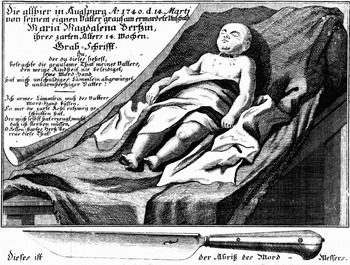
Another ballad, entitled “The merely eighteen-week-old Martyr Maria Magdalena Bertzin Speaking from the Grave,” enacts a conversation between the father and his murdered child. The child, an innocent “lamb” that was now singing with a choir of angels, laments her father's deed but also exhorts him to repent so she might be reunited with him in heaven.Footnote 129 Maria Magdalena was a Protestant child, but the images of her dead body resemble “the corporeal sensuality of pious suffering” that R. Po Hsia has described in the seventeenth-century engravings of several alleged victims of Jewish ritual murder, images “that brings to mind Rubenesque cherubs, redemptive flesh in the sensuous iconography of baroque Catholicism.”Footnote 130 Simon of Trent was often portrayed with the instruments of his martyrdom—evoking the Arma Christi, “the weapons of Christ,” i.e., the instruments of the passion (cross, nails, lance, crown of thorns).Footnote 131 Similarly the murder weapon, the knife, figures prominently beneath the portrayal of Maria Magdalena. In “the anatomical-surgical rendering”Footnote 132 of the image the viewer can look into the wound it inflicted (Figure 1).
Engraving commemorating the murder of fourteen-week-old Maria Magdalena Bertzin by her fater in Augsburg, 1740. The caption below the knife reads: “This is a sketch of the murder-knife.” Stadt- und Staatsbibliothek Augsburg (StStBA), Graphic, Verbrecher etc, 29/120, “Die alhier in Augsbug Ao 1740 den 14. Marty von seinem eigenen Vatter grausam ermordete Unschuld Maria Magdalena Bertzin.”

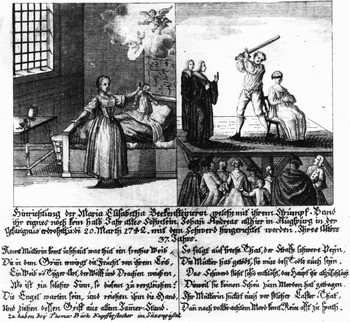
When Maria Elisabetha Beckensteinerin, an Augsburg cardmaker's wife imprisoned for theft, strangled her six-month-old baby boy in her prison cell two years later so that she might “earn [her death] by means of her child's death,” this murder prompted a similar outpouring. No fewer than three engravings portraying the murder were published, and the deed inspired several ballads. One of the images directs the viewer's gaze to the murder weapon in an inset showing the stocking ribbon (Strumpfbändel) with which she strangled him, with the caption “Length and Breadth of the Murder Band.” A ballad commemorated the “twenty-seven-week-old martyr.” Another pamphlet (Figure 2) juxtaposes two images, the moment of the murder as the baby's naked soul leaves his body ascending upward into the waiting arms of an angel, and the moment of the mother's execution. The salvation of the child is certain, while the salvation of the mother is in abeyance. A cautionary verse beneath the image warns that repentance often comes too late, but the clergymen who accompanied her to her execution stand with her on the scaffold gesturing toward heaven. Several ballads attested to her heartfelt repentance.
Engraving commemorating Maria Elisabetha Beckensteinerin's murder of her infant son in Augsburg, 1742. Note the portrayal of the baby's soul as it rises into the waiting arms of the angel. StStBA, Graphik, Verbrecher etc, 29/123, “Hinrichtung der Maria Elisabetha Beckensteinerhin, … den 20. Marty 1742.”

Another parallel between suicides by proxy and public execution was of course the forms of death of victims and perpetrators and the blood symbolism they shared. As we have seen, most victims had their throat cut, and all perpetrators who were executed died by beheading. The “bloodthirsty murderer” who “washed her hands in the innocent blood of the child,”Footnote 133 victims found lying in a pool of blood, and the blood of the innocent that cried out to God for vengeanceFootnote 134 are recurrent themes in the pamphlet literature commemorating these crimes. Authorities evoked the Old Testament maxim of blood for blood,Footnote 135 and perpetrators offered up their blood in “payment” for their sins. Ultimately, of course, it was the blood of Christ that would wash away the killers' sin.Footnote 136 The promise of redemption on the scaffold exercised a powerful hold on the imagination of perpetrators of suicide by proxy. Several of them formed the intent to commit murder after witnessing a public execution.Footnote 137 In a remarkable analogy, the defense advocate of Elisabeth Schmied, who had cut the throat of a six-year-old girl in Leipzig in 1714, claimed that a criminal's recent “beheading and salvation” (sic!) had made such an “impression” on her, that “as if captured by the furor of love, she did not know right from wrong.”Footnote 138
***
How did governments respond to the phenomenon of suicide by proxy? The free imperial city of Nuremberg was the first to react with legislation. In 1702 the city government issued an edict that first lamented the rising number of cases of classic infanticide and threatened infanticidal mothers with execution by drowning or even being impaled alive. It then addressed
… others who out of an imagined weariness with life and in the Godless opinion, that if only they do [not] rob themselves of life, but instead forfeit life and limb for killing other innocent persons and are executed, then, after coerced and—God knows—if righteous contrition and penitence, Heaven's gate must stand open to them, and therefore they dare to kidnap other people's innocent children and kill them, and even do not hesitate or have scruples to carry out such evil deeds upon adults.
Such murderers would not suffer a quick death by beheading. Instead the death sentence would be sharpened in such a way, that it would be “far more painful and shameful for them than death itself.”Footnote 139
This law took a traditional approach: the government believed that if a crime continued to occur or became more frequent, that meant that the existing penalties were not severe enough. The penalties of drowning and impaling alive were traditional death penalties for women that had fallen into disuse in the sixteenth century. Faced with what they perceived of as a rising tide of infanticide, the Nuremberg city government decided to reintroduce these archaic forms of execution.Footnote 140 The government took the same approach toward suicide by proxy, threatening such murderers with exacerbated penalties rather than standard beheading. Nuremberg put this edict into practice by sentencing perpetrators of suicide by proxy to having their right hand amputated prior to beheading. Head, hand, and body were to be exposed on the wheel or buried in a shallow grave beneath the gallows.Footnote 141 The Austrian edict of 1706 discussed above also threatened proxy killers with exacerbated penalties. Clearly these edicts did not have the desired effect. Cases of suicide by proxy continued to occur in Nuremberg and Austria after 1702 and 1706. The threat of exacerbated penalties might even have been counterproductive for these offenders. Perpetrators of suicide by proxy frequently expressed fantasies of bodily destruction. Agnes Catherina Schickin, whose murder of a seven-year-old boy was discussed above, prior to the killing had expressed the desire to be boiled in oil or ripped apart by claws.Footnote 142 Did the threat of exacerbated penalties make death on the scaffold even more alluring for such perpetrators?
It took several more decades for secular authorities to develop a new approach. In 1767 Schleswig and Holstein published an edict
… that, when someone … wants to lay hands on an innocent child or an adult and kill him or her with the sole intention of committing a felony in order to forfeit his or her life, such an evildoer will not lose his or her life but instead … will be punished in the following manner: 1) The criminal will be publicly whipped and branded on the forehead and then cast in chains, and will be locked up for life at the hardest … and most shameful … labor … 2) In order to make a greater impression on those who might have the same idea, once a year on a market day such criminals will be led from the penitentiary in a hideous outfit, with uncovered head, flying hair, and with a rope around their necks, with hands bound and their feet in chains, with a board attached to their chest with this inscription: Murderer (Mörder oder Mörderin) of an innocent child …, and led through town exposed on the skinner's cart. 3) When such a criminal dies, his or her body should be taken to the gallows by the executioner's servants, where the head and hand will be hacked off and the body exposed on the wheel, and head and hand nailed to a post.Footnote 143
This legislation was at once traditional and innovative. It made full use of the time-honored repertoire of defamatory measures available in the traditional theater of punishment to maximize the convict's suffering and dishonor, including the practice of branding that had all but fallen out of use by the mid-eighteenth century. At the same time, however, the law took the quite radical step of decoupling murder and capital punishment, thus abandoning the Old Testament demand of blood for blood in murder cases.Footnote 144 And yet this law, too, failed to bring an end to the practice of suicide by proxy. Cases of suicide by proxy continued to occur in Schleswig and Holstein throughout the eighteenth century and well into the nineteenth. Silke Göttsch cites a case as late as 1832.Footnote 145
Prussia enacted similar legislation in 1794. Paragraph 831 and 832 of the Allgemeines Landrecht ordered that
If it is established that someone who is otherwise of sound mind commits a murder … with the intent of being executed, he should not achieve his goal. Instead he should be imprisoned for life in the narrowest confinement under close supervision and be whipped in public at regular intervals.Footnote 146
Here, too, the legislation did not put a stop to suicide by proxy. Cases continued to occur in Prussia at least until 1829.Footnote 147 It is unclear why such legislation failed to stop such murders in Schleswig, Holstein, and Prussia. Did the legislation remain a dead letter, or was it inconsistently applied? Was it insufficiently publicized? Whatever the reason, governments proved unable to prevent such killings.
Suicide by proxy also posed a significant challenge to religious authorities of both confessions, although it was Lutheran clergy who engaged with the problematic of suicide by proxy most directly. As Lutheran clergy ministered to poor sinners awaiting execution, they pointed out that they were in fact guilty of suicide. The pastor of Johanna Martauschin, who faced execution in 1746 for bludgeoning a small child to death, admonished her that “she had wantonly abused God's grace, and that she was indeed a self-murderer.”Footnote 148 This did not preclude her salvation, however, because like people who had attempted suicide or suicides who did not die immediately, she could still repent and be forgiven. Another fundamental theological error from the pastors' point of view was that perpetrators of suicide by proxy believed that they could expiate their sins on the scaffold. They spoke a language of payment and exchange that clashed with the official Lutheran view of the believer as a passive vessel of grace. Awaiting execution for cutting the throat of a four-year-old girl in 1745, Gertrude Magdalena Bremmel exclaimed, “Let me do good penance here, let me pay with my blood, let me make up for everything with my death!” It was an error, her pastor instructed her, that one could do penance for one's sins through works or suffering.Footnote 149 More than two centuries after Luther, the clergy was still struggling to inculcate the doctrine of salvation by grace alone.
The one Catholic execution sermon for a perpetrator of suicide by proxy that I have found did not address the problem of suicide by proxy at all. Instead, the execution sermon for Maria Anna Mayrin, who had cut the throat of a three-year-old girl in 1783, warned against the dangers of romantic love and the inordinate passions it inspired that had precipitated her suicidal intent in the first place.Footnote 150 Catholic clergy apparently addressed the issue of suicide by proxy less frequently than their Lutheran counterparts. Does this mean that they were in fact confronted with the practice less often, or that dealing with suicide by proxy posed a greater challenge for Catholic clergy than for Lutherans? Catholic theologians believed, after all, that Christians were obligated to do penance to expiate their sins, though for sinners to orchestrate their own execution was hardly what they had in mind. Perhaps this made it more difficult for Catholic priests to condemn suicide by proxy on theological grounds.
***
The rituals of public execution have often been portrayed as the clearest manifestation of the social disciplining agenda of the early modern state. Suicide by proxy, however, was an unintended consequence of social discipline, as common people manipulated criminal justice to achieve their own ends. In recent years the historiography on crime has been undergoing something of a shift, moving away from emphasizing the purely repressive elements of early modern criminal justice. Instead of viewing criminal justice as something that is imposed upon subjects as a top-down instrument of social disciplining, some historians understand criminal justice as something common people “appropriate” to meet their own needs (Justizaneignung). Susanna Burghartz, for example, sees common people as clients of institutional justice, arguing that criminal justice was available to common people as an option in conflict resolution.Footnote 151 In a stimulating essay about the relationship between eighteenth-century Parisians and the police, Martin Dinges has formulated the concept of the “usage” of criminal justice (Justiznutzung) by common people to show how subjects availed themselves of criminal justice for their own private ends. Dinges stresses the significance of imagination and the role of criminal justice in fantasy life. Eighteenth-century Parisians developed what he has called “justice fantasies.” Common people incorporated the institutions of criminal justice into fantastical threats, such as having the entire police department descend upon an adversary, or acted out justice fantasies by impersonating a police commissioner to intimidate an opponent. Dinges has emphasized the destabilizing, anarchic potential of such justice fantasies, which tended to undermine the official claim that criminal justice was an evenhanded, impartial arbitrator of disputes in the public interest.Footnote 152
Suicide by proxy presents a rather more extreme example of the usage and appropriation of criminal justice by common people. Perpetrators of suicide by proxy developed and acted out execution fantasies in which they articulated a proprietary claim upon criminal justice. The theological differences in the two confessions' official teachings on suicide and forgiveness of sins did not affect how Catholic and Lutheran common folk reacted to suicide or how perpetrators of suicide by proxy performed their script. Upon turning herself in, Agnes Catherina Schickin requested that “one should now do to her what she had earned” (Man solle ihr nun thun, was sie verdient habe). She wanted to suffer “the justice that belongs to her” (das Recht, daß ihr gehöre).Footnote 153 After strangling her six-month-old son in Augsburg in 1742, Maria Elisabetha Beckensteinerin told authorities that she wanted to “earn” (verdienen) her own death with the death of her child.Footnote 154 The German word “verdienen” translates as something you earn as a payment, and something you deserve as a punishment. The officially stated purpose of capital punishment as deterrence was certainly destabilized, as perpetrators of suicide by proxy, both Catholics and Protestants, claimed their own execution as an entitlement and instrumentalized criminal justice to meet their own emotional and religious needs.