




No CrossRef data available.
Article contents
Gender and stylistic variation in second language phonology
Published online by Cambridge University Press: 08 November 2004
Abstract
Communicative competence comprises many things, including the ability to use the appropriate pronunciation, based on gender and style. Previous L2 research in phonology has focused on the frequency of nativelike and nonnative forms and variation within nonnative forms, rather than variation within nativelike forms. This study, however, examines variation in nativelike forms by investigating gender and stylistic differences in the English of native speakers and native speakers of Japanese and Spanish. The results of the native speakers demonstrated that there were significant differences based on gender and style. Both groups of nonnative speakers exhibited significant gender differences but only one group showed significant stylistic differences. The results suggest that gender differences are acquired before stylistic differences.Different versions of this article were delivered at the following conferences: EUROSLA, June 1999 in Lund, Sweden; NWAVE, October 1999 in Toronto, Canada; and SLRF, October 2003 in Tucson, Arizona.
Information
- Type
- Research Article
- Information
- Copyright
- © 2004 Cambridge University Press
Variation in native speakers (NSs) occurs in all languages, based on style and prestige. For example, If he would have come thi[š] year, I would have been happy is more casual and less prestigious than If he had come

year, I would have been happy. Numerous studies have demonstrated that formality, prestige, and social class go hand in hand; that is, the more formal the situation and the higher the social class, the greater occurrence of prestigious forms (e.g., Labov, 1966, 1972, investigated the postvocalic r and the interdental fricatives

in New York City; Trudgill, 1974, examined -ing

, glottal stop substitution for /t/, and h-deletion in Norwich).
Differences based on gender also occur in all languages. In general, females use more prestigious forms than males (for a review see Smith, 1979, and for a general sociolinguistic account see Coates, 1993). This pattern is true even in young children. In an early study of children (ages 3–10), Fischer (1958) found that boys used a higher frequency of final -in' as opposed to -ing than girls. In the 24 children he studied, only 17% (2/12) of the girls used more -in' than -ing, in contrast to 58% (7/12) of the boys. In Singapore English, Hiang and Gupta (1992) found that postvocalic /r/ (a prestige feature) occurred more frequently in females than in males. Other studies dealing with adult native speakers include the following: Labov (1966) found postvocalic r-use more frequent in females than in males; Milroy (1988) demonstrated glottalization of stops in British English was dependent on gender; Sankoff and Cedergren (1971) discovered that men deleted /l/ more frequently than women in Montreal French (but the difference was only 8%); Shibamoto (1987) established that in Japanese /i/ and /r/ deletion is correlated with gender; Trudgill (1974) found men used more nonstandard -in' than women. Other research showing that females use more prestige forms than males include studies on American English (Eckert, 1996; Labov, 1966, 1972; Luthin, 1987), Arabic (Haeri, 1987), British English (Trudgill, 1984), Chukchi (cited in Wardhaugh, 2001), Gross Ventre (cited in Wardhaugh, 2001), Koasati (Haas, 1944), and Spanish (Rissel, 1989).
Whereas studies in stylistic variation of NSs have usually concentrated on the frequency of standard or prestigious forms versus nonstandard or nonprestigious forms, second language acquisition (SLA) phonological studies of stylistic variation have focused almost exclusively on the frequency of standard native versus nonnative forms, with little or no investigation of variation within native forms (i.e., standard vs. nonstandard). In general, it has been found that the more formal the style, the less L1 transfer and the greater the frequency of targetlike forms, as seen, for example, in Nemser's classic study (1971a) of Hungarian learners of English. In the oft-cited classic study by Dickerson and Dickerson (1977), Japanese learners of English produced /r/ with 100% accuracy in word lists, but only with 50% accuracy in free conversation. Other studies revealing the same tendencies regarding style and accuracy include Gatbonton (1975, 1978), Petrenko (1989), Preston (1989), Sato (1985), Schmidt (1977), Tarone (1979, 1982, 1983, 1988), Wenk (1979, 1983), and Wilson and Møllergard (1981). Several other studies, however, indicate that greater targetlike accuracy is not always associated with more formal styles (Beebe, 1980; Lin, 2001; Major, 1996; Weinberger, 1987, 1994). Major (2001) cited numerous examples where a less formal style can produce more targetlike forms. For example, in slow formal speech Japanese speakers insert a vowel between initial consonant clusters, due to transfer: sky → [sukay]; however, in conversation the vowel deletes, producing nativelike [skay], due to the Japanese rule of vowel devoicing and deletion between voiceless obstruents, which in native Japanese occurs in more casual styles.1
Although these processes can produce nativelike English pronunciation in words with onsets of voiceless obstruent clusters, such as spa, stew, and ski, the same processes can produce nonnative pronunciation in such words as city→ [sti].
Most SLA variation studies have dealt with the frequency of native versus nonnative forms, but have not differentiated between the various types of errors. A growing number of studies do address variation within these nonnative forms, although the majority do not deal with stylistic variation (Broselow, Chen, & Wang, 1998; Broselow & Finer, 1991; Eckman & Iverson, 1993, 1994, 1997; Hancin-Bhatt, 2000; Hancin-Bhatt & Bhatt, 1997; Johansson, 1973; Nemser, 1971b). Some studies, however, address the relationship between style and different types of nonnative forms. Major (1987, 2001, 2002) has claimed that the relative influence of L1 transfer and universals depends on style. Numerous studies of Carlisle (e.g., 1994, 1998, 2002) have shown that vowel epenthesis for Spanish learners of English depends on linguistic environment and style. Abrahamsson (2001) examined errors in consonant clusters and claimed that epenthesis was less “destructive” or “erroneous” than deletion because the underlying forms are preserved, whereas deletion leaves no trace of the consonant and thus underlying forms are unrecoverable. In his study, he accurately predicted that as formality increases, epenthesis would be favored over deletion (also see Weinberger's, 1987, 1994, discussions on recoverability). Abrahamsson's claims follow logically from universals of NSs in terms of style, listener, and speaker. Universally, more formal styles favor the listener (i.e., forms are more intelligible) and informal styles favor the speaker (i.e., forms are easier to pronounce, e.g., what is the matter?

). Thus, it would be expected that epenthesis in L2 learners would be favored over deletion, as formality increases. This pattern was found in Lin's (2001) study, where epenthesis in Chinese EFL learners' consonant clusters increased as formality increased, but deletion increased as formality decreased.
Although there has been considerable research on stylistic variation in L2 phonology, there have been very few studies addressing gender variation in L2 phonology. In contrast, L2 gender studies dealing with nonphonological differences are legion. In addition to research on general issues (Ellis, 1993), L2 gender studies have found quantitative and qualitative differences between males and females in such diverse phenomena as rate of interaction (Kasanga, 1996), age and rate of learning (Slavoff & Johnson, 1995), speech rate (Dewaele, 1998), acculturation (Jewell, 1992; Tran, 1988), styles and strategies (Oxford, 1993), discourse (Johnson, 1992), pragmatics (Kasper & Schmidt, 1996), motivation (Boyle & Houndoulesi, 1993; Dörnyei & Clement, 2001; Syed, 2001), peer group structure and bilingualism (Woolard, 1997), gender as social practice (Ehrlich, 1997), gain during study abroad (Brecht, Davidson, & Ginsberg, 1995), comprehensible output (Pica, Holliday, Lewis, & Morgenthaler, 1989), listening and social interaction (Furo, 2000), NNS/NNS interactions (Gass & Varonis, 1986), vocabulary (Levine & Reves, 1990; Scarcella & Zimmerman, 1998), reading (Schueller, 2000), bilingual writing (Broussard, 2000), computer-assisted writing (Rogers, 1999), and neurolinguistics (Xu, 2001).
In contrast to the large number of nonphonological studies on L2 and gender, the number of L2 gender studies on phonology is probably limited to about half a dozen. The common belief that women have better pronunciation is only somewhat supported by the research. Although Weiss (1970) found better pronunciation by females than males, Elliott (1995) and Tahta, Wood, and Loewenthal (1981) found no gender-based differences. Although Frey (1995) did not compare differences in accuracy of an L2, she found syllabification for females to be more sensitive to consonant strength, whereas syllabification for males was more sensitive to accent and vowel quality. She then argued that these differences have applications to foreign language teaching. Gussenhoven (1979) and Broeders (1982) both reported that Dutch female students were more favorably disposed toward use of the prestigious accent of an L2 than were males. However, neither study actually measured pronunciation accuracy of the prestigious/nonprestigious norms; rather, they dealt with pronunciation attitudes.
Perhaps the most detailed study involving prestige and nonprestige forms in nonnative speakers was Adamson and Regan's study (1991) of Cambodian immigrants' use of -ing morpheme in English. The results showed that the female patterns were similar to the NSs but the male patterns were not. Although the nonnative speaker (NNS) females used the prestige variant -ing more frequently than males and as style became more formal (patterns similar to NSs), the startling finding was that the frequency of -ing for NNS males actually decreased as style became more formal. The authors suggest that the males quite accurately perceived the -in' as a male marker, and accordingly for them it was the prestige variant. As style became more formal and more attention was paid to form, these male speakers were more accurate in terms of what they perceived to be the male norm, rather than being more accurate in terms of style, where a greater frequency of -ing in formal styles occurs for both genders. Thus, for the males, it appeared that gender was more salient than style. However, the authors caution that perhaps the high frequency for -in' was a result of the fact that the male speakers had been exposed largely to working-class English, in which -in' is very frequent.
In all the SLA studies cited dealing with stylistic variation, these investigations have been limited to variation in the occurrence of native and nonnative forms and variation within the various kinds of nonnative forms, rather than variation within the various types of nativelike forms. In the L2 gender studies, as well, perhaps with the one notable exception of Adamson and Regan (1991), research has been limited to variation in the frequency of native and nonnative forms for males and females. These traditions for variation and gender research in SLA strongly contrast with the long tradition in sociolinguistics, which has focused on the frequency of standard versus nonstandard forms in NSs, based on style and gender.
Although many areas of SLA research have focused on variation in nativelike utterances taking into account the social context (e.g., syntax, pragmatics, and discourse analysis), SLA phonological research has not. The following study attempts to address the shortcomings of previous research. Rather than being concerned solely with the frequency of native and nonnative forms based on style and gender, this study is unique because it addresses variation of nativelike forms, based on style and gender.
METHOD
Research questions
The following study examines phonological variation of NNSs, based on style and gender. The factors of style and gender are framed in the following research questions:
- Are gender differences acquired by NNSs?
- Are stylistic differences acquired by NNSs?
- Which factor, gender or style, is more salient?
These questions are addressed by investigating the frequency of four widespread casual speech processes occurring in American English: (1) palatalization (e.g., got you →

), (2) deletion of v in of, (3) -ing versus -in', and (4) n assimilation in can (e.g., he

. Since variation in these phenomena also occur in NSs, the study is thus an investigation of communicative competence of NNSs.
Subjects
The 48 subjects were NSs of American English, Japanese, and Latin American Spanish, with 8 males and 8 females in each native language (NL) group. They were all undergraduates at the author's institution, enrolled in first-year compositions courses. The NSs of Japanese and Spanish both averaged 24 years of age and the Americans averaged 21 years of age. The length of residence in the United States averaged 1.3 years for the NSs of Japanese and 5.3 years for the NSs of Spanish.
Speech materials
The study was designed to investigate stylistically conditioned phonological phenomena occurring in NS speech. To do this, four phonological processes were chosen that are widespread in all varieties of American English: (1) palatalization in four environments (e.g., got you →

you, did you →

you, this year →

year, raise your →

your), (2) deletion of v in of (e.g., can o' beans), (3) -ing pronounced in' (e.g., runnin'),
2This process should properly be considered a morphophonological process because it is limited to the -ing morpheme, whereas the other three processes are strictly phonological, because they are not morpheme dependent.

in she

). Although -ing/-in' variation has been thoroughly investigated in NSs (see references cited previously), there seems to be no published research on whether these other three processes are conditioned by style and gender. The following study should therefore add to our knowledge of NNS behavior, in addition to our knowledge of NS behavior.
A list of 56 short phrases was designed that contained the proper phonological environments for the processes to operate (e.g., the [n] in the auxiliary can may assimilate to a following bilabial or velar: ca[m] pay,

kill). Following this, the list of phrases was randomized and then a list of sentences containing these phrases was prepared. The list of sentences, phrases, and directions can be found in Appendices A and B. Eight environments for each process occurred in these 56 phrases and sentences [8 × (palatalization in 4 environments, plus the 3 other processes)]. Because [v] deletion in of is more common before consonants than before vowels, only environments before consonants
3Since -ing → -in' might be disfavored before velars, this environment was excluded.
Procedure and tasks
Each subject was presented with the sentence list, given several minutes to look it over, and then asked if there were any unfamiliar words. None of the subjects indicated any unfamiliar words. The subjects were then recorded reading the list of sentences containing key phrases and then this task was repeated. Following this, they read the list of these same key phrases in isolation; this task was then also repeated. The order of the tasks—sentence first, then phrase—was chosen so that the subjects would not recognize the key phrase when reading the sentences. Together the 48 subjects produced 10,758 tokens that comprised the data (224 tokens/subject).
Data collection and analysis
The data were gathered in the following manner: Two trained phoneticians listened to the recordings and marked the occurrences of the various processes, that is, the presence or absence of them. Only instances of the processes were tabulated; other nonnative forms were not considered.4
For the NNSs there were only a handful of nonnative pronunciations, such as vowel epenthesis in can call, etc.
The author first considered analyzing each process separately, but the number of analyses necessary was deemed too cumbersome. Furthermore, it is not apparent that analyzing the data separately would address the research questions more fully.
RESULTS
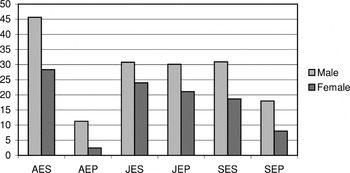
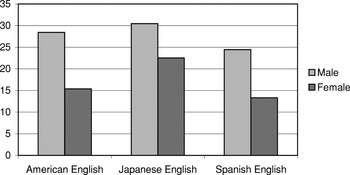
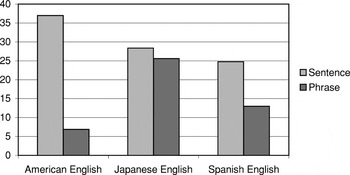
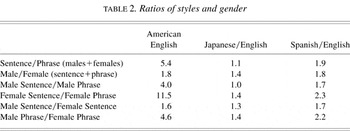
A summary of results is shown in Table 1 and Figures 1, 2, and 3. The detailed data for each subject can be found in Appendix C. Table 2 indicates ratios of various types, for example, the ratio of one style to the other and one gender to the other. This table allows one to compare the relative importance of style and gender.
Occurrences of casual process by NL, style, and gender


Percent casual processes by style and gender. (AE = American English, JE = Japanese/English, SE = Spanish/English, S = sentences, P = phrases).

Percent casual processes by gender, styles combined. (AE = American English, JE = Japanese/English, SE = Spanish/English, S = sentences, P = phrases).

Percent casual processes by style, genders combined. (AE = American English, JE = Japanese/English, SE = Spanish/English, S = sentences, P = phrases).
Ratios of styles and gender

Figure 1 and Table 1 show that for the NSs there are observable differences in both gender and style (all comparisons are significant), but the differences between styles are noticeably greater than the differences between genders (also see Table 2).
ANOVA analyses yielded significant main effects for language, F (2, 42) = 3.69, p < .05, gender, F (1, 42) = 21.55, p < .001, and style, F (2, 84) = 193.59, p < .001. One-tailed t-tests yielded the following: For the NSs both gender and style show significant differences: gender, Bonferroni adjusted p < .05; style, Bonferroni adjusted p < .001. The Japanese/English speakers also exhibited differences but the only significant differences are those for gender, Bonferroni adjusted p < .001 (style, Bonferroni adjusted p > .5). The differences in both gender and style are significant for the Spanish/English speakers: gender, Bonferroni adjusted p < .05; style, Bonferroni adjusted p < .001. For the Spanish/English speakers, the differences for style and gender appear to be about equal, in contrast to the NSs where the stylistic differences are much greater than the gender differences.
Thus, the overall results for the NNSs show that the gender differences are greater than the stylistic differences, in contrast to the NSs where the stylistic differences are greater than the gender differences (but both are statistically significant). These patterns can be clearly seen in Figures 2 and 3. Figure 2 indicates that gender differences are approximately equal for the three groups of subjects, but Figure 3 depicts large stylistic differences in the NSs, negligible differences in the Japanese/English speakers, and intermediate differences in the Spanish/English speakers.
The ratios in Table 2 demonstrate the relative importance of gender compared to style. For the NSs the stylistic differences are greater than gender differences (5.4 vs. 1.8); in the Japanese/English speakers style is negligible but there are moderate differences for gender (1.1 vs. 1.4); in the Spanish/English speakers both style and gender show nearly identical differences (1.9 vs. 1.8).
DISCUSSION
The data on the NSs corroborate decades of research and scores of studies on gender and stylistic differences in American English, which have demonstrated that nonstandard or less prestigious forms occur more frequently in males than in females and more frequently in casual styles. The present study strongly supports these generalizations: The male NSs showed a higher percentage of casual or less prestigious speech forms than the females, and both males and females exhibited a higher frequency in the sentences than in the phrases. Comparing the factors of gender and style, the differences between styles are much greater than the differences between genders (Table 2: sentence/phrase = 5.4, M/F = 1.8; also see Figures 2 and 3). Style comparisons within each gender reveal another noteworthy difference. For the males the sentence/phrase ratio is 4.0, but for the females it is 11.5 (Table 2). This means that when the women were performing the most careful reading (the phrases), they were relatively much more careful than the men (2% vs. 11% frequency of casual forms). In fact, three of the females did not produce any of the casual forms at all (AEF2, AEF3, AEF5, see Appendix C).
The behavior of Japanese/English speakers sharply contrasts with the NSs. There are no significant differences between styles (note in Table 2: ratio = 1.1 vs. 5.5 for NSs); however, there are significant differences between genders (note in Table 2: ratio = 1.4 vs. 1.8 for NSs). These data suggest that the Japanese/English speakers have achieved some competence with gender differences but not with stylistic differences. That these stylistic differences were not learned is strikingly exemplified by one subject, who when reading the phrase list, slowly and deliberately pronounced got you as

.
The process of palatalization deserves further comment, in connection with the Japanese/English speakers. Palatalization occurs in all speech styles in native Japanese: /t d s z/ →

before [i]. Although the conditions for palatalization in American English are somewhat different from Japanese (in English the process occurs before [y] but not before [i]: did you →

but not did Edie →

, the Japanese rule might still operate in L2 English, because the difference between [i] and [y] is merely one of syllabicity. Because of these considerations, one might argue that palatalization should be eliminated from the data because the effects of transfer would obscure any potential effects resulting from style. However, the palatalization data were included because there were no noticeable stylistic differences for palatalization or for the other three processes (the author's tabulation of data not shown here indicated this). Furthermore, the frequency of palatalization was no higher for the Japanese/English speakers than for the American speakers.
The Spanish/English speakers showed significant differences both in style and gender. However, it is especially important to note that the gender differences and stylistic differences are nearly equal, in contrast to the NSs, where stylistic differences are much greater (Spanish/English: 1.8 vs. 1.9; NSs: 1.8 vs. 5.4. See Table 2). Thus, even though the gender differences of the Spanish/English speakers equal the NSs, the Spanish/English speakers' mastery of stylistic differences still falls short of the NSs, further suggesting that gender differences are acquired before stylistic differences. That is, there is a deficiency or lag in learning the stylistic differences, but not the gender differences. Making an analogy, professional golfers can hit golf balls farther than professional baseball players can hit baseballs. If a novice learning both sports hits both balls the same distance then this person has done a relatively better job in baseball.
The results from both the Japanese/English speakers and the Spanish/English speakers point to the same conclusion: Gender differences are acquired before stylistic differences. This conclusion follows logically from the fact that the Japanese/English speakers have only acquired gender differences, but the Spanish/English speakers have acquired both. Because the Spanish/English speakers had been in the United States longer than the Japanese/English speakers (5.3 years vs. 1.3 years, respectively), this additional time apparently had enabled them to acquire some competence in stylistic differences, albeit this competence lagged behind their competence in gender differences. Universally across languages, research has shown that NS females use more prestige and standard forms than men, although previous research has not examined this issue in SLA. The results of the present study suggest that this is also true in SLA, since the Japanese/English and Spanish/English female speakers used fewer casual speech forms than the males, in both the sentences and phrases (with both NLs and styles combined: 18% vs. 27%, calculated from Table 1; NSs: 15% vs. 28%).
The data for individual subjects also support the generalization that gender differences are acquired before stylistic differences. By examining the total number of casual speech forms, subject by subject (Appendix C), and ranking all 16 speakers for each NL group, the following can be observed. The top five NSs are all males; only the top two Japanese/English speakers are male, but four out of the top five are males; the top six Spanish/English speakers are males. Contrast this with the stylistic differences: All 16 NSs (males and females) showed a greater occurrence of casual forms in the sentences compared to the phrases, and the minimal ratio (sentence/phrase) is 1.5 for the males and 3.6 for the females; for the Japanese/English speakers 10 out of 16 used more casual forms in the sentences, while six speakers actually used more in the phrases (for two speakers, JEM3 & JEM4, the ratios were approximately 0.7); for the Spanish/English speakers 12 out of 16 exhibited more casual forms in the sentences and four exhibited more in the phrases. These rankings and comparisons demonstrate that the NNS patterns more closely resemble the NS patterns for gender but not for style, suggesting that the NNSs' competence with gender was greater than with style.
The overall results of Japanese/English and Spanish/English speakers clearly suggest answers to the research questions:
- Are gender differences acquired by NNSs? The data unambiguously suggest that gender differences can be acquired by NNSs, as both groups showed significant differences.
- Are stylistic differences acquired by NNSs? The results suggest that stylistic differences can be acquired. However, they seem to be acquired more slowly or to a lesser degree than gender differences, as only the Spanish/English speakers exhibited stylistic differences.
- Which factor, gender or style, is more salient? The data strongly suggest that gender is more salient because both groups showed significant gender differences, but only the Spanish/English group showed stylistic differences. These stylistic differences in the Spanish/English group, however, were not nearly as great as in the NSs, although the gender differences equaled those of the NSs.
These findings are surprising considering that for at least 40 years in ESL/EFL teaching situations, stylistic differences have been taught, although there is no evidence that gender differences in phonology have been taught (whether they should be taught or not is a pedagogical not a theoretical question). Furthermore, gender differences in NSs for the casual speech processes in question (with the exception of -in'/-ing) have not previously been documented, prior to this study. Yet these L2 learners are clearly acquiring these differences. There seems to be no obvious explanation why gender should be more salient than style. Perhaps in part this is because gender differences are prominent in all languages, and even by age three gender differences in NSs appear (Fischer, 1958). Besides playing an important role in the formation of self-concept, gender also is very salient in face-to-face interactions. Although interlocutors may or may not notice certain physical characteristics of each other, such as eye color, height, and weight, it would be rare for gender to go unnoticed. On hearing news of a birth or passing a newborn infant on the street, a person frequently asks, “Is it a boy or girl?” Even in very young children the concept of self is strongly influenced by gender identification. In Lambert and Klineberg's (1967) Children's Views of Foreign Peoples, the researchers asked children around the world a number of questions, such as, “What are you?” and “Who are you?” The most frequent answer was “I am a girl” or “I am a boy.” Less frequent categories included nationality and being a student (responses that included these categories increased around puberty, but were practically nonexistent in younger children).
One final note concerning these four sandhi processes analyzed in this study. Although they are commonly called casual speech processes, they are so prevalent that perhaps they should be termed merely running speech processes, rather than casual speech processes. Although they are certainly stylistically conditioned, even the least formal task in this study cannot be called casual, as it involved reading a list of sentences. Yet these four processes occurred with a frequency of nearly 40% in the combined results of both the NS men and women. These data suggest that the processes are simply characteristics of American English, not just limited to casual speech.
There are at least two important limitations in this study. One is the difference in the length of residence (LOR) between the Japanese/English speakers and the Spanish/English speakers (they averaged 1.3 years and 5.3 years, respectively). It would be informative to select four groups, with each NL divided into two groups, one with short LORs and one with long LORs. Another shortcoming of the present study is the limited range of styles investigated. There were only two styles: reading a sentence list and reading a phrase list. Although using sentences and phrases has the important advantage of strictly controlling for phonological environments, the range of these two styles is obviously very limited. Further research should include a wider range of more casual styles, such as reading a passage, making up a story from a picture, and free conversation.
CONCLUSION
The NSs exhibited significant differences in gender and style, but the differences for style were much greater than for gender. Both the male and female NSs used more casual forms in the less formal style, and in both styles males used more casual forms than females. The Japanese/English and Spanish/English speakers showed significant gender differences similar to the NSs, but only the Spanish/English speakers showed any significant stylistic differences. However, the stylistic differences in the Spanish/English speakers were much less than in the NSs. The results of both groups clearly indicate that for these four phonological processes, gender differences were acquired before stylistic differences.
Some gender differences in language reflect pejorative stereotypes about females and males. There have been a wealth of studies on sexist language and other gender issues that include lexical, semantic, pragmatic, and discourse differences (Coates, 1993; Coates & Cameron, 1989; Eckert, 1989; Lakoff, 1975; Maltz & Borker, 1982; Roman, Juhasz, & Miller, 1994; Tannen, 1990, 1993). However, the phonological differences investigated in this study seem to have less potential for negative stereotyping and discrimination. It is doubtful many people would become upset if a man says too much thi[s] year or a woman says too much

year or if it happens nex[t] year or even

year. What this study does demonstrate is that gender differences are salient and therefore should be included in any accurate description of interlanguage.
APPENDIX A
Sentence List
These oral instructions were given to each participant.
Imagine you are talking to a close friend or partner in an informal setting. Please read aloud these sentences as if you were talking to this person.
- You really had your day yesterday, didn't you?
- I like making popcorn at home and smuggling it into the movies.
- Nancy likes to tease you a lot.
- Sometimes she can be real nice.
- It's not my cup of tea.
- That really made your day, didn't it?
- Bill likes playing baseball a lot.
- Please put plenty of sugar in the tea.
- You can call me anytime you want to.
- I want to kiss you before you go.
- I want to pat you on the back for doing that.
- Just one pinch of salt will do it.
- I don't like running to the store three times a day.
- That new bill will raise your income taxes by 10%.
- Doing that can kill you if you're not careful.
- I guess you better tell them the truth.
- Try to use your brain next time!
- He opened a can of beans and ate them in a hurry.
- I'll be heading back to the ranch soon.
- He likes making sandwiches for his kids.
- I know this university is one of the biggest in the U.S.
- You better eat your dinner before it gets cold.
- Chris saw the man running down the road.
- Aren't they going to let you go?
- Is your mother really coming?
- Could you please use the other door next time?
- Can Betty go or not?
- If you're hunting deer for a living, you'll starve to death.
- They poured a bucket of water over their coach.
- If you're not careful, that'll cause your grades to drop.
- I can get it for you real easy.
- That painting has lots of yellow in it.
- Do you think you're going to pass your tests?
- How did you like the game?
- I told you not to go.
- Don't give me an answer unless you're absolutely sure.
- After playing in the mud, you better hose yourself off before coming in.
- Be very careful with the knife so you don't cut yourself.
- I got you figured out.
- You can pay for it by cash or credit card.
- I bet you won't finish your paper by tomorrow.
- He saw a herd of deer yesterday.
- Your outfit really shows your patriotic spirit.
- Close your eyes when you kiss me!
- Can't you wait five more minutes for me?
- I like to hold your hand when I walk down the street.
- I don't know if she can go this week.
- Did he hurt your feelings?
- I'd like another piece of pie.
- Tom likes ASU real well.
- I have to feed you.
- She likes elephants but she especially likes seeing zebras in the wild.
- She sold your piano for nothing.
- What led you to believe that was true?
- I don't know how well he'll do this year.
- I'm sure he can play real well.
APPENDIX B
Passage recorded: Phrase list
These oral instructions were given to each participant.
Please read aloud the following slowly and carefully. Leave about a 1–2 second pause between each number.
- had your
- making popcorn
- tease you
- can be
- cup of
- made your
- playing baseball
- plenty of
- can call
- kiss you
- pat you
- pinch of
- running to
- raise your
- can kill
- guess you
- use your
- can of
- heading back
- making sandwiches
- this university
- eat your
- running down
- let you
- is your
- please use
- can Betty
- hunting deer
- bucket of
- cause your
- can get
- lots of
- pass your
- did you
- told you
- unless you're
- hose yourself
- cut yourself
- got you
- can pay
- bet you
- herd of
- shows your
- close your
- can't you
- hold your
- can go
- hurt your
- piece of
- ASU
- feed you
- seeing zebras
- sold your
- led you
- this year
- can play
APPENDIX C

References
REFERENCES
Abrahamsson, N.
(2001).
Acquiring L2 syllable margins: Studies on the implication of onsets
and codas in interlanguage phonology.
Unpublished doctoral dissertation,
Centre for Research on Bilingualism, Stockholm University.
Adamson, H. D., &
Regan, V. M.
(1991).
The acquisition of community speech norms by Asian immigrants
learning English as a second language.
Studies in Second Language Acquisition
13:1–22.Google Scholar
Beebe, L. M.
(1980).
Sociolinguistic variation and style shifting in second language
acquisition.
Language Learning
30:433–447.Google Scholar
Boyle, G. J., &
Houndoulesi, V.
(1993).
Utility of the school motivation analysis test in predicting second
language acquisition.
British Journal of Educational Psychology
63:500–512.Google Scholar
Brecht, R. D.,
Davidson, D. E., &
Ginsberg, R. B.
(1995).
Predictors of foreign language gain during study abroad. In
B. F. Freed (ed.),
Second language acquisition in a study abroad context.
Amsterdam:
Benjamins.
37–66.
Broeders, A.
(1982).
Engels in nederlandse oren: Uitspraakvoorkeur bij nederlandse studenten
engels. In
Toegepaste taalkunde in aritkelen
(Vol 9).
Amsterdam:
Vu Boekhandel.
127–128.
Broselow, E.,
Chen, S.-I., &
Wang, C.
(1998).
The emergence of the unmarked in second language phonology.
Studies in Second Language Acquisition
20:261–280.Google Scholar
Broselow, E., &
Finer, D.
(1991).
Parameter setting in second language phonology and syntax.
Second Language Research
7:35–59.Google Scholar
Broussard, K. M.
(2000).
Developmental and transfer influences in elementary bilingual
writing.
Unpublished doctoral dissertation,
Georgetown University.
Carlisle, R. S.
(1994).
Markedness and environment as internal constraints on the
variability of interlanguage phonology. In
M. Yavas (ed.),
First and second language phonology.
San Diego, CA:
Singular.
223–249.
Carlisle, R. S.
(1998).
The acquisition of onsets in a markedness relationship: A
longitudinal study.
Studies in Second Language Acquisition
20:245–260.Google Scholar
Carlisle, R. S.
(2002).
The acquisition of two and three member onsets: Time III of a
longitudinal study. In
J. Leather and
A. James (eds.),
New Sounds 2000: Proceedings of the fourth international symposium
on the acquisition of second language speech.
Klagenfurt, Austria:
University of Klagenfurt.
42–47.
Coates, J.
(1993).
Women, men, and language: A sociolinguistic account of gender
differences in language.
London:
Longman.
Coates, J., &
Cameron, D. (eds.).
(1989).
Women in their speech communities: New perspectives on language and
sex.
London:
Longman.
Dewaele, J. M.
(1998).
Speech rate variation in two oral styles of advanced French
interlanguage. In
V. Regan (ed.),
Contemporary approaches to second language acquisition in social
context: Crosslinguistic perspectives.
Dublin, Ireland:
University College Dublin.
113–123.
Dickerson, L. B., &
Dickerson, W. B.
(1977).
Interlanguage phonology: Current research and future directions.
In
S. P. Corder &
E. Roulet (eds.),
Actes du 5eme colloque de linguistique appliquée.
Neuchâtel, Switzerland:
Faculté de Lettres.
18–29.
Dörnyei, Z., &
Clement, R.
(2001).
Motivational characteristics of learning different target
languages: Results of a nationwide survey. In
Z. Dörnyei &
R. Schmidt (eds.),
Motivation and second language acquisition.
Honolulu:
University of Hawai‘i Press.
399–432.
Eckert, P.
(1989).
The whole woman: Sex and gender differences in variation.
Language Variation and Change
1:245–267.Google Scholar
Eckert, P.
(1996).
The whole woman: Sex and gender differences in variation. In
D. Brenneis &
R. Macaulay (eds.),
The matrix of language: Contemporary linguistic anthropology.
Boulder, CO:
Westview Press.
116–137.
Eckman, F. R., &
Iverson, G. K.
(1993).
Sonority and markedness among onset clusters in the interlanguage
of ESL learners.
Second Language Research
9:234–252.Google Scholar
Eckman, F. R., &
Iverson, G. K.
(1994).
Pronunciation difficulties in ESL: Coda consonants in English
interlanguage. In
M. Yavas (ed.),
First and second language phonology.
San Diego, CA:
Singular.
251–265.
Eckman, F. R., &
Iverson, G. K.
(1997).
Structure preservation in interlanguage phonology. In
S. J. Hannahs &
M. Young-Scholten (eds.),
Focus on phonological acquisition.
Amsterdam:
Benjamins.
183–207.
Ehrlich, S.
(1997).
Gender as social practice: Implications for second language
acquisition.
Studies in Second Language Acquisition
19:421–446.Google Scholar
Elliott, A. R.
(1995).
Field independence/dependence, hemispheric specialization, and
attitude in relation to pronunciation accuracy in Spanish as a foreign
language.
The Modern Language Journal
79:356–371.Google Scholar
Ellis, R.
(1993).
Social factors and second language acquisition.
The TESOL ANZ Journal: The Journal of the TESOL Association of
Aotearoa New Zealand
1:19–36.Google Scholar
Fischer, J. L.
(1958).
Social influences on the choice of a linguistic variant.
Word
14:47–56.Google Scholar
Frey, E.
(1995).
Gender specific characteristics of word syllabification: A new
aspect for the conceptualization of pronunciation instruction;
Geschlechtsspezifische Merkmale bei der Syllabierung von Wortern: ein
neuer Aspekt fur die Konzeptionierung von Ausspracheschulung.
Zilesprach Deutsch
26:136–142.Google Scholar
Furo, H.
(2000).
Listening responses in Japanese and US English: Gender and social
interaction. In
B. Swierzbin,
F. Morris,
M. E. Anderson,
C. A. Klee, &
E. Tarone (eds.),
Social and cognitive factors in second language acquisition:
Selected proceedings of the 1999 Second Language Research Forum.
Somerville, MA:
Cascadilla.
445–457.
Gass, S. M., &
Varonis, E. M.
(1986).
Sex differences in NNS/NNS interactions. In
R. R. Day (ed.),
Talking to learn: Conversation in second language acquisition.
Rowley, MA:
Newbury House.
327–351.
Gatbonton, E.
(1975).
Systematic variations in second language speech: A sociolinguistic
study.
Unpublished doctoral dissertation,
McGill University,
Montreal.
Gatbonton, E.
(1978).
Patterned phonetic variability in second-language speech: A gradual
diffusion model.
Canadian Modern Language Review
34:335–347.Google Scholar
Gussenhoven, C.
(1979).
Pronunciation preference among Dutch students.
Paper presented at the Second International Conference on the
Teaching of Spoken English,
University of Leeds.
Haeri, N.
(1987).
Male/female differences in speech: An alternative
interpretation. In
K. M. Denning,
S. Inkelas,
F. C. McNair-Knox, &
J. R. Rickford (eds.),
Variation in language NWAV XV at Stanford: Proceedings of the
Fifteenth Annual Conference on New Ways of Analyzing Variation.
Stanford, CA:
Department of Linguistics, Stanford University.
173–182.
Hancin-Bhatt, B.
(2000).
Optimality in second language phonology: Codas in Thai ESL.
Second Language Research
16:201–232.Google Scholar
Hancin-Bhatt, B., &
Bhatt, R. M.
(1997).
Optimal L2 syllables: Interactions of transfer and developmental
effects.
Studies in Second Language Acquisition
19:331–378.Google Scholar
Hiang, T. C., &
Gupta, A. F.
(1992).
Postvocalic /r/ in Singapore English.
York Papers in Linguistics
16:
139–152.Google Scholar
Jewell, C. M.
(1992).
Gender roles and second language acquisition in Hmong acculturation.
Unpublished doctoral dissertation,
West Virginia University,
Morgantown.
Johansson, F. A.
(1973).
Immigrant Swedish phonology.
Lund, Sweden:
Gleerup.
Johnson, D. M.
(1992).
Interpersonal involvement in discourse: Gender variation in L2
writers' complementing strategies.
Journal of Second Language Writing
1:195–215.Google Scholar
Kasanga, L. A.
(1996).
Effect of gender on the rate of interaction: Some implications for
second language acquisition and classroom practice.
Review of Applied Linguistics
111–112:
155–192.Google Scholar
Kasper, G., &
Schmidt, R.
(1996).
Developmental issues in interlanguage pragmatics.
Studies in Second Language Acquisition
18:149–169.Google Scholar
Labov, W.
(1966).
The social stratification of English in New York City.
Arlington, VA:
Center for Applied Linguistics.
Labov, W.
(1972).
Sociolinguistic patterns.
Philadelphia:
University of Pennsylvania Press.
Lakoff, R.
(1975).
Language and woman's place.
New York:
Harper & Row.
Lambert, W. E., &
Klineberg, O.
(1967).
Children's views of foreign peoples: A cross-national study.
New York:
Appleton Century Crofts.
Levine, A., &
Reves, T.
(1990).
Does the method of vocabulary presentation make a difference?
TESL Canada Journal/Revue TESL du Canada
8:37–51.Google Scholar
Lin, Y.-H.
(2001).
Syllable simplification strategies: A stylistic perspective.
Language Learning
51:681–718.Google Scholar
Luthin, H. W.
(1987).
The story of California (ow): The coming-of-age of English in
California. In
K. M. Denning,
S. Inkelas,
F. C. McNair-Knox, &
J. R. Rickford (eds.),
Variation in language NWAV XV at Stanford: Proceedings of the
Fifteenth Annual Conference on New Ways of Analyzing Variation.
Stanford, CA:
Department of Linguistics, Stanford University.
312–324.
Major, R. C.
(1987).
A model for interlanguage phonology. In
G. Ioup &
S. H. Weinberger (eds.),
Interlanguage phonology: The acquisition of a second language sound
system.
New York:
Newbury House/Harper & Row.
101–125.
Major, R. C.
(1996).
Markedness in second language acquisition of consonant clusters.
In
R. Bayley &
D. R. Preston (eds.),
Variation linguistics and second language acquisition.
Amsterdam:
Benjamins.
75–96.
Major, R. C.
(2001).
Foreign accent: The ontogeny and phylogeny of second language
phonology.
Mahwah, NJ:
Erlbaum.
Major, R. C.
(2002).
The phonology of the L2 user. In
V. Cook (ed.),
Portraits of the L2 user.
Clevedon:
Multilingual Matters.
65–94.
Maltz, D., &
Borker, R.
(1982).
A cultural approach to male-female miscommunication. In
J. J. Gumperz (ed.),
Language and social identity.
Cambridge:
Cambridge University Press.
195–216.
Milroy, L.
(1988).
Gender as a speaker variable: The interesting case of the
Glottalised stops in Tyneside.
York Papers in Linguistics 13: Selected papers from the
sociolinguistics symposium.
Nemser, W.
(1971a).
Approximative systems of foreign learners.
International Review of Applied Linguistics
9:115–124.Google Scholar
Nemser, W.
(1971b).
An experimental study of phonological interference in the English
of Hungarians.
Bloomington:
Indiana University Press.
Oxford, R. L.
(1993).
Gender differences in styles and strategies for language learning:
What do they mean? Should we pay attention?
Georgetown University Round Table on Languages and Linguistics
541–557.
Petrenko, A. D.
(1989).
Stilistische Varianten der Aussprache im Fremdsprachenunterricht
[Stylistic variants of pronunciation in second language
instruction].
Deutsch als Fremdsprache
26:267–272.Google Scholar
Pica, Y.,
Holliday, L.,
Lewis, N., &
Morgenthaler, L.
(1989).
Comprehensible output as an outcome of linguistic demands on the
learner.
Studies in Second Language Acquisition
11:63–90.Google Scholar
Preston, D. R.
(1989).
Sociolinguistics and second language acquisition.
Oxford:
Blackwell.
Rissel, D. A.
(1989).
Sex, attitudes, and the assibilation of /r/ among young
people in San Luis Potosi, Mexico.
Language Variation and Change
1:269–283.Google Scholar
Rogers, E. M.
(1999).
An investigation of the effects of collaborative, computer-mediated
communication and non-collaborative, computer-assisted writing skills
practice on L2 writing.
Unpublished doctoral dissertation,
University of Arizona,
Tucson.
Roman, C.,
Juhasz, S., &
Miller, C. (eds.).
(1994).
The women and language debate: A sourcebook.
New Brunswick, NJ:
Rutgers University Press.
Sankoff, D., &
Cedergren, H.
(1971).
Some results of a sociolinguistic study of Montreal French. In
R. Darnell (ed.),
Linguistic diversity in Canadian society.
Edmonton:
Linguistic Research.
61–87.
Sato, C. J.
(1985).
Task variation in interlanguage phonology. In
S. M. Gass &
C. G. Madden (eds.),
Input in second language acquisition.
Rowley, MA:
Newbury House.
181–196.
Scarcella, R., &
Zimmerman, C.
(1998).
Academic words and gender: ESL student performance on a test of
academic lexicon.
Studies in Second Language Acquisition
20:27–49.Google Scholar
Schmidt, R. W.
(1977).
Sociolinguistic variation and language transfer in phonology.
Working Papers in Bilingualism
12:79–95.Google Scholar
Schueller, J. M.
(2000).
The effects of two types of strategic training on foreign language
reading comprehension: An analysis by gender and proficiency.
Unpublished doctoral dissertation,
University of Wisconsin,
Madison.
Shibamoto, J.
(1987).
The womanly woman: Manipulation of stereotypical and
nonstereotypical features of Japanese female speech. In
S. Philips,
S. Steele, &
C. Tanz (eds.),
Language, gender, and sex in comparative perspective.
Cambridge:
Cambridge University Press.
26–49.
Slavoff, G. R., &
Johnson, J. S.
(1995).
The effects of age on the rate of learning a second language.
Studies in Second Language Acquisition
17:1–16.Google Scholar
Smith, P. M.
(1979).
Sex markers in speech. In
K. R. Scherer &
H. Giles (eds.),
Social markers in speech.
Cambridge:
Cambridge University Press.
109–146.
Syed, Z.
(2001).
Notions of self in foreign language learning: A qualitative
analysis. In
Z. Dörnyei &
R. Schmidt (eds.),
Motivation and second language acquisition.
Honolulu:
University of Hawai‘i Press.
127–148.
Tahta, S.,
Wood, M., &
Loewenthal, K.
(1981).
Foreign accents: Factors relating to transfer of accent from the
first language to a second language.
Language and Speech
24:265–272.Google Scholar
Tannen, D.
(1990).
You just don't understand: Women and men in conversation.
New York:
Morrow.
Tannen, D. (ed.).
(1993).
Gender and conversational interaction.
New York:
Ballantine.
Tarone, E.
(1982).
Systematicity and attention in interlanguage.
Language Learning
32:69–82.Google Scholar
Tarone, E.
(1983).
On the variability of interlanguage systems.
Applied Linguistics
4:142–164.Google Scholar
Tarone, E.
(1988).
Variation in interlanguage.
London:
Edward Arnold.
Tran, T. V.
(1988).
Sex differences in English language acculturation and learning
strategies among Vietnamese adults aged 40 and over in the United
States.
Sex Roles
19:747–758.Google Scholar
Trudgill, P.
(1974).
The social differentiation of English in Norwich.
Cambridge:
Cambridge University Press.
Trudgill, P.
(1984).
Sex and covert prestige: Linguistic change. In
J. Baugh &
J. Sherzer (eds.),
Language in use: Readings in sociolinguistics.
Englewood Cliffs, NJ:
Prentice Hall.
54–66.
Wardhaugh, R.
(2001).
An introduction to sociolinguistics, (
4th ed.).
Oxford:
Blackwell.
Weinberger, S. H.
(1987).
The influence of linguistic context on syllable simplification.
In
G. Ioup &
S. H. Weinberger (eds.),
Interlanguage phonology: The acquisition of a second language sound
system.
New York:
Newbury House/Harper & Row.
401–417.
Weinberger, S. H.
(1994).
Functional and phonetic constraints on second language phonology.
In
M. Yavas (ed.),
First and second language phonology.
San Diego:
Singular.
283–302.
Weiss, L.
(1970).
Auditory discrimination and pronunciation of French vowel
phonemes.
Dissertation Abstracts International
31:4051–A.Google Scholar
Wenk, B. J.
(1979).
Articulatory setting and de-fossilization.
Interlanguage Studies Bulletin
4:202–220.Google Scholar
Wenk, B. J.
(1983).
Articulatory setting and the acquisition of second language
phonology.
Revue de Phonetique Appliquée
65:5–65.Google Scholar
Wilson, D., &
Møllergard, E.
(1981).
Errors in the production of vowel no. 10 /[caret ]/ by
Norwegian learners of English.
International Review of Applied Linguistics
19:69–76.Google Scholar
Woolard, K. A.
(1997).
Between friends: Gender, peer group structure, and bilingualism in
urban Catalonia.
Language in Society
26:533–560.Google Scholar
Xu, L.
(2001).
The neurolinguistic significance of gender differences to the
establishment of optimized second language acquisition strategies.
Foreign Languages and Their Teaching
6:6–8.Google Scholar

Occurrences of casual process by NL, style, and gender
Percent casual processes by style and gender. (AE = American English, JE = Japanese/English, SE = Spanish/English, S = sentences, P = phrases).
Percent casual processes by gender, styles combined. (AE = American English, JE = Japanese/English, SE = Spanish/English, S = sentences, P = phrases).
Percent casual processes by style, genders combined. (AE = American English, JE = Japanese/English, SE = Spanish/English, S = sentences, P = phrases).
Ratios of styles and gender
 You have
Access
- 43
- Cited by