


I. Introduction
Overweight, obesity and chronic diseases remain leading causes of premature mortality in the European Union (EU) and constitute major public health priorities. Between 2010 and 2016, overweight and obesity rates on the continent have increased, respectively, from 55.9% of the population to 58.7% and from 20.8% to 23.3%.Footnote 1 It is estimated that in 2017 over 950,000 deaths and over 16 million lost healthy life-years were attributable to unhealthy diets and the resulting non-communicable diseases, amongst which are cardiovascular diseases, diabetes and kidney diseases.Footnote 2
The EU is increasingly active in public health matters,Footnote 3 including in the prevention of lifestyle-related health risks.Footnote 4 The EU health programme 2014–2020 seeks “to promote health, prevent diseases, and foster supportive environments for healthy lifestyles … by addressing in particular the key lifestyle related risk factors”,Footnote 5 amongst which diets figure prominently.Footnote 6 Since the publication of the White Paper “A Strategy on Nutrition, Overweight, and Obesity-Related Health Issues” in 2007, improving the quality of European diets has remained an important priority for the EU.Footnote 7 The Farm to Fork Strategy, published in 2020, aims, inter alia, at creating “a favourable food environment that makes it easier to choose healthy and sustainable diets [that] will benefit consumers’ health and quality of life, and reduce health-related costs for society”.Footnote 8
Empowering consumers through the provision of nutrition information has always been a key component of EU action. Generally speaking, nutrition labelling is appealing to policymakers for two mains reasons. First, it is congruent with the idea that, in a market relationship, consumers should be provided with adequate information in order to make choices that are best aligned with their preferences. It is a way to remedy existing asymmetries of information regarding the composition of foods.Footnote 9 Rules on labelling are also comparatively less burdensome for food operators and consumers than other policies and thus tend to be easier to adopt and implement. Second, it is thought – and hoped – that the provision of nutrition information improves the quality of diets, not only because consumers make healthier food choices, but also because food operators are incentivised to reformulate their products.
Regardless of its advantages, nutrition labelling as currently mandated by EU law suffers from serious defects from a public health perspective. The capacity of classic textual, tabular, back-of-pack information to nudge consumer behaviour towards healthier choices appears limited in light of the existing scientific evidence. In reaction, governments and food operators have been experimenting with more effective front-of-pack (FoP) labels that convey information in a simplified and more salient manner. In Europe, the Nutri-Score, a type of colour-coded FoP indicator that classifies foods according to their nutritional quality, is gaining traction. Originally developed and adopted in France, it is being used in a growing number of EU Member StatesFootnote 10 and is now supported by a wide range of actors, including EU citizens themselvesFootnote 11 and a number of Members of the European Parliament (MEPs), companies and consumer organisations.Footnote 12 More generally, a recent Eurobarometer survey shows that 85% of Europeans favour the adoption of a logo helping them to choose healthy and sustainable foods.Footnote 13 After years of discussion with stakeholders, the European Commission recently announced that it will propose, as part of its Farm to Fork Strategy and Beating Cancer Plan, the adoption of a common and mandatory FoP nutrition labelling scheme.Footnote 14
The present contribution seeks to provide a general overview of the main scientific, legal and policy aspects pertaining to FoP nutrition labelling in the EU context. Section II introduces the concept of FoP labelling, its main applications and the existing scientific evidence regarding its effect on consumer behaviour and diets. Section III presents the EU legal framework currently applicable to nutrition labelling in general and FoP labelling in particular. Section IV outlines the main reasons justifying action at the EU level and reflects on possible obstacles to the adoption of a FoP scheme common to all Member States. The article covers FoP nutrition labelling in general, but it adopts a particular focus on the Nutri-Score, arguably the most popular label currently in use in the EU and a serious candidate for a potential pan-EU scheme.
II. The science of FoP nutrition labellingFootnote 15
1. What is FoP nutrition labelling?
FoP nutrition labelling can be defined as the provision of nutrition information in the principal field of vision on food and drinks packaging.Footnote 16 Under Regulation 1169/2011 on the provision of food information to consumers (FIC Regulation), the “field of vision” is defined as “all the surfaces of a package that can be read from a single viewing point”,Footnote 17 and the “principal field of vision” is “the field of vision … which is most likely to be seen at first glance by the consumer at the time of purchase and that enables the consumer to immediately identify a product in terms of its character or nature and, if applicable, its brand name”.Footnote 18
Beyond this basic characteristic, FoP labels vary widely in their design (shape, colour, use of symbols, etc.) and purpose.Footnote 19 Various categories have been proposed in the literature.Footnote Footnote 21 Table 1 provides a summary of these categories and gives examples of some of the FoP labels currently in use in Europe and other regions.Footnote 22
Front-of-pack (FoP) nutrition labels in use in Europe and other regions.Footnote 20
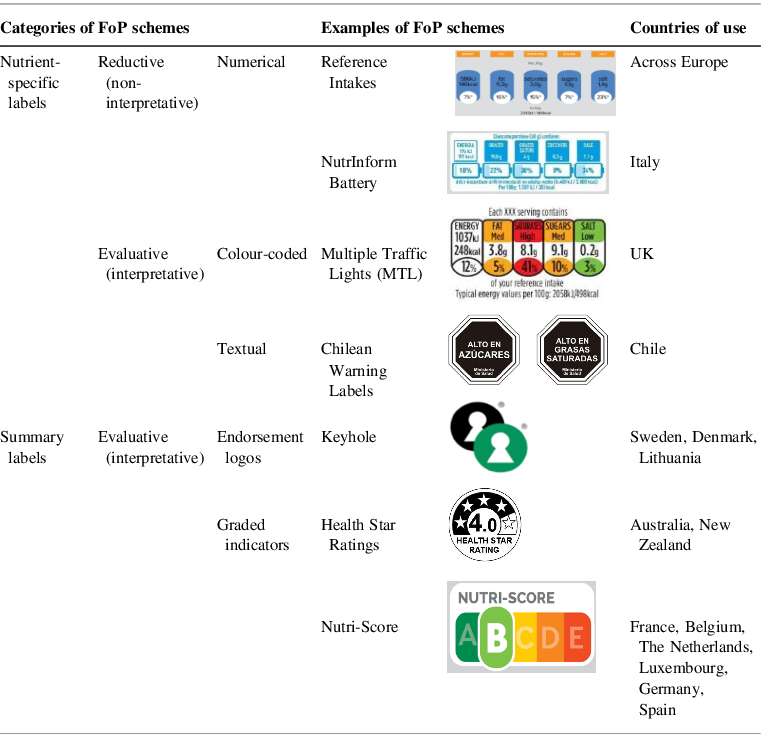
FoP labels differ along three main dimensions. Some are nutrient-specific and provide detailed information on the amount of energy and nutrients present in a product, usually expressed per serving or 100 g/ml, whilst others provide a summary of the overall nutrition quality of products. Labels can also be reductive, conveying nutrition information in a simpler but “neutral” way, or evaluative, in which case they assess the nutritional quality of products. Summary labels tend also to be evaluative. The Multiple Traffic Lights (MTL) and the Nutri-Score are both evaluative and based on a “traffic light” colour code, but the MTL evaluates separately different aspects of the food composition, whereas the Nutri-Score gives a general grade to products. Finally, evaluative labels can be positive or negative. The Keyhole is a positive label, as it endorses the healthiest choices within a food category. Warning labels, on the other hand, signal to consumers when a product contains excessive quantities of certain nutrients (eg salt, sugar, saturated fat or a high energy content).
All evaluative FoP labelling schemes use nutrient profiles in order to determine the nutritional quality of foods. Nutrient profiling can be defined as “the classification of foods for specific purposes based on their nutrient composition”.Footnote 23 Different methods are used in the context of FoP labelling.Footnote 24 While nutrient-specific schemes use nutrient thresholds to determine whether a given product should bear a warning or be labelled with a specific colour, summary labels usually use more complex algorithms that compute the content of different nutrients and result in an overall score.
The Nutri-Score, originally conceived and developed in France under the aegis of the French government, is a type of evaluative summary label that expresses nutrition information in the form of a colour-coded and graded indicator. Products are rated along a five-grade scale, from most to least healthy, using a combination of letters and colours (see Table 1). It uses a nutrient profiling system, the Food Standard Agency Nutrient Profiling System (FSA-NPS), which incorporates various favourable and unfavourable elements. The presence of fruits, vegetables, nuts, fibre and proteins leads to a better score, whilst the energy content and the presence of sugar, saturated fatty acids and salt leads to a worse score.Footnote 25 The Nutri-Score applies to foods in general and is intended both to guide people in their overall diet and to facilitate the comparison of products within categories (ie helping consumers to choose between two oils or two cheeses).Footnote 26
It is important to stress that FoP schemes also differ in their purpose and their relation to consumer autonomy. Some simply convey information, whereas others seek to influence choices.Footnote 27 Reductive schemes provide nutrition information in a simplified manner but do not express a judgment on food. This means that any potential behavioural change will arise from an enhanced reflection on the part of the consumer on what is good or bad for them. Evaluative schemes directly tell consumers what the “good” and/or the “bad” choice is. Furthermore, whilst labels that use verbal and numerical information are most likely to operate at the deliberative level in individuals, with the need to process rather complex pieces of information, labels that use visual elements such as colours or symbols can operate as nudges,Footnote 28 relying on people’s cognitive heuristics and biases and operating at the level of their automatic and non-reflective system of thinking. An example is the use of the green and red colours on labels, which traditionally symbolise, respectively, the ideas of approval and prohibition.Footnote 29 Keeping this in mind is important when evaluating the merits and effectiveness of different FoP labelling schemes.
2. FoP versus classic nutrition information
The growing appeal of FoP labelling is a direct consequence of the vast body of evidence showing that the provision of textual, tabular and back-of-pack nutrition information does not have any significant impact on people’s dietary choices and is unlikely to lead to any meaningful improvement from a public health perspective.Footnote 30 This is in line with the more general conclusion that mandated disclosure of information as a policy tool suffers from serious shortcomings: it is often ignored, misunderstood and not acted upon.Footnote 31 Disclosures rely too often on an imagined version of the rational and diligent consumer who reads labels, understands complex pieces of information and subsequently adopts the right course of action. In reality, people are prone to errors, have limited mental bandwidth and have limited willpower.Footnote 32 In the area of nutrition, consumers themselves consider that more information is better, despite the fact that most of them “are not equipped to interpret all this information due to factors such as low levels of nutrition knowledge, time pressure and competing priorities”.Footnote 33
However, there are reasons to believe that more consumer-friendly labels could lead to better results, especially if they target System 1 thinking – the automatic and intuitive decision-making system.Footnote 34 Using the principal field of vision increases salience, and several studies have concluded that FoP labels are noticed earlier and receive more attention than classic back-of-pack nutrition information.Footnote 35 In particular, since consumers have difficulties interpreting technical and numerical nutrition information, recourse to visual elements such as graphics and symbols should be encouraged.Footnote 36 Vivid elements catch consumers’ attention more easily, especially under time pressure, as is often the case in a retail environment.Footnote 37 They may also have an impact on people’s feelings and emotions, which has been shown to have an influence on behaviour.Footnote 38 As mentioned earlier, colours play an important role in this regard. The use of green in labels has, for instance, been proven to increase the perceived healthiness of products.Footnote 39 Finally, there is also evidence that the provision of health-related information at the point of purchase can have a “goal priming” function, providing a non-conscious cue that activates the latent long-term health goals that are present in individuals.Footnote 40
It is worth noting at this point that not all consumers are equal.Footnote 41 Some – a minority – do read labels and have the necessary knowledge, resources and motivation to engage with the information that is provided. Classic back-of-pack nutrition information may be sufficient to guide the choices of these consumers. The many others that do not or cannot pay attention to and process complex information, however, can benefit greatly from simplified information and visual cues.
3. Effectiveness of FoP nutrition labelling
The failure of classic back-of-pack nutrition information to guide consumers’ choices towards healthier options is clear, but this does not in itself suffice to establish that FoP labels do significantly better, nor the extent to which they do so if FoP labels indeed prove to do significantly better. It is also important to determine how FoP labels compare with one another. The following developments present the available evidence regarding the effects of FoP labels.
Before delving into further details regarding the various studies and reviews, it is worth highlighting two important methodological caveats. First, studying the effectiveness of FoP labels, or any label for that matter, requires us to consider different aspects of consumer choice: “[A] given FoP scheme will not have an effect on behaviour unless it is noticed, understood, and ultimately accepted as reliable information and potentially guidance”.Footnote 42 But these preconditions alone are not sufficient to establish that a given label will actually alter the behaviour of consumers and ultimately achieve the desired policy results. Adequate knowledge and motivation do not necessarily translate into healthier behaviours.Footnote 43 This needs to be studied and established separately.
Second, studying food choices is difficult. Food purchase takes place in a highly contextual and complex setting where shoppers are confronted with many different cues. Alongside health, consumer choice is driven by a variety of other factors, such as time and money.Footnote 44 Ideally, studies should therefore be realised in real-life situations in order to gain greater ecological validity. However, such studies are more difficult to conduct and therefore rarer. Most studies are conducted online or in laboratory settings and adopt a piecemeal approach, meaning that “consumer responses are investigated in an artificially simplified choice context (e.g. with less information to be assessed, more time to decide, larger and more readable labels/logos, etc.), with subjects usually primed to focus on a specific piece of information”.Footnote 45 The results yielded by these types of studies are, of course, pertinent, but nonetheless they should be taken with a certain degree of caution.Footnote 46
a. Attention, attractiveness and understanding of FoP labels
Different characteristics can increase the attention given to labels, including size, colour, contrast, placement and overall package context.Footnote 47 Colour is effective if there is sufficient contrast between the label and the package.Footnote 48 Overall, “studies show good attention-grabbing potential of Nutri-Score, Multiple Traffic Lights, and warning labels”.Footnote 49 However, it is important to note that some studies using eye tracking rather that self-reported data question how much attention is actually paid to nutrition information.Footnote 50 In terms of attractiveness, consumers tend to favour FoP labels over classic nutrition declarations, with a preference for evaluative schemes that use colours to indicate nutrient levels or the overall nutritional quality of foods.Footnote 51 A recent study concluded that the MTL was most liked and trusted compared to other FoP schemes.Footnote 52 Whilst some studies have concluded that consumers’ tastes vary amongst countries and cultural groups,Footnote 53 some others show consistent patterns in consumer perceptions between different populations.Footnote 54
It is not enough that consumers notice and like labels – they also need to understand the information that is provided to them. One usually distinguishes subjective understanding (whether consumers believe they have understood the information) from objective understanding (consumers’ ability to correctly interpret the information as intended by the labels’ designers).Footnote 55 Evidence shows that short and simple labels are best for objective understandingFootnote 56 and that interpretative summary indicators are best to help consumers identifying the healthier products.Footnote 57 Colour-coded FoP schemes tend to do better,Footnote 58 especially when combined with a graded indicator, as is the case for the Nutri-Score.Footnote 59 A number of online studies recently conducted in various European countries point to greater effectiveness of the Nutri-Score in terms of consumers’ understanding and ability to rank products according to their nutritional quality.Footnote 60 Again, such studies only provide partial information about the real-life performance of FoP schemes, but they are nonetheless useful to indicate “which FoP schemes or specific characteristics are most likely to aid quick and accurate decisions about the nutritional quality of products”.Footnote 61
An important horizontal issue regarding the perception and understanding of FoP labels is their effect on different subgroups in the population. Health inequalities are a major concern in the EU and worldwide,Footnote 62 and the risk exists that FoP labels would work best on the already privileged segments of the population and thus reinforce the existing inequalities. Indeed, consumers with the highest income and education level tend to have better nutrition knowledge and an interest in healthier eating habits, resulting in greater label use and understanding.Footnote 63 In this regard, colour-coded evaluative FoP labels seem to work best across different segments of the population in terms of consumer understanding and product healthfulness assessment.Footnote 64 Compared to other FoP labels, the Nutri-Score performs best across subgroups, and its strongest impact is observed amongst individuals with no nutritional knowledge.Footnote 65
b. Effect of FoP labels on purchases, diet and health
To date, there is little evidence regarding the effects of FoP labels on food choices, diet and health, limiting our ability to conclude on whether they have a decisive impact on the population. Scientific studies on the effects of FoP labels on consumers’ choices are not as common as studies on consumer perception and understanding.Footnote 66 Combined evidence from laboratory experiments and real-life grocery shopping studies suggests a positive but limited effect of FoP nutrition labelling on the healthfulness of food purchases.Footnote 67 In this regard, colour-coded evaluative FoP schemes, such as MTL and the Nutri-Score, have been found to work best,Footnote 68 but the evidence remains mixed, with some studies concluding that no major difference in food choices is observed between the different labels tested.Footnote 69 Evaluative labels seem to work by augmenting the consumption of “virtue” green products rather than decreasing the consumption of “vice” red products.Footnote 70
Various factors can explain the limited effect of FoP labels and nutrition labelling in general on food choices. As we have seen, health interacts with other characteristics that are relevant for choice, such as tastiness or price, and the effects of labels may be undermined by cognitive depletion arising from fatigue or hunger.Footnote 71 Labels are also highly dependent on the inclination of consumers towards healthy choices, working on pre-existing health motivation rather than creating it.Footnote 72 The possibility also exists that consumers engage in compensating behaviour, deliberately choosing unhealthier foods after having eaten healthy ones.Footnote 73
Regarding the effects of FoP labels on overall diets and the improvement of the population’s health, evidence is scant. It is indeed very difficult to appropriately monitor people’s choices over a long period and to factor in all other policies and influences that may have had an impact on diets and health. This pertains more broadly to the difficulty of assessing whether a policy has reached its intended goal or not. The comprehensive review conducted by the Joint Research Centre of the European Commission concluded that there was, to date, no available real-life empirical evidence linking FoP labelling or specific FoP schemes with concrete changes in food intake and a particular effect on diet and health.Footnote 74 Modelling studies, which extrapolate changes in diets that could result from FoP labelling and their health outcomes, suggest the existence of positive health benefits for evaluative labels.Footnote 75
However, relevant predictors of the ability of a FoP scheme to improve diets are its ability to adequately distinguish between healthy and unhealthy products within and across food groups and its compliance with dietary recommendations.Footnote 76 In that regard, studies show a reasonable match between FoP labels and dietary recommendations.Footnote 77 The Nutri-Score has been found to be particularly effective in discriminating between the nutritional quality of products in different national contexts and to be consistent with a set of different national dietary guidelines.Footnote 78
c. Limitations and unforeseen effects of FoP labels
FoP labels present certain limitations and may lead to unforeseen and undesirable effects.Footnote 79 Evaluative labels that recommend the consumption of certain products could, for instance, lead to a halo effect – an overgeneralisation that leads consumers to believe that these products have general health benefits beyond their nutritional value. They could also provoke inaccurate inferences about other aspects of these products or competing products,Footnote 80 leading consumers to evaluate unhealthy products as better than they are.Footnote 81
This is especially likely considering that FoP labels focus on nutrients and leave aside some other crucial determinants of the healthiness of food. For instance, the Nutri-Score is often criticised for not incorporating additives or pesticides into its algorithm, and more broadly for not discriminating enough between natural and processed foods.Footnote 82 There is a growing body of evidence showing that the consumption of ultra-processed foods – “products with additives and industrially processed ingredients that have been technologically broken down and modified”Footnote 83 – is detrimental to human health.Footnote 84 This dimension is currently not captured by the available FoP labels. This criticism must be tempered, partly because it is overblownFootnote 85 (for instance, the Nutri-Score ranks most ultra-processed foods in its two lowest categories: D and EFootnote 86) and also because scientific knowledge does not seem to currently allow the development of a comprehensive indicator that would cover all of the dimensions of health in food.Footnote 87 Nonetheless, considering the possible undesirable behavioural effects that have just been described, there is a clear risk that people may draw wrong inferences from a well-graded food.Footnote 88
Finally, summary labels such as the Nutri-Score, which work with a system where “positive” and “negative” nutrients compensate for each other, allow products with a (very) high content of a “negative” nutrient to bear a positive logo. For instance, some popular brands of cereals for children are graded “B” by the Nutri-Score thanks to their use of whole-grain flour and their low levels of fat, in spite of a very high sugar content (25%).Footnote 89 The Health Stars Rating has faced similar problems.Footnote 90 Consumers may not realise that these products contain problematic levels of certain nutrients and as a result risk perceiving them as healthier than they are.
III. Nutrition labelling under EU law
1. Mandatory nutrition labelling
Regulation 1169/2011 (the FIC Regulation) is the main instrument regulating food information at the EU level. In line with the information paradigm that has dominated EU consumer policy to date, it foresees a classic mandatory nutrition declaration.
a. Food labelling and the information paradigm
The “information paradigm” is a cornerstone of EU consumer policy. Providing information, especially through labelling, is considered to give consumers relevant knowledge on the products or services that they buy and to be an adequate way to protect their interests.Footnote 91 This view usually follows the traditional assumptions of standard rationality under which consumers provided with adequate information make decisions that are best aligned with their preferences. This idea has been applied in the fields of food and nutrition,Footnote 92 following “the assumption … that if consumers are aware of what each foodstuff contains, they should be trusted to apply their nutrition knowledge and make appropriate choices”.Footnote 93 This stance is politically charged, as it “reflects the view that in a society where individuals are autonomous and dislike limitations, it is expected that they take primary responsibility for their dietary choices”.Footnote 94
The information paradigm finds its origin in the European Court of Justice’s case law on freedoms of movement, especially the free movement of goods, as the Court’s main prism to assess the proportionality of restrictive national measures that protect the health or interests of consumers. The Court considers that the average consumer is “reasonably well-informed and reasonably observant and circumspect”Footnote 95 – that they read labels and process information in the right way. As the Court repeated several times, “consumers whose purchasing decisions depend on the composition of the products in question will first read the list of ingredients”.Footnote 96 It follows that compared to other more stringent types of measures, such as restricting the use of certain ingredients or regulating other aspects of the presentation of products, the disclosure of information in the form of labels has been considered to be less restrictive of free movement and equally capable of protecting consumers.Footnote 97
This view has been taken on board by the Commission and has greatly influenced EU consumer lawFootnote 98 and food law,Footnote 99 including nutrition and the fight against related public health scourges.Footnote 100 The Commission White Paper on nutrition, overweight and obesity clearly states that “the individual is ultimately responsible for his lifestyle, and that of his children, whilst recognising the importance and the influence of the environment on his behaviour” and that “only a well-informed consumer is able to make rational decisions”.Footnote 101 The Farm to Fork Strategy does not entirely depart from these premises, as it seeks “to empower consumers to make informed, healthy and sustainable food choices”.Footnote 102
b. EU mandatory nutrition declaration
The FIC Regulation, whose provisions on nutrition started to apply from 13 December 2016, replaced Directive 90/496, the first EU legislative piece on nutrition labelling.Footnote 103 Pursuant to Article 30 of the Regulation, all foods must carry a nutrition declaration including the energy value and the amounts of fat, saturates, carbohydrates, sugars, protein and salt, which can be supplemented by other elements, such as fatty acids or fibre.Footnote 104 Article 16(3) foresees exceptions to the mandatory character of the nutrition declaration: in general, products that comprise a single ingredient or category of ingredients and specific products such as water, salt, coffee or tea.Footnote 105 Beverages containing more than 1.2% by volume of alcohol are also exempted from the mandatory nutrition declaration as well as the obligation to provide the list of ingredients.Footnote 106 For these beverages, operators are encouraged to provide the energy value on a voluntary basis,Footnote 107 and Member States are authorised to adopt stricter measures requiring the provision of the list of ingredients.Footnote 108
The energy value and nutrient amounts contained in the declaration must be expressed per 100 g or 100 ml and may also be expressed per portion or consumption unit,Footnote 109 “easily recognisable by the consumer, provided that the portion or the unit used is quantified on the label and that the number of portions or units contained in the package is stated”.Footnote 110 All mandatory nutrition information must be presented in the same field of vision. Food business operators usually choose the back of packaged foods, although this is not textually required by the Regulation. Nutrition information must be given in a clear format – in tabular format if space permits, otherwise in linear format.Footnote 111 It must be expressed with words or numbers.Footnote 112
This form of textual/numerical information presented in tabular form, outside the principal field of vision, is a good illustration of the information paradigm and is typically the kind of nutrition information that appears defectuous in light of the behavioural evidence presented in Section II. A 2006 consultative document from the Commission was already exploring the possibility of introducing alternative and more consumer-friendly forms of presentation, pointing to the evidence suggesting that “simplified front of pack labelling (‘signposting’) may offer significant advantages in terms of increasing consumer use”.Footnote 113 The initial legislative proposal actually foresaw the mandatory display of energy value and key nutrient contents on the front of the pack.Footnote 114 It was later dropped during the legislative process, due in part to the heavy opposition of the agri-food lobby.Footnote 115
Article 35 of the FIC Regulation leaves Member States and food operators free to experiment, on a voluntary basis and under certain conditions, with the use of additional graphical forms or symbols to express or present the mandatory nutrition declaration in order to help consumers to better understand it.Footnote 116 Recital 43 of the FIC Regulation notes that there was at the time of its adoption “insufficient evidence across all the Union on how the average consumer understands and uses the alternative forms of expression or presentation of the information”. To gather such evidence, the FIC Regulation invited the Commission to “facilitate and organise the exchange of information between Member States, itself and stakeholders”Footnote 117 and to submit a report by December 2017 on the use of additional forms of expression and presentation and the advisability of further harmonisation of those forms.Footnote 118 The delayed report was published in May 2020 and its conclusions are discussed in Section IV.
2. FoP nutrition labelling
The fact that EU law does not mandate the provision of FoP nutrition information does not mean that this form of labelling is left unregulated. It is governed by two main pieces of legislation: the FIC Regulation again and Regulation 1924/2006 on nutrition and health claims made on foods (the Claims Regulation).Footnote 119 FoP labels cannot be made mandatory for food operators, but they can be used voluntarily and recommended by Member States. The applicable regime differs for nutrient-specific and summary labels and in function of their evaluative character.Footnote 120 FoP labels officially adopted by Member States are also considered “draft technical regulation” in the sense of Directive 2015/1535 and must therefore respect the notification obligation and the three-month standstill period provided for in the Directive.Footnote 121
a. FoP labelling under the FIC Regulation
Nutrient-specific FoP labels, either evaluative like the MTL or reductive like the NutrInform Battery, are regulated by Articles 30(3) and 35 of the FIC Regulation. “[I]n order to help consumers to easily see the essential nutrition information when purchasing foods”,Footnote 122 the Regulation allows the repetition in the principal field of vision of the most important elements of the mandatory declaration: the energy value alone or the energy value together with the amounts of fat, saturates, sugars and salt.Footnote 123 This supplementary and voluntary FoP nutrition information can be expressed using graphical forms or symbols, provided that it complies with a number of requirements, including not creating obstacles to the free movement of goods, not being misleading and being based on solid scientific evidence.Footnote 124 These additional forms of expression and presentation may only be recommended by Member States, who are then under the duty to notify any such scheme to the Commission.Footnote 125 Member States must also monitor the use by food operators of these additional forms of nutrition information.Footnote 126
Labels that are not nutrient-specific and provide information on the overall quality of foods, such as the Nutri-Score, are regulated by Article 36 of the FIC Regulation. They are considered to be voluntary food information and must also comply with a set of requirements broadly similar to those of Article 35: they must not mislead the consumer, must not be ambiguous or confusing and shall be based on the relevant scientific data.Footnote 127
b. FoP labelling under the Claims Regulation
Evaluative FoP labels not only provide factual information, but also present some food as healthy or not. When a food is labelled as healthy, with the use of the green colour or of an endorsement logo, this is considered to be a nutrition claim in the sense of the Claims Regulation. A nutrition claim is “any claim which states, suggests or implies that a food has particular beneficial nutritional properties” based on its calorific value or its nutrients.Footnote 128 In this case, evaluative labels must comply with the requirements set out in the Claims Regulation and must not “be false, ambiguous or misleading; give rise to doubt about the safety and/or the nutritional adequacy of other foods; encourage or condone excess consumption of a food”.Footnote 129 They are only permitted if the average consumer can be expected to understand the beneficial effects of the food carrying the label.Footnote 130 Evaluative schemes that are officially recommended by Member States must be notified to the Commission and the other Member States and respect a six-month standstill period.Footnote 131 However, it remains unclear how the use of evaluative FoP labels, duly approved by the Commission,Footnote 132 fits with Article 8 of the Claims Regulation, which only authorises a series of verbal nutrition claims listed in its Annex.
An interesting feature of the Claims Regulation is its reference to nutrient profiles. To prevent a situation “where nutrition or health claims mask the overall nutritional status of a food product, which could mislead consumers when trying to make healthy choices in the context of a balanced diet”,Footnote 133 Article 4 foresees the establishment of nutrient profiles for foods or categories of foods that must be complied with in order to bear a claim.Footnote 134 These nutrient profiles are used to determine which foods are excluded from bearing nutrition claims, the idea being that “food containing high levels of nutrients whose excessive intakes as part of the overall diet is not recommended should not be able to be marketed as providing nutrition or health benefits if, ultimately, such consumption is not healthy”.Footnote 135 The relevance of these nutrient profiles for FoP labelling and the difficulties that have resulted in the non-adoption of these profiles are discussed in Section IV.
IV. Towards a harmonised and mandatory EU FoP labelling scheme
1. The development of a common EU scheme
a. The benefits of a common EU scheme
On the basis of the existing scientific evidence regarding both the shortcomings of the mandatory nutrition declaration and the potential health benefits of FoP labels, the introduction of a harmonised and mandatory FoP labelling scheme at the EU level would be a welcome development. The Commission has clearly signalled its will to act on the matter. In its recent report adopted pursuant to Article 35(5) of the FIC Regulation and published in 2020, it announced that a new harmonised and mandatory FoP nutrition label would be proposed for adoption.Footnote 136 The Commission will soon launch an impact assessmentFootnote 137 that should result in a formal legislative proposal by the last quarter of 2022.Footnote 138
The introduction of a common EU FoP nutrition label would bring about several benefits. For diets and health, it would ensure that all foodstuffs marketed in the EU convey appropriate nutrition information that is noticed and understood by consumers, hopefully leading to healthier food choices and a reduction in the burden of diet-related diseases. The proliferation of different FoP labels on the European market could become a source of confusion and misunderstanding,Footnote 139 whereas having a single label would help consumers to better understand information and make relevant comparisons between products.Footnote 140 The mandatory character of the EU FoP label is crucial so that consumers can have access to relevant and effective nutrition information at all times. Furthermore, voluntary schemes may bias consumers favourably towards products bearing a label that are actually less nutritious than products without a label.Footnote 141 An interesting additional potentiality of FoP nutrition labels lies in their interaction with nutrition and health claims. They can help to neutralise the tendency that consumers have to attribute general health benefits to products bearing claims beyond the specific content of the claim in question by ensuring that consumers can correctly identify healthier and less healthy products.Footnote 142 An EU FoP nutrition label would therefore contribute to the general objective of the Claims Regulation, which is to limit the misleading character of claims. Finally, adopting an EU FoP label could create a strong incentive for the reformulation of foods marketed in the EU,Footnote 143 as food manufacturers would want to avoid seeing their nutritionally poorer products shunned by consumers. Evidence actually suggests that evaluative FoP labels lead to an improvement in the nutritional quality of food products where these have been adopted.Footnote 144
A common scheme would, to a certain extent, also be good for food business operators. It would limit the fragmentation of the internal market that is already occurring at the EU and Member State levels, as countries and companies are experimenting with a growing number of different schemes. Having to adapt to different labels entails costs and uncertainty for operators, even if these remain optional. Indeed, “[t]he fact that a FoP scheme is recommended by a Member State could create expectations for consumers that food products marketed in that country, including those coming from other countries, should be labelled with the official scheme … and could create a pressure on EU food business operators to label all products present on the national market with the official scheme promoted by the Member State”.Footnote 145
b. The rolling-out of a common EU scheme
The Commission has not expressed its preference for a specific scheme yet, but in light of the evidence gathered and the backing of a growing number of Member States, the Nutri-Score clearly appears as a frontrunner. In its report, the Commission itself concludes that evaluative schemes that use colour coding, with or without a graded indicator, appear most promising for improving the nutritional quality of food choices.Footnote 146 However, a number of Member States, led by Italy and supported by powerful interest groups,Footnote 147 strongly oppose the adoption of a Nutri-Score-like label at the EU level and continue to favour, in spite of the evidence, the provision of classic textual nutrition information.Footnote 148 Italy has developed and promotes its own FoP label, the NutrInform Battery (see Table 1). This nutrient-specific reductive label was recently approved by the Commission.Footnote 149 Few studies have yet been made on this new label. It may be good to convey nutrient-specific information,Footnote 150 but based on the evidence presented above, it is highly probable that it is overall less effective than colour-coded evaluative labelling schemes.
That controversies arise around the adoption a single European FoP nutrition label should not come as a surprise. Food is intensely political, and a number of legitimate interrogations remain that must be addressed with the help of sound scientific evidence. The European Food Safety Authority (EFSA) has been tasked by the Commission to provide advice in this regard.Footnote 151 The upcoming consultation and impact assessment should provide an adequate forum for discussion and enable the Commission to propose the adoption of the nutrition label that best suits the interests of European consumers. It would perhaps be good if the adopted scheme provided sufficient flexibility to allow experts to redefine it when needed in order to keep pace with new findings in nutrition and behavioural sciences and correct possible mistakes or insufficiencies.Footnote 152
If a summary and graded indicator were to be adopted, in order to avoid the possibility described above of products containing problematic levels of certain nutrients being attributed a “good score”, thresholds could be introduced alongside the underlying algorithm. Above the set levels, products that would otherwise be positively labelled because of their overall composition would be prevented from figuring in the best categories.Footnote 153 The long-awaited nutrient profiles referred to in the Claims Regulation, which the Commission also recently signalled its willingness to adopt,Footnote 154 serve a similar purpose. The work done in that context could hence usefully be transposed to inform the design of the EU FoP label.Footnote 155 Ideally, the nutrient profiling system adopted under the Claims Regulation and the one adopted for the purpose of developing the FoP label should not contradict each other.
It is of paramount importance that the roll-out of the label is accompanied by a vast communication and education campaign reaching consumers in all Member States. Consumers must become familiar with the new scheme and the way it functions in order to be able to build trust, especially if the scheme is a summary label that does not convey as much information as the classic nutrition declaration.Footnote 156 They must learn how to use it to reduce their overall consumption of foods with poor nutritional quality, but also to be able to make useful comparisons within food groups. Any labelling scheme has its blind spots and can be misinterpreted by consumers; it is therefore important that consumers understand that nutrition labels do not aim at summarising all that there is to know about food. Finally, any such campaign should also promote healthy eating and nutrition knowledge more generally, as it has been shown that labels work best on people who already have healthy goals and health knowledge.Footnote 157
2. EU scheme and the challenge of cultural diversity
As pertinent as it is to protect the health of European citizens, devising and generalising a common FoP scheme throughout the EU does not go without challenges. One that is particularly relevant to the EU is the wide diversity that exists in food habits across Europe and the importance of certain types of food to national cultures. Despite its importance, this topic is too often overlooked in the making of EU food law.Footnote 158
a. Cultural diversity: an obstacle to the effectiveness of a single EU label?
The diversity of the European population and its dietary habits could prove to be an obstacle to the effectiveness of a single scheme across all Member States. Generally speaking, a growing body of evidence shows that behavioural traits can be culturally situated,Footnote 159 putting into question the effectiveness of behavioural strategies uniformly applied in different contexts. Regarding FoP labels, some studies do suggest that variations in consumer preferences are linked to cultural differences.Footnote 160 The evidence remains mixed, however, with a recent study concluding that “[n]o meaningful or consistent patterns were observed in the interactions between country and [FoP labelling] type, indicating that culture was not a strong predictor of general perceptions”.Footnote 161 When it comes to consumer understanding, evidence supporting the Nutri-Score appears to be consistent across a significant number of European countries.Footnote 162 Whatever scheme is ultimately proposed by the European Commission, it will have to be robustly tested in all Member States.
Another, potentially more problematic consequence of cultural diversity lies with the variation in dietary habits that exists between EU Member States. As previously discussed, the classification of food that results from the application of a FoP label and its nutrient profiling system needs to be pertinent where these are applied and in compliance with local dietary guidelines. These dietary guidelines vary from country to country and are heavily influenced by cultural factors and local patterns of consumption. For instance, in its Opinion on the establishment of food-based dietary guidelines, EFSA noted that it was “not feasible to establish detailed and effective food based dietary guidelines which could be used at the EU level”,Footnote 163 due to diverging public health priorities between countries and the wide disparity in dietary habits and availability of food products.Footnote 164
The importance of these cultural differences and the possible difficulties arising therefrom materialised in the context of the adoption of the Claims Regulation’s nutrient profiles. The Claims Regulation itself recognises that nutrient profiles should take into account “the variability of dietary habits and traditions”.Footnote 165 In its Opinion on the matter, EFSA noted that “the lack of uniform data for food composition and food consumption across the EU, as well as differences in nutrient intake recommendations and food based dietary guidelines between Member States, makes it more difficult to set nutrient profiles at EU level than at national level”.Footnote 166 This, amongst other things, explains why it has been difficult to establish nutrient profiles at the EU level.
Variations in local patterns of consumption could hence render the establishment of a common nutrient profiling system underpinning the EU FoP nutrition label difficult, as the classification resulting from it would need to be suitable in all EU food markets. In light of the existing evidence, this seems, however, not to be the case for the Nutri-Score, whose food classification has been tested and validated in several countries already.Footnote 167 It would perhaps also be possible to adopt a single label and make local adaptations to the nutrient profiling system when necessary.
b. Application of a FoP label to traditional products
Cultural diversity is not only a challenge for the scientific validity of an EU FoP scheme, but also for its political acceptance. Food has many other values beyond nutrition,Footnote 168 and it is commonly accepted that science and health alone cannot provide a basis for the regulation of health risks.Footnote 169 Managing these risks require the incorporation of broader societal concerns. The application of an EU evaluative label to traditional products is seen by some as a threat to the integrity of these products and the preservation of cultural traditions, or even as an attempt at stigmatising products that fulfil an importance social role.
The EU recognises a number of “quality products”, protected by schemes such as the protected designation of origin (PDO), the protected geographical indication (PGI) or the traditional speciality guaranteed (TSG). These quality schemes aim “at protecting the names of specific products to promote their unique characteristics, linked to their geographical origin as well as traditional know-how”.Footnote 170 Thousands of foods and beverages that often form the core of national or local food cultures benefit from these schemes,Footnote 171 such as the Italian Parma ham, the Dutch Gouda cheese or the French champagne. They tend to have a high energy content and often contain excessive levels of fat, salt or sugar.
The application of nutrition rules to these products has led to political difficulties in the context of the Claims Regulation. The impossibility of establishing the nutrient profiles as mandated by the Claims Regulation partly stems from the opposition of certain Member States that wanted to seek exemptions or establish more lenient conditions for certain categories of foods.Footnote 172 One of their main arguments was that applying the nutrient profiles proposed by the Commission would lead to a segregation of the market between “traditional products, for which reformulation would be challenging, if not impossible, due to their legal composition specifications … and therefore would be perceived as nonhealthy foods” and “processed foods which could be more easily reformulated and … would be perceived as healthy foods”.Footnote 173
The same considerations have been expressed with regards to FoP nutrition labelling. In 2016, the Council delegations of seven Member States submitted a note regarding the MTL label developed in the UK,Footnote 174 in which they signalled their discontent with the system and its detrimental effects on EU quality products. They bemoaned that some of these products “would get a ‘red label’ in reason of their composition” and be shunned by consumers, in contradiction with European quality policy.Footnote 175 This line of argumentation continues to be used in the most recent debates. In its 2020 FoP labelling report, the Commission noted that “[e]xperts from a few EU national competent authorities favoured reductive FoP schemes providing nutrient-specific information, based on portion sizes, without evaluating foods and are concerned that under evaluative FoP schemes some traditional products and regional specialities (e.g. cheeses, edible oils, meat products) might display labels that deter consumer purchase”.Footnote 176 The same Member States that reject evaluative and colour-coded FoP labels also call for PDO, PGI, TSG and single-ingredient products, such as olive oil, to be exempted from any EU FoP label, basing their claim of the necessity to protect the European cultural heritage.Footnote 177
Despite being partly – or perhaps mostly – motivated by economic and corporate interests,Footnote 178 these claims cannot be entirely dismissed. It is undeniable that the uniform application of an evaluative FoP scheme would lead to a situation where some traditional products would be ranked less favourably than some processed foods with less cultural value, which could hurt the former to the benefit of the latter. The Treaty on the Functioning of the European Union itself recognises that Europe’s rich and diverse food heritage must be preserved.Footnote 179 Moreover, alienating certain populations would risk completely undermining trust in an EU label and threaten its effectiveness.
However, an exemption for EU quality products does not seem to be the right way forward. It would reinforce the tendency that people have to judge traditional products as healthier than they actually areFootnote 180 and open up a Pandora’s Box of other kinds of exceptions. If health is taken seriously, then an EU FoP label should apply to all foods, and to alcoholic beverages, too.Footnote 181 It falls on all of the relevant stakeholders to explain that a red label does not mean that a product should never be consumed, but simply consumed in reasonable quantities.
V. Conclusion
The bumpy journey to an EU FoP nutrition labelling scheme may have entered its final phase. There is momentum for the adoption in a few years’ time of a consumer-friendly FoP label that would supplement the current mandatory nutrition declaration and, hopefully, contribute to the improvement of Europeans’ diets, health and well-being. It would also contribute to the overall goals of promoting a more sustainable EU food system, as healthier and plant-based diets also tend to be better for the environment. A robust and evidence-based proposal will have to be elaborated in order to build a coalition that is as broad as possible. The complexity of the issue and the remaining scientific uncertainties that exist regarding nutrition and consumer behaviour are no excuses to refrain from acting.
Deep and long-lasting changes in dietary habits are, however, unlikely to come from nutrition labelling alone. It should be one of the building bricks of a broader strategy. Food consumption, obesity and chronic diseases are complex, multifactorial phenomena that require horizontal and multilevel action. Other important regulatory initiatives should be considered by the EU, amongst which should be a dramatic upscale in the protection of children against harmful marketing and advertising.Footnote 182 Chile offers a successful example of such combined action. The simultaneous introduction in 2016 of a FoP warning label system and of a ban of sales in schools and restrictions on child-directed marketing targeting unhealthy products led to a significant reduction in purchases of sugar-sweetened beverages.Footnote 183



