Introduction
Posttraumatic stress disorder (PTSD) is a psychiatric disorder triggered after experiencing or witnessing a traumatic event. It regroups four main symptom clusters: re-experiencing symptoms such as flashbacks or nightmares, cognitive and behavioral avoidance of traumatic reminders, increased arousal, and negative cognitions and mood (American Psychiatric Association, 2013). Psychotherapy is considered the first-line treatment, whereas pharmacological interventions lack compelling evidence (Bryant, Reference Bryant2019). However, although recommended trauma-focused therapies are reasonably efficacious, the current literature estimates that 30% of PTSD patients exhibit residual symptoms (Bradley, Greene, Russ, Dutra, & Westen, Reference Bradley, Greene, Russ, Dutra and Westen2005; Larsen et al., Reference Larsen, Bellmore, Gobin, Holens, Lawrence and Pacella-LaBarbara2019; Schnurr & Lunney, Reference Schnurr and Lunney2019) and 8% relapse despite appropriate care. Several pharmacological or psychological adjunct interventions have been tested to augment trauma-focused therapies, but none of them have been recommended until now (Bryant, Reference Bryant2019).
Cognitive models emphasize the implication of threat-related attentional biases (ABs) in the development and maintenance of PTSD (Aupperle, Melrose, Stein, & Paulus, Reference Aupperle, Melrose, Stein and Paulus2012; Ehlers & Clark, Reference Ehlers and Clark2000), suggesting that heightened sustained attention to negative information should be considered a potential target for PTSD treatment (Badura-Brack et al., Reference Badura-Brack, Naim, Ryan, Levy, Abend, Khanna and Bar-Haim2015). The emotional dot-probe task (DPT) is one of the most commonly used paradigms to assess AB for emotional information (MacLeod, Mathews, & Tata, Reference MacLeod, Mathews and Tata1986). AB toward or away from emotional stimuli is inferred by faster or slower responses to respond to a target (for example, localize a dot) displayed at the previous location of an emotional stimulus (i.e. congruent trials) than a probe displayed at the previous location of a neutral stimulus (i.e. incongruent trials). The two stimuli, which can be words or photographs of faces or natural scenes, are presented together on a screen. In the last decade, mixed findings have been reported on the association between AB and PTSD using DPT: some studies found AB toward aversive stimuli (Bardeen & Orcutt, Reference Bardeen and Orcutt2011; Fani et al., Reference Fani, Tone, Phifer, Norrholm, Bradley, Ressler and Jovanovic2012b), whereas others found AB away from threat (Bar-Haim et al., Reference Bar-Haim, Holoshitz, Eldar, Frenkel, Muller, Charney and Wald2010; Fani, Bradley-Davino, Ressler, & McClure-Tone, Reference Fani, Bradley-Davino, Ressler and McClure-Tone2011; Sipos, Bar-Haim, Abend, Adler, & Bliese, Reference Sipos, Bar-Haim, Abend, Adler and Bliese2014), AB variability (ABV; Iacoviello et al. Reference Iacoviello, Wu, Abend, Murrough, Feder, Fruchter and Charney2014; Naim et al. Reference Naim, Abend, Wald, Eldar, Levi, Fruchter and Bar-Haim2015), or even no AB at all (Fani et al. Reference Fani, Jovanovic, Ely, Bradley, Gutman, Tone and Ressler2012a; Iacoviello et al. Reference Iacoviello, Wu, Abend, Murrough, Feder, Fruchter and Charney2014; Schoorl, Putman, & Van Der Does, Reference Schoorl, Putman and Van Der Does2013). Moreover, a recent meta-analysis of threat-related dot-probe bias did not find any evidence for AB toward threat in individuals with clinical anxiety, including patients with PTSD (Kruijt, Parsons, & Fox, Reference Kruijt, Parsons and Fox2019). This latter result raised doubts on whether anxiety disorders and PTSD are characterized by AB toward negative information (MacLeod, Grafton, & Notebaert, Reference MacLeod, Grafton and Notebaert2019; McNally, Reference McNally2019).
The inconsistent findings for DPT have been related to the poor psychometric properties of standard response time (RT)-based measures to index AB (McNally, Reference McNally2019; Rodebaugh et al., Reference Rodebaugh, Scullin, Langer, Dixon, Huppert, Bernstein and Lenze2016), with several DPT studies reporting low internal consistency, test-retest reliability, and convergent validity (Evans & Britton, Reference Evans and Britton2018; McNally, Enock, Tsai, & Tousian, Reference McNally, Enock, Tsai and Tousian2013; Schmukle, Reference Schmukle2005; Staugaard, Reference Staugaard2009; Waechter & Stolz, Reference Waechter and Stolz2015; Waechter, Nelson, Wright, Hyatt, & Oakman, Reference Waechter, Nelson, Wright, Hyatt and Oakman2014). In this context, eye-tracking measures have been considered a relevant alternative to explore attentional allocation, including in PTSD samples (Lazarov et al., Reference Lazarov, Suarez-Jimenez, Tamman, Falzon, Zhu, Edmondson and Neria2019, Reference Lazarov, Suarez-Jimenez, Zhu, Pine, Bar-Haim and Neria2021). The eye-tracking technique automatically detects eye position and gaze direction, allowing for an investigation of the time course of attentional deployment during actual exposure to stimuli (Armstrong & Olatunji, Reference Armstrong and Olatunji2012). Consistent evidence has been obtained by eye-tracking studies in PTSD for heightened sustained attention on aversive information, with notably repeated observations of longer dwell time on negative stimuli among individuals with PTSD compared with healthy controls (HC; Lazarov et al. Reference Lazarov, Suarez-Jimenez, Tamman, Falzon, Zhu, Edmondson and Neria2019; Mekawi et al. Reference Mekawi, Murphy, Munoz, Briscione, Tone, Norrholm and Powers2020). Importantly, Powers et al. (Reference Powers, Fani, Murphy, Briscione, Bradley, Tone and Jovanovic2019) used the eye-tracking technique combined with DPT and found that PTSD was associated with both initial vigilance, and sustained attention to negative faces, as measured by the average initial fixation within the first 1000 ms and the average dwell duration over full 5000 ms, respectively. However, these authors, similar to others who used a combination of DPT and eye-tracking measures (Lakshman et al., Reference Lakshman, Murphy, Mekawi, Carter, Briscione, Bradley and Powers2020; Mekawi et al., Reference Mekawi, Murphy, Munoz, Briscione, Tone, Norrholm and Powers2020), did not report any RT-based results. Moreover, even though evidence shows the superiority of eye-tracking over RT regarding the psychometric properties of AB measures, acceptable test-retest reliability, and high internal consistency have been observed for total dwell time but not for first-fixation measures (Lazarov et al., Reference Lazarov, Suarez-Jimenez, Zhu, Pine, Bar-Haim and Neria2021; Lazarov, Abend, & Bar-Haim, Reference Lazarov, Abend and Bar-Haim2016; Lazarov, Ben-Zion, Shamai, Pine, & Bar-Haim, Reference Lazarov, Ben-Zion, Shamai, Pine and Bar-Haim2018; Skinner et al., Reference Skinner, Hübscher, Moseley, Lee, Wand, Traeger and McAuley2018; Waechter et al., Reference Waechter, Nelson, Wright, Hyatt and Oakman2014; Wermes, Lincoln, & Helbig-Lang, Reference Wermes, Lincoln and Helbig-Lang2017).
Eye-tracking evidence for heightened sustained attention on aversive information mainly comes from studies comparing individuals with PTSD with either trauma-exposed healthy controls (TEHC), or HC (Lazarov et al., Reference Lazarov, Suarez-Jimenez, Tamman, Falzon, Zhu, Edmondson and Neria2019). However, very few studies compared individuals with PTSD with both TEHC and HC, and it remains unclear whether or not exposure to a traumatic event in itself could be associated with an AB towards negative stimuli (Armstrong, Bilsky, Zhao, & Olatunji, Reference Armstrong, Bilsky, Zhao and Olatunji2013; Lazarov et al., Reference Lazarov, Suarez-Jimenez, Zhu, Pine, Bar-Haim and Neria2021; Lee & Lee, Reference Lee and Lee2012, Reference Lee and Lee2014; Thomas, Goegan, Newman, Arndt, & Sears, Reference Thomas, Goegan, Newman, Arndt and Sears2013). Recently, Lazarov et al. (Reference Lazarov, Suarez-Jimenez, Zhu, Pine, Bar-Haim and Neria2021) used a free viewing eye-tracking task in which participants were shown matrices depicting eight negatively-valenced faces (anger, fear, or sadness) and eight neutral faces. Analysis of total dwell time revealed that individuals with PTSD and TEHC showed an AB toward negative faces but the AB was stronger for individuals with PTSD. Conversely, HC dwelled longer on neutral faces. This result confirms that the impact of exposure to a traumatic event must also be considered.
The present study aimed to expand these findings to more complex and diverse aversive stimuli than negative faces, which is crucial to enhance their generalizability (Armstrong & Olatunji, Reference Armstrong and Olatunji2012; Richards, Benson, Donnelly, & Hadwin, Reference Richards, Benson, Donnelly and Hadwin2014). We also intended to link previous results from eye-tracking research and behavioral studies. To this end, we recorded eye movements and RT of participants with clinically diagnosed PTSD, TEHC, and HC performing an emotional DPT (Veerapa et al., Reference Veerapa, Grandgenevre, El Fayoumi, Vinnac, Haelewyn, Szaffarczyk and D'Hondt2020). In addition, the choice of the task performed by participants determines the cognitive processes responsible for eye movements (Yarbus, Reference Yarbus1967), and it appears that it is most likely more evident to link eye movements to attentional allocation when the task requires a response because it encourages participants to be attentive (Garner, Mogg, & Bradley, Reference Garner, Mogg and Bradley2006). Our emotional DPT was made up of gender-selected pairs of negative and neutral scenes from the International Affective Picture System (IAPS) (Lang, Bradley, & Cuthbert, Reference Lang, Bradley and Cuthbert2008). These stimuli were presented for either 1 s or 2 s and were carefully controlled for their emotional characteristics and physical parameters to minimize the influence of stimulus-driven factors. We analyzed total dwell times and first-fixation direction, latency, and duration (Armstrong & Olatunji, Reference Armstrong and Olatunji2012; Chen & Clarke, Reference Chen and Clarke2017; Lazarov et al., Reference Lazarov, Suarez-Jimenez, Tamman, Falzon, Zhu, Edmondson and Neria2019, Reference Lazarov, Suarez-Jimenez, Zhu, Pine, Bar-Haim and Neria2021; Suslow, Hußlack, Kersting, & Bodenschatz, Reference Suslow, Hußlack, Kersting and Bodenschatz2020). Based on previous PTSD studies in the field, we expected patients with PTSD to present a stronger AB toward unpleasant stimuli than both control groups, as measured with dwell times.
Methods
Participants
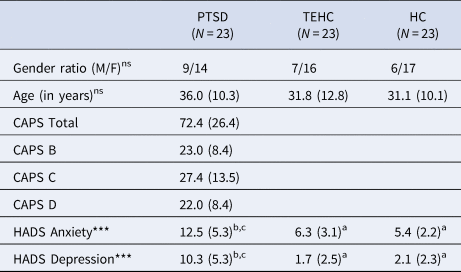
Sixty-nine individuals took part in the study: 23 participants with clinically diagnosed PTSD, 23 TEHC, and 23 HC. Thirteen out of the 46 healthy participants had already been included in a previous analysis of AB published elsewhere (Veerapa et al., Reference Veerapa, Grandgenevre, El Fayoumi, Vinnac, Haelewyn, Szaffarczyk and D'Hondt2020). Demographic and psychopathological characteristics by group are presented in Table 1. PTSD participants were recruited from the Centre Regional Psychotrauma Hauts-de-France, CHU de Lille. Before inclusion in this study, they had been diagnosed with PTSD following DSM-5 criteria (American Psychiatric Association, 2013) by a psychiatrist, who also ensured that participants had been exposed to only one traumatic event without any childhood traumatic experiences, as assessed with the Childhood Questionnaire Trauma (CTQ; Bernstein et al. Reference Bernstein, Fink, Handelsman, Foote, Lovejoy, Wenzel and Ruggiero1994; Paquette, Laporte, Bigras, & Zoccolillo, Reference Paquette, Laporte, Bigras and Zoccolillo2004). HC and TEHC were recruited through local advertising or from a list of volunteers at the CIC1403–Clinical Investigation Center (Univ. Lille, Inserm, CHU Lille).
Demographic and psychopathological characteristics of individuals with PTSD, TEHC, and healthy controls (HC): mean (s.d.)

Note: CAPS, Clinician-Administered PTSD Scale; HADS, Hospital Anxiety and Depression Scale. ns nonsignificant, * p < 0.05, ** p < 0.01, *** p < 0.001. The superscripts indicate significant pairwise differences between groups (a = PTSD; b = TEHC; c = HC).
All participants provided informed consent before participating in the study, which was approved by the local ethics committee (Comité de protection des personnes Nord Ouest IV, France) and was conducted in accordance with the Declaration of Helsinki. Verification of inclusion and exclusion criteria, as well as clinical assessments, were performed by psychiatrists, who were trained over a one-day session on the semi-structured interviews used in the present study. All participants had normal or corrected-to-normal vision and had a score on the Montreal Cognitive Assessment test of 26 or above (Nasreddine et al., Reference Nasreddine, Phillips, Bédirian, Charbonneau, Whitehead, Collin and Chertkow2005). All participants were assessed for primary and comorbid psychiatric diagnoses using the Mini International Neuropsychiatric Interview (Sheehan et al., Reference Sheehan, Lecrubier, Sheehan, Amorim, Janavs, Weiller and Dunbar1998). All lacked any neurological or psychiatric (other than PTSD for the PTSD group), substance-related, or major neurocognitive disorders. Participants in the two trauma-exposed groups met DSM-5 criterion A. Traumatic events included interpersonal violence (e.g. molestation, attacks, combat) and accidents (e.g. drowning, domestic accidents, public road accidents). TEHC had no current or past diagnosis of PTSD. To assess the severity of the symptoms among patients with PTSD, we administered the Clinician-Administered PTSD for DSM-IV (Blake et al., Reference Blake, Weathers, Nagy, Kaloupek, Gusman, Charney and Keane1995; Weathers, Keane, & Davidson, Reference Weathers, Keane and Davidson2001) as we did not have access to the French version of the CAPS for DSM-5 at the time this study was initiated. Accordingly, given the partial reorganization of symptoms clusters between DSM-IV and DSM-5, we only considered the total score for further analyses with experimental results (see Complementary analyses) and it should be noted that this total score probably does not fully represent the severity of patients' symptoms as considered by the DSM-5 which includes three symptoms more than the DSM-IV did. The psychometric properties of the CAPS were found to be excellent (Blake et al., Reference Blake, Weathers, Nagy, Kaloupek, Gusman, Charney and Keane1995; Weathers et al., Reference Weathers, Keane and Davidson2001). Cronbach's α in the sample was 0.95. All participants were administered the Hospital Anxiety and Depression Scale (HADS; Zigmond and Snaith, Reference Zigmond and Snaith1983). A literature review of the validity of the HADS indicates that it has satisfying psychometric properties and performs well in screening for anxiety and depression in the general population, general practice, and psychiatric patients (Bjelland, Dahl, Haug, & Neckelmann, Reference Bjelland, Dahl, Haug and Neckelmann2002). Cronbach's α in the sample was 0.95.
Dot-probe task
We used the version of the DPT developed by Veerapa et al. (Reference Veerapa, Grandgenevre, El Fayoumi, Vinnac, Haelewyn, Szaffarczyk and D'Hondt2020), which consists of one practice block of 10 trials followed by one experimental block of 96 trials presented in randomized order. Each trial begins with a black fixation cross on a gray background. Its duration is randomly selected between 500 and 1500 ms before its initiation. Participants are asked to fixate their gaze on the central fixation cross to ensure that they initially focus their visual attention at the center of the screen in each trial. This instruction is also used as a drift check to confirm the reliability of the eye-gaze calibration (see Procedure). Once the participant's eyes are detected at the center of the screen, the fixation cross is removed and two stimuli appear simultaneously – one neutral scene and one negative scene – for a duration of either 1000 or 2000 ms (with an equal number of presentations for each presentation duration) and are followed by a small black dot randomly presented at the location previously occupied by the negative (i.e. congruent trials) or the neutral (i.e. incongruent trials) scene. During the task, participants have thus to successively focus their gaze on the central cross, freely explore the images, and then indicate as quickly as possible the spatial location (left or right) of the dot by pressing one of two keys. The entire task lasts approximately 15 min.
This DPT uses two sets of 24 negative stimuli and 24 neutral stimuli from the IAPS, one for women and one for men, selected using affective norms in terms of arousal and valence for female subjects and male subjects as provided in the IAPS manual (Lang et al., Reference Lang, Bradley and Cuthbert2008). The mean values of valence and arousal, were respectively, 2.49 ± 0.38 and 5.68 ± 0.83 for the unpleasant stimuli, 4.97 ± 0.19 and 2.99 ± 0.56 for the neutral in the sets for women, and 2.54 ± 0.46 and 5.63 ± 0.85 for the unpleasant stimuli, and 4.92 ± 0.28 and 2.94 ± 0.59 for the neutral in the sets for men (Veerapa et al., Reference Veerapa, Grandgenevre, El Fayoumi, Vinnac, Haelewyn, Szaffarczyk and D'Hondt2020). Affective characteristics of negative and neutral sets are thus very close between women and men. Negative stimuli include pictures associated with death and depicting accidents, attacks or injured, afraid, or suffering persons, and neutral stimuli include pictures of inanimate objects or depicting people with neutral expressions or in neutral situations (such as daily activities for instance). Descriptions of the stimuli and their physical and emotional characteristics are available in Veerapa et al. (Reference Veerapa, Grandgenevre, El Fayoumi, Vinnac, Haelewyn, Szaffarczyk and D'Hondt2020). At each trial, one negative stimulus and one neutral stimulus were randomly selected (without replacement) from the gender-based sets. The pictures were displayed on a gray background and had an angular size of 8° (horizontal) × 6° (vertical) at a fixed viewing distance of 1 m. The distance between the fixation cross and the center of each image was 8°.
Apparatus
Eye movements were recorded during the DPT using the iViewX Hi-Speed eye tracker from Senso-Motoric Instruments (Teltow, Germany; connected to a PC with an Intel Pentium 4 3.00 GHz processor and 1 GB RAM) at a sampling rate of 350 Hz. The manufacturers report a gaze position accuracy of 0.25–0.5°.
The stimuli were presented on a 22″ monitor (AOC, resolution: 1680 × 1050; refresh rate: 60 Hz) connected to a PC with an Intel Core i3–2120 3.30 GHz processor, 3 GB RAM, and an AMD Radeon HD5450 card. The presentation of stimuli and the recording of responses were performed using the Psychophysics Toolbox Version 3 (Kleiner et al., Reference Kleiner, Brainard, Pelli, Ingling, Murray and Broussard2007) for MATLAB (R2015a, The MathWorks, Inc., Natick, Massachusetts, United States).
Procedure
Participants were tested individually at the CURE platform at CHU Lille. They provided informed consent and then participated in demographic and psychopathological measures. Participants were then seated in front of the eye-tracking monitor, with their heads on a chin rest. They were first presented with a central white square (40° × 40°) containing five calibration points and had to fixate on the black dots (center, top right, top left, bottom right, and bottom left), whereas their eye positions were recorded by the system. Once the calibration was completed, the participant started the DPT.
Data preparation
Eye-tracking measures
Eye-tracking data were analyzed using BeGaze software from SensoMotoric Instruments (Teltow, Germany). Visual inspection of data indicated eye-gaze calibration was successful for all participants included in the present study. Areas of interest (AOIs) corresponded to the location of the negative and the neutral images. Only fixations longer than 80 ms were considered in the analyses. Using the DPT, we had the opportunity to assess whether or not participants with PTSD were more likely than controls to dwell longer on negative stimuli compared to neutral stimuli when both are competing for attentional resources. Because the two stimuli are presented simultaneously for a predetermined length of time during each trial, each time one participant looks at one picture, he does not look at the other one and has also less time to do it as time goes by. Dwell time on one picture category has thus an influence on dwell time on the other. Considering a ‘valence’ factor in the statistical model and directly applying analyses on dwell times according to the picture category (see Experimental data) did not seem appropriate as these measures are not fully independent from each other. For this reason, we chose to use a dwell time bias measure calculated for each exposure duration by computing the difference between the mean dwell times on negative and neutral pictures. First-fixation direction bias corresponded to the total number of trials in which the first fixation was made on the negative picture type divided by the total number of trials in which the first fixation was made on either the negative or the neutral picture. First-fixation latency and first-fixation duration were calculated by averaging the latency to and duration of first fixations for each AOI, respectively.
Response times
RT corresponded to the time between the presentation of the dot and the button press. Trials with response errors were excluded (1.68% of data). No trial was excluded because of a very fast (all RTs ⩾ 170 ms) or long (all RTs ⩽ 1968 ms) RT. Trials with RT more than 2.5 s.d.s greater or less than −2.5 s.d.s below the participant's mean were discarded to reduce the influence of outliers (2.07% of data). Individual mean RTs were computed for each experimental condition on the remaining trials (representing, on average, 96 ± 2% of the total number of trials). Individual AB scores were computed for each exposure duration by subtracting the individual mean RT in incongruent conditions from the individual mean RT in congruent conditions.
Data analysis
Statistical analyses were performed using R studio version 1.4.1106 software (RStudio, Inc.).
Demographic and psychopathological characteristics
The threshold of significance was set at p < 0.05. Groups were compared for age, trait anxiety, HADS anxiety, and HADS depression using Kruskal–Wallis tests (because the normality assumption was not met for these variables), and significant effects were followed up with post hoc tests (with an alpha corrected for the number of tests). Groups were also compared for gender by performing a Pearson χ2 test.
Experimental data
We performed four statistical tests for eye-gaze data, and statistical significance was accepted at a Bonferroni-adjusted alpha level of 0.0125. We performed mixed analyses of variance (ANOVA) on the dwell time bias with exposure duration (1000, 2000) as a within-subject factor and group (PTSD, TEHC, HC) as a between-subject factor, and on first-fixation duration and latency with valence (negative, neutral) as a within-subject factor and group (PTSD, TEHC, HC) as a between-subject factor. Significant interactions were followed up by: (i) dependent t tests comparing exposure durations or valence categories in each group; (ii) one-way ANOVAs comparing groups for each exposure duration or valence category, and significant group effects were followed up by independent t tests (or Welch's t test when the assumption of homogeneity of variance was not met) comparing the groups. One-sample t tests (unilateral) were also performed to determine whether the dwell time bias in the 1000 and 2000 ms conditions was significantly greater than 0 in each group. Finally, a one-way ANOVA compared the first-fixation direction bias between groups.
We also performed a mixed analysis of variance (ANOVA) on RT-based AB scores with exposure duration (1000, 2000) as a within-subject factor and group (PTSD, TEHC, HC) as a between-subject factor. For this analysis, the threshold of significance was set at p < 0.05.
The sample size was not determined for this study, which was part of a larger protocol. Consequently, we performed a sensitivity power analysis for a group × exposure duration or a group × valence interaction using a two-tailed α = 0.05, with 0.90 power. Considering our sample size, this analysis indicated that the minimum effect size that the study was sensitive to was η 2p = 0.046 (G*Power 3.1.9.4; Faul, Erdfelder, Lang, and Buchner, Reference Faul, Erdfelder, Lang and Buchner2007).
Complementary analyses
Bravais-Pearson correlational analyses examined the association between AB measures and psychopathological variables for which group differences were observed, across the sample and in each group separately, except for CAPS measures that were collected in PTSD participants only. We also indexed the internal consistency of the task by computing bivariate Bravais-Pearson correlations between AB measures of the odd and even trials (split-half reliability). In both cases, we conducted bootstrap analysis (2000 replications) of the Pearson correlations.
Results
Demographic and psychopathological characteristics
No significant group differences were observed for age, H(2) = 4.28, p = 0.118, or gender, χ2(2) = 0.93, p = 0.627 (Table 1). Groups significantly differed for HADS anxiety, H(2) = 20.85, p < 0.001, and HADS depression, H(2) = 33.70, p < 0.001. For the two measures, scores were significantly higher for the PTSD group than for the TEHC and HC groups.
Experimental data
Dwell time bias
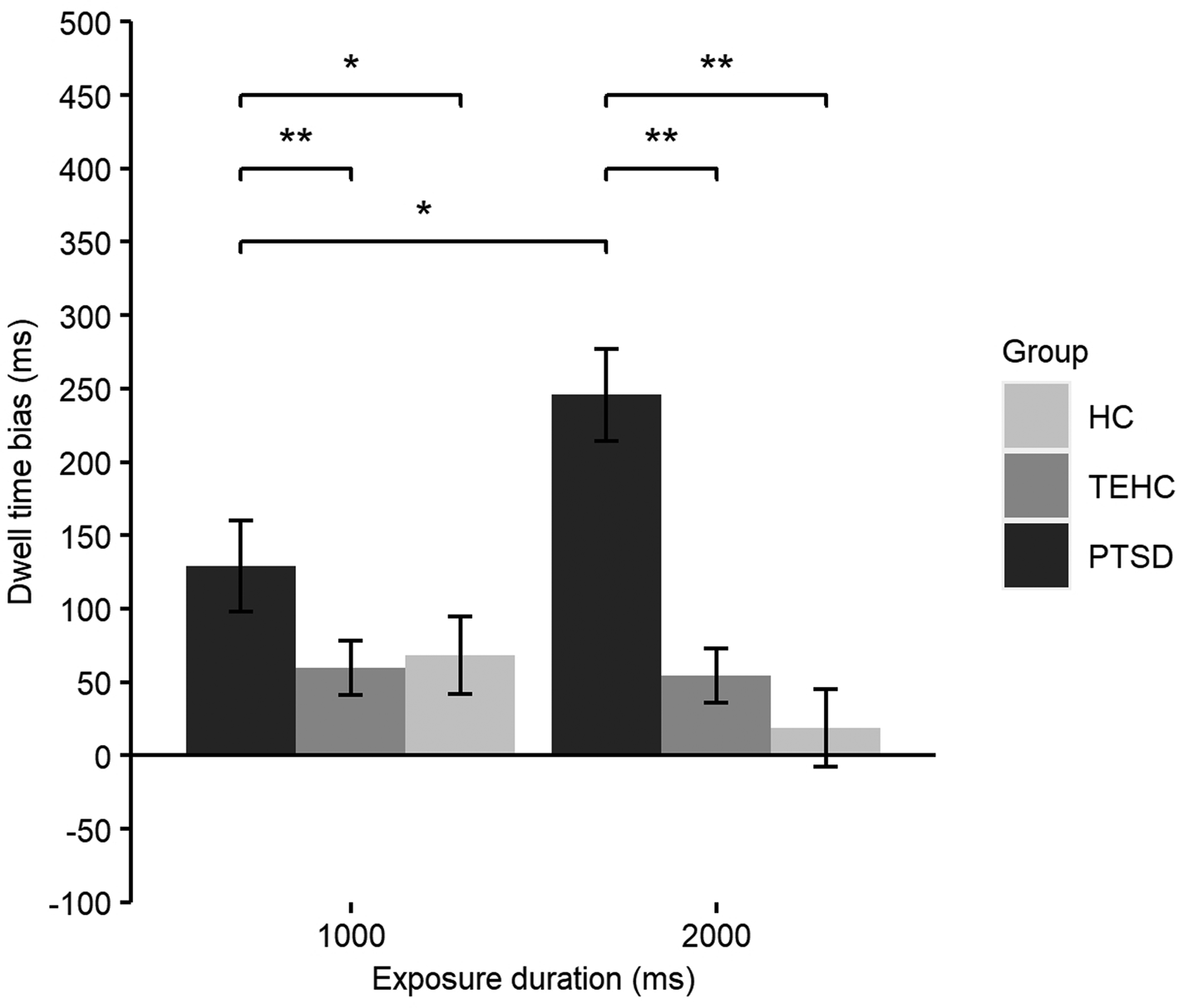
There was a significant interaction between exposure duration and group, F (2,66) = 5.50, p = 0.006, η 2p = 0.14 (Fig. 1). Follow-up analyses revealed that the dwell time bias was significantly greater in the 2000 ms condition than in the 1000 ms condition for the PTSD group, t(22) = 2.65, p = 0.015, d = 0.55, but did not significantly differ according to exposure duration for the TEHC group, t(22) = −0.20, p = 0.842, d = −0.04 and the HC group, t(22) = −1.32, p = 0.201, d = −0.28. Follow-up analyses also revealed a significant simple group effect in the 1000 ms condition, F (2,66) = 6.35, p = 0.003, η 2p = 0.16. The bias was significantly greater in the PTSD group than the TEHC group, t(39.95) = 2.64, p = 0.012, d = 0.78, and the HC group, t(37.87) = 3.12, p = 0.003, d = 0.92, but did not differ between the TEHC group and the HC group, t(43.60) = 0.48, p = 0.634, d = 0.14. There was also a simple group effect in the 2000 ms condition, F (2,66) = 7.21, p = 0.001, η 2p = 0.18. The bias was significantly greater in the PTSD group than the TEHC group, t(42.03) = 3.17, p = 0.003, d = 0.94, and the HC group, t(35.66) = 2.95, p = 0.006, d = 0.87, but did not differ between the TEHC group and the HC group, t(40.40) = −0.64, p = 0.525, d = −0.19.
Mean averaged dwell time bias as a function of exposure duration (1000, 2000 ms) and group. Positive values indicate higher dwell time on negative pictures than on neutral pictures. HC, healthy controls; PTSD, posttraumatic stress disorder; TEHC, trauma-exposed healthy control. Error bars represent the standard error of the mean (Morey, Reference Morey2008). * p < 0.05, ** p < 0.01, *** p < 0.001.

One-sample t tests showed that the dwell time bias was significantly greater than 0 in the PTSD group in the 1000 ms condition, t(22) = 6.92, p < 0.001, d = 1.44, and in the 2000 ms condition, t(22) = 4.40, p < 0.001, d = 0.92. In the TEHC group, it was also greater than 0 in the 1000 ms condition, t(22) = 4.89, p < 0.001, d = 1.02, but not in the 2000 ms condition, t(22) = 1.65, p = 0.057, d = 0.34. Finally, the bias was significantly greater than 0 in the HC group in the 1000 ms condition, t(22) = 5.09, p < 0.001, d = 1.06, but not in the 2000 ms condition, t(22) = 0.42, p = 0.341, d = 0.09.
First-fixation measures
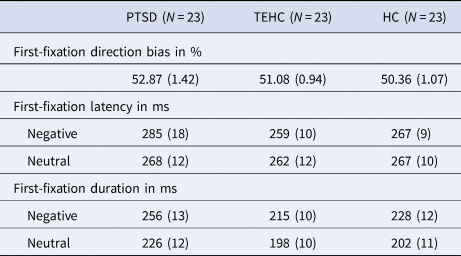
The means and standard errors of the first-fixation measures are shown in Table 2. There was no significant group difference for first-fixation direction bias, F (2,66) = 1.23, p = 0.299, η 2p = 0.04. For first-fixation latency, the main effect of valence, F (1,66) = 1.38, p = 0.245, η 2p = 0.02, of group, F (2,66) = 0.47, p = 0.624, η 2p = 0.01, and the interaction between valence and group, F (2,66) = 2.25, p = 0.114, η 2p = 0.06, were not significant. For first-fixation duration, there was a significant main effect of valence, F (1,66) = 31.96, p < 0.001, η 2p = 0.33, indicating longer first-fixation duration for negative pictures (M = 233, s.e. = 7) than for neutral pictures (M = 209, s.e. = 6). The main effect of group, F (2,66) = 2.71, p = 0.074, η 2p = 0.08, and the interaction between valence and group, F (2,66) = 0.68, p = 0.511, η 2p = 0.02, were not significant.
Mean (standard error) first-fixation direction bias as a function of group and mean (standard error) first-fixation latency and first-fixation duration as a function of valence and group.

Note: HC, healthy controls; PTSD, posttraumatic stress disorder; TEHC, trauma-exposed healthy control.
Response times
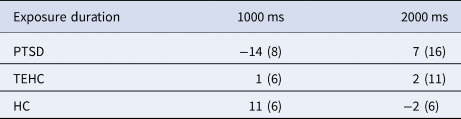
The means and standard errors of RT-based AB scores are shown in Table 3. The main effect of exposure duration, F (1,66) = 0.27, p = 0.602, η 2p < 0.01, the main effect of group, F (2,66) = 0.30, p = 0.743, η 2p < 0.01, and the interaction between exposure duration and group, F (2,66) = 2.31, p = 0.107, η 2p = 0.07, were not significant.
Mean (standard error) RT-based AB scores (in ms) as a function of exposure duration, and group

Note: HC, healthy controls; PTSD, posttraumatic stress disorder; TEHC, trauma-exposed healthy control.
Complementary analyses
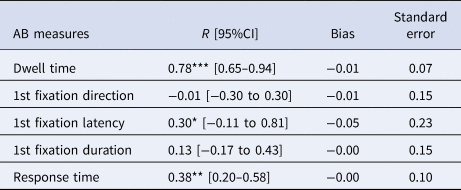
The results of the correlational analyses between AB measures and psychopathological characteristics are described in online Supplementary Table S1. For the 1000 ms condition, significant correlations emerged between dwell time bias and HADS anxiety scores across the sample (r = 0.30), HADS depression scores across the sample (r = 0.30) and for HC (r = −0.58), and CAPS scores (r = 0.48). For the 2000 ms condition, significant correlations emerged between dwell time bias and HADS anxiety scores across the sample (r = 0.34), and HADS depression scores across the sample (r = 0.34) and for HC (r = −0.43). The results of split-half reliability analyses are described in Table 4. The reliability was high for dwell time and medium for first-fixation latency and RT.
Split-half reliability assessed through bootstrapped bivariate Bravais-Pearson correlations between odd and even trials of the DPT for eye-tracking measures and response times

Note: * p < 0.05, ** p < 0.01, *** p < 0.001.
Discussion
The present study analyzed both eye-tracking and behavioral data of patients with PTSD, TEHC, and HC performing an emotional DPT during which they were exposed to pairs of negative and neutral scenes for either 1 or 2 s. The main finding is that individuals with PTSD display an AB toward unpleasant stimuli, which is characterized by heightened sustained attention to this aversive information and persists with prolonged exposure to the stimuli.
Our results described a pattern of AB toward aversive stimuli among patients with PTSD, which occurs after a stronger initial engagement for this information regardless of the group of participants. First-fixation analyses did not reveal any significant group differences for direction or latency, in line with the results obtained by previous studies using images as emotional stimuli (Lazarov et al., Reference Lazarov, Suarez-Jimenez, Tamman, Falzon, Zhu, Edmondson and Neria2019, Reference Lazarov, Suarez-Jimenez, Zhu, Pine, Bar-Haim and Neria2021; Mekawi et al., Reference Mekawi, Murphy, Munoz, Briscione, Tone, Norrholm and Powers2020; Powers et al., Reference Powers, Fani, Murphy, Briscione, Bradley, Tone and Jovanovic2019). Moreover, the first-fixation duration was longer on negative than neutral stimuli, regardless of the group. Thus, it appears that PTSD is not associated with facilitated attention toward aversive stimuli and that negative information holds longer attention than neutral stimuli once detected, independent of the PTSD status. The results obtained on total dwell time show that group differences emerge after the initial attentional engagement, with patients showing heightened sustained attention on negative stimuli that persists with prolonged exposure. Indeed, we found a stronger total dwell time bias for PTSD participants than for the two control groups in the 1000 ms condition. This bias was even stronger in the 2000 ms condition for individuals with PTSD, whereas it was no longer significant for control groups. In other words, people with PTSD engage more attention in the processing of aversive information once detected, as do trauma- and nontrauma-exposed individuals without PTSD. However, contrary to those individuals, individuals with PTSD continue to engage more attentional resources to these stimuli afterward.
Previous eye-tracking studies found increased sustained attention to negative stimuli among PTSD patients, as revealed by longer dwell time on negative stimuli compared with control groups. This study notably extends the findings by Lee and Lee (Reference Lee and Lee2014) and Lazarov et al. (Reference Lazarov, Suarez-Jimenez, Zhu, Pine, Bar-Haim and Neria2021), who observed an AB toward negative faces, whatever the discrete emotion considered (i.e. anger, fear, or sadness) among patients with PTSD. One previous eye-tracking study explored AB associated with PTSD using a free viewing task in which participants were presented with matrices of four images depicting natural scenes, combining one negative, positive, neutral, and (general or trauma-relevant) threat image (Thomas et al., Reference Thomas, Goegan, Newman, Arndt and Sears2013). This study also found that participants from the clinical PTSD symptoms group presented heightened attention to threat images across the 2 initial seconds of exposition compared to the participants from the no-trauma-exposure group. However, this threat-related AB was restricted to trauma-relevant threat, which could question the exact nature of the AB linked to PTSD, or at least what can be considered as trauma-relevant stimuli. Indeed, several studies report AB toward negative faces (Lazarov et al., Reference Lazarov, Suarez-Jimenez, Tamman, Falzon, Zhu, Edmondson and Neria2019, Reference Lazarov, Suarez-Jimenez, Zhu, Pine, Bar-Haim and Neria2021; Mekawi et al., Reference Mekawi, Murphy, Munoz, Briscione, Tone, Norrholm and Powers2020; Powers et al., Reference Powers, Fani, Murphy, Briscione, Bradley, Tone and Jovanovic2019), which may be considered trauma-relevant when participants were exposed to a traumatic event of an interpersonal nature but not for other traumatic events. The present study also found AB toward multiple negative stimuli among a group of patients who were exposed to traumatic events of different categories. Finally, unlike Thomas et al. (Reference Thomas, Goegan, Newman, Arndt and Sears2013), Kimble, Fleming, Bandy, Kim, and Zambetti (Reference Kimble, Fleming, Bandy, Kim and Zambetti2010) found using a free viewing task that veterans of the war in Iraq with higher subclinical PTSD symptoms spent more time looking at negative pictures, either trauma-relevant (i.e. related to war) or not (i.e. pictures of motor vehicle accidents) when presented concurrently with neutral scenes.
In line with previous proposals (Lazarov et al., Reference Lazarov, Suarez-Jimenez, Tamman, Falzon, Zhu, Edmondson and Neria2019, Reference Lazarov, Suarez-Jimenez, Zhu, Pine, Bar-Haim and Neria2021), our results may be associated with either hypervigilance or difficulty disengaging attention from negative stimuli, possibly because of impaired attention control. Either way, the dynamics of AB evidenced by our study support the ‘maintenance’ hypothesis, positing that threat-related stimuli hold attention longer than neutral stimuli once they are detected rather than the ‘vigilance-avoidance’ hypothesis postulating facilitated orienting of attention toward aversive stimuli, followed by avoidance of this information (Weierich, Treat, & Hollingworth, Reference Weierich, Treat and Hollingworth2008). We assume that patients with PTSD have difficulties ‘rebalancing’ the distribution of their attentional resources once they face negative stimuli, leading to persisting AB with exposure time. The correlational results with psychopathological characteristics further suppose that the extent of these difficulties increases with symptom severity, in line with recent results from eye-tracking studies (Lazarov et al., Reference Lazarov, Suarez-Jimenez, Tamman, Falzon, Zhu, Edmondson and Neria2019; Mekawi et al., Reference Mekawi, Murphy, Munoz, Briscione, Tone, Norrholm and Powers2020; Powers et al., Reference Powers, Fani, Murphy, Briscione, Bradley, Tone and Jovanovic2019).
Note that our results slightly differ from those recently obtained by Lazarov et al. (Reference Lazarov, Suarez-Jimenez, Zhu, Pine, Bar-Haim and Neria2021), who also examined both first-fixation duration and total dwell time. First, although our results indicated that healthy individuals no longer engaged sustained attention to negative stimuli after initial vigilance, first-fixation results obtained by Lazarov et al. (Reference Lazarov, Suarez-Jimenez, Zhu, Pine, Bar-Haim and Neria2021) in HC indicated a longer first-fixation dwell time in neutral AOI than in negative AOI. Methodological differences are likely to explain these discrepancies. Lazarov et al. (Reference Lazarov, Suarez-Jimenez, Zhu, Pine, Bar-Haim and Neria2021) used a free viewing task of 4 × 4 matrices of faces displayed for 6000 ms – more information and during a longer exposure time. Isolated facial stimuli may also be less complex visual stimuli than most of the natural scenes we selected from the IAPS. Evidence suggests that affective characteristics of stimuli are associated with their visual complexity, with higher visual complexity being correlated with higher arousal ratings (Madan, Bayer, Gamer, Lonsdorf, & Sommer, Reference Madan, Bayer, Gamer, Lonsdorf and Sommer2018). It should also be noted that split-half reliability was low for the first-fixation duration in our study and that psychometric properties were lower (but still good) for the first-fixation dwell time than other eye-tracking indices analyzed by Lazarov et al. (Reference Lazarov, Suarez-Jimenez, Zhu, Pine, Bar-Haim and Neria2021). Second, Lazarov et al. found more similarities in eye gaze patterns between trauma-exposed individuals with or without PTSD than between nontrauma and trauma-exposed healthy individuals, suggesting that the impact on attentional processing is mediated by exposure to a traumatic event. However, and importantly, the clinical characteristics of TEHC differed significantly between our study and that of Lazarov et al., because in our work, TEHC were exposed to only one traumatic event and only during adulthood. In contrast, in Lazarov et al., they could have endorsed multiple traumatic events, including during childhood. It is then plausible that the observations made by Lazarov et al. (Reference Lazarov, Suarez-Jimenez, Zhu, Pine, Bar-Haim and Neria2021) among TEHC are the results of repeated exposure to traumatic events, and we agree with them that future studies should specifically consider this issue.
Following the meta-analysis by Bar-Haim, Lamy, Pergamin, Bakermans-Kranenburg, and van IJzendoorn (Reference Bar-Haim, Lamy, Pergamin, Bakermans-Kranenburg and van IJzendoorn2007) showing a threat-related AB among individuals with anxiety, several studies used variations of the DPT in therapeutic versions aiming at modifying AB, with promising results (Hakamata et al., Reference Hakamata, Lissek, Bar-Haim, Britton, Fox, Leibenluft and Pine2010). Recent results obtained from the meta-analysis by Kruijt et al. (Reference Kruijt, Parsons and Fox2019), who considered threat-related dot-probe bias measured at baseline in randomized clinical trials using AB modification procedures, raised doubts over the relevance of using AB modification procedures considering the absence of evidence in favor of AB from RT-based measures. Here, we did find an AB toward negative stimuli, as revealed by eye-tracking data, whereas RT-based measures did not indicate any biased attention among individuals with PTSD. This result has important therapeutic implications because it invites us to still consider AB modification procedures in the treatment of PTSD. Moreover, it implies that these procedures should specifically target what we can consider abnormal AB. At the moment, two main types of AB modification procedures are used, and both are derived from the emotional DPT: (i) in the attention bias modification treatment, the probe always followed the neutral picture to train attention away from threatening stimuli (Bar-Haim, Reference Bar-Haim2010); (ii) in the attention control training, the probe replaces the negative and neutral stimuli with equal frequency to train participants to disregard irrelevant threat-related contingencies and focus instead on the task performance (Badura-Brack et al., Reference Badura-Brack, Naim, Ryan, Levy, Abend, Khanna and Bar-Haim2015). Our results indicate that these procedures should be adjusted to specifically target the eye-gaze patterns that consist of continuing to engage more attentional resources toward negative stimuli after they have been fixated for the first time. This implies the use of real-time eye-tracking measures during AB modification procedures (Lazarov, Pine, & Bar-Haim, Reference Lazarov, Pine and Bar-Haim2017; Shamai-Leshem, Lazarov, Pine, & Bar-Haim, Reference Shamai-Leshem, Lazarov, Pine and Bar-Haim2021).
The present study has several limitations. While we measured anxiety and depression levels and we evaluated their links with experimental results, we did not include patients with comorbid disorders. We thus cannot rule out that comorbid disorders influence the attentional patterns of patients, in particular anxiety and depression disorders, which frequently co-occur with PTSD (Pietrzak, Goldstein, Southwick, & Grant, Reference Pietrzak, Goldstein, Southwick and Grant2011; Rytwinski, Scur, Feeny, & Youngstrom, Reference Rytwinski, Scur, Feeny and Youngstrom2013) and have been associated with AB to emotional information (Clauss, Gorday, & Bardeen, Reference Clauss, Gorday and Bardeen2022; Suslow et al., Reference Suslow, Hußlack, Kersting and Bodenschatz2020). It should also be noted that the present study only included patients exposed to a single traumatic event. Even though preliminary data indicate that there is no significant association between overall trauma load and AB towards threat (Powers et al., Reference Powers, Fani, Murphy, Briscione, Bradley, Tone and Jovanovic2019), future studies should consider the possible influence of multiple trauma exposure.
In conclusion, the present study provides new eye-tracking evidence that PTSD is associated with an AB toward aversive stimuli, which is characterized by heightened sustained attention toward negative scenes once detected and persists with exposure time. It encourages further analysis of individual differences, including the effect of repeated traumatic exposure, on attention to negative stimuli, and the design of optimized therapeutic interventions specifically targeting abnormal AB patterns.
Acknowledgements
This study was supported by a grant from the Fondation Pierre Deniker and a grant from the Fondation pour la Recherche Médicale (FRM).
Author contributions
EV, PG, SS, and FD designed the study. EV and FD performed the literature review. EV, PG, BV, MEF, GV, and FD managed the data collection. EV, SS, MW, TF, and FD conducted the data analyses. EV and FD wrote the first draft of the manuscript, and the final version was approved by all of the authors.
Conflict of interest
The authors declare no competing interests.
Supplementary material
The supplementary material for this article can be found at https://doi.org/10.1017/S0033291722003063.