Naming varieties of the Expanding Circle is a very controversial and much debatable issue (see Nelson & Proshina, Reference Nelson and Proshina2020); therefore, it is a high-priority, pressing question, brought up for timely discussion by the English Today journal. Those who are negative or hesitant about the legitimacy of these varieties, prefer speaking about English in a country – for example, English in China. However, this naming proves to be deficient as it is ambiguous and, in a way, exclusive. Its ambiguity lies in the fact that this naming can embrace speakers of any variety, i.e., of all three Circles (see Kachru, Reference Kachru, Quirk and Widdowson1985), who happen to be in China. On the other hand, it excludes those Chinese speakers of English who have left China, either as emigrants or temporarily, though they use English while abroad. This means that the descriptive phrase English in China lacks its terminological nature.
Supporters of legitimacy of Expanding Circle varieties waver between two or even three variants – China English, Chinese English, and Chinglish; though the third one is usually stigmatized, for it refers to informal typically non-educated speech, highly hybridized and pidginized. The differentiation of the terms was first suggested by Ge Chuangui (Reference Ge1980) and is still a highly debatable issue (Jiang, Reference Jiang2002; Kirkpatrick & Xu, Reference Kirkpatrick and Xu2002; Wei & Fei, Reference Wei and Fei2003; Chen & Hu, Reference Chen and Hu2006; He & Li, Reference He and Li2009; Eaves, Reference Eaves2011; Li, Reference Li2019, to mention just a few). Some scholars argue that the term Chinese English is derogatory too (Eaves, Reference Eaves2011); it represents interlanguage (Wei & Fei, Reference Wei and Fei2003), and only China English is worthy to be used as a term denoting ‘a performance variety of English which has the standard Englishes as its core but is colored with characteristic features of Chinese phonology, lexis, syntax and discourse pragmatics, and which is particularly suited for expressing content ideas specific to Chinese culture through such means as transliteration and loan translation’ (He & Li, Reference He and Li2009: 83).
However, this definition is challenged by the fact that there is no universal standard of English (Hickey, Reference Hickey2012; Halliday, Reference Halliday, Nelson, Proshina and Davis2020) to be considered as the core; each variety, even those that are codified, have their own linguacultural specifics. As for Chinese English being an interlanguage, this statement reveals a shift from the field of sociolinguistics to psycholinguistics, since world Englishes as an average phenomenon typical of a certain speech community are associated with sociolinguistics, while interlanguage as an individual level of a target language knowledge and mastering is characterized in a psycholinguistic framework.
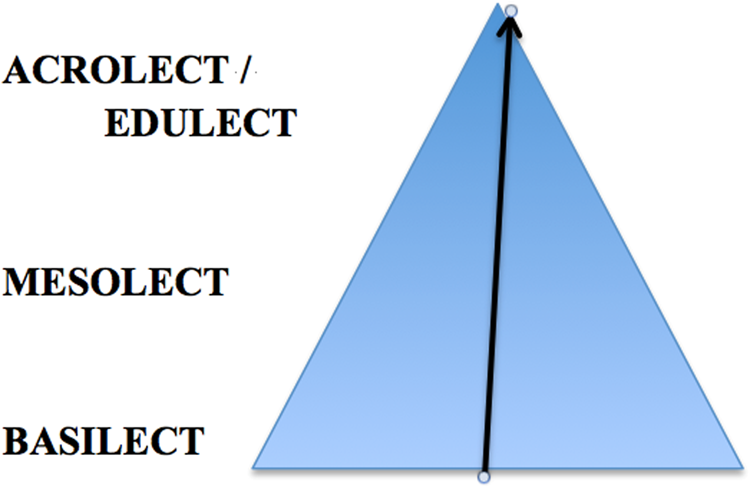
Our approach to a language variety is consonant with the Kachruvian bilingual cline (Kachru, Reference Kachru and Smith1983). Any variety is a continuum that can roughly be divided into three lectal zones based on the functional and stylistic contexts of use and linguistic features. These are acrolect, mesolect and basilect that correspond to China English, Chinese English, and Chinglish.
Acrolect is the use of language in a formal context; it is based on the written standard of English, which for China is exonormative as yet, but has a specific Chinese standard of Romanization (Pinyin). However, unlike British or American Englishes that serve as educational models in China, China English as an exonormative variety can use not only one norm but all codified norms that are appropriate for the context: Australian, New Zealand, Canadian, even Indian, Nigerian or other Outer Circle varieties’ norms (suppose an educated Chinese has to work or study in these countries). This requires awareness of these norms and recognition of the conception of English as an International Language to make an informed choice. So we can claim that Expanding Circle varieties differ from endonormative Inner Circle varieties in being more variable in norms. Acrolectal China English, being a formal educated form of the language and, therefore, also termed edulect (Bautista & Gonsalez, Reference Bautista, Gonsalez, Kachru, Kachru and Nelson2006: 132), functions mostly in mass media, on the government and diplomatic level, at universities, in translingual (or contact) literature, and so on.
Mesolectal Chinese English is based on spoken English standards that are apt to change quicker than written standards. Therefore, they have many more innovations, including features transferred from the first language of the speakers and reflecting their culture and mindset. That is why description of varieties is usually done in the mesolectal zone of a variety cline. Usually, mesolectal English is found in the speech of educated people in informal settings but it may be characteristic of formal contexts as well when people using English as a second language lose, to some degree, control over their English, which might be caused by psychological reasons (stress, fatigue, strong emotions, etc.). In other circumstances, speakers/writers can easily change the forms they use to more formal appropriate variants but due to fatigue or stress they miss their deviations from the norm, and gradually these forms become typical and productive features of their community's English. Interestingly, insufficiently educated speakers of this variety tend to manifest similar features, as the latter are caused by their first language transfer and their mentality. When typified, these features become linguistic features of a variety rather than an interlanguage, an intrinsic part of an individual learner's speech. What is recognized as error can be later accepted as a new linguistic form if this form has a wide and typified use. This was pointed to by Jenkins (Reference Jenkins2006: 44), who argued that deviations ‘often start life as forms that are widely perceived as errors in the standard language, the NS [native speaker] “error” gradually becomes accepted as a new standard form (for example, the use of “data” to replace “datum” in the singular)’. The situation is similar with the ‘non-native’ Englishes: ‘L1 transfer errors’ could become legitimate innovations due to their systematical and frequent production and understanding by proficient speakers of other varieties (Jenkins, Reference Jenkins2007: 21). This being the case, it is clear why the term Chinese English is sometimes held in contempt, but this way of developing a variety is quite natural and synergetic. We can take control over our individual speech but we cannot control the development of a social variety. Chinese English should not be taken as shameful.
Basilectal English as a Sinicized hybrid form of English, or Chinglish, is a constitutional part of a variety. It is as indispensable to a variety as argot or slang to language. Basilectal English is characteristically used by learners of English – that is why it is confused with interlanguage. But basilectal English cannot be named as an entire variety – it makes up only one-third of a variety cline and functions mostly in informal or artificial educational settings, being typical of mostly uneducated (and therefore, unsuccessful) communicators.
To sum up, a variety of English used by Chinese communicators has three constitutional parts: acrolectal China English, mesolectal Chinese English, and basilectal Chinglish (see Figure 1). These parts represent zones of a bilingual cline formed as result of two (or more) language contact, English and Chinese. They make the entire total of a variety as a social speech phenomenon of the Chinese community. Every member of this English-speaking community can manifest features of a certain lectal zone depending on the context of use, style, and his/her proficiency. Those who are well-proficient can slide down from the acrolectal zone through mesolectal part to basilectal one and then back upwards (see the examples given by Anne Pakir [Reference Pakir1991] on Singapore English, wherein educated communicators can switch back and forth from one lect to another, using acrolect at work, mesolect at home, and basilect at the market, which proves the functional nature of the cline, but the switch upward is impossible for basilectal speakers).
Variety's cline (Based on Kachru, Reference Kachru and Smith1983)

The general term for all three subvarieties of English used by Chinese speakers/writers might be China's English – the term that shows their ownership of the variety that expresses their cultural identity and might have (as well as might not have) certain linguistic features transferred from the Chinese language and reflecting the Chinese way of thinking.
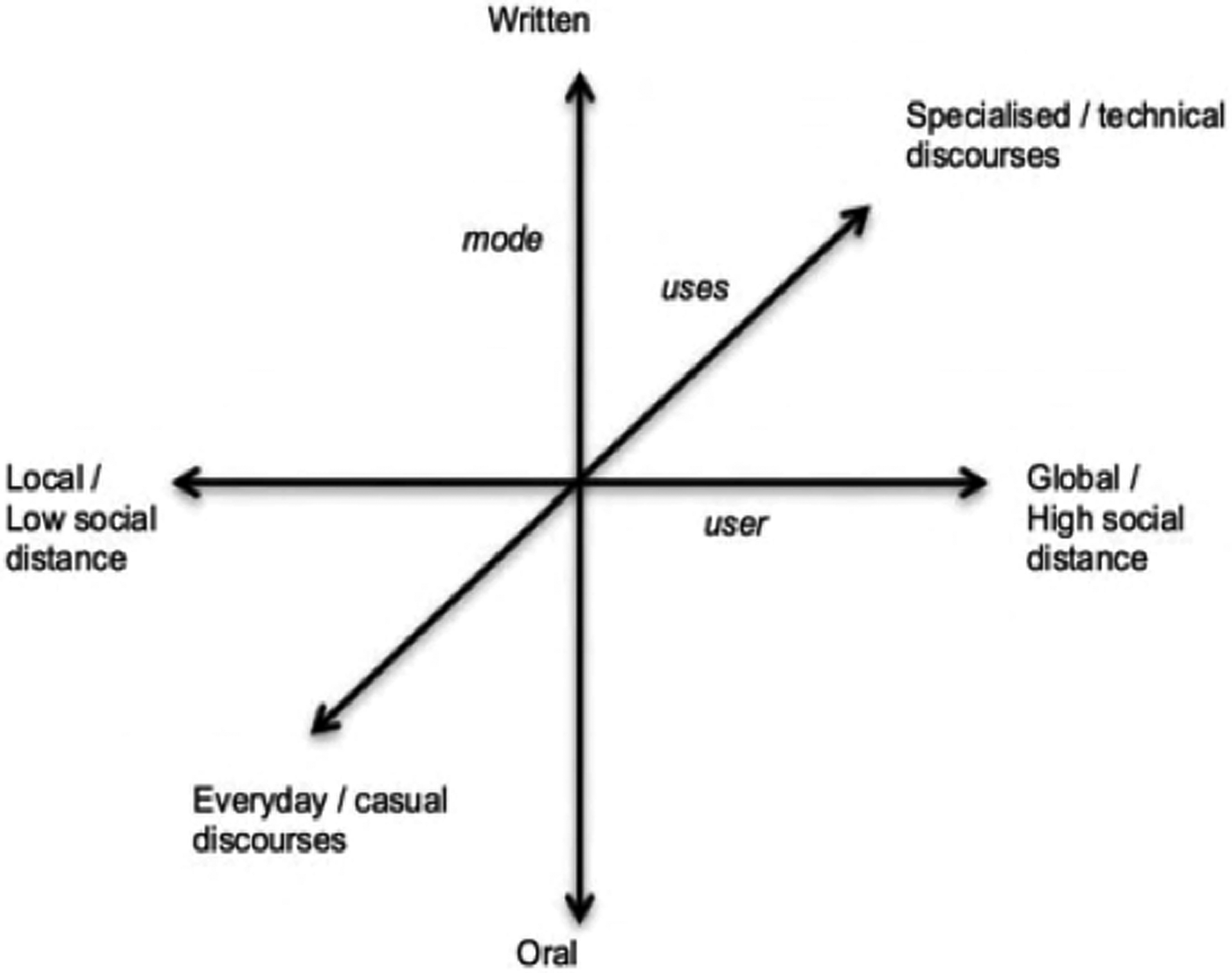
This interpretation of China/Chinese English proves to be in concert with the framework of language variation by A. Mahboob (Mahboob & Liang, Reference Mahboob and Liang2014) – see Figure 2. It is represented by three lines: vertical, horizontal, and diagonal. The vertical line demonstrates a written and an oral mode of speech. The diagonal line presents language variation based on uses, from everyday/casual (informal) use to specialized/technical (formal) discourse. The horizontal line ranges users’ distance, which is a pragmatic aspect: local /low social distance is associated with informal speech, while global/high social distance is covered by formal variation.
Language variation framework (Mahboob & Liang, Reference Mahboob and Liang2014: 134)

In this framework, China English serves specialized or technical discourses; it is oriented towards a global user, is formal and expresses high social distance; therefore, it occupies the upper right positions of the scheme, though sometimes it can occur in the oral mode – so the right-hand part of the framework might be represented by acrolectal China English. Mesolectal Chinese English takes the left-hand part of the scheme: it might be represented in written and oral modes; it is typical of casual discourse and reveals mostly low social distance between the communicators and includes more local features than acrolectal English. Basilectal Chinglish is represented about equally in written and oral modes, probably more in its oral mode and informal net communication, which, as research shows, ‘displays properties of both’ written and spoken language (Crystal, Reference Crystal2011: 415). It has considerable local transfer features and is mostly used in everyday discourse, from which we can conclude that basilectal Chinglish is characteristic of the marginal zone of the left-hand side of the scheme, mostly its down quarter.
To conclude, English used by Chinese speakers is of no doubt a distinct variety as it has specific linguistic features (see Jiang, Reference Jiang2002; Wei & Fei, Reference Wei and Fei2003; He & Li, Reference He and Li2009; Xu, Reference Xu2010; Xu, He & Deterding Reference Xu, He and Deterding2017) typically and productively manifested on different levels of the language structure in the speech of English-using Chinese community, though members of the community reveal the distinctive features in a heterogeneous way, depending on the context, style, and level of proficiency. No variety is monolithic. The existing names China English, Chinese English, Chinglish correlate with the lectal representations of the bilingual cline, i.e., acrolect, mesolect, and basilect, correspondingly. The use of lects is determined by functional needs of the context of situation, communicative style, and language proficiency. Since the most formal standard usage of English by Chinese communicators got the name of China English, the entire variety that includes the three lects could be termed China's English, the name that claims the English language ownership of Chinese people who express their linguacultural identity to the international community.
 ZOYA G. PROSHINA, Dr. (Habil.), is Professor in the Department of Foreign Languages Teaching Theory, Faculty of Foreign Languages and Area Studies, Lomonosov Moscow State University. Her fields of interest include World Englishes, sociolinguistics, intercultural communication, and translation studies. She is a former president of the Far Eastern English Language Teachers’ Association (1995–1997) and the International Association for World Englishes (2011–2012). She is co-editor of Dictionary of Intercultural Communication Terms (Moscow: Flinta:Nauka, 2013); Russian English: History, Features, Functions (Cambridge University Press, 2016) and The Handbook of World Englishes (2nd edn.) (Wiley–Blackwell, 2019). She is the author of The ABC and Controversies of World Englishes (Moscow, Berlin: Direct Media, 2015); World Englishes Paradigm (Moscow: Flinta:Nauka, 2017); Theory of Translation Studies (Moscow: Urait, 2019); Intercultural Communication Studies: English and Culture of East Asia (Moscow: Urait, 2020) and Intermediary Translation of East Asian Words (English) (Moscow: Urait, 2021). Email: proshinazoya@yandex.ru