INTRODUCTION
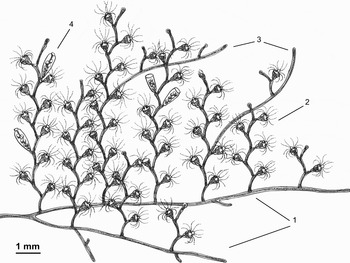
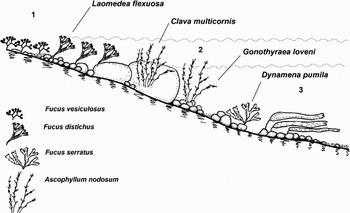
At the White Sea the colonial hydroid Laomedea flexuosa (Alder, 1857) (Figure 1) inhabits a narrow belt only 20–25 cm high along the lower edge of the intertidal zone. Colonies of L. flexuosa cover thallae of the seaweeds Ascophyllum nodosum, Fucus vesiculosus and Fucus distichus—typical inhabitants of the lower tidal zone (Figure 2). What are the reasons for so precise a restriction of spatial habitat in L. flexuosa? Why do colonies of L. flexuosa not inhabit the sublittoral zone?
Fragment of a colony of Laomedea flexuosa. (1) Stolons; (2) stems; (3) unattached stolons; (4) gonothecae.

In the White Sea the colonial hydroid Laomedea flexuosa inhabits a narrow belt along the border between the middle and lower littoral zones. (1) Zone of neap tide; (2) zone of lowest tide; (3) sublittoral.

We have not found answers to these questions in the literature. At the same time the strong preference of a species for a particular biotope affords an opportunity to understand its spatial differentiation and to find a key to its ecological distinctiveness. We tried first to determine ecological characteristics of several closely related species among hydroids of the family Campanulariidae including L. flexuosa by studying: (1) features of functional morphology (Marfenin, Reference Marfenin1993a) including the resistance of colonial stems to water flow (Marfenin & Malutin, Reference Marfenin and Malutin1994); (2) the spectrum of food (Marfenin & Homenko, Reference Marfenin, Homenko, Koltun, Marfenin and Stepaniantz1989); and (3) feeding behaviour (Marfenin, Reference Marfenin1981). We found that stems of L. flexuosa have a resistance intermediate between more flexible stems of Obelia longissima and Gonothyraea loveni and less flexible stems of O. geniculata and Dynamena pumila, which could more effectively resist currents. It appeared that the spectrum of food items taken by L. flexuosa is a little wider than in other hydroids from the same biotope. Due to the large sizes of its hydranths and hydrothecae this species is able to catch prey exceeding 1 mm, including planktonic and also some benthic organisms. These investigations, however, appeared insufficient to explain the main determinants of habitat for given species. It seemed that the answer could be found by studying attachment of planulae and especially their choice of substratum. The study of taxa in the planulae of several species of hydroids from the Campanulariidae including L. flexuosa and also the reactions of planulae to specific substratum features (Orlov et al., Reference Orlov, Marfenin and Railkin1994; Orlov, Reference Orlov1996) produced interesting results. Given a choice of substratum some preference for algae was found. Among these were Ascophyllum nodosum and Fucus distichus, which are the preferred substrates for L. flexuosa, but also certain algae never found in the tidal zone. Data about functional morphology, feeding, colony structure and growth, fertilization and so on were not sufficient to account for the restriction of L. flexuosa colonies to a narrow belt along the lower border of the littoral zone.
To understand better the adaptive value of certain aspects of reproductive behaviour whose details might explain the spatial distribution of this species, we decided to study: (1) the time of liberation of planulae from gonothecae in relation to the tidal cycle; (2) the duration of the free swimming phase before settlement; and (3) the behaviour of planulae before they settled.
New data for L. flexuosa reveal synchronization of the release of larvae, and clarify ethological mechanisms which produce a strongly localized distribution.
MATERIALS AND METHODS
Laomedea flexuosa (Alder, 1857) belongs to the family Campanulariidae of the order Thecaphora. Colonies include creeping rectilinear stolons and poorly ramified sympodial uprights. In the White Sea they are inactive during the greater part of the year, being without hydranths and in growth diapause. Growth of a colony is renewed only during May or even at the beginning of June. Sexual zooids or gonangia (a blastostyle within a gonotheca) are formed on stems (upright stocks) at the end of July. The formation of a gonangium takes place over 3–4 days. Inside the gonangia sexual products mature in spherical gonophores, as sexual reproduction by-passes a jellyfish stage. Each gonotheca has 10 to 12 gonophores. At its distal end a mature gonophore is displaced closer to the opening of the gonotheca (Figure 3).
Five stages (I–V) of planulae developing in the gonotheca of Laomedea flexuosa. (1) Blastostyle; (2) sporosacs; (3) planulae; (4) empty gonothecae.

Three simple methods were used to record tidal-dependent dynamics of planula release: (1) plankton collecting bags around Fucus distichus macrophytes with mature hydroid colonies; (2) active stirring of Fucus distichus with hydroids in a container of seawater, which is an old way to stimulate the release of planulae; and (3) direct counts of mature planulae in gonangia. Brief descriptions of methods precede results reported below.
The first method: plankton ‘traps’ were a cone-shaped net similar to that used for collecting plankton samples but without a collector. Traps were fixed on a seaweed with hydroid colonies. We chose for research fronds of Fucus distichus 15 × 2 cm densely covered by L. flexuosa colonies. The number of liberated planulae was determined at three phases of the tidal cycle: (a) from the time of drainage ended to the beginning of flood tide (duration about 1.5–2 hours); (b) from the beginning of flood tide up to high water (4–4.5 hours); and (c) from high water to the beginning of drainage (3–4 hours).
The second method: selected fronds of the seaweed F. distichus with mature colonies of L. flexuosa were attached to cords 2–2.5 m long with small buoys. The seaweeds with colonies of L. flexuosa were cautiously lifted from the bottom four times during a tidal cycle, placed in a container with seawater and shaken up for several minutes, and the planulae were then collected. The collection of planulae was carried out: (1) just after drainage ended at low water; (2) then just after the tide had turned when incoming seawater was flooding the littoral; (3) at high water; and (4) at the beginning of ebb, sampling the zone of the lower littoral.
The third method: four fragments of F. distichus thallus with colonies L. flexuosa were collected three times during a tidal-cycle (at low water, high water and at the beginning of ebb-tide) and were fixed in 4% formaldehyde. Then at the laboratory 20 stems of L. flexuosa were removed from each thallus. Each stem bore from 9 to 15 gonothecae with gonophores at different stages of maturity (Figure 3). Gonothecae were conditionally divided into 5 categories according to stages of maturing and releasing of planulae from gonothecae, namely: (I) oval and transparent embryos; (II) embryos are rounded form, large, and homogeneous white colour; (III) embryos pear-shaped or lengthened oval shape, dark colour; (IV) embryos strongly lengthened, the cylindrical form; mature planulae; and (V) an empty gonotheca.
In total 80 stems were examined for each of three phases of a tidal cycle; each sample contained about a thousand gonothecae (gonangia). By dividing the gonangia into three groups (with mature gonophores, or with planulae, or already empty), it is possible to reveal the periods of synchronous clearing of mature planulae from the gonothecae.
How far away from mother colonies are L. flexuosa planulae distributed? What is the strategy of this species for ecological expansion? Looking answers to these questions we counted the number of nearby attached planulae (young colonies) around a site with many L. flexuosa colonies by using a transect method. Pieces of Fucus were collected along twenty transects perpendicular to the shore line, and five transects parallel to it. The transects were spaced 1 m apart. Along each transect four identical pieces of Fucus distichus (15 cm2) were taken at 5 sites 0.5 m apart, altogether 20 pieces per transect. Then the number of young colonies was counted on each fragment of Fucus.
We carried out pilot experiments in the laboratory on the intensity of settlement by planulae of L. flexuosa on glass slides inclined at different angles to the horizontal plane. We next used small glass containers with vertical or sloping lateral walls in which were placed fragments of clean algae (F. distichus). The algae were set in three positions in three containers: horizontal, vertical and at an angle to the horizontal (from 30° to 60°). Twenty planulae were placed in each of these containers. We recorded for 3 days the percentage of planulae which left a gonotheca and attached to this substratum. After 3 days 36 planulae were attached to a horizontal thallus and 24 on a sloping thallus and none on a vertical one. Parallel experiments were carried out with planulae of Clava multicornis (Clavidae: Athecata) and Dynamena pumila (Sertulariidae: Thecaphora).
RESULTS
The behaviour of planulae during liberation from gonothecae and settlement
Two to three mature planulae 0.7–0.9 mm in length accumulate near the distal part of the gonangium. They are located without order, but they always leave the gonotheca distal end first. The interval between mature planulae leaving one after another is on average less than a minute. Free planulae move in a Petri dish with water at a speed of 0.3–0.5 mm/sec. The majority settle passively on a substratum immediately. Planulae move around slowly and find a suitable place within a few hours (on average 20–30 minutes) and attach to the substratum by their distal end. Hydranth formation takes a day. After 3–6 hours planulae which do not attach lose the ability to metamorphose.
Output of planulae from gonangia at different stages of the tidal cycle
We have found that the output of planulae from gonangia occurs in phases and most intensively during low water. This result was obtained by all three methods described.
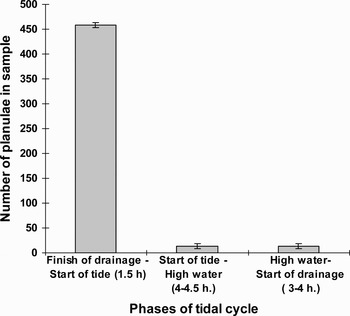
The greatest concentration of planulae in plankton ‘traps’ appeared when drainage of the tidal zone ended: up to 95% of the planulae leave the gonothecae at low water. In counts 1.5–2 hours after the beginning of flood tide the number of planulae in ‘plankton traps’ was significantly smaller (Figure 4).
Number of planulae collected in ‘plankton traps’ during the phases of a tidal cycle. Duration of sampling 1.5 hours at low tide, and 3–4.5 hours at two other phases. Averages for 20 samples.

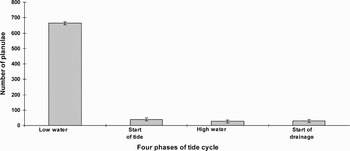
Similar results were obtained by shaking fronds of Fucus bearing hydroids in a container of seawater. The majority of planulae (87.4%) were released at the end of ebb-tide (Figure 5).
Number of planulae collected by stirring samples of Fucus fronds in seawater. Fronds were collected at different phases of the tidal cycle. Averages for 35 samples.

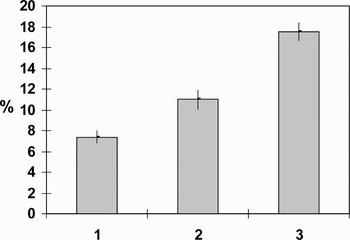
A counting of gonophores in gonangia according to their degree of maturity (third method) gave the same results. The proportion of planulae ready to leave the gonothecae (stages of maturity Numbers III and IV) is highest in stems of L. flexuosa at the time of low tide (30.7%). At high water it is reduced (11.2%), and increases up to the beginning of ebb tide (24.5%) (Figure 6).
Percentage of gonothecae with IV and V stages of planulae maturation sampled at three phases of a tidal cycle: (1) high tide; (2) beginning of falling tide; (3) end of low tide.

Spatial distribution of attached planulae in the tidal zone
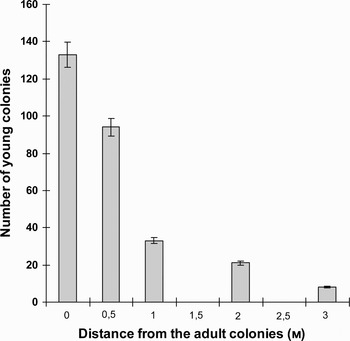
It appears that planulae of L. flexuosa settle mainly in the area where adult colonies of the same species are concentrated. The greatest numbers of primary stems are found in the same place as adult colonies. As the distance from them increased we observed a significant reduction in the density of attached planulae on Fucus fronds and even 3 m away from the mother population the young stems were found only as sporadic units (Figure 7).
Number of young colonies of Laomedea flexuosa per 15 cm2 on the surface of a Fucus thallus according to their distance from the location of the nearest mature colonies.

Settlement of planulae on horizontal and inclined surfaces
In the tidal zone the fronds of macrophytes covered with colonial hydroids are oriented to the sea bottom at different angles according to the stage of the tidal cycle. During low tide, algae lie mainly horizontal, and as the water level goes up their orientation becomes vertical. Hydroid planulae probably have some negative or positive geotaxis which determines their behaviour after release from a gonotheca, and they search for optimal attachment sites on substrates whose inclination changes tidally.
In the experiment investigating settlement on horizontal and inclined surfaces, planulae of C. multicornis preferred to settle on a sloping substratum (68%), but a quarter of them (26%) attached to a vertical thallus. Using planulae of D. pumila for the same experiment 55% were found attached to the horizontal substratum, 36% to the sloping one, and only 9% to a vertical one.
DISCUSSION
What factors determine distribution of a species within a given habitat, and the differentiation of ecological niches between similar species?
Most investigations of settlement focus on the final stages of larval life, when it is choosing a place for attachment. Correlations between the time of larval release and different environmental factors defining the ecological niche of a species have been insufficiently documented. It is well known that the larvae of numerous marine invertebrates are released during a fixed period of the year determined by natural cycles. The period of spawning is explained as an adaptation of the life cycle to the short seasonal period optimal for successful growth of a given species and its future reproduction (Grigg, Reference Grigg1977; Glynn et al., Reference Glynn, Gassman, Eakin, Cortes, Smith and Guzman1991).
Moreover, release of larvae is connected to regular events which occur during the reproductive season such as light intensity, ebb-tide and lunar phases (see, for example, reviews by DeCoursey, Reference DeCoursey, Vernberg and Vernberg1983; Neumann, Reference Neumann1985). In the case of mass spawning the synchronization of larval release with natural events is usually explained as a benefit from the reduction of larval death rate. There are few examples of the spatial distribution of species into a local microbiotope being determined by limitation of the period of larval spawning.
However, few data are available concerning the correlation of spawning of marine invertebrate larvae with phases of a tidal cycle. It is known that some species of littoral and semi-terrestrial crabs spawn larvae during high water (Saigusa, Reference Saigusa1981, Reference Saigusa1982; Salmon et al., Reference Salmon, Seiple and Morgan1986; Morgan & Christy, Reference Morgan and Christy1994, Reference Morgan and Christy1995), also that oysters can spawn larvae at the beginning of tidal flow which allows a new generation of oysters to stay near the shoreline instead of being carried away (Goulletquer & Heral, Reference Goulletquer and Heral1997).
Other papers contain information on the dependence of larval spawning on such factors as circadian rhythm (DeCoursey, Reference DeCoursey, Vernberg and Vernberg1983), intensity of illumination (Keough & Downes, Reference Keough and Downes1982; Olson, Reference Olson1983; Hurlbut, 1993; Morgan & Christy, Reference Morgan and Christy1994, Reference Morgan and Christy1995; Morgan, Reference Morgan and McEdward1995), phases of the moon (Korrinda, Reference Korrinda1947; Christy, Reference Christy1982; Saigusa & Hidaka, Reference Saigusa and Hidaka1978; Salmon et al., Reference Salmon, Seiple and Morgan1986).
Much more is known about the settlement of marine invertebrate larvae. The following environmental factors play an important role in this process: positive and negative phototaxis (Williams, Reference Williams1965; Burykin & Marfenin, Reference Burykin, Marfenin and Starostin1978; Aldrich, Reference Aldrich1980; Orlov, Reference Orlov1996); geotaxis (Orlov & Marfenin, Reference Orlov, Marfenin and Stepanijanz1995); the attractive influence of bacterial films covering a substratum (Orlov et al., Reference Orlov, Marfenin and Railkin1994; Railkin, Reference Railkin and Stepanijanz1995, Reference Railkin2004); and the influence of exometabolites of seaweed which causes complex behavioural reactions in hydroid planulae (Steinberg, Reference Steinberg1985).
In corals it was shown that the larva spawn can be caused by a combination of factors, for example a lunar cycle and sunset together, lunar cycle and increase of water level (Dahan & Benayahu, Reference Dahan and Benayahu1997; Slattery et al., Reference Slattery, Hines, Starmer and Paul1999).
In the case of L. flexuosa we found some regularity in behaviour and some positive or negative correlation of planula settlement with bacterial films, with exometabolites of seaweed, speed of flow, and an indifferent reaction to intensity of illumination (Orlov & Marfenin, Reference Orlov, Marfenin and Stepanijanz1995).
But these facts could not explain the habitat of L. flexuosa as a narrow belt within the littoral zone. New data presented here clarify possible determinants of planula settlement near the mother colonies.
Large planulae of L. flexuosa released from gonothecae of the parent colony fall passively onto a substratum (macrophyte fronds, stones or the bottom of a Petri dish) and then start to move on its surface screening a place for attachment. Orlov (Reference Orlov1994) described earlier how movement of planulae upon the substratum surface is limited by the speed of water flow, which should be less than 4 mm/second. Metamorphosis of planulae of L. flexuosa is successful therefore only in quiet motionless water. From our present data attachment of planulae onto a substratum occurs intensively during a short period of 20–40 minutes. Planulae of the related species Gonothyraea loveni, which inhabits the White Sea in shallow water, undergo metamorphosis and attachment to the substratum only 20–40 hours after release. For the first few hours these planulae are not able to attach (Orlov & Marfenin, Reference Orlov, Marfenin and Stepanijanz1995). In other species of hydroids the time for attachment of planulae may be as long as 20 days (Sommer, Reference Sommer1992).
The accelerated settlement of planulae could have another explanation. In laboratory experiments we find that planulae of L. flexuosa do not attach on a vertically oriented surface, but they will attach on the similar substratum either flat on the bottom of the Petri dish or inclined at an angle to the horizontal. This feature distinguishes their behaviour from similar planulae of other species of hydroids such as Gonothyraea loveni and Dynamena pumila. Therefore, planulae of L. flexuosa attach more easily to fronds of Fucus and Ascophyllum while they are lying on the bottom during a low tide than in the rest of the tide cycle when inflow causes the fronds to rise until they remain vertical.
We find by using ‘traps’ in the natural habitat that 94.4% of the planulae leave gonangia just after low water when the tide turns (Figure 4). These data were confirmed by two other methods described above, including a direct count of mature planulae in gonangia. Hence a great number of planulae of L. flexuosa leaving gonangia during the beginning of tidal inflow are dragged into the littoral zone due to the unidirectional water flow. Laomedea flexuosa is thus kept in a narrow belt along the border between littoral and sublittoral zones, where it avoids interspecies competition.
The drift of planulae into the open sea is impeded by slow current speeds during the initial stage of a tide and by the dense growth of fucoids. After leaving the parent colony planulae are caught in the drainage space between fronds of algae, to which they may attach during a short period of quiet water. The most available substrates for settlement of planulae and growth of L. flexuosa are younger fronds of the same alga nearby. Examination of fucoids has shown that if one-year colonies occupy the third internode of a thallus (counting from the tip), most of the planulae settle on the second internode and they are never attached to the first one. Branches of Fucus grow one internode in one year, which gives hydroids the opportunity to occupy the clean surfaces of two year-old algae. The surface of fucoids is attractive to planulae of L. flexuosa (experiments of Orlov (Reference Orlov1994)). Planulae of L. flexuosa do not settle far from the parent colony.
When under water, algae never form the dense ‘mat’ seen in littoral fucoids exposed during low tide. For L. flexuosa planulae it is much more difficult to attach to a hard substratum in moving water than still water. On the other hand colonies living on fucoids find the best conditions for feeding when the algae take up a vertical position during the ebb-tide, when the hydroids are in flowing seawater and catching zooplankton.
Morphological features of L. flexuosa stems correspond to life in a littoral zone that undergoes regular tidal drainage. This species has a much thicker and more rigid perisarc compared to the related species G. loveni, so upright parts of the colonies more effectively resist pressure from the surface water film which flattens them during drainage. Infrequent branching of the stems favours a dense micromat of hydroids which retains seawater during low tide and protects the colonies from getting too dry (Marfenin, Reference Marfenin1993b). By being adapted to living within the intertidal zone L. flexuosa gains the trophic advantages of closeness to a water surface rich in small zooplankton, chiefly the larvae of numerous species of marine invertebrates, the best food for hydroids. As this species settles above the low water mark it avoids strong interspecific competition and inhabits a fairly stable long-term substrate.
Features of larval spawning typical for L. flexuosa bring about the limited vertical distribution of this species in the White Sea. The short free-swimming period and the association of spawning with a tidal phase of quiet water would prevent the wide horizontal distribution of larvae. How then is the broad geographical distribution of L. flexuosa achieved? Most probably the distribution of the hydroid over significant distances occurs after storms by means of fragments of algae (Fucus and Ascophyllum) or by normal breakdown of fronds 5 to 7 years old.
Water temperature is another important factor in determining the specific ecotope of L. flexuosa. During the summer, water covering the littoral zone periodically is warmer than the nearest surface water layer by 1–3°C. Inhabiting this area, the hydroid L. flexuosa, which comes into the White Sea from the North Sea, is able to undergo sexual reproduction. Gametogenesis and embryogenesis in L. flexuosa can proceed due to littoral temperatures above 14–15°C, the maximum for surface layer water in July and August. Most probably the specific ecotope of L. flexuosa in the White Sea is a result of adaptation to living in marginal environmental conditions. Naumov (Reference Naumov1960) has considered this species as a strongly intertidal one. His knowledge is based on investigation of mainly Arctic and far-east fauna. According to Cornelius (Reference Cornelius1995) ‘L. fexuosa is distributed ‘common intertidally and to 40 m depth offshore, with occasional records to 100 m’ (p. 282). Whether the colonies from sublittoral location have been fertile, viz they bore gonotheca with mature gonophores, it is not clear. Possibly the sublittoral population of L. flexuosa, or at least some of them are infertile. At the White Sea L. flexuosa restart growth after the winter diapauses much more later than the closely related species Obelia longissima and Gonothyraea loveni. If the reproduction season of O. longissima begins in the White Sea in May and finishes in June, and the reproduction of G. loveni starts in June and finishes in July, the reproduction of L. flexuosa starts in July and finishes in August during the warmest period of year. The surface water temperature range during the reproduction season of L. flexuosa is 12–16°C. But the temperature of the off-water intertidal zone bottom may be at the same place of habitat much higher: up to 20°C, and even occasionally 30°C (I.V. Bourkovskii, unpublished data). Unfortunately, no experimental data of a temperature preference and a temperature range of sexual reproduction concerning L. flexuosa are available.
The association of larval spawning with periodic events in the environment opens new prospects for understanding the adaptive specializations of species to spatially limited biotopes. Free-living larvae for many species of marine invertebrates characterized by a mosaic type of distribution have not yet been found. One reason for this could be the impact of spawning of larvae, and a very short free-swimming term before settlement. That mechanism for ensuring distribution after reproduction allows populations to be maintained on small favourable biotopes. Environmental factors responsible for synchronization of the release of larvae are less important.
CONCLUSIONS
1. In the White Sea the colonial hydroid Laomedea flexuosa inhabits a narrow belt of the lower littoral zone which occupies only the lowest 25 cm of the tidal range.
2. Timing of general release of larvae is correlated with the period of low water. By following the incoming tide planulae stay in the littoral area.
3. The planulae of L. flexuosa have a short period of swimming (less than 1/2 hour), unlike those of Gonothyraea loveni and Dynamena pumila whose swimming period is about 36 hours.
4. Tidal planula release and quick settlement could explain the restricted spatial distribution of L. flexuosa within the lower intertidal zone.
5. As a result of the described reproduction adaptation to tidal cycles this species can reproduce sexually during summer into the warmest conditions of the White Sea biotope where the temperature is 1–3°C higher than that of the surface water mass. Most probably the specific ecotope of L. flexuosa in the White Sea is a result of adaptation to a severe environment.
ACKNOWLEDGEMENTS
We acknowledge the Russian Foundation of Fundamental Researches for support by grants No. 98-04-49342-a and No. 07-04-00736-a. The authors are grateful to Dr Elaine Robson for critical reading and English language correction of the manuscript, Dr Keith Hiscock for consultation during a study of hydroids at Plymouth and Mrs Irina Semenuk for redrawing figures 1 and 3.