Introduction
The increasing prevalence of allergic disease is a matter of public health concern, especially in developed countries.Reference Owaga, Mpondab and Nyang'injac 1 Treatment is costly and long-term treatment can lead to complications. This has prompted investigations into complementary or alternative dietary methods to prevent or improve clinical symptoms.Reference Srivastava, Singh, Dubey, Misra and Khar 2
Allergic rhinitis is a symptomatic disorder of the nose induced by allergen exposure, which triggers immunoglobulin E (IgE)-mediated inflammation of the nasal membranes.Reference Bousquet, Van Cauwenberge and Khaltaev 3 It affects 10–30 per cent of the population, principally children and adolescents.Reference Sih and Mion 4 In an atopic individual, prolonged exposure to indoor and/or outdoor allergens may initiate allergen-specific IgE production. Re-exposure triggers a cascade of events (including early- and late-phase responses) that culminate in allergic rhinitis symptoms. The early-phase response develops within minutes of re-exposure to the offending allergen and is characterised by sudden sneezing, nasal itching, nasal congestion and rhinorrhea.Reference Vinke, KleinJan, Severijnen, Hoeve and Fokkens 5
Curcumin (diferuloylmethane) is a promising antiallergic dietary agent that may be useful in the clinical management of allergic disorders. Curcumin has a wide spectrum of biological and pharmacological effects, exhibiting anti-inflammatory, antioxidant, antimicrobial, antihepatotoxic, hypolipidaemic and anticancer properties.Reference Srivastava, Singh, Dubey, Misra and Khar 2 The several hydroxyl groups present in the molecule contribute to its antioxidant and antiallergic activities.Reference Kurup and Barrios 6
The biological activities of curcumin include regulating histamine release during degranulation; inducing changes in cytokine, eosinophil and inducible nitric oxide synthase levels; activating mast cell activation; and regulating expression of the chymase II protease and Syk kinase.Reference Owaga, Mpondab and Nyang'injac 1 Curcumin regulates biological processes via post-translational mechanisms that include suppressing Syk-dependent phosphorylation of the linker of activated T cells (‘LAT’) and Grb2-associated binder 2 adaptor proteins, Akt, the p44, p42 (extracellular signal-regulated kinases 1 and 2) and p38 mitogen-activated protein kinases, and c-Jun N-terminal kinase. Curcumin inhibits transcription factors to downregulate the transcription of genes encoding tumour necrosis factor alpha and tryptase.Reference Owaga, Mpondab and Nyang'injac 1
The present study explored the effects of curcumin on experimental allergic rhinitis in rats.
Materials and methods
This study was performed at the Faculty of Medicine of Eskisehir Osmangazi University. Animal adaptation and care, and all experimental work, were undertaken at TICAM (the Experimental Studies Center of Eskisehir Osmangazi University). During both the adaptation and experimental periods, all animals were treated in compliance with the principles of the Declaration of Helsinki.
Animals
Twenty-four healthy male albino Wistar male rats weighing 190–220 g were used for all experiments. The experimental protocol was approved by the Ethics Committee of the Center of Medical and Surgical Experiments, Osmangazi University. Rats were housed in a temperature- and humidity-controlled environment (20 ± 1 °C, 50 ± 10 per cent relative humidity) under a 14:16 hour light:dark cycle. Tap water and standard pelleted food were provided ad libitum.
Experimental design
The 28 Wistar rats were randomly divided into 4 groups of 7 rats: a control group, comprising healthy rats; an untreated group, in which allergic rhinitis was induced and no treatment was given; an azelastine treatment group, in which allergic rhinitis was induced and azelastine hydrochloride (1 mg/ml; an antihistamine; Allergodil nasal spray, Meda Pharma, Cologne, Germany) was administered on days 21–28; and a curcumin treatment group, in which allergic rhinitis was induced and curcumin (Sigma Aldrich, Saint Louis, Missouri, USA) was given on days 21–28.
Rat model of allergic rhinitis: sensitisation
All rats except for controls were sensitised with an intraperitoneal injection of ovalbumin (100 µg/animal) and aluminium hydroxide (5 mg/animal) in 0.9 per cent (weight per volume) saline on days 1, 3, 5, 7, 9, 11 and 13 (a total of seven injections). From day 14 onward, animals underwent daily topical intranasal instillation with 50 µl of 2 per cent ovalbumin in saline (weight per volume) for 14 days (25 µl into each nostril).Reference Bozdemir, Şahin, Altintoprak, Muluk, Cengiz and Acar 7 – Reference Tsumuro, Ogawa, Minami, Takubo, Rahman and Fujii 10
Immunoglobulin E measurement
On day 28, total serum IgE levels were measured in all rats. For this, 1 µl blood samples were centrifuged for 20 min at 3,000 rpm and supernatants were stored at −20 °C until analysis. Serum IgE levels were determined using a commercial rat IgE enzyme-linked immunosorbent assay kit (SunReed Biotechnology, Shanghai, China) according to the manufacturer's instructions. Results are expressed as kU/l.
Scoring of allergic rhinitis symptoms
The numbers of episodes of sneezing, nose rubbing, eye lacrimation and difficulty in breathing (caused by nasal congestion) were observed over a 30-minute period by a researcher (MA) who was not blinded to the treatment. This prevented the objective evaluation of allergic rhinitis symptoms. Sneezing was defined as an explosive expiration just after deep inspiration and was scored on a 0–3 scale.Reference Mizutani, Nabe, Takenaka and Kohno 11 Nose rubbing was defined as external perinasal scratching with one or both forelimbs and was scored on a 0–3 scale.Reference Mizutani, Nabe, Takenaka and Kohno 11 Eye lacrimation was scored as: 0, no lacrimation; 1, hazy eyes; 2, lacrimation; and 3, lacrimation with onset of conjunctivitis.Reference Brozmanová, Calkovský, Plevková, Bartos, Plank and Tatár 12 Nasal congestion or obstruction was scored as: 0, no obstruction; 1, mild breathing impairment; 2, moderate breathing impairment; and 3, severe breathing impairment.
Treatments
Rats in the azelastine treatment group received azelastine hydrochloride (one drop containing 0.14 mg azelastine HCl in each nostril / once daily) once daily on days 21–28 inclusive. Rats in the curcumin treatment group received 4 mg curcumin dissolved in distilled water (200 mg/ml solution; 20 µl per nostril) twice daily on days 21–28. For both groups, drops were given 1 hour before intranasal ovalbumin.
Histological analysis
Rats were euthanised with high-dose pentobarbital on day 28, and samples of nasal mucosa were excised, cut into 5-μm thick sections, transferred to adhesive slides, dried overnight at 37 °C and then at 60 °C for 20 minutes, and deparaffinised by immersion in xylene twice for 10 minutes. After dehydration in a series of ethanol baths of ascending concentrations (70, 80, 96 and 100 per cent), tissue samples were cleared in xylene, embedded in paraffin and stained with hematoxylin and eosin and Giemsa. A minimum of 10 fields per sample were scored by an observer blinded to treatment for the severity of changes in vascular congestion, ciliary loss, increased goblet cell numbers, inflammation, plasma cell infiltration, chondrocyte hypertrophy and eosinophil and mast cell infiltration as: 0, none; 1, mild; 2, moderate; or 3, severe.Reference Tirkey, Kaur, Vij and Chopra 13 , Reference Bahekar, Shah, Ayer, Mandhane and Thennati 14 A light microscope (Entella Olympus BH-2) was used for scoring and photographs were taken using an Olympus DP-70 digital camera.
Statistical analysis
SPSS for Windows, Version 16.0 (SPSS Inc, Chicago, Illinois, USA) was used for all statistical analyses. Kruskal–Wallis variance analysis was used to identify significant differences among all four treatment groups. The Mann–Whitney U test with Bonferroni correction was then used to identify which variable was responsible for the difference. A p value of less than 0.05 was considered statistically significant. If Bonferroni adjustment was performed, a p adjusted value of less than 0.0125 was considered statistically significant.
Results
Total serum IgE levels were 1656.4 kU/l in the control group, 2563.9 kU/l in the untreated allergic rhinitis group, 1223.8kU/l in the azelastine treatment group and 1804.5 kU/l in the curcumin treatment group. Pairwise comparisons showed that the total IgE level in untreated rats was significantly higher than in controls and treated groups (p adjusted < 0.0125).
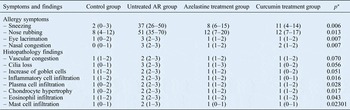
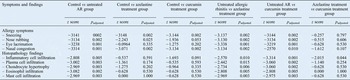
Allergy symptoms and histopathological data for all experimental groups are shown in Table I. There were significant differences among groups for each allergy symptom (sneezing, nose rubbing, eye lacrimation and nasal congestion; p < 0.05). Pairwise comparisons showed that for sneezing, nose rubbing, eye lacrimation and nasal congestion, values were significantly higher for the untreated allergic rhinitis group than for the control, azelastine treatment and curcumin treatment groups (p adjusted < 0.0125). Moreover, sneezing and nasal congestion scores were significantly higher for the azelastine treatment and curcumin treatment groups than for controls (p adjusted < 0.0125). There was no difference in the severity of these four symptoms between the azelastine and curcumin treatment groups (p adjusted > 0.0125; Table II).
Allergy symptoms and histopathological findings for all experimental groups

n = 7 for all groups. *As determined by Kruskal–Wallis variance analysis. AR = allergic rhinitis
Pairwise comparisons between groups

A p adjusted value of less than 0.0125 was considered statistically significant. AR = allergic rhinitis; p adjusted = the p value for the Mann–Whitney U test after Bonferroni adjustment
Kruskal–Wallis variance analysis of histopathological data showed a significant difference in inflammatory and plasma cell numbers, eosinophil and mast cell infiltration, and chondrocyte hypertrophy among groups (p < 0.05). In contrast, there were no significant differences among groups in vascular congestion, ciliary loss or increase in goblet cell numbers (p > 0.05).
Pairwise comparisons showed significantly more inflammatory and plasma cells, eosinophil and mast cell infiltration, and chondrocyte hypertrophy in the untreated allergic rhinitis group than in all other experimental groups (p adjusted < 0.0125). Plasma cell infiltration was significantly higher in the untreated group than in the control and curcumin treatment groups (p adjusted < 0.0125), but there was no significant difference between untreated and azelastine-treated rats (p adjusted > 0.0125; Table II). For the other five items, no significant differences were identified between the control and azelastine treatment groups, the control and curcumin treatment groups, or the azelastine and curcumin treatment groups (p adjusted < 0.0125; Table II).
Histopathological findings
The nasal mucosa of control rats was normal (Figure 1a,b). In untreated rats with allergic rhinitis, an intense inflammatory cell infiltrate comprising eosinophils, polymorphonuclear leukocytes, plasma cells, neutrophils and lymphocytes was evident, as well as vascular proliferation in the lamina propria (Figure 1c) and diffuse goblet cell metaplasia of the nasal mucosa epithelium (Figure 1d). In the azelastine treatment group, focal goblet cell metaplasia was evident on the surface of the respiratory epithelium, along with reduced inflammatory cell infiltration. Minimal mast cell infiltration into, and vascular proliferation of, the lamina propria was evident (Figure 1e,f). In the curcumin treatment group, goblet cell metaplasia was reduced and inflammatory cell infiltration (eosinophils, polymorphonuclear leukocytes, plasma cells, neutrophils and lymphocytes) and vascular proliferation in the lamina propria were greatly reduced (Figure 1 g,h).
Photomicrographs showing histopathology findings for all experimental groups. (a) H&E & (b) Giemsa staining of normal nasal mucosa in the control group (×400). (c) & (d) Nasal mucosa of rats in the untreated allergic rhinitis group, showing (c) an intense inflammatory cell infiltrate consisting of eosinophils, polymorphonuclear leukocytes, plasma cells, neutrophils and lymphocytes, and vascular proliferation in the lamina propria (H&E; ×400) and (d) diffuse goblet cell epithelial metaplasia (Giemsa; ×400). (e) & (f) Nasal mucosa of rats in the azelastine treatment group, showing (e) focal goblet cell metaplasia on the surface of the respiratory epithelium, a reduced level of inflammatory cell infiltration into the lamina propria (H&E; ×400) and (f) only a few mast cells and slight vascular proliferation in the lamina propria (Giemsa; ×400). (g) & (h) The nasal mucosa of rats in the curcumin treatment group, showing (g) mild, confined inflammatory cell infiltration (eosinophils, polymorphonuclear leukocytes, plasma cells, neutrophils and lymphocytes) and minimal vascular proliferation in the lamina propria (H&E; ×400) and (h) reduced goblet cell epithelial metaplasia and inflammatory cell infiltration into, and vascular congestion within, the lamina propria (Giemsa; ×400).

Discussion
Curcumin has attracted increasing interest in recent years for its beneficial effects in experimental studies of acute and chronic diseases characterised by an exaggerated inflammatory reaction.Reference Bengmark 15 Curcumin is a yellow natural polyphenolic pigment isolated from the rhizomes of Curcuma longa L. (turmeric) that inhibits antigen-mediated activation of mast cells, IgE production, airway inflammation and passive cutaneous anaphylaxis in animal models of allergy.Reference Owaga, Mpondab and Nyang'injac 1
Curcumin modulates cellular signalling pathways and inhibits cyclooxygenase-2 and inducible nitric oxide synthase activity, arachidonic acid metabolism, and the activities of certain hormones, growth factors and oncogenes.Reference Surh, Chun, Cha, Han, Keum and Park 16 Curcumin inhibits lipoxygenases and leukotrienes such as leukotriene B4 and 5-hydroxyeicosatetraenoic acid.Reference Wallace 17 Curcumin intercepts and neutralises potent pro-oxidants and carcinogens, reactive oxygen species (e.g. superoxide, peroxyl and hydroxyl radicals), and nitric oxide and peroxynitrite.Reference Jovanovic, Boone, Steenken, Trinoga and Kaskey 18 Curcumin may also be effective in modulating type 1 T helper cell mediated immune diseases.Reference Bengmark 15 , Reference Kang, Song, Kim, Choe, Hwang and Kim 19
Cyclooxygenases are responsible for catalysing prostaglandin synthesis. Cyclooxygenase-1 is constitutively expressed and is required for maintaining basic cellular functions; in contrast, the COX2 enzyme (cyclooxygenase-2) is inducible and the gene encoding cyclooxygenase-2 enzyme is barely detectable under normal physiological conditions. COX2 expression is rapidly but transiently induced early in the response to proinflammatory mediators and mitogenic stimuli such as cytokines, endotoxins, growth factors, oncogenes and phorbol esters. Cyclooxygenase-1 is responsible for protecting the mucosal surface, for maintaining renal function, and for platelet activation and stabilisation. Cyclooxygenase-2 synthesises the series 2 prostaglandins (prostaglandin E2 and prostaglandin F2 alpha), which are involved in inflammation, swelling and pain.Reference Bengmark 15 Prostaglandin E2 promotes the synthesis of interleukin-10, an immunosuppressive cytokine, and suppresses interleukin-12 synthesis.Reference Stolina, Sharma, Lin, Dohadwala, Gardner and Luo 20 Inducible nitric oxide synthase also has a pivotal role in inflammation: it is activated by nuclear factor κB and acts synergistically with cyclooxygenase-2 to promote inflammatory reactions.Reference Bengmark 15
Curcumin was recently reported to have antiasthmatic effects in guinea pigs sensitised with ovalbumin by significantly reducing both airway constriction and histamine hyper-reactivity.Reference Ram, Das and Ghosh 21 Curcumin binds to albumin via hydrophobic interactions and may be thus transported to target cells, where it exerts its pharmacological effects.Reference Pulla Reddy, Sudharshan, Appu Rao and Lokesh 22
Orally administered curcumin (at 50 mg/kg) is reported to suppress mast cell dependent IgE production and antigen-induced local passive cutaneous anaphylaxis.Reference Srivastava, Singh, Dubey, Misra and Khar 2 Curcumin reduces vascular permeability and suppresses transcriptomic, proteomic and/or metabolomic factors involved in inflammatory cells such as mast cell mediated degranulation and cytokine release.Reference Owaga, Mpondab and Nyang'injac 1 , Reference Choi, Yan, Chai and Song 23 In a mouse model of asthma, serum IgE levels were significantly reduced by curcumin.Reference Bengmark 15 In a guinea-pig model of allergy, curcumin prevented significant IgE elevation in nasal lavage fluid.Reference Thakare, Osama and Naik 24
In the present study, the effects of curcumin were investigated in a rat model of experimental allergic rhinitis. Scores for sneezing, nose rubbing, eye lacrimation and nasal congestion were higher in the untreated allergic rhinitis group than in all other experimental groups. Moreover, sneezing and nasal congestion were less severe in both treatment groups than in controls. Similarly, in a guinea-pig model of allergic rhinitis, curcumin also reduced allergy-related symptoms including sneezing, nose rubbing, lacrimation and nasal congestion, as well as inflammatory cell infiltration of the nasal mucosa.Reference Thakare, Osama and Naik 24 In the present study, allergy symptom scores were lower in the curcumin treatment group than in the untreated group.
Histopathological analysis showed no difference among groups in the extent of vascular congestion, ciliary loss and the increase in goblet cell numbers. Inflammatory cell numbers and the extent of eosinophil and mast cell infiltration and of chondrocyte hypertrophy were higher in the untreated allergic rhinitis group than in the other three groups. The level of plasma cell infiltration in the untreated group was higher than in the control and curcumin treatment groups, but there was no significant difference between the untreated allergic rhinitis and azelastine treatment groups. The latter five variables (inflammatory cell inflammation, plasma cell infiltration, chondrocyte hypertrophy, eosinophil infiltration and mast cell infiltration) did not differ significantly between the control and azelastine treatment groups, the control and curcumin treatment groups, and the azelastine and curcumin treatment groups.
In the mouse, curcumin is reported to inhibit antigen-mediated activation of mast cells and passive cutaneous anaphylaxis.Reference Baek, Kang, Choi, Choi, Kim and Nah 25 Choi et al. found that curcumin led to a dose-dependent reduction in vascular permeability changes triggered by compound 48/80 in a model of the anaphylactic response.Reference Choi, Yan, Chai and Song 23 Curcumin (at 10 and 100 μmol/l) inhibited tumour necrosis factor alpha secretion from HMC-1 human mast cells stimulated by trypsin or activating peptide.Reference Baek, Kang, Choi, Choi, Kim and Nah 25 Suppression of degranulation and stimulation of tumour necrosis factor alpha and interleukin-4 secretion by curcumin (at 3 μmol/l) have been demonstrated in both cultured mast cells and a mouse model of passive cutaneous anaphylaxis.Reference Lee, Kim, Ko, Mun, Her and Kim 26
In the present study, the nasal mucosa was normal in control rats. Rats in the untreated allergic rhinitis group exhibited diffuse epithelial goblet cell metaplasia; an intense inflammatory infiltrate comprising eosinophils, polymorphonuclear leukocytes, plasma cells, neutrophils and lymphocytes; and vascular proliferation in the lamina propria. In the azelastine treatment group, focal goblet cell metaplasia was evident on the epithelial surface, along with reduced inflammatory cell infiltration into the lamina propria, which also contained a few mast cells and exhibited minimal vascular proliferation. In the curcumin treatment group, epithelial goblet cell metaplasia was reduced, as were inflammatory cell infiltration into, and vascular proliferation within, the lamina propria.
Mast cell degranulation is a key step in the pathogenesis of IgE-mediated allergies.Reference Kalesnikoff and Galli 27 Histamine release, principally from mast cell granules, increases vascular permeability, which in turn causes fluid to escape from capillaries into tissues, creating allergy symptoms (runny nose and watery eyes).Reference Owaga, Mpondab and Nyang'injac 1 Choi et al. reported rat peritoneal mast cell pretreatment with curcumin (50–100 μmol/l) inhibited both degranulation and histamine release in a dose-dependent manner.Reference Choi, Yan, Chai and Song 23
-
• Curcumin is effective in treating experimentally induced allergic rhinitis in rats
-
• Goblet cell metaplasia was reduced by curcumin treatment
-
• Curcumin reduced inflammatory cell infiltration into the nasal mucosa
Thakare et al. reported that curcumin reduced interleukin-4 levels in nasal lavage fluid in a guinea-pig model of allergy.Reference Thakare, Osama and Naik 24 Curcumin also inhibited house dust mite induced lymphocyte proliferation and the production of interleukins 2, 4 and 5 and of granulocyte macrophage-colony stimulating factor in vivo.Reference Aggarwal and Harikumar 28
In the present study, curcumin reduced inflammatory cell infiltration into, and goblet cell metaplasia within, the nasal mucosa. The intensity and foci number for inflammatory cell infiltration were reduced after curcumin treatment. Similarly, goblet cell metaplasia became more focused and inflammatory cell infiltration of the lamina propria decreased after azelastine treatment.
Conclusion
Curcumin can effectively treat allergic rhinitis in a rat model system. Further research is required to determine whether this effect can be translated into a new allergic rhinitis therapy for humans.
Acknowledgements
Study design and planning and manuscript preparation were supported by the Continuous Education and Scientific Research Association, Turkey.