The Peruvian guano boom was an extraordinary phenomenon in nineteenth-century economic history. Guano had accumulated for centuries in large deposits on arid islands off the Peruvian coast. Beginning in the 1840s, Peru exported much of this guano to Europe and the United States, where it was used as a fertilizer. Such was the scale of the guano trade that it transformed Peru—a failed state with a record of fiscal irresponsibility—into a leading borrower in the London capital market. Peru accumulated a huge foreign debt because investors viewed its bonds as extremely low risk instruments. From 1849 to 1875 the country maintained a stellar record of debt service, and its bonds were among the most highly valued Latin American securities.
In this article, I examine how Peru was able to take advantage of the guano boom to transform itself in the eyes of creditors. I argue that the spectacular magnitude of the revenues that guano generated was perhaps necessary, but it was certainly not a sufficient condition for this transformation. The key factor was that Peru specifically pledged guano revenues to service its foreign debt, and that this pledge was credible to bondholders. In an era when such special pledges of security were common, but frequently violated, the credibility that guano gave to Peruvian paper is remarkable. Two circumstances were particularly important. Guano revenues were earned from exports, mostly to the United Kingdom, and the Peruvian government contracted with a British merchant house to manage the country's guano exports and simultaneously service its foreign debt with the proceeds. The geographic location was important because the collection of revenues was outside the jurisdiction of the Peruvian government. The employment of a respected British merchant house was equally important because an organization that had invested heavily to build its reputation in London would not forsake it for any temporary gain from colluding with the Peruvian government to defraud the bondholders.
The security of this commitment to repay is underscored by the fact that the price of Peruvian bonds was insensitive to the country's political instability. Peru, like many Latin American countries, was plagued by violence and warfare for decades following independence. During the twenty-five years corresponding to the height of the guano boom (1850–1875), there were fourteen changes in government, and ten of these changes followed a civil war or uprising. The fact that creditors lent so much to such an unstable country, and that bondholders would consistently value its debt highly, stands in stark contrast with the conventional wisdom that political instability hinders the expansion of credit.Footnote 1 In what follows, I explain why successive Peruvian governments found it in their interest to service the foreign debt, and why foreign creditors were indifferent to Peru's political woes. I begin by presenting evidence from financial markets on Peru's debt burden, and on the performance of Peruvian bonds during the guano boom. Then I describe how guano transformed the Peruvian economy and government finances, and explain Peru's motivation for settling its defaulted debt. Later I discuss why creditors willingly lent on such a large scale to Peru and Peru's incentives to faithfully service its debt. Lastly, I present statistical evidence in support of my arguments. I conclude with a discussion of the lessons of the Peruvian experience for the literature on sovereign debt.
BOND PRICES, 1830–1875

PERU AND THE LONDON CAPITAL MARKET, 1822–1890
The origin of Peru's foreign debt goes back to the 1820s, during its war for independence from Spain. Like many other revolutionary governments in Latin America, Peru floated bond issues in London to finance military expenses. Virtually all of these governments defaulted by 1826, with the exception of Brazil.Footnote 2 In the case of Peru, two loans were issued, one in 1822 for £1.2 million and another in 1825 for an additional £616,000. The government defaulted in 1826 and remained in default until 1849. During this time Peruvian paper traded at extremely low prices, often less than 20 percent of par (Figure 1).
In 1849 Peru reached an agreement with the bondholders to begin payments on the outstanding principal and to issue bonds for the accumulated interest. Under the scheme, the principal of the old loans was converted into new “active” bonds for a total of £1,759,100, 25 percent of the interest was written off, and the remainder of the accumulated interest (£1,854,700) was floated as “passive” bonds, which would not begin to pay interest until April 1852.Footnote 3 Peru adhered to the terms of the settlement, and starting in 1853 successive Peruvian governments accessed fresh loans for a variety of purposes—debt conversion, general expenses, war finance, and railway construction.
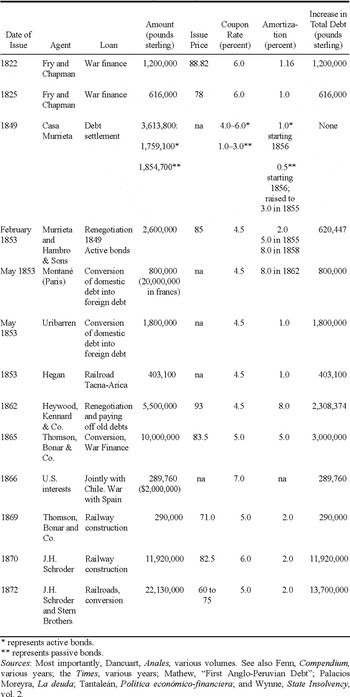
Table 1 presents all foreign bond issues floated by the Peruvian government in the nineteenth century, including the dates, amounts, issue prices, and interest rates. In 1853 Peru contracted for four separate loans, three in London and one in Paris. The largest of these loans effectively converted all active foreign bonds into a new series, reducing the interest rate from 6 percent to 4.5 percent. The other loans, also made at 4.5 percent, were earmarked for the conversion of the domestic debt. They greatly increased Peru's foreign debt, from approximately £3.5 million to over £7.5 million. Peru floated another large issue in 1862, about half of which was dedicated to paying off older bonds. Later during war with Spain in 1865, it was able to place a loan in Europe for £10 million and another in the United States in 1866 for a smaller amount. In the late 1860s Peru, like many other countries at the time, began a major campaign of railway construction. Three loans were issued that dramatically expanded its foreign debt from around £10 million to £33 million. Then, in December 1875 Peru defaulted on its entire foreign debt, and did not settle for nearly fifteen years, when railroads and other assets were placed in the hands of the bondholders through the creation of the Peruvian Corporation in 1890.Footnote 4 In sum, the Peruvian experience in foreign capital markets in the nineteenth century consisted of a twenty-five-year stretch of faithful debt service and frequent borrowing, both preceded and followed by decades of complete penury and default. The twenty-five years of solvency correspond to the height of the guano boom.
During this period, Peru's foreign debt was exceptional for two reasons. First, despite Peru's ongoing political instability and poor capital market reputation, the price of Peruvian bonds soared shortly after settlement in 1849, and the country enjoyed relatively low credit risk until the 1870s (Figure 1). Second, Peru accumulated a great deal of debt, becoming the largest solvent debtor in Latin America.
LOANS TO PERUVIAN GOVERNMENT (1822–1872)

* represents active bonds.
** represents passive bonds.
Sources:
Most importantly, Dancuart, Anales, various volumes. See also Fenn, Compendium, various years; the Times, various years; Mathew, “First Anglo-Peruvian Debt”; Palacios Moreyra, La deuda; Tantaleán, Política económico-financiera; and Wynne, State Insolvency, vol. 2.
Figure 2 plots the yield spreads of the most important Brazilian, Chilean, and Peruvian sovereign bonds against the British consol for the years 1830 to 1875.Footnote 5 The Peruvian series shows a sudden, dramatic improvement in 1849, when debt settlement occurred. During the guano boom, when all three countries were in good standing, Peruvian yield spreads were frequently below 2 percent, at or below the levels achieved by Brazil and Chile, a striking result considering that Brazil and Chile were the most stable countries in the region, and had excellent reputations among bondholders.Footnote 6
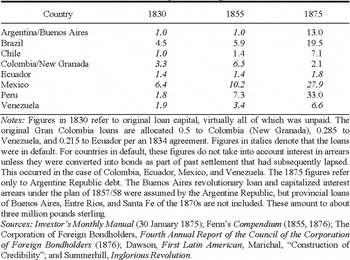
In Table 2, I compare the external debt for Latin American countries in 1830, 1855, and 1875. In 1855 and 1875, Peru's external debt was rivaled only by Mexico's, but nearly all of Mexico's debt accumulated after 1830 was due to the capitalization of unpaid interest on old loans during Mexico's several failed attempts to settle its debt.Footnote 7 Peru, in contrast, issued millions of pounds in new loans after its successful debt settlement. Indeed, among those countries that had defaulted on their independence loans, only Argentina (Buenos Aires), Chile, and Peru took out significant new foreign loans before 1875.
YIELD SPREADS VERSUS CONSOL, 1830–1875
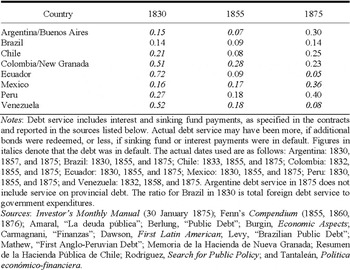
Not only was Peru's debt bigger than that of other Latin American countries, the ratio of its external debt service to government revenue was also comparatively large. Table 3 shows the external debt service ratio for Latin American countries in 1830, 1855, and 1875. Debt service ratios also are shown for countries in default so that one can compare the debt burdens of solvent and defaulting debtor nations. Obviously, these ratios are hypothetical, representing what the ratio would have been if the country had been servicing its debt. Note that in
LATIN AMERICA'S EXTERNAL DEBT (millions of pounds sterling)

Notes:
Figures in 1830 refer to original loan capital, virtually all of which was unpaid. The original Gran Colombia loans are allocated 0.5 to Colombia (New Granada), 0.285 to Venezuela, and 0.215 to Ecuador per an 1834 agreement. Figures in italics denote that the loans were in default. For countries in default, these figures do not take into account interest in arrears unless they were converted into bonds as part of past settlement that had subsequently lapsed. This occurred in the case of Colombia, Ecuador, Mexico, and Venezuela. The 1875 figures refer only to Argentine Republic debt. The Buenos Aires revolutionary loan and capitalized interest arrears under the plan of 1857/58 were assumed by the Argentine Republic, but provincial loans of Buenos Aires, Entre Rios, and Santa Fe of the 1870s are not included. These amount to about three million pounds sterling.
Sources:
Investor's Monthly Manual (30 January 1875); Fenn's Compendium (1855, 1876); The Corporation of Foreign Bondholders, Fourth Annual Report of the Council of the Corporation of Foreign Bondholders (1876); Dawson, First Latin American; Marichal, “Construction of Credibility”; and Summerhill, Inglorious Revolution.
both 1855 and 1875, Peru had the highest debt service ratio of any solvent debtor. In 1855 servicing the external debt was 18 percent of government revenues, and in 1875—on the cusp of default—it had ballooned to 40 percent. Given the relatively low risk premium of Peruvian securities, these comparatively high debt service ratios suggest that creditors must have had an especially high degree of confidence in Peru's ability and commitment to service its debt. In the following sections, I explain how Peru's extraordinary performance in financial markets was founded on its credible commitment to service its debt with the guano proceeds.
A RESOURCE BOOM
During the late colonial period, Peru's economy was dominated by mineral extraction, primarily for export, and agriculture, which was largely for domestic consumption. By the time of its independence in 1825, mining, although still important relative to other industries,
RATIO OF EXTERNAL DEBT SERVICE TO GOVERNMENT REVENUE

Notes:
Debt service includes interest and sinking fund payments, as specified in the contracts and reported in the sources listed below. Actual debt service may have been more, if additional bonds were redeemed, or less, if sinking fund or interest payments were in default. Figures in italics denote that the debt was in default. The actual dates used are as follows: Argentina: 1830, 1857, and 1875; Brazil: 1830, 1855, and 1875; Chile: 1833, 1855, and 1875; Colombia: 1832, 1855, and 1875; Ecuador: 1830, 1855, and 1875; Mexico: 1830, 1855, and 1875; Peru: 1830, 1855, and 1875; and Venezuela: 1832, 1858, and 1875. Argentine debt service in 1875 does not include service on provincial debt. The ratio for Brazil in 1830 is total foreign debt service to government expenditures.
Sources:
Investor's Monthly Manual (30 January 1875); Fenn's Compendium (1855, 1860, 1876); Amaral, “La deuda pública”; Berlung, “Public Debt”; Burgin, Economic Aspects; Carmagnani, “Finanzas”; Dawson, First Latin American; Levy, “Brazilian Public Debt”; Mathew, “First Anglo-Peruvian Debt”; Memoria de la Hacienda de Nueva Granada; Resumen de la Hacienda Pública de Chile; Rodríguez, Search for Public Policy; and Tantaleán, Política económico-financiera.
was a shadow of its former self.Footnote 8 The new republic had a population of approximately two million, but the majority of the population consisted of Indian peasants who lived in the highlands and relied on subsistence agriculture. A small elite resided primarily on the coast, mostly in the capital, Lima. The elite specialized in plantation agriculture, mining, and commerce. There was no banking system, and credit markets were thin, and dominated by personal connections. Foreign commerce consisted of the exchange of minerals for luxury manufactures with Europe, and agricultural trade with Chile and Bolivia. The discovery of guano impacted greatly this small and weak economy.Footnote 9
The existence of deposits of guano on islands near the Peruvian coast had been noted by travelers for some time. Agricultural chemists conducted experiments with Peruvian guano and found it contained significant quantities of nitrogen and phosphorus that made it an especially useful fertilizer, with major advantages over other manures, as well as bone and dried blood.Footnote 10 Large deposits were found on the Chincha Islands, a group of three uninhabited islands about 20 kilometers off the coast of Peru, and less than 200 kilometers from Callao, the main port of Lima. Under Peruvian law, they were property of the state, and because of their isolated location, with a modicum of naval presence they were not difficult to protect from poachers. Thus, legal tradition and geography made the enforcement of a government monopoly possible.
The extraction of guano required very little capital investment. It mainly involved digging the guano and transporting it to chutes that led from the island's cliffs into the holds of ships that were anchored nearby. However, it could take over one month to load a ship, and during the heyday of the trade in the 1850s and 1860s, there were often more than fifty ships loading at any given point in time. The length of loading time and the voyage meant that the cost of transport was substantial.Footnote 11 Procurement of vessels and coordination of sales, foreign warehousing, and marketing were also costly and demanded a certain degree of expertise that the Peruvian government lacked.
As a consequence, the state contracted with “consignees” who managed the export to and marketing in the various foreign markets.Footnote 12 The largest and most lucrative contract was for the British market, and the consignee was a highly reputable British merchant house, Anthony Gibbs and Sons, until 1862.Footnote 13 Gibbs earned commissions as well as a cost-plus arrangement for freight, loading, and storage.Footnote 14 After 1862 the consignment system was modified so as to permit Peruvian nationals to enjoy more of the rents, but the key role in Britain remained in the hands of a U.K. firm of high standing, this time Thomson, Bonar, and Co.Footnote 15
Although the principal foreign market for guano was Great Britain, the United States and France were also important markets. Figure 3 shows Peruvian guano exports between 1845 and 1879. The erratic nature of the data series is deceptive—the flow of revenues to the Peruvian government was much less variable because of the holding of stocks by consignees in the importing countries. Unfortunately, outside of some data for Britain, little direct evidence exists on actual guano sales.
PERUVIAN GUANO EXPORTS
The value of Peruvian guano exports to Britain, which was the destination for between one-half and two-thirds of all Peruvian guano exports, rose dramatically between 1847 and 1860, and it routinely exceeded two million pounds sterling per year. Prices were relatively stable. The Peruvian government set a minimum sales price that was usually binding.Footnote 16 As a consequence, fluctuations in guano export revenues mirrored fluctuations in the quantity exported. Because Peru did not publish trade statistics between 1847 and 1877, the value and relative importance of guano exports can only be estimated. Charles Fenn estimated Peru's total exports at £2.92 million, of which £1.56 million was estimated as guano. Estimates based upon U.K. trade statistics indicate that between 1854 and 1871, the height of the guano boom, guano constituted on average 60 percent of the value of all Peruvian exports to Britain.Footnote 17
A REVOLUTION IN PERUVIAN PUBLIC FINANCE
Before guano, Peru was stricken by regional, class, and ethnic tensions. These factors contributed to extreme political instability. From 1821 until 1845, caudillo warfare dominated Peruvian politics, leading to over fifty changes in government and seven constitutions.Footnote 18 Reflecting the turbulent political atmosphere, statistics on government revenue and expenditures are scarce. Customs revenue and an Indian head tax—a holdover from the colonial era—were the two largest sources of revenue. Expenditures exceeded revenues throughout the period.Footnote 19 In particular, military expenditures were sometimes as much as £450,000 a year.Footnote 20 Budget deficits were often covered through “emergency loans” from domestic merchants. Although these were promised to be repaid from future customs and other revenue, many of these loans remained unpaid until the 1860s. The exact amount of this credit will probably never be known, but estimates have put them at around 3 million pesos (£600,000) between 1821 and 1845, large but much less than the revolutionary war bonds floated in London that totaled £1.816 million.Footnote 21
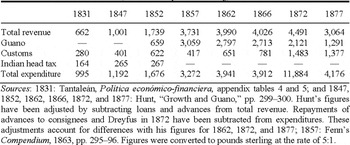
The Peruvian state's guano monopoly was a revolution for government finance. As is shown in Table 4, guano exceeded customs revenue beginning in the early 1850s, from then until the late 1860s it accounted for two-thirds or more of total government revenue. In the mid-1850s, when guano income exceeded two million pounds sterling
PERUVIAN GOVERNMENT REVENUES AND EXPENDITURES (thousands of pounds sterling)

Sources:
1831: Tantaleán, Política económico-financiera, appendix tables 4 and 5; and 1847, 1852, 1862, 1866, 1872, and 1877: Hunt, “Growth and Guano,” pp. 299–300. Hunt's figures have been adjusted by subtracting loans and advances from total revenue. Repayments of advances to consignees and Dreyfus in 1872 have been subtracted from expenditures. These adjustments account for differences with his figures for 1862, 1872, and 1877; 1857: Fenn's Compendium, 1863, pp. 295–96. Figures were converted to pounds sterling at the rate of 5:1.
per year, Peru reduced import tariffs and abolished the Indian head tax. Tariff revenue still grew because imports were growing rapidly during the period. Government revenues nearly doubled between 1847 and 1852, and doubled again by the early 1860s.
The state's expenditures expanded in tandem with guano income (see Table 4). Military expenditures and debt service accounted for large portions of the increase. A major reason for the rising military expenditures was that political instability continued to afflict the country. As mentioned above, during the height of the guano boom there were fourteen changes in government, most of which followed a civil war or uprising.Footnote 22 Control over guano revenues was a double-edged sword. On the one hand, it permitted the government to pay off supporters, and to finance a large military. On the other, guano revenues were a prize, increasing the private gains to those parties who were able to seize control of the state. The fact that creditors lent so much to such an unstable country, and that bondholders would consistently value this debt highly is a testament to the credibility of the debt service commitment, which raises the issue of the incentives Peru and its creditors faced.
DEBT SETTLEMENT: THE CARROT AND THE STICK
In January 1849 the Peruvian government reached a settlement with British bondholders. Guano provided the means to resume payment on the debt, and the basis for serving new loans, but why did Peru wish to emerge from default and incur new debt?
With respect to the settlement, there are two possible explanations for why Peru settled its foreign debt. First, Peru might have feared that the British government would intervene either by seizing guano cargos abroad or by otherwise disrupting the guano trade. Second, Peru could have anticipated some kind of reward if it did settle.
There is no evidence in support of the first hypothesis. The literature persuasively suggests that the British did not threaten Peru with any military or trade sanctions. It was certainly the case that after the relatively high levels of guano exports in 1847 and 1848, the bondholders felt that Peru had the ability to pay, but not the will. The bondholders had been pressing the British government for assistance for years, and in 1847 they renewed their campaign.Footnote 23 They passed a series of resolutions in July of that year, including a formal request to the British government for aid, stating that “… it appears abundantly evident … that there exist within the territories of [Peru] ample resources in the article of guano alone to provide for the liquidation of its foreign debt; and that consequently the government is bound by every principle of public faith and national honour to proceed to that stipulation without further delay.” Footnote 24
The possibility of British intervention—even seizure of the islands—was openly discussed in Peru. Peruvian Finance Minister Del Río in his Memoria in 1847, expressed the government fears that “… until the foreign debt is settled, the remission of guano abroad … could bring major complications that we must avoid.” Footnote 25 It is unlikely, however, that such fears were decisive. Studies on this precise issue concluded that the Foreign Office communicated its displeasure to the Peruvian government, but that no threats were issued. As W. M. Mathew puts it: “… Foreign Office documents show that British pressure was relatively weak …” Footnote 26 Mathew's view is consistent with the findings of other scholars who have pored over British Foreign Office archives, concluding that there was no policy on the part of the British government of backing up bondholders with military, economic, or diplomatic threats.Footnote 27
The evidence suggests, instead, that Peru settled its debt because of the promise of a significant reward. The big prize was renewed access to international capital markets. At the time, British and Continental bondholders were able to exert pressure on delinquent debtors through a simple institutional device: the leading European stock exchanges would not list any new issue proposed by a defaulting state.Footnote 28 Peru's president at the time, Ramón Castilla (1845–1851) unequivocally expressed the rationale for settlement: “… to revive the credit which the Republic lost in Europe almost at the same time as it came into existence.” Footnote 29 Peru's growing financial needs were cited as reasons for renewing access to international credit markets. In spite of the riches brought by guano, Peru's fiscal emergency, which became more acute as a result of the violent wars that preceded Castilla's rise to power, remained a severe constraint on state building. When Castilla assumed power, customs and the mint were mortgaged for over 700,000 pesos. In the 1840s the state received a total of around 5.5 million pesos in guano revenues, mostly in the form of cash advances (i.e., short-term loans advanced by the consignees and backed by guano), which only satisfied one-tenth of Peru's budgetary needs.Footnote 30 In 1847 the government tried to obtain loans from the domestic merchant elite to manage the financial crisis—they refused.Footnote 31
A careful account of flows of guano revenues from the time of settlement (1849) to the end of Castilla's first presidency (1851) shows that the government received net flows (all in the form of cash advances from the consignees) for as much as £344,400.Footnote 32 These advances were conceded at lower interest rates than in the presettlement years.Footnote 33 On the other hand, the government payments to the bondholders were about £202,768 in the same period.Footnote 34 That is, settlement did not pose a negative flow of income or any additional risk of losing power. On the contrary, it allowed the Peruvian government to borrow at lower interest rates and opened up the prospects of receiving long-term loans for the first time since the 1820s.
ESTABLISHING A CREDIBLE COMMITMENT: THE GUANO-DEBT CONTRACTS
In 1852 the Peruvian Congress authorized its representative in London to negotiate the terms of a new debt issue. An agreement was reached in early 1853, and the prospectus for the debt issue was advertised on February 26. The loan redeemed the 1849 active bonds that were scheduled to take on an interest of 6 percent in April 1853, and still yielded a net capital inflow of over 600,000 pounds sterling. The issue, priced at 85 pounds sterling, came at a lower rate of interest (4.5 percent instead of 6 percent), and annual sinking fund payments of 2 percent were committed.Footnote 35 Thus, the 1853 bonds represented new debt. So why did bondholders believe Peru's promise to repay?
The Peruvian government needed to persuade the bondholders that it was capable of servicing the debt and that it would choose to do so. Insofar as ability to pay, Peru's main source of government revenue was the proceeds from the state guano monopoly, which were explicitly pledged to service the debt in each bond contract. The ability of Peru to maintain high levels of export revenues depended on the extent of its guano deposits and whether or not it faced serious competition from abroad. Surveys of the Chincha Islands were conducted in the 1850s, and the surveyors included foreign observers. In 1851, for example, it was estimated that the guano deposits were of around 26 million tons, which would last—at current export rates—until the year 2112. In 1853 the deposits were estimated at a total of around 12.5 million tons. The grimmest view calculated the Chincha deposits at about 6–8 million tons, which still implied the guano deposits would last for about twenty years.Footnote 36
Concerning the possibility of outside competition, the most significant new discoveries, the Lobos Islands, were also claimed by Peru. No comparable guano deposits were found, nor were they likely to be. The exceedingly arid climate and the nutrient-rich Humboldt current made the Peruvian coast an ideal location where guano could accumulate. Many locations had one of those two key characteristics, but not the other. As a result of Peru's dominance of the guano market, guano's privileged place among fertilizers, and rising fertilizer demand abroad, investors in the late 1840s and early 1850s felt sure that Peruvian guano would yield a considerable stream of revenue for many years.Footnote 37
It was one thing to convince creditors that Peru had the resources to pay; it was quite another to convince them that it would repay. The problems confronted by governments in establishing credible commitments with creditors are well known. Sovereign contracts are not subject to third-party enforcement. Thus, unless lenders (often in combination with the sovereign) orchestrate a credible threat to levy a sufficiently large penalty in case of government default, the promise to repay is not credible. Theoretically, a sovereign can commit to honor his financial obligations in two ways. One is by building a reputation. Reputation effects imply that a default is penalized either through a future credit boycott or higher interest rates on future loans reflecting a default risk premium.Footnote 38 Alternatively, the government can commit by orchestrating an increased penalty for default over and above the threat of credit restrictions. Those penalties (or sanctions) can take several forms. They can emanate from domestic political institutions that punish the ruler if he should repudiate the debt, as in the emblematic case of Great Britain; from ad hoc contracts that explicitly link debt repayment to sanctions radiating from a complementary (nonlending) relationship, as in Hapsburg Spain; or from foreign government diplomatic or military pressure, as with early twentieth century U.S. imperialism in the Caribbean.Footnote 39
In the case of Peru, the sanction in play was not a byproduct of superior political institutions or a result of any formal threats of British intervention. In what follows, I suggest that the penalty for default—which was willingly contracted into by the Peruvian government—was the threat of a major loss in government income due to the disruption in the guano trade in case of government default.
The linkage of the guano trade to debt service was simple and effective. Recall that because Peru did not possess the expertise and connections needed to sell guano in European markets, it relied on consignees for the guano trade—namely the British House of Gibbs until 1862. Castilla admitted to the British Charge d'Affaires in October 1849, however, that his main reason for persisting with Gibbs was his wish to establish Peru's credit on a firm basis.Footnote 40
The basic terms for the debt settlement with the bondholders were agreed upon in January 1849.Footnote 41 In a newly drafted guano consignment contract, Peru appointed Gibbs as the financial agent for the service of the debt and made it responsible for withholding a large portion of guano income (originally 50 percent of proceeds from the British market) for debt servicing. The issuer of the new bonds was the House of Murrieta, with which the government signed a complementary contract in April 1849.Footnote 42 Guano revenues were collected by Gibbs in Britain and handed shortly after to Murrieta. The operation was clean and did not involve meddling by the Peruvian government.Footnote 43
It was not uncommon at the time for governments to pledge government revenues—usually customs revenues—for the payment of interest and sinking fund obligations. The original Peruvian loans were in fact “secured” by such a promise. In a number of Latin American cases, however, such pledges were ignored at the government's convenience.Footnote 44 Notwithstanding, guano had the potential to be superior collateral because guano revenues were collected at the point of sale abroad. A bondholder quoted in the Times in April 1857 said exactly as much: “The security of the guano is unquestionable, and from its local situation is beyond the reach of any Government in Peru to control … and it must be borne in mind that the proceeds are received in England and not in Peru.” Footnote 45 In assessing the history of Peru's credit, Fenn observed in 1876 that, “Above all, in distinction from other securities hypothecated by foreign states, the transfer was so easy, the Peruvian revenue being, as it were, collected in Europe—that Peru grew in favour with European capitalists.” Footnote 46 Fenn's reference to the same argument advanced twenty years earlier suggests that this perspective was probably shared by a large number of bondholders, and greatly bolstered the confidence of lenders and investors alike.
The location of the guano trade was not the only factor that enhanced Peruvian standing with creditors, however. Equally important was that Peru trusted the debt service to a firm with an excellent reputation within the British financial community. A firm with substantial reputational capital would be less likely to collude with a foreign government and defraud the bondholders because it could cost them their network. Mathew illustrates the importance of such a network for Gibbs: “…Gibbs' base was the London money market and therein they were attempting, with substantial long-run success, to build up a large acceptance business. Progress in this field had to do with the marketability of one's name and reputation.” Footnote 47 Mathew adds: “… the fact that the funds due to them [the bondholders] came from a reputable London merchant house and not from exposed government coffers in Lima gave them great confidence in Peruvian paper.” Footnote 48
Still, could the Peruvian government not simply renege on its consignment contract with Gibbs, default on its debt, and find an alternative outlet for the guano trade? Finding an alternative merchant house with expertise in the guano trade and the capacity for raising capital for transportation, and storage was not an easy task. By their experience, Gibbs had developed a considerable advantage in these departments and finding an adept consignee willing to handle such a capital intensive business (and capable of raising capital from the British financial community) would have been challenging. In any event, any abrupt change in the guano arrangements would have implied an interruption in the flow of guano income—the government's lifeline, which in the context of political instability could have toppled the government because of Peru's dependence on guano revenues and its complete inability to save. The Peruvian foreign minister, Gómez Sánchez, implied as much in a letter to a British government official, “… the obligations of the government with each one of the consigners are so complicated and so important that if they were to attempt to make an immediate change in this respect, the entire nation would be placed in a crisis which perhaps it could not overcome although it might exercise all its energy.” Footnote 49
The government's options were further limited by the fact that there was no alternative to guano. At the onset of the guano boom in the early 1850s, Presidents Echenique and Castilla radically reformed the tax system. Some of the key changes included massive reduction in tariffs, commercial treaties with foreign countries, and the abolition of the tribute (Indian head tax). Tariffs and the head tax comprised close to 70 percent of government income in the pre-guano era. Reimposition of the head tax or raising tariffs would have entailed political negotiations that could have been time-consuming and perhaps have unintended political consequences. There is well-documented evidence of major resistance to any tax reforms (reimposition of these measures) in the period.Footnote 50 Furthermore, a fall in guano exports would cut into imports, so that even with an increase in tariff rates, positive effects on revenue would be uncertain. This meant that, at least in the short term, there was no alternative to guano. The penalty for default—an interruption of the guano trade—therefore carried with it large financial costs. Historians have typically interpreted Peru's tax reforms of the 1850s as motivated by domestic political considerations, but the credible commitment problem offers another possible explanation. By increasing dependence on guano, Peru made its commitment to the bondholders more credible because it could not risk interrupting the guano trade. No Peruvian government could take such a risk. Consequently, Peru's notorious political instability did not weaken the credible commitment to repay its foreign debt. Because of the nature of the guano security, the identity of the government was of secondary concern.
EVIDENCE FROM FINANCIAL MARKETS
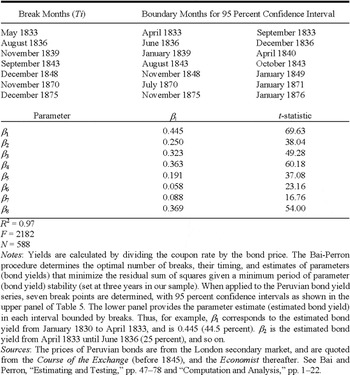
If Peru's commitment to service its debt was credible, there should be a statistically and economically significant increase in Peruvian bond prices (and a decrease in yields) coincident with the onset of the guano-debt contracts. I provide evidence to assess this prediction, and to determine whether political events mattered. I do so by testing for multiple endogenous structural breaks in the means of the Peruvian yield and yield spread (versus consol) series using the methodology of Jushan Bai and Pierre Perron.Footnote 51 The Bai and Perron methodology involves a dynamic programming search algorithm to calculate the optimal number and timing of breaks. A key parameter is the interval length—or minimum period of parameter stability. I fix this length at three years so as to eliminate relatively transient events.Footnote 52
BREAKS IN PERUVIAN BOND YIELD SERIES, JANUARY 1830 – DECEMBER 1878

R 2 = 0.97
F= 2182
N = 588
Notes:
Yields are calculated by dividing the coupon rate by the bond price. The Bai-Perron procedure determines the optimal number of breaks, their timing, and estimates of parameters (bond yields) that minimize the residual sum of squares given a minimum period of parameter (bond yield) stability (set at three years in our sample). When applied to the Peruvian bond yield series, seven break points are determined, with 95 percent confidence intervals as shown in the upper panel of Table 5. The lower panel provides the parameter estimate (estimated bond yield) in each interval bounded by breaks. Thus, for example, β1 corresponds to the estimated bond yield from January 1830 to April 1833, and is 0.445 (44.5 percent). β2 is the estimated bond yield from April 1833 until June 1836 (25 percent), and so on.
Sources:
The prices of Peruvian bonds are from the London secondary market, and are quoted from the Course of the Exchange (before 1845), and the Economist thereafter. See Bai and Perron, “Estimating and Testing,” pp. 47–78 and “Computation and Analysis,” pp. 1–22.
The procedure selects seven breaks in the Peruvian series, each significant at the 1 percent level. The breaks are identical in the yield and yield spread series. For simplicity, I focus on the yield series. The results are presented in Table 5. The first three break points coincide with military and political events in Peru, but during each corresponding interval the “yield” remains very high (bond prices remain very low).Footnote 53 The fourth break point, which occurs in 1843—around the beginning of the period of guano exports—results in a substantial decline in Peruvian bond yields from 36 percent to 19 percent. The fifth break corresponds precisely with the debt settlement agreement, and the parameter estimate falls from 19 percent to 5.8 percent. What is remarkable about the data is that no further breaks are detected until twenty years later, in 1870/71, when the procedure detects a break indicating an increase to nearly 9 percent in the yield. This break corresponds to the very large 1870 loan and increased concern over guano reserves, and it is a signal that the guano debt contracts were no longer seen as credible by investors. The final break in the series corresponds with Peruvian default. Overall, the statistical evidence of low and relatively stable yields strongly supports the view that investors regarded highly Peru's contractual commitment to repay its debt over the height of the guano boom.
Further discussion of the yield series is illustrative of the factors to which the bondholders were most sensitive. Figures 1 and 2 show that during the guano age, the price of Peruvian bonds remained high (the yield spread low) except for three relatively short interludes: 1854/55, 1865–1867 and after 1871. During the first episode, the yield spread of Peruvian bonds versus the consol increased from about 2.5 percent in 1853 to a peak of 5.1 percent in April 1854. By July 1854 it had fallen to 3.3 percent and it hovered in the 3 percent range until August 1855, when it abruptly fell again to 2.3 percent. The increased yield spread during this period reflects the concern of bondholders of the Peru's £2.6 million loan of 1853 (the Murrieta loan that was in large part a conversion of the original revolutionary debt to a lower interest rate), when they learned the details about the new loans that Peru had taken out. These Uribarren and Montané loans, totaling another £2.6 million, were a conversion of domestic Peruvian debt into external debt. This conversion was unexpected and highly controversial, considered by many a payoff of domestic political allies, as the government-recognized domestic debt included not a small amount of highly questionable claims.Footnote 54 Still relatively early in the guano boom, some bondholders expressed doubt about the adequacy of the guano revenues to cover the sudden increase in the debt burden. Others complained that the issues were diluting the value of their investments, even if guano was available in sufficient quantities to secure the loan.Footnote 55
Peru took steps to address both complaints. It permitted surveys of the deposits by foreign observers, deemed independent. A report by Admiral Moresby of the Royal Navy was publicized in the Times on 25 March 1854, which estimated the Chincha Island deposits at 7 million tons, less than one-third of the 26 million ton estimate several years earlier and almost one-half of the 12.5 million ton estimate by French engineers released in December 1853. The release of Moresby's report coincides with the highest yield spread during this period. As a consequence of the increased debt burden and reduced estimates of guano reserves, British bondholders began to clamor for an increase in the sinking fund on the Murrieta 1853 bonds, and on the 1849 passive bonds. Negotiations ensued, and on 7 August 1855 the bondholders accepted a Peruvian proposal from 25 July 1855 to increase the sinking fund on the former from 2 percent to 5 percent, and on the latter from 0.5 percent to 3 percent. This announcement corresponds precisely with a sudden rise and stabilization of Peruvian bond prices.Footnote 56
The second episode during which the yield spread on Peruvian bonds rose was 1865/66, which corresponds to a conflict between Spain and Peru. The conflict originated when the Spanish ordered a naval expedition to seize the guano-rich Chincha Islands.Footnote 57 The islands were seized between April 1864 and January 1865. In January 1865 Peru and Spain signed the Vivanco-Pareja Treaty. Under the terms of the treaty, Spain withdrew from the islands in exchange for an indemnification. Many considered the treaty as an affront to national honor and shortly after, in January 1866, Peru declared war on Spain. Importantly, the perception in Britain was that Peruvian possession of the Chincha Islands was threatened.Footnote 58 Yield spreads over the 1864–1868 period peaked precisely during the war, at between 4.5 percent and 5 percent. After Peruvian victory was secured, by mid-1866, bond prices began to recover and the yield spread initiated a downward trend. It is not surprising that yields did not fully return to the prewar level, because Peru had contracted for a very large increase in debt in order to fight the war (see Table 1).
The final period of increased yields coincides with the massive increase in debt in 1870 and 1872, and with the increasing realization that the prime guano deposits of the Chincha Islands were nearly exhausted, and that deposits on other islands were not of the same quality. The first jump in the yield spread occurred with the issue of 1870, which debuted on the exchange in December 1870 at a price of 76 percent (yield 4.6 percent), about twice the yield of the 1865 bond a month earlier. The second increase occurred shortly after the 1872 bond issue, to over 5.5 percent, and then a very rapid deterioration in the second half of 1875 as default became imminent. The massive increase in the debt burden was clearly a major factor contributing to the declining confidence of Peruvian bondholders, but a decline in the guano market also coincided with the increase in debt. Peru sought to allay fears about the exhaustion of the Chincha Islands by providing surveys claiming more guano there and on other islands. Over the period 1871–1875, the Times contained numerous reports speculating on the size of Peruvian guano holdings. The Corporation of Foreign Bondholders noted that Peruvian surveys did not “provide for any authentication of the results by bondholders.” Their reports note the increasing anxiety among bondholders about the true extent of Peru's remaining guano deposits, requests by the corporation for independent surveys to be conducted, and insistence that the bondholders maintain priority over all other creditors in their claims on revenues earned from the guano that was left.Footnote 59 In 1874 a British Parliamentary Paper brought together information from the most recent British surveys. They confirmed that the Chincha deposits were nearly exhausted and were unable to corroborate Peruvian claims about the size and richness of deposits on the other islands.Footnote 60
The delicate balance of guano revenues, a manageable debt burden, and the contractual commitment was unraveling. The Peruvian president, Manuel Pardo, in his message to Congress in 1874, stated as much: “My predecessor, Balta, formed the idea to convert our guano into railways. In two years, he contracted for nine railways to cost 125 million dollars—say 24 million pounds sterling, which money being raised by foreign loans, the Dreyfus guano contract for 8.5 million dollars per year would pay the interest. Such enormous loans soon crippled us, as the railways were unproductive … then came failures and suspensions and all the troubles that have reduced Peru to her present wretched condition.” Footnote 61 Peru attempted to access foreign credit in order to nationalize its nitrate of soda industry, thereby converting it into a government monopoly capable of servicing its debt and financing the government. Foreign creditors refused to assist. With the stream of guano revenues declining, the penalty for default built into the guano debt service arrangement was no longer binding. Peru defaulted in January 1876.
The review of these episodes shows that the main risk that concerned bondholders was the size of the debt burden relative to the expected stream of guano revenues. The major factors influencing Peruvian bond prices were news about the debt level, and about the size and control over the guano deposits. What is remarkable about the evolution of the bond series is the relative unimportance of internal politics. Perhaps the best way to illustrate the irrelevance of political instability is to cite a letter from a British bondholder to the Times: “With respect to the [disturbed] internal state of Peru … It is not of the slightest importance to the English bondholders. Did their security rest upon no other foundation than the internal resources of Peru and the honesty of her government, I do not believe there is a single holder of the stock who would value it at 10 percent (…) but the security of the guano is unquestionable, and from its local situation is beyond the reach of any government in Peru to control.” Footnote 62
In sum, the evidence shows that in the bondholders' view the guano debt contracts provided a credible commitment to service the debt. The evidence also suggests that investors were indifferent to much of the internal instability that scholars argue held back Peru's broader development.
CONCLUSIONS
Peru's experience with sovereign debt during the guano boom is one of the most remarkable in the nineteenth century. The country emerged from postindependence bankruptcy to become Latin America's largest debtor. Its bonds commanded a high price in the London market and earned a yield at or inferior to the bonds of the countries most well regarded for fiscal probity in Latin America.
The Peruvian experience is particularly instructive for modern economic theories of sovereign debt. It demonstrates that natural resource booms have the potential to be leveraged for the accumulation of debt, but that such leverage is not automatic. In the case of Peru, it required the creative construction of contractual linkages between exports and debt service. The Peruvian case also shows that hypothecation of state revenues need not be “cheap talk,” but in the right circumstances can be credible. Three circumstances were important. The guano revenues were collected in a geographic location where it was next to impossible for the Peruvian government to seize them. The foreign merchant house acting as consignee and agent had strong incentives not to collude with the Peruvian government to suspend payment and seize the proceeds of guano sales. Finally, unilateral suspension of the contractual mechanism by the Peruvian government would have led to a disruption of the guano trade, and of the revenue stream, which its chronically unstable governments depended on for one-half or more of its revenues. With no good alternatives to guano, the commodity was indispensable for defense against foreign and domestic enemies. Thus, in a twist, the financial and military vulnerability of Peru's unstable governments actually contributed to the country's creditworthiness.
With respect to the debate about the roles of sanctions versus reputation, the Peruvian case is a hybrid. The sanction in play was not the formal threat of military or commercial retribution from foreign governments. Although Peru was subject to the threat of commercial disruption in the event of default, this risk was willingly contracted into by the debtor government as a means of generating credit. Insofar as reputation is concerned, Peru's successive military and quasi-civilian governments won little respect in Europe, but through the guano debt contracts Peru nevertheless was able to “borrow” against the excellent reputation of Gibbs and later of Thomson and Bonar.
The guano windfall ushered in an era of relative prosperity for many in Peru, particularly those among the elite. Those who point to the guano boom's positive impacts note that access to foreign capital and the flow of guano revenues facilitated the creation of Peru's first banks, and of investment in cotton, nitrates, and sugar. However, the perception among many Peruvian scholars and citizens alike is that the prosperity of the guano period was ephemeral, and that it did not leave a positive legacy insofar as the Peruvian economy or its political institutions.