


“Money was never a big motivation for me, except as a way to keep score.”—Donald Trump (Reference Trump1987, 63), The Art of the Deal
Recent research shows that affluent Americans have disproportionate influence over policy outcomes in the United States (e.g., Bartels Reference Bartels2008; Druckman and Jacobs Reference Druckman and Jacobs2015; Gilens Reference Gilens2012; Rhodes and Schaffner Reference Rhodes and Schaffner2017). When affluent Americans use this influence to advance conservative economic policies that serve their financial interests, it facilitates rising economic inequality (Bonica et al. Reference Bonica, McCarty, Poole and Rosenthal2013).
I identify an unrecognized source of affluent Americans’ self-interested political behavior: the desire for social status. In his classic Theory of the Leisure Class (Reference Veblen1899), Thorstein Veblen argues that affluent Americans frequently pursue money as a means of achieving social status. Building off Veblen’s theory, I argue that affluent Americans’ pursuit of social status plays an important role in the politics of inequality. The desire for social status causes affluent Americans to support conservative economic policies that benefit themselves financially, making it more likely that their disproportionate influence over government will translate into increased economic inequality. By considering the interacting effects of class and gender, I also argue that my theory will hold especially well for affluent men, who are vastly overrepresented in positions of political power. When affluent men view money as a source of social status, it causes them to use this power in ways that benefit themselves financially and increase inequality.
I subject this theory to a series of rigorous observational and experimental tests. First, I develop a new survey scale that allows me to measure affluent Americans’ desire for social status and its relationship with their views toward conservative economic policies. Using this scale in conjunction with a representative sample of affluent Americans, I show that affluent Americans’ desire for social status strongly predicts their level of support for conservative economic policies that facilitate rising inequality, including policies that lower their own income taxes, lower taxes on capital gains, and decrease government regulation of business and industry. I also find that the desire for social status has an especially strong relationship with economic conservatism among affluent men.
Second, I test my theory experimentally in the context of social media.Footnote 1 On sites like Facebook, Instagram, and Twitter, affluent Americans pursue social status by sharing carefully curated versions of their lives that demonstrate their economic success and upper-class lifestyle (Marwick Reference Marwick2013; Williams Reference Williams2013). This behavior represents a technologically enhanced form of the status-seeking behaviors that Thorstein Veblen first documented in The Theory of the Leisure Class (Reference Veblen1899; see also Taylor and Strutton Reference Taylor and Strutton2016). I make use of this context in a survey experiment where I randomly assign affluent Americans from a second representative sample to encounter Facebook posts in which others broadcast their economic success. The experimental treatments include Facebook posts that share feelings of self-worth following a career achievement, Facebook posts that show how social approval accrues to the economically successful in the form of “Likes” and positive comments from Facebook friends, and Facebook posts that broadcast acts of conspicuous consumption. Using this design, I show that the desire for social status causes affluent Americans—and affluent men in particular—to support conservative economic policies.
This study makes a number of contributions. First, I show how affluent Americans’ pursuit of social status shapes American politics. Over the past several decades, affluent Americans have engaged in a highly successful effort to shift economic policy in a conservative direction (e.g., Hacker and Pierson Reference Hacker and Pierson2010). This effort has been led by affluent men, who have used their vastly disproportionate share of political power to push economic policy further to the right (e.g., Mayer Reference Mayer2017). Although this behavior facilitates rising inequality, few studies have considered its social and psychological origins. I fill this gap by providing evidence that the desire for social status plays an important role in causing affluent Americans—and affluent men in particular—to support conservative economic policies that facilitate rising inequality. These findings are made possible by a novel survey scale that I designed to measure affluent Americans’ desire for social status for the first time, and a preregistered experiment in which I use social media to measure the causal effects of affluent Americans’ desire for social status. Results from both methods align on a central conclusion: Affluent Americans would be substantially less likely to use their political power in ways that increase inequality if they were less concerned about social status.
Second, this study challenges the existing view of why people pursue their financial interests in politics. Canonical theories of public opinion assume that people pursue their financial interests in politics to improve their concrete material well-being (e.g., Sears et al. Reference Sears, Lau, Tyler and Allen1980; Sears and Funk Reference Sears and Funk1990). This view does not hold well for affluent Americans. Although I consistently find evidence that affluent Americans pursue money through politics to achieve social status, I find no evidence that they pursue money through politics to improve their concrete material well-being. As these findings show, the desire for social status can motivate the rich to pursue money through politics long after they already have enough wealth to meet all of their material needs. This has important consequences for society. The conservative economic policies that affluent Americans pursue out of a desire for social status also make it harder to provide public goods. As Frank (Reference Frank2005) points out, the money that affluent Americans are able to spend on “larger houses and more expensive cars” thanks to tax breaks might otherwise have been spent on “improving public education, conducting medical research, or inspecting the cargo containers that enter our ports” (141). This aligns with Thorstein Veblen’s (Reference Veblen1899) central argument that affluent Americans’ pursuit of social status imposes costs on the rest of society.
Third, this study provides a new perspective on the political consequences of social media. Political scientists are increasingly concerned about both the political effects of social media (e.g., Guess, Nyhan, and Reifler Reference Guess, Nyhan and Reifler2018) and the high level of inequality in the United States (e.g., Page and Gilens Reference Page and Gilens2017). Yet these issues have largely been viewed in isolation from one another. I am the first to bridge the gap between these two increasingly important streams of research in political science. I do so by providing experimental evidence that exposure to status competition on social media causes affluent Americans to become more economically conservative. I also provide observational evidence suggesting that these effects occur as affluent Americans use social media in their daily lives. The more time affluent Americans spend on Facebook, the more strongly they desire social status, and the more supportive they are of conservative economic policies. These experimental and observational results provide the first evidence that social media encourages political behaviors that are conducive to rising inequality.
AFFLUENT AMERICANS AND THE POLITICS OF INEQUALITY
Political scientists have sought to understand why democracy has failed to slow rising inequality in the United States. One important reason is the political influence of affluent Americans. As Bonica et al. (Reference Bonica, McCarty, Poole and Rosenthal2013) write, the “rich have been able to use their resources to influence electoral, legislative, and regulatory processes through campaign contributions, lobbying, and revolving door employment of politicians and bureaucrats” (105). Affluent Americans often use this influence to advance conservative economic policies that benefit themselves financially and facilitate rising inequality, including policies that lower their own income taxes, lower taxes on capital gains, and reduce government regulation of business and industry.
Although researchers often attribute these policy outcomes to the political influence of affluent Americans (Hacker and Pierson Reference Hacker and Pierson2010; Martin Reference Martin2013; McCarty, Poole, and Rosenthal Reference McCarty, Poole and Rosenthal2015), it may be more accurate to say that they arise through the political influence of affluent men. Affluent men dominate the channels through which affluent Americans influence politics. They are far more likely than affluent women (or anyone else) to make large campaign contributions during elections (Weber et al. Reference Weber, Olsen-Phillips, Choma and Bynder2015), lead the corporations and interest groups that lobby government (Wolfers Reference Wolfers2015), and hold high-level elected office (Center for Responsive Politics 2014). Affluent men frequently use these positions of power to advance conservative economic policies that benefit themselves financially, making them arguably more responsible than any other group for the rise of conservative economic policies in the United States (e.g., Mayer Reference Mayer2017).
Despite the important role that affluent Americans play in the politics of inequality, few previous studies have considered the causal origins of their economic conservatism. To the extent that social scientists have considered the causal origins of economic conservatism at all, they have tended to focus on the social and cultural origins of economic conservatism among the lower class and middle-class (e.g., Bartels Reference Bartels2005; Cramer Reference Cramer2012; Frank Reference Frank2004; Hochschild Reference Hochschild2016), while paying comparatively little attention to the social and cultural origins of economic conservatism among the rich. I address this gap by focusing on the political consequences of an important, but understudied aspect of upper class culture in the United States: the pursuit of social status (e.g., Lamont Reference Lamont1994; Veblen Reference Veblen1899).
STATUS MOTIVATION AND THE POLITICS OF AFFLUENT AMERICANS
In studying the political consequences of affluent Americans’ pursuit of social status, I build on Thorstein Veblen’s classic Theory of the Leisure Class (Reference Veblen1899). Veblen’s key theoretical insight is that “property is accumulated, not just to satisfy our basic physical needs, but also for its honorific qualities” (Heath Reference Heath and Misak2008, 242; see also Veblen Reference Veblen1899, 15–6). This point has been affirmed by further research on the social psychology of money (Lea and Webley Reference Lea and Webley2006; Srivastava, Locke, and Bartol Reference Srivastava, Locke and Bartol2001; Zelizer Reference Zelizer1994). This research suggests the presence of two distinct motivations for pursuing money, each of which has the potential to cause affluent Americans to support conservative economic policies that serve their financial interests: Status Motivation and Concrete Motivation. I define these two motivations in detail below.
Status motivation consists of the desire for money to generate esteem. In The Theory of the Leisure Class (Reference Veblen1899), Thorstein Veblen argues that the pursuit of money to gain esteem is an essential part of upper-class culture. In more recent work, Michele Lamont (Reference Lamont1994) provides a nuanced qualitative description of how status motivation operates among affluent Americans. She shows how it comprises the desire for money to achieve three distinct status-related goals. The first is Social Approval. For example, affluent Americans often pursue money to keep up with friends who are as rich or richer than themselves, and fear that failure to do so will result in social exclusion. The second is Self-Esteem. For example, affluent Americans often pursue money to feel like they are successful, and attain a sense of satisfaction with their lives. The third is Conspicuous Consumption. For example, affluent Americans often pursue money to afford the kinds of beautiful homes and high-performance cars that others will notice and admire (see Lamont Reference Lamont1994, 64).
While status motivation consists of the desire for money to generate esteem, concrete motivation consists of the desire for money to meet material needs. With the possible exception of the very richest Americans, most people pursue money at least in part to provide for the material necessities of life. For affluent Americans, these material necessities may include things like supporting their families, maintaining financial security, and affording costs related to housing, transportation, and food that can be expensive depending on where one lives (e.g., Sherman Reference Sherman2017). Concrete motivation captures the desire for money to meet these material needs. Status motivation and concrete motivation are not mutually exclusive, and they may coexist in the same person. Yet they are theoretically and empirically distinct (I provide evidence of this in the analysis section below).
Status motivation and concrete motivation both have the potential to explain why affluent Americans pursue money through politics. On the face of it, an explanation based on concrete motivation may seem more plausible. Canonical theories of public opinion assume that people pursue their financial interests in politics to obtain “concrete economic benefits” and “material well-being” (Sears and Funk Reference Sears and Funk1990, 248–50; see also Sears et al. Reference Sears, Lau, Tyler and Allen1980). These same studies also tend to assume that nonmaterial goals such as “social status” are unimportant in driving the pursuit of financial interests in politics (Sears and Funk Reference Sears and Funk1990, 248). This suggests that concrete motivation, rather than status motivation, should be the driving force behind affluent Americans’ economic conservatism.
By neglecting the role of social status, this traditional view may fundamentally misunderstand why the most powerful Americans pursue money through politics. As Thorstein Veblen argues in The Theory of the Leisure Class (Reference Veblen1899), affluent Americans frequently pursue money not as a means of meeting concrete material needs, but as a means of generating the “esteem of their fellow-men” and building “self-respect” (Reference Veblen1899, 15–6). In her more recent interviews with affluent Americans, Lamont (Reference Lamont1994) similarly describes how affluent Americans often pursue money because they believe it will bring “social acceptance” and a “sense of self-worth,” rather than because they necessarily need money to provide for their families (64).
Veblen felt that pursuing social status in this way could lead affluent Americans to feel a sense of “chronic dissatisfaction” with their share of economic resources (Reference Veblen1899, 16; see also Lamont Reference Lamont1994). More recent work has shown how this sense of chronic dissatisfaction can persist even among those who have reached the top of the economic hierarchy. Studies of those in the top 0.1% of the wealth distribution suggest that some of the wealthiest Americans still struggle with a sense that they are not successful enough, and persist in the belief that they will only achieve a sense of life satisfaction through the further accumulation of wealth (Lewis Reference Lewis2014, 257). One researcher describes this perspective among billionaires as follows: “Although they know money is not the key to happiness, they can’t stop counting it. Their entire self-image and all their self-esteem is wrapped up in the pursuit of money” (Zimmerman Reference Zimmerman2017, 1).
As this research suggests, status motivation can be a potent force in shaping the behavior of affluent Americans. Yet this research has not been extended to consider how the desire for social status influences affluent Americans’ political behavior. I extend this existing work by arguing that the desire for social status causes affluent Americans to pursue conservative economic policies that benefit themselves financially and increase inequality. As affluent Americans’ desire for social status increases, so too does their sense of dissatisfaction with their share of economic resources (Lamont Reference Lamont1994; Veblen Reference Veblen1899). In turn, this growing sense of dissatisfaction causes affluent Americans to pursue money through politics by supporting conservative economic policies that benefit themselves financially and increase inequality. To provide a benchmark, I will compare this status-based explanation for affluent Americans’ economic conservatism against a more traditional view based on the desire for money to meet concrete material needs (e.g., Sears and Funk Reference Sears and Funk1990; Sears et al. Reference Sears, Lau, Tyler and Allen1980). I expect that status motivation will outperform concrete motivation as an explanation for affluent Americans’ economic conservatism.
STATUS MOTIVATION AND THE POLITICS OF AFFLUENT MEN
As an extension of this theory, I argue that the desire for social status should cause especially large increases in economic conservatism among affluent men. This hypothesis is informed by prior research, which finds that status competition among affluent Americans is highly gendered. In The Theory of the Leisure Class, Thorstein Veblen argues that men are the driving force behind status competition in affluent communities (see also Gilman Reference Gilman1999). Along these same lines, Lamont (Reference Lamont1994) and Sherman (Reference Sherman2017) find in their interviews with affluent Americans that men are far more likely than women to express a powerful desire for social status. For example, one of Lamont’s affluent male interviewees tells her: “Let’s face it, most men want to build their ego by saying, ‘I’ve made it, I’ve been successful.’ Hell, how do you grade that success? You grade it by the amount of money you made” (Reference Lamont1994, xxix). Sherman (Reference Sherman2017) similarly finds that affluent men frequently talk about pursuing money to prove that they are successful, and notes “I never heard women talk about earning a lot of money in the same way that men did, as proving themselves” (74).Footnote 2
This gender-based difference among affluent Americans reflects a more general finding in the economics and psychology literatures that males “seek status more intensely” than females “across situations” (Huberman, Loch, and Onculer Reference Huberman, Loch and Onculer2004, 103). Studies supporting this conclusion repeatedly demonstrate that social status concerns have larger effects on the behavior of men than they do on the behavior of women (e.g., Kennedy and Kray Reference Kennedy and Kray2014; Mujcic and Frijters Reference Mujcic and Frijters2013; Schram, Brandts, and Gerxhani Reference Schram, Brandts and Gerxhani2019). I expect that I will observe a similar gender-based difference in the context of my study. Specifically, I predict that the desire for social status will have larger conservatizing effects on the economic policy preferences of affluent men than it does on the economic policy preferences of affluent women. This would matter because affluent men are vastly overrepresented in positions of political power, and have the requisite political influence to turn their conservative economic preferences into policies that facilitate rising inequality.
EMPIRICAL STRATEGY: A NEW SURVEY SCALE AND SOCIAL MEDIA
I subject my theory to a series of rigorous observational and experimental tests, both of which entail methodological innovation. First, I design a new survey scale that allows me to measure affluent Americans’ level of status motivation, as well as their level of concrete motivation. Using this scale, I am able to measure the association between each of these motivations and affluent Americans’ level of support for conservative economic policies. I perform this test using a sample of N = 1,809 survey respondents, which includes a representative main sample of affluent Americans (n = 1,207) and a secondary sample of nonaffluent Americans (n = 602). This secondary sample allows me to test whether nonaffluent Americans have similar motivations for pursuing their financial interests in politics.
Second, I test my theory experimentally in the context of social media. As discussed further below, social media has emerged as a primary venue for affluent Americans to pursue social status. I utilize this context in an experiment where I randomly assign affluent Americans from a second representative sample to encounter Facebook posts in which others broadcast their economic success. This experiment allows me to test for a causal effect of status motivation on affluent Americans’ level of support for conservative economic policies. The experiment is also designed in a way that allows me to contrast the size of this causal effect with the causal effect of concrete motivation. I perform this test using a second sample of N = 3,096 survey respondents, which includes a representative main sample of affluent Americans (n = 2,010) and a secondary sample of nonaffluent Americans (n = 1,086).
TEST 1: OBSERVATIONAL ANALYSIS
In Test 1, I seek to measure the relationship between affluent Americans’ level of status motivation and their level of economic conservatism. I also seek to compare the strength of this relationship with the strength of the relationship between affluent Americans’ level of concrete motivation and their level of economic conservatism.
Data
Test 1 uses an original online survey (N = 1,809) that I conducted in January 2017. The survey was carried out by Cint, a marketing research firm that maintains a large online self-recruited survey panel (Martinsson, Dahlberg, and Lundmark Reference Martinsson, Dahlberg and Lundmark2013). The survey consists of a main sample of affluent Americans (n = 1,207) and a secondary sample of nonaffluent Americans (n = 602). Aligning with the definition used by Gilens (Reference Gilens2012), I identify affluent Americans as having household incomes in excess of $150,000 annually, which places them in the top 10% of the national income distribution.Footnote 3 I identify nonaffluent Americans as having household incomes below this threshold. As I demonstrate in the appendix, the affluent sample closely matches the demographics of the actual population of affluent Americans. To deal with the few discrepancies that do exist, I weight my affluent sample against the actual population of affluent Americans on education, age, gender, and race/ethnicity (see Appendix A.1 for details). The results are substantively indistinguishable when no weights are used.
Dependent Variable: Economic Conservatism
The outcome of interest is affluent Americans’ level of support for conservative economic policies. I focus on three policies that have been previously argued to serve affluent Americans’ financial interests and facilitate rising inequality. These are lowering income taxes on affluent Americans (Martin Reference Martin2013), lowering taxes on capital gains (Hacker and Pierson Reference Hacker and Pierson2010), and decreasing government regulation of business and industry (McCarty, Poole, and Rosenthal Reference McCarty, Poole and Rosenthal2015). Respondents’ views of these policies are measured in three separate questions, which ask whether they would favor or oppose (1) “a proposal to decrease the taxes on households making $150,000 or more a year,” (2) “a proposal to decrease the taxes on money people make from selling investments, also referred to as capital gains,” and (3) “a proposal to decrease government regulation of business and industry.” All three questions have the same five response options, which I code to range from 0 (the most liberal response) to 1 (the most conservative response). These response options are as follows strongly oppose (0), somewhat oppose (0.25), neither favor nor oppose (0.5), somewhat favor (0.75), and strongly favor (1). For the purposes of the main analysis, I average these three items together to form an Economic Conservatism Index (Cronbach’s α = 0.73), which serves as the dependent variable in the analyses presented below.Footnote 4 The appendix provides descriptive statistics for the items in the Economic Conservatism Index (see Appendix A.2).
Independent Variables: Status Motivation and Concrete Motivation
I develop a novel survey scale to measure the concepts of status motivation (i.e., the desire for money to achieve esteem) and concrete motivation (i.e., the desire for money to meet material needs), and their relationship with affluent Americans’ level of economic conservatism. The design of the scale, which I refer to as the Income Motives scale, is informed by research in social psychology on the relationship between motives for earning money and subjective well-being (Srivastava, Locke, and Bartol Reference Srivastava, Locke and Bartol2001).
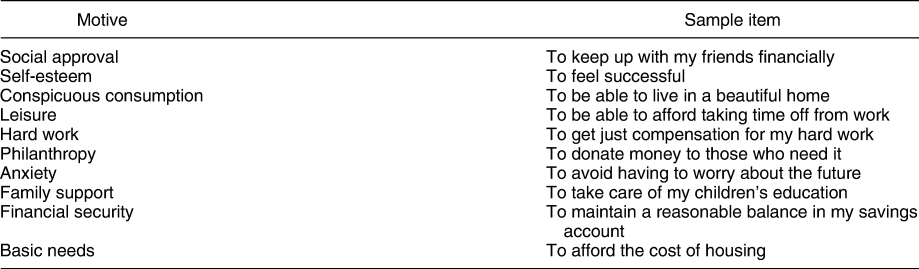
The Income Motives scale measures ten distinct motives for pursuing money, which I chose based on previous research to account for the most prevalent motives underlying individuals’ pursuit of money (e.g., Lea and Webley Reference Lea and Webley2006; Srivastava, Locke, and Bartol Reference Srivastava, Locke and Bartol2001; Zelizer Reference Zelizer1994). As shown in Table 1, the ten motives range from those at the top that implicate the pursuit of money to attain social status (e.g., Social Approval, Self-Esteem, and Conspicuous Consumption) to those at the bottom that implicate the pursuit of money to satisfy concrete material needs (e.g., Basic Needs, Financial Security, and Family Support).Footnote 5
Sample Items From Income Motives Scale

Note: Respondents to the scale are asked to “indicate how important each of the following is as a reason for you to make money.” See Appendix A.3.1 for the full list of items corresponding to each motive.
Respondents are asked to “indicate how important each of the following is as a reason for you to make money,” before responding to 10 subscales, each of which measures one of the ten motives. Each subscale consists of three items to avoid the measurement error that comes with single item measures. Each item is rated on a five-point scale from “not at all important” to “extremely important.” Table 1 shows example items from each subscale. The complete list of items is provided in the appendix, along with descriptive statistics (see Appendix A.3). Each of the 10 three-item subscales forms a reliable scale, with a minimum Cronbach’s α of 0.76 and an average Cronbach’s α of 0.84.
The measurement of Conspicuous Consumption deserves particular attention. Conspicuous Consumption refers to highly visible purchases that are meant to signal social status (Veblen Reference Veblen1899). Importantly, Conspicuous Consumption does not require that signaling social status be the sole motive behind a purchase. For example, I might desire to live in a beautiful home both for my own aesthetic pleasure and because it will signal my social status to my friends. To capture this latter dimension, I utilize research by Heffetz (Reference Heffetz2011), who uses survey data to measure the type of purchases that are most likely to be noticed by members of one’s own social class. The items measuring Conspicuous Consumption capture three types of consumption that Heffetz finds to be highly conspicuous within affluent social networks: living in a beautiful home, driving a nice car, and eating out at popular restaurants.Footnote 6
An additional concern is social desirability bias. Perhaps, respondents are unwilling to honestly report how important status is in motivating them to pursue money. In anticipation of this concern, I embedded a series of list experiments in the survey to gauge whether respondents’ descriptions of their motives are influenced by social desirability bias. The results from the list experiments indicate that social desirability bias is not affecting responses to the Income Motives scale (see Appendix A.3.4).
Construct Validation
Having measured these ten motivations, I next proceed to ask how they relate to one another. As discussed above, the scale is designed to capture motivations ranging from those that capture status motivation, such as Social Approval, Self-Esteem, and Conspicuous Consumption, to those that capture concrete motivation, such as Basic Needs, Financial Security, and Family Support. Reflecting the presence of these underlying dimensions in the data, several of the motives are highly correlated (see Appendix A.3.5 for the intermotive correlation matrix). I use principal component analysis (PCA) to account for the presence of redundancy in the scale as well as to uncover the underlying dimensions that account for variation in respondents’ motivations for increasing their income.
PCA is a procedure for extracting a smaller number of more meaningful variables, called principal components, from a larger set of correlated variables. These principal components are linear combinations of the original variables, which are constructed with the aim of explaining the largest amount of variance in the data with the fewest number of principal components. Principal components may thus be thought of as the underlying dimensions that account for variation in survey responses, in this case respondents’ self-reported motives for increasing their own income.
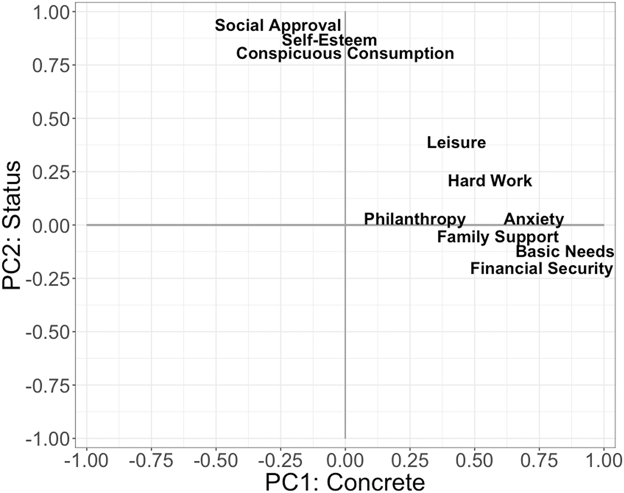
A promax-rotated PCA on the sample of affluent respondents yields two principal components that explain a substantial share of the variance in the affluent’s motivations for making money. Figure 1 maps the loadings of each variable on these two components (the exact loadings are also listed in Appendix A.3.6). The loadings represent the correlations between each of the variables and the estimated components. A component may therefore be substantively interpreted by examining the variables with which it is most highly correlated.
Results of Principal Component Analysis for Affluent Respondents
Note: Principal component analysis results for affluent respondents. The affluent’s desire for money can be separated into two distinct components: their desire to provide for the concrete material needs of their families (PC1) and their desire to achieve social status (PC2).

In line with my theory, the income motives cluster into two discrete categories, which help to define the two principal components. The first principal component, which I label Concrete, is defined by a cluster of motives including Basic Needs, Financial Security, Anxiety, and Family Support. This component, which captures 30% of the variance in the importance of money to affluent respondents, can thus be said to align with the concept of Concrete motivation, i.e., the desire for money to attain concrete material well-being. This component aligns closely with the existing view that the pursuit of money in politics is driven by the desire for “concrete economic benefits” (Sears and Funk Reference Sears and Funk1990, 248–50; Sears et al. Reference Sears, Lau, Tyler and Allen1980).Footnote 7
The second principal component, which I label Status, is defined by a cluster of motives including Social Approval, Self-Esteem, and Conspicuous Consumption. This component, which captures 25% of the variance in the importance of money to affluent respondents, can thus be said to align with the concept of Status motivation, i.e., the desire for money to achieve esteem. This component aligns with my alternative view that affluent Americans’ pursuit of money in politics is driven by the desire for social status.Footnote 8
Statistical Methods
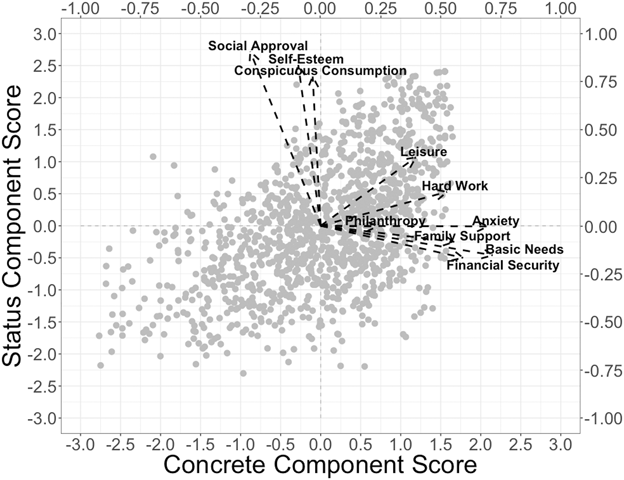
I analyze how affluent Americans’ income motives relate to their level of economic conservatism using principal component regression (PCR). PCR is an extension of ordinary least squares (OLS) in which the principal components from a PCA are included as independent variables. This is done by extracting principal component scores for each respondent in the sample for the Status and Concrete components of income motivation (see Appendix A.3.7 for details). These scores, which are visualized in Figure 2, have a mean of 0 and a standard deviation of 1 for both Status and Concrete motivation. I note that I find substantively indistinguishable results when I use other methods to extract measures of Status and Concrete motivation from the Income Motives scale, such as Exploratory Factor Analysis (see Appendix A.3.8).
Biplot with Affluent Respondents’ Component Scores on Status and Concrete Motivation
Note: Affluent respondents’ scores on the status and concrete components of income motivation. The top and right axes apply to the component loadings (and are the same as the x and y axes in Figure 1 above), while the bottom and left axes apply to respondents’ component scores, which are represented by grey circles.

The component scores visualized in Figure 2 are then entered as independent variables into the following OLS regression model, where Status i represents the respondent’s Status component score, Concrete i represents the respondent’s Concrete component score, and Xi is a vector of individual-level demographic controls:
 $${Y_i} = \alpha + {\beta _1}Statu{s_i} + {\beta _2}Concret{e_i} + {\bf{X}}_i^ \top {\bf{b}} + {\varepsilon _i}$$
The vector of controls Xi includes a range of variables that might be correlated with respondents’ scores on Status and Concrete motivation, as well as their economic policy preferences. First, I include an indicator variable for being a Male, where affluent men are coded 1 and affluent women are coded 0. This is a control variable in the baseline model. In subsequent models, I interact Male with the measures of Status and Concrete motivation. Second, I control for the Regional Cost of Living within the respondent’s state of residence using the Cost of Living Index.Footnote 9 Third, I control for race and ethnicity with indicator variables for Asian, Latino, Black, and Other, leaving White as the omitted category. Fourth, I control for age with indicator variables for Age 30–44 years, Age 45–54 years, and Age 55 years and older, leaving Age 18–29 years as the omitted category. Finally, I control for the highest level of educational attainment with indicator variables for College Degree and Graduate Degree, leaving Less Than a College Degree as the omitted category. To ensure comparability across coefficients, all nonbinary variables including the measures of Status and Concrete motivation are standardized by dividing by two times their standard deviations (Gelman Reference Gelman2008). This makes their coefficients interpretable as the effect of a two standard deviation increase in the level of the variable.
The appendix shows the main results without controls (see Appendix A.4.3). The findings are unchanged, suggesting they are not driven by the choice of control variables. The appendix also shows the main results when I control for partisanship, as well as economic factors including occupation, household income, and primary earner status. The main results are not affected by any of these controls (see Appendixes A.4.4 and A.4.5).
Results
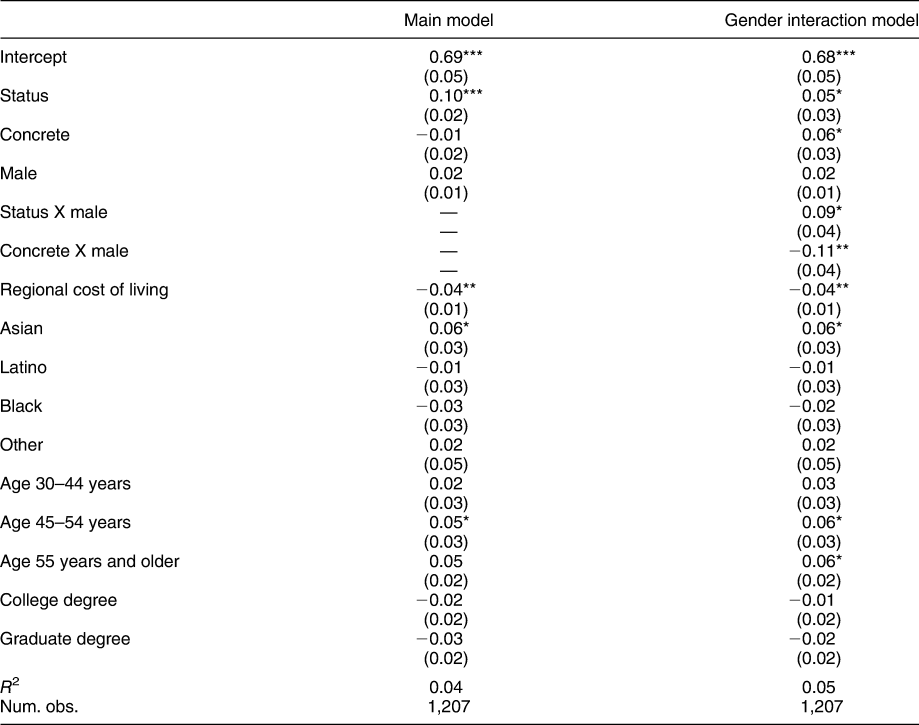
I begin by examining how affluent Americans’ scores on Status motivation and Concrete motivation relate to their level of economic conservatism. Column 1 of Table 2 shows results from the main model. The outcome is the Economic Conservatism Index, which averages together support for lowering taxes on the affluent, lowering taxes on capital gains, and reducing regulation of business and industry. I find that affluent Americans’ level of Status motivation is positively and significantly associated with their level of support for conservative economic policies. This aligns with my main hypothesis. In addition, there is no evidence of an association between affluent Americans’ level of Concrete motivation and their level of support for conservative economic policies.
OLS Regressions Predicting Affluent Americans’ Level of Economic Conservatism

Note: OLS regressions predicting support for conservative economic policies among affluent Americans. The outcome is coded to range from 0 for “strongly oppose” to 1 for “strongly favor.”
*** p < 0.001, ** p < 0.01, * p < 0.05 (two-sided).
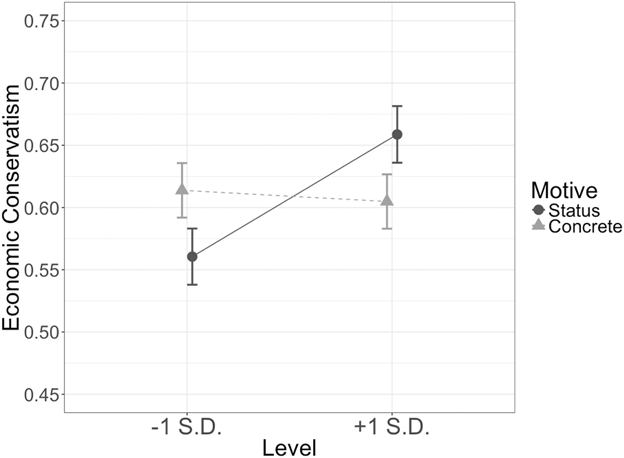
Figure 3 shows the magnitude of the effects based on the main model in Column 1 of Table 2. Examining predicted levels of economic conservatism when all other variables (including Concrete motivation) are held at their means, I find that an affluent American who is one standard deviation below the mean for Status motivation has a predicted score of 0.56 on the Economic Conservatism Index, while one who is one standard deviation above the mean for Status motivation has a predicted score of 0.66, a ten percentage point difference. By contrast, affluent Americans’ level of economic conservatism appears to be unaffected by their level of Concrete motivation. These results provide a first piece of evidence in favor of my main hypothesis that Status motivation leads affluent Americans to support conservative economic policies. In addition, I find that my status-based explanation for affluent Americans’ economic conservatism performs better than an alternative view based on Concrete motivation.
Association between Income Motives and Economic Conservatism for Affluent Respondents
Note: Predicted levels of economic conservatism at low (one standard deviation below the mean) and high (one standard deviation above the mean) levels of status and concrete motivation. Bars are 95% confidence intervals. Based on the regression analysis in Column 1 of Table 2.

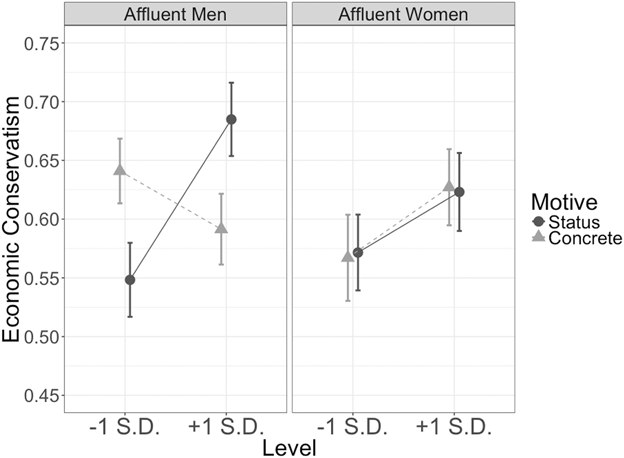
Next, I test my hypothesis that the effects of Status motivation will be stronger for affluent men. Column 2 of Table 2 shows the results from a model in which each of the income motives is interacted with an indicator variable for being a Male. In line with my theory, I observe a positive and significant interaction between Status motivation and being an affluent man.Footnote 10 Figure 4 shows how the predicted effect of Status motivation differs by gender. A two standard deviation increase in Status motivation is associated with a 14 percentage point increase in economic conservatism among affluent men. By contrast, a two standard deviation increase in Status motivation is associated with a 5 percentage point increase in economic conservatism among affluent women, which is less than half the size of the predicted effect for affluent men. These results provide initial evidence for my hypothesis that the desire for social status has larger conservatizing effects on the economic policy preferences of affluent men than it does on the economic policy preferences of affluent women. I also observe a negative and significant interaction between Concrete motivation and being an affluent man. Although I did not predict this negative interaction effect for Concrete motivation in advance, it does not conflict with my hypothesis about status motivation having larger effects on affluent men.
Results Shown Separately for Affluent Men and Affluent Women
Note: Predicted levels of economic conservatism at low and high levels of status and concrete motivation. Bars are 95% confidence intervals. Based on the regression analysis in Column 2 of Table 2.

Summary
These observational findings are consistent with my theory in which Status motivation leads affluent Americans—and affluent men in particular—to support conservative economic policies that serve their financial interests and increase inequality. As I report in the appendix, a placebo test shows that Status motivation is not associated with nonaffluent Americans’ level of support for economic policies that serve their financial interests (see Appendix A.5). Next, I seek to replicate the findings from Test 1 experimentally in the context of social media.
TEST 2: SOCIAL MEDIA EXPERIMENT
Test 2 provides an experimental test of my theory in the context of social media. Sites like Facebook, Instagram, and Twitter have emerged as increasingly important venues for affluent Americans to pursue social status. On these sites, affluent Americans pursue social status by sharing carefully curated versions of their lives that highlight their economic success and upper-class lifestyle. When affluent Americans share pictures from an expensive vacation on Instagram or news of a high-paying job offer on Facebook, they communicate to others that they are doing well in a society that is increasingly divided between “haves” and “have nots” (Marwick Reference Marwick2013; Williams Reference Williams2013). The frequency of status displays on social media makes it an ideal context for experimentally testing my theory about the effects of status motivation on affluent Americans’ political behavior.
My experiment focuses on Facebook, which is widely used by affluent Americans.Footnote 11 In the experiment, affluent Americans are randomly assigned to encounter Facebook posts in which others broadcast their economic success. These posts are designed in a way that encourages affluent respondents to view economic success as a means of achieving social status. After viewing these posts, respondents answer reinforcing questions that draw their attention to the theoretically important parts of the Facebook posts that I had manipulated. I expect that exposure to these posts will cause affluent Americans to become more supportive of conservative economic policies that benefit themselves financially and increase inequality. I also expect that exposure to these posts will cause especially large increases in economic conservatism among affluent men. These hypotheses and the analysis plan for this experiment were preregistered with the Evidence in Governance and Politics preregistration initiative before the analysis of the data. The pre-analysis plan is included in the appendix (see Appendix B.1).
Data
Test 2 uses a second original online survey (N = 3,096) that I conducted in January 2018. The survey consists of a main sample of affluent Americans (n = 2,010) and a secondary sample of nonaffluent Americans (n = 1,086). Like the data for Test 1, the data for Test 2 are also collected through the survey research firm Cint. As in Test 1, all affluent respondents in Test 2 have household incomes in the top 10% of the income distribution ($150,000 or more), and all nonaffluent respondents have household incomes below this threshold. The data used in Test 2 are approximately as representative of the population of affluent Americans as the data used in Test 1 (see Appendix B.2 for full details).
Experimental Design
At the beginning of the survey, respondents are randomly assigned to one of five conditions in which they view different kinds of Facebook posts. Table 3 provides a description of the five experimental conditions, including an example of the Facebook posts shown to respondents, a description of what was varied in the Facebook posts, and the number of respondents in the condition. As described further below, each respondent saw three Facebook posts similar to the examples shown in Table 3. In addition, although all the example posts in Table 3 show a male poster, the gender of the posters was randomized in the experiment such that respondents were as likely to see female posters as they were to see male posters.Footnote 12 The appendix shows a version of Table 3 with a female poster (see Appendix B.3.1).
Description of Experimental Conditions
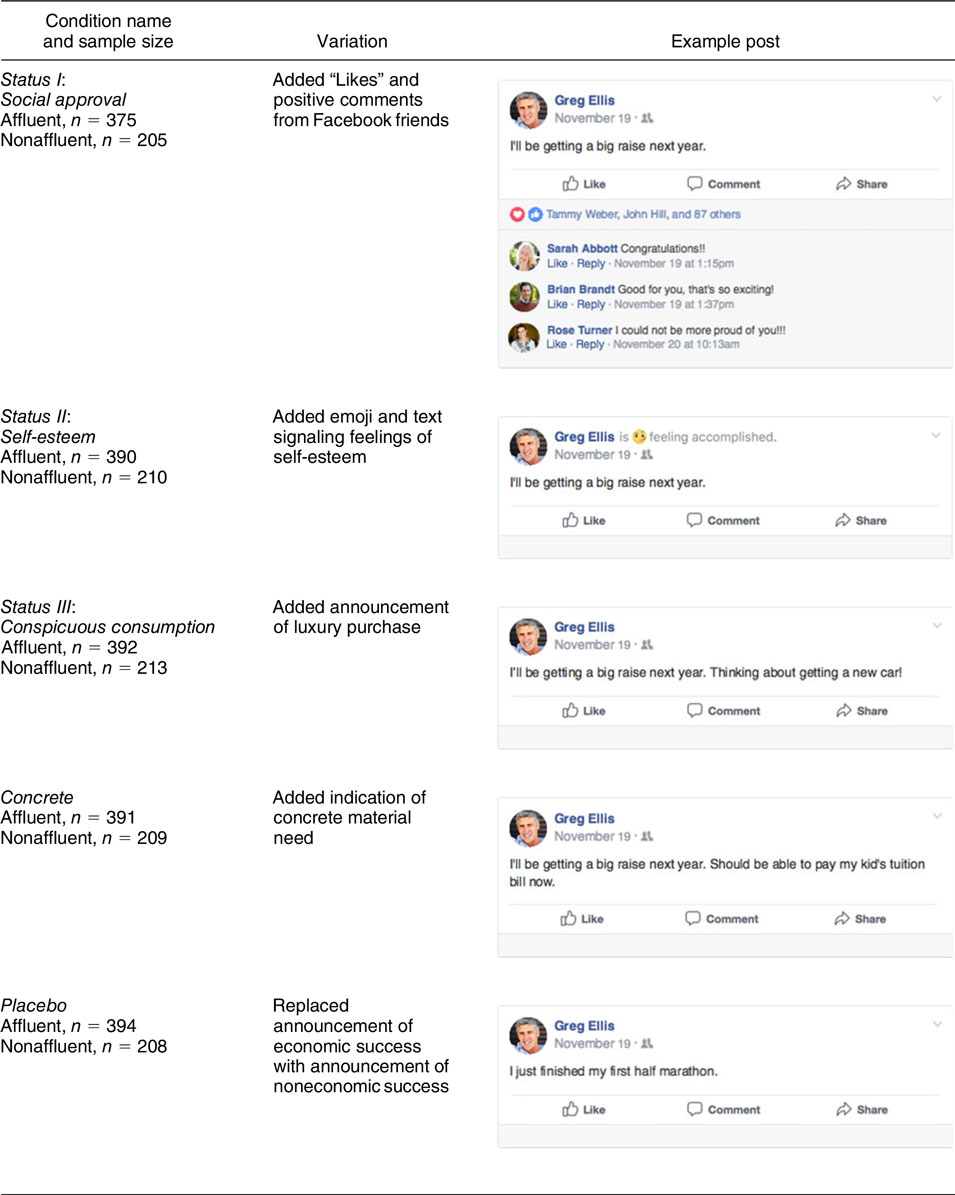
Note: Description of the five experimental conditions. The gender of the posters was randomized such that respondents were as likely to see female posters as they were to see male posters. As described further below, respondents in each condition saw three posts similar to the examples shown here (see Figure 5).
The example posts shown in Table 3 are all variations on a post in which a man named Greg Ellis (who does not actually exist) uses Facebook to announce an economic success: “I’ll be getting a big raise next year.”Footnote 13 Each of the conditions varies this basic post using features that are actually available on Facebook.
The first three Status posts encourage affluent respondents to view economic success as a means of achieving social status. They use features available on Facebook to show how economic success can lead to Social Approval, Self-Esteem, and Conspicuous Consumption, which are the three elements of status motivation that I observed in Test 1 (see Figure 1). In the Social Approval condition (Row 1 of Table 3), Greg Ellis’s announcement is accompanied by a high volume of “Likes,” as well as positive comments from Facebook friends. This post makes use of two features on Facebook—the “Like” button and comments section—that allow users to quantify how much social status they get in return for posting certain kinds of content (Marwick Reference Marwick2013). In the Self-Esteem condition (Row 2 of Table 3), Greg Ellis’s announcement is accompanied by text indicating that he is feeling positively about himself. This post makes use of a feature on Facebook that allows users to communicate how they are feeling as part of a status update. In this example, I make use of a preset option on Facebook that allows users to communicate that they are “feeling accomplished,” along with an emoji that Facebook designed to represent a person who is feeling accomplished. In the Conspicuous Consumption condition (Row 3 of Table 3), Greg Ellis’s announcement that he will be “getting a big raise next year” is accompanied by the additional announcement that Greg is “thinking about getting a new car.” Although buying a new car is sometimes considered an act of conspicuous consumption in and of itself (Lamont Reference Lamont1994, 64), it is clearly conspicuous consumption in this case as Greg is announcing it on Facebook. As Social Approval, Self-Esteem, and Conspicuous Consumption are all closely related elements of status motivation, I expect all three of these conditions to cause increases in affluent Americans’ level of support for conservative economic policies.
The fourth condition, which I label Concrete (Row 4 of Table 3), aligns with the alternative to my theory examined in Test 1: that affluent Americans are driven to support conservative economic policies by concrete motivation rather than status motivation. This condition encourages affluent respondents to view economic success as a means of meeting material needs. In the example Concrete post shown in Table 3, Greg Ellis’s announcement is accompanied by an indication that he will be using the money from his raise to fulfill a concrete material need, in this case paying his child’s tuition bill.Footnote 14 I do not expect this condition to cause an increase in affluent Americans’ level of support for conservative economic policies.
The effects of the four previous conditions are measured relative to a Placebo condition (Row 5 of Table 3). Respondents assigned to the Placebo condition see Facebook posts that are identical to those in the Status and Concrete conditions, with the exception that the active ingredient—the announcement of an economic success—has been removed and replaced by an announcement related to health and fitness. In the example Placebo post shown in Table 3, Greg Ellis’s announcement that he is “getting a big raise” has been replaced by an announcement that he has just finished his first half marathon. There is no established theoretical reason to expect that posts about health and fitness will affect the affluent’s level of support for conservative economic policies. As a consequence, respondents assigned to this condition can provide a baseline for measuring the effects of being assigned to the Status and Concrete conditions.
Experimental Procedure
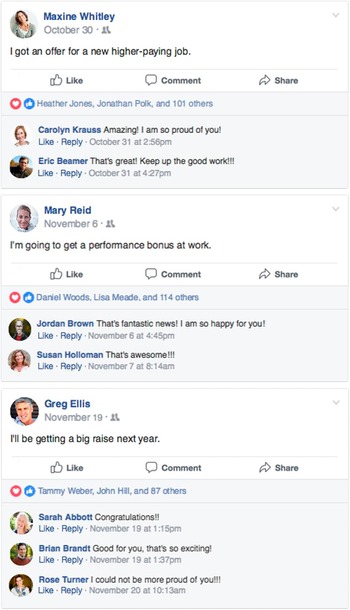
In the experiment itself, respondents saw three Facebook posts like those shown in the examples in Table 3. Figure 5 shows what respondents actually saw, using an example from the Social Approval condition. The appendix shows examples of what respondents saw in the other four conditions (see Appendix B.3.2).
Example of Respondent’s View of Social Approval Condition
Note: The following text appeared above the posts: “Please take a moment to study the Facebook posts below, which are taken from the Facebook pages of people living in your area. We will ask you some questions about these posts later on in the survey, so please pay careful attention to the details of each post.” The posters’ gender identity is randomized, such that respondents are as likely to see a majority of female posters as they are to see a majority of male posters.

After respondents viewed the Facebook posts, I asked them a series of three reinforcing questions that encouraged them to pay attention to the theoretically relevant parts of the Facebook post, and adopt the theoretically relevant motivation for making money. These questions focused on the praise the Facebook posters received from friends in the Social Approval condition, the Facebook posters’ positive feelings of self-worth in the Self-Esteem condition, the Facebook posters’ purchase of visible luxury goods in the Conspicuous Consumption condition, and the Facebook posters’ concrete material needs in the Concrete condition. Similar questions were asked in the Placebo condition as well to preserve symmetry across conditions.
For example, respondents in the Social Approval condition shown in Figure 5 were first asked, “What happened when the Facebook posters shared the news that they would soon be making more money?,” with the following response options, the first three of which are correct (respondents were allowed to select more than one): “They received ‘Likes’ from Facebook friends,” “They received positive comments from Facebook friends,” “Their Facebook friends were proud of what they had accomplished,” and “None of the above.” This question draws respondents’ attention to the specific parts of the post that I had manipulated, which is the presence of “Likes” and positive comments from Facebook friends in the Social Approval condition.
Next, respondents in the Social Approval condition were asked two linked questions that asked them to think about which members of their own social network would be proud of them if they were to announce an economic success. The first of these questions asks respondents to do the following: “Imagine you learned that you are about to start making more money. Please provide the first names of several people who would be proud of you if you told them about it.” Respondents entered three names, which were then piped into the following question: “In 2–3 sentences please tell us why [Person 1], [Person 2], and [Person 3] would feel proud of you if you told them that you are about to start making more money.”Footnote 15 Respondents then provided their answer in a text box. The appendix provides the wording of the reinforcing questions asked to respondents in the other four conditions (see Appendix B.3.3). These reinforcing questions were designed to be as similar as possible across conditions, while still drawing respondents’ attention to the theoretically relevant parts of the condition to which they were randomly assigned.
Dependent Variable: Economic Conservatism
After viewing the Facebook posts and answering the reinforcing questions, respondents were asked about their views of conservative economic policies with the same three policy measures used in Test 1. These include support for decreasing “taxes on households making $150,000 or more a year,” support for decreasing the “taxes on money people make from selling investments, also referred to as capital gains,” and support for decreasing “government regulation of business and industry.” All three items have the same response options, which are coded to range from 0 (the most liberal response) to 1 (the most conservative response): “strongly oppose” (0), “somewhat oppose” (0.25), “neither favor nor oppose” (0.5), “somewhat favor” (0.75), and “strongly favor” (1). The three items are averaged together to form the Economic Conservatism Index (Cronbach’s α = 0.73). Of the 3,096 respondents who were assigned to a condition at the beginning of the survey, only 4% dropped out before completing these outcome measures at the end of the experiment. The appendix provides further details on attrition (see Appendix B.4).
Statistical Methods
The main analysis measures the effects of the three Status conditions and the Concrete condition relative to the Placebo condition.Footnote 16 I perform this analysis with an OLS model that regresses the Economic Conservatism Index on indicator variables for being randomly assigned to the Conspicuous Consumption, Self-Esteem, Social Approval, and Concrete conditions, leaving the Placebo condition as the omitted category. In line with my hypothesis that the desire for social status causes affluent Americans to become more supportive of conservative economic policies, I expect that the three Status conditions will increase affluent Americans’ level of economic conservatism relative to the Placebo condition. By contrast, I do not expect the Concrete condition to increase affluent Americans’ level of economic conservatism relative to the Placebo condition.
The secondary analysis measures the effects of the three Status conditions relative to the Concrete condition. I perform this analysis with an OLS model that regresses the Economic Conservatism Index on indicator variables for being randomly assigned to the Conspicuous Consumption, Self-Esteem, and Social Approval conditions, leaving the Concrete condition as the omitted category. In line with my hypothesis that status motivation is a more powerful influence on affluent Americans’ level of economic conservatism than concrete motivation, I expect that the three Status conditions will increase affluent Americans’ level of economic conservatism relative to the Concrete condition. As described in my pre-analysis plan, one-sided hypothesis tests are used in these analyses, given my strong a priori expectation of positive effects of the Status conditions relative to the Placebo and Concrete conditions.
Results
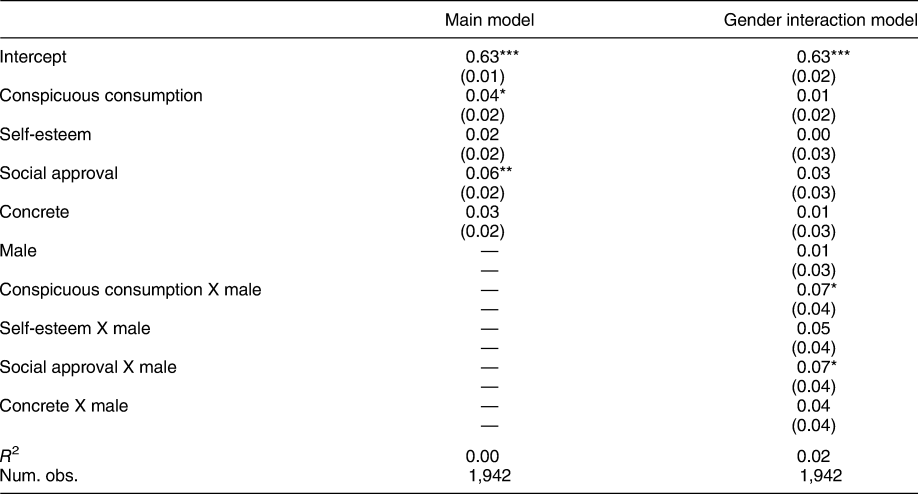
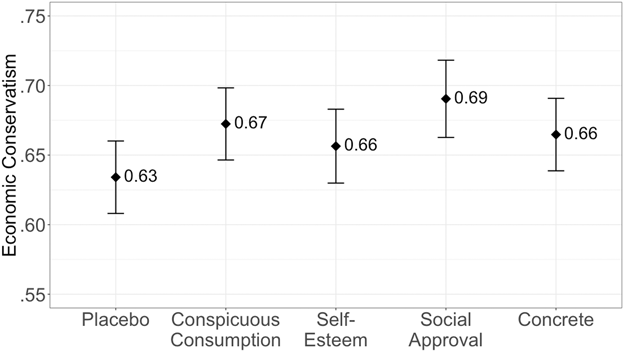
Column 1 of Table 4 shows the results of the main analysis for affluent respondents, which measures the effects of the three Status conditions and the Concrete condition relative to the Placebo condition. Figure 6 visualizes the differences in means across the five conditions with 95% confidence intervals. Aligning with my expectations, two of the three Status treatments—Conspicuous Consumption and Social Approval—cause affluent Americans to become more economically conservative. When affluent respondents view the Conspicuous Consumption posts, in which economically successful posters publicly broadcast their intention to buy expensive goods, it causes a statistically significant four-percentage point increase (p < 0.05) in their level of economic conservatism. When affluent respondents view the Social Approval posts, in which economically successful posters are rewarded with ‘Likes’ and positive comments from Facebook friends, it causes a statistically significant six-percentage point increase (p < 0.01) in their level of economic conservatism. By contrast, the third Status treatment—Self-Esteem—fails to have a statistically significant treatment effect, which is contrary to my expectations.Footnote 17 On balance, the finding that two of the three Status treatments have significant positive effects supports my main hypothesis that the desire for social status causes affluent Americans to become more economically conservative.Footnote 18
Effects of Treatments on Affluent Americans’ Level of Economic Conservatism

Note: OLS regression predicting support for conservative economic policies among affluent Americans. Responses are coded to range from 0 for “strongly oppose” to 1 for “strongly favor.” The coefficients represent the causal effects of being assigned to each condition relative to the Placebo condition.
*** p < 0.001, ** p < 0.01, * p < 0.05 (one-sided).
Mean Level of Support for Conservative Economic Policies Across Conditions
Note: Mean levels of economic conservatism among affluent respondents. Bars are 95% confidence intervals. The Conspicuous Consumption and Social Approval conditions have significant effects relative to the Placebo.

In addition to hypothesizing that the desire for social status would cause affluent Americans to become more economically conservative, I also hypothesized that status motivation would outperform concrete motivation as an explanation for affluent Americans’ economic conservatism. Although the Concrete condition does not have a statistically significant effect relative to the Placebo condition in Column 1 of Table 4, that tells us little about whether the effects of the Status conditions are larger than the effects of the Concrete condition. To assess this possibility directly, I ask whether any of the Status conditions significantly increased economic conservatism relative to the Concrete condition (see regression results in Appendix B.5). Contrary to my expectations, none of the Status conditions has statistically significant effects relative to the Concrete condition.Footnote 19 These results do not support my hypothesis that status motivation is a more powerful influence on affluent Americans’ level of economic conservatism than concrete motivation.
Next, I ask whether these results persist for respondents with especially high incomes.Footnote 20 This question is important to consider, given that political influence tends to increase as income rises (e.g., Page and Gilens Reference Page and Gilens2017). I focus here on the results among respondents in the top 5% of the income distribution, all of whom have household incomes of at least $250,000 a year (n = 475). When I analyze this more affluent subset, the results become substantially stronger (see regression results on Appendix B.7.6). This is especially the case when the Concrete condition serves as the baseline. Among the top 5%, the Conspicuous Consumption and Social Approval conditions both have statistically significant effects relative to the Concrete condition of eight (p < 0.05) and twelve (p < 0.01) points, respectively.Footnote 21 This exploratory analysis suggests that status motivation is a more powerful influence on economic conservatism than concrete motivation among affluent Americans with especially high incomes.
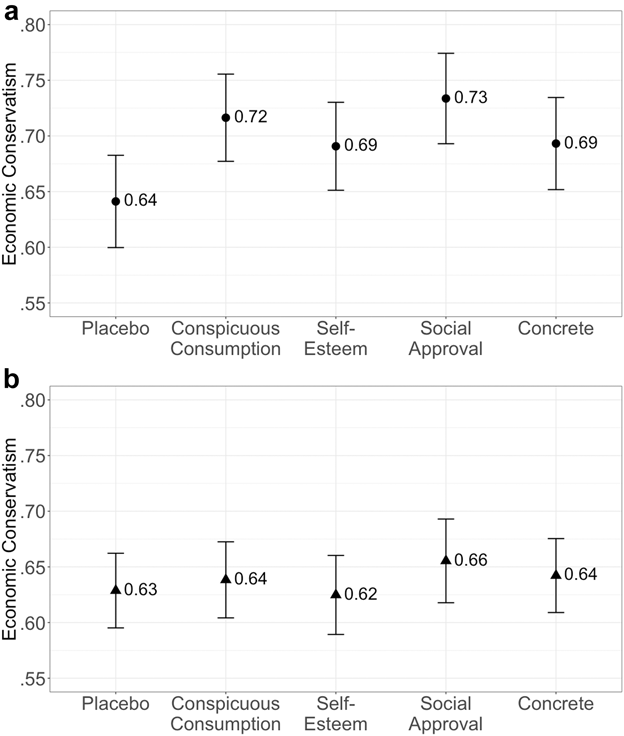
Finally, I ask whether the effects differ by gender. Column 2 of Table 4 interacts each condition with an indicator variable for being a Male, where affluent males are coded 1 and affluent females are coded 0. Aligning with my predictions, I observe positive and significant interaction effects for the Conspicuous Consumption and Social Approval conditions. The effects of both of these treatments are seven points stronger among affluent men than they are among affluent women. Figure 7 visualizes the results separately for affluent men (panel a) and affluent women (panel b). The Conspicuous Consumption and Social Approval conditions have effects of eight points (p < 0.01) and nine points (p < 0.001) respectively on affluent men, but no effects on affluent women. These findings provide further evidence that the desire for social status triggers especially large increases in economic conservatism among affluent men, who are vastly overrepresented in positions of power.Footnote 22
Results for Affluent Men and Affluent Women
Note: Mean levels of economic conservatism among affluent men and affluent women. Bars are 95% confidence intervals. The effects of the Conspicuous Consumption and Social Approval conditions relative to the Placebo condition are significantly stronger among affluent men.

Summary
Tests 1 and 2 produce remarkably similar results. My primary hypothesis is that the desire for social status causes affluent Americans to become more economically conservative. In support of this hypothesis, Test 1 found that Status motivation is positively associated with affluent Americans’ level of economic conservatism, and Test 2 found that two of the three Status treatments—Social Approval and Conspicuous Consumption—cause affluent Americans to become more economically conservative.
In addition, I hypothesized that status motivation would outperform concrete motivation as an explanation for affluent Americans’ economic conservatism. In support of this hypothesis, Test 1 found that Status motivation is more strongly associated with affluent Americans’ level of economic conservatism than Concrete motivation. Test 2 found no significant differences between the Status and Concrete treatments in the pre-registered analysis, though an exploratory analysis found large differences in the expected direction among respondents in the top 5%. These results do not uniformly support my hypothesis that status motivation is a more powerful influence on affluent Americans’ level of economic conservatism than concrete motivation. Yet both tests provide some support for this hypothesis, with Test 2 suggesting that status motivation has larger conservatizing effects than concrete motivation among affluent Americans with very high incomes.
Finally, I hypothesized that the desire for social status would have larger conservatizing effects on the economic policy preferences of affluent men than it does on the economic policy preferences of affluent women. In support of this hypothesis, Test 1 found evidence that Status motivation is more strongly associated with economic conservatism among affluent men, and Test 2 found that two of the three Status treatments have larger conservatizing effects on affluent men.
As this comparison demonstrates, there is a remarkable similarity between the results of Tests 1 and 2. In particular, both provide evidence that the desire for social status causes affluent Americans—and affluent men in particular—to support conservative economic policies that benefit themselves financially and increase inequality. In further alignment with the results of Test 1, a placebo test shows that the Status treatments in Test 2 do not cause nonaffluent Americans to support policies that serve their financial interests (see Appendix B.9).
Based on the results for affluent respondents, one may wonder if the same effects observed in the experiment occur as affluent Americans use Facebook in their daily lives. There are reasons to expect that this is the case. For example, the kinds of posts used in the experiment—which include posts announcing career successes and posts announcing health and fitness accomplishments—occur commonly on Facebook (Marshall, Lefringhausen, and Ferenczi Reference Marshall, Lefringhausen and Ferenczi2015, 37). Yet there are other ways in which the experimental context is dissimilar to what affluent Americans are likely to actually experience on Facebook. For example, respondents are being shown posts from strangers, rather than personal acquaintances. In the appendix I conduct an observational analysis to assess whether the effects observed in the experiment might occur as affluent Americans use Facebook in their daily lives. I find evidence that this is the case: as the amount of time affluent Americans spend on Facebook increases, so too does their level of Status motivation, as well as their level of support for conservative economic policies (see Appendix B.10).
CONCLUSION
Affluent Americans hold a disproportionate share of political power in the United States. When they use this power to pursue conservative economic policies that serve their financial interests, it facilitates rising economic inequality (e.g., Bartels Reference Bartels2008).
Building off Thorstein Veblen’s Theory of the Leisure Class (Reference Veblen1899), I argue that the desire for social status is an important and unrecognized reason why affluent Americans support conservative economic policies that benefit themselves financially and increase inequality. I then subject this theory to a series of rigorous observational and experimental tests. First, I design a new survey scale to measure affluent Americans’ desire for social status, a process that includes the use of list experiments to detect social desirability bias. Using this scale, I demonstrate a positive relationship between affluent Americans’ desire for social status and their level of support for conservative economic policies. Second, I report the results of an experiment in which affluent Americans are randomly assigned to encounter Facebook posts in which others announce their economic success. When these posts show social approval flowing to the economically successful in the form of “Likes” and positive comments from Facebook friends, or the economically successful engaged in acts of conspicuous consumption, they cause affluent Americans to become more economically conservative.
The substantive importance of these findings is enhanced by observational and experimental evidence that affluent men are particularly likely to pursue money through politics out of a desire for social status. Affluent men are far more likely than others to make large campaign contributions during elections, lead the corporations and interest groups that lobby government, and serve in elected office. The evidence produced here suggests that the desire for social status causes affluent men to use this political power in ways that benefit themselves financially and increase inequality. These results align with prior qualitative research suggesting that status competition within affluent communities, as well as its consequences for the rest of society, are driven by affluent men (Lamont Reference Lamont1994; Veblen Reference Veblen1899). In addition, these results imply that gender inequalities in political and economic leadership have substantial potential consequences for the behavior of America’s financial elite. In particular, men in positions of influence may be more willing to use their power as a means of increasing their own social status than women would be if they were in the same positions (see also Kennedy and Kray Reference Kennedy and Kray2014).
By testing my theory in the context of Facebook, I also provide a new perspective on the political effects of social media. While political scientists are increasingly concerned about the political effects of Facebook and other social media sites, they have not considered how social media might shape the politics of inequality. I take an important step toward addressing this gap in knowledge in Test 2, where I provide experimental and observational evidence that affluent Americans become more economically conservative when they are exposed to evidence of others’ success on social media. This represents the first evidence to my knowledge that social media encourages political behaviors that are conducive to rising inequality.
As a whole, my analysis provides new insight into the politics driving rising inequality in the United States. When affluent Americans use their political power to pursue conservative economic policies that lower their own taxes and decrease government regulation, they facilitate rising inequality (e.g., Bonica et al. Reference Bonica, McCarty, Poole and Rosenthal2013). Despite the importance of this political behavior for politics, the economy, and society, few studies have considered its origins. I fill this gap by demonstrating that the desire for social status causes affluent Americans to become more supportive of conservative economic policies. Were it not for their desire for social status, affluent Americans would be far less likely to use their political power in ways that increase inequality.
SUPPLEMENTARY MATERIAL
To view supplementary material for this article, please visit https://doi.org/10.1017/S0003055419000893.
Replication materials can be found on Dataverse at: https://doi.org/10.7910/DVN/GL2WN8.





Comments
No Comments have been published for this article.