Introduction
Cannabis is the most widely used illicit substance (United Nations Office on Drugs and Crime, 2013). Cannabis use can induce transient psychotic symptoms in healthy people (Bhattacharyya et al. Reference Bhattacharyya, Crippa, Allen, Martin-Santos, Borgwardt, Fusar-Poli, Rubia, Kambeitz, O'Carroll, Seal, Giampietro, Brammer, Zuardi, Atakan and McGuire2012b ) and exacerbate pre-existing psychotic symptoms in people with schizophrenia (e.g. Grech et al. Reference Grech, van Os, Jones, Lewis and Murray2005). Longitudinal studies in the general population indicate that cannabis use in adolescence or young adulthood is associated with the later development of psychotic-like symptoms and psychosis (Casadio et al. Reference Casadio, Fernandes, Murray and Di Forti2011) and it has been estimated that cannabis use is associated with a 40% increased risk of subsequently developing psychosis (Moore et al. Reference Moore, Zammit, Lingford-Hughes, Barnes, Jones, Burke and Lewis2007). However, whether the association between cannabis and psychosis is causal remains unconfirmed. Psychosis vulnerability might predispose people to cannabis use; indeed, it has been suggested that people use cannabis in an effort to cope with psychotic symptoms (‘self-medication’; Hall & Degenhardt, Reference Hall and Degenhardt2000). Cannabis use could also be a proxy marker for other psychosis risk factors, such as social isolation, psychosocial stress or trauma (Macleod et al. Reference Macleod, Oakes, Copello, Crome, Egger, Hickman, Oppenkowski, Stokes-Lampard and Davey Smith2004; Gage et al. Reference Gage, Zammit and Hickman2013).
The effect of cannabis use on psychosis risk appears to be modulated by several factors: the age at first use, the pattern of use, existing psychosis vulnerability, and genotype (Casadio et al. Reference Casadio, Fernandes, Murray and Di Forti2011). Epidemiological studies have found that initiation of cannabis use during adolescence is associated with an increased risk of developing psychosis (Arseneault et al. Reference Arseneault, Cannon, Poulton, Murray, Caspi and Moffitt2002; Konings et al. Reference Konings, Henquet, Maharajh, Hutchinson and van Os2008), while studies of people with established psychosis indicate that early cannabis use is related to earlier onset (Stefanis et al. Reference Stefanis, Dragovic, Power, Jablensky, Castle and Morgan2013; Tosato et al. Reference Tosato, Lasalvia, Bonetto, Mazzoncini, Cristofalo, De Santi, Bertani, Bissoli, Lazzarotto, Marrella, Lamonaca, Riolo, Gardellin, Urbani, Tansella and Ruggeri2013). A dose–response relationship between the pattern of use and psychotic symptoms or psychosis has also been reported, with heavier use increasing the risk (van Os et al. Reference van Os, Bak, Hanssen, Bijl, de Graaf and Verdoux2002; Di Forti et al. Reference Di Forti, Morgan, Dazzan, Pariante, Mondelli, Marques, Handley, Luzi, Russo, Paparelli, Butt, Stilo, Wiffen, Powell and Murray2009). Continued use after the onset of psychosis is linked to poorer outcomes (Gonzalez-Pinto et al. Reference Gonzalez-Pinto, Alberich, Barbeito, Gutierrez, Vega, Ibanez, Haidar, Vieta and Arango2011; Stone et al. Reference Stone, Fisher, Major, Chisholm, Woolley, Lawrence, Rahaman, Joyce, Hinton, Johnson and Young2014). Several studies have found that cannabis is more likely to be associated with psychosis-like experiences in people who have an existing predisposition, on account of having subclinical psychotic experiences (van Os et al. 2002; Henquet et al. Reference Henquet, Krabbendam, Spauwen, Kaplan, Lieb, Wittchen and van Os2005) or a family history of psychosis (Miller et al. Reference Miller, Lawrie, Hodges, Clafferty, Cosway and Johnstone2001; Stowkowy & Addington, Reference Stowkowy and Addington2013). There is also increasing evidence for a gene–environment interaction, with the likelihood of people who have used cannabis having psychosis or psychotic-like experiences being influenced by variation in genes such as catechol-O-methyltransferase (COMT) and protein kinase B (AKT1) (Caspi et al. Reference Caspi, Moffitt, Cannon, McClay, Murray, Harrington, Taylor, Arseneault, Williams, Braithwaite, Poulton and Craig2005; van Winkel et al. Reference van Winkel2011; Di Forti et al. Reference Di Forti, Iyegbe, Sallis, Kolliakou, Falcone, Paparelli, Sirianni, La Cascia, Stilo, Marques, Handley, Mondelli, Dazzan, Pariante, David, Morgan, Powell and Murray2012).
People at ultra-high risk (UHR) for psychosis are an ideal clinical group in which to investigate the putative role of cannabis use in the onset of psychosis, as 20–35% will develop the disorder within a few years following clinical presentation (Yung et al. Reference Yung, Phillips, McGorry, McFarlane, Francey, Harrigan, Patton and Jackson1998; Fusar-Poli et al. Reference Fusar-Poli, Bonoldi, Yung, Borgwardt, Kempton, Valmaggia, Barale, Caverzasi and McGuire2012). To date, studies of substance use in this population have reported inconsistent findings and few have investigated cannabis specifically in relation to psychosis onset (Addington et al. Reference Addington, Case, Saleem, Auther, Cornblatt and Cadenhead2013). Phillips et al. (Reference Phillips, Curry, Yung, Yuen, Adlard and McGorry2002) and Auther et al. (Reference Auther, McLaughlin, Carrion, Nagachandran, Correll and Cornblatt2012) investigated cannabis use in large samples of people at high risk (n = 100 and n = 101, respectively) but did not find a significant difference in transition to psychosis between cannabis users and non-users. However, in a smaller sample (n = 48), Kristensen & Cadenhead (Reference Kristensen and Cadenhead2007) found that UHR participants who met diagnostic criteria for cannabis abuse or dependence were more likely to develop psychosis than those who had never used or used only minimally. These inconsistencies highlight the need for further work in UHR samples in order to understand the role of cannabis use in the onset of psychosis (van der Meer et al. Reference van der Meer, Velthorst, Meijer, Machielsen and de Haan2012).
Our first aim in this study was to determine the relationship between cannabis use and transition to psychosis in a large sample of people who were identified as UHR and then followed clinically for 2 years. Our second aim was to establish whether the putative effect of cannabis use was influenced by the age at first use, the pattern of use and genetic vulnerability for psychosis. Our primary hypothesis was that cannabis use in people who were already at UHR would be associated with transition to psychosis. Our secondary hypotheses were that this effect would be particularly evident in participants who were frequent cannabis users, had started at an early age, continued using cannabis during the UHR phase, or had a family history of psychosis.
Method
Participants
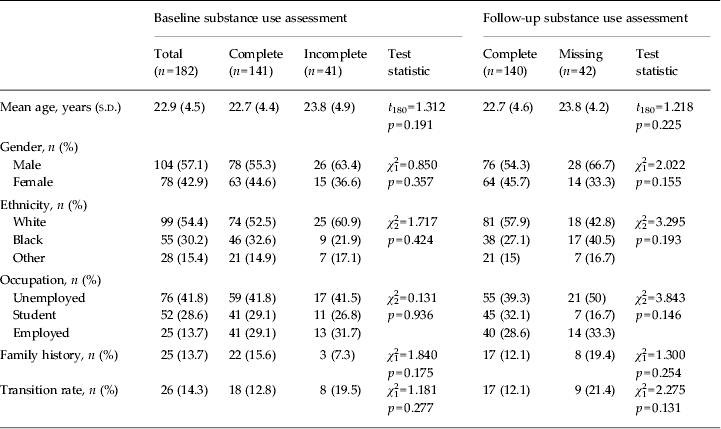
Participants (n = 182) were individuals who met the Personal Assessment and Crisis Evaluation (PACE) UHR criteria (Yung et al. Reference Yung, Phillips, McGorry, McFarlane, Francey, Harrigan, Patton and Jackson1998), through Outreach and Support in South London (OASIS), a clinical service for people at UHR for psychosis (Fusar-Poli et al. Reference Fusar-Poli, Bonoldi, Yung, Borgwardt, Kempton, Valmaggia, Barale, Caverzasi and McGuire2012). OASIS offers treatment to individual who meet one or more of the following: (i) attenuated positive psychotic symptoms; (ii) a brief psychotic episode lasting less than 1 week that resolved without antipsychotic medication (brief limited intermittent psychosis); and/or (iii) trait vulnerability (defined as the individual having either schizotypal personality disorder or a first-degree relative with a psychotic disorder) coupled with a recent decline in function. Use of substances is not considered an exclusion criterion. Demographic and clinical characteristics of the participants are presented in Table 1.
Demographic and clinical characteristics of the total sample and comparison of the complete and incomplete/missing subsamples

s.d., Standard deviation.
Baseline assessment of substance use
A modified version of the Cannabis Experience Questionnaire (Barkus et al. Reference Barkus, Stirling, Hopkins and Lewis2006), administered as an interview, was used to obtain information on lifetime use of cannabis, stimulants [e.g. amphetamine, ecstasy and 3,4-methylendioxymethamphetamine (MDMA)], cocaine, hallucinogens [e.g. lysergic acid diethylamide (LSD), mushrooms], inhalants (e.g. poppers, solvents), crack, opioids (e.g. heroin, morphine) and sedatives (e.g. Valium, sleeping pills). When use of a substance was reported, participants were asked in detail about current use, age of first (and last) use, and the frequency and duration of use for that substance. Participants were defined as being current users of a substance if they identified as such or if they reported any use in the preceding month. For each substance, the frequency (using Phillips et al. Reference Phillips, Curry, Yung, Yuen, Adlard and McGorry2002) and duration (using Di Forti et al. Reference Di Forti, Morgan, Dazzan, Pariante, Mondelli, Marques, Handley, Luzi, Russo, Paparelli, Butt, Stilo, Wiffen, Powell and Murray2009) of use data were recoded into dichotomous variables to allow sufficient power for statistical comparisons. Phillips et al. (Reference Phillips, Curry, Yung, Yuen, Adlard and McGorry2002) defined frequent use as once per week or more and infrequent use as less than once per week. Di Forti et al. (Reference Di Forti, Morgan, Dazzan, Pariante, Mondelli, Marques, Handley, Luzi, Russo, Paparelli, Butt, Stilo, Wiffen, Powell and Murray2009) defined long-term use as 5 years or more and short-term use as less than 5 years. Early-onset cannabis use was defined as use beginning before the age of 15 years (Arseneault et al. Reference Arseneault, Cannon, Poulton, Murray, Caspi and Moffitt2002). Lifetime users of cannabis were asked additional questions about unpleasant experiences associated with cannabis use. Past users of cannabis were asked an open-ended question about why they had chosen to stop their use (‘If you are no longer using cannabis, why did you stop?’). A further assessment of substance use was performed in order to determine rates of continued use during the clinical follow-up period, as well as any incident use or changes to patterns of use.
In a minority of participants (n = 41, 22.5%), it was not possible to complete all of the baseline substance use measures. The records for these individuals are missing some items relating to patterns of substance use, reasons for stopping cannabis use, or unpleasant experiences associated with cannabis use. Information on continued substance use was not available for 42 (23.1%) participants. The sample size available for each analysis thus varied depending on the completeness of the data for each measure. The missing information was due to non-attendance of appointments or disengagement from the clinical service. There were no statistically significant demographic or clinical differences between participants with complete and incomplete or missing data (Table 1).
Clinical follow-up
All 182 participants were followed up by OASIS for at least 2 years after presentation to determine whether or not transition to psychosis had occurred. Of the participants, 26 (14.3%) developed psychosis during this time.
Statistical analysis
Statistical analyses were performed using SPSS version 22 (IBM, USA). Two-tailed Pearson χ 2 and independent-samples t tests were used to investigate demographic and clinical differences according to completeness of record and substance use status. Two-tailed Pearson χ 2 tests and Kaplan–Meier survival analysis censored at 24 months from presentation to OASIS were used to explore differences in the rate of transition to psychosis in relation to baseline substance use and continued use during follow-up.
Ethics
Participants provided informed consent and the study was approved by the local research ethics committee.
Results
Substance use
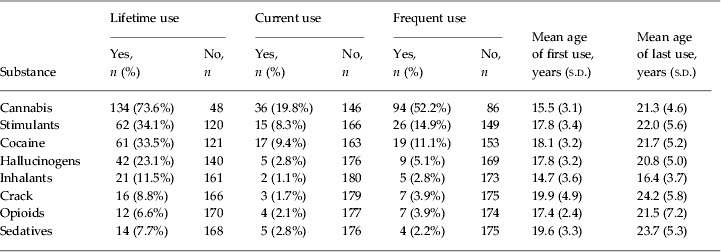
At the time of the baseline assessment, 136 of the 182 participants (74.7%) had used an illicit substance on at least one occasion and 51 participants (28.0% of the total sample; 37.5% of substance users) were currently using an illicit substance. Use of two or more substances was reported by 78 participants (42.9% of the total sample; 57.4% of substance users). The prevalence and patterns of use for each type of substance are presented in Table 2.
Number of participants of the sample reporting lifetime, current, and frequent use for each substance/group of substances and the mean age of first and last use for users of each substance/group of substances

s.d., Standard deviation.
Cannabis was the most commonly used substance, with 73.6% of the sample having tried it at least once. Half reported using cannabis at a frequency of at least once per week (52.2%). About a quarter of lifetime cannabis users were currently using it at the time of presentation (26.9%). The mean duration of cannabis use was 6.0 years (s.d. = 4.6, range 0–20) and long-term use (i.e. more than 5 years) was reported by 54 participants (30.7% of the sample).
Lifetime use of stimulants and cocaine was reported by about a third of the sample (34.1% and 33.5%, respectively). The rates of frequent use of these and other substances ranged between 2% and 15%. No more than 10% of the sample reported current use of substances other than cannabis.
Female participants were less likely to have tried cannabis than male participants (62.8% v. 79.8%, respectively; χ 2 1 = 6.455, p = 0.011). No other differences in substance use were associated with demographic characteristics.
Adverse effects of cannabis use and reasons for cessation of use
Of the 155 lifetime cannabis users, 88 (76.5%) reported unpleasant experiences whilst using cannabis. Psychotic-like experiences (paranoia, hearing voices, having visions) were the most common, reported by 79 people (67.5%; see Fig. 1 for details of other adverse experiences). The majority of past cannabis users stopped because of unpleasant experiences (46 of 74 past users; 62.2%). Typical responses included: ‘it made me more paranoid’, ‘I had panic attacks and paranoia – it sent me really weird’ and ‘it made my symptoms worse’. The remainder stopped because of a lack of positive effects (‘it didn't do anything for me’; ‘it stopped being enjoyable’) or for practical or social reasons (‘I didn't want to keep spending the money’; ‘I moved away and changed my social situation … left it behind’).
Unpleasant experiences associated with cannabis use in ultra-high-risk participants (n = 115). The chart shows the percentage of cannabis users who reported adverse effects.

Continued substance use during the follow-up period
Of the 140 participants whose substance use was reassessed, 111 (79.3%) reported no change in their substance use: 37 non-users, 56 past users, and 18 current users remained as such. Twelve individuals who were current substance users at baseline had ceased their use during the follow-up period, while nine of the baseline past users subsequently resumed their substance use. Continued use of cannabis was reported by 31 individuals. Only eight (5.7%) participants started using a new substance after the baseline assessment: cannabis was tried by two people who had never used substances previously, while stimulants were tried by four individuals, cocaine by two, and hallucinogens by two, all of whom had previously used other substances.
Substance use and transition to psychosis
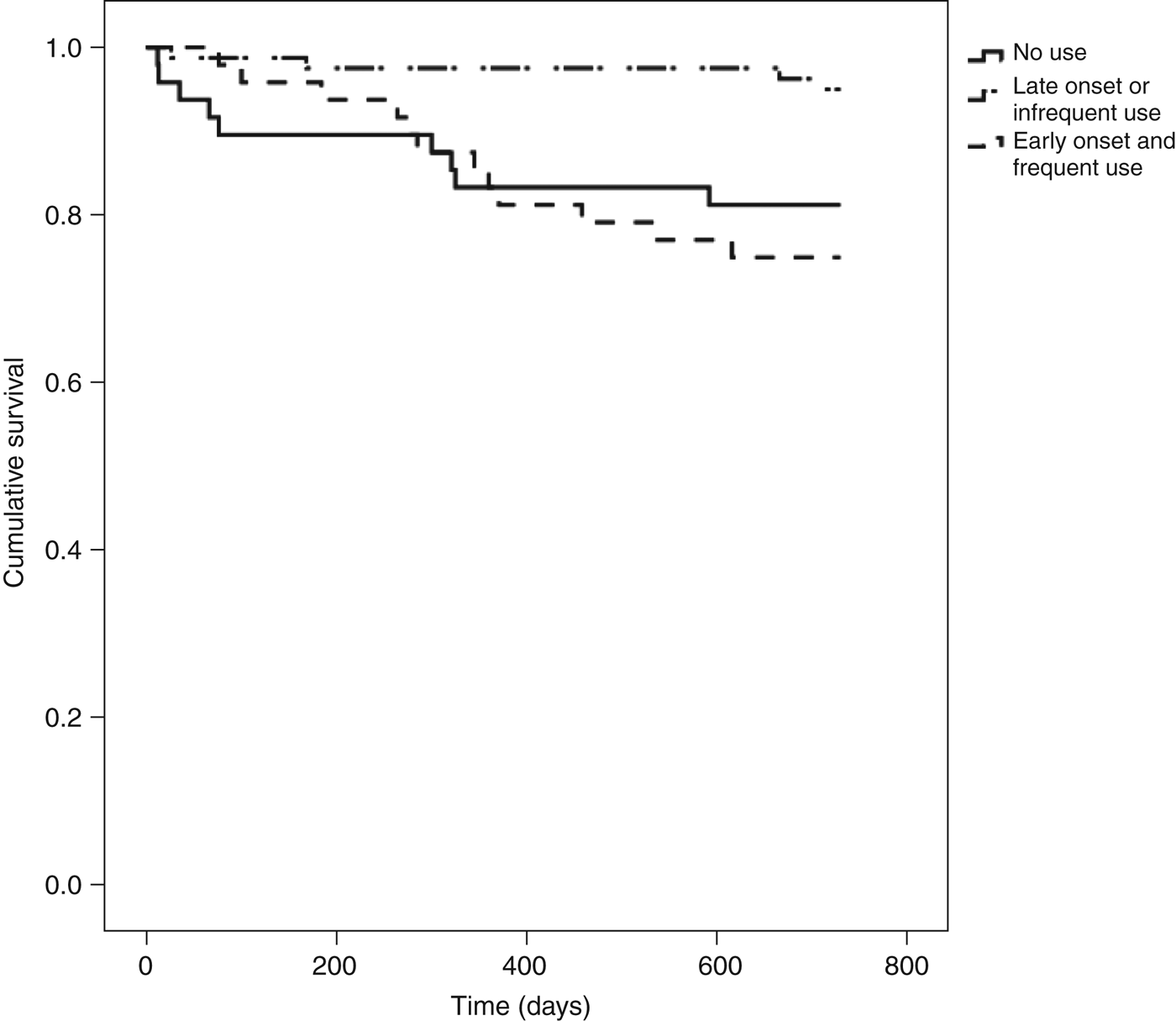
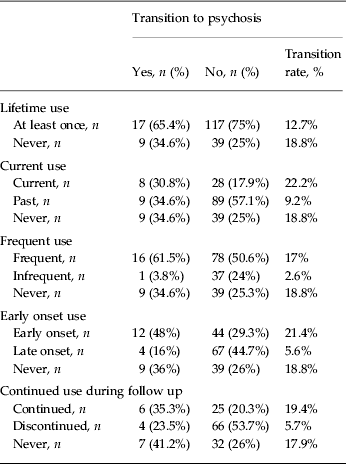
Table 3 shows the pattern of substance use in participants who did (n = 26) and did not (n = 156) develop psychosis during the follow-up period. There was no difference in transition rate between participants who had and had not tried cannabis prior to presentation (12.7% v. 18.8%, respectively, χ 2 1 = 1.061, p = 0.303). Among lifetime users, there was a higher rate of transition to psychosis in those who had been frequent, as opposed to infrequent users [16 of 94 frequent users (17.0%) v. one of 38 infrequent users (2.6%); χ 2 1 = 4.994, p = 0.025], and those whose first use was before the age of 15 years [12 of 56 early-onset users (21.4%) v. four of 71 late-onset users (5.6%); χ 2 1 = 7.093, p = 0.008]. Moreover, early-onset users who then went on to use cannabis frequently had an even higher risk of transition than other cannabis users [12 of 48 early-onset frequent users (25%) v. four of 80 late-onset or infrequent users (5%); χ 2 1 = 10.971, p = 0.001]. Continued use of cannabis during the UHR follow-up period was also associated with an increased risk of transition to psychosis [six of 31 continued users (19.4%) v. four of 70 past users (5.7%); χ 2 1 = 4.481, p = 0.034]. However, in comparison to participants who had never tried the drug (transition rate 18.8%), the transition rates associated with frequent cannabis use, early-onset use, frequent use from early adolescence, and continued use were not significantly elevated (χ 2 1 = 0.065, p = 0.798; χ 2 1 = 0.115, p = 0.734; χ 2 1 = 0.549, p = 0.459; χ 2 1 = 0.023, p = 0.881, respectively). Fig. 2 shows the survival curves for non-users, infrequent or late-onset users, and frequent early-onset users of cannabis. Duration of total cannabis use did not influence the risk of later psychosis: nine of 54 long-term users made a transition to psychosis compared with seven of 74 short-term users (16.7% v. 9.5%, respectively; χ 2 1 = 1.483, p = 0.223). Lifetime cannabis use was not associated with an increased risk of transition to psychosis in participants who had a first-degree relative with psychosis: four of 14 people with a family history who also smoked cannabis developed psychosis (22.2%), compared with 13 of 116 cannabis users who did not have a family history (11.2%; χ 2 1 = 1.707, p = 0.191).
Survival curves for transition to psychosis over 2 years for early-onset frequent users, late-onset/infrequent users, and non-users of cannabis.

Table showing the pattern of cannabis use in participants who did and did make a transition to psychosis

There were no statistically significant differences in the rate of transition to psychosis between lifetime users and non-users of any of the other substances assessed; similarly, current or frequent use of any substance was not associated with increased transition to psychosis (data not shown).
Discussion
In this study, we aimed to assess the influence of cannabis use on transition to psychosis in people at UHR of developing psychosis and to examine the extent to which this depends on age at first cannabis use, pattern of use, and genetic vulnerability for psychosis.
In general population samples, cannabis use in people experiencing psychosis-like phenomena but not seeking clinical help has been associated with a greater risk of later psychosis (Casadio et al. Reference Casadio, Fernandes, Murray and Di Forti2011). In our help-seeking UHR sample, we did not find lifetime cannabis use to be associated with transition to psychosis in the 24-month follow-up period. Although contrary to our primary hypothesis, this result is consistent with the data of Phillips et al. (Reference Phillips, Curry, Yung, Yuen, Adlard and McGorry2002) and Auther et al. (Reference Auther, McLaughlin, Carrion, Nagachandran, Correll and Cornblatt2012), who also found no association between lifetime cannabis use and subsequent onset of psychosis. However, among lifetime cannabis users in our sample, frequent cannabis use, early age of first use, and continued use over the UHR follow-up period were all associated with increased risk of transition to psychosis. These findings support our secondary hypotheses and are consistent with data from another study in UHR participants (Kristensen & Cadenhead, Reference Kristensen and Cadenhead2007) and studies of cannabis use in first-episode psychosis samples (Di Forti et al. Reference Di Forti, Morgan, Dazzan, Pariante, Mondelli, Marques, Handley, Luzi, Russo, Paparelli, Butt, Stilo, Wiffen, Powell and Murray2009; Gonzalez-Pinto et al. Reference Gonzalez-Pinto, Alberich, Barbeito, Gutierrez, Vega, Ibanez, Haidar, Vieta and Arango2011; Stone et al. Reference Stone, Fisher, Major, Chisholm, Woolley, Lawrence, Rahaman, Joyce, Hinton, Johnson and Young2014).
Participants who had used cannabis frequently from before the age of 15 years had a higher risk of developing psychosis than those who had become frequent users later in life or had only used cannabis infrequently. The apparent interaction between the age at first use and the frequency of use is consistent with previous studies showing that cannabis use increases the risk of psychosis when use begins in early adolescence (Arseneault et al. Reference Arseneault, Cannon, Poulton, Murray, Caspi and Moffitt2002). Both this finding and the lack of an association between long-term cannabis use and transition provide support for the hypothesis that it is exposure to cannabis during a sensitive period of neurodevelopment that increases the risk of psychosis, rather than cumulative exposure over the lifetime. Studies in humans and other animals show that exposure to cannabis has many effects on the brain (Batalla et al. Reference Batalla, Crippa, Busatto, Guimaraes, Zuardi, Valverde, Atakan, McGuire, Bhattacharyya and Martin-Santos2013) and these effects appear to have the greatest potential for harm when exposure occurs during adolescence (Chadwick et al. Reference Chadwick, Miller and Hurd2013; Rubino & Parolaro, Reference Rubino and Parolaro2013). There are several possible mechanisms through which cannabis use during adolescence could increase the neurobiological predisposition to psychosis. It is thought that cannabis could act to disrupt normal neurodevelopment directly via the endocannabinoid system or indirectly through its actions on other neurotransmitter systems and brain regions involved in neurodevelopment. The endocannabinoid system in the brain is known to play an important role in neurodevelopmental processes during adolescence and exogenous cannabinoids could disrupt these processes (Chadwick et al. Reference Chadwick, Miller and Hurd2013). Several brain regions are known to be rich in presynaptic cannabinoid receptors that modulate glutamatergic and GABAergic neurotransmission, so it is possible that over-exposure to cannabis could lead to neurotoxicity and reduced neuroplasticity (Hermann & Schneider, Reference Hermann and Schneider2012; Rapp et al. Reference Rapp, Bugra, Riecher-Rossler, Tamagni and Borgwardt2012). For example, chronic cannabis use is associated with structural changes in the hippocampus, a brain area which undergoes considerable change during adolescence and is consistently found to be abnormal in psychosis (Rocchetti et al. Reference Rocchetti, Crescini, Borgwardt, Caverzasi, Politi, Atakan and Fusar-Poli2013).
Despite the large evidence base showing a link between cannabis and psychosis, it is generally accepted that cannabis use alone is neither sufficient nor necessary to cause psychosis (Gage et al. Reference Gage, Zammit and Hickman2013), and this view is consistent with our finding that lifetime users were no more likely to develop psychosis than those who had never used cannabis. It is likely that other unmeasured or unknown risk factors, in combination with underlying psychosis vulnerability, are responsible for the high rate of transition in the non-use group (van Nierop et al. Reference van Nierop, Janssens, Bruggeman, Cahn, de Haan, Kahn, Meijer, Myin-Germeys, van Os and Wiersma2013). The particularly low rates of transition associated with infrequent use (2.8%), cessation of use (9.4%) and later onset of use (5.6%), however, were unexpectedly low compared with UHR participants who had never used cannabis (18.8%). It is possible that, in the UHR group, these patterns of use might represent proxy markers for some potentially protective characteristics, such as good socio-occupational function (Rebgetz et al. Reference Rebgetz, Conus, Hides, Kavanagh, Cotton, Schimmelmann, McGorry and Lambert2013; Valmaggia et al. Reference Valmaggia, Stahl, Yung, Nelson, Fusar-Poli, McGorry and McGuire2013).
Previous studies have suggested that cannabis use is more likely to be associated with psychotic symptoms when people have a family history of psychotic disorder (Miller et al. Reference Miller, Lawrie, Hodges, Clafferty, Cosway and Johnstone2001; Stowkowy & Addington, Reference Stowkowy and Addington2013) and an investigation in UHR individuals provides further support for an interaction between cannabis use and genetic vulnerability in determining psychosis risk (Kristensen & Cadenhead, Reference Kristensen and Cadenhead2007). In our study, however, there was no significant effect of familial risk for psychosis on the rate of transition in cannabis users. It is possible that our study was underpowered to detect such an effect, as only a small proportion (14%) of UHR participants had a family history of psychosis. Future work in larger UHR samples could investigate the interaction between cannabis use and genes specifically implicated in mediating its effects on psychosis, such as AKT1 (van Winkel et al. Reference van Winkel, Esquivel, Kenis, Wichers, Collip, Peerbooms, Rutten, Myin-Germeys and van Os2010; Bhattacharyya et al. Reference Bhattacharyya, Atakan, Martin-Santos, Crippa, Kambeitz, Prata, Williams, Brammer, Collier and McGuire2012a ), as well as other known risk factors for psychosis, such as childhood adversity and urbanicity (van Nierop et al. Reference van Nierop, Janssens, Bruggeman, Cahn, de Haan, Kahn, Meijer, Myin-Germeys, van Os and Wiersma2013).
Almost three-quarters of the sample had tried cannabis and over half had used cannabis on a frequent basis. This rate of lifetime use is higher than that estimated for the general population of young adults in the UK (35%; European Monitoring Centre for Drugs and Drug Addiction, 2013), but comparable with that found in people with first-episode psychosis from the same geographical area (57–72%; Jonsson et al. Reference Jonsson, Freeman, Hinton, Towle, O'Donnell and Power2004; Di Forti et al. Reference Di Forti, Morgan, Dazzan, Pariante, Mondelli, Marques, Handley, Luzi, Russo, Paparelli, Butt, Stilo, Wiffen, Powell and Murray2009). However, the majority of cannabis users in this sample had stopped using cannabis long before they presented to OASIS; in contrast, among first-episode patients, most lifetime cannabis users were still using cannabis in the month prior to presentation (91%; Jonsson et al. Reference Jonsson, Freeman, Hinton, Towle, O'Donnell and Power2004). The main reason for cessation of cannabis use in this study was adverse effects generated by the drug, particularly paranoia or exacerbation of existing attenuated psychotic symptoms. The discontinuation of cannabis use was self-initiated and not a result of clinical intervention, as it predated contact with OASIS and other health services. This suggests that it is unlikely that UHR participants were using cannabis as a form of self-medication for attenuated psychotic symptoms and is consistent with the mood-enhancing motivation for use described by Gill et al. (Reference Gill, Poe, Azimov, Ben-David, Vadhan, Girgis, Moore, Cressman and Corcoran2013): if the effects of cannabis were becoming unpleasant and causing feelings of anxiety and depression, then it makes sense that people would stop using it. UHR individuals may also be more likely to link their psychotic experiences to cannabis use, and therefore stop using the drug: people at UHR differ from people with a psychotic disorder in being more likely to attribute psychotic phenomena to a problem with their health, as opposed to external agencies or supernatural forces (Lappin et al. Reference Lappin, Morgan, Valmaggia, Broome, Woolley, Johns, Tabraham, Bramon and McGuire2007). These possibilities could have implications for clinical work with people at UHR of psychosis or public health campaigns regarding substance use in young people more generally. Continued exploration of the motivations for starting and stopping substance use and individual differences in how people experience the effects of cannabis use will therefore be useful.
Limitations
This study investigated associations between transition to psychosis and substance use assessed at two time points over 2 years in the largest sample of UHR individuals to date. Assessment of other outcomes such as social and occupational functioning and severity of psychotic symptoms would have allowed a richer exploration of the potential long-term effects of cannabis and other substance use in the UHR group. Moreover, inclusion of other potential confounding factors known to be related to cannabis use and psychosis, such as childhood trauma, cognitive function, and use of tobacco, would have improved the study. The additional substance use assessment indicated relatively low rates of incident or resumed cannabis use, which is consistent with another study involving repeated measures in a similar high-risk sample that found no incident substance use among participants who were not already users at presentation (Corcoran et al. Reference Corcoran, Kimhy, Stanford, Khan, Walsh, Thompson, Schobel, Harkavy-Friedman, Goetz, Colibazzi, Cressman and Malaspina2008). Nevertheless, regular assessment of substance use anchored to clinical assessments throughout the follow-up period would have allowed an opportunity to investigate the nature of the temporal relationship between cannabis use and the expression of psychotic symptoms and onset of psychosis in more detail. Our study also relied upon self-reported substance use. While the high rates of lifetime use reported suggest that participants were being truthful, there may have been an incentive to minimize or deny current or recent use, as the individuals were seeking help from a clinical service. Due to the low numbers of participants who used cannabis relatively infrequently, we used a dichotomous frequency variable, which applied only to the period of most regular use, as a measure of overall cannabis exposure. This measure was therefore unlikely to provide an accurate reflection of lifetime cumulative exposure to cannabis, and precluded further investigation of any dose–response relationship that might exist. No information was available regarding the type of cannabis that was used, which might be relevant to the risk of psychosis, as this is known to vary with the tetrahydrocannabinol (THC) content of cannabis (Di Forti et al. Reference Di Forti, Morgan, Dazzan, Pariante, Mondelli, Marques, Handley, Luzi, Russo, Paparelli, Butt, Stilo, Wiffen, Powell and Murray2009). Consideration should also be given to the extent to which the current findings regarding cannabis use and the onset of psychosis can be generalized. UHR individuals who present to early-intervention teams may not be representative of all people at increased risk of developing psychosis, some of whom may be unwilling or unable to access mental health services.
Conclusion
When considering lifetime users of cannabis, the results of this study are broadly consistent with previous research showing an association between cannabis use and psychosis, in that frequent cannabis use, especially from an early age, and continued use in the context of attenuated psychotic symptoms were associated with transition to psychosis. Although the vast majority of the sample had tried cannabis at some point and over half had used it frequently, most UHR participants with a history of cannabis use did not develop a psychotic disorder and were no more likely to do so than those who had never tried it. Future work investigating cannabis use in the UHR group should seek to determine, through repeated assessment of substance use alongside other potential risk factors and multiple outcomes, the interplay between cannabis, pre-existing vulnerability for psychosis, and symptom expression in the onset of psychosis.
Acknowledgements
We would like to thank all staff and service users at OASIS. This research received no specific grant from any funding agency, commercial or not-for-profit organizations.
Declaration of Interest
None.