

Introduction
The genus Hypengonoceras, introduced by Spath (Reference Spath1922), was based on the type species Placenticeras warthi Kossmat, Reference Kossmat1895, which was recorded from the lower Utatur Group (Albian) of South India. Hypengonoceras was later found from various countries, including Sakhalin (Russia) (Matsumoto, Reference Matsumoto1942), Madagascar (Boule et al., Reference Boule, Lemoine and Thévenin1907; Collignon, Reference Collignon1963), Morocco (Collignon, Reference Collignon1966), Mozambique (Förster, Reference Förster1975), Israel (Lewy, Reference Lewy1981), South Africa (Kennedy and Klinger, Reference Kennedy and Klinger1975; Klinger and Kennedy, Reference Klinger and Kennedy1989), and France (Latil, Reference Latil1989). Everywhere, Hypengonoceras has been dated as Albian. The type species Placenticeras warthi was originally described by Stoliczka (Reference Stoliczka1864) as Ammonites orbignyanus, based on a fragmentary holotype. Later, Kossmat (Reference Kossmat1895) redesignated it as Placenticeras warthi, and subsequently, Spath (Reference Spath1922) described it as the type species of the genus Hypengonoceras. All of them based their descriptions on the drawings provided by Stoliczka (Reference Stoliczka1864, pl. 48, fig. 2). We recently inspected the holotype archived in the Curatorial Division of Geological Survey of India, Kolkata, and found that the drawings of Stoliczka's Ammonites orbignyanus are highly imaginary and misleading. Many morphological characters (e.g., flexuous ribs, umbilical and outer tubercles, and concave venter on the outer whorl) are absent in the original specimen. The septal sutural pattern shown in the drawing of Stoliczka (Reference Stoliczka1864, pl. 48, fig. 2) is faithful, but Kossmat's observation (Reference Kossmat1895, pl. 6, fig. 8), especially in the external saddle, is restored. We assume that Stoliczka (Reference Stoliczka1864) did not inspect the specimen but based his description on the sketches that were provided by the artist. When redesignating the holotype within Placenticeras, Kossmat (Reference Kossmat1895) was also influenced by Stoliczka's (Reference Stoliczka1864) description and figures and perhaps did not inspect the actual specimen. This misinterpretation of the type specimen had a far-reaching consequence because Spath (Reference Spath1922) erected a new genus, Hypengonoceras, and many attributes of the genus were provided by many subsequent workers from the highly restored sketches in Stoliczka (Reference Stoliczka1864) and Kossmat (Reference Kossmat1895). Diagnostic characters of the genus Hypengonoceras provided by Klinger and Kennedy (Reference Klinger and Kennedy1989, p. 362) were also influenced by the incorrect description of the holotype. Here, we redescribe the holotype of the type species Placenticeras warthi. Another specimen (no. L3/41) of Placenticeras warthi from the Geological Survey of India, Kolkata, which is now kept in the Invertebrate Gallery of the Indian Museum, Kolkata, has also been studied. We also discuss the systematic position of Hypengonoceras in the light of reinterpretation of the type species.
Materials and methods
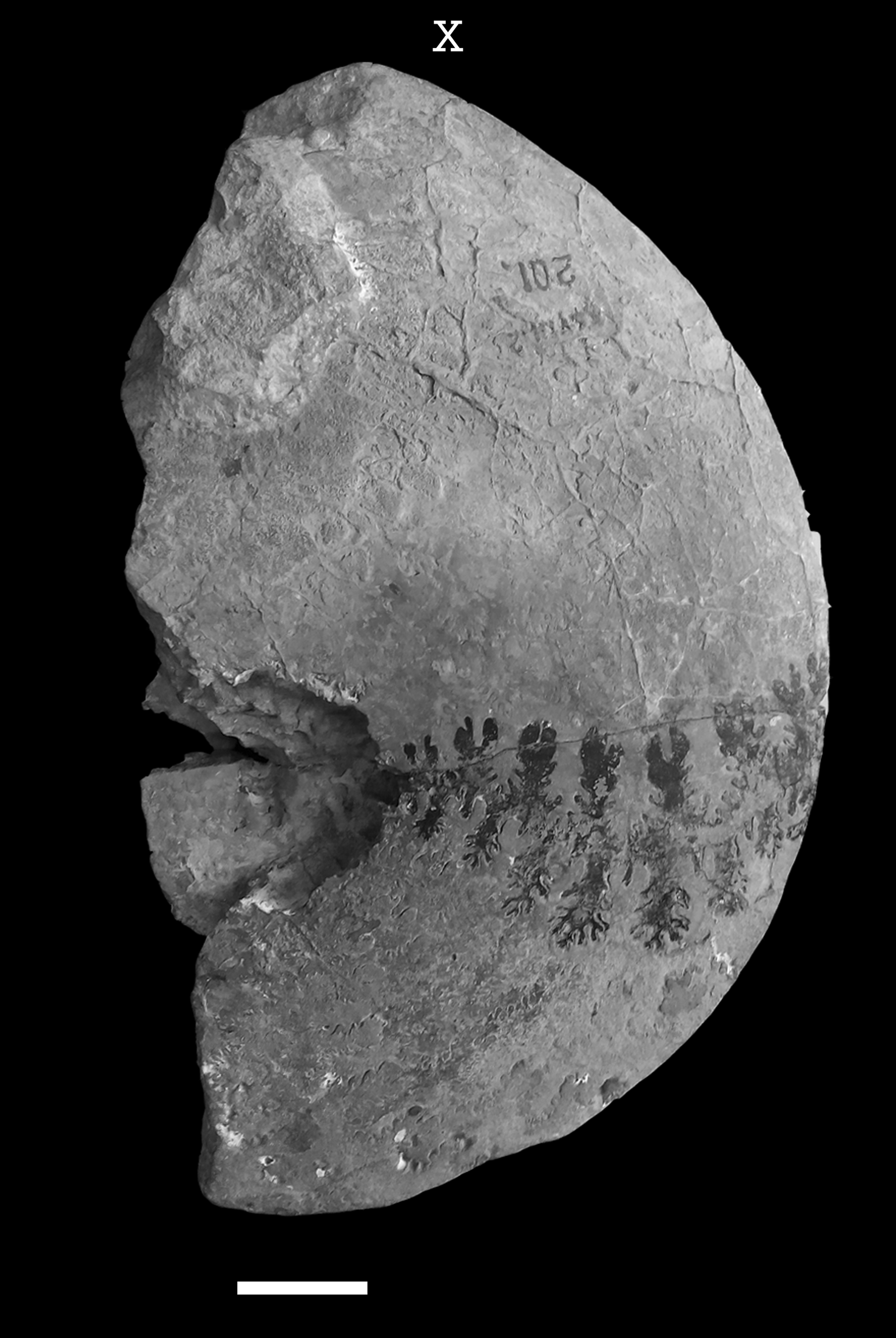
Hypengonoceras warthi was described on the basis of incorrect sketches of the holotype made by Stoliczka (Reference Stoliczka1864) and later reproduced by Kossmat (Reference Kossmat1895). The actual holotype reposited in Curatorial Division, Geological Survey of India, Kolkata, was not illustrated anywhere before. We have photographed and reproduced it in the present study. The holotype represents various ontogenetic details, including part of the adult body chamber. Another specimen of Hypengonoceras warthi reported by Kossmat from the same locality (Fig. 1) and archived in the Invertebrate Gallery of Indian Museum, Kolkata, has also been studied by us. The fossils could not be coated with ammonium chloride for better photographs since this is not allowed by the authority of Geological Survey of India. We have described the species on the basis of a detailed ontogenetic study of sutural development, ornamental changes, and other shell details. We have reproduced sutures at different ontogenetic stages and have documented features of the shell at different growth stages. We follow the sutural terminology of Kullman and Wiedmann (Reference Kullmann and Wiedmann1970). Korn et al. (Reference Korn, Ebbighausen, Bockwinkel and Klug2003) revised the sutural phylogeny of Mesozoic ammonites and rejected the U-mode sutural ontogeny. They suggested a revised terminology only for the primary sutures. Since then, to our knowledge, no detailed discussions have been attempted describing the adult sutures according to the suggestion of Korn et al. (Reference Korn, Ebbighausen, Bockwinkel and Klug2003). We have compared the type species with other species of the genus. All the measurements were done by digital caliper with a precision up to 0.01 mm.
(1) Location of Cauvery Basin in southern India; (2) Location map of the studied area. A star marks the fossil locality.

Repository and institutional abbreviation
Specimen numbers bear the following repository institutional prefix: GSI, Geological Survey of India, Kolkata.
Systematic paleontology
Abbreviations
The following letters are used to indicate shell parameters: D = diameter of the shell; H = height of the whorl from the umbilical shoulder; U = diameter of the umbilicus; W = width of the whorl.
Order Ammonoidea Zittel, Reference Zittel1884
Family Engonoceratidae Hyatt, Reference Hyatt and Zittel1900
Genus Hypengonoceras Spath, Reference Spath1922
Type species
Placenticeras Warthi Kossmat, Reference Kossmat1895, p. 80.
Hypengonoceras warthi (Kossmat, Reference Kossmat1895)
Figures 2–4
- Reference Stoliczka1864
Ammonites Orbignyanus (non Geinitz, Reference Geinitz1849–1850), Stoliczka, p. 92, pl. 48, fig. 2a, b.
- Reference Kossmat1895
Placenticeras Warthi Kossmat, p. 80, pl. 20, fig. 8.
- Reference Spath1922
Hypengonoceras warthi (Kossmat) Spath, p. 112.
Hypengonoceras warthi (Kossmat, Reference Kossmat1895). Holotype (GSI type no. 201). Shell with partly preserved adult body chamber from the Utatur Group (Albian), South India; right lateral. Scale bar = 2 cm.
Hypengonoceras warthi (Kossmat, Reference Kossmat1895). (1–3) Holotype (GSI type no. 201). Shell with partly preserved adult body chamber from the Utatur Group (Albian), South India; (1) left lateral, (2) apertural, (3) ventral views. (4, 5) The hand sketches by Stoliczka (Reference Stoliczka1864, pl. 48, fig.2) reproduced here; (4) left lateral; (5) part of the venter. Note that the flexuous ribs in (4) and the concave venter in (5) are absent in the original type specimen. (6–9) Specimen no. L3/41. Adult phragmocone shell; (6) right lateral (note the pincer-like saddles; arrow), (7) left lateral, (8) apertural, (9) ventral views (note the tabulate and feebly clavate venter). ‘X’ marks the initiation of body chamber. Scale bar = 2 cm.

(1) Sutural line of Hypengonoceras warthi (Kossmat, Reference Kossmat1895) reproduced from Kossmat (Reference Kossmat1895, pl. 6, fig. 8). (2) Sutural line of Hypengonoceras warthi drawn from the left lateral of the holotype figured in Figure 2. (3) Sutural pattern in Hypengonoceras chouberti Collignon, Reference Collignon1966 (reproduced from Klinger and Kennedy, Reference Klinger and Kennedy1989, fig. 127). (4) Sutural ontogeny of the holotype in early stage (in between whorl height 27 mm and 30 mm). Note the pincer-like saddles in (1), (2), and (4) and the non-pincer-like saddles in (3).

Holotype
GSI type no. 201.
Occurrence
Maruvathur locality, Utatur Group (Albian), about 15 km east of Perambalur, South India (Fig. 1).
Description
The holotype consists of an internal mold with shell remains at places. Maximum preserved shell diameter is about 190 mm (height = 112 mm) with a partly preserved adult body chamber. Another septate specimen from the same locality and stratigraphic horizon (no. L3/41), possibly collected by Kossmat (Reference Kossmat1895), has a maximum preserved whorl height of 120 mm. The body chamber in the holotype begins at a diameter of 180 mm. The shell is highly compressed (W/H = 0.44), with its maximum width near the umbilical shoulder. The strongly involute shell (U/D = 0.08) has a narrow but tabulate venter. Flanks are slightly curved. The umbilicus is small and deep with a rounded shoulder and vertical to overhanging wall. The whorl section is oxyconic.
In the adult phragmocone stage, the shell is relatively more compressed (W/H = 0.39) at 117 mm diameter. Flanks remain slightly curved and entirely smooth except for one single, very faint rib-like bulge near the midflank at 130 mm diameter. At 117 mm diameter, the venter is first visible. It is tabulate (from early ontogeny) and has alternating feeble elongated clavi. Clavi continue to the end-phragmocone stage and remain feeble throughout. There is a sharp change in the width of the venter and the nature of the ventrolateral shoulder at this stage. At about 117 mm diameter, the venter is 3.75 mm wide with a sharp shoulder but becomes wider (7.44 mm) with blunt edges in the body chamber. In addition, the beginning of body chamber is marked by the disappearance of clavi, thus indicating adulthood.
The inner whorl is partially exposed as half of the outer whorl is missing. At about 84 mm diameter, the shell is relatively less involute (U/D = 0.10). The umbilicus has a gradual margin and steep wall. Feeble elongated umbilical tubercles have already appeared at this stage and are distinct in the internal mold. Umbilical tubercles are prorsiradiate and lie just above the shoulder. There are at least three umbilical tubercles per half whorl. One elongated outer tubercle is feebly exposed near the midflank. The flanks are devoid of any ribs. The venter is broken.
The septal suture was described by Stoliczka (Reference Stoliczka1864) and Kossmat (Reference Kossmat1895), and the drawings were more or less faithful, showing characteristic ‘pincer-like’ saddles. However, Kossmat's figure of the external saddle (Reference Kossmat1895, pl. 20, fig. 8; reproduced here in Fig. 4.1) is somewhat restored. The distinct subdivision of the external saddle into four auxiliary saddles as shown in Kossmat's figure is not correct. We could not redraw the same suture from the specimen due to heavy inking. However, the suture immediately below it is clearly discernible on the opposite side and has been reproduced here (Fig. 4.2). Wright et al. (Reference Wright, Callomon, Howarth and Kaesler1996) also provided an image of this suture (Reference Wright, Callomon, Howarth and Kaesler1996, fig. 101.3). The external saddle is clearly bifid, and each auxiliary saddle develops a minute incision, which is highly exaggerated in Kossmat's drawing.
The inner whorl exposes early sutural patterns at a reconstructed shell diameter of about 60 mm. These early sutural patterns were not described by Stoliczka (Reference Stoliczka1864) and Kossmat (Reference Kossmat1895). The earliest visible suture line is characterized by a broad, rounded saddle with minor incisions and narrow, almost entire to slightly frilled lobes (ceratitic). The sutural elements become successively more incised, with saddles divided into two main branches, but the pincer-like pattern has yet to appear. Lateral lobes (possibly third and fourth) become rapidly frilled over a short distance. The third lateral lobe is the deepest. Unfortunately, the outer flank of the inner whorl is broken, and thus the development of any adventitious lobes, if present, cannot be observed. The adult suture has distinct pincer-like saddles. Saddles are narrow whereas lobes are wide, teardrop-shaped, and highly frilled.
Dimensions
See Table 1.
Measurements of the holotype and one additional specimen of Hypengonoceras warthi. D = diameter of shell; U = diameter of umbilicus; W = width of whorl; H = height of whorl from umbilical shoulder. Values with suffix “c” (circa) indicates approximate values.

Remarks
Klinger and Kennedy (Reference Klinger and Kennedy1989) described the range of intraspecific variability and dimorphism in Hypengonoceras decaryi Collignon, Reference Collignon1963 from the upper Albian of Zululand, South Africa. It is a highly variable species, and hence comparison with the holotype of H. warthi is difficult. H. decaryi ranges from being very compressed to inflated but differs from H. warthi in having laterals with low falcoid ribs and tubercles. Collignon (Reference Collignon1966) described three species from the upper Albian of Morocco, Hypengonoceras chouberti, Hypengonoceras fauremuretae, and Hypengonoceras tarfayense. Klinger and Kennedy (Reference Klinger and Kennedy1989) mentioned that H. chouberti is more compressed than H. warthi and has well-defined keels on the ventral shoulders with tiny clavi. H. tarfayense is a smooth, slender species with a narrow venter and small umbilicus but has numerous fine tubercles on the laterals. H. fauremuretae Collignon has pincer-like sutures (see Collignon, Reference Collignon1966, pl. 6, fig. 1) similar to H. warthi. This Moroccan species is also highly compressed with narrow venter, but the venter is distinctly concave (see Collignon, Reference Collignon1966, figs. 2a, 3a) whereas it is tabulate in H. warthi.
Discussion
Many workers have studied the genus Hypengonoceras from different perspectives such as phylogenetic affinity, stratigraphic position, and so on (Casey, Reference Casey1960; Renz, Reference Renz1970; Latil, Reference Latil1989; Bujtor, Reference Bujtor2010; Bulot, Reference Bulot, Vincent, van Buchem, Bulot, Immenhauser, Caron, Baghbani and Huc2010; Cooper and Owen, Reference Cooper and Owen2011). Many of the diagnostic characters of Hypengonoceras resulted from the incorrect drawings of the type specimen of Placenticeras warthi. The taxonomic position of Hypengonoceras is not firmly established, and Klinger and Kennedy (Reference Klinger and Kennedy1989) considered the proper interpretation of the genus contentious. One diagnostic or apomorphic character in a cladistic sense is the pincer-like saddle, which is apparent in our examination of the available material. Klinger and Kennedy (Reference Klinger and Kennedy1989, p. 362) described pincer-like saddles as deeply incised bifid folioles. Another fragmentary and septate specimen, possibly collected by Kossmat (Reference Kossmat1895) from the same Albian horizon in South India, also displays the typical pincer-like lateral saddles (Fig. 3.6). However, there are many species of Hypengonoceras described later by Collignon (Reference Collignon1963, Reference Collignon1966) and Klinger and Kennedy (Reference Klinger and Kennedy1989), such as H. decaryi Collignon, Reference Collignon1963, H. chouberti Collignon, Reference Collignon1966, and so on, where typical pincer-like saddles are absent (see Fig. 4.3). Many of the diagnostic characters of the genus, such as a narrowly umbilicate, compressed shell with weakly developed ribs and tubercles, and a flat to concave venter with clavi at some stage, are also found in the species of Placenticeras sensu stricto (Klinger and Kennedy, Reference Klinger and Kennedy1989; Bardhan et al., Reference Bardhan, Gangopadhyay and Mandal2002). Spath (Reference Spath1922) categorically claimed that Hypengonoceras has no direct relationship with Placenticeras, but later Spath (Reference Spath1931) referred the genus to the Placenticeratidae without specifying any reason for the change in affiliation (Klinger and Kennedy, Reference Klinger and Kennedy1989).
From our revised description of the holotype, it appears that Hypengonoceras warthi is an involute and highly compressed species. Its outer whorl is smooth with a narrow, tabulate venter having feeble clavi up to the end-phragmocone stage. However, Stoliczka (Reference Stoliczka1864) erroneously showed a concave venter in his drawing (reproduced here in Fig. 3.5). The umbilicus is still small, and its shoulder and walls are rounded and steep, respectively. The holotype is perhaps a macroconch (adult phragmocone diameter is 180 mm). This adult shell form strongly resembles the early ontogeny of placenticeratids (Klinger and Kennedy, Reference Klinger and Kennedy1989, p. 246) and is similar to the ‘umkwelanense’ morphotype of P. kaffrarium Etheridge, Reference Etheridge1904.
However, H. warthi has a different ontogenetic development of ornaments. Feeble umbilical tubercles develop at an early stage and soon disappear, but ventral clavi continue to the end-phragmocone stage. In placenticeratids, the early shell is smooth. Umbilical tubercles and clavi appear simultaneously at a later stage, and both continue into the outer whorl. Thus, H. warthi has ornamental development, which is unlike that of placenticeratids. H. decaryi Collignon, Reference Collignon1963 also has a similar developmental pattern of ornaments (Klinger and Kennedy, Reference Klinger and Kennedy1989, p. 381).
Kennedy and Wright (Reference Kennedy and Wright1983) tentatively considered Hypengonoceras and Hengestites an early evolutionary offshoots (Casey, Reference Casey1960) from the placenticeratid Karamaites during the Albian. They separated Hengestites from the mainstream placenticeratids and included it within Engonoceratidae mainly because ornamental development in Hengestites is unlike the developmental pattern occurring in Placenticeras. Like Hypengonoceras, Hengestites Casey, Reference Casey1960 has early development of ornament followed by a smooth, compressed stage with an entire venter. On the other hand, Casey (Reference Casey1960) believed that Hengestites, especially Hengestites applanatus Casey, Reference Casey1960, is an early member of the Placenticeratidae, but its co-occurrence with Hypengonoceras indicates a polyphyletic origin of the Placenticeratidae. Recently, Cooper and Owen (Reference Cooper and Owen2011) included Hengestites within Anahoplitinae, which they removed from Hoplitidae and considered the rootstock of Placenticeratidae.
Klinger and Kennedy (Reference Klinger and Kennedy1989) mentioned the difference between Placenticeratidae and Engonoceratidae in the sutural pattern. Hypengonoceras has a simple, broadly ceratitic suture whereas Placenticeratidae is characterized by highly frilled saddles and lobes. All species of Hypengonoceras do not have pincer-like adult saddles. On the other hand, placenticeratids have highly variable sutural ontogeny and patterns. Klinger and Kennedy (Reference Klinger and Kennedy1989) noted that the early sutural ontogeny of Hypengonoceras is not known. We have traced the early sutures on the holotype (Fig. 4.4). It is typically pseudoceratitic. Saddles are broad and almost entire. The pattern strongly resembles the early sutural patterns of Metaplacenticeras Spath (Klinger and Kennedy, Reference Klinger and Kennedy1989, figs. 2, 3). Schindewolf (Reference Schindewolf1967) also noted a similar sutural pattern between Hypengonoceras and Metaplacenticeras, which belongs to Placenticeratidae. In fact, early sutural patterns of many placenticeratid species have simple, less frilled sutures similar to that of Hypengonoceras warthi at equivalent shell diameter (Klinger and Kennedy, Reference Klinger and Kennedy1989, fig. 5D). These placenticeratid species soon attain the complexity of the typical ‘paw-shaped’ suture of the family, with highly incised lobes and saddles. However, H. warthi neotenically retained the early sutural pattern up to the adult stage with little modification. Neoteny is the process in which the descendants retain the early developmental features of the ancestors (Gould, Reference Gould1977; McNamara, Reference McNamara1986). Karamaites, which is an Albian placenticeratid, is a highly compressed and involute genus like the coeval H. warthi. Many Karamaites species, for example, Karamaites guardakense (Luppov, Reference Luppov1963), also have less complex sutural patterns (Klinger and Kennedy, Reference Klinger and Kennedy1989, fig. 6). Because of neotenic retention, H. warthi has a smooth, involute adult shell. Its suture also retains the early placenticeratid pattern throughout the ontogeny. However, the early ornamental development of H. warthi and other Hypengonoceras species is opposite to that of the mainstream Placenticeratidae. Ornaments in Hypengonoceras were predisplaced in early ontogeny through a complex heterochronic interplay (McNamara, Reference McNamara1986) and disappeared soon. According to McNamara (Reference McNamara1986), predisplacement is a process in which the growth of the morphology (here, umbilical tubercles) begins at an earlier age than in the purported ancestor (here, Albian placenticeratid taxa). In placenticeratid phylogeny, Klinger and Kennedy (Reference Klinger and Kennedy1989) observed that the rate and duration of morphological development are extremely variable. Hypengonoceras is thus a distinct form and separated from Placenticeratidae.
Acknowledgments
The authors are grateful to the director, Curatorial Division, Geological Survey of India, Kolkata, for providing access to the type specimen. Thanks are due to Prof. S. Mukherjee for providing logistic support in the Department of Geological Sciences, Jadavpur University, Kolkata, India. The authors thank the editors H.-D. Sues and M. Yacobucci for their support and suggestions. The manuscript largely benefitted from the critical reviews by L.G. Bulot and L. Bujtor.



