Introduction
Idiopathic sudden sensorineural hearing loss (SNHL) is defined as hearing loss of at least 30 dB in three sequential frequencies on a standard pure tone audiogram, occurring over 72 hours.Reference Wilson, Byl and Laird1 The incidence of idiopathic sudden SNHL is between 5 and 30 cases per 100 000 person-years,Reference Wu, Lin and Chao2,Reference Nosrati-Zarenoe, Arlinger and Hultcrantz3 and the causes are identifiable in as few as 7 per cent to 45 per cent of cases.Reference Nosrati-Zarenoe, Arlinger and Hultcrantz3–Reference Huy and Sauvaget6
Although the underlying pathogenesis of idiopathic sudden SNHL remains controversial, with potential infectious, autoimmune, traumatic, vascular, neoplastic, metabolic and neurological aetiologies, numerous studies have attempted to determine the predictive factors of idiopathic sudden SNHL.Reference Narozny, Kuczkowski, Kot, Stankiewicz, Sicko and Mikaszewski7–Reference Cvorovic, Deric, Probst and Hegemann9 Possible predictive factors of idiopathic sudden SNHL include: duration of hearing loss; patients’ demographics; associated symptoms; audiogram characteristics; and cardiovascular risk factors including hypertension, diabetes, dyslipidaemia and neutrophil-to-lymphocyte ratio.Reference Narozny, Kuczkowski, Kot, Stankiewicz, Sicko and Mikaszewski7,Reference Kuhn, Heman-Ackah, Shaikh and Roehm10–Reference Lee, Lee, Kang, Lee and Lee16
The Framingham risk score is a widely accepted tool for predicting the 10-year risk of developing cardiovascular disease, which has been validated in large population cohort studies conducted by the Framingham Heart Study group.Reference D'Agostino, Vasan, Pencina, Wolf, Cobain and Massaro17–Reference Wilson, D'Agostino, Levy, Belanger, Silbershatz and Kannel19 Specifically, the Framingham risk score assigns points to six risk factors for cardiovascular disease (age, total cholesterol, high-density lipoprotein cholesterol, systolic blood pressure, smoking status and diabetes); these points are then converted to determine the risk (percentage) of developing cardiovascular disease.Reference D'Agostino, Vasan, Pencina, Wolf, Cobain and Massaro17
A recent study suggested that the Framingham risk score may be a useful tool in predicting the prognosis for patients with idiopathic sudden SNHL and multiple co-morbidities.Reference Chang, Choi, Ahn, Ryu, Moon and Hong14 In that study, authors demonstrated that the high-risk group (Framingham risk score of 20 per cent or higher) had poorer hearing recovery than the low-risk group in terms of their mean pure tone average (PTA) thresholds. As that study included patients with a combination of well-established risk factors, such as hypertension, diabetes, hyperlipidaemia, smoking and stroke, the overall successful recovery rate was only 23.81 per cent. However, the results were limited to patients with idiopathic sudden SNHL and multiple co-morbidities.
The present study aimed to assess the Framingham risk score as a prognostic tool for idiopathic sudden SNHL patients, regardless of the presence of multiple co-morbidities.
Materials and methods
Ethics statement
This study was approved by the institutional review board of the Korea University Ansan Hospital (institutional review board number: 2018AS0044).
Participants
At a tertiary referral centre, we reviewed the medical documents of all patients who were affected by unilateral idiopathic sudden SNHL at Korea University Ansan Hospital between January 2010 and October 2017. Those aged 30–74 years who underwent proper laboratory testing during their initial visits were enrolled according to the criteria suggested by D'Agostino et al.Reference D'Agostino, Vasan, Pencina, Wolf, Cobain and Massaro17 The exclusion criteria were as follows: (1) patients with previous history of any otological diseases (otitis media, idiopathic sudden SNHL, vestibular schwannoma and Ménière's disease); (2) patients who had taken any medication before visiting our institution; and (3) any patients with conductive hearing loss on audiometry.
Thirty-nine patients with unilateral idiopathic sudden SNHL that developed within 72 hours were eligible for the study. They were diagnosed through physical examination, tympanometry, and pure tone audiometry showing 30 dB or greater hearing loss at three consecutive frequencies.
Each patient was admitted and treated with a high-dose steroid regimen, consisting of intravenous steroid injections (dexamethasone ampoule 5 mg intravenously, three times/day for 5 days and then tapered over 7 days; or oral methylprednisolone at a maximum of 64 mg daily for 4 days, with subsequent sequential tapering at 32 mg/day, 24 mg/day, 16 mg/day and 2 mg/day). If hearing recovery was not established within 4 or 5 days following steroid treatment, we would attempt intratympanic steroid injections, where patients received intratympanic steroid injections (dexamethasone, 5 mg/ml) perfused into the middle ear every other day for a total of four treatments. After the injections, patients were advised to avoid moving their head, speaking or swallowing for 20 minutes.
Standard assessments
Standard assessments included routine audiometric testing and serological tests, including whole blood cell counts, total cholesterol and high-density lipoprotein cholesterol levels, as well as blood pressure measurements, and evaluations of diabetes or hypertension medical history, smoking status, and any current anti-hypertensive medications. Neutrophil-to-lymphocyte ratio was calculated as a simple ratio between the absolute neutrophil and the absolute lymphocyte counts. An automated blood cell counter was used for complete blood count measurements.
Audiometric data
All patients were evaluated using a Grason-Stadler GSI 61™ audiometer with Telephonics® TDH 50P headphones, which is the standard method to determine pure tone air and bone conduction thresholds. Air conduction was calculated as the mean threshold at four frequencies (0.5, 1.0, 2.0 and 4.0 kHz).
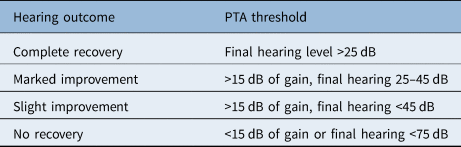
Hearing assessments were performed on the subjects’ initial visits and one month after treatment began. First, we calculated the hearing recovery (hearing recovery (dB) = (initial PTA) – (PTA one month after commencing treatment)). Second, an audiological improvement evaluation was performed using both the PTA threshold at the aforementioned four frequencies and the criteria of Siegel.Reference Siegel20 The outcomes were classified as follows: complete recovery, marked improvement, slight improvement and no recovery (Table 1). Successful recovery was defined as complete recovery or marked improvement one month after commencing treatment.
Criteria used to define audiological improvement*

* Siegel's criteria.Reference Siegel20 PTA = pure tone average (mean threshold at 0.5, 1.0, 2.0 and 4.0 kHz)
Framingham risk score
We calculated the Framingham risk score – representative of the 10-year risk of developing cardiovascular disease – by adopting the equation suggested by D'Agostino et al.Reference D'Agostino, Vasan, Pencina, Wolf, Cobain and Massaro17 This equation incorporates a multivariable analysis and regression coefficient for each possible risk factor: age, total cholesterol, high-density lipoprotein cholesterol, systolic blood pressure, smoking status and diabetes. We then subdivided the patients into groups according to their Framingham risk score: group 1 – score of less than 10 per cent; group 2 – score of 10 per cent to less than 20 per cent; and group 3 – score of 20 per cent or higher.
Statistical analyses
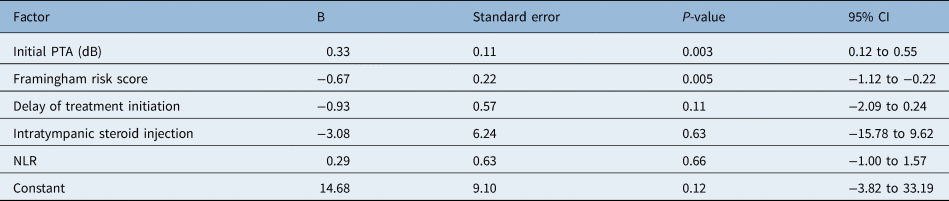
Fisher's exact test was performed to evaluate whether treatment outcomes (classified using Siegel's criteriaReference Siegel20) were different within the subdivided groups. Pearson's correlation analyses were performed to analyse the correlation between two factors. A multivariable linear regression analysis was performed to evaluate the factors associated with hearing recovery. The initial PTA, delay of treatment initiation, additional intratympanic steroid injection, neutrophil-to-lymphocyte ratio and Framingham risk score were adopted as possible associated factors, and hearing recovery was used as the outcome variable. When we set intratympanic steroid injections as a possible associated factor, the patients in the group with no additional intratympanic steroid injections was used as a reference. A two-sided p-value of less than 0.05 was considered statistically significant. All data were analysed with SPSS software version 20.0 (SPSS, Chicago, Illinois, USA).
Results
Eighty-seven patients met the inclusion criteria for the study. Forty-four patients did not have a follow-up PTA or initial laboratory test, and four patients did not meet the age criteria to appropriately calculate the Framingham risk score. Therefore, a total of 39 patients were reviewed in this study.
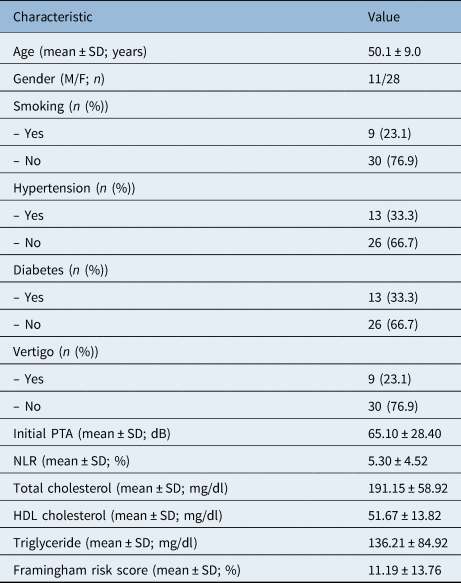
The mean (± standard deviation (SD)) age of enrolled patients was 50.1 ± 9.0 years. There were 11 males (28.2 per cent) and 28 females (71.8 per cent). A total of 13 patients (33.3 per cent) took anti-hypertensive medications, and 13 patients were diagnosed with diabetes. Nine patients complained of vertigo (defined as a sensation of rotation, or movement of oneself or one's surroundings in any plane) following sudden hearing loss. The treatment differed between patients, and the delay of treatment initiation ranged from 0 to 21 days (mean (± SD) = 4.36 ± 5.22 days). The patients’ detailed demographic, audiometric and laboratory results are shown in Table 2.
Participants’ baseline characteristics*

* Total n = 39. SD = standard deviation; M = male; F = female; PTA = pure tone average (mean threshold at 0.5, 1.0, 2.0 and 4.0 kHz); NLR = neutrophil-to-lymphocyte ratio; HDL = high-density lipoprotein
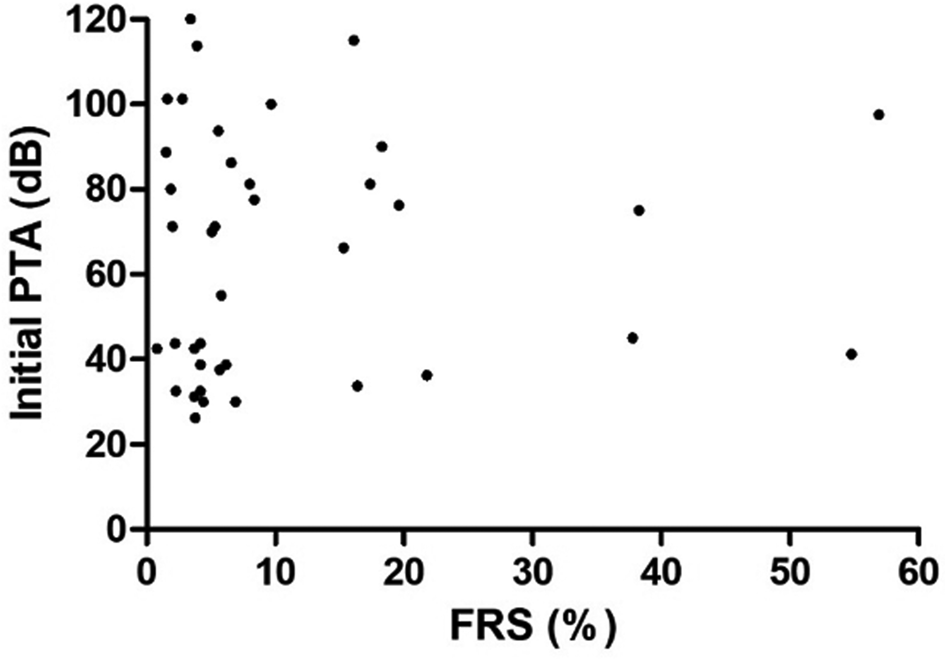
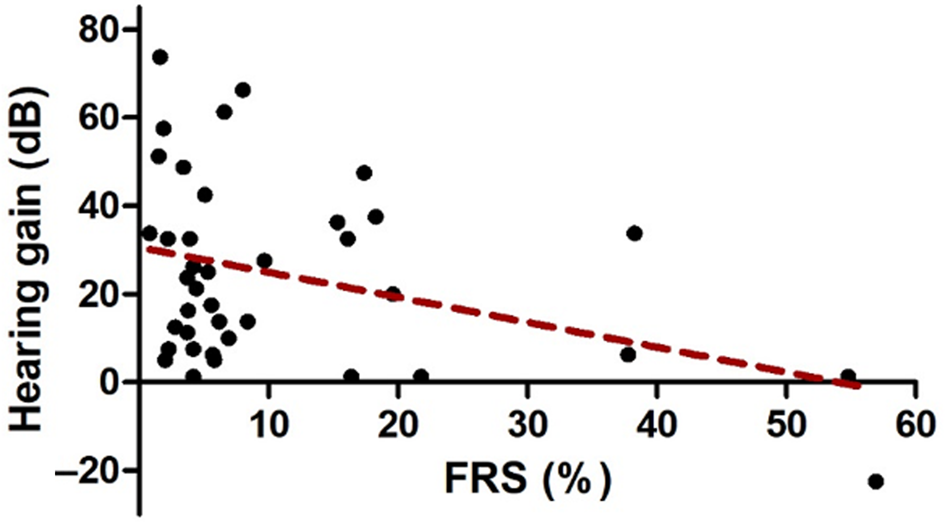
The mean (± SD) Framingham risk score for the study population was 11.2 per cent (± 13.76; range of 0.8 to 56.9). The initial PTA and Framingham risk score did not show a significant association (p = 0.32) (Figure 1). The Spearman correlation coefficients revealed a significant negative correlation between hearing recovery and Framingham risk score (ρ = −0.37, p = 0.02) (Figure 2).
The association between Framingham risk score (FRS) and initial pure tone average (PTA; mean threshold at 0.5, 1.0, 2.0 and 4.0 kHz) (p = 0.32).

The association between Framingham risk score (FRS) and hearing gain (the degree of improvement at one month after commencing treatment) (ρ = −0.37, p = 0.02). The dotted line constitutes the fitted line of the linear regression analysis according to the Framingham risk score.

The hearing outcomes (according to Siegel's criteria) for each group (based on Framingham risk score) are shown in Table 3. The overall rate of successful recovery (complete recovery and marked improvement) was 48.7 per cent. None of the patients in group 2 (Framingham risk score of 10 per cent to less than 20 per cent) and group 3 (score of 20 per cent or higher) showed complete recovery, and the rate of no recovery for those groups was 45.5 per cent (5 out of 11). In contrast, 13 patients in group 1 (Framingham risk score of less than 10 per cent) had a complete recovery (46.4 per cent), and the rate of no recovery was 25 per cent (7 out of 28). There was a significant difference in the recovery rate between group 1 and groups 2 and 3 (p = 0.008; Fisher's exact test).
Hearing outcomes for each Framingham risk score group

Data represent numbers of cases, unless indicated otherwise. *Chi-square test
Both the initial PTA and the Framingham risk score were significantly associated on multivariable linear regression analysis (R2 = 0.36). The regression coefficient of the initial PTA was 0.33 (p = 0.003) and that of the Framingham risk score was −0.67 (p = 0.005). The results of the multivariable linear regression analysis are shown in Table 4. The additional intratympanic steroid injections and neutrophil-to-lymphocyte ratio were not associated with hearing recovery (p = 0.63 and p = 0.66, respectively).
Multivariable analysis of factors possibly associated with hearing gain in idiopathic sudden SNHL

SNHL = sensorineural hearing loss; B = unstandardised regression coefficient; CI = confidence interval; PTA = pure tone average (mean threshold at 0.5, 1.0, 2.0 and 4.0 kHz); NLR = neutrophil-to-lymphocyte ratio
Discussion
The major finding of this study is that the Framingham risk score can be used as a prognostic predictive tool in patients with idiopathic sudden SNHL. A higher Framingham risk score was significantly associated with poorer hearing recovery (as determined by mean PTA thresholds) on multivariable linear regression analysis. We adjusted several factors, including the initial PTA, delay of treatment initiation, neutrophil-to-lymphocyte ratio, and additional intratympanic steroid injection treatment, which have been highlighted as possible predictive factors of idiopathic sudden SNHL in previous studies.Reference Narozny, Kuczkowski, Kot, Stankiewicz, Sicko and Mikaszewski7,Reference Kuhn, Heman-Ackah, Shaikh and Roehm10–Reference Lee, Lee, Kang, Lee and Lee16
The Framingham risk score was derived from a large community-based sample that was under continuous surveillance, using the same standardised criteria for cardiovascular disease incidence. Numerous studies have demonstrated the value of the Framingham risk score for assessing vascular damage, such as atherosclerosis or atherothrombotic events.Reference Toth21,Reference Li and Wang22 Li and Wang reported that high-risk individuals according to the Framingham risk score had thicker carotid vessel walls and higher plaque lipid content than did low-risk participants, as determined via multi-contrast magnetic resonance imaging (MRI).Reference Li and Wang22 In that study, common carotid artery intima-media thickness progression was a factor associated with stroke incidence in the cohort without prevalent cardiovascular disease and atrial fibrillation at baseline.
One of the pathological mechanisms of idiopathic sudden SNHL is vascular dysfunction, often involving a decrease of blood supply to the cochlea through the labyrinthine artery without collateral blood flow, resulting in the reduction of oxygen exchange in the cochlear lymph.Reference Jung, Shim, Hah, Kim and Yeo23 The cochlea, therefore, may be more vulnerable to transient ischaemia in patients with a higher Framingham risk score. Our results suggest that the Framingham risk score may be useful in assessing semi-permanent changes in blood vessels, which are negatively associated with outcomes in patients with idiopathic sudden SNHL.
Possible predictive factors of idiopathic sudden SNHL, such as patients’ demographics, hypertension, diabetes,Reference Nagaoka, Anjos, Takata, Chaim, Barros and Penido Nde24,Reference Rudack, Langer, Stoll, Rust and Walter25 dyslipidaemiaReference Nagaoka, Anjos, Takata, Chaim, Barros and Penido Nde24 and smoking, were used to calculate the Framingham risk score, revealing clinical applications. Although a previous study adopted the Framingham risk score as a prognostic tool for idiopathic sudden SNHL,Reference Chang, Choi, Ahn, Ryu, Moon and Hong14 our current data demonstrate the clinical significance of using the Framingham risk score after adjusting for several possible factors. In addition, the present study demonstrates an overall successful recovery rate for those with idiopathic sudden SNHL of 48.7 per cent. This rate is higher than that reported in the previous study (23.8 per cent), which included only the patients with combined risk factors including hypertension, diabetes, hyperlipidaemia, and a history of malignant tumour or stroke.Reference Chang, Choi, Ahn, Ryu, Moon and Hong14 These differences in the inclusion criteria between the two studies should be considered before interpreting and adjusting the results for clinical decision-making. The observations made in the current study might shed additional light on how to better formulate a prognosis for idiopathic sudden SNHL patients, regardless of multiple co-morbidities.
In recent years, several measures of inflammation have proven to be associated with idiopathic sudden SNHL in clinical practice, including white blood cell count and subtype counts, C-reactive protein, neutrophil-to-lymphocyte ratio, and platelet-to-lymphocyte ratio.Reference Mosnier, Stepanian, Baron, Bodenez, Robier and Meyer26,Reference Seo, Choi and Moon27 Of the several potential markers for predicting idiopathic sudden SNHL, the value of neutrophil-to-lymphocyte ratio is emphasised by many researchers because increased neutrophil-to-lymphocyte ratio values is a risk factor for atherosclerosis and microvascular structure inflammation.Reference Balta, Demırkol and Kucuk28–Reference Kum, Ozcan, Baklaci, Kum, Yilmaz and Unal30 We used multivariable linear regression to analyse the neutrophil-to-lymphocyte ratio, which did not show any significance in the present study when it was adjusted for several promising factors including the Framingham risk score. As both the Framingham risk score and the neutrophil-to-lymphocyte ratio are considered possible associated factors for atherosclerosis and microvascular structure inflammation in pathophysiology,Reference Seaoud and Shawky31 they can be confounding factors. Therefore, further investigation is necessary to determine the association between the Framingham risk score and the neutrophil-to-lymphocyte ratio in patients with idiopathic sudden SNHL.
• The Framingham risk score is a widely accepted formulation for predicting the 10-year risk of developing cardiovascular disease
• This may be a useful predictive tool for patients with idiopathic sudden sensorineural hearing loss, regardless of multiple co-morbidities
• Initial pure tone average (PTA) and Framingham risk score were significantly associated on multivariable linear regression analysis (R2 = 0.36)
• The regression coefficient was 0.33 for initial PTA and −0.67 for Framingham risk score
Recent analyses of the inner ear and advances in imaging techniques have revealed non-tumorous isolated labyrinthine lesions, such as a labyrinthine haemorrhage or inflammation, as a potential pathophysiology of idiopathic sudden SNHL. One study reported that 3 Tesla three-dimensional fluid-attenuated inversion recovery (‘3D-FLAIR’) MRI could be used to elucidate pathological conditions in the inner ears of patients with idiopathic sudden SNHL and provide new radiological indicators (mild haemorrhage, acute inflammation, presence or absence of blood–labyrinth or blood–nerve barrier breakdown).Reference Berrettini, Seccia, Fortunato, Forli, Bruschini and Piaggi32 In addition, several serum markers,Reference Weisel33 such as serum fibrin, D-dimer or thrombospondin, may be helpful to determine the clinical implications of the Framingham risk score and the pathophysiology of idiopathic sudden SNHL.
One limitation of the study was the small sample size, although we demonstrate the statistical results using multivariable linear regression analysis. In addition, the proportion of patients with a higher Framingham risk score was smaller because we surrogated the data for overall idiopathic sudden SNHL regardless of co-morbidities. Additionally, the sex distribution of the study was skewed, with a predominance of women. This imbalance might indicate a selection bias in the study.
Conclusion
The Framingham risk score may be useful in predicting outcomes for patients with idiopathic sudden SNHL, as patients with a higher Framingham risk score showed poorer hearing recovery. Further research is needed to determine the optimal laboratory test for the aetiology of idiopathic sudden SNHL.
Competing interests
None declared