INTRODUCTION
Natural traps have always caused animal mortality, and some of the best fossil assemblages in terrestrial habitats come from animals accidentally falling in such traps (Hearty et al. Reference Hearty, Olson, Kaufman, Edwards and Cheng2004; Pokines et al. Reference Pokines, Nowell, Bisson, Cordova and Ames2011). In recent times, animal deaths as a consequence of natural traps have been reported for amphibians (Hirschfield Reference Hirschfield1968), reptiles (Turner Reference Turner2007), birds (Stanback Reference Stanback1998) and mammals (Muller et al. Reference Muller, Kohlmann and Alkon1995). However, conservationists are not overly concerned about such threats, because these traps are considered inherent to the natural dynamics of populations (Schlaepfer et al. Reference Schlaepfer, Runge and Sherman2002). Human induced traps are of conservation concern. Among the multiple facets of habitat modification by humans in recent times (Pimm Reference Pimm2008), one is the appearance of infrastructures for human settlement, industry and transport, sometimes acting as death traps that cause accidental mass mortality for animals (Kornilev et al. Reference Kornilev, Price and Dorcas2006; Wolak et al. Reference Wolak, Gilchrist, Ruzicka, Nally and Chambers2010). For vertebrates, artificial ponds have acted as death traps for amphibians during the breeding season, because these ponds are suddenly drained or dry out earlier than natural ones (DiMauro & Hunter Reference DiMauro and Hunter2002). For reptiles, turtles may be trapped between railroad tracks (Kornilev et al. Reference Kornilev, Price and Dorcas2006), and snakes retained by melting asphalt (Harris Reference Harris1985). For birds, gulls may be entrapped accidentally by oil booms (Barth Reference Barth1977), while, among mammals, bats are reportedly entrapped within chimneys (Gazaryan & Bakhtadze Reference Gazaryan and Bakhtadze2002). A primary objective of conservation biologists and natural resource agencies should be to identify, describe and quantify such threats, as well as developing appropriate management actions to avert the impact of recent infrastructures.
Water cisterns have been described as sources of accidental vertebrate mortality, particularly for amphibians (Scoccianti Reference Scoccianti2001), reptiles (Manning Reference Manning2007; Woinarski et al. Reference Woinarski, Armstrong, Brennan, Connors, Milne, McKenzie and Edwards2000) and mammals (Pautasso et al. Reference Pautasso, Raimondi, Bierig and Leiva2010). Infrastructures for water storage are used increasingly in deserts and arid habitats (Frederick Reference Frederick1997). Deserts cover 17% of the world's land mass, and are generally perceived as barren and rather homogeneous areas. Moreover, their remoteness has contributed to limited knowledge concerning their biodiversity (Brito et al. Reference Brito, Godinho, Martinez-Freiría, Pleguezuelos, Rebelo, Santos, Gomes, Velo-Antón, Boratyński, Carvalho, Ferreira, Gonçalves, Silva, Tarroso, Campos, Vasco Leite, Nogueira, Alvares, Sillero, Sow, Fahd, Crochet and Carranza2014). These areas, however, harbour high biodiversity and endemism (Safriel & Adeel Reference Safriel and Adeel2008; Davies et al. Reference Davies, Poulsen, Schulte-Herbrüggen, Mackinnon, Crawhall, Henwood, Dudley, Smith and Gudka2012). Currently, arid ecosystems are under threat as a direct result of the synergistic effects of multiple human pressures, such as hunting (resulting in local extinction of large mammals and birds), overgrazing, wood collection, conversion of natural habitats into agricultural fields and pastures (ECOWAS [Economic Community of Western African States] & SWAC-OECD [Sahel and West Africa Club-Organization for Economic Cooperation and Development] 2006), and extraction of natural resources (Butt et al. Reference Butt, Beyer, Bennet, Biggs, Maggini, Mills, Renwick, Seabrook and Possingham2013). Deserts and arid regions of North Africa, central Asia and the Middle East are very little studied. There is a persistent bias in targeting conservation funding towards tropical forests and other global biodiversity hotspots, with the argument of maximizing the number of species conserved per conservation dollar (Davies et al. Reference Davies, Poulsen, Schulte-Herbrüggen, Mackinnon, Crawhall, Henwood, Dudley, Smith and Gudka2012). To counter this bias, reporting threats to biodiversity in arid regions needs to be made a conservation priority.
In the arid north-western Sahara, an important economic activity is livestock raising (Thorton et al. Reference Thorton, Jones, Owiyo, Kruska, Herrero, Orindi, Bhadwal, Kristjanson, Notenbaert, Bekele and Omolo2008). Sheep and goats must drink daily, thus limiting grazing to a radius of less than 10 km around the already scarce wells. To increase grazing possibilities, local people traditionally retained the runoff water from sporadic rains in reservoirs, called matfiya and al jiba in the local language, which were later used for watering livestock. The use of modern construction techniques (reinforced concrete) has led to the proliferation of modern cisterns covering an increasingly large area for pasturing. The construction of cisterns is increasing in the study area. Although cisterns represent a place for amphibian reproduction and for any vertebrate to forage and find shelter (Burkett & Thompson Reference Burkett and Thompson1994), they may also act as traps (DiMauro & Hunter Reference DiMauro and Hunter2002). In addition, debris from cistern construction remains in the field for years, providing some species with shelter, but, at the same time, increasing the possibility of later entrapment through falls into the cistern.
In this study, we examined the impact of old and recent cisterns on amphibians and reptiles in south-western Morocco, providing the first quantification of this potential threat in Saharan regions. Amphibians and reptiles are model groups for several reasons. They are vulnerable to many impacts worldwide (Stuart et al. Reference Stuart, Chanson, Cox, Young, Rodrigues, Fischman and Waller2004; Böhm et al. Reference Böhm2013). They have high endemism in Morocco, and constitute a large proportion of the herpetofaunal diversity in the Mediterranean Basin (Pleguezuelos et al. Reference Pleguezuelos, Brito, Fahd, Feriche, Mateo, Moreno-Rueda, Reques and Santos2010; Appendix 1, Table S1, see supplementary material at Journals.cambridge.org/ENC). Reptiles make a particularly large contribution to vertebrate biodiversity in arid regions (Brito et al. Reference Brito, Godinho, Martinez-Freiría, Pleguezuelos, Rebelo, Santos, Gomes, Velo-Antón, Boratyński, Carvalho, Ferreira, Gonçalves, Silva, Tarroso, Campos, Vasco Leite, Nogueira, Alvares, Sillero, Sow, Fahd, Crochet and Carranza2014). Desert species of these groups are inadequately represented in the current network of protected areas in Morocco (de Pous et al. Reference de Pous, Beukema, Weterings, Dummer and Geniez2011). Amphibians are under strong pressure from climate change, and small changes in water availability can generate changes in numbers, morphology, and even genetic structure (Tryjanowski et al. Reference Tryjanowski, Sparks, Rybacki and Berger2006).
Our primary objective was to quantify the impact of these infrastructures by recording amphibian and reptile species and estimating the number of individuals trapped per cistern and per year. Specifically, we aimed to quantify trapping information according to the type and age of construction, the season when cisterns were visited, and the surrounding habitat where cisterns were placed. We categorized the study area by physiographic region, and compared trapping rates among regions. We also recorded body size of both trapped and non-trapped species, to check for potential biases within the communities. Our results may help conservation authorities to evaluate the impact of water cisterns as death traps for amphibians and reptiles, and to prioritize specific managements to reduce such impacts.
METHODS
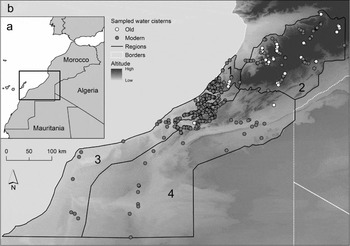
The study area, covering 114 672 km2 in south-western Morocco (north–south range: 30° 42.6′ N–26° 11.3′ N; western–eastern range: 14° 26.5′ W–7° 38.6′ W), was divided into four physiographic regions (Fig. 1), namely Ifni (2637 km2), Western Anti-Atlas (24 401 km2), Guelmim (27 613 km2), and the Low Draa (60 021 km2) (El Gharbaoui Reference El Gharbaoui1987). The climate is rather variable due to the Atlantic Ocean's influence and the altitude gradient (0–1830 m), but is mostly arid (rainfall 50–450 mm yr−1) and warm (mean annual temperature 14.0–23.7 °C; El Gharbaoui Reference El Gharbaoui1987). The southernmost region (Low Draa) is arid and flat, with large portions of the landscape lacking vegetation, although some grasses appear after rainy periods. Along the c. 50 km wide coastal belt, the Atlantic Ocean exerts a marked influence in the form of hidden precipitation; this Macaronesian region (Guelmim) is characterized by dense formations of succulent shrubs. Inland hilly landscape is largely dominated by sparse scrubby vegetation (the Ifni and Western Anti-Atlas regions). Sparse tree formations, savannah-like in appearance, are found on the valley floors of all four regions and in the deeper soils of the Ifni and Anti-Atlas regions. The centres of some valleys have been transformed into croplands.
(a) Location of the study area in north-west Africa. (b) Distribution of sampled water cisterns and boundaries of the regions studied: 1 = Ifni; 2 = Western Anti-Atlas; 3 = Guelmim coastal belt; 4 = Low Draa.

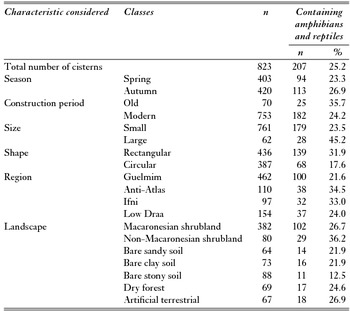
The study area is characterized by a high density of cisterns constructed during different periods and with different shapes. Old cisterns (>40 years old) were built using traditional materials (stone, lime and wood), and their walls tend to be rough (Appendix 1, Fig. S1, see supplementary material at Journals.cambridge.org/ENC); modern cisterns (mostly < 15 years old) were built using reinforced concrete, and their walls are smooth (Appendix 1, Fig. S1, see supplementary material at Journals.cambridge.org/ENC). All cisterns are roofed and have one or two sedimentation chambers of c. 1 m3 each; most are rectangular in plan, but some are circular (3 × 3 m, diameter × depth). Sizes range from approximately 3 × 5 × 2.5 m (small type) to 4 × 8 × 3 m (large type). We investigated the presence and exact location (georeferenced at 10 × 10 m) of cisterns by searching for these structures in Google Earth through random tracks. The location of cisterns was uploaded to a GPS device, and they were visited during fieldwork. Although the search procedure using Google Earth allowed for the location of almost all the cisterns, we failed to visit some of them because of their remoteness, weather constraints or aversion of local people. In all, we examined 823 cisterns (Fig. 1; Table 1) between April 2011 and November 2012, 3.4% of the estimated number of cisterns in the study area. The cisterns were classified according to their age (old or modern), season of the first visit (spring or autumn), shape (rectangular or circular), size (small or large), region (one of the four categories, see above), and surrounding habitat (whether bare sandy soil, bare clay soil, bare stony soil, Macaronesian scrubland, non-Macaronesian scrubland, dry forest or artificial). These factors were considered a priori to determine whether a particular species would likely be trapped within the cisterns.
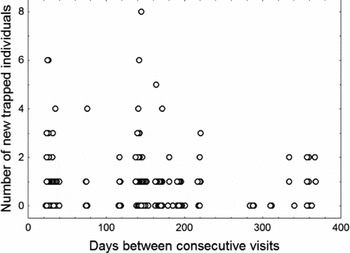
Frequency of water cisterns acting as death traps for amphibians and reptiles in south-western Morocco, indicating the environmental variables with potential influence (see Methods).
The herpetological community in the study area is composed of six amphibian and 59 reptile species (Bons & Geniez Reference Bons and Geniez1996; Appendix 1, Table S1, see supplementary material at Journals.cambridge.org/ENC). We searched for amphibians and reptiles, both in the sedimentation chamber and inside the cistern. In dry cisterns, all materials (stones, sand, rubbish) were examined, and, in the few cisterns with water, we looked for floating specimens. Tadpole schools were counted as a single individual. Live and dead individuals were collected, identified to the species level and live specimens released outside the cistern. Of the 823 cisterns examined during 20 months, 476 were visited once, 190 twice, 89 three, 26 four, 20 five, 16 six, and 6 seven times, with intervals varying between 23 and 278 days. As all specimens were removed after each visit, multiple visits enabled us to count the number of animals trapped over time interval between visits as a proxy of the cistern's propensity for trapping amphibians and reptiles. Amphibians were potentially active all year round, as their activity was linked mainly to the irregular rainfall events. In contrast, reptile activity followed environmental temperatures, and detection probabilities decreased from mid-November until mid-February; accordingly, the three-month period of decreased reptile activity was not considered in calculations of the number of individuals trapped per unit of time.
We used chi-square tests to examine the variation in the frequency of cisterns with trapped reptiles according to cistern age, season, shape, region, and surrounding habitat. To examine whether particular amphibian and reptile species were selectively trapped with respect to cistern location (by region) and habitat classes, we used multivariate analyses (program CANOCO for Windows; ter Braak & Šmilauer Reference ter Braak and Smilauer2002). The longest gradient in a detrended correspondence analysis (DCA) was 8.284, indicating a unimodal distribution of the data (matrix of number of individuals found per species and cistern); accordingly, we examined the relationship between variables (species counts) and factors (regions and habitat classes) using a canonical correspondence analysis (CCA), and tested the relationship between the axes and variables using a Monte Carlo permutation test (ter Braak & Šmilauer Reference ter Braak and Smilauer2002). These multivariate techniques were applied to a species-count matrix considering all the cisterns with at least one trapped amphibian or reptile. In the first step, we included data for all the species found in the 823 cisterns we visited. In the second step, we removed all species found less than five times in order to reduce the statistical influence of species seldom found trapped in cisterns.
We further analysed the potential relationship between the propensity for falling into cisterns and species body size, measured as the maximum body length. This analysis was done separately for lizards and snakes, as they have very different body shape and size. Body size data were obtained from Schleich et al. (Reference Schleich, Kästle and Kabisch1996). We did not examine this relationship for amphibians because amphibian body sizes were similar throughout the study area.
The high proportion of modern cisterns in the study area (91.5% of sampled cisterns, n = 823) implies that cistern construction is an increasing phenomenon. To estimate the impact of cisterns on amphibians and reptiles, we calculated cistern density within the study area by randomly examining 40 5 × 5 km squares (10 squares within each region). In these squares, we located and counted all cisterns by closely examining Google Earth images (Appendix 1, Fig. S2, see supplementary material at Journals.cambridge.org/ENC). In addition, we estimated the number of amphibians and reptiles trapped per time unit, regardless of the species.
RESULTS
Amphibians and/or reptiles were found trapped in 207 (25.2%) of the 823 cisterns examined. No differences were detected in the proportion of cisterns with amphibians and reptiles trapped according to season when cisterns were visited (χ2 = 1.42, df = 1, p = 0.23). By contrast, there were differences according to cistern age (χ2 = 4.53, df = 1, p = 0.03; more frequent in old cisterns), shape (χ2 = 22.30, df = 1, p < 0.0001; more frequent in rectangular cisterns) and size (χ2 = 14.26, df = 1, p = 0.0002; more frequent in large cisterns). We also found differences among regions (χ2 = 38.50, df = 3, p < 0.0001; more frequent in the Anti-Atlas and Ifni regions), and among habitats (χ2 = 78.19, df = 6, p < 0.0001; more frequent in non-Macaronesian scrubland and less frequent in bare stony soil; Table 1).
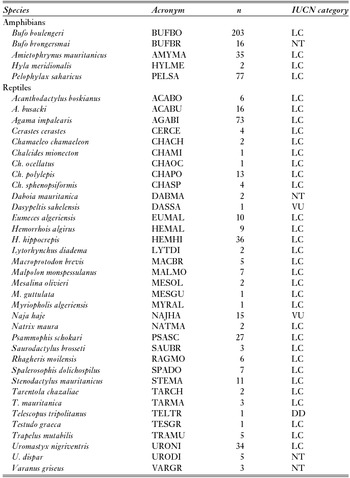
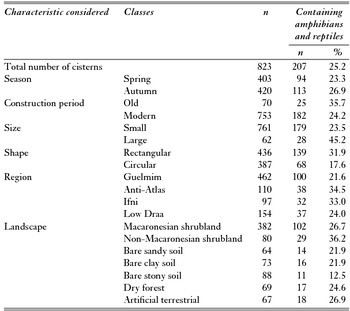
We found 333 amphibians of four species (66.6% of species recorded) and 323 reptiles comprising 35 species (60.3% of the species recorded) trapped in cisterns (Table 2); 53% of the individuals recorded were alive. Additionally, we found the tree frog Hyla meridionalis and the gecko Tarentola mauritanica inside the cisterns, but due to their climbing abilities, they were not recorded as trapped. Bufo boulengeri accounted for 61% of the amphibian records, and Agama impalearis accounted for 23% of the reptile records.
Number of trapped amphibians and reptiles in cisterns in south-western Morocco by species and International Union for the Conservation of Nature (IUCN) extinction risk category at the regional level of Morocco (from Pleguezuelos et al. Reference Pleguezuelos, Brito, Fahd, Feriche, Mateo, Moreno-Rueda, Reques and Santos2010). LC = Least Concern; NT = Near Threatened; VU = Vulnerable; and DD = Data Deficient.
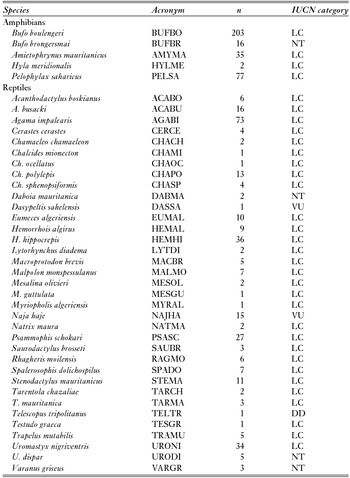
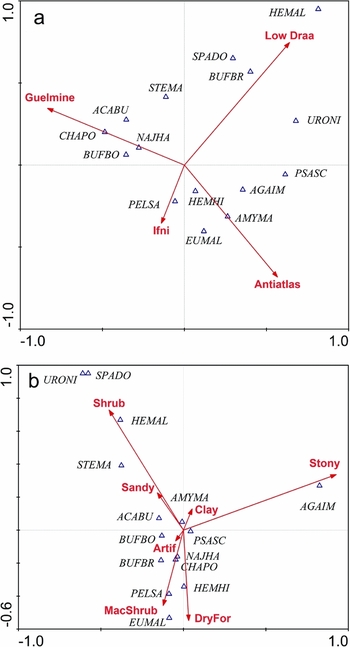
Pooling the entire data set (common and uncommon amphibian and reptile species) of the species found in cisterns, the CCA indicated significant differences among the four regions (trace = 0.885, F-ratio = 2.354, p = 0.002). The greatest difference was between the Guelmim and Low Draa/Anti-Atlas regions, with a clear and significant discrimination in axis 1 (eigenvalue = 0.498, F-ratio = 3.912, p = 0.002). Significant differences also appeared in species composition among cisterns in different habitats (trace = 1.439, F-ratio = 1.929, p = 0.008), although the first canonical axis proved not to be significant (eigenvalue = 0.356, F-ratio = 2.739, p = 0.1). When we repeated these analyses removing species with less than five records, the CCA also showed significant differences in species composition among regions (trace = 0.767, F-ratio = 4.315, p = 0.002) with the first canonical axis being significant (eigenvalue = 0.481, F-ratio = 7.910, p = 0.002; Fig. 2 a). This analysis again discriminated between the Guelmim and Low Draa/Anti-Atlas regions, and identified several species associated with one of the regions (Fig. 2 a). The CCA showed significant differences (trace = 1.039, F-ratio = 2.951, p = 0.002) among habitats, with the first canonical axis being significant (eigenvalue = 0.306, F-ratio = 4.856, p = 0.006; Fig. 2 b), discriminating between bare stony and the rest of the habitats. The second axis (eigenvalue = 0.263) discriminated species composition between Macaronesian shrubs and non-Macaronesian shrubs/dry forest habitats. Several common species were associated with particular habitats (Fig. 2 b).
Canonical correspondence analysis plots of the association between amphibian and reptile species trapped within cisterns, and (a) regions (Ifni, Anti-Atlas, Guelmim and Low Draa) and (b) habitats (Macaronesian scrubland, non-Macaronesian scrubland, bare sandy soil, bare clay soil, bare stony soil, dry forest, artificial terrestrial) within the space generated by the two first axes extracted. Species codes are as provided in Table 2. Only species recorded on more than four occasions were included in the analysis.
There were no differences in body size between trapped and non-trapped reptile species, either within the subgroup of lizards (mean ± SD of total body length of trapped = 219.5 mm ± 23.5, n = 19; non-trapped = 176.6 mm ± 21.3, n = 17; t-test = 1.33, df = 34, p = 0.19) or the subgroup of snakes (trapped = 1055.8 mm ± 124.8, n = 16; non-trapped = 923.3 mm ± 218.6, n = 6; t-test = 0.54, df = 20, p = 0.59). None of the amphibians trapped in cisterns were red listed as threatened within Morocco. Two of the reptiles, Dasypeltis sahelensis and Naja haje, are listed as Vulnerable and three reptiles are listed as Near Threatened, Daboia mauritanica, Uromastyx flavifasciata and Varanus griseus; Telescopus tripolitanus is listed as Data Deficient (Appendix 1, Table S1, see supplementary material at Journals.cambridge.org/ENC).
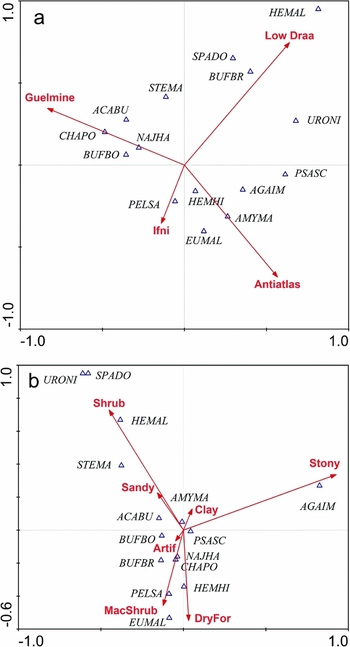
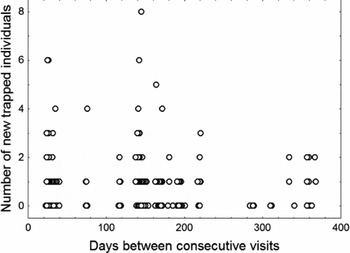
The mean number of cisterns per 5 × 5 km square was 5.4 ± 1.7 SE (range 0–222), although with a sharp variation among regions (Kruskal-Wallis test: H (3, n = 40) = 29.93, p < 0.0001); the mean of cisterns per 25 km2 in Ifni was 108.1 ± 22.1, whereas in Anti-Atlas, Low Draa and Guelmim the means were 10.6 ± 3.5, 1.0 ± 0.7 and 0.5 ± 0.4 cisterns per square, respectively. The relationship between the number of days between consecutive visits and trapped amphibians and reptiles did not follow any discernible pattern (Fig. 3). An estimation using only visits to cisterns with trapped amphibians and reptiles, and within a maximum period of 100 days between consecutive visits (a method meant to avoid underestimation due to cistern cleaning activities and the removal effect by scavengers), showed that the mean number of trapped amphibians and reptiles per day and cistern was 0.051 specimens day−1 ± 0.006 SE (n = 61), suggesting that each cistern traps, on average, one amphibian and/or reptile every 19.6 days. Given the area studied, the mean number of cisterns per 25 km2, and mean number of individuals trapped per day and cistern in each region, the estimated number of amphibians and reptiles trapped in our study area was 459 017 individuals yr−1 in a total area of 114 672 km2.
Number of recent trapped amphibians and reptiles in cisterns in south-western Morocco versus time between consecutive visits. Data pooled from 347 different cisterns of different age, shape, size, region and habitat.
DISCUSSION
The high percentage of amphibian and reptile species recorded within cisterns, two-thirds of the amphibian richness and more than a half of the reptile richness within the study area, suggests that these unintentional traps can be more effective than conventional survey techniques in documenting the amphibian and reptile species composition in north-western Morocco (our own unpublished data; Enge et al. Reference Enge, Cobb, Sprandel and Francis1996). The lack of difference in body size between trapped and non-trapped reptile species also confirms the indiscriminate capacity of cisterns to trap most of the reptile species from the surrounding habitats.
Old rough-walled cisterns significantly trapped more amphibians and reptiles than deep and smooth-walled modern cisterns; it may be that old cisterns are viewed as a natural habitat and are more attractive to amphibians and reptiles. Deserts and flattened arid regions often offer few microhabitats for these organisms, specifically water bodies for amphibians and shelter for reptiles (Brito et al. Reference Brito, Fahd, Geniez, Martínez-Freiría, Pleguezuelos and Trape2011b , Reference Brito, Godinho, Martinez-Freiría, Pleguezuelos, Rebelo, Santos, Gomes, Velo-Antón, Boratyński, Carvalho, Ferreira, Gonçalves, Silva, Tarroso, Campos, Vasco Leite, Nogueira, Alvares, Sillero, Sow, Fahd, Crochet and Carranza2014; Márquez-Ferrando et al. Reference Márquez-Ferrando, Pleguezuelos, Santos, Ontiveros and Fernández-Cardenete2009). Thus, watered cisterns may be suitable spots for amphibian breeding (the case in at least 13 different cisterns), whereas walls may provide a good refuge for saurian reptiles: 119 individuals of four broad-fingered gecko species, Ptyodactylus oudrii, Tarentola annularis, T. boehmei, and T. mauritanica were found on external walls of 79 cisterns. Shed snakeskins were found on the walls of 11 cisterns, usually those built with individual bricks or blocks.
Interestingly, we found that the two northernmost regions (Ifni and Anti-Atlas) contained the greatest number of individuals trapped in cisterns. These regions are both situated at moderate altitudes, are less affected by the Saharan aridity, and have the greatest herpetological density within the study area (Bons & Geniez Reference Bons and Geniez1996). Trapping rates may be consistent with amphibian and reptile density, and this pattern may help anticipate impacts resulting from the construction of new cisterns in other arid regions. Ifni is the most densely human populated region of the study area (El Gharbaoui Reference El Gharbaoui1987), has the greatest cistern density, and had a great number of trapped amphibians and reptiles per cistern. Such a relationship suggests that mortality associated within unintentional capture in cisterns may be a severe threat to the herpetofauna within this small and diverse region of Morocco (Bons & Geniez Reference Bons and Geniez1996). Differences in the frequency of amphibians and reptiles trapped may also be related to the amount of vegetation found in each habitat. Cisterns in the non-Macaronesian and Macaronesian scrublands found in the Ifni and Anti-Atlas regions had high trap rates, whereas cisterns located in bare stony soil habitats had low rates. Vegetation cover might thus serve as a good predictor of overall amphibian and reptile abundance (Cunningham et al. Reference Cunningham, Lindenmayer, Crane, Michael and MacGregor2007) and trapping impact of cisterns in arid regions. As cisterns trap most of the species in surrounding areas, differences among cisterns were consistent with differences among communities found within the regions and habitats sampled. Bufo boulengeri, Acanthodactylus busacki, Chalcides polylepis and N. haje were often trapped in cisterns from the Guelmim region, Amietophrynus mauritanicus and A. impalearis were frequently trapped in the Anti-Atlas region, and B. brongersmai and Uromastyx nigriventis were often trapped in the Low Draa region. Similarly, rock-dwelling species, such as A. impalearis, were often trapped in cisterns built on rocky soils, while Hemorrhois hippocrepis was found in cisterns located in dry-forest habitats, because this whip snake frequently seeks shelter and forage in argan trees (Argania spinosa). Cisterns in Macaronesian shrubs frequently captured Eumeces algeriensis, a robust skink that is frequently found on the clay soils of the coastal habitats and Anti-Atlas slopes where succulent shrubs grow.
A number of species found trapped in cisterns are of conservation concern at the regional level in Morocco: Naja haje was listed as Vulnerable because of intensive harvesting for snake charming, and D. sahelensis because of its restricted range, low density and relict populations, lacking the possibility of extra-regional populations to contribute to a rescue effect (Pleguezuelos et al. Reference Pleguezuelos, Brito, Fahd, Feriche, Mateo, Moreno-Rueda, Reques and Santos2010). Our study suggests that accidental mortality in cisterns is a threat to these species; for instance, 15 out of 20 N. haje recorded by us in the last two years within the study area were observed inside these cisterns, suggesting cisterns have a potentially significant impact on this snake. Moreover, five other species were listed as Near Threatened or Data Deficient, being close to being listed as threatened because of harvesting for food and trade (U. nigriventris, V. griseus), snake charming (D. mauritanica), and habitat loss due to changes in agriculture and livestock (B. brongersmai) (Pleguezuelos et al. Reference Pleguezuelos, Brito, Fahd, Feriche, Mateo, Moreno-Rueda, Reques and Santos2010).
The impact of cisterns on the amphibians is of particular concern, as the percentage of Moroccan amphibians that are regionally threatened is high (30.7%; that of globally-threatened Mediterranean amphibians is 25.5%; Cox et al. Reference Cox, Chanson and Stuart2006). We found most of the amphibians inside both dry and water-holding cisterns (all except Discoglossus scovazzi). Some species were frequently observed breeding, such as the Moroccan endemic B. brongersmai, either in the open settling tanks or within the roofed cisterns. Although cisterns apparently increase the availability of breeding habitats and dispersal possibilities in arid regions, cisterns were invariably death traps for adult amphibians and almost always for post-metamorphic individuals. With respect to the larval stage, artificial breeding habitats rarely mimic natural ponds (Korfel et al. Reference Korfel, Mitsch, Hetherington and Mack2010), and many cisterns had poor conditions for larval development, because of high exposure to aerial predation (in the settling tanks), oligotrophic waters, and drying prior to juvenile emergence (Stevens et al. Reference Stevens, Paszkowski and Stringer2006). Some cisterns were built at otherwise natural breeding sites for amphibians, but, by changing the natural hydrology, cisterns are reducing the variety of water bodies and the quality of amphibian breeding sites (see Burkett & Thompson Reference Burkett and Thompson1994).
The mortality rate of amphibians and reptiles in cisterns in the north-western Sahara (47%) was much greater than that for other artificial traps (for example pipeline trenches; Enge et al. Reference Enge, Cobb, Sprandel and Francis1996; Woinarski et al. Reference Woinarski, Armstrong, Brennan, Connors, Milne, McKenzie and Edwards2000). Among other arid environments, in New Mexico, individuals of the lizard Uta stansburiana die by being trapped inside water pipes (Manning Reference Manning2007), and, in northern South Australia, abandoned mine shafts cause 10–28 million reptile deaths yr−1 as a consequence of accidental falls (Pedler Reference Pedler2010). The number of amphibians and reptiles trapped per year (459 017 individuals) within our study area (114 672 km2) seems small in comparison; however, several factors may modify this view. First, the low productivity of arid regions such as Western Sahara (Brito et al. Reference Brito, Martínez-Freiría, Sierra, Sillero and Tarroso2011 a, Reference Brito, Fahd, Geniez, Martínez-Freiría, Pleguezuelos and Trape b ) supports low species diversity and overall population densities of terrestrial vertebrates (Louw & Seely Reference Louw and Seely1982; Ward Reference Ward2009). The potential impact is also expected to be greater for species with low dispersal ability and already scattered populations (Davies et al. Reference Davies, Poulsen, Schulte-Herbrüggen, Mackinnon, Crawhall, Henwood, Dudley, Smith and Gudka2012), such as amphibians in desert habitats (Wang Reference Wang2009). Moreover, particular cisterns with high mortality rates may be depleting local amphibian and reptile populations by selectively killing one sex or body size range (Stevens et al. Reference Stevens, Paszkowski and Stringer2006; Wolak et al. Reference Wolak, Gilchrist, Ruzicka, Nally and Chambers2010), a possibility that merits future research.
The real impact of cisterns on Saharan herpetofauna may be much greater than our results suggest. The lack of correlation between time elapsed between surveys and the number of individuals trapped suggests loss of information with time. In dry seasons, shepherds clean cisterns of sediments, removing both dead and living (which they kill) amphibians and reptiles; some amphibians (Amietophrynus and Bufo species) dig deeply in sediments to avoid desiccation, and some of the reptiles trapped were burrowing species (eight skink, one amphisbaenian and three snake species), prone to remaining undetected within settling tanks or cisterns. Scavenger beetles of the genus Akis, Blaps and Morica frequent the bottoms of cisterns and contribute to the disappearance of dead amphibians and reptiles, as does predation and scavenging among trapped reptiles (our own unpublished data). The smallest species (namely Saurodactylus brosseti and Tropiocolotes algirus) and juveniles of many species may remain undetected at the bottom of uncleaned cisterns.
The large percentage of modern cisterns in the study area suggests that construction will continue in the future as a major economic development activity (Frederick Reference Frederick1997; Brito et al. Reference Brito, Godinho, Martinez-Freiría, Pleguezuelos, Rebelo, Santos, Gomes, Velo-Antón, Boratyński, Carvalho, Ferreira, Gonçalves, Silva, Tarroso, Campos, Vasco Leite, Nogueira, Alvares, Sillero, Sow, Fahd, Crochet and Carranza2014). Moreover, the construction of modern cisterns by the Moroccan Government in the larger regions of the study area (Anti-Atlas, Guelmim and Low Draa) is promoting the exploitation of remote and irregular pastures by livestock (ECOWAS & SWAC-OCDE 2006; Thorton et al. Reference Thorton, Jones, Owiyo, Kruska, Herrero, Orindi, Bhadwal, Kristjanson, Notenbaert, Bekele and Omolo2008). Consequently, adverse impacts on the regional herpetofauna are expected to increase, and this trend may especially impact Uromastyx sp., the lizards with the largest body mass in the study area. These lizards rely on patches of unpredictable food, as they are mainly herbivorous when adults and take advantage of the sporadic blooms of Saharan vegetation to accumulate fat reserves for fasting periods. Modern cisterns are expected to favour access to grasslands for herbivores such as goats, which probably exert greater pressure on vegetation than that exerted by wild mammalian herbivores; spiny tailed lizards would be unlikely to be able to compete.
CONCLUSION
Our study provides the first quantitative evidence of the threat of cisterns to Saharan herpetofauna, and the number of species and of individuals gives cause for concern. However, there are ways to reduce and even avoid the accidental entrapment of organisms (Wilson & Topham Reference Wilson and Topham2009). Simple ramps in the rather shallow settling tanks could facilitate the escape of trapped species, and dense wire mesh in the inlet and overflow slits of the deeper cisterns (Appendix 1, Fig. S3, see supplementary material at Journals.cambridge.org/ENC) could prevent many amphibians and reptiles from being caught, while not restricting livestock from watering in these arid environments. It is yet unknown whether local people would be amenable to these suggestions.
ACKNOWLEDGEMENTS
J. Álvarez, I. Arróspide, J. Barnestein, E. Dimitris, M. Feriche, J. Otero, J. Rodríguez, J. Sánchez and A. Valdeón participated in fieldwork. J.C. Brito was funded by the North Portugal Regional Operational Programme 2007/2013 (ON.2–O Novo Norte), under the National Strategic Reference Framework (NSRF) through the European Regional Development Fund (ERDF), J.M. Pleguezuelos by the Junta de Andalucía (RNM-254), and X. Santos by a post-doctoral grant (SFRH/BPD/73176/2010) from Fundação para a Ciência e a Tecnologia (FCT, Portugal).
Supplementary material
To view supplementary material for this article, please visit Journals.cambridge.org/ENC