Contemporary narratives and historical sources provide a general view of manumission in the United States and other slave societies. But little is known of the details, and almost nothing of the economics. How effective was manumission in overcoming the severe agency costs that must be present in any situation of unfree labor? Who was manumitted? By whom? Did slaves pay “fair market prices,” or did slave owners exploit their monopoly power? Using a remarkable new data set, this article will answer these questions within the context of slavery in Louisiana at the turn of the nineteenth century, providing the first real empirical evidence on the economics of manumission.
Manumission, the freeing of a slave from bondage, has served as a powerful incentive for slaves throughout history. It was common enough in ancient times that economic historians have gone as far as to describe the Roman labor system as a functioning labor market, encouraging slaves to work cooperatively with their owners.1
Temin, “Labor Supply.” See Fenoaltea, “Slavery,” for a comprehensive discussion of manumission in a historical perspective.
Although generally permitted by U.S. state legal codes until the middle of the nineteenth century, manumission was much less common in the United States than in ancient Rome or Greece.
2 Stefano Fenoaltea attributes the relative infrequence of manumission to the nature of the work performed by U.S. slaves.
3 He contends that pain (“the lash”) can generate greater work effort, but not more care, whereas positive rewards are effective in eliciting care. Thus, manumission would not be an optimal incentive for difficult manual labor, such as plantation farming, the major occupation of slaves in the South.
Even so, there were many exceptions. A system of “term slavery” in Maryland at the turn of the nineteenth century allowed a slave holder to make a legally binding agreement with a slave to free her after a certain number of years, in return for greater and more reliable work effort. A special court was set up to adjudicate disputes between slaves and slave-holders who had made this agreement.4
Whitman, “Diverse Good Causes.”
Spanish-ruled territories had a system of
coartación (described in detail in what follows), whereby a slave could sue for freedom if she had enough money to compensate her owner.
The incentive schemes designed by slave owners could be complex: Charles Dew describes the operations of an iron forge staffed by slaves in Virginia in the early nineteenth century.5
The owner designed an “overwork system” whereby slaves were obliged to provide a standard amount of output per day, and were paid at a piece rate equal to the wages for free labor for output above their quota. Slaves were allowed to use their wages to purchase food and goods (above the standard ration), but there is only one documented example of a slave purchasing his freedom.
The idea that manumission provided a powerful performance incentive was part of the early cliometric debate over the profitability of slavery. In response to the pioneering work of Alfred Conrad and John Meyer,6
Conrad and Meyer, “Economics” and “Reply.”
John Moes argued that the U.S. system of slavery was not efficient, because a system encouraging manumission was:
to the advantage of the owner because it gave the slave an incentive to work well and in general to make himself agreeable to his master … the idea that slavery is profitable (and therefore likely to be maintained) when slave prices are high does not stand up against this modern notion of opportunity cost but is the result of overlooking the most relevant alternative opportunity: that of allowing the slave to buy himself.7
Moes, “Economics,” pp. 183–84.
Moes adduced an anecdote about a philanthropist who reported having agreed to pay the slaves on his plantation for work on Saturday, in return for their eventual freedom. The philanthropist claimed to have received enough in payments to replace the departed slaves with double their number.
Although closer scrutiny by Fenoaltea revealed this story to be apocryphal, the principle could still hold.8
See Fenoaltea, “Slavery,” note 40, p. 645.
In Coasian terms, there are at least two reasons why manumission could be more efficient than slavery: first, productivity effects aside, slaves may value their freedom more than masters value their enslavement. Second, to the extent that there are frictions in inducing slaves to exert effort, the prospect of manumission
even at market price (or above) could provide a powerful incentive motivating slaves to work. Thus, we might reasonably expect that property rights will eventually be transferred to those who value them most, and that manumission would thus be an important feature of U.S. slave society. Conrad and Meyer's response to this criticism was agnostic: “… this is clearly an empirical question—an empirical question, moreover, about which neither we nor Moes now have sufficient information to say anything definitive.”
9 Conrad and Meyer, “Reply,” p. 188.
A rich new dataset from every surviving document on slavery and manumission in Louisiana from 1770–1820 allows me to paint a qualitative, quantitative, and economic portrait of manumission in Louisiana. I examine whether slaves who purchased their freedom paid above or below market prices. Moreover, a change in the laws regulating manumission following the Louisiana Purchase allows me to explore how legal rights affected the economics of manumission, and better explain why manumission was relatively rare in the United States.
EVIDENCE AND DATA
The question of whether manumitted slaves paid the market price for their freedom has puzzled economic historians for over a century. A. M. Wergeland, in a survey article on slavery in medieval Europe, notes that data on the price of manumission are almost unavailable. He cites some prices listed in legal codes, which were well below “market value,” but points out that these amounts were most likely not actually used in practice.10
Wergeland, “Slavery,” p. 242.
In an early cliometric exercise, William Westerman examined over a thousand Delphic manumissions, from 201 to 53 BC. The majority were outright grants, whereby a slave purchased her unconditional freedom. He reports that an examination of the manumissive price of over 500 slaves reveals that slaves paid higher prices for their freedom than the average market price. Westerman ascribes the higher prices to the monopoly power of slave-holders.
11 Westerman, Slave Systems.
Louisiana is a particularly good place to study manumission: it was relatively common, and records are well preserved. For example, archival copies in Spain have helped fill gaps in the surviving records in Louisiana. Kimberly Hanger uses surviving notarial records from Spanish New Orleans to study manumission.12
Hanger, Bounded Lives. These data are also in the Hall database.
She provides some demographic information, along with the annual average price paid from a sample of 700 manumissions over the period from 1771 to 1803, but does not compare these prices to the market prices. Lawrence Kotlikoff and Anton Rupert examine jury records of manumissions in New Orleans from 1827 through 1846, and find that free blacks, as purchasers, were involved in a significant proportion of manumissions. However, because price data were typically not recorded in the jury records, they cannot investigate the terms of the manumissions.
13 Kotlikoff and Rupert, “Manumission.”
I use information from two recent databases: the “Louisiana Slave Database” and “Louisiana Free Database,” collected by Gwendolyn Hall and her team.14
They spent 15 years collecting information from every document available relating to slavery in Louisiana, from the arrival of the Europeans until 1820. Sources include every archive and courthouse in Louisiana, as well as archives in Mississippi, Alabama, Florida, Texas, France, and Spain. The databases contain detailed descriptions of over 100,000 individual slave sales or other transactions. Four thousand sixty records relate to manumission.
15 Duplicate documents were deleted, though if a person appeared multiple times in different documents, the observations were retained.
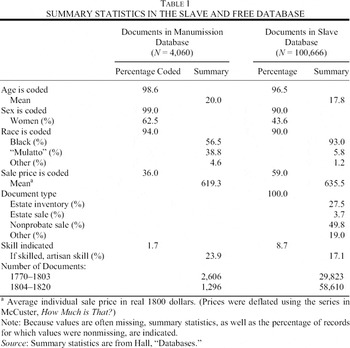
provides some key summary statistics about the coverage and scope of principal demographic variables of interest.
The various documents were produced in the course of normal transactions, and consist primarily of sale contracts, probate records, manuscripts, and published census records. They provide information about the age, sex, origin, health, character, and skills of slaves and manumitted slaves. In addition, the investigators coded information on the relationship between freer and freed, whether a freed slave was (or potentially was) a child of a master, the illnesses or disabilities of the slave or freed person, and the location.
During the period covered by the databases, Louisiana was ruled by three regimes, with several currencies, and significant currency fluctuations. Fortunately, a large number of government and commercial historical documents list prices in several currencies, allowing Hall to convert all prices into nominal dollars using the appropriate exchange rate. Hall cautions, however, that the earlier price data are less reliable. The present analysis involving price data is restricted to observations from 1770 on.16
Hall, “Prices.” Inclusion of slave sales and manumissions prior to 1770 does not change the results. (Results available from author).
LEGAL CONTEXT AND THE NATURE OF MANUMISSION IN LOUISIANA
From 1769 until 1803 Louisiana was under Spanish control.17
The Spanish slave code was not promulgated until 1770. (Baade, “Law,” p. 56).
Compared to the French
code noir it replaced, and U.S. slave codes which followed, the Spanish legal system afforded several specific protections to slaves. Masters did not require any official permission to manumit slaves; mistreated slaves could request resale to another master, and slaves could purchase their freedom by paying their market price to their masters.
18 This last right, a system of self-purchase called “coartación,” developed initially in Cuba prior to the first half of the eighteenth century, and spread to varying degrees throughout the Spanish colonies.19
Bergad et al., “Cuban Slave Market,” p. 131; and Aimes, “Coartacion,” p. 414.
The linguistic root of coartación is “
cortar,” which means to cut or limit. This system sought to balance slaves' aspirations for freedom with masters' property rights, by allowing a slave to manumit herself if she paid her master her fair market value. By custom as well as law, if a slave's master refused a slave's request to purchase her freedom, the slave could sue. If there was a dispute about the fair price, each party, as well as the court, would be provided an assessor, and the slave would be freed following payment of the court-determined value to the master. These rights were guaranteed by officials called “
sindicos,” who were charged with protecting the rights of the poor, the Native Americans, and the slaves.
20 Aimes, “Coartacion,” p. 418.
Although the right of self-purchase was not codified into Louisiana law (the other two protections were), coartación in Louisiana “was recognized and enforced, nevertheless, in a steady stream of judicial decisions, averaging somewhat less than two cases per year for the thirty-three year period of direct Spanish rule.”21
Hanger reports that approximately one in seven cases of coartación required court supervision to set a fair price. Petitioners paid litigation costs, but these appear to have been relatively low. I found only one enumeration of court costs, given as 27.5 pesos for a purchase price of 800 pesos, or about 3.5 percent of the sale price.22
When American administrators took over Louisiana on 20 December 1803, they worked with local slave-holders to bring Louisiana laws in line with other southern states, including eliminating the right to sue for freedom.23
Ingersoll, “Free Blacks,” p. 174. The Spanish legacy of manumission may have persisted more in Louisiana than other states. Despite significant curtailment of manumissive rights following the Louisiana Purchase, some steps forward were made. In 1825 Louisiana was one of only three states to explicitly allow slaves to contract for their own freedom. (Matison, “Manumission.”) As late as 1860 Louisiana's manumission rate was several times greater than the median rate of southern states. (United States, Statistics of the United States, p. 337).
In 1807 the first legislature of the Territory of Orleans passed a law limiting manumission to individuals over 30 years of age, unless they had saved the life of their slave-holder.
WHO WAS MANUMITTED? HOW?
The breadth and depth of the Hall database allow me to paint a comprehensive picture of manumission in Louisiana. Unique in scale and scope, the data are particularly well suited for economic analysis, because a large share of the observations include both individual characteristics and sale prices of slaves and freed slaves.
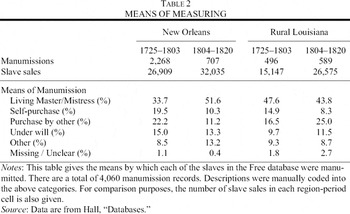
Table 2 indicates how each of the 4,060 slaves achieved freedom between 1725 and 1820, in both New Orleans and rural Louisiana.24
The “Free database” has 4,064 records, but four of the slaves were not actually manumitted.
The consensus view that manumission was less common in the American period than the Spanish period is correct: the documents in the database suggest there were only 2.3 manumissions for every 100 slave sales in the U.S. period, compared to 6.5 per 100 slave sales in the Spanish period.
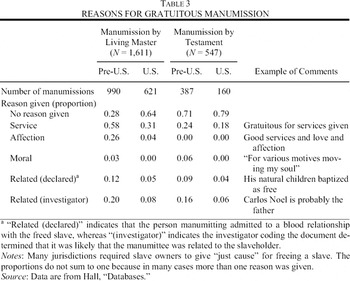
In both the Spanish and U.S. regime, the most common path to freedom was an outright grant by a living master or mistress. Why did masters free slaves? It is hard to imagine, in any other economic setting, forfeiture of so much wealth as the gratuitous manumission of slaves in the new world. Although one cannot hope to understand all the complexities in the relationship between the owner and slave, the data can speak to what the owners thought was most important. To manumit a slave, the owner was typically prompted or required to give just cause. I manually coded the causes recorded in the manumission documents into the five most common reasons. The data are presented in Table 3, broken down according to whether the manumission was by a living grant, or through a will, as well as by time period (Spanish vs. U.S.).
The prevalence of “good service” suggests that an incentive dynamic may have been important in as many as half of all manumissions in which there was no monetary payment. Appeals to the immorality of slavery were surprisingly rare: perhaps those uncomfortable owning slaves sold the slaves, rather than freeing them.
Although freers typically did not admit to a blood relationship with the slaves they freed, family bonds were often a reason for manumission. Of the 2,158 manumissions that were grants of freedom (by living masters or in wills), only 192 stated outright that the freed slave was related to the master. However, the investigators were able to deduce from evidence in the documents and elsewhere that 323 freed slaves were likely children of masters: thus approximately 24 percent of gratuitous manumissions involved relatives of the slave owner.25
The Hall data are broadly consistent with findings by Hanger, who examined notarial records of Spanish-period manumissions. She found that a majority of manumissions were gratuitous, and that women, children, and the elderly, as well as slaves of mixed African and European descent were over-represented among manumitted slaves. (Hanger, Bounded Lives, pp. 28–30.)
A typical case is perhaps that of Genevieve, who in 1779 was freed along with her brother Nicolas, in Point Coupee, upon the death of their master, Simon Macour. He recognized the children as his in his will: his widowed wife and their white son protested, but the slaves were freed nonetheless.
Also notable is the disappearance of “affection,” and the sharp drop in relationships, as reasons for manumission in the U.S. period. Although manumission by living masters was slightly more common in the U.S. period (79 percent of U.S. vs. 72 percent of Spanish manumissions), manumission for reasons of affection became much less common: affection is cited in 26 percent of Spanish, and only 4 percent of U.S. manumissions. The difference may be attributable to different attitudes towards slaves: the Spanish tradition recognized that “slavery was not the natural condition of men.”26
Hanger, Bounded Lives, p. 25.
Cuban law, for example, explicitly allowed owners to free slaves in wills, provided such action proceeded “from an honest and laudable motive.”
27 Knight, Slave Society in Cuba, pp. 130–31.
U.S. laws and attitudes were much less sympathetic. There is a less severe, but still noticeable, decline in the proportion of documents indicating that manumission is granted for service.
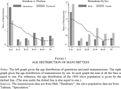
The importance of blood relations between the freer and the slave probably also accounts for the skewed age and sex distribution of manumitted slaves. Figure 1 graphs the age distribution of manumissions, decomposed by whether the manumission was gratuitous or by purchase (left panel), and by gender (right panel). For comparison purposes, the age distribution of slaves in 1850 is given as a dashed line.28
The slave population distributions are from the U.S. Census, as reported by Tadman, Speculators, p. 240.
Young children were significantly overrepresented among gratuitous manumissions: many were children of the slave-owner. Similarly, prime-aged women were much more likely to be manumitted than men, probably both because their productive value was lower, and they were more likely to have been in intimate relationships with their owners.
FIGURE 1 AGE DISTRIBUTION OF MANUMITTEES
Manumissions appeared to follow the seasonal pattern of the slave market. Outright grants of manumission were least common during the summer months of July, August, and September (over the entire time period, approximately 88 manumissions occurred per summer month, whereas 113 per month occurred during the rest of the year.) Kotlikoff reports a similar lull in slave sales at this time, and attributes it to the fact that summer months were idle months: perhaps slaves seeking to manumit themselves also had less earning opportunity during the slack summer months.29
Kotlikoff, “Structure,” p. 503.
Southern manumission has been described as a largely urban phenomenon, because there were more opportunities for slaves to earn money, and slaves could benefit from association with free blacks, who typically lived in cities.30
Matison, “Manumission.” See also Goldin, Urban Slavery.
The data confirm that manumission was more common in urban areas. Though we do not have information about the actual residence of the slaves, 76 percent of manumission records originate from New Orleans (the only urban parish in Louisiana prior to 1820), whereas only 57 percent of the slave records originate in New Orleans.
31 No population data are available: thus, when appropriate, the number of slave sales can be used to scale the number of manumission records.
Of the manumissions by self-purchase, 81 percent were in the parish of New Orleans.
Historical accounts suggest that manumission was most prevalent among skilled workers. Although the share of records for which skill information is given is insufficient to make detailed claims, many records indicate either basic skills (such as laborer) or artisan skills (such as tailor). Skill distributions are reported in Table 1.
The prevalence of self-purchase or purchase by others is striking: more than 30 percent of manumissions occurred either through self-purchase or purchase by other. Though typically described as an urban phenomenon, manumission by purchase was prevalent in rural areas as well, during both the Spanish and U.S. administrations. Slaves earned money in various ways, such as hiring their own time from their owners and working for others or selling produce of individual vegetable plots.32
In 1806 Louisiana even passed a law obliging slaveholders to pay slaves for work on Sundays, though it is not clear to what extent the law was enforced.
33 See Morris, “Measure,” p. 236, as well as the court case Rice v. Kade, 10 La. 288 (1836).
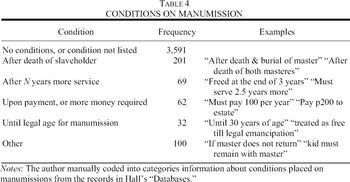
Manumission sometimes represented a complex legal contract, with owners placing conditions of future servitude, good behavior, or additional payments on freed slaves. Approximately 12 percent of manumission records included additional conditions; they are detailed in Table 4.34
Twelve percent is a lower bound, as surviving documents might not mention all of the conditions, particularly if they have already been fulfilled.
The most common condition freed a slave after the death of the master, though freers also demanded additional payment and required additional years of service. It is not clear how well these conditions were enforced, but historians have documented instances of courts siding with slaves against their owners in disputes.
35 Hanger, Bounded Lives, pp. 185–86.
Some calculations by Robert Fogel and Stanley Engerman are informative here. Using the best estimates of slave wages, the cost of raising slaves, and the opportunity cost of capital, Fogel and Engerman estimated that the break-even point of holding a slave in the South in 1850 was 26 years.36
Fogel and Engerman, “Philanthropy.”
Thus, slave-holders who chose to manumit slaves aged 26 and above easily earned accounting profits.
Economic theory does not provide a clear prediction about the relationship between the real price of slaves, and the incidence of manumission. The price of slaves increases with the value of their labor, but their earning potential (or the gains from reducing frictions in the principal-agent problem) should also increase. Ronald Findlay studies this problem in detail and under strict assumptions derives comparative statics with respect to the interest rate, but does not examine the effect of price changes.37
Similarly, the total wealth of owners increases as slaves become more valuable, but so too does the cost of granting manumission.
I find that manumissions are positively correlated with prices. A simple regression of the number of manumissions on the real price of a 30-year old male field hand yields a positive and significant co-efficient; this relationship is robust to the inclusion of a time trend, and a dummy for U.S rule (1803–1820).38
Results available from the author. Prices are deflated using data from John McCusker, How Much is that?
This holds both for total manumissions and for manumissions by purchase. These results should be taken as indicative rather than definitive, because it is not clear what drives the time-series variation in prices.
THE PRICE OF FREEDOM
Did slaves who purchased their own freedom, or whose freedom was purchased by others (such as relatives), pay a price higher than their replacement cost? A slave's willingness to pay exceeded the owner's valuation of the slave, because the slave would gain not only the economic value of her labor, but also freedom. Owners could purchase a replacement for a manumitted slave on the market. Owners may therefore have attempted to extract above-market prices from slaves seeking manumission, when legally allowed to do so.
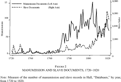
The data show that institutions and attitudes governing manumission mattered. Figure 2 plots the number of manumissions and slave sales that took place from 1720–1820. A simple test, regressing the proportion of manumissions to slave sales on a constant and a dummy for U.S. rule confirms that there were significantly fewer manumissions per slave sale under the U.S. regime: the number of manumissions per slave record fell by approximately two-thirds.39
This regression gives a constant 0.088 (0.005), meaning about 9 percent of slave documents prior to U.S. rule relate to manumission, whereas the dummy (–0.062 (0.009)) indicates that only 2.6 percent of documents per year were manumissions. I use manumissions per slave sale rather than per capita because there are no annual census records.
This is driven by both a decrease in the number of manumissions, from an average of 114 per year in the ten years before the Louisiana Purchase, to 76 per year in the first decade of U.S. rule, and a substantial increase in the number of slave sales, from 1,182 per year to 2,512, as the free and slave populations expanded.
40 Figure 2 also provides assurance that bias from nonsurviving documents may be minimal. From 1807 through 1813, the law required all manumissions be registered in parish court offices. Since the number of manumissions prior to and after this period is similar, it is reasonable to believe that the surviving manumission records in other periods are representative. Manumitted slaves would have every incentive to ensure their manumissions were well documented.
The elimination of
coartación led to a severe drop in the level of manumissions, even as the number of slave sales (and the slave population) increased dramatically.
FIGURE 2 MANUMISSION AND SLAVE DOCUMENTS, 1720–1820
To shed light on the economics of manumission, I use data from 400 manumissions and 5,512 slave sales from the period 1770 to 1820. To ensure as accurate data as possible, I limit attention to slaves who were sold individually, and to slaves aged 30 and above. (For much of the time period, there were restrictions on manumitting slaves younger than 30 years old.41
This law is somewhat at odds with the facts: children were commonly manumitted. However, if purchased by or manumitted with their parents, the intent of the Louisiana restriction would be satisfied, because they would not be wards of the state. The results presented do not change if all slaves are included, not just those over 30.
This also reduces the likelihood that the person freed was related to the slave-holder).
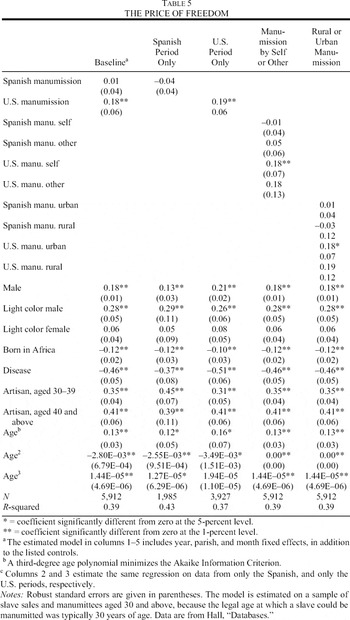
The richness of the data allows for a relatively detailed pricing model, which is presented in Table 5. The estimated equation in column 1 is
The dependent variable is log price, and the regressors of interest are δS, the coefficient on the manumission dummy in the Spanish period, and δUS, the coefficient on the manumission dummy for the U.S. period. These give estimates of the manumission premium before and after the Louisiana Purchase. Control variables X include a three-degree age polynomial, dummies for male, light color male, light color female, skilled (aged 30–40), skilled (aged 40+), African birth, and 11 month dummies, as well as fixed effects for parish, Θp, and year, γt.
The general features of the model are similar to those found by Kotlikoff.42
Column 1 presents the results of including the entire sample, 1770–1820. The results indicate that male slaves commanded a premium, whereas, not surprisingly, sick slaves, and those born in Africa fetched lower prices. Light-color skin was valued, but apparently more for males than for females. The age-profile is declining, with 30-year-old slaves commanding the highest price, and falling almost linearly as the age of the slave increases, again similar to Kotlikoff's findings.
The estimates do suggest that the system of coartación was effective: the point estimate of the coefficient on δS is very close to zero, and precisely estimated, indicating that manumission prices were equal to slave sale prices in the Spanish regime. However, once coartación was abolished, slaves paid a substantial manumission premium. The coefficient on δUS suggests that slaves seeking manumission paid 19 percent more than their market value.43
Because the dependent variable is measured in log terms, coefficients on the regressors can be approximately be interpreted as percentage terms.
This result is statistically significant at the 1-percent level.
44 Including a manumission dummy throughout the entire sample, rather than one for each time period, yields an insignificant point estimate of 0.05.
To allay the concern that a change in the pricing model (for example, different age-price profiles) confounds the estimated value of the manumission dummy, I estimate the models separately for the Spanish and U.S. periods in columns 2 and 3. A Chow test (results available from the author) suggests that the pricing model did not change substantially between the two periods: the manumission premium, the male dummy, and the age polynomial are the only parameters for which the hypothesis of equality across time periods can be rejected.
These results are robust to a variety of estimations techniques.45
In particular, using Donald Rubin's technique of matching on observables, which is consistent even if the true model is not linear, yields nearly identical estimates. (Results available from author).
Yet even the estimate of 19 percent may be an underestimate: after all, a significant number of manumission records indicate that manumission was granted at least in part as compensation for “good service.” Recall also that approximately 10 percent of the manumissive records place some condition on manumission, such as additional service. Though these records were not included in the preceding analysis, it is certainly possible that some of the manumissions included in the analysis had additional, unrecorded, service requirements.
A nonstatistical concern is the potential presence of other omitted variables that could bias the estimate of the manumission premium. However, several reasons suggest this is not a serious concern. Most importantly, there is no evidence, or reason to believe, that the recording of skills or characteristics changed significantly before and after 1803. Thus, whatever bias there exists would be present in both periods. Yet, during the Spanish period, the system of coartación would ensure the prices should be the true prices, and that is precisely what I find.
As a second test, we compare the manumission premium of those who purchased their own freedom to the manumission premium of those whose freedom was paid for by another. In both cases the owner could potentially exploit monopoly power, but individuals whose freedom was purchased by a third party are plausibly less exceptional than individuals who purchased their own freedom. In the fourth column of Table 5, I present results from a regression that includes dummies for four types of manumission: self-purchase (Spanish), purchase by other (Spanish), self-purchase (U.S.), and purchase by other (U.S.). The point estimate for the manumission premium for self-purchase and purchase by other are both indistinguishable from zero in the Spanish period; in the U.S. period, the point estimates are both 0.18, though the estimate for purchase by other is imprecise.
I conduct a similar comparison for urban and rural manumissions, under the premise that rural slaves may exhibit less unobserved heterogeneity.46
I designate a manumission as a rural manumission if it occurs outside the parish of New Orleans.
The point estimates for the urban and rural manumission premium during the U.S. regime, reported in column 5 of
Table 5, are identical, though the rural premium estimate is imprecise. Nevertheless, neither approach provides evidence that slaves purchasing their freedom were different in unobservable ways.
To sum up, it seems unlikely that the manumission premium is driven by omitted factors. Any explanation of systematic differences of manumitted slaves would have to explain why those differences appeared only after 1803. And even if the level of the premium were wrong, I still find the striking fact that the quantity of manumissions falls as the price paid by slaves purchasing their freedom rises, following the abolition of the right of coartación.
DISCUSSION
The evidence shows that a nontrivial faction of slaves, including rural slaves, were able to purchase their own freedom, often at prices above their replacement price. Why then, was manumission, so common in other slave systems, so rare in the United States? The most compelling explanation advanced is that of Fenoaltea, who argues in great detail that the threat of pain was such a powerful incentive to work in effort-intensive enterprises, that free labor could never be as productive as slave labor. Thus, a freed slave would never be able to compensate her master for the net present value of her labor.
However, this theory is not sufficient to explain the patterns demonstrated in the data presented here. The frequency of manumission dropped precipitously after the Louisiana Purchase, as U.S. rule erected additional barriers to manumission. Moreover, although Fenoaltea's theory posits that the nature of work in which slaves are engaged determines whether manumission is a feasible incentive, these arguments were not advanced by those who advocated limiting manumission.
Opponents of manumission did express substantial concerns about potential externalities of freeing slaves. Some thought the presence of some free blacks would give slaves unreasonable expectations of freedom, rendering them less productive workers.47
Holland, Refutation, quoted by Matison, “Manumission,” p. 149.
A Louisiana court shared this view, ruling that negative externalities posed by free blacks justified state limitations of manumission.
48 Henriette v. Barnes, La. An. 453, 454 (1856), cited in Wahl, “Legal Constraints.”
These beliefs contrast sharply with Spanish rule, under which the prospect of manumission was held out as an incentive for work, and significant numbers of slaves gained freedom.
49 Elsa Goveia reports that Cuba in 1774 had 96,440 whites, 30,847 free people of color, and 44,333 slaves, whereas the ratio of free people of color to slaves in Puerto Rico in 1827 was almost four to one. (“West Indian Slave Laws,” p. 15).
Manumission also carried important political implications. In a union strongly divided over the morality of slavery, the presence of freed blacks in the South undermined the claim that “slavery was justifiable and necessary because Negroes were inferior beings and hence incapable of maintaining themselves as freemen.”50
Finally, many southerners feared slave revolts. Ulrich Phillips argues that many Southerners feared that free slaves were likely to incite rebellion.
51 Phillips, American Negro Slavery, p. 398.
CONCLUSION
My study confirms the consensus view that manumission as an incentive scheme would probably not have brought an end to the American system of slavery: manumission was not common, and laws prohibiting it were effective. My results, however, suggest that it is incorrect to simply dismiss manumission as a very rare, infeasible, or exclusively urban phenomenon. In Spanish Louisiana, a system of coartación provided a system of incentives to slaves to work diligently, which made both the slaves and the masters better off. Owners manumitting their slaves were indeed compensated the fair market value of the slaves. When the United States took over, the right of coartación was repealed, and the Spanish paternalist organization was replaced by one less sympathetic to the motives, character, and aspiration of slaves. The loss of the right to sue for freedom was an important factor in the subsequent sharp drop in the number of manumissions. However, concern about potential externalities (real or imaginary), racism, and the desire to preserve slavery as an institution ensured the decline. Still, hundreds of slaves were manumitted gratuitously as a reward for “good service,” and some managed to purchase their own (or relatives') freedom. Owners in this new regime appeared to exploit their monopoly position, and charged prices about 20 percent higher than market prices.
I am grateful to Dora Costa for guidance, as well as Victor Chernozhukov, Esther Duflo, Gwendolyn Hall, Andrei Levchenko, Ani Mukherji, Peter Temin, Petia Topalova, the Editors (Jeremy Atack and Gavin Wright), one anonymous referee, and participants at the 2003 NBER Summer Institute (Development of the American Economy) and MIT Development Lunch workshop. Financial support from a National Science Foundation Graduate Research Fellowship is acknowledged. Errors and omissions are mine alone.