INTRODUCTION
End-of-life (EoL) care planning is instrumental in that it helps ensure that persons with terminal illnesses receive preferred care, and it alleviates the stress on their family caregivers. EoL care planning often involves preparation and coordination of various tasks, such as initiation of EoL care communication, identification of designated decision makers, and completion of an advance directive (AD) (Kwak et al., Reference Kwak, Ko and Kramer2014). An AD is basically written instructions about the type of medical treatment people would desire to receive or any legal arrangements for designations of a decision maker when they are not functionally capable due to illness (Fagerlin et al., Reference Fagerlin, Ditto and Hawkins2002).
Previous research has indicated that a lack of AD knowledge was a primary barrier to AD completion (Ko & Lee, Reference Ko and Lee2010) and that AD knowledge levels varied across ethnic groups (Kwak & Haley, Reference Kwak and Haley2005; Murphy et al., Reference Murphy, Palmer and Azen1996; Phipps et al., Reference Phipps, True and Harris2003). For example, African and Latino Americans are less likely to know about ADs than their Caucasian counterparts (Morrison et al., Reference Morrison, Zayas and Mulvihill1998). In a review of literature on EoL decision making (Kwak & Haley, Reference Kwak and Haley2005), non-Hispanic white elders tended to have higher levels of AD knowledge than ethnic minority groups.
Although it appears that Asian-American elders also tend to have limited knowledge about ADs, the limited number of studies on specific Asian groups and small sample sizes of each Asian subgroup in existing studies suggest a need for more research on EoL care in this particular group of Asian patients (Kwak & Salmon, Reference Kwak and Salmon2007; Murphy et al., Reference Murphy, Palmer and Azen1996).
The Chinese-American elder population is one of the fastest growing ethnic groups (Administration on Aging, 2009); however, the literature on their knowledge and completion of ADs or EoL decision making is limited. Although sparse, the extant research suggests that, consistent with other minority populations, Chinese Americans are less likely to complete an AD than their Caucasian counterparts. One study with a sample of Chinese Americans (n = 80) living in Hawaii found that 36% of them completed a living will and that 27% had healthcare proxies (Braun et al., Reference Braun, Onaka and Horiuchi2001). The AD completion rate has been consistently low in nursing home residents, as Vaughn and colleagues (Reference Vaughn, Kiyasu and McCormick2000) found that 38% of Chinese-American residents (n = 181) had completed an AD.
The previous literature has shed some light on the association between acculturation and EoL care among immigrant elders. Defined as “the process of acquiring the cultural characteristics of the new country one migrates to” (Hwang & Ting, Reference Hwang and Ting2008, p. 2), acculturation is often measured by immigrants' lifestyles, their language literacy, and their customs/manners (Huang, 2013). The existing literature on other ethnic minority groups suggests that higher levels of acculturation are associated with more acceptance of discussions about EoL care. For example, acculturated Mexican-American elders are more open to a physician's disclosure of a terminal diagnosis (Blackhall et al., Reference Blackhall, Murphy and Frank1995; Reference Blackhall, Frank and Murphy2001), and more acculturated Japanese immigrant elders are more likely to accept EoL care (Bito et al., Reference Bito, Matsumura and Singer2007; Matsumura et al., Reference Matsumura, Bito and Liu2002).
Considering that four of five Chinese-American elders are foreign born (Gallagher-Thompson et al., Reference Gallagher-Thompson, Gray and Tang2007), the traditional Chinese cultural values and acculturation levels may directly influence EoL care planning (Fang et al., Reference Fang, Malcoe and Sixsmith2014). More acculturated older Chinese adults may be less likely to adhere to traditional cultural beliefs when it comes to EoL issues (e.g., the taboo on open discussion of death and dying), and to be more likely to have better English skills and communication with health professionals within the community (Fang et al., Reference Fang, Malcoe and Sixsmith2014), which may increase their capacity to understand and complete an AD. The potential impact of cultural factors, particularly acculturation, on AD knowledge among Chinese-American elders, however, has not yet been examined quantitatively (e.g., Matsumura et al., Reference Matsumura, Bito and Liu2002; Wittenberg-Lyles et al., Reference Wittenberg-Lyles, Villagran and Hajek2008).
Moreover, in traditional Chinese culture, a conversation about a person's own death and dying would not be initiated until the person faced a terminal illness. Open discussions about death are regarded as a bad omen (Hall, Reference Hall1976). Therefore, Chinese immigrant elders may not want to discuss their EoL care preferences with service professionals, quite apart from the fact that most face language barriers (Fang et al., Reference Fang, Malcoe and Sixsmith2014). Moreover, the authoritarian role of physicians in the patient–doctor relationship may inhibit Chinese-American elders from bringing up EoL care (Ho et al., Reference Ho, Radha Krishna and Yee2010). Rather, Chinese elders may ease up when family members, particularly adult children, are involved in the EoL discussion (Bowman & Singer, Reference Bowman and Singer2001).
However, Chinese elders may face the dilemma of choosing to abide by their cultural/family expectations (e.g., prolonging life) or their true wishes (e.g., preferences for hospice care) during the EoL decision-making process (Eleazer et al., Reference Eleazer, Hornung and Egbert1996). Family-oriented cultural beliefs may inhibit Chinese elders' desire for their own life-sustaining treatments, as evidenced by Chinese elders who would not choose to avail themselves of artificial life support (Bowman & Singer, Reference Bowman and Singer2001). It is valuable to know what factors Chinese elders perceive to be important in their EoL decision making, which has not been answered empirically in the existing literature. Moreover, Asians may be more likely to designate their adult sons as decision makers much more often than their adult daughters and spouses (Hornung et al., Reference Hornung, Eleazer and Stroghers1998). Yet, no current empirical data on Chinese-American elders is available to support these assumptions.
Our study is the first of its kind to quantitatively examine the role of acculturation in AD awareness in Chinese-American elders. The twofold aims of the study are (1) to describe AD awareness, knowledge, and completion, and preferences regarding EoL care communication, decision making, and designation of surrogates in a sample of Chinese-American elders living in the Phoenix metropolitan area, and (2) to examine the role of acculturation variables on AD awareness. We hypothesized that better-acculturated Chinese-American elders would be more likely to know about advance directives.
METHODS
Design
A cross-sectional survey via face-to-face interviews was conducted with Chinese-American adults aged 55 and above (n = 385) living in the Phoenix metropolitan area during 2013. The questionnaire was translated into Chinese using a forward-and-back translation process to ensure that the measurement had the same meanings in different languages. The cross-sectional survey questionnaire was piloted with three Chinese elders and then distributed to Chinese-American elders (aged 55 and above) living in the Phoenix metropolitan area. The choice of language (Mandarin, Cantonese, or English) and place of interview (senior apartment, Chinese senior center, or homes) was left to the respondent's preference. The average length of an interview was one hour. Bilingual and bicultural interviewers were trained to fully understand the study purpose and survey contents, and to master the interviewing strategies needed to work with older adults. Institutional review board approval was obtained from a state university in the Southwest. Participants were informed that receiving the interview was considered their consent to participate.
Sample
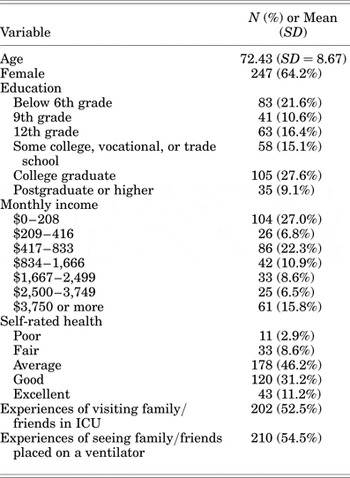
The study employed purposive sampling to maximize the variation of demographic characteristics within the sample. Participants were recruited from various settings, such as Chinese senior centers, senior housing facilities, churches, and community groups/events. The inclusion criterion were: aged 55 or older, able to speak English or Chinese, of Chinese descent, and living in the Phoenix metropolitan area. A total of 385 Chinese-American elders participated in this survey study. The average age of participants was 72.4 years (SD = 8.67). About two thirds were female; over 70% were married; and a third had an education level below 12th grade. More than half have resided in the United States for more than two decades (see Table 1).
Characteristics of survey participants (N = 385)

MEASURES
Awareness, Knowledge, and Completion of AD
Awareness of an AD was measured by one question: “Have you heard of an advance directive before?” (1 = yes, 0 = no). Only those who answered “yes” were asked about their AD knowledge measured on a scale including seven true-or-false statements about advance directive. Examples of these statements include the following: “An advance directive can manage your financial affairs,” and “You need a lawyer to complete an advance directive.” These items were modified from the AD scale of Murphy et al. (Reference Murphy, Sweeney and Chiriboga2000). Total scores on this scale range from 0 to 7, with higher scores indicating more accurate knowledge of ADs (Cronbach's α = 0.79). Participants who answered AD knowledge questions were asked whether they had ever completed one.
Communication About EoL Care
Participants were asked to indicate whether they ever communicated with physicians and family members about the use of life-support measures (e.g., a ventilator). Sample questions included, “Have you ever spoken with your doctor about the life-sustaining interventions such as a ventilator, CPR, and a feeding tube you would or would not want, if you were seriously ill?” Participants were also asked to rate their comfort level from 1 (very uncomfortable) to 4 (very comfortable) regarding who (e.g., physicians, family members, or themselves) should initiate the EoL care conversation. One example is as follows: “How comfortable would you be if your doctor initiated the discussion about your end-of-life care?”
EoL Care Decision Making and Designation of Surrogates
Factors important for EoL care decision making were assessed by six items. Participants were asked to rate the importance of the six factors (pain relief, possibility of being cured, religion, financial burden, caregiving burden, and opinions from family members) in their own EoL care decision making (1 = not important at all to 5 = very important). Participants were also asked to indicate how they would prefer the decision to be made (e.g., the decision of one person, or by several people) and who should be involved in decision making (e.g., spouse, son, daughter, and doctor).
Acculturation Variables
Acculturation variables included level of acculturation and years of U.S. residency. The acculturation level of elders was assessed by a 10-item scale that had been previously validated with Chinese Americans (Gupta & Yick, Reference Gupta and Yick2001), covering language preference, social customs, and social networks on a 5-point Likert-type scale (from 1 = completely disagree to 5 = completely agree). The total scores ranged from 10 to 50, with a higher score indicating a higher level of acculturation. The Cronbach's alpha for this scale in our sample was 0.88. Data on years of residency in the United States were obtained and categorized to: less than 10 years, between 10 and 20 years, and more than 20 years.
Background Variables
Background variables included demographics (gender, age, education, and monthly household income), self-rated health (1 = poor to 5 = excellent), and previous experience of EoL care, which included elders' experiences of visiting family/friends in an intensive care unit (ICU) (yes/no) and their experiences of seeing family/friends placed on a ventilator (yes/no).
Analysis Strategies
Survey data were entered into an IBM SPSS 21 system for storage and analysis. Descriptive analyses were conducted among variables about EoL care communication and decision making. Correlation analyses were run among variables of interest. Only awareness of AD was chosen as a dependent variable because of the small number of participants who were probed to answer questions about knowledge and completion of an AD. Hierarchical logistic regression analysis was utilized to examine the influence of acculturation variables on AD awareness. In the first step, demographic variables, self-rated health, and previous experiences of EoL care were entered, followed by acculturation variables in the second step.
RESULTS
Awareness, Knowledge, and Completion of AD
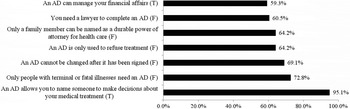
About one of five participants (n = 80) had heard about an AD before. Among those who were aware of it, slightly less than half (n = 38) had completed an AD. In other words, only 10% of all participants had completed one. Among those who had heard of an advance directive, an average participant answered five of seven questions correctly. They tended to know more about the role of an AD in arrangement of medical treatment (accuracy rate of 95.1%) and less about its role in financial affairs (accuracy rate of 59.3%) (see Figure 1).
Accuracy rates of knowledge of advance directives among those who have heard of ADs before (N = 80).

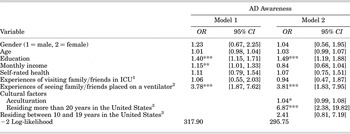
Binary logistic regression was conducted to examine the impact of acculturation on AD awareness. Variables having both statistical and conceptual meanings were entered into the regression models. In the hierarchical logistic regression model, gender, age, education, monthly income, self-rated health, and previous experiences of EoL care were entered into the first model. Those with higher education levels, higher monthly incomes, and experience with ventilators were more likely to know about ADs. In the second model, the acculturation levels and years of U.S. residency were entered. Education and experiences with ventilators remained significant. Elders with higher acculturation levels and those residing more than 20 years in the United States were more likely to have an awareness of advance directives (see Table 2).
Results of hierarchical logistic regression analysis

Note. * p < 0.1 (two-tailed). ** p < 0.05 (two-tailed). *** p < 0.01 (two-tailed).
1 Reference group is those who did not have experiences of visiting family/friends in ICU.
2 Reference group is those who did not have experiences of seeing family/friends placed on a ventilator.
3 Reference group is those who lived less than 10 years in the United States.
Communication About EoL Care
Many more participants discussed their preferences for use of life-sustaining interventions with their family members (23%) than with their physicians (6%). More than 80% of participants would be comfortable if their physicians initiated the topic (84.9%) or their family members did so (82.8%). A smaller percentage of participants reported that they would be comfortable with initiating the topic themselves with physicians (62.9%) or with their families (70.7%).
EoL Decision Making and Health Surrogates
When asked about how medical decisions (e.g., CPR, feeding tubes, ventilators) should be made when they were too ill to decide for themselves, about half answered that several people would decide together: 28.1% said only one person would decide, and 15.8% said that more people would be involved, but that one person would make the final decision. The decision makers in order of preference were daughters (55.1%), sons (49.1%), spouses (45.5%), doctors (15.8%), and others (6.5%).
Concerns about causing burden on families (89.3%) was the most important factor that influenced an elder's preference for EoL care, followed by pain relief (88.8%), best interests in the eyes of family members (86.6%), the possibility of being cured (78.7%), and financial cost (78.3%). Only half the participants considered religious beliefs an important factor in their decision-making process.
DISCUSSION
The findings of our study suggest that Chinese-American elders have limited awareness of advance directives. This is evidenced by the fact that only one of five had heard about an AD before. Among those who had heard, not all of them could correctly describe one. This finding appears consistent with Kwak and Salmon's (Reference Kwak and Salmon2007) work on the knowledge of ADs in a sample of Korean Americans, where one out of five Korean elders was able to correctly describe an AD. It appears that Chinese elders were more familiar with certain aspects of ADs (e.g., arrangement of medical treatment) than others (e.g., the procedures necessary to complete an AD). The low awareness of ADs and unbalanced knowledge of special AD aspects necessitate the need for educating Chinese elders on all the possible functions of an AD and the procedures necessary to complete one.
Similarly, the Chinese-American elders had a low AD completion rate (less than 10%). This percentage was much lower than that in a sample of older Caucasian Americans recruited from New York City (59.2%) (Ko & Lee, Reference Ko and Lee2010) and that in a sample comprised of Caucasian, Latino, and African-American older adults (35%) in another New York study (Morrison & Meier, Reference Morrison and Meier2004). However, this rate is slightly higher than that among Korean-American adults aged 65 or older (5.4%) (Ko & Lee, Reference Ko and Lee2010). It could be that our study had a larger proportion of acculturated adults age 55 to 64 than the study on Korean Americans.
People who had higher educations, previous experiences of seeing family/friends placed on a ventilator, higher acculturation levels, and longer U.S. residency were more likely to be aware of ADs. The advance directive was developed in Western culture to facilitate EoL care decisions (Fagerlin et al., Reference Fagerlin, Ditto and Hawkins2002). Thus, more acculturated Chinese elders or those living in the United States for an extended period of time may have more opportunities and less language barriers to learning about ADs, as well as exposure to English-speaking media. Moreover, the more acculturated group may be less susceptible to the impact of traditional Chinese culture, which views discussions about EoL issues as a cultural taboo, and they may thus be open to receiving information about EoL knowledge from various sources. When helping Chinese-American elders with EoL care preparation, it is important to see the impact of education and previous exposure to EoL care as well as the role of acculturation.
The lack of awareness of EoL care is also manifested by communication patterns with respect to EoL care in Chinese-American elders. They appeared to lack initiative in seeking AD knowledge or discussing EoL care with their physicians or family members. Their avoidance of this topic could be due to their cultural beliefs on death and dying: “Even for those who are dying, discussion about death is avoided because it is believed that such talk may hasten the pace of the dying process or even cause death prematurely” (Xu, Reference Xu.2007, p. 412). Despite their reluctance to begin EoL conversations, the majority of participants in our study preferred to have physicians initiate these discussions, which is consistent with a previous study of Asian Americans that recognized the “paternalistic role” of physicians in EoL care communications (Ho et al., Reference Ho, Radha Krishna and Yee2010). Chinese immigrant elders tend to accept the paternalism of physicians, emphasized in Confucian teaching, which is in conflict with the idea of patient autonomy emphasized in American culture.
Regarding the most influential factors for their EoL decision making, Chinese elders ranked family values first. Due to strong family beliefs and the collective interest in Chinese culture, concerns about causing a burden for their families appeared to be the deciding factor that impacted their preference for EoL care. Relatively, religious beliefs were perceived to be less important in EoL decision making, which could be related to the fact that 42.9% of Chinese-American elders reported they did not have any religious beliefs. This is consistent with a finding suggesting that about half of Chinese Americans lack religious beliefs (Lugo et al., Reference Lugo, Cooperman and Funk2012).
The most likely designated decision makers for Chinese-American elders are adult children, which is consistent with one study on Cantonese-speaking elders in Canada (n = 40, 65+) (Bowman & Singer, Reference Bowman and Singer2001). The family-centered beliefs in Chinese culture emphasize adult children's responsibilities for elder care. Surprisingly, daughters are the most likely designated decision makers, which is inconsistent with a prior study on physically frail Asian elders, which suggested that adult sons were the most likely designated decision makers (Hornung et al.. 1998). The Hornung study focused on nursing home–eligible elders, whereas participants were of better health and had less physical limitations in our study. Such differences in physical health status may explain the differences in the most likely healthcare proxies. Frail elders may be more dependent on their adult sons for help with physical needs (e.g., moving heavy medical equipment), while healthy older adults may consider adult daughters most eligible and trustworthy to act in their best interests, as daughters often take up the primary caregiving roles within the family. Another possible reason is that immigration to the United States may have weakened some older adults' beliefs in patriarchy and preferred reliance on sons.
Several limitations of this study should be noted. First, the study used a nonprobability sample recruited from ethnic Chinese elders residing in Phoenix. Despite the effort to maximize variation of sample characteristics, the results of our study may not be applicable to older Chinese Americans from other geographic regions. Second, this cross-sectional study examined the risk factors of AD awareness but did not identify its predictors over the long term. Third, the study did not probe into the correlates of AD knowledge levels or completion of AD because only a small proportion of participants reported that they had heard of ADs. Admittedly, promoting awareness of and increasing knowledge of ADs are inseparable goals in community outreach or interventions, and further studies should examine the factors associated with AD knowledge.
This study examined the perceptions of EoL care, including AD awareness, knowledge, and completion, communication about EoL care, and EoL care decision making, and identified the role of acculturation in AD awareness among Chinese-American elders living in Phoenix. It suggests that this minority population lacked awareness of ADs, or had limited knowledge of them. Higher education, previous experiences with ventilators, higher acculturation levels, and longer U.S. residency were associated with AD awareness. Typically, they would not initiate the dialogue on EoL care with their physician or family members. Adult daughters were the most frequently reported designated decision makers, and concerns for burdens on family members were a pivotal factor for elders' decisions on EoL care.
It is recommended that health service professionals develop awareness campaigns targeting this minority population to provide AD knowledge and to involve family members (particularly adult children) in such educational programs. The awareness campaigns or educational programs should consider the unique needs of Chinese-American elders of differential levels of education and acculturation, and target both Chinese elders and their families. Educational programs are suggested to cover knowledge domains that Chinese Americans need most, such as the functions of an AD and the procedures necessary to complete one. Physicians need to be informed to proactively, yet discreetly, initiate EoL discussions with their Chinese patients, considering the influence of physician paternalism valued in Chinese culture and that of patient autonomy so valued in Western culture. Physicians' initiation of EoL care communication should happen in the presence of family members who have an influence on the patient's EoL care decision making.
ACKNOWLEDGMENTS
The authors acknowledge funding support from the Silberman Faculty Grant Program of the New York Community Trust Fund.