Anxiety disorders are common in children and adolescents, with prevalence rates of up to 12.3% in children and 11% in adolescents (Costello et al., Reference Costello, Egger, Copeland, Erkanli, Angold, Silverman and Field2011) and a lifetime prevalence in the range of 15% to 20% (Beesdo et al., Reference Beesdo, Bittner, Pine, Stein, Höfler, Lieb and Wittchen2007). However, we also know that internalizing disorders are less overt than externalizing ones (Bettge et al., Reference Bettge, Wille, Barkmann, Schulte-Markwort and Ravens-Sieberer2008) and may be underdiagnosed. To prevent these anxiety disorders becoming chronic and to prevent the development of other psychiatric disorders (Rapee et al., Reference Rapee, Schniering and Hudson2009), early diagnosis and intervention are essential. Valid and reliable screening tools are therefore needed.
Several instruments have been validated to identify anxiety disorders in children and adolescents. Among the most used is the 37-item Revised Children’s Manifest Anxiety Scale (RCMAS; Reynolds & Richmond, Reference Reynolds and Richmond1978), a self-report measure of general anxiety symptoms that has shown good internal consistency (Reynolds et al., Reference Reynolds, Bradley and Steele1980) and test-retest reliability (Wisniewski et al., Reference Wisniewski, Genshaft, Mulick and Coury1987). Nevertheless, it has some limitations that may affect its validity; for example, it only gives a general anxiety score and it was developed by adapting an adult version of the scale. The Screen for Child Anxiety Related Emotional Disorders (SCARED; Birmaher et al., Reference Birmaher, Khetarpal, Brent, Cully, Balach, Kaufman and Neer1997) is another self-report scale that measures panic disorder, generalized anxiety disorder, social phobia, separation anxiety disorder, and school phobia. Originally covering 85 items, it has subsequently been reduced to 41 and has shown good psychometric properties (Essau et al., Reference Essau, Muris and Ederer2002). The SCARED was designed to screen specific anxiety disorders detailed in the fourth edition of the Diagnostic and Statistical Manual for Mental Disorders (DSM–IV; American Psychiatric Association, 1994) but it did not include specific phobias or obsessive-compulsive symptoms. Moreover, the SCARED incorporated a subscale about school phobia, which does not refer to the object that generates fears or worries (as with the other disorders) but to a possible consequence of anxiety symptoms. The Spence Children’s Anxiety Scale (SCAS; Spence, Reference Spence1998) was subsequently developed to overcome some of the limitations of these questionnaires.
The child version of the SCAS consists of 45 items designed to measure symptoms of six DSM–IV anxiety disorders in children and adolescents. These disorders are panic/agoraphobia, generalized anxiety disorder, social phobia, separation anxiety disorder, obsessive-compulsive disorder, and physical injury fears. The advantages of the SCAS are that it offers a larger number of subscales that better fit the structure of the DSM–IV and that it was specifically designed to address anxiety symptoms in children and adolescents rather than merely adapting adult questionnaires. The psychometric properties of SCAS have been studied in more than 15 countries of five continents. These studies have demonstrated excellent internal consistency, good test-retest reliability, adequate convergent and divergent validity, and a factorial structure consistent with the six targeted diagnostic categories. To date, most of the SCAS validation studies have been carried out in community samples, and we are only aware of six studies in which the children’s version of the SCAS has been validated in clinical and community populations. The total score and subscales have generally been found to be internally consistent (DeSousa et al., Reference DeSousa, Pereira, Petersen, Manfro, Salum and Koller2014; Olofsdotter et al., Reference Olofsdotter, Sonnby, Vadlin, Furmark and Nilsson2016; Spence, Reference Spence1998; Whiteside et al., Reference Whiteside, Gryczkowski, Biggs, Fagen and Owusu2012) except for two studies that found worse results for the subscale of physical injury fears (Arendt et al., Reference Arendt, Hougaard and Thastum2014; Whiteside & Brown, Reference Whiteside and Brown2008). None of the previous studies has explored the test-retest reliability in a clinical sample. Adequate convergent and discriminant validity has been found in all the previous studies in clinical samples (Arendt et al., Reference Arendt, Hougaard and Thastum2014; DeSousa et al., Reference DeSousa, Pereira, Petersen, Manfro, Salum and Koller2014; Olofsdotter et al., Reference Olofsdotter, Sonnby, Vadlin, Furmark and Nilsson2016; Spence, Reference Spence1998). Three of these previous studies conducted confirmatory factor analysis (CFA) but only with community samples (DeSousa et al., Reference DeSousa, Pereira, Petersen, Manfro, Salum and Koller2014; Spence, Reference Spence1998) or combining both community and clinical samples (Arendt et al., Reference Arendt, Hougaard and Thastum2014). All of them favored the six-factor model, in line with the results of a systematic review (Orgilés et al., Reference Orgilés, Fernández-Martínez, Guillén-Riquelme, Espada and Essau2016) performed with 29 studies (most of them with community samples).
Most previous studies of the SCAS combined clinical and community samples to explore its psychometric properties. Consequently, no studies have evaluated its test-retest reliability or its adjustment to the six original factors in an exclusively clinical sample. This is unsatisfactory because professionals in clinical settings must rely on questionnaires validated in community populations. The evidence we have to date points out that SCAS is a good instrument for research, but there is very little literature on its application in the clinical setting. It is important to have data on the clinical population because the manifestation of the symptoms (intensity, comorbidity, awareness or expression of symptoms) is different from that found in the community population (Fonseca & Perrin, Reference Fonseca, Perrin, Silverman and Treffers2000) and because previous studies have found differences in some psychometric properties between clinical and community samples (e.g. internal consistency and convergent and discriminant validity: Arendt et al., Reference Arendt, Hougaard and Thastum2014; Nauta et al., Reference Nauta, Scholing, Rapee, Abbott, Spence and Waters2004; Olofsdotter et al., Reference Olofsdotter, Sonnby, Vadlin, Furmark and Nilsson2016; Whiteside & Brown, Reference Whiteside and Brown2008). In addition, no studies have validated the SCAS in Spanish clinical populations.
We aimed to overcome the limitations of previous investigations by validating the child version of the SCAS in a clinical sample of children and adolescents. First, we performed a CFA and explored the reliability (internal consistency and test-retest reliability) for the total scale and subscales, and examined the validity (convergent and discriminant validity) for the total scale. Second, we studied the gender and age differences in SCAS total scale and subscales, and the concordance between the child and the parent versions of the SCAS total scale. We expected the psychometric properties to be in line with previous literature. However, as mentioned above, there is no evidence on factorial structure or test-retest reliability in an exclusively clinical sample so our study will explore this area. We also expected small differences when comparing groups by gender and age, and moderate to large correlations between the child and parent versions.
Method
Sample
The sample was recruited from among the children and adolescents who attended the Department of Child and Adolescent Psychiatry and Psychology, Hospital Clinic, Barcelona, Spain, between 2010 and 2015. Inclusion criteria were age 6 to 17 years with a principal diagnosis of any anxiety disorder detailed in the DSM–IV (American Psychiatric Association, 1994) and confirmed by the Anxiety Disorders Interview Schedule, Child and Parent versions (ADIS-C/P; Silverman & Albano, Reference Silverman and Albano1996), such as separation anxiety disorder, social phobia, generalized anxiety disorder, panic disorder with or without agoraphobia, specific phobia, post-traumatic stress disorder, obsessive-compulsive disorder, adaptive disorder with anxiety or anxiety disorder not otherwise specified. Exclusion criteria were the presence of comorbidity with autism spectrum disorders, substance abuse, psychotic disorders, acute affective disorders, acute organic conditions, or intellectual deficits that could affect comprehension of the assessment.
The sample was recruited in two phases. In the first prospective phase, possible participants were detected by a clinical psychologist or psychiatrist among the families attending our child and adolescent mental health department between 2012 and 2015. A clinical psychologist or a psychiatrist recorded the family’s reason for consultation and applied our department’s standard diagnostic protocol, which included clinical methods such as separate interviews with child/adolescent and parents, the use of information from teachers and other caregivers and from general and specific psychopathology questionnaires, at the discretion of the clinician. If the initial principal diagnosis was an anxiety disorder, the patient and family were recruited for the study and the research team checked the inclusion and exclusion criteria, provided information regarding the study’s objectives and invited the patient and family to participate. Patients and families who agreed to enter the study signed the consent document and were interviewed using the ADIS-C/P, which confirmed the diagnosis. They completed the SCAS and a battery of other clinical questionnaires about anxiety, depression and general psychopathology described in the Instruments paragraph, to allow the analysis of convergent and discriminant validity. Seventy-three outpatients and families completed the recruitment proceedings but 8 participants did not return the SCAS. Those 65 participants that answered the SCAS were invited to complete it for a second time up to one month after its first administration in order to perform the test-retest analysis.
To enlarge the sample a second phase of recruitment was performed in which data were retrospectively collected from outpatients who attended our same department between 2010 and 2012 and who were diagnosed with anxiety disorders. For this second subsample, the diagnostic procedure had applied the standard clinical method used in all patients consulting our department, as described above. The patients with anxious and comorbid diagnoses recruited for this subsample were recorded by their own clinicians. The outpatients diagnosed with anxiety disorder were often referred to a cognitive-behavior intervention program, in which the SCAS and other anxiety questionnaires were administered. In this way, baseline information recorded from questionnaires of 65 outpatients (before the beginning of any treatment for anxious symptoms) were obtained and included in the study. Thus, the final sample comprised 130 subjects. The Ethical Review Board of the Hospital Clinic approved the study and the dual method for recruiting the sample.
Instruments
Anxiety Disorders Interview Schedule, Child and Parent versions (ADIS-C/P; Silverman & Albano, Reference Silverman and Albano1996). The ADIS-C/P is a semi-structured interview of children and parents that assesses the presence of clinical criteria for all anxiety disorders of childhood together with any comorbidity. It also offers a judgment of the current clinical severity of those disorders. In this study, it was administered only to the prospective sample.
The children’s version of the SCAS (Spence, Reference Spence1998). This scale investigates the recurrence of anxious symptoms on a 4-point scale (0 = never, 1 = sometimes, 2 = often, 3 = always). The children’s version is formed by 45 items, grouped into six clinical subscales (i.e., panic/agoraphobia, generalized anxiety disorder, social phobia, separation anxiety disorder, obsessive-compulsive disorder, and physical injury phobia) and one subscale of six positive items. The total score ranges from 0 to 114. We used the Spanish adaptation validated by Orgilés et al. among 3082 children and adolescents aged 8–17 years from the general population of Elche, Spain, a medium-sized city located near Barcelona (Orgilés et al., Reference Orgilés, Méndez, Spence, Huedo-Medina and Espada2012; Orgilés et al., Reference Orgilés, Spence, Marzo, Méndez and Espada2014). The Spanish SCAS had high internal consistency (α = .89), but the subscales only had moderate reliabilities (r = .52 – .76). The convergent validity with other child anxiety questionnaires was also moderate (r = .41 – .63), whereas the discriminant validity with depression scales was good for children (r = –.004) and poor for adolescents (r = .23). The SCAS was completed by all participants in the prospective and retrospective samples. We used the SCAS parent version to study the concordance between the child and the parent versions.
Screen for Child Anxiety Related Emotional Disorders, Child version (SCARED-C; Birmaher et al., Reference Birmaher, Brent, Chiappetta, Bridge, Monga and Baugher1999, Reference Birmaher, Khetarpal, Brent, Cully, Balach, Kaufman and Neer1997). The SCARED-C is a self-report questionnaire for children and adolescents aged 8–18 years that comprises 41 items covering the symptoms of anxiety disorders on 3-point scales (0 = almost never, 1 = sometimes, 2 = often). Items are grouped around five subscales: Panic disorder, generalized anxiety disorder, separation anxiety disorder, social phobia, and school refusal. We used the Spanish adaptation validated by Vigil-Colet et al. (Reference Vigil-Colet, Canals, Cosí, Lorenzo-Seva, Ferrando, Hernández-Martínez, Jané, Viñas and Doménech2009) in a non-clinical sample and found to have good reliability (α = .88). The SCARED-C was completed by the prospective and retrospective samples. Only the total score was used for the analysis of convergent validity.
Youth Self-Report (YSR) from the Achenbach System of Empirically Based Assessment (Achenbach & Rescorla, Reference Achenbach and Rescorla2001). The YSR was completed by adolescents older than 11 years and comprised 113 items that cover symptoms across eight areas: Anxious-depressed, depressed withdrawal, somatic complaints, social problems, thought problems, attention problems, rule-breaking behaviors, and aggressive behavior. Each item was scored as 0 (Never), 1 (Sometimes), or 2 (Often) for three general indices: Internalizing, externalizing, and total scores. Secondary grouping of the items showed the probability of fit to DSM clinical diagnoses: Anxiety disorders, affective disorders, somatic problems, attention deficit-hyperactivity disorder problems, oppositional defiant problems, conduct problems, obsessive-compulsive problems, post-traumatic stress problems, or sluggish cognitive tempo problems. Internalizing and anxiety disorders scores were used for the analysis of convergent validity, and externalizing and affective disorder scores were used for the analysis of discriminant validity.
Children’s Depression Inventory (CDI; Kovacs, Reference Kovacs1995). The CDI is a self-reported questionnaire that assesses the frequency and severity of depressive symptoms in children and adolescents aged 7–17 years, and comprises 27 items with three degrees of severity. We used the Spanish adaptation validated by del Barrio et al. (Reference Del Barrio, Moreno and López1999) in general population, showing reliability and validity of the Spanish adaptation to be moderate to high. The Spanish CDI was administered to our prospective sample for the analysis of discriminant validity.
Statistical Analyses
Confirmatory factor analyses were carried out to test which of the two models with the most evidence, (a) six correlated factors or (b) six correlated factors and one higher-order factor, better fit the Spanish adaptation of the SCAS for children. To fit the two models, we employed factor analytic procedures based on the item-level polychoric correlation matrix. Since only 103 participants answered to all SCAS items, we performed a data imputation procedure for continuous data (missForest method) tolerating a maximum of 10% missings as indicated in other studies with similar data (Weitkamp et al., Reference Weitkamp, Romer, Rosenthal, Wiegand-Grefe and Daniels2010) obtaining a final sample of 122 participants. The following indices were used to assess the goodness of fit of the models tested. Based on Hu and Bentler (Reference Hu and Bentler1999), values indicating acceptable model fit were: χ2/df ⩽ 3, comparative fit index (CFI), Tucker–Lewis index (TLI), and goodness of fit index (GFI) ⩾ .90, and root mean square error of approximation (RMSEA) ⩽ .08. Following previous literature (Orgilés et al., Reference Orgilés, Méndez, Spence, Huedo-Medina and Espada2012, Reference Orgilés, Spence, Marzo, Méndez and Espada2014), factor loadings that were statistically significant with standardized values exceeding .30 were considered acceptable. Following Spence (Reference Spence1998) an exploratory factor analysis (EFA) was performed using a Varimax rotation to explore and determine the grouping of SCAS items in this clinical sample.
We performed t-tests to compare the total and subscale scores between girls and boys and between children (age ≤ 12 years) and adolescents (age > 12 years). Cronbach’s alpha and Pearson’s correlations were used to assess the internal consistency, corrected item-total correlations, correlations between SCAS items, test-retest reliability, and convergent and discriminant validity of the scale. As recommended on multidimensional scales (Deng & Chan, Reference Deng and Chan2017) we also reported the reliability of the instrument using the omega coefficient. Using Cohen’s classification, correlations of ≥ .50, .30–.49, and .10–.29 were defined as large, medium, and small respectively.
Data for the factor analysis and omega coefficient were calculated using R and lavaan library version 0.6–3, whereas data for reliability and validity were calculated using SPSS 18.0. Statistical significance was set at p < .05. All statistical tests were two-tailed.
Results
Demographic and Clinical Features
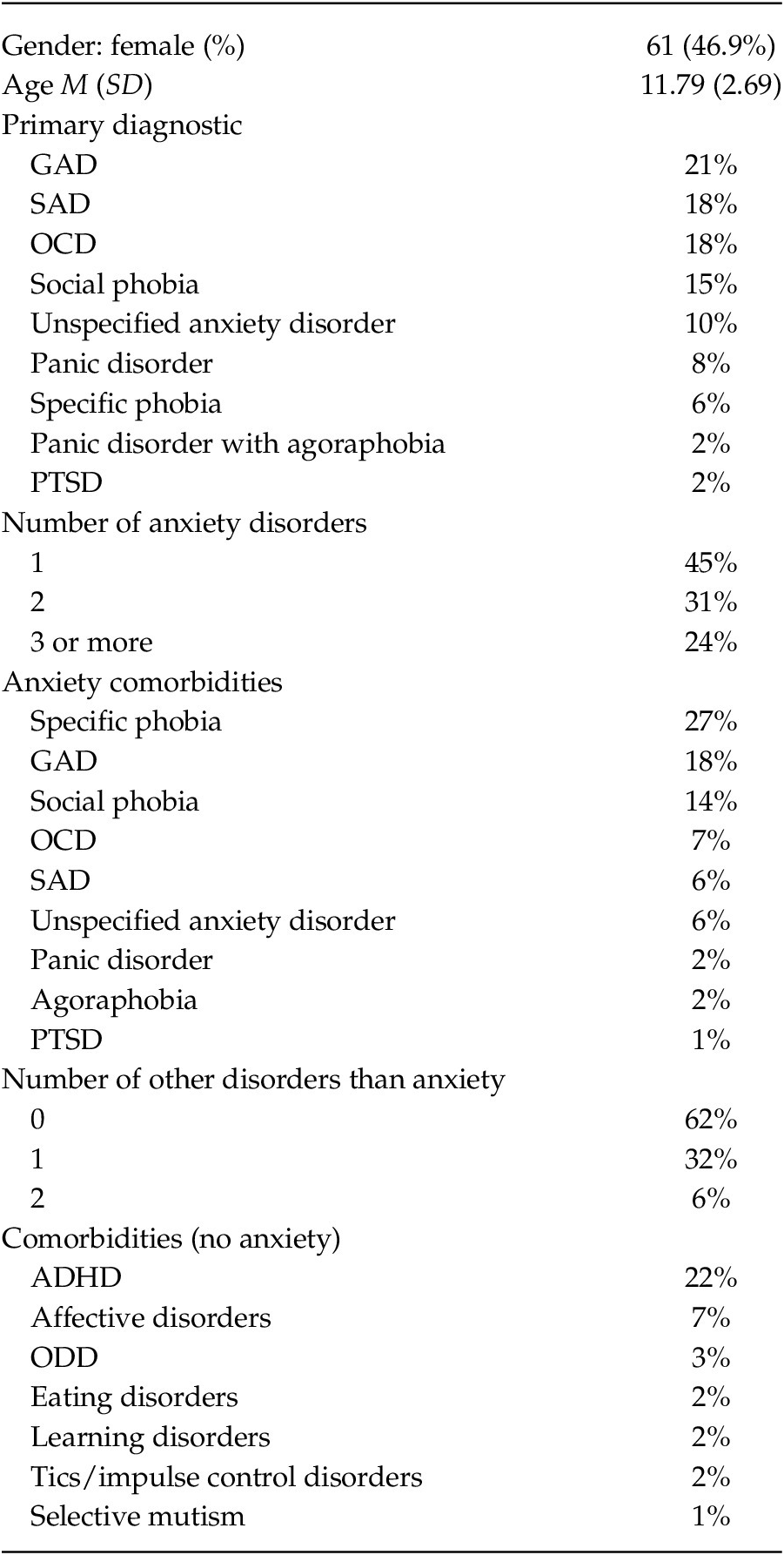
The demographic data for the sample of 130 participants (61 females, M age = 11.79 years, SD = 2.69) are shown in Table 1, together with their clinical data, including primary diagnosis, number of anxiety and non-anxiety disorders, and comorbidities. There were no significant differences in demographic or clinical data when comparing prospective and retrospective samples. Table 2 shows significant differences between males (n = 69) and females (n = 61) on several original subscales. Females scored higher than males in the SCAS total score and subscales for generalized anxiety, physical injury fears, separation anxiety, and panic/agoraphobia. This indicated greater anxious symptomatology among girls. When comparing groups by age, children (n = 80) only scored significantly higher than adolescents (n = 50) in the separation anxiety subscale.
Demographic Variables (n = 130)

Note. GAD = generalized anxiety disorder; SAD = separation anxiety disorder; OCD = obsessive-compulsive disorder; PTSD = post-traumatic stress disorder; ADHD = attention deficit hyperactivity disorder; ODD = oppositional defiant disorder.
Means for the SCAS (Total Scores and Gender/Age Scores)

Note. SCAS = Spence Children’s Anxiety Scale.
Comparability of the Child and Parent Versions
There was a moderate correlation between the total scores of the child and parent versions of the SCAS (r = .58, 95% CI [.45, .68], p < .001).
Confirmatory Factor Analysis
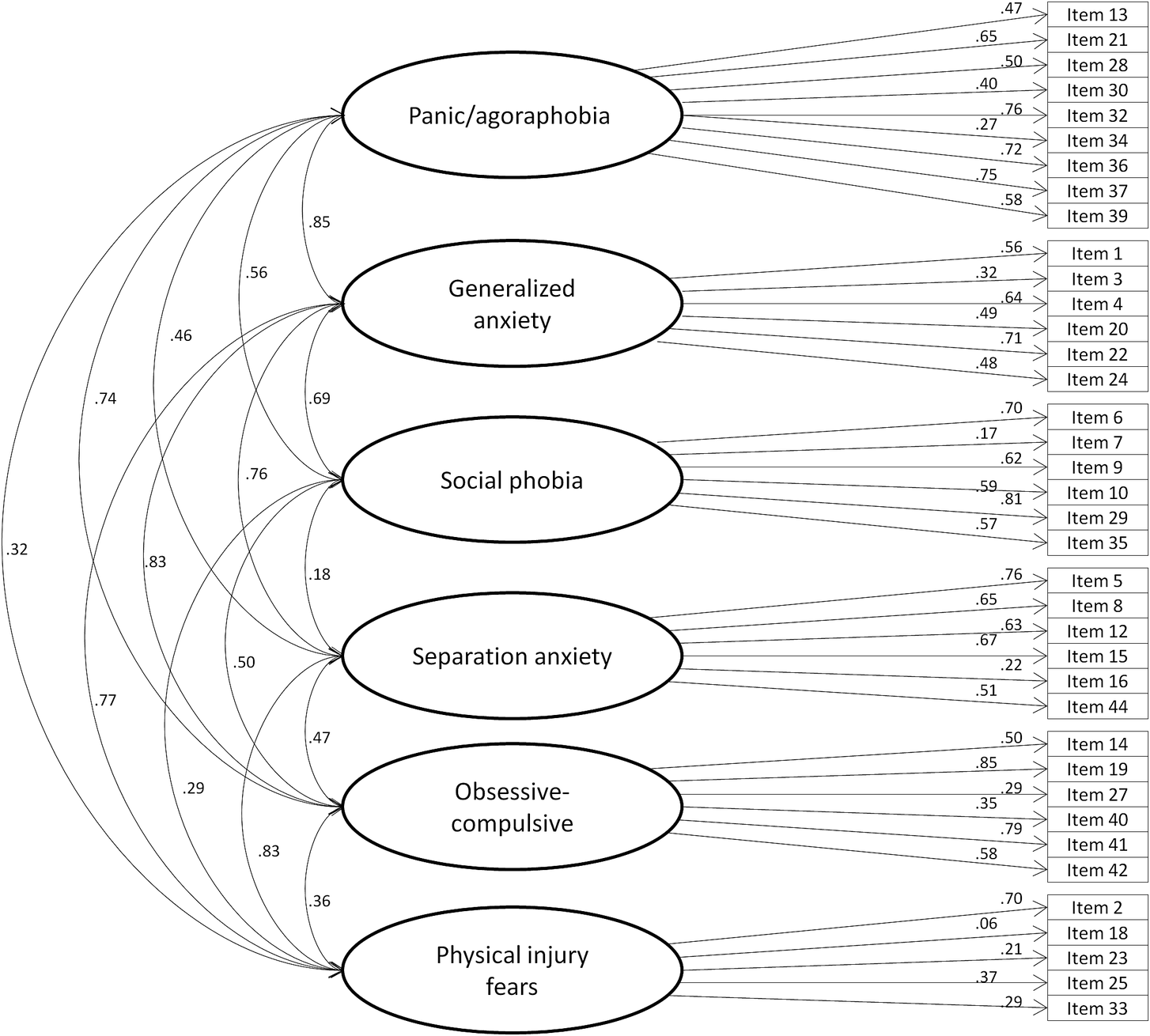
Factor analysis was carried out in a subsample of 122 participants. Table 3 shows the results for the CFA comparing the two models tested. The model that showed the greatest adjustment was Model 1 (six correlated factors) with good results in all the indices (and better than those obtained by the other model). Figure 1 shows that most of the factor loadings for model 1 had standardized values that exceeded .30 (except Items 7, 16, 18, 23, 27, 33, and 34). All were statistically significant except for Item 7 (“I feel afraid if I have to use public toilets or bathroom”), and Item 18 (“I am scared of dogs”). Finally, Figure 1 also shows correlations between factors for the six correlated factors model.
Fit Indices for Factor Models of the SCAS

Note. SCAS = Spence Children’s Anxiety Scale; CFI = comparative fit index; TLI = Tucker–Lewis index; GFI = goodness of fit index; RMSEA = root mean square error of approximation.
Standardized Factor Loadings and Correlations of the Six Correlated Factor (Model 1)

Exploratory Factor Analysis
Following the original study of the SCAS (Spence, Reference Spence1998) we performed an EFA to assess the grouping of the items. As Abad et al. (Reference Abad, Olea, Ponsoda and García2011) and Hair et al. (Reference Hair, Black, Babin and Anderson2014) we removed those items (1, 8, 9, 13, 14, 20, 21, 22, 25, 27, 28, 30, 33, 36, 39, 40, and 44) with communalities < .30, factor loadings < .50, and cross loadings between factors (primary loading had to be at least 0.20 larger than secondary loading). When performing the EFA with the rest of the items, a six-factor solution emerged. These six factors model accounted for 63% of the variance in SCAS scores and showed sufficient large correlations between items and good sampling adequacy as indicated by Bartlett’s test of sphericity, χ2(190) = 712.88, p < .001, and KMO = .76, above the recommended value of 0.6 (Kaiser & Rice, Reference Kaiser and Rice1974). The fourth (generalized anxiety disorder), fifth (panic/agoraphobia), and sixth factor (physical injury phobia) had only one or two items. Four items loaded upon a factor that was not predicted: Item 3 (“When I have a problem, I get a funny feeling in my stomach”) loaded upon the social phobia factor, and Item 4 (“I feel afraid”) loaded upon the separation anxiety factor, rather than the generalized anxiety factor. Item 16 (“I have trouble going to school in the mornings because I feel nervous or afraid”) loaded upon the social phobia factor, rather than separation anxiety. Finally, Item 37 (“I worry that I will suddenly get a scared feeling when there is nothing to be afraid of”) loaded upon the obsessive-compulsive factor rather than panic/agoraphobia factor.
Internal Consistency and Subscales Correlation
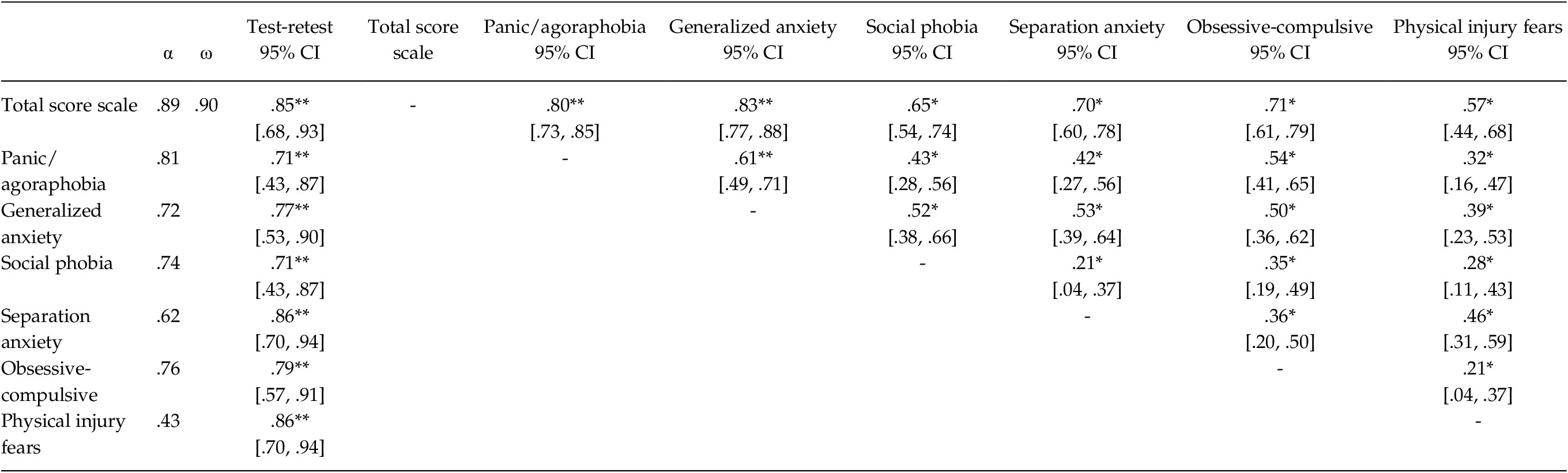
As shown in Table 4, good internal consistency was found considering the alpha and omega coefficients for the total scale, and for panic/agoraphobia, generalized anxiety, social phobia, and obsessive-compulsive. Internal consistency was questionable for separation anxiety, and unacceptable for physical injury fears. High correlations existed between the total and subscale scores.
Correlations between Subscales of the SCAS Child Version

Note. SCAS = Spence Children’s Anxiety Scale; CI = Confidence intervals.
* p < .05. ** p < .01.
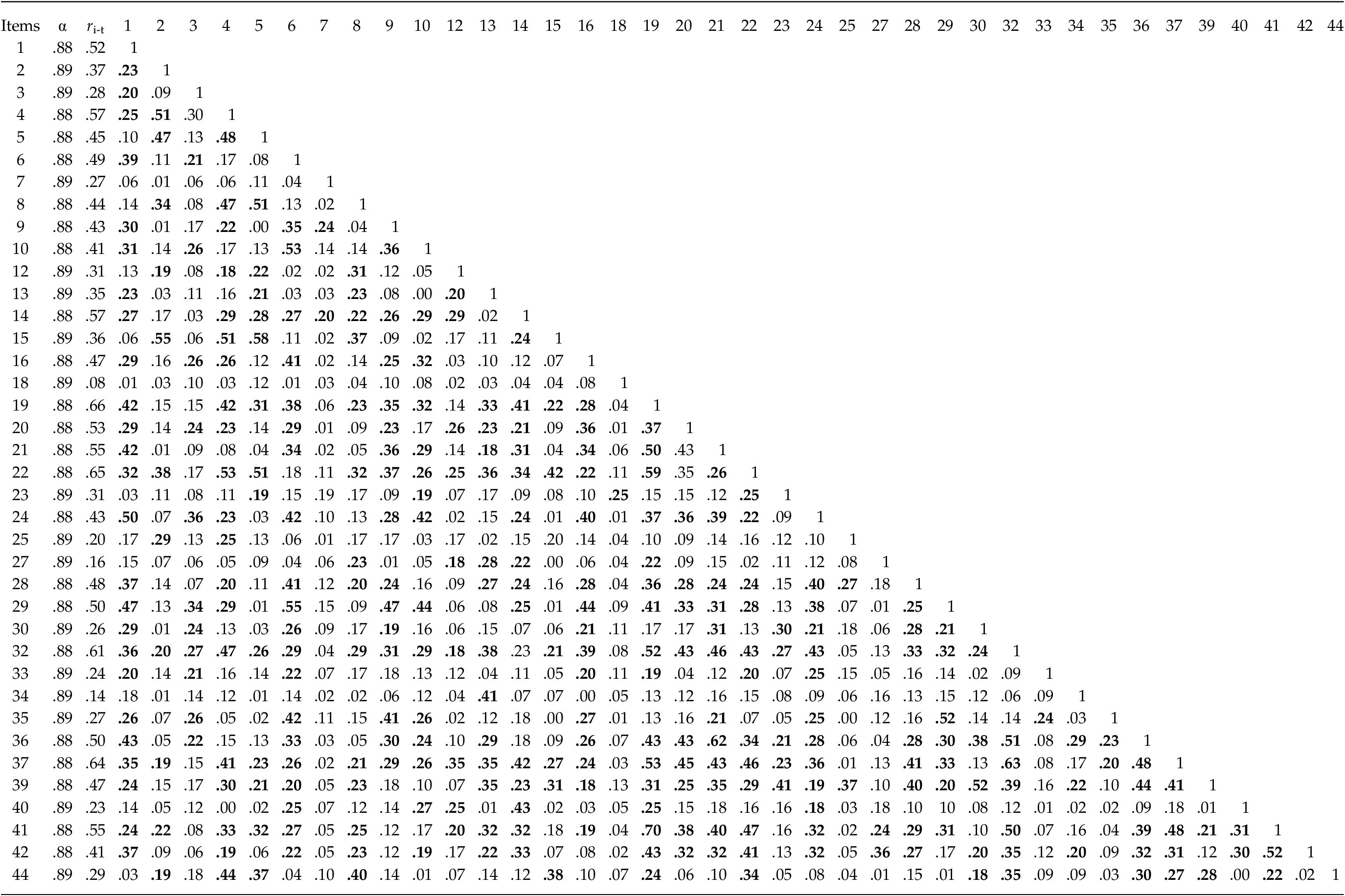
Moreover, Table 5 shows that internal consistency would not increase with the omission of any of the items. Corrected item-total correlations (that is, correlations of each item with the sum of the rest of the items) were generally moderate. However, Items 3, 7, 18, 25, 27, 30, 33, 34, 35, 40 and 44 obtained small correlations, and they practically did not correlate with the rest of the items.
Cronbach’s alpha if Item Deleted, Corrected Item-total Correlations, and Correlations between SCAS Items

Note. SCAS = Spence Children’s Anxiety Scale; ri-t = corrected item-total correlations. Significant correlations are shown in bold.
Test-retest Reliability
We assessed test-retest reliability of the SCAS in a sample of 24 participants. As shown in Table 4, high correlations were found for the total score and for the different subscales. Thus, the version of the SCAS assessed was reliable across time.
Convergent and Discriminant Validity
Table 6 shows the results for convergent and discriminant validities. With regard to convergent validity, the SCAS total score correlated significantly with the other three questionnaires about anxious symptoms (high correlation with the SCARED questionnaire, and moderate with the YSR subscales for anxiety disorders and internalizing symptomatology.) Thus, the adaptation of the SCAS showed adequate convergent validity in this clinical sample.
Convergent and Discriminant Validity: Correlations between the SCAS Child Version and Anxiety and Non-anxiety Questionnaires

Note. SCAS = Spence Children’s Anxiety Scale; YSR = Youth Self-Report; CDI = Children’s Depression Inventory. CI = Confidence intervals.
* p < .05. ** p < .01.
As for discriminant validity, significant moderate correlations between the SCAS total score, the CDI and with the affective disorder subscale of the YSR suggested a lower association with the depression symptoms scales compared with the anxiety questionnaires. However, as hypothesized, the correlation with the externalizing subscale of the YSR was not statistically significant.
Discussion
The sample used in this validation of the Spanish adaptation of the child version of the SCAS had a balanced proportion of females and males and was characterized by high comorbidity of anxiety and non-anxiety disorders. As expected, girls showed significantly higher scores than boys overall, extending to four subscale scores. Consistent with our clinical experience and previous studies (de Lijster et al., Reference De Lijster, Dierckx, Utens, Verhulst, Zieldorff, Dieleman and Legerstee2017), children younger than 13 years showed higher scores on the separation anxiety subscale than their older peers. Furthermore, we found a moderate significant correlation between the child and parent versions of the SCAS total score, as previously reported in clinical samples (Arendt et al., Reference Arendt, Hougaard and Thastum2014; Brown-Jacobsen et al., Reference Brown-Jacobsen, Wallace and Whiteside2011; DeSousa et al., Reference DeSousa, Pereira, Petersen, Manfro, Salum and Koller2014; Olofsdotter et al., Reference Olofsdotter, Sonnby, Vadlin, Furmark and Nilsson2016; Whiteside & Brown, Reference Whiteside and Brown2008).
The CFA supported the fit for the six-correlated factor model. Although many previous studies in community populations have confirmed this adjustment, this is the first evidence in an exclusively clinical sample. To date, studies performing CFA have reported similar conclusions to those originally reported by Spence (Reference Spence1998), finding support for the six-factor model and for a model with first-order factor loading on a second-order factor (general anxiety). All subsequent studies that have performed CFA in whole samples (clinical and general) have also supported this model (Arendt et al., Reference Arendt, Hougaard and Thastum2014; DeSousa et al., Reference DeSousa, Pereira, Petersen, Manfro, Salum and Koller2014; Nauta et al., Reference Nauta, Scholing, Rapee, Abbott, Spence and Waters2004). However, although the present study replicated the model of six correlated factors, the adjustment was not as robust as that observed previously, with some factor loadings being slightly lower than in studies with community samples. Specifically, we found seven items with a loading factor below .30. As shown in Figure 1, there were few differences in item loadings among the factors, except for that concerning physical injury fears. In this factor, only two in five items obtained an adequate factor loading. Although less obviously, a similar pattern was observed in community samples with item 18 ("I am scared of dogs") which was especially notable for its low factor loading (Arendt et al., Reference Arendt, Hougaard and Thastum2014; DeSousa et al., Reference DeSousa, Pereira, Petersen, Manfro, Salum and Koller2014; Orgilés et al., Reference Orgilés, Méndez, Spence, Huedo-Medina and Espada2012, Reference Orgilés, Spence, Marzo, Méndez and Espada2014). An explanation could be that the physical injury fears related to dark, dogs, doctors, high places, or insects are less valid in a clinical setting where these fears are less specific, that is, they are frequent in most anxiety disorders (27% of the participants in our sample met criteria for specific phobia as a secondary diagnosis, being the most prevalent comorbidity).
The exploratory factor analysis supported the results obtained with the CFA. While the EFA also revealed a six-factor structure, it should be noted that multiple items had to be removed from the analysis due to factor loadings below .50 and cross loadings between factors. Furthermore, four of the items loaded upon a factor that was not predicted. Thus, the EFA demonstrated that the SCAS items showed some problems fitting into the model based on six diagnostic subscales.
Our results on the factorial analyses (CFA and EFA) could be indicating that the proposed model of six correlated factors would be too restrictive in a clinical sample. We believe that this difficulty in the adjustment could be explained by a substantial difference between community and clinical samples: The comorbidity. Indeed, most of our participants had clinically relevant comorbid disorders, including anxiety and non-anxiety disorders (55% of the participants had two or more anxiety disorders). Therefore, our data could be reflecting a more basic problem: the categories in which we divide anxiety disorders may not have such clear limits, which could explain that the assessment of these symptoms in a clinical sample (where comorbidity is usual) with a categorical model does not fit properly. Thus, our results could be supporting the need to combine the categorical model with a dimensional approach (Shear et al., Reference Shear, Bjelland, Beesdo, Gloster and Wittchen2007) to improve our classification model.
Our results indicate that the Spanish adaptation of the child version of the SCAS has good internal consistency for the total scale, as reported previously in clinical samples (DeSousa et al., Reference DeSousa, Pereira, Petersen, Manfro, Salum and Koller2014; Olofsdotter et al., Reference Olofsdotter, Sonnby, Vadlin, Furmark and Nilsson2016; Whiteside et al., Reference Whiteside, Gryczkowski, Biggs, Fagen and Owusu2012). Nevertheless, we did note differences in the reliability of the subscales; those for physical injury fears and separation anxiety showed poor internal consistency (as reported in Arendt et al., Reference Arendt, Hougaard and Thastum2014, Whiteside & Brown, Reference Whiteside and Brown2008) whereas those for generalized anxiety, social phobia, and obsessive-compulsive symptoms showed acceptable or good values that better reflected the SCAS total scores. Several high correlations were found between SCAS subscales, but the most notable was between the generalized anxiety subscale and the total score. By contrast, the lowest correlation was between the total and the physical injury fears scores, but even then, the correlation was moderate. Although the SCAS globally showed adequate values in terms of internal consistency, the detailed analysis of the items showed that a significant number of items did not correlate with the rest, which could indicate that those items were not representing the same construct. The dimension that contained most items that did not correlate with the rest was physical injury fears subscale. These results, together with those of internal consistency, are consistent with the previous literature and emphasize the weakness of the physical injury fears subscale.
The Spanish adaptation of the SCAS child version showed good convergent validity with other validated anxiety questionnaires, such as the SCARED-C, in agreement with reports in other clinical populations (Arendt et al., Reference Arendt, Hougaard and Thastum2014; DeSousa et al., Reference DeSousa, Pereira, Petersen, Manfro, Salum and Koller2014; Olofsdotter et al., Reference Olofsdotter, Sonnby, Vadlin, Furmark and Nilsson2016). The significant correlations between the SCAS and depression questionnaires were lower than those obtained between the SCAS and other anxiety scales, and these results have also been replicated in the literature. However, the correlation with the CDI was considerable, so we can only confirm adequate, not good, discriminant validity of the SCAS in this study. A possible explanation can be seen in the clinical characteristics of our sample, in which the rates of comorbid obsessive-compulsive disorder, generalized anxiety disorder, social phobia, and specific phobia were higher than reported in earlier studies, pointing to the inclusion of more complex disorders in this study.
The results indicated excellent test-retest reliability for all subscales with correlations between r = .71 and r = .86. Our analyses demonstrate good temporal stability for detecting anxious symptomatology. We are not aware of any other studies of test-retest reliability in an exclusively clinical sample.
Our study has several strengths. For example, we recruited the largest clinical sample reported to date and used a formal diagnostic assessment to ensure that participants were currently affected by one or more of the screened disorders at a level that affected their usual functioning. However, several limitations have to be considered. First, the sample involved prospective and retrospective sampling methods. Although we aimed to recruit all participants prospectively (thus enabling dual assessment with the ADIS-C/P), we could not achieve the required sample size to extract valid results. Therefore, a second sample was created pragmatically from retrospective data, but this failed to include the ADIS-C/P and the CDI for assessment of convergent and discriminative validity. The lack of a structured interview targeting the study requirements could have meant an underdiagnosis of mild comorbid conditions (anxious and non-anxious) in the retrospective sample. The greater complexity of the sample could explain the slight reductions in internal consistency, discriminant validity, and adjustment to the six-factor model compared with previous studies. Another limitation is that our sample size was relatively small to conduct a CFA and to test more than two models. Finally, we had considerable loss to follow-up in the analysis of test-retest reliability, which was attributable to the difficulties in recruiting participants to complete the second SCAS. However, reasonable efforts were made to contact families by phone. The SCAS was designed to measure symptoms of DSM–IV anxiety disorders: Future studies should update the scale to the new model proposed by the DSM–5.
In conclusion, our data shows that the Spanish adaptation of the child version of the SCAS has similar psychometric properties to those described in previous reports and can provide new data for clinical samples. The SCAS showed good reliability and internal and external validity to assess child anxiety in clinical populations. We have confirmed the original factor structure of the SCAS based on six correlated factors. This is a relevant finding given that, as far as we know, this is the first time that the SCAS structure has been studied in a purely clinical environment. However, future studies need to evaluate whether the factorial structure of the present instrument is the most suitable for use in clinical populations, and should focus on the aspects that might need adjustment. Finally, it will also be necessary to explore the relevant screening thresholds for the questionnaire and to validate the parent version of the SCAS in clinical samples.
Ethical approval. All procedures performed in studies involving human participants were in accordance with the Ethical Review Board of the Hospital Clinic and with the 1964 Helsinki declaration and its later amendments or comparable ethical standards.
Informed consent. Informed consent was obtained from all individual participants included in the study.