Introduction
Palate surgery plays a crucial role in treating obstructive sleep apnoea syndrome (OSAS). While surgical interventions can be effective, they may also lead to various patient complaints.Reference Li, Riley and Powell1, Reference Pang, Vicini, Montevecchi, Piccin, Chandra and Yang2 Recently, Rashwan et al. introduced the Palate Postoperative Problems Score, a questionnaire aimed at assessing patients’ perceptions of their surgery.Reference Rashwan, Montevecchi, Firinua, Dachuri, Obaidat and Gobbi3 This tool enables the evaluation of post-surgical complaints following palate surgery, marking a significant advance as the first questionnaire tailored to this purpose. The Palate Postoperative Problems Score is designed to address the primary and most prevalent concerns and complications arising from palate surgery in a practical and realistic manner.Reference Rashwan, Montevecchi, Firinua, Dachuri, Obaidat and Gobbi3 The questionnaire comprises 12 questions covering issues such as post-operative swallowing difficulties, weight changes, alterations in voice quality and throat discomfort. By assessing patient morbidity resulting from palate surgery, the Palate Postoperative Problems Score provides valuable insights into patient outcomes and experiences (Figure 1).
The Palate Postoperative Problems Score questionnaire.

Retrospective testing of the Palate Postoperative Problems Score questionnaire in previous studies on patients who underwent surgery within a five-year timeframe revealed that complaints persist in the later stages following palate surgery. Despite this, surgical complaints are predominantly experienced in the early post-operative period and tend to diminish over time.
The Palate Postoperative Problems Score questionnaire has shown promise in tracking changes in palate-related complaints during the early stages after surgery. However, there is a lack of literature regarding the utilisation of the questionnaire for monitoring patients undergoing palate surgery during the early post-operative period. Hence, the objective in this study was to observe the progression of complaints in patients who had undergone modified barbed reposition pharyngoplasty by employing the Palate Postoperative Problems Score questionnaire longitudinally at the first, third and sixth months post-surgery.
In the majority of surgical procedures for OSAS, tonsillectomy is typically performed alongside palate surgery. However, tonsillectomy alone can also result in complaints recorded in the Palate Postoperative Problems Score questionnaire because of its impact on swallowing. To investigate the specific effects of tonsillectomy alone, we administered the Palate Postoperative Problems Score questionnaire to patients who underwent tonsillectomy without concomitant palate surgery.
Modified barbed reposition pharyngoplasty
The objective of expansion sphincterpharyngoplasty surgery is to reposition the muscular structures of the pharynx and palate, thereby expanding the pharyngeal airway. During this procedure, the palatopharyngeus muscle is dissected and rotated upward and anterolaterally.Reference Güler, Kuzucu, Baklacı, Kum, Kum and Özcan4 This surgical approach leads to a significant reduction in the Apnea-Hypopnea Index among patients diagnosed with moderate or severe OSAS and lateral pharyngeal collapse.Reference Pang and Woodson5, Reference Neruntarat, Khuancharee and Saengthong6
Barbed reposition pharyngoplasty offers a method for stabilising the retraction of pharyngeal soft tissue through traction while preserving mucosal and muscle integrity. By utilising a series of barbed sutures, barbed reposition pharyngoplasty facilitates lateral expansion of the oropharyngeal isthmus and anterior rearrangement of the lateral aspect of the soft palate, thereby increasing the retropalatal airway.Reference Pang and Woodson5, Reference Neruntarat, Khuancharee and Saengthong6
We opted to perform barbed palatoplasty and expansion sphincterpharyngoplasty concurrently in our patients to leverage the benefits of both procedures. In our modified barbed reposition pharyngoplasty technique, bilateral tonsillectomy serves as the initial step. Following this, muscle flaps are fashioned using monopolar electrocautery in the lower segment of the palatopharyngeus muscle within the third tonsil region.
An incision is then made from the hamulus utilising unipolar cautery, creating a tunnel leading to the upper pole of the tonsil. Subsequently, using barbed sutures, these flaps are guided through the previously formed tunnel at the upper pole of the tonsil and anchored to the hamulus. Barbed palatoplasty is subsequently performed on the palate using 2-0 V-loc™ Coviden® sutures (Covidien, Mansfield, MA, USA).
Suture lines are delineated on the soft palate and a single barbed suture is inserted at the central point (posterior nasal spine), then directed back to the tonsillectomy site to suspend the palatopharyngeus muscle and posterior pilica. It is securely sutured to the raphe at least three times from various angles. This procedure is repeated on the opposite side using the same continuous suture technique. The flap on the opposing side is also sutured to the hamulus on the corresponding side. Finally, the suture returns to its central point (posterior nasal spine) to secure the stitches.Reference Babademez, Gul and Teleke7
Materials and methods
The initial linguistic validation of the Palate Postoperative Problems Score questionnaire was conducted by researchers. The questionnaire consists of 12 questions, each of which the patient scores between 0 and 3. A score of 0 for each question indicates no complaints and scores increase as the severity of complaints increases. Because healthy individuals have no throat complaints, their total score is expected to be 0. Questionnaire scores are expected to decrease during the post-operative recovery period. The study enrolled 40 patients who presented to the ENT polyclinic with complaints of witnessed apnoea, snoring and daytime sleepiness. These patients underwent modified barbed reposition pharyngoplasty following physical examination and polysomnography testing, with a diagnosis of obstructive sleep apnoea disease or simple snoring.
Following surgery, patients completed the Palate Postoperative Problems Score questionnaire during the early post-operative period and at the first, third and sixth months thereafter. Additionally, the severity of daytime sleepiness among these patients was assessed using the Epworth Sleepiness Scale pre-operatively and post-operatively at the first and third months.
Parameters such as the Apnea-Hypopnea Index, minimum oxygen saturation and body mass index (BMI) were recorded for each patient both before surgery and at the third month post-operatively.
To assess the impact of tonsillectomy in OSAS surgery, adult patients who underwent tonsillectomy alone completed the questionnaire at the first and third months post-surgery. Tonsillectomy was conducted using the cold dissection method, with bipolar cautery utilised for haemostasis.
Data analysis was performed using SPSS 25.0 (IBM SPSS Statistics 25; IBM Corp., Armonk, NY). Given that the assumptions for parametric tests were not met, the Friedman test (followed by post hoc analysis using a Wilcoxon paired two-sample test with Bonferroni correction) was employed. Additionally, the Mann–Whitney U test was used to compare differences between independent groups.
This study adhered to the principles outlined in the Declaration of Helsinki and received approval from the local ethics committee (Pamukkale University Clinical Research Ethics Committee, Ethical Project Identification Code: 60116787-020-152557).
Results
The study included patients with ages ranging from 24 to 69 years old. Modified barbed reposition pharyngoplasty was conducted in 40 patients (30 males and 10 females), while 18 patients (9 males and 9 females) underwent only tonsillectomy.
Results for patients undergoing modified barbed reposition pharyngoplasty
The Palate Postoperative Problems Score questionnaire was completed at the first, third and sixth months following modified barbed reposition pharyngoplasty. Sleep tests were conducted on these patients both before surgery and at the third month post-operatively. However, the post-operative Apnea-Hypopnea Index results could not be analysed as a result of eight patients declining to undergo sleep tests at the third month post-operatively. Table 1 presents the pre- and post-operative averages of the Apnea-Hypopnea Index, Epworth Sleepiness Scale scores, BMI and minimum oxygen saturation changes for patients who underwent modified barbed reposition pharyngoplasty. Statistical analysis revealed that, when comparing pre- and post-operative values, all parameters except BMI showed statistically significant differences (p < 0.05) (Table 1).
Comparison of modified barbed reposition pharyngoplasty pre- and post-operative Apnea-Hypopnea Index, Epworth Sleepiness Scale, body mass index and minimum oxygen saturation change

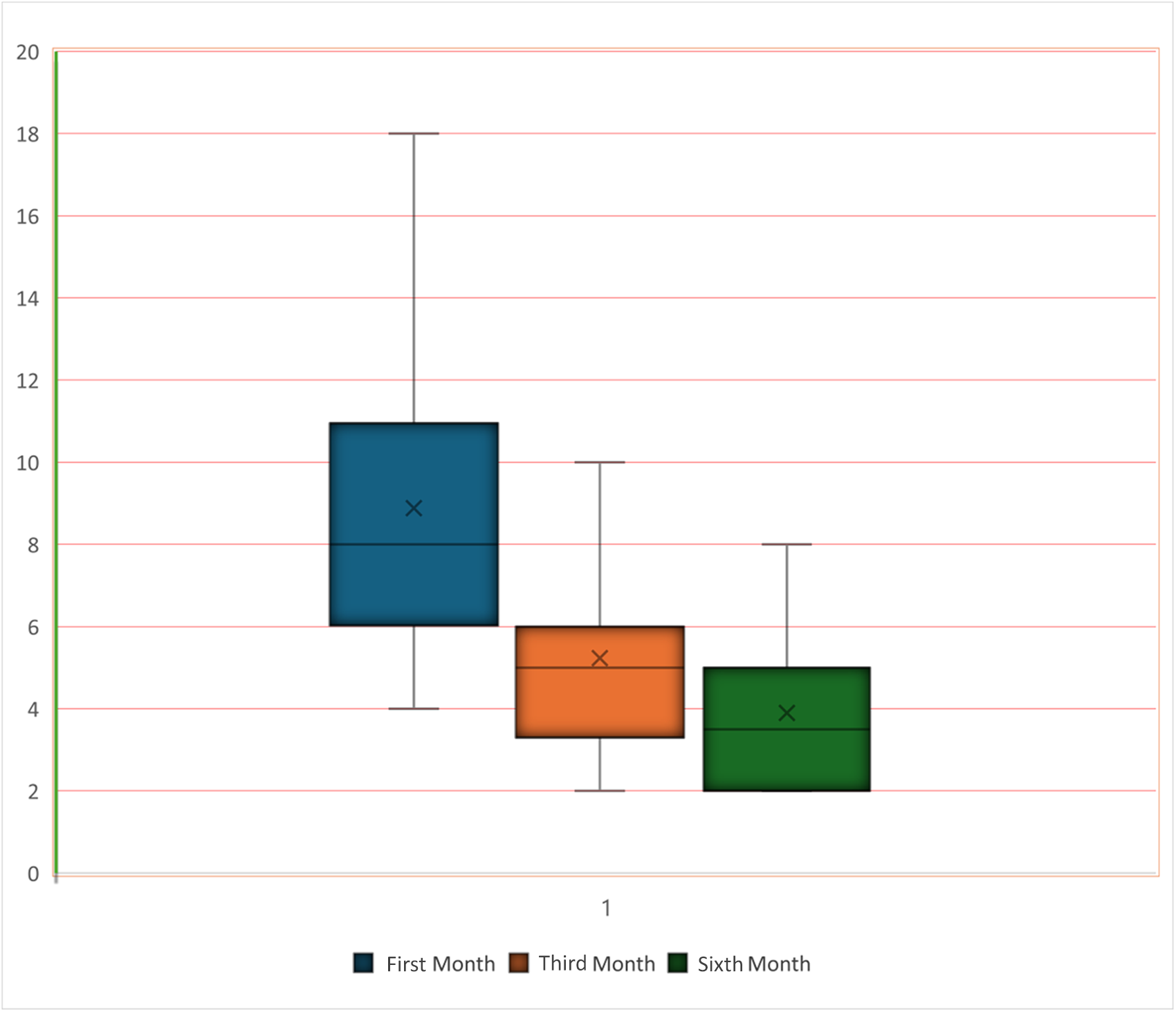
The total mean score of modified barbed reposition pharyngoplasty patients at the first month was 8.85 ± 3.55, decreasing to 5.12 ± 2.6 at the third month and further reducing to 4.07 ± 2.06 at the sixth month. This progressive decrease in scores over the months was found to be statistically significant (p < 0.05), as illustrated in Figure 2. Moreover, when comparing the total scores of the questionnaire across different time points, statistically significant differences were observed between the first and third months, as well as between the first and sixth months.
Change in the total score of modified barbed reposition pharyngoplasty patients on the Palate Postoperative Problems Score questionnaire at the first, third, and sixth postoperative months. The blue, orange, and green boxes represent the first, third, and sixth months, respectively. The error bars indicate the standard deviation.

Results for patients who underwent tonsillectomy only
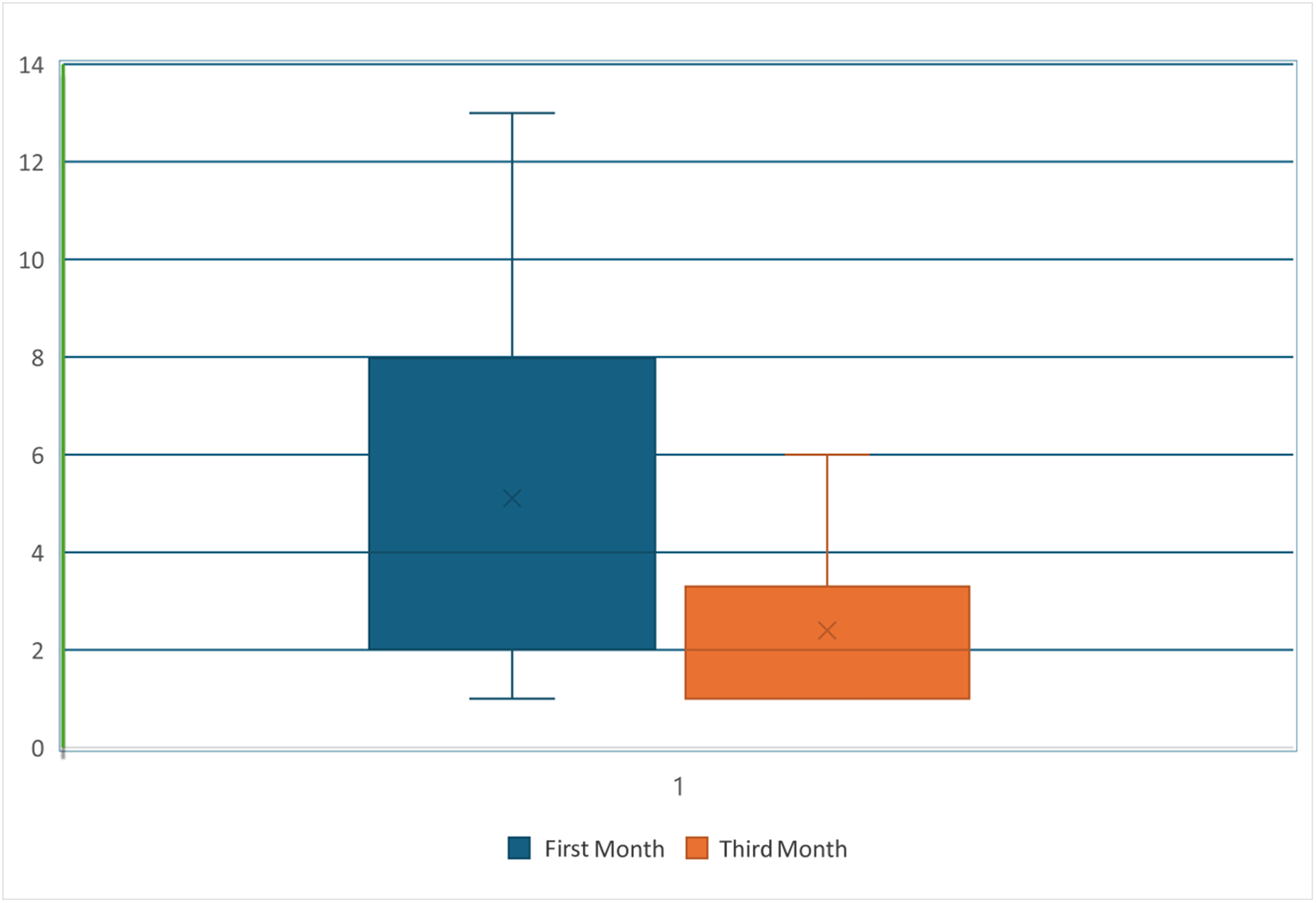
In the first month, the mean total score on the Palate Postoperative Problems Score questionnaire for patients who underwent tonsillectomy alone was 5.28 ± 3.64, which decreased to 2.61 ± 1.72 in the third month. Among these patients, five individuals reported persistent complaints at the third post-operative month, while the remaining patients’ Palate Postoperative Problems Score responses returned to normal. Statistical comparison of the total scores between the first and third months revealed a significant difference (p < 0.05), as depicted in Figure 3.
First and third month total questionnaire score change of patients with tonsillectomy. Change in the total score of modified barbed reposition pharyngoplasty patients on the Palate Postoperative Problems Score questionnaire at the first, third, and sixth postoperative months. The blue, orange, and green boxes represent the first, third, and sixth months, respectively. The error bars indicate the standard deviation.

Discussion
The Palate Postoperative Problems Score questionnaire represents a significant advance as the first tool designed to evaluate outcomes and gather patient feedback following any palatal surgery.Reference Rashwan, Montevecchi, Firinua, Dachuri, Obaidat and Gobbi3 Comprising 12 items, it delves into various post-operative complaints, including swallowing difficulties, weight loss, sensations of foreign bodies or obstruction in the throat, and feelings of being stuck. Quality of life stands as a paramount objective in any surgical intervention.
The Palate Postoperative Problems Score questionnaire has been recognised for its ability to provide a comprehensive assessment of post-operative quality of life, specifically addressing the most prevalent complaints experienced by patients after palate surgery.
Importantly, many post-operative complications associated with palatal surgery are rooted in the subjective perceptions of patients. In this regard, the Palate Postoperative Problems Score serves as an invaluable tool for investigating and understanding these subjective perceptions.
There are four studies conducted with the Palate Postoperative Problems Score survey in the literature. In three of the four studies, the complaints of patients who underwent palate surgery within five years were examined with the Palate Postoperative Problems Score questionnaire.Reference Rashwan, Montevecchi, Firinua, Dachuri, Obaidat and Gobbi3, Reference Iannella, Vallicelli, Magliulo, Cammaroto, Meccariello and De Vito8, Reference Modica, Lorusso, Presti, Fasola and Gallina9 These studies show that the Palate Postoperative Problems Score questionnaire can be used successfully in the late post-operative evaluation of palate complaints over a long period of time. However, OSAS surgical procedures cause complaints that begin in the early post-operative period and may change over many years. The effectiveness and morbidity of surgical procedures may change in the post-operative period. If the aim is to evaluate palate surgical procedures, the evaluation should begin in the early post-operative period and the evaluation of the effects and results of the treatment should continue longitudinally. In the literature, it has not been found that the early results of the Palate Postoperative Problems Score questionnaire are evaluated with repeated measurements.
In their original article, Rashwan et al. also stated that the questionnaire could be easily completed at certain follow-up intervals (e.g. first, third and sixth months after surgery), considering the high response rate and reasonable average completion time.Reference Rashwan, Montevecchi, Firinua, Dachuri, Obaidat and Gobbi3 In this study, the early effects of the Palate Postoperative Problems Score and surgery were evaluated by making repeated measurements at the first, third and sixth months. According to our results, it is documented that the Palate Postoperative Problems Score questionnaire also shows improvement in the early period. This is further proof that the Palate Postoperative Problems Score questionnaire is valid and fit for purpose. Our study is the first study in the literature to demonstrate the validity of the Palate Postoperative Problems Score questionnaire in this early post-operative period.
According to a study by Iannella et al.Reference Iannella, Vallicelli, Magliulo, Cammaroto, Meccariello and De Vito8, post-operative swallowing issues were reported by 11 per cent of patients for a few days, 21 per cent for several weeks and 19 per cent of patients experienced the problem within the first month after surgery. Palate Postoperative Problems Score results from the same study revealed that 8 per cent of patients experienced mild dysphagia, while 1 per cent reported moderate dysphagia. Notably, no patients reported severe residual dysphagia. The study suggested that patients often experience swallowing problems in the initial weeks and months following surgery, likely attributable to scarring and reabsorption of barbed sutures in the palatal tissue.Reference Iannella, Vallicelli, Magliulo, Cammaroto, Meccariello and De Vito8
In our cohort, 30 per cent of patients experienced mild dysphagia and 5 per cent reported moderate dysphagia in the first month post-operatively. The subsequent reduction in swallowing complaints over time aligns with the notion that the questionnaire reflects improvement, consistent with findings from Iannella et al.Reference Iannella, Vallicelli, Magliulo, Cammaroto, Meccariello and De Vito8 The total mean Palate Postoperative Problems Score for patients undergoing barbed reposition pharyngoplasty in Iannella et al.Reference Iannella, Lechien, Perrone, Meccariello, Cammaroto and Cannavicci10 study was 9.57, compared with 4.35 in the first study by Rashwan et al.Reference Rashwan, Montevecchi, Firinua, Dachuri, Obaidat and Gobbi3 and 4.05 in study by Modica et al.Reference Modica, Lorusso, Presti, Fasola and Gallina9 Iannella et al.Reference Iannella, Lechien, Perrone, Meccariello, Cammaroto and Cannavicci10 attributed the higher score in their study to the larger sample size and longer observation period.
In our study, the total mean Palate Postoperative Problems Score for patients undergoing modified barbed reposition pharyngoplasty was 8.85 in the first month, decreasing to 5.12 in the third month and 4.07 in the sixth month. The higher score observed in the first month is likely due to the questionnaire being administered early in the post-operative period, when patients had not yet fully recovered, and also being influenced by the effect of tonsillectomy on swallowing function. However, the subsequent decrease in scores over time aligns with the findings of Rashwan et al.,Reference Rashwan, Montevecchi, Firinua, Dachuri, Obaidat and Gobbi3 indicating improvement.Reference Iannella, Vallicelli, Magliulo, Cammaroto, Meccariello and De Vito8–Reference Iannella, Lechien, Perrone, Meccariello, Cammaroto and Cannavicci10
In most surgical procedures for OSAS, tonsillectomy is commonly performed alongside palate surgery. Research on the recovery process following tonsillectomy suggests that nearly a month is required for throat muscles to fully heal.Reference Vaiman and Gavrieli11 Additionally, a study evaluating patients who underwent tonsillectomy with a quality of life questionnaire in the third post-operative year found that complaints such as dry mouth and throat (6.5 per cent of patients), foreign body sensation (3.4 per cent), throat clearing (8 per cent) and voice changes (7.3 per cent) either emerged or worsened during the post-operative period.Reference Ovesen, Kamarauskas, Hlidarsdottir, Dahl and Mainz12 These findings indicate that tonsillectomy alone can significantly impact Palate Postoperative Problems Score questionnaire results.
To specifically assess the effects of tonsillectomy on the Palate Postoperative Problems Score questionnaire, we focused solely on patients who underwent tonsillectomy. The total mean Palate Postoperative Problems Score for patients who underwent tonsillectomy alone was 5.28 ± 3.64 in the first month, decreasing to 2.61 ± 1.72 in the third month. Our analysis revealed a decrease in scores between the first and third months, with a statistically significant difference observed. Notably, the complaint of dysphagia in the first month did not persist into the third month among tonsillectomy patients. This suggests that tonsillectomy may contribute to the exacerbation of swallowing complaints in OSAS surgery. Only the tonsillectomy group’s scores were lower than the modified barbed reposition pharyngoplasty group’s scores. This indicates that those having a tonsillectomy have problems for a shorter time compared with those who have barbed reposition pharyngoplasty.
When evaluating the results of the Palate Postoperative Problems Score questionnaire in OSAS surgical procedures, it is also essential to consider the effect of tonsillectomy. To our knowledge, this is the first study in the literature to specifically investigate the effects of tonsillectomy on the Palate Postoperative Problems Score questionnaire.
• Objective assessment of surgical outcomes in obstructive sleep apnoea syndrome is challenging because of the subjectivity of patient-reported symptoms
• The Palate Postoperative Problems Score provides a structured tool for evaluating patient complaints after palatal surgery
• The Palate Postoperative Problems Score includes 12 items addressing post-operative swallowing, voice changes, weight loss and throat discomfort
• Previous studies have validated the Palate Postoperative Problems Score in long-term follow up, but its early post-operative utility has not been systematically investigated
• This study demonstrates a significant decrease in Palate Postoperative Problems Scores within the first three months, supporting its validity in early recovery assessment
• The potential influence of tonsillectomy on Palate Postoperative Problems Score outcomes should be considered in interpreting results
Conclusion
The results of repeated measurements during the early post-operative period for patients undergoing OSAS surgery demonstrate a decrease in the Palate Postoperative Problems Score, with statistical significance indicating an improvement in patient complaints. The Palate Postoperative Problems Score is a simple questionnaire that can be used to establish how people recover after an operation on their upper aero digestive tract. Performing repeated Palate Postoperative Problems Score questionnaires during post-operative follow ups allows us to determine when to intervene if patients’ symptoms persist for too long.
Tonsillectomy may influence the Palate Postoperative Problems Scores, particularly within the first three months post-operatively, therefore clinicians should consider the potential impact of tonsillectomy on Palate Postoperative Problems Score outcomes when assessing patients who undergo both tonsillectomy and OSAS surgery.
With studies using this questionnaire in larger patient series, standard average Palate Postoperative Problems Scores can be determined after operations such as OSAS surgery and tonsillectomy. Surgeons can objectively evaluate the follow up of patients during the recovery process by using these scores.
Supplementary material
The supplementary material for this article can be found at https://doi.org/10.1017/S0022215125103022.
Competing interests
None declared.