Introduction
Taphonomic processes that affect freshwater invertebrates in fluvial environments are critically understudied compared with those that operate in marine (Kidwell and Bosence Reference Kidwell and Bosence1991; Kowalewski and Labarbera Reference Kowalewski and Labarbera2004; Erthal and do Nascimento Ritter Reference Erthal and do Nascimento Ritter2020), terrestrial (Yanes et al. Reference Yanes, Tomašových, Kowalewski, Castillo, Aguirre, Alonso and Ibáñez2008, Reference Yanes, Aguirre, Alonso, Ibáñez and Delgado2011), lagoon (do Nascimento Ritter et al. Reference do Nascimento Ritter, Erthal and Coimbra2013), and lacustrine settings (Cohen Reference Cohen1989; Cummins Reference Cummins1994; Alin and Cohen Reference Alin and Cohen2004; Hassan et al. Reference Hassan, Tietze, Cristini and de Francesco2014; Cristini and de Francesco Reference Cristini and de Francesco2017; Pisano et al. Reference Pisano, Pommáres, Luengo and Fucks2017; Tietze and de Francesco Reference Tietze and de Francesco2017). Numerous studies have investigated the role of fluvial processes in disarticulating, altering, and preserving biological remains of terrestrial vertebrates, including dinosaurs, mammals, and hominids (Boaz and Behrensmeyer Reference Boaz and Behrensmeyer1976; Behrensmeyer Reference Behrensmeyer1982, Reference Behrensmeyer1987, Reference Behrensmeyer1988; Koster Reference Koster1987; Wood et al. Reference Wood, Thomas and Visser1988; Coard and Dennell Reference Coard and Dennell1995; Aslan and Behrensmeyer Reference Aslan and Behrensmeyer1996; Moore and Varricchio Reference Moore and Varricchio2018), plants (Spicer and Greer Reference Spicer and Greer1986; Spicer Reference Spicer1991), and modern human remains (Evans Reference Evans, Pokines, Symes and Roper2013). In contrast, taphonomic studies of freshwater mollusks are relatively scarce. Previous studies of freshwater molluscan taphonomy focused on ecological fidelity or environmental concerns (Briggs et al. Reference Briggs, Golbertson and Harris1990; Cummins Reference Cummins1994; Brown et al. Reference Brown, Kowalewski, Neves, Cherry and Schreiber2005; Erthal et al. Reference Erthal, Kotzian and Simões2011, Reference Erthal, Kotzian and Simões2014; Tietze and de Francesco Reference Tietze and de Francesco2014), rather than on taphonomic processes that control the initial formation of fluvial shell assemblages. Similarly, research is lacking on temporal mixing (time-averaging) of freshwater mollusk shells, though substantial effort has been dedicated to studying marine invertebrates (Flessa et al. Reference Flessa, Cutler and Meldahl1993; Kidwell Reference Kidwell1997; Carroll et al. Reference Carroll, Kowalewski, Simões and Goodfriend2003; Dominguez et al. Reference Dominguez, Kosnik, Allen, Hua, Jacob, Kaufman and Whitacre2016; Kowalewski et al. Reference Kowalewski, Casebolt, Hua, Whitacre, Kaufman and Kosnik2018), terrestrial invertebrates (Yanes et al. Reference Yanes, Tomašových, Kowalewski, Castillo, Aguirre, Alonso and Ibáñez2008, Reference Yanes, Aguirre, Alonso, Ibáñez and Delgado2011), and terrestrial vertebrates (Behrensmeyer and Chapman Reference Behrensmeyer and Chapman1993; Graham Reference Graham1993).
Our motivation for this study came from the need to evaluate the limited and occasionally conflicting conclusions of previous freshwater taphonomic studies. Historically, fluvial systems have been considered dynamic and taphonomically destructive, with high current velocities, limestone bedrock substrate, coarse sediment bed loads, including rocks and shells, and submerged debris, including logs, stumps, and trees, all of which contribute to severe physical damage and shell fragmentation, disarticulation, abrasion, or complete destruction (Newell et al. Reference Newell, Gower, Benton and Tverdokhlebov2007; Ilarri et al. Reference Ilarri, Souza and Sousa2015, Reference Ilarri, Souza, Amorim and Sousa2019; Martello et al. Reference Martello, Kotzian and Erthal2018). Many aquatic predators, including fish, crabs, crayfish, and turtles crush shells when feeding, also contributing to fragmentation (Glass and Darby Reference Glass and Darby2009; Covich Reference Covich2010). Water chemistry (i.e., low pH) in some freshwater settings promotes dissolution of calcium carbonate, weakening and destroying shell material (Cummins Reference Cummins1994; Strayer and Malcom Reference Strayer and Malcom2007). Additionally, over geologic timescales, springs and rivers represent ephemeral systems, as spring discharge decreases and river channels migrate (Gray Reference Gray1988; Taylor Reference Taylor1988). Considering these factors, one might expect that freshwater shells would be quickly dissolved or otherwise destroyed and, consequently, that freshwater mollusk death assemblages, that is, the loose, surficial accumulation of shell material in these systems, would not undergo the extensive centennial-to-millennial time-averaging that is often observed in marine systems (Flessa et al. Reference Flessa, Cutler and Meldahl1993; Kidwell Reference Kidwell1997; Carroll et al. Reference Carroll, Kowalewski, Simões and Goodfriend2003; Krause et al. Reference Krause, Barbour, Kowalewski and Kaufman2010; Scarponi et al. Reference Scarponi, Kaufman, Amorosi and Kowalewski2013; Tomašových et al. Reference Tomašových, Kidwell, Barber and Kaufman2014; Kosnik et al. Reference Kosnik, Hua, Kaufman and Zawadzki2015; Dominguez et al. Reference Dominguez, Kosnik, Allen, Hua, Jacob, Kaufman and Whitacre2016; Kowalewski et al. Reference Kowalewski, Casebolt, Hua, Whitacre, Kaufman and Kosnik2018). Furthermore, formation of such death assemblages may be complicated by input from multiple sources, making interpretation of a fluvial system's historical ecology difficult (Kotzian and Simões Reference Kotzian and Simões2006; Leorri and Martin Reference Leorri and Martin2009). Mixing of newly deceased specimens, those that died in the last few years or decades, with older, reworked skeletal remains that are hundreds to thousands of years old complicates interpretation. Although the expectation of the “taphonomic clock,” that older specimens will have accumulated greater damage than younger specimens because of their longer exposure to taphonomic processes, has been tested in marine settings, its utility in fluvial settings has not been investigated extensively (Kidwell and Flessa Reference Kidwell and Flessa1996; Kidwell Reference Kidwell1997; Tomašových et al. Reference Tomašových, Schlögl, Biroň, Hudáčková and Mikuš2017).
Conservation paleobiological studies in marine settings often use fidelity or discordance between live and dead assemblages to recognize anthropogenic changes and provide long-term baseline assessments that can assist conservation and restoration efforts (Kidwell Reference Kidwell2001, Reference Kidwell2007, Reference Kidwell2013; Yanes Reference Yanes2013; Hyman et al. Reference Hyman, Fraser, Jacoby, Frost and Kowalewski2019). A rigorous understanding of the taphonomic history and time-averaging of freshwater shell accumulations is vital for applying these assemblage types to conservation and restoration efforts in riverine systems (Martello et al. Reference Martello, Kotzian and Erthal2006; Erthal et al. Reference Erthal, Kotzian and Simões2011). Springs and rivers of Florida today are at risk from groundwater withdrawals, excessive nutrient inputs, declining water quality, introductions of invasive plant and animal species, and climate change (Spechler and Halford Reference Spechler and Halford2001; Wetland Solutions, Inc. 2014). Thus, their management and restoration are of critical importance in terms of both the ecological health of fluvial habitats and societal value of Florida's freshwater resources (Hall and Ritter Reference Hall and Ritter1995; Mitsch and Day Reference Mitsch and Day2004; Shrestha et al. Reference Shrestha, Stein and Clark2007; Barquín and Scarsbrook Reference Barquín and Scarsbrook2008; Wetland Solutions, Inc. 2014).
The primary goal of this study was to assess the relationship between taphonomic processes and time-averaging in freshwater mollusk assemblages, using material from two Florida spring-fed river systems. The study addressed assumptions of time-averaging, taphonomic pathways, and the taphonomic clock in fluvial systems, enabling a better understanding of freshwater fossil and death assemblages in paleontological studies. Although this study did not address live–dead–fossil fidelity in freshwater systems directly, results provided the taphonomic context to aid ecological fidelity analyses and other paleontological investigations.
Methods
Study Area and Sampling Methods
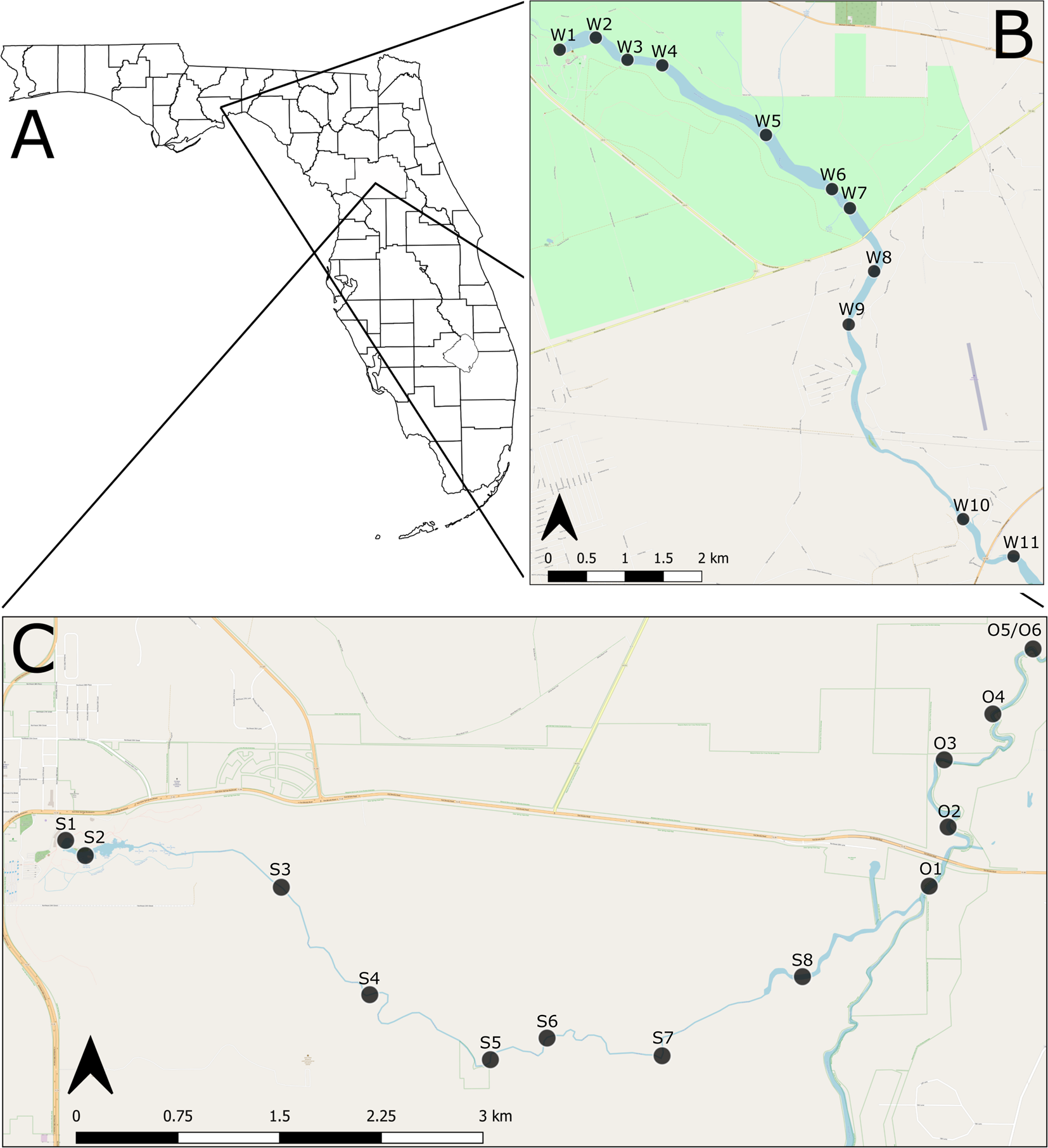
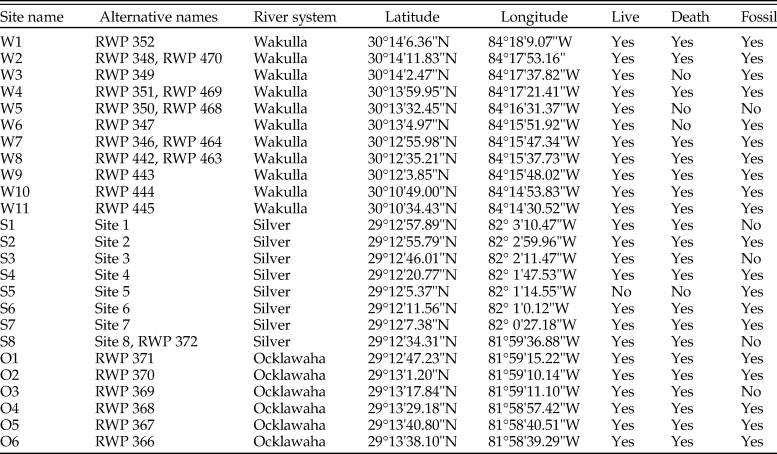
Samples were collected from two spring-fed river systems in Florida (Fig. 1, Table 1). The Silver River, located in Marion County, Florida, was sampled at eight sites along its entire 7.5-km length, from Mammoth Spring (main spring of the Silver Springs Group) to the confluence of the Silver and Ocklawaha Rivers. Six sites were sampled along a 3.5-km stretch of the Ocklawaha River, downstream from the confluence with the Silver River. Both rivers are sinuous. The headspring and uppermost portion of the Silver River are located in Silver Springs State Park. The park, originally designated in 1985, subsequently expanded to include the headspring in 2013 when the state took over the lease from the company that ran the Silver Springs attraction. The average annual discharge of the Silver Springs Group has decreased over the past 50 years, from about 22 m3/s to the current average of 20.6 m3/s. These two rivers flow over undifferentiated Holocene and Pleistocene sediments, which overlie the upper Eocene Ocala Limestone. The Ocala Limestone is exposed at numerous locations along the river channel. Bottom conditions vary from limestone hardgrounds, limestone cobbles, and shell marls, to softer silts, clays, and muds with variable distribution of submerged aquatic vegetation.
A, General location of the sampled spring/river systems with site names; B, Wakulla River sampling sites in Wakulla County; C, Silver and Ocklawaha Rivers sampling sites in Marion County. Circles indicate sampling sites.

Location of sampled sites, alternative site names, and the types of samples collected at each.

The Wakulla River, located in Wakulla County, Florida, was sampled at 11 sites along the uppermost 11 km of the river, beginning at Wakulla Spring, which has an annual discharge of 19.3 m3/s. Seven of these sites are located within Edward Ball Wakulla Springs State Park and include the headspring and uppermost 5 km of the river. The river is primarily meandering, with a short, braided section in the lower portion of the state park. The park was designated in 1966, following its purchase by the state from a businessman who had operated a lodge and guest house at the spring since the 1930s. There is no public boat access to the park, and boat tours operate only in close proximity to the headspring, an uppermost stretch of the Wakulla River that spans approximately 1.5 km, leaving most of the park free from direct human impacts. The four sites sampled downstream from the park represent the publicly accessible portion of the Wakulla River. The lowermost of these sites lies approximately 4 km upriver from the confluence of the Wakulla and the St. Marks Rivers and about 9 km from where the river flows into Apalachee Bay, Gulf of Mexico. The Wakulla flows over undifferentiated Holocene and Pleistocene sediments, which overlie limestone deposits of the lower Miocene St. Marks Formation. Bottom substrates vary from limestone hardgrounds containing limestone cobbles and silicified corals, to quartz sand, silt, mud, and peat. Lag deposits containing molluscan remains can be found within the channel, where they overlie fossiliferous marl and are, in turn, overlain by peats (G.H.M. personal observation 2019).
Three types of samples were collected using SCUBA: live, dead, and fossil. Live assemblages were sampled through timed (5, 10, or 15 minute) collection by hand of living mollusk specimens by divers across all habitat types at a given site. Habitats typically included shallow shoreline emergent vegetation, deeper midriver channels, floating vegetation, submerged aquatic vegetation, submerged logs, and leaf litter.
Death assemblage samples represented loose shell material collected in approximately 1-gallon bulk volumes from the river bottom. These samples typically contained shelly material with little or no additional sediment, which accumulated in loose, high abundances in scours, divots, or similar depressions on the river bottom.
Fossil assemblages represent shell material collected from in situ sediment exposed along cut banks and scours. Samples were acquired by bulk collection and then wet-sieving with 1-mm-mesh sieves. Fossiliferous sediments were exposed in submerged outcrops that differed in vertical height, typically ranging from 1 to 4 m. In addition, small marl exposures on the riverbed were occasionally accessible for sampling. These larger outcrops and marls were typically composed of white to tan shell-rich clays with occasional carbonate silt. Some outcrops contained a poorly indurated, dark brown, organic-rich, silt layer. Fossil material, however, was not available at every site, as sediment outcrops are not exposed uniformly along the river. Each exposure is different with respect to vertical height, lateral extent, lithology, fossil content, and other factors. Additionally, there are no beds or similar features correlatable between outcrops. When possible, fossil assemblages were sampled along a vertical transect of the outcrop at either regular intervals (~1 m apart), or selectively positioned above and below observed lithologic changes. Stratigraphic differences were not encountered at all submerged outcrops. Vertical distance below the uppermost outcrop surface was recorded for each sample, to the nearest 10 cm. Each sample represented approximately 1 gallon of sediment, which was acquired from a rectangular cuboid that spanned 5–10 cm vertically, 50–100 cm horizontally along the outcrop wall, and 10–20 cm horizontally into the outcrop wall. Because of the difficulty of sampling relatively unconsolidated sediments in murky, fast-moving waters, these dimensions are approximate. Each cuboid volume was sampled until a 1-gallon ziplock bag was filled with sediment. For death and fossil assemblage samples that contained small amounts of shell material, all specimens captured by wet-sieving with 1-mm mesh were processed and counted. For large samples, specimens were subsampled using strategies (sample splitters or multiple random subsets) designed to minimize size-selective bias.
Specimen Description and Analysis
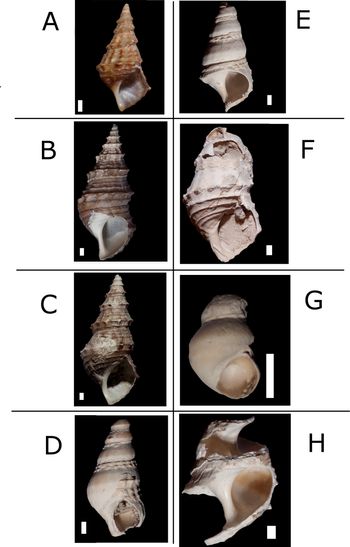
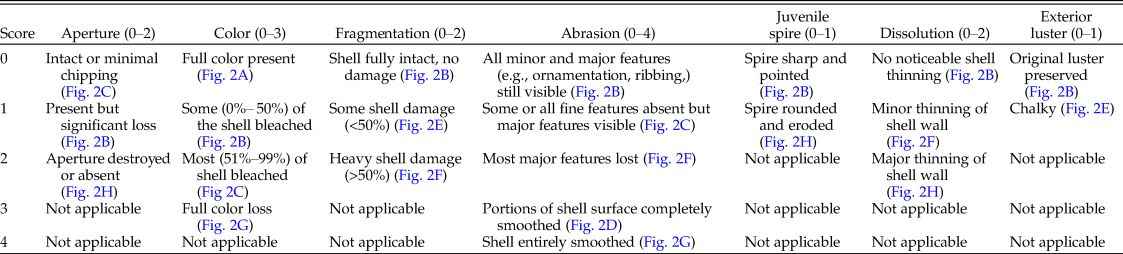
A total of 220 samples of the three molluscan assemblage types were collected from the two river systems (death = 53, fossil = 69, live = 98). Specimens were identified to the lowest taxonomic level, yielding a dataset of 45,372 specimens representing 24 taxa. We selected two gastropod species for taphonomic analysis, native Elimia floridensis and introduced Melanoides tuberculata. These two taxa were selected because of their comparable size, shape, mineralogy, and ecological roles, as well as their presence at many sites in both river systems. Elimia floridensis was present in live, death, and fossil assemblages, whereas M. tuberculata, introduced to Florida in 1966 (Clench Reference Clench1969), was found only in live and death assemblages. To quantify taphonomic attributes of shells, 2673 specimens (2504 E. floridensis and 168 M. tuberculata) from 66 samples were scored using the following seven traits: aperture condition, external color, fragmentation, abrasion, juvenile spire condition, dissolution, and exterior luster (Table 2, Fig. 2). Whereas both species were present in the samples, E. floridensis represented the majority of our specimens, a consequence of their higher abundance in live and death assemblages and the complete absence of M. tuberculata in fossil (in situ sediment) samples. For each scored specimen, shell length and width were measured using electronic calipers with precision of 0.01 mm.
Representative photographs of Elimia floridensis for taphonomic scoring traits. Each photograph is diagnostic of certain trait scores (listed as a score followed by those traits matching that score for each specimen). These include: (A) 0–color; (B) 0–fragmentation, abrasion, juvenile spire, dissolution, and exterior luster, 1–aperture and color; (C) 0–aperture, 1–abrasion, 2–color; (D) 3–abrasion; (E) 1–fragmentation and exterior luster; (F) 1–dissolution, 2–fragmentation and abrasion; (G) 3–color, 4–abrasion; (H) 1–juvenile spire, 2–aperture and dissolution. All scale bars, 1 mm. See Table 2 for more details.

Scoring criteria of taphonomic attributes.

Because ranges of scores varied across taphonomic variables, raw scores were converted to normalized scores (z-scores). For each specimen, individual trait z-scores were summed to create a total taphonomic (TT) score, a measure of overall taphonomic degradation, with negative values representing less altered shells and positive values representing more altered shells. Linear discriminant analysis of live and fossil E. floridensis taphonomic z-scores was used to generate a classificatory table to assess the accuracy in sourcing live and fossil shells based on TT scores. Leave-out-one strategy (also known as “jackknife correction”) was used to estimate more realistic error rates (Efron Reference Efron1979; Hora and Wilcox Reference Hora and Wilcox1982; Davison and Hall Reference Davison and Hall1992; Kowalewski et al. Reference Kowalewski, Dyreson, Marcot, Vargas, Flessa and Hallman1997). Specimens of E. floridensis from death assemblage samples were classified a posteriori to evaluate whether their provenance as either recently dead or reworked fossil shell could be discerned reliably. In addition, the classificatory analysis was conducted a posteriori to categorize dead specimens of M. tuberculata using the same linear discriminant function based on z-scores of live and fossil specimens of E. floridensis.
A principal coordinate analysis (PCO) was conducted on individual-trait z-scores to ordinate all specimens in terms of taphonomic attributes and assess the importance of and relationships between the individual taphonomic traits. Because the taphonomic values are discretized even after z-standardization, Manhattan distances were used to estimate multivariate distances used to derive PCO ordination axes. Permutational multivariate analysis of variance (PERMANOVA) was conducted on trait z-scores to assess whether live, dead, and fossil specimens were distinguishable statistically in terms of taphonomic traits.
Size of individuals was estimated for sufficiently complete specimens as a geometric mean of length and width. Log-transformed estimates of size were used in plots and analyses unless otherwise noted. Nonparametric univariate rank tests were used to evaluate differences in central tendency in size between specimen groups.
Radiocarbon Dating
Radiocarbon dating was conducted on 25 gastropod shells, including 19 terrestrial Polygyra septemvolva and six freshwater E. floridensis. Dating of freshwater species is often confounded by the radiocarbon reservoir effect (i.e., hard-water issue; see Webb et al. Reference Webb, Price, Nothdurft, Deer and Rintoul2007; Philippsen Reference Philippsen2013), which can be substantial in karst terrains where old carbonate rocks are present. The studied rivers all flow over karstic carbonate bedrock, and so freshwater mollusk shells likely incorporate substantial “old” carbon from the dissolution of the ancient rocks. Small terrestrial gastropods, which are less susceptible to this problem and are often preserved in the sampled sediments, were selected for radiocarbon dating (Goodfriend et al. Reference Goodfriend, Ellis and Toolin1999; Pigati et al. Reference Pigati, Quade, Shahanan and Haynes2004, Reference Pigati, Rech and Nekola2010, Reference Pigati, McGeehin, Muhs and Bettis2013, Reference Pigati, McGeehin, Muhs, Grimley and Nekola2015). While the shells of both freshwater species are elongated, P. septemvolva are discoidal/lenticular, with smaller, less prominent spires and numerous, small-caliber whorls (Pilsbry Reference Pilsbry1930, Reference Pilsbry1940; Emberton Reference Emberton1988). As in most terrestrial snails, members of the family Polygyridae secrete shells made of a single layer of aragonite, covered by a thin, proteinaceous periostracum (Tompa Reference Tompa1976; Pigati et al. Reference Pigati, McGeehin, Muhs, Grimley and Nekola2015; Yanes et al. Reference Yanes, Al-Qattan, Rech, Pigati, Dodd and Nekola2019). The terrestrial shells were used to constrain the ages of fossiliferous sediment samples. In addition, the six freshwater specimens were analyzed to test whether they could be dated accurately.
The 19 P. septemvolva specimens were dated individually and included two specimens from death assemblage samples collected in the Ocklawaha River and 15 shells from fossil samples, 14 from the Ocklawaha River and 1 from the Wakulla River. Four fossil specimens of E. floridensis were dated, two from the Silver River and two from the Wakulla River. Four specimens collected live from the same region before atmospheric nuclear bomb testing (two P. septemvolva taken in 1929, and two E. floridensis from 1934 and 1929), were analyzed to assess radiocarbon reservoir ages (R). All accelerator mass spectrometry (AMS) dating was conducted using powdered carbonate targets (Bush et al. Reference Bush, Santos, Xu, Southon, Thiagarajan, Hines and Adkins2013) at the University of California Irvine AMS facility. Age calibration was performed on R-corrected 14C ages using IntCal13 data (Reimer et al. Reference Reimer, Bard, Bayliss, Beck, Blackwell, Bronk Ramsey, Buck, Cheng, Edwards, Friedrich, Grootes, Guilderson, Haflidason, Hajdas, Hatté, Heaton, Hoffmann, Hogg, Hughen, Kaiser, Kromer, Manning, Niu, Reimer, Richards, Scott, Southon, Staff, Turney and van der Plicht2013) and the OxCal program (Bronk Ramsey Reference Bronk Ramsey2009).
Results
Radiocarbon Dating and Time-Averaging
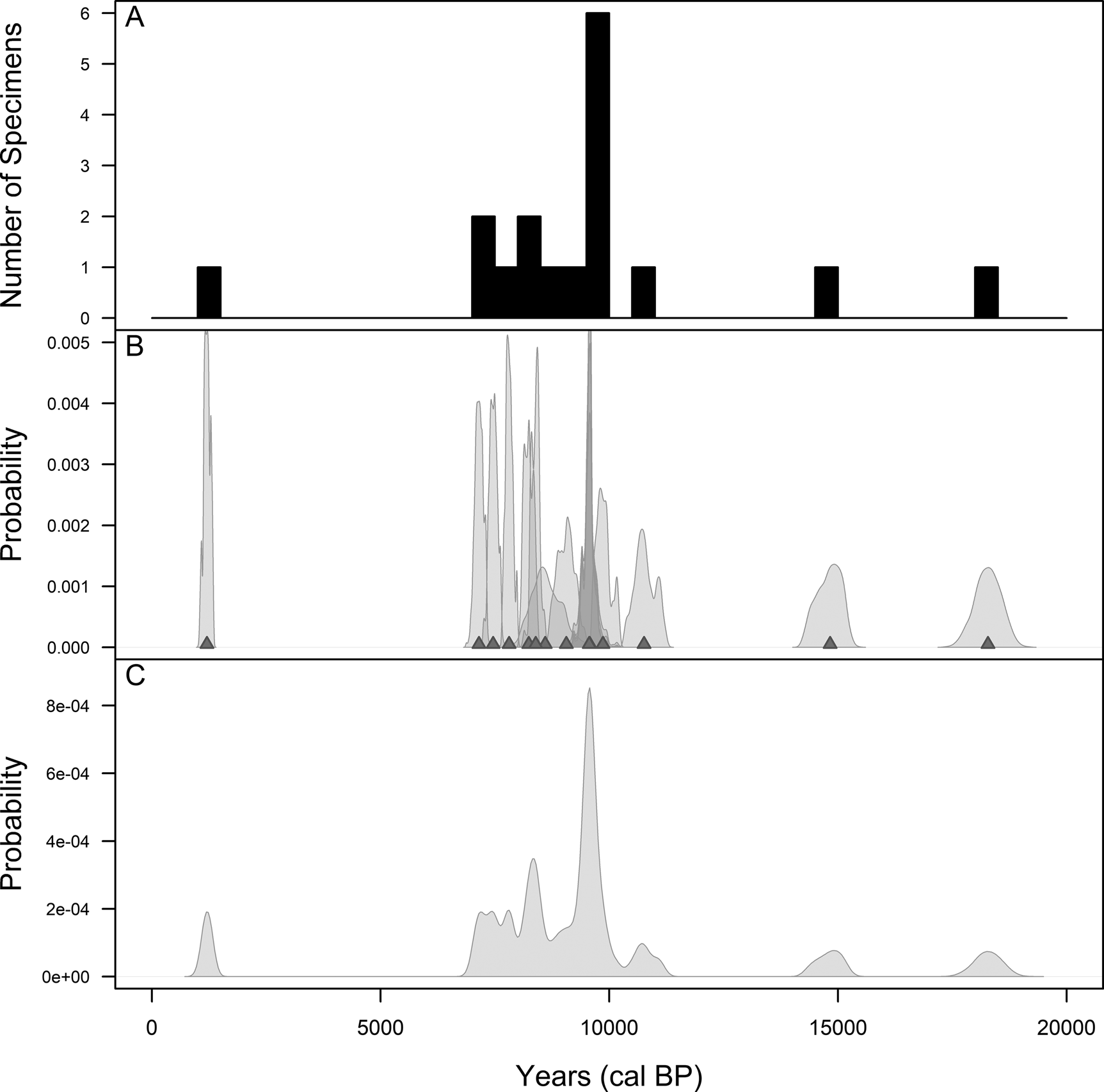
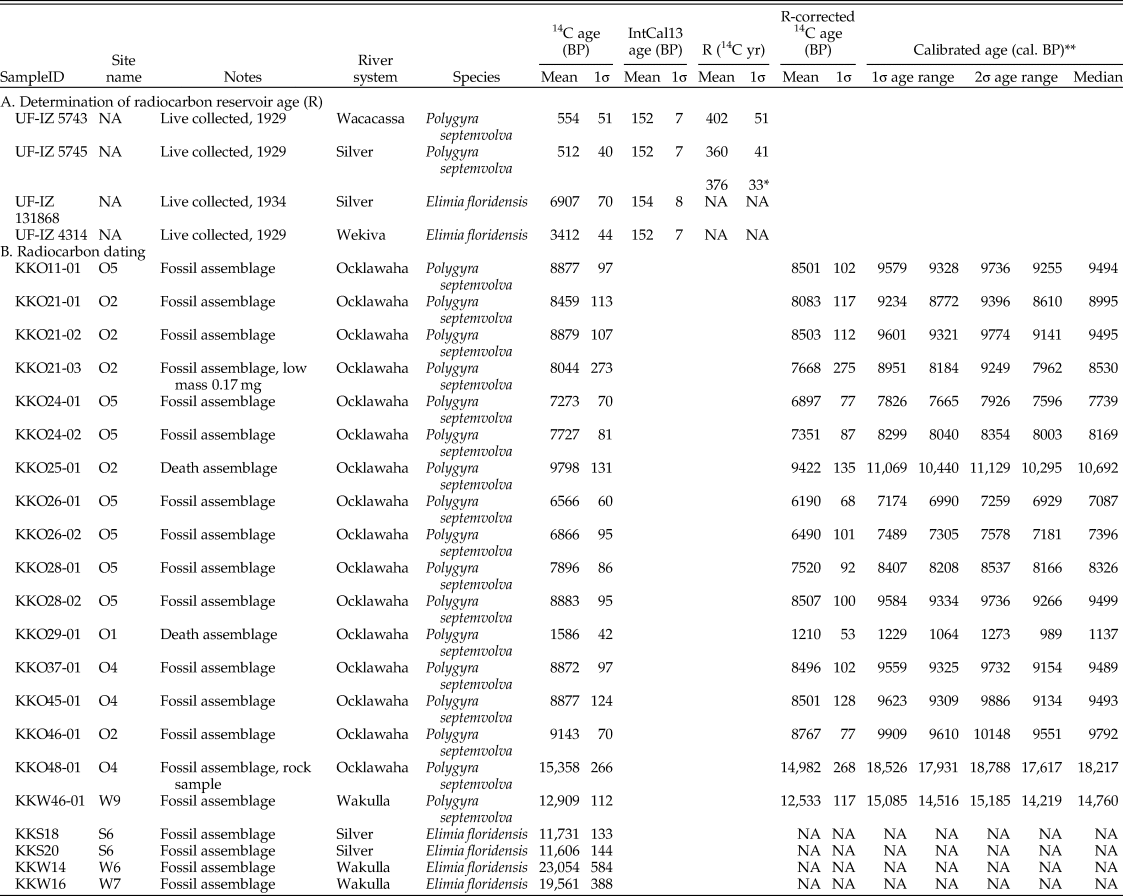
Radiocarbon results from the two live-collected, freshwater E. floridensis indicated that they were strongly but differently influenced by old carbonate, with apparent ages of 6907 and 3412 cal BP (before present), with 0 cal BP being 1950 CE, despite similar collection dates (1929 and 1934), indicating this species was unsuitable for radiocarbon dating (Table 3). In contrast, the two live-collected, pre-bomb P. septemvolva from different river systems yielded consistent, statistically indistinguishable ages, displaying reasonable reservoir ages of approximately 400 14C yr or less (Table 3). The mean estimated radiocarbon reservoir age for live-collected P. septemvolva (376 ± 33 14C yr) was used to correct all measured ages on fossil and death assemblage specimens of this species, after which dates were calibrated. Ocklawaha River fossil specimens ranged in age from 18,217 to 7087 cal BP, with most dates clustering between 9792 and 7087 cal BP (Fig. 3). The oldest specimen came from a fossiliferous marl exposed in the river channel, rather than from sediment samples from a vertical outcrop along the riverbank. Most specimen ages were consistent with their stratigraphic position, with younger specimens typically, but not always, above older specimens in a vertical exposure. A single fossil specimen from the Wakulla River dated to 14,760 cal BP. The two death assemblage specimens collected from surficial (currently forming) accumulation dated to 10,692 and 1137 cal BP.
Radiocarbon summary from fossil and dead Polygyra septemvolva including (A) distribution of median calibrated ages, (B) age probability distribution of each specimen, and (C) combined probability distributions.

Radiocarbon results. *Weighted R mean (n = 2), which was used for the determination of R-corrected 14C ages for all Polygyra septemvolva samples. **Age calibration was performed using the IntCal13 data (Reimer et al. Reference Reimer, Bard, Bayliss, Beck, Blackwell, Bronk Ramsey, Buck, Cheng, Edwards, Friedrich, Grootes, Guilderson, Haflidason, Hajdas, Hatté, Heaton, Hoffmann, Hogg, Hughen, Kaiser, Kromer, Manning, Niu, Reimer, Richards, Scott, Southon, Staff, Turney and van der Plicht2013) and OxCal program (Bronk Ramsey Reference Bronk Ramsey2009).

Taphonomic Scoring
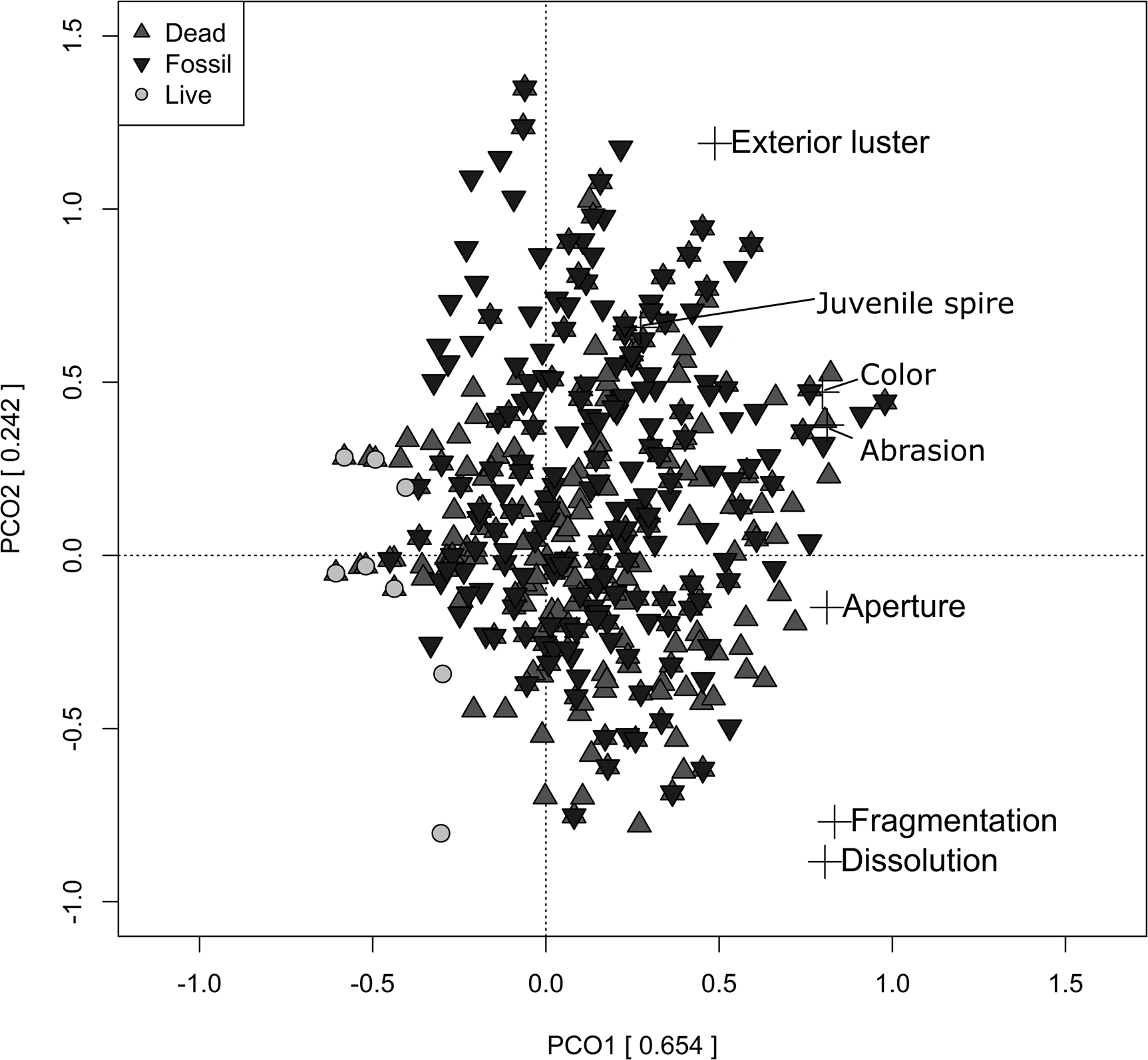
In a principal coordinate analysis, death assemblage and fossil assemblage specimens ordinated as broadly overlapping clusters of points (Fig. 4). Live specimens are restricted to negative PCO1 scores, overlapping with those death and fossil assemblage specimens characterized by unusually low PCO1 scores. Both the native and introduced species overlap at lower PCO1 scores, though M. tuberculata becomes increasingly sparse to absent at higher scores, a pattern that becomes increasingly evident when fossil samples are removed (Supplementary Fig. 1A,B). PCO1 explains 65.4% of variation and is positively correlated with all taphonomic traits. PCO2, which explains 24.4% of variation, correlates positively with dissolution and fragmentation and relates negatively to changes in a shell's exterior finish. PERMANOVA suggests that the three assemblage types vary significantly in taphonomic traits (F = 104.56, p = 0.008).
Principal coordinate analysis (PCO) of individual specimen z-scored taphonomic traits. Live specimens in light gray open circles, death assemblage specimens in medium gray triangles, and fossil assemblage specimens in dark gray inverted triangles.

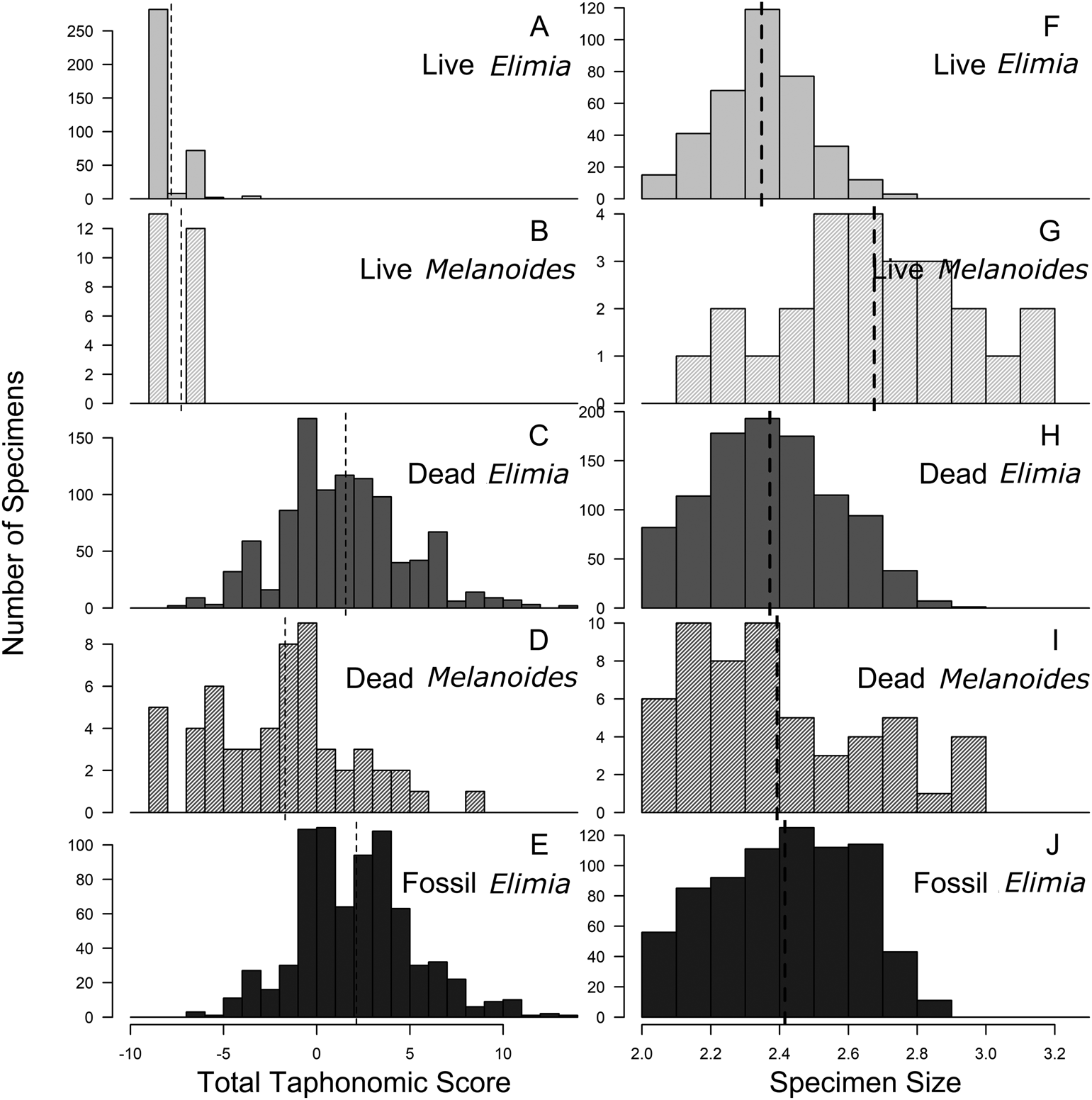
Elimia floridensis TT scores ranged from −8.75 (least-degraded specimen) to 12.70 (most-degraded specimen) (Fig. 5A,C,E). Live specimens (n = 373) were least degraded (mean = −8.22) and least variable (SD = 1.01, range = −8.75 to −3.52) in terms of TT scores (Fig. 5A). Death assemblage specimens (n = 1191) were intermediate in terms of average degradation (mean = 1.32) but displayed the largest variation (SD = 3.38, range = −8.75 to 12.70) in TT scores (Fig. 5C). Fossil specimens (n = 940) were most degraded (mean = 1.77) and intermediate in variation (standard variation = 3.09, range = −6.77 to 12.70) in TT scores (Fig. 5E).
Total taphonomic score distributions (left, A–E) and size distributions for specimens with geometric mean greater than 2 mm (right, F–J). Vertical dotted lines mark mean values.

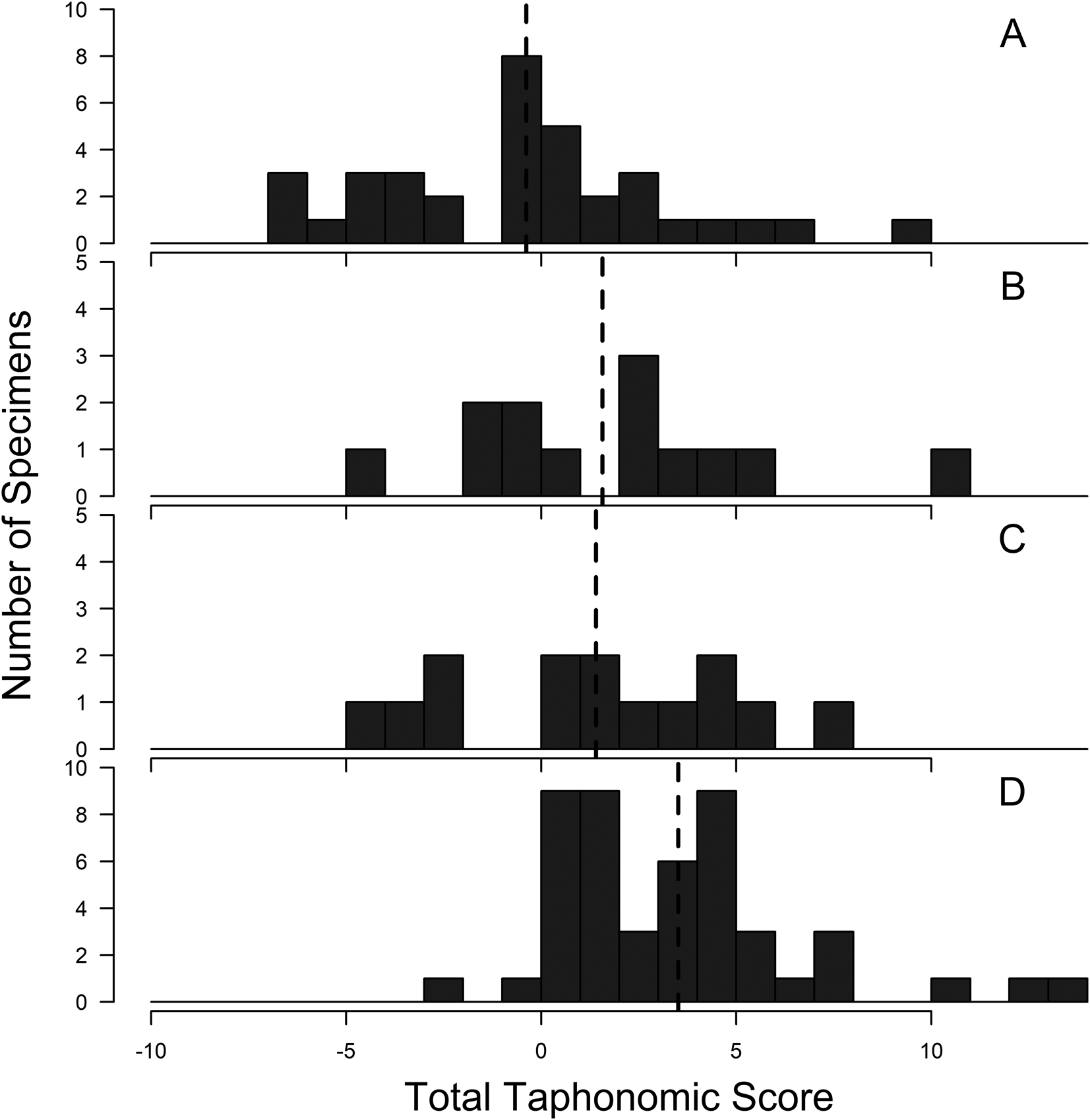
When taphonomic attributes of fossil samples collected along a single vertical profile spanning 3 m (S7; Silver River) are compared, specimens from the topmost sample appear least degraded (mean TT score of −0.38). The mean TT score generally increased down the profile, with the highest mean TT score of 3.51 recorded for the lowermost sample (Fig. 6A–D).
Distribution of Elimia floridensis TT scores along a single fossil outcrop at “S7” on the Silver River. Samples collected in a vertical succession at (A) the top of the outcrop, (B) 1 m down, (C) 2 m down, and (D) 3 m down (bottom of outcrop). Vertical dotted lines mark mean TT scores.

Size and TT Score
Live, dead, and fossil E. floridensis have comparable mean shell lengths (15.39, 14.53, and 14.67 mm, respectively), whereas mean lengths of M. tuberculata specimens tend to be much greater for live assemblages (26.26 mm) than for death assemblages (12.69 mm). When all scored specimens of all assemblage types are considered, there is a weak but significant negative correlation between TT score and shell size, indicating that larger specimens are more altered than smaller specimens (Table 4). This trend is also apparent when the two species are considered separately and among death assemblages of E. floridensis specimens. There is no significant correlation between TT score and size for any other permutation of sample type and species. Restricting specimens to those with geometric mean size > 2 mm mitigates size effects. For this reason, all further analyses in this study restrict specimens to those with geometric mean size > 2 mm. Under this restriction, the mean size of live M. tuberculata is still greater than mean size for other groups (Fig. 5F–J).
Correlation (cor) between total taphonomic scores and log geometric size. *p < 0.05; **p < 0.1.

Discriminant Analysis
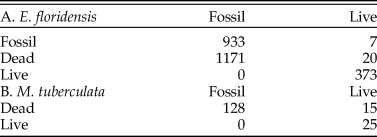
The discriminant analysis correctly categorized all 373 scored live E. floridensis specimens as coming from living assemblages (Table 5A), reflecting their lower TT scores. Low TT scores typically represent minimal taphonomic changes, including undamaged juvenile spires, intact apertures, intact body whorls, and little alteration of exterior color or luster. Fossil specimens were categorized correctly as fossil for 933 of 940 specimens, with a jackknife-corrected error rate of < 1% (0.0074). Shells categorized as coming from fossil assemblages reflect their higher TT scores and are characterized by damaged or missing apertures and body whorls, rounded and abraded apexes, bleaching of color, and chalkier shell exteriors. Of 1313 specimens, 1306 (99.4%) were classified correctly. When the discriminant function derived for live and fossil specimens was used, death assemblage specimens classified predominantly as fossil in origin (1171), and only 20 (1.7%) were classified as having taphonomic characteristics comparable to live specimens. Using classifications derived from E. floridensis TT scores to classify shells of nonnative M. tuberculata, all 25 live-collected specimens were classified correctly as belonging to live assemblages (Table 5B). For M. tuberculata death assemblage specimens, 128 (89.5%) were classified as having taphonomic characteristics similar to fossil specimens, whereas 15 (10.5%) were classified as having taphonomic characteristics comparable to live specimens.
Posteriori classification summary for discriminant analysis using jackknife cross-validation of Elimia floridensis and Melanoides tuberculata.

Introduced Species
Comparison of the taphonomic scores of introduced M. tuberculata with native E. floridensis revealed that the two species differ somewhat in their taphonomic signatures. With respect to live assemblages, the introduced and native species are statistically indistinguishable, with mean TT scores of −8.09 and −7.55 (Fig. 5A,B). However, the two species differ with respect to their death assemblages, with the introduced taxon showing, on average, less degradation than the native species, with statistically distinct mean TT scores (introduced TT score = −1.21; native TT score = 1.32; p = < 0.001; two-sample t-test) (Fig. 5C,D).
Discussion
Age of Sampled Sediments
Because terrestrial gastropods are derived from adjacent riverbank environments, either in vivo or postmortem, the age of sediments in which the dated specimens are found is probably best estimated by the youngest cohort of dated specimens. Except for a few older specimens, most dated gastropods ranged in age between 9792 and 7087 cal BP, indicating an early Holocene age for the sampled sediments. These results are consistent with radiocarbon dates on sediment cores taken from other Florida springs and shallow lakes in the region, including the Silver Glen Springs Complex (8980–8170 cal BP), Salt Springs (8320 cal BP), Newnans Lake (8870 cal BP), Lochloosa Lake (9280 cal BP), and Lake Harris (10,680 cal BP) (O'Donoughue Reference O'Donoughue2015; Kenney et al. Reference Kenney, Brenner, Curtis, Arnold and Schelske2016; Larios-Mendieta et al. Reference Larios-Mendieta, Gerber and Brenner2018). At Silver Glen Springs, this dated interval represents a shift from siliciclastic sands devoid of organic material to organic deposits including reddish-brown peats and black mucks with preserved vegetation, possibly recording a local drowning episode (O'Donoughue Reference O'Donoughue2015). This lithologic change was hypothesized to represent either the most recent activation of spring flow or a substantial stage increase in an already flowing spring (O'Donoughue Reference O'Donoughue2015). Similar radiocarbon ages on shells from Silver, Ocklawaha, and Wakulla sediments suggest that hydrologic reactivation of those systems was roughly coincident with that of Silver Glen Springs. These changes also postdate a documented pulse in sea-level rise ca. 11,000 cal BP in the northern Gulf of Mexico, hypothesized to have driven a rise in the water table in Florida that activated or reactivated many of Florida's springs and filled its shallow lakes (Balsillie and Donoghue Reference Balsillie, Donoghue, Buster and Holmes2011; Donoghue Reference Donoghue2011; O'Donoughue Reference O'Donoughue2015).
Interpretation of the earliest fossil deposits as newly activated springs imposes potential constraints on the age of youngest shells that could be common in those sediments. Reworking of older terrestrial gastropod shells into the newly activated river system may explain the presence of a few late Pleistocene shells among the dated specimens. Alluvial sediments capture shells of terrestrial gastropods that typically lived in close proximity to springs and channels, and it is therefore likely that the terrestrial and freshwater specimens found in the same sediments experienced similar taphonomic histories and lived at about the same time. Even if the assumption of equivalent taphonomic pathways is invalid, freshwater shells contained within (and eroding from) those deposits should be the same age or older than the early Holocene interval during which fossil assemblage sediments accumulated. The absence of specimens dated between 7087 and 1137 cal BP may be attributed to fossil deposits of this age being (1) poorly exposed and therefore unsampled in this study; (2) sampled, but sparse in collected shell material; or (3) abundant with respect to some species, but missing the necessary terrestrial P. septemvolva. Any of the three scenarios would lead to an absence of younger shell material.
Size and Taphonomy
The larger mean size of live M. tuberculata is driven, in part, by absence of smaller specimens, which may be scarce in the dataset (Fig. 5F) because of preferential hand sampling by divers, with larger specimens more visible and more easily collected, depending on water conditions. This effect may be mitigated in live E. floridensis because of overall higher densities of individuals in sampling areas, which enabled capture of a wider range of sizes within the timed collection interval.
Specimen size is known to have an influence on the speed and extent of taphonomic destruction (Strayer and Malcom Reference Strayer and Malcom2007; Ilarri et al. Reference Ilarri, Souza, Amorim and Sousa2019). This study found a significant, but weak, negative correlation between specimen size and TT score, suggesting that larger specimens are more altered than smaller specimens. A weak, but significant correlation was not surprising, given the positive relationship between shell size and taphonomic state observed in previous studies (Strayer and Malcom Reference Strayer and Malcom2007; Ilarri et al. Reference Ilarri, Souza, Amorim and Sousa2019). This may be the consequence of documented preferential destruction of smaller specimens, which are more susceptible to the physical, biological, and chemical factors in fluvial systems, leaving larger specimens intact, but more altered (Strayer and Malcom Reference Strayer and Malcom2007; Ilarri et al. Reference Ilarri, Souza, Amorim and Sousa2019).
The “size effect,” however, is unlikely to have played a substantial confounding role for shells of the native species, E. floridensis, because specimens from all three assemblage types are comparable in terms of size–frequency distribution and mean specimen size (Fig. 5F,H,J). Individuals in the M. tuberculata death assemblage display a similar distribution and mean size (Fig. 5I). The larger size of live specimens of M. tuberculata (Fig. 5G) suggests that TT scores for live assemblages are overestimated because of their larger specimen sizes. The low amount of degradation observed in these specimens (Fig. 5B), however, suggests the size effect is small or absent in the taphonomic trends identified in this study.
Death Assemblage Taphonomic Provenance and Pathways
Taphonomic scores for all assemblage types reflect some of the expectations of the taphonomic clock, based on their assumed relative ages. The live-collected specimens of both species are relatively unaltered and have very low PCO and TT scores (Figs. 4, 5A,B). Fossil E. floridensis assemblages, expected to include the oldest of the sampled specimens, are characterized by the most altered shells and highest PCO and TT scores (Figs. 4, 5D). However, not all predictions of the taphonomic clock were met at the individual specimen level. While the introduced M. tuberculata as a whole are generally characterized by lower PCO and TT scores than the native E. floridensis, many individual death assemblage specimens of M. tuberculata have higher scores, comparable to those observed for death assemblage specimens of E. floridensis, even though M. tuberculata was introduced to the system <50 years ago, whereas the E. floridensis death assemblage is not similarly age constrained (Fig. 5B,C, Supplementary Fig. 1). For both species, death assemblages contain moderately to severely altered individuals alongside more pristine shells, suggesting that a complicated taphonomic pathway influenced those surficial shell accumulations.
Multiple alternative hypotheses can be postulated to explain the taphonomic signatures of the death assemblages, which are dominated by highly degraded specimens, but also include a small percentage of less-degraded individuals. The first hypothesis is that the death assemblage contains primarily young shells that are undergoing rapid dissolution and degradation, thus leading to rapid degradation of most specimens, leaving only very recently deceased specimens relatively unaltered. A second hypothesis postulates that alteration rates are moderate, but that death assemblage shells are exposed in a taphonomically active zone for a longer length of time, allowing an individual shell to slowly accrue damage and alteration. Under this scenario, the dominance of altered shells reflects more substantial time-averaging, with most shells in surficial accumulations having been dead for multiple decades. The third hypothesis is that the death assemblage contains substantial numbers of reworked fossils and represents a mixture of more-degraded fossil specimens and less-degraded specimens sourced recently from the living mollusk community. These hypotheses are end-member scenarios that may have all contributed simultaneously to the formation of surficial death assemblages.
The first hypothesis aligns with previous research, which concluded that rivers are taphonomically destructive environments (Cummins Reference Cummins1994; Newell et al. Reference Newell, Gower, Benton and Tverdokhlebov2007; Ilarri et al. Reference Ilarri, Souza and Sousa2015, Reference Ilarri, Souza, Amorim and Sousa2019; Martello et al. Reference Martello, Kotzian and Erthal2018). Shells in these systems undergo rapid alteration by physical and chemical forces upon the death of an individual and its introduction into the death assemblage. Martello et al. (Reference Martello, Kotzian and Erthal2018) proposed that even the most robust bivalve shells would disintegrate completely in about 6.5 years, with some thinner-shelled species needing as little as 1 year. Many specimens are quickly destroyed, whereas those that do not disappear completely rapidly reach more degraded taphonomic scores, consistent with those expected in much older shells. Discriminant analysis of the introduced M. tuberculata (Table 5B) may support this hypothesis. Although the first appearance of introduced M. tuberculata in the studied river systems was not recorded, their first appearance in Florida in 1966 means they cannot have been in the studied rivers for more than ~50 years (Clench Reference Clench1969). Despite their recent arrival, some death assemblage specimens were highly degraded (i.e., high TT scores). Whereas the mean TT score of M. tuberculata specimens from death assemblages was lower than that of death or fossil assemblages of E. floridensis, the maximum TT score among those M. tuberculata specimens was 8.95, which is comparable to TT scores of highly degraded fossil specimens. As a recent introduction, M. tuberculata cannot be derived from reworked deposits, meaning all observed degradation occurred in the fluvial channels of the modern river within the last five decades, at most. Similar patterns of rapid alteration for invasive and exotic taxa have been noted in marine settings, where dead shells of recently introduced species may appear taphonomically similar to shells of much older, native species (Martínez et al. Reference Martínez, Rojas, Cabrera and Antuña2020). This interpretation, however, relies on the two species having similar taphonomic pathways, such that TT scores of fossil and live E. floridensis can be applied a posteriori to M. tuberculata for classification, an assumption that is not unreasonable given the similarity in size, shape, and ecology of the two compared species. Similar assumptions must be made about the preservation potential in the lotic systems, which may change over time in response to physical, chemical, and biological changes in the rivers.
A second hypothesis is that damage and alteration in the death assemblage may have accumulated at a slower rate than in the first hypothesis, but that shells were exposed, or periodically re-exposed, to processes in a taphonomically active zone for decades or longer, allowing some specimens to degrade notably and thus attain high TT scores. Here, the preponderance of higher TT scores would reflect the larger number of older shells exposed to taphonomic degradation, relative to a smaller number of fresh, recently dead shells. The validity of this hypothesis is dependent on the rate of shell production (input of fresh shell), frequency of re-exposure, and speed of removal from the taphonomically active zone, either through final burial or complete destruction, as postulated in multiple case studies in marine environments (Meldahl et al. Reference Meldahl, Flessa and Cutler1997; Olszewski Reference Olszewski1999; Tomašových et al. Reference Tomašových, Fürsich and Olszewski2006, Reference Tomašových, Kidwell and Barber2016). In the marine case studies, input was assumed to be fairly constant, barring environmental changes, and shell removal appeared to take place randomly (Meldahl et al. Reference Meldahl, Flessa and Cutler1997; Tomašových et al. Reference Tomašových, Kidwell and Barber2016). Although some freshwater mollusks are undergoing population declines in Florida rivers, both E. floridensis and M. tuberculata have not seen such significant declines in the studied river systems, suggesting shell input from these two species has remained relatively constant (Odum Reference Odum1957; Corrao et al. Reference Corrao, Darby and Pomory2006; Munch et al. Reference Munch, Toth, Huang, Davis, Fortich, Osburn, Philips, Quinlan, Allen, Woods, Cooney, Knight, Clarke and Knight2006). Death assemblage M. tuberculata TT scores may support this hypothesis. Higher TT scores are absent from these assemblages, suggesting that five decades, the maximum amount of time these introduced specimens have been in the system, is not long enough for taphonomic degradation to reach scores comparable to those seen at the higher end of E. floridensis death assemblages. Unlike specimens of the introduced species M. tuberculata, specimens of the native species E. floridensis could have been present in the taphonomically active zone for centuries or millennia. Consequently, they could have accumulated more substantial alteration, leading to the higher average TT scores relative to the nonnative M. tuberculata. Shells in fluvial settings with lower water energy or sheltering eddies appear to undergo degradation at a slower pace (Strayer and Malcom Reference Strayer and Malcom2007; Ilarri et al. Reference Ilarri, Souza, Amorim and Sousa2019). These sheltered settings are present throughout the studied rivers and provide less aggressive taphonomic conditions, which potentially allow for exposed shells to persist over longer periods of time.
In the third hypothesized process, more-degraded shells, sourced primarily from reworked fossil deposits along the riverbanks, are mixed with less-degraded, recently deceased individuals of the living community in the modern river. This fossil input is driven by erosion of riverbanks by physical, biological, and anthropogenic processes. Human recreational use of rivers in Florida can negatively impact vegetation that stabilizes shorelines and bottom sediments, leading to higher rates of erosion (Mumma et al. Reference Mumma, Cichra and Sowards1996). In the past decade, Florida's waterways have also undergone increased erosion and bank instability, driven by invasive catfish that create nests and establish burrowing colonies in riverbanks (Nico et al. Reference Nico, Jelks and Tuten2009; Hill and Sowards Reference Hill and Sowards2015). Enhanced erosion contributes more fossil material to the rivers, where it mixes with less-degraded modern shells to form the death assemblage. Radiocarbon dates on death assemblage specimens support the hypothesis that assemblages contain reworked fossil input. Two terrestrial P. septemvolva in death assemblage samples from adjacent sites on the Ocklawaha River, one at the confluence with the Silver River and the next downriver site, returned radiocarbon dates of 1137 and 10,692 cal BP. In a taphonomically destructive river, neither shell is likely to have survived for so long on the surface of the channel bottom, suggesting they were derived recently from older shoreline sediments. In addition, the very different ages of the two specimens suggest they came from different sources. The older date is similar to dates on sampled fossil deposits, whereas the younger date suggests that shell was sourced from younger sediments that were not sampled in this study. Smaller channel lag deposits, like those documented in the Wakulla River, may be a source of these younger shells. The preponderance of early Holocene (11,000–7000 cal BP) dates compared with younger dates (1137 cal BP) likely reflects either increased input of older sediments or a change in preservation over time.
Further support for the third hypothesis can be drawn from the distribution of TT scores of native and introduced species (Fig. 5A–E). The mean TT score of the native species death assemblage is significantly more degraded than its recently introduced counterpart. This finding is largely a consequence of the scarcity of highly degraded M. tuberculata specimens. In native E. floridensis death assemblages, more degraded individuals are likely sourced from reworked fossil deposits, as fossil individuals have comparably degraded TT scores. Out of 143 M. tuberculata specimens from the death assemblage, 128 (88.8%) had a TT score below the mean fossil TT score, highlighting the paucity of specimens with more-degraded shells in the former group. If these more-degraded specimens are primarily sourced from fossil deposits, it makes sense that they would rarely be observed among dead specimens of the introduced species. When significant taphonomic damage and alteration has occurred in introduced specimens, they may have been exposed to either harsh taphonomic conditions (the first hypothesis) or represent specimens from the oldest cohorts of the introduced species (the second hypothesis). During fieldwork for this study, fossil deposits were observed eroding into the river, leaving no doubt that death assemblages include some fraction of reworked fossil specimens.
In summary, the death assemblage is likely a mixture of recently dead specimens and old fossil shells. Reworked fossils from the riverbanks drive the overall death assemblage taphonomic signature toward more-degraded values. TT scores may also reflect either rapid alteration of recently deceased individuals, slow alteration in settings conducive to longer exposure times, or both. Renewed alteration of fossil input, reintroduced to the river system, is also possible. The modern, live community is the single source for less-degraded shells, whereas reworked fossils and fluvial processes both contribute to higher TT scores in death assemblages. Freshwater bivalves likely undergo similar reworking, though this may be complicated by their range of life modes, poor preservation of shell material (particularly of taphonomically nonrobust mussels), and other biological/ecological differences (Cummins Reference Cummins1994; Newell et al. Reference Newell, Gower, Benton and Tverdokhlebov2007; Wolverton et al. Reference Wolverton, Randklev and Kennedy2010; Ilarri et al. Reference Ilarri, Souza and Sousa2015, Reference Ilarri, Souza, Amorim and Sousa2019; Martello et al. Reference Martello, Kotzian and Erthal2018).
The mixing of fossil and recently deceased individuals resulted in multimillennial time- averaging of death assemblages in the sampled freshwater environments. Both the youngest (1137 cal BP) and third oldest (10,692 cal BP) radiocarbon-dated P. septemvovla are from death assemblage samples (Table 3). Additionally, live specimens were intermingled with shells of dead individuals in samples from many death assemblage accumulations. Following their death, these individuals contribute fresh, that is, age 0 shells, resulting in a surficial death assemblage that is a mix of modern shells and those that date to > 10,000 years old. This multimillennial time-averaging is consistent with, or exceeds, averaging reported for molluscan assemblages in marine settings (Flessa et al. Reference Flessa, Cutler and Meldahl1993; Kidwell Reference Kidwell1997, Reference Kidwell2013; Carroll et al. Reference Carroll, Kowalewski, Simões and Goodfriend2003; Kosnik et al. Reference Kosnik, Hua, Jacobsen, Kaufman and Würst2009, Reference Kosnik, Kaufman and Hua2013, Reference Kosnik, Hua, Kaufman and Zawadzki2015; Kidwell and Tomašových Reference Kidwell and Tomašových2013; Dexter et al. Reference Dexter, Kaufman, Krause, Barbour Wood, Simões, Huntley, Yanes, Romanek and Kowalewski2014; Dominguez et al. Reference Dominguez, Kosnik, Allen, Hua, Jacob, Kaufman and Whitacre2016; Kowalewski et al. Reference Kowalewski, Casebolt, Hua, Whitacre, Kaufman and Kosnik2018; Tomašových et al. Reference Tomašových, Kidwell, Alexander and Kaufman2019) and vertebrate fluvial assemblages (Behrensmeyer Reference Behrensmeyer1982; Aslan and Behrensmeyer Reference Aslan and Behrensmeyer1996).
Broader Paleontological Implications
Enhancing Vertebrate Studies
Although vertebrate taphonomic studies benefit from integrating invertebrate data, such data are rarely considered and included (Hunt Reference Hunt1991; Schrenk et al. Reference Schrenk, Bromage, Gorthner and Sandrock1995; Rogers et al. Reference Rogers, Kidwell, Deino, Mitchell, Nelson and Thole2016). Vertebrate assemblages in fluvial systems are subject to a range of taphonomic processes that are typically inferred from sedimentologic context, and taphonomic features of the bones and are often used to enhance paleoenvironmental interpretations (Behrensmeyer Reference Behrensmeyer1988; Smith et al. Reference Smith, Sidor, Tabor and Steyer2015; Moore and Varricchio Reference Moore and Varricchio2018). Taphonomic study of vertebrates in Florida's Aucilla River, a spring-fed system, documented natural alteration of the bones through water wear, predation, and scavenging and human-related alteration by butchering, tool use, and thermal alteration (Peres and Simons Reference Peres and Simons2006; Webb Reference Webb2006; Webb and Simons Reference Webb and Simons2006).
However, spring-fed rivers, such as those in this study, may differ from snowmelt rivers in water chemistry, mineral content, temporal span, and other factors that influence taphonomic damage and preservation (Saunders Reference Saunders1975; Bilbey Reference Bilbey1999). In fluvial deposits with scarce, heavily damaged, or unidentifiable bone fragments, invertebrate fossils may provide context regarding river dynamics and habitat variability. In some cases, invertebrates may serve as proxies for fluvial conditions at sites where the primary interest is vertebrate fossils or archaeological remains (Balsillie et al. Reference Balsillie, Means, Dunbar and Means2005). Invertebrates also enhance inferences about past ecosystems that the bones alone do not, providing environmental or ecological context to large vertebrate or hominid fossil discoveries (Keen Reference Keen1990; Howard et al. Reference Howard, Wood, Greenwood and Rendell2009; WoldeGabriel et al. Reference WoldeGabriel, Ambrose, Barboni, Bonnefille, Bremond, Curie, DeGusta, Hart, Murray, Renne, Jolly-Saad, Stewart and White2009). Inclusion of molluscan taphonomic analyses can provide context and enhance vertebrate studies in past and present freshwater settings.
Implications of Using Freshwater Death Assemblages in Fidelity Studies
This study highlights the need to critically assess how freshwater mollusk death assemblages form, including potential input sources of molluscan material, levels of time-averaging, and viable taphonomic pathways. Such assessments are needed to establish baseline community range, assess historical fidelity of freshwater ecosystems, and calibrate ecosystem recovery efforts (Kotiaho et al. Reference Kotiaho, ten Brink and Harris2016). Most marine studies of ecological fidelity are conducted through comparisons of live and death assemblages, with the assumption that the death assemblage is a time-averaged reflection of previous, historical communities and can be used as a baseline (Kidwell Reference Kidwell2007, Reference Kidwell2008, Reference Kidwell2013). Similar rates of time-averaging in freshwater assemblages suggest they may be used similarly to address ecological fidelity. This study, however, revealed that death assemblages in freshwater systems may form via complex processes, including inputs of individuals from multiple sources that differ notably in origin and age. Similar complexity was previously noted in some marine and terrestrial case studies (Leorri and Martin Reference Leorri and Martin2009; Dominguez et al. Reference Dominguez, Kosnik, Allen, Hua, Jacob, Kaufman and Whitacre2016; Tomašových et al. Reference Tomašových, Kidwell and Barber2016), suggesting that complex taphonomic pathways can develop in various depositional settings.
If freshwater death assemblages combine multiple inputs ranging from recently dead material from present-day communities to reworked fossil materials spanning multiple millennia, the resulting death assemblage may not be a faithful representation of baseline communities. Fidelity studies in freshwater systems must consider what community best represents the baseline for comparisons with the modern. In rivers, death assemblages may be highly time- averaged and may not represent the recent community. If fidelity studies seek baselines on the scale of hundreds to thousands of years, the death assemblage may not be appropriate, because it may include older material alongside much younger specimens. This study lays the groundwork for future conservation paleobiological research in freshwater settings, using taphonomy to contextualize the death assemblages often used to develop ecological baselines.
Conclusion
The taphonomic analyses suggest that, for both Florida spring-fed rivers studied here, molluscan shells can follow multiple taphonomic pathways. This multifaceted taphonomic history can lead to the formation of genetically complex and strongly time-averaged molluscan death assemblages that represent a mixture of recently dead individuals as well as late Pleistocene- and Holocene-age fossils reworked from riverbank deposits. The results highlight the complex origin of molluscan death assemblages in freshwater environments, enhance our understanding of taphonomic processes in spring-fed river systems, and provide insights into applicability of late Quaternary freshwater mollusks in conservation paleobiology.
Acknowledgments
We thank the Felburn Foundation, University of Florida Thompson Fund, the Florida Museum of Natural History, Florida Paleontological Society, Inc., and Southwest Florida Fossil Society, Inc., for funding. We gratefully acknowledge C. Albin, A. Bard, A. Stiles, S. Lieb, P. Wilbur, A. Conyers, and others at the Florida Park Service for assistance with permitting, access, and collecting within the Florida state parks. We thank S. Casebolt (Florida Museum of Natural History), C. Pedrozo (University of Florida/Florida Museum of Natural History), J. Slapcinsky (Florida Museum of Natural History), J. Williams (Florida Museum of Natural History/Florida Fish and Wildlife Conservation Commission), and M. Ziegler (University of Florida/Florida Museum of Natural History) for assistance in the field and laboratory. R. Green, Florida Geological Survey, kindly provided helpful comments. We thank A. Tomašových (Slovak Academy of Sciences), W. Kiessling (GeoZentrum Nordbayern), and one anonymous reviewer for useful suggestions that improved the quality and accuracy of this report. Collection was conducted under Florida Park Service permit numbers 05121613, 16100711, and 12071810.