Introduction
Cover crops are planted for their potential to provide multiple ecosystem services, including increasing soil organic matter (SOM), improving soil nutrient availability to a subsequent crop, enhancing water infiltration and retention, and suppressing weeds—all important components of soil health (Adetunji et al. Reference Adetunji, Ncube, Mulidzi and Lewu2020; Cherr et al. Reference Cherr, Scholberg and McSorley2006; Sharma et al. Reference Sharma, Singh, Kahlon, Brar, Grover, Dia and Steiner2018). Because of these benefits, cover crop planting is increasing in the United States, exceeding 6 million ha in 2017 (CTIC 2020). Weed suppression by cover crops occurs through competition for light, water, and nutrients (Wayman et al. Reference Wayman, Cogger, Benedict, Burke, Collins and Bary2015). Cover crops can be planted in spring and terminated in summer, planted in spring or summer and terminated in autumn, or planted in autumn and terminated the following spring. Each of these periods would control a different suite of weed species and use different types of cover crops (Smith et al. Reference Smith, Warren and Cordeau2020). Considerable research is being conducted to determine which cover crop or combination of cover crops will consistently result in useful amounts of weed suppression (Baraibar et al. Reference Baraibar, Hunter, Schipanski, Hamilton and Mortensen2017; Hayden et al. Reference Hayden, Brainard, Henshaw and Ngouajio2012; Smith et al. Reference Smith, Warren and Cordeau2020; Wallace et al. Reference Wallace, Curran and Mortensen2019). And it is expected that the appropriate cover crops will vary by region and cropping system.
Except for winter wheat and crops grown for seed, almost all annual crops in western Washington are spring planted. Intensive tillage in these spring-planted systems is common both after an autumn harvest and sometimes several more times during the winter to control winter annual weeds before application of preemergence herbicides to control summer annual weeds. Cover crops can help mitigate soil degradation in these rotations through reducing the number of tillage operations while producing biomass to improve soil health and reduce populations of winter annual weeds.
Potatoes (Solanum tuberosum L.) are the most widely grown and often the most profitable crop in western Washington, producing approximately 5.4 × 10⁹ kg of potatoes on 66,368 ha in 2019 (USDA-NASS 2020). In this region, most potatoes are grown for fresh market or as seed potatoes. Based on annual meetings with farmer groups, growers are interested in planting cover crops, but the environment presents specific challenges to finding suitable options. Typically, potato harvest occurs in September and October, making it difficult to plant and establish a cover crop before wet winter conditions bring months of cold, saturated soil. The first cover crops trialed in farm fields were brassicas [Sinapis alba L. and Brassica juncea (L.) Coss.], which are commonly used in eastern Washington potato systems (Hills et al. Reference Hills, Collins, Yorgey, McGuire and Kruger2018), because they establish quickly and are competitive against weeds in addition to having biofumigant properties that can reduce diseases (McGuire Reference McGuire2003) and parasitic nematodes (Ploeg Reference Ploeg2008). However, in western Washington, flowering brassica cover crops are discouraged due to brassica seed production for crops such as cabbage (Brassica oleracea L.) because of the risks of cross-pollination. If a seed crop of a specific variety is cross-pollinated by another variety or a weed, some of the seed produced will not be true to type, and the harvested seed unsellable for seed market. Brassica crop seed can also be infected by pathogens such as black leg [Leptosphaeria maculans (Desm.) Ces & de not. and Leptosphaeria biglobosa Shoemaker & Brun], which are diseases that spread through the seed and can originate in weedy brassica plants. In addition to increasing some soilborne diseases, some cover crops can increase soilborne pests like wireworm (Conoderus spp.), which can infest potatoes and other crops (Agriotes spp.; Blua et al. Reference Blua, Rondon, Jensen, Bell and Hollingsworth2018).
To date, cover crop research in Pacific Northwest potato systems has focused on disease management in eastern Washington with little attention given to impacts on weeds (e.g., Davis et al. Reference Davis, Huisman, Westermann, Hafez, Everson, Sorensen and Schneider1996, Reference Davis, Huisman, Everson, Nolte, Sorensen and Schneider2010; McGuire Reference McGuire2003). Soil-focused cover crop research in western Washington has been conducted using barley (Hordeum vulgare L.), cereal rye (Secale cereale L.), vetch (Vicia spp.), and barley/rye–vetch mixtures. However, these studies have not included other cover crop species nor have they been conducted in potato systems and are based on a single year of cover crops at a site (Lawson et al. Reference Lawson, Fortuna, Cogger, Bary and Stubbs2013, Reference Lawson, Cogger, Bary and Fortuna2015; Wayman et al. Reference Wayman, Cogger, Benedict, Burke, Collins and Bary2015).
This study is part of a larger project that included determining the impact of a variety of cover crops on the short-term effects of winter cover crops on labile carbon pools, inorganic nitrogen, and potato and spinach (Spinacia oleracea L.) seed yield and quality to determine cover crop suitability in northwestern Washington’s potato production area (Una et al. Reference Una, McMoran, Seefeldt, Maupin, Myhre and Griffin-LaHue2022). The purpose of this study is to determine the impacts of 2 yr of nine different cover crop treatments compared with a non-planted control on weed biomass, cover, and populations with a goal of making recommendations to growers about what cover crop planting would be most effective at controlling winter annual weed species that are common in western Washington. Our hypothesis is that there are winter cover crops or mixes that are as good as or better than brassica crops that have been used in the past in western Washington for suppressing winter annual weeds.
Materials and Methods
Site Description
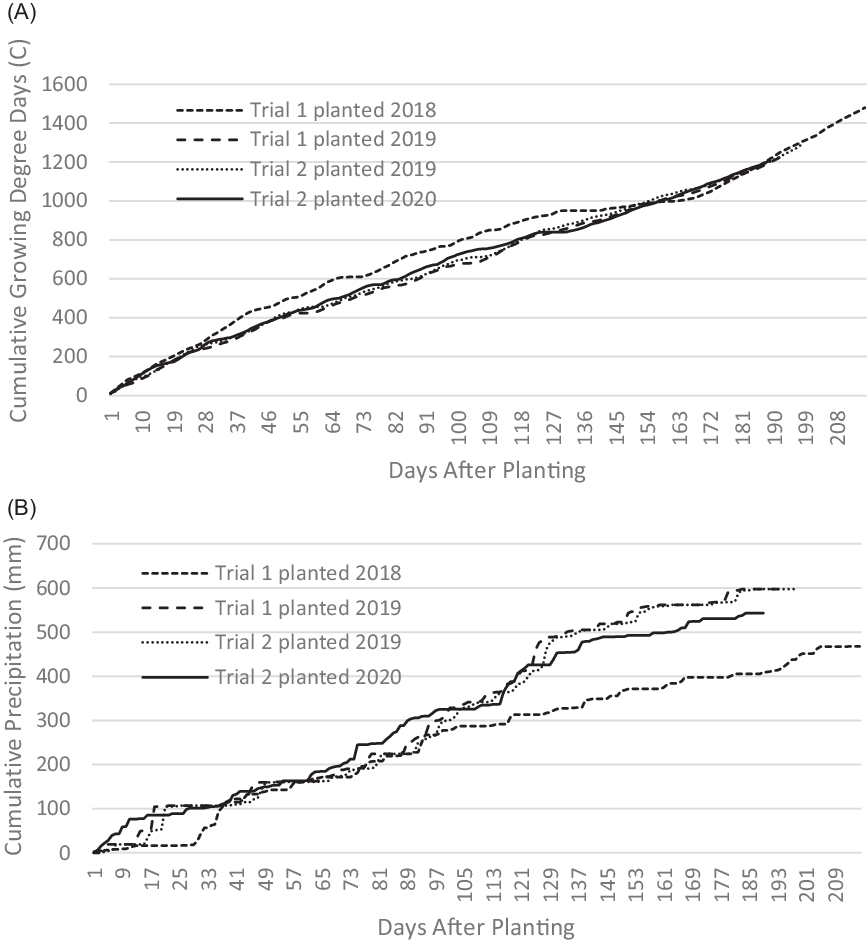
Two field trials were established at Washington State University’s Northwestern Washington Research and Extension Center in Mount Vernon, WA (48.440°N, 122.437°W, elevation 6 m). The soil is mapped as a Skagit silt loam, classified as fine-silty, mixed, superactive, nonacid, mesic Fluvaquentic Endoaquepts. Before trial establishment, soil pH was 6.4 and SOM content was 2.8%. Climate in the maritime Pacific Northwest is Mediterranean, with a mean air temperature of 7 C October through April and 15 C May through September, and mean precipitation of 61 cm October through April and 22 cm May through September (10-yr average; AgWeatherNet 2021). Temperature and precipitation data during the study were collected at a weather station located <500 m from the field. Growing degree-day values were determined by averaging the high and low temperatures for the day with a base temperature of 0 C (Figure 1).
Growing degree days (A) and cumulative precipitation (B) during the cover crop study in Mount Vernon, WA. Growing degree-day values were determined by averaging the high and low temperatures for the day. A base temperature of 0 C was used.

Treatment Description
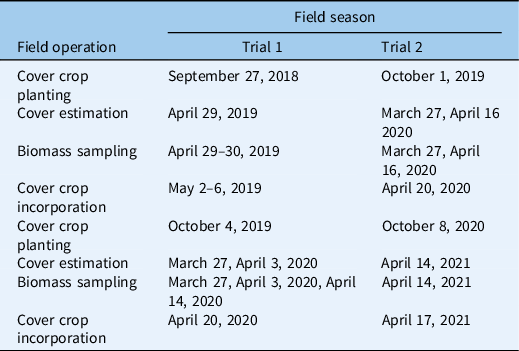
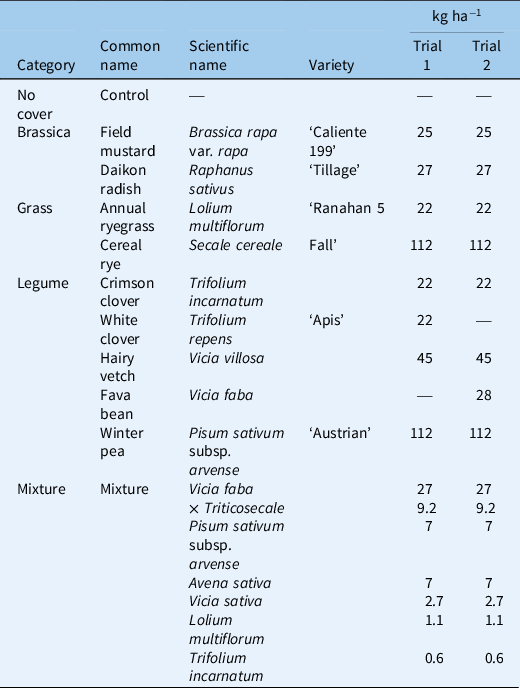
The first cover crop trial took place from 2018 to 2020 and was then repeated in an adjacent field from 2019 to 2021. Both fields had been in fallow for a year preceding the trial. Weed control was maintained through tillage with a duck foot–type chisel cultivator combined with tine harrows throughout the year as needed. Cover crops were planted in autumn after rototilling to 15 cm, and cover crops were terminated by using a rototiller to 15 cm in the spring followed by a potato crop (‘Chieftain’) (Table 1). After the potato crop harvest, cover crops were replanted and incorporated in the spring followed by a spinach crop grown for seed. Both trials were arranged as a randomized complete block design with 10 winter cover crop treatments and four replications per treatment. Treatment randomization was independent for each trial. A no-cover control was compared with nine winter cover crop treatments representing different plant types: brassicas, grasses, and legumes (Table 2). Treatments were chosen by the authors to represent typical or potential winter cover crops in western Washington. Cover crops were grown as single species, except for one mixture treatment that included 50% fava bean (Vicia faba L.), 17% triticale (× Triticosecale Wittm. ex A. Camus [Secale × Triticum]), 13% winter pea [Pisum sativum subsp. arvense (L.) Poir. ‘Austrian’], 12% oat (Avena sativa L.), 5% common vetch (Vicia sativa L.), 2% annual ryegrass (Lolium multiflorum Lam.), and 1% crimson clover (Trifolium incarnatum L.) by weight. Single species included field mustard (Brassica rapa L. var. rapa), daikon radish (Raphanus sativus L.), annual ryegrass, cereal rye (Secale cereale L.), crimson clover (Trifolium incarnatum L.), white clover (Trifolium repens L.), hairy vetch (Vicia villosa Roth), and winter pea. In the second trial, white clover was replaced by fava bean, as white clover did not establish well in the first trial. In the second year of the second trial, daikon radish was not planted, as a certified disease-free seed lot could not be obtained. See Table 2 for more details about cover crop treatments. Each plot was 15.2-m long and 4-m wide with 3-m-wide fallow buffers around each plot.
Chronology of cover crop measurements in experimental trials in Mount Vernon, WA, 2018–2021.

Cover crop treatments and seeding rates for autumn-planted experimental trials in Mount Vernon, WA, 2018–2020.

The dates of major field and sampling operations are listed in Table 1. Cover crops were planted 1.5-cm deep with a Nordston CLA 2.50-4.00 m drill seeder (Ramsomes, Sims & Jefferies Ltd., Ipswich, UK) in 15-cm-wide rows after rototilling 15-cm deep, which prepared the soil for planting and eliminated any weeds. To evaluate the effect of cover crop treatments on weed biomass and populations, no weed management was conducted while the cover crops were growing.
Cover Crop Cultivation and Measurements
Biomass and ground cover of the cover crop and weeds were measured after a winter of growth and just before mowing and incorporation. In the second year of the first trial and both years of the second trial, cover and biomass of daikon radish and field mustard treatments were measured 2 wk earlier, as these plots were flail mowed to remove flowers and buds, eliminating the potential for cross-pollination with surrounding brassica crops that were being grown for seed production. Measuring plant biomass is time-consuming and labor-intensive and requires equipment (plot frames, clippers, bags, drying ovens, scales, etc.). If biomass measures are to be determined by plant species, this task becomes almost unmanageable. An alternative to biomass measurements is visual estimation of percent cover, which requires some skill to become accurate and consistent (SS Seefeldt, personal observation).
Biomass samples were collected within three 625-cm2 subsamples per plot. All vegetation within the 25 by 25 cm quadrat was cut at the soil surface and separated into individual cover crop or weeds and put into paper bags. Biomass samples were oven-dried at 40 C to a constant weight and weighed. Cover crop and weed cover were estimated visually by species over the entire plot area. Cover was measured as a percent of the ground covered by each crop and each weed species. The estimation was conducted by the same person over the course of the study. After cover crop sampling was completed, plots were flail mowed, rototilled to 15-cm depth, chisel plowed, fertilized, and then rototilled before planting potatoes the first year of each trial and spinach the second year of each trial. Flail mowing was used to cut the cover crop biomass into smaller pieces that would make incorporation of the biomass into the soil with the rototiller possible.
Statistical Analyses
Statistical analyses were conducted in SAS (v. 9.4, SAS Institute, Cary, NC) using a mixed-factor ANOVA to assess how cover crop species, biomass, and cover affected weed biomass and cover. Assumptions of normality and homogeneity of variance were tested through Shapiro-Wilk and Levene’s tests and data were determined to be normally distributed. The statistical model included block, cover crop treatment, and year as factors and the interaction of treatment and year. Cover crop treatment, trial, and year were fixed effects. Block, biomass, and cover measurements were random effects. A second ANOVA was conducted to compare biomass and cover for each treatment in the first and second year of each trial. Weed cover was normalized as a percent of the control to better understand the impact of the cover crop on weed suppression and was then analyzed. For all analyses, when the treatment effect was significant (P < 0.05), treatment means were compared with least-squares means.
Results and Discussion
Cover Crop Biomass
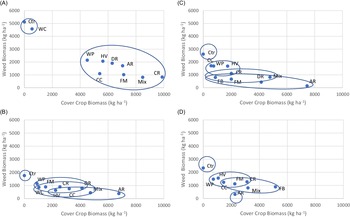
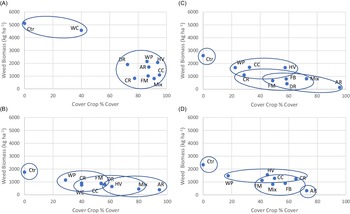
Because cover crop biomass accumulation and percent cover were different for each year and for each trial (P < 0.0001), analyses of weed biomass and cover were conducted separately for each year. Typically, rates of plant biomass and development are impacted by the weather, and various plant species will respond differently to those changes in the weather. Cover crop biomass differed by trial (P < 0.0001) and by year within a trial (P < 0.0001). In the first trial planted in 2018, with the exception of white clover, for which biomass was 1.9 times higher (P < 0.0001), and annual ryegrass, for which biomass remained constant (P = 0.86) from 2019 to 2020 sampling, cover crop biomass production was less in the first trial planted in 2019 (Figure 2A and B). In that harvest, the biomass values for crimson clover, winter pea, cereal rye, the mixture, daikon radish, field mustard, and hairy vetch were 60% (P < 0.0001), 20% (P = 0.0093), 74% (P < 0.0001), 44% (P = 0.0013), 34% (P = 0.018), 79% (P < 0.0001), and 60% (P < 0.0001), respectively, of the year before. In the second trial, cover crop biomass planted in 2019 was comparable to Trial 1 planted in 2019, as both trials were grown during the same time period (Figure 2B and C). In the second trial planted in 2020 compared with Trial 2 planted in 2019, biomass of annual ryegrass was reduced 70% (P < 0.0001); the mixture, cereal rye, field mustard, hairy vetch, and winter pea were the same (P = 0.09, 0.06, 0.55, 0.093, 0.87, respectively); whereas fava bean and crimson clover were 5.9 (P <0.0001) and 2.6 (P < 0.0001) times higher, respectively (Figure 2C and D).
Impact of cover crop species and biomass on weed biomass in western Washington: (A) Trial 1 planted in 2018, (B) Trial 1 planted in 2019, (C) Trial 2 planted in 2019, and (D) Trial 2 planted in 2020. Cover crop abbreviations: Ctr, control; AR, annual ryegrass; CC, crimson clover; CR, cereal rye; DR, daikon radish; FB, fava bean; FM, field mustard; HV, hairy vetch; Mix, mixture; WC, white clover; and WP, winter pea. Weed biomass within a circle is similar (P > 0.05).

Differences between years were likely due to planting date (Table 1), annual variation in cumulative growing degree days, and cumulative precipitation (Figure 1) or, in the case of cereal rye, due to heavy grazing of leaves by overwintering birds in 2019 and 2020 that removed at least 50% of the biomass (personal observation). Initial cumulative growing degree days were similar among the trials and years; however, the time the land was in cover crops differed, with the 2018 planting having 23, 18, and 27 more days of growing time, which equated to 1,480, 1,235, 1,290, and 1,209 growing degree days, respectively, for the first trial planted in 2018, both trials planted in 2019, and the second trial planted in 2020 (Figure 1A). This increase in growing degree days would translate into increased biomass if there were no other limiting factors. In 2019 and 2020, about 100 mm of precipitation occurred within 2 wk of planting, saturating the soil and resulting in standing water; whereas in 2018, it was more than 5 wk before that amount of precipitation fell (Figure 1B). These wetter weather conditions seemingly favored a cover crop (annual ryegrass; Figure 2) and two weed species (common chickweed [Stellaria media (L.) Vill.] and annual bluegrass (Poa annua L.) (Table 3). The excess precipitation in 2019 and 2020 created unusually wet soil conditions that generally reduced cover crop establishment and biomass compared with the autumn of 2018. These results reflect those of Luna et al. (Reference Luna, Sullivan, Garrett and Xue2020), who measured an 80% reduction in hairy vetch biomass and 69% reduction in overall biomass among all species (oat, common vetch, phacelia [Phacelia tanacetifolia Benth.]) in the wetter year of a 2-yr trial near Corvallis, OR.
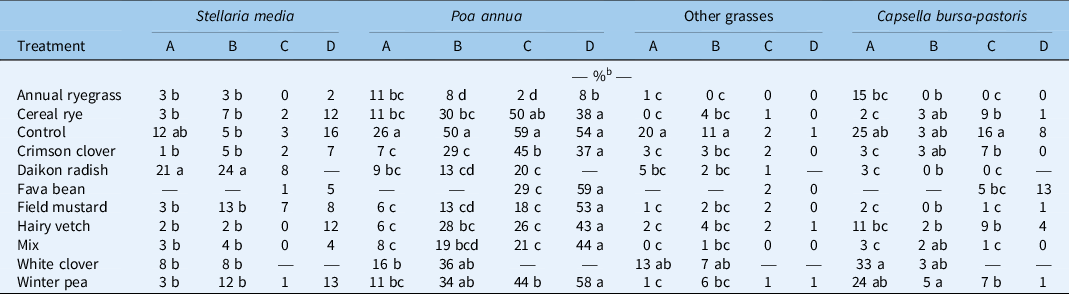
Visual estimate of Stellaria media, Poa annua, other grasses, and Capsella bursa-pastoris cover growing in cover crop experimental trials in Mount Vernon, WA. a

a A, Trial 1 planted in 2018; B, Trial 1 planted in 2019; C, Trial 2 planted in 2019; D, Trial 2 planted in 2020.
b Values within a column with the same letter are similar (P > 0.05).
Cover crop biomass in Trial 1 ranged from 550 to 9,880 and 910 to 6,770 kg ha−1 dry weight in 2018 and 2019 plantings, respectively, and in Trial 2 from 560 to 7,450 and 720 to 5,150 kg ha−1 dry weight in 2019 and 2020 plantings, respectively (Figure 2). These amounts of biomass are within the range of biomass measured in other studies in western Washington (Cogger et al. Reference Cogger, Bary, Myhre, Fortuna and Collins2016; Lawson et al. Reference Lawson, Fortuna, Cogger, Bary and Stubbs2013, Reference Lawson, Cogger, Bary and Fortuna2015; Wayman et al. Reference Wayman, Cogger, Benedict, Burke, Collins and Bary2015).
In Trial 1 planted in 2018, white clover biomass was less than that of all other cover crop treatments (P < 0.0001). There were differences among the other cover crops (Figure 2A), but legume crops generally produced the lowest biomass, grasses produced the most biomass, and the brassicas were intermediate. In Trial 1 planted in 2019 and Trial 2 planted in 2019, annual ryegrass produced the most biomass, with the mixture and daikon radish producing an intermediate amount (Figure 2B and C).
Weed Biomass
Weed biomass in the control treatment was greater (P = 0.0004) in Trial 1 planted in 2018 (5,120 kg ha−1) than in Trial 1 planted in 2019 (1,760 kg ha−1) (Figure 2A and B) and the same (P < 0.45) in Trial 2 planted in 2019 (2,610 kg ha−1) and 2020 (2,330 kg ha−1) (Figure 2C and D). Weed biomass in the control treatments was greater than the weed biomass in all of the cover crop treatments, with the exception of the white clover cover crop in Trial 1 planted in 2018, for which weed biomass was similar to the control (P = 0.61).
In the first trial, the weed biomass in each treatment remained the same in both years for annual ryegrass (P = 0.66), field mustard (P = 0.53), and crimson clover (P = 0.22), whereas biomass was less in Trial 1 planted in 2019 for cereal rye (P = 0.03), daikon radish (P = 0.014), hairy vetch (P = 0.018), the mixture (P = 0.01), white clover (P < 0.0001), and winter pea (P = 0.011) treatments than in the first year. In the second trial, weed biomass values in each treatment were greater from the first year compared with the second year for annual ryegrass (P = 0.02) and field mustard (P = 0.002), whereas biomass remained the same in both years for cereal rye (P = 0.34), fava bean (= 0.69), hairy vetch (P = 0.74), the mixture (P = 0.99), crimson clover (P = 0.19), and winter pea (P = 0.64) (Figure 2C and D).
Generally, as biomass of the cover crop increased, weed biomass decreased regardless of the growing conditions within any given year. This conclusion is consistent with many studies assessing weed suppression by cover crops and is expected given our knowledge of plant competition for resources (e.g., Baraibar et al. Reference Baraibar, Hunter, Schipanski, Hamilton and Mortensen2017; Hayden et al. Reference Hayden, Brainard, Henshaw and Ngouajio2012; Wayman et al. Reference Wayman, Cogger, Benedict, Burke, Collins and Bary2015). However, the responses of weed biomass to the biomass of a cover crop were not uniform, as shown in Figure 2. For example, in Figure 2A–D, annual ryegrass with 7,040, 6,770, 7,450, and 2,270 kg ha−1 kept weeds suppressed to 1,710, 390, 140, and 320 kg ha−1, respectively. There is an indication here that annual ryegrass grew quickly in the first two seasons (2018 and 2019 plantings) and was not impacted by the weather as much as most other plant species and that in the 2020 planting, when weather did seem to reduce annual ryegrass growth, it did not correspond to an equivalent response in weed biomass production. In the first 2 yr of the study, annual ryegrass was as good as or, in the case of Trial 2 planted in 2020, the best of the cover crop species at reducing weed biomass. The mixture was also a good cover crop choice, and both suppressed weed biomass equivalently to field mustard and daikon radish standards.
Impact of cover crop species and cover on weed biomass in western Washington: (A) Trial 1 planted in 2018, (B) Trial 1 planted in 2019, (C) Trial 2 planted in 2019, and (D) Trial 2 planted in 2020. Cover crop abbreviations are Ctr, control; AR, annual ryegrass; CC, crimson clover; CR, cereal rye; DR, daikon radish; FB, fava bean; FM, field mustard; HV, hairy vetch; Mix, mixture; WC, white clover; and WP, winter pea. Weed biomass within a circle is similar (P > 0.05).

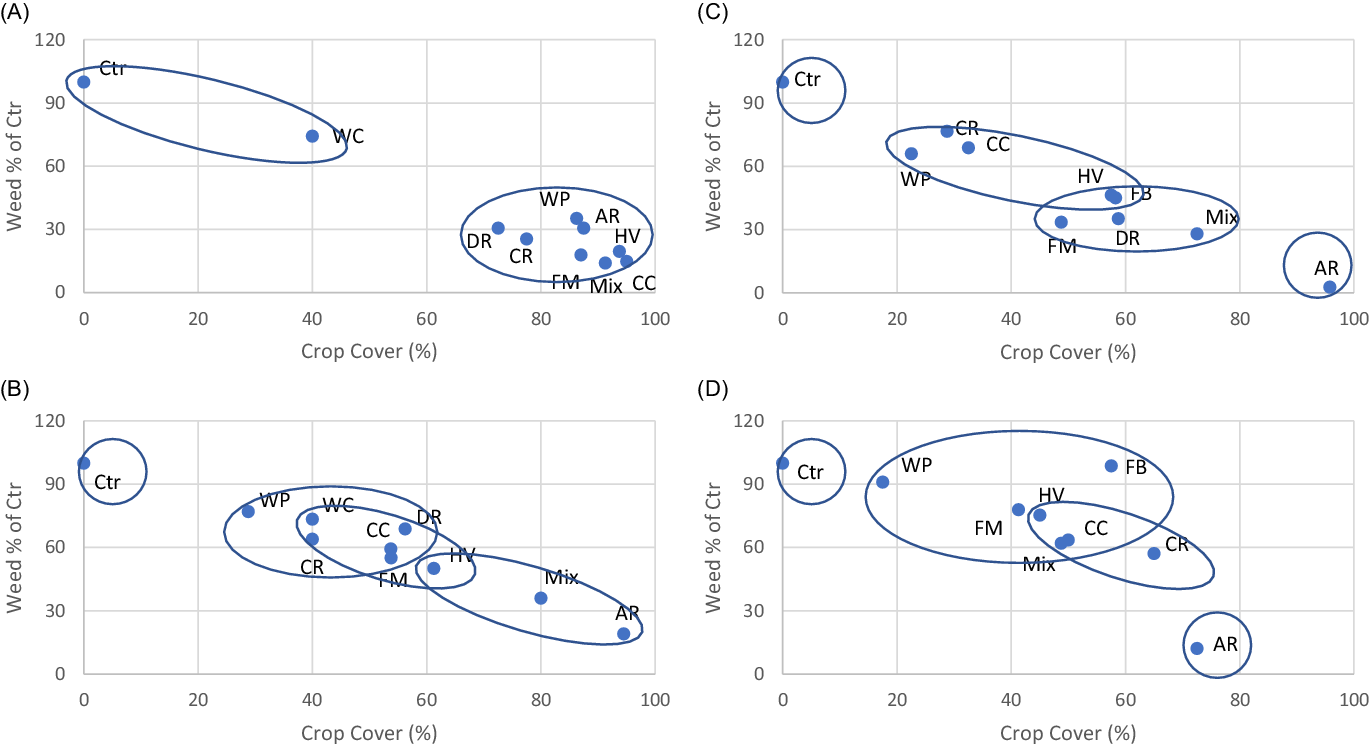
Impact of cover crop species and cover on normalized weed cover in western Washington: (A) Trial 1 planted in 2018, (B) Trial 1 planted in 2019, (C) Trial 2 planted in 2019, and (D) Trial 2 planted in 2020. Cover crop abbreviations are Ctr, control; AR, annual ryegrass; CC, crimson clover; CR, cereal rye; DR, daikon radish; FB, fava bean; FM, field mustard; HV, hairy vetch; Mix, mixture; WC, white clover; and WP, winter pea. Weed normalized cover within a circle is similar (P > 0.05).

Cover Crop Cover and Weed Biomass
Similar to the negative impact of greater cover crop biomass on weed biomass, greater cover crop cover reduced weed biomass (Figure 3). Analyses using cover crop cover instead of biomass generally changed the order of the response variables (compare Figure 2 with Figure 3), which affected how well these points were described using an exponential equation. For example, the r2 of Trial 1 planted in 2018 went from 0.95 to 0.76 (Figures 2A and 3A), whereas the r2 of Trial 1 planted in 2019 went from 0.75 to 0.95 (Figures 2B and 3B). However, in comparing means separation using cover crop biomass to cover crop cover among the various cover crop treatments, there were no changes (Figures 2 and 3). Although there are no studies comparing the correlation of cover crop biomass to cover crop cover on weed suppression, there are studies that indicate cover measurements can be used to estimate biomass (Abella Reference Abella2020; Axmanova et al. Reference Axmanová, Tický, Fajmonova, Hájková, Hettenbergerová, Li, Merunková, Nejezchlebová, Otýpková, Vymazalová and Zelený2012; Chieppa et al. Reference Chieppa, Power, Tissue and Nielsen2020; Prabhakara et al. Reference Prabhakara, Hively and McCarty2015). These correlations are especially useful with the increase of remote sensing technologies (Prabhakara et al. Reference Prabhakara, Hively and McCarty2015) and the need to reduce the cost of vegetation sampling in remote rangeland areas (Abella Reference Abella2020).
Generally, when comparing the biomass of grass species to herbaceous plants, grass species often have more dry weight than herbaceous species if both have the same fresh weight, which may result in a bias in dry weight data indicating that a grass species might not be as suppressive to weeds as a herbaceous plant (Axmanova et al. Reference Axmanová, Tický, Fajmonova, Hájková, Hettenbergerová, Li, Merunková, Nejezchlebová, Otýpková, Vymazalová and Zelený2012). Similarly, cover measures come with certain biases. For example, cover crop plants like field mustard that are more erect and have a reduced cover:biomass ratio compared with other weeds have a height advantage that could keep them above many plant species and legumes. Despite these biases, using either cover crop biomass or cover to correlate with impact on weed biomass resulted in similar results in this study.
Cover Crop Cover and Normalized Weed Cover
To try to control for differences in environmental conditions and biases associated with biomass and cover, weed cover response was normalized for each year, with the control weed cover being equal to 100% and analyzed against cover crop cover. The decrease in normalized weed cover was linear and negatively correlated to cover crop cover in each trial and year (Figure 4). The regression lines among trials and years were not different (data not shown). However, in comparing means separation using cover crop biomass or cover crop cover among the various cover crop treatments to normalized weed cover, there was only one change in in Trial 2 planted in 2019, where the weed biomass in the annual ryegrass treatment was less than the weed biomass of all other treatments (Figures 3C and 4C). We know of no cover-cropping studies that compare weed impacts using this methodology.
We conducted two trials over the course of 3 yr to determine the impacts of cover crops on weeds wherein we compared three methodologies; cover crop biomass versus weed biomass, cover crop cover versus weed biomass, and cover crop cover versus normalized weed cover. The results of all methodologies were similar in sorting the response of weeds to the various cover crops. The easiest and least expensive methodology was a comparison of respective cover with weed cover normalized each year with the no-cover control.
Weed Species Cover
Weed species in the study included S. media, P. annua, volunteer wheat (Triticum aestivum L.), perennial ryegrass (Lolium perenne L.), Shepherd’s-purse [Capsella bursa-pastoris (L.) Medik.], hedge mustard [Sisymbrium officinale (L.) Scop.], henbit (Lamium amplexicaule L.), pineappleweed (Matricaria discoidea DC.), dandelion (Taraxacum officinale F.H. Wigg.), common groundsel (Senecio vulgaris L.), clover (Trifolium spp.), common vetch, horsetail (Equisetum arvense L.), ivy leaf speedwell (Veronica hederifolia L.), and an unknown mustard (Brassica sp.). Only S. media, P. annua, other grasses, and C. bursa-pastoris had populations that were uniform enough throughout the study area to be analyzed; all the other weed species were patchy and/or of very low density.
Because field mustard and daikon radish were mowed 2 wk earlier in the second and third year of this study, V. hederifolia, L. amplexicaule, and C. bursa-pastoris had only started flowering, whereas the other weed species were producing seed. When the other treatments were terminated, all weed species were producing seed. Data do not indicate earlier termination of the brassica crops resulted in a decline of V. hederifolia, L. amplexicaule, and C. bursa-pastoris in the following year due to a reduced input into the seedbank. Veronica hederifolia, L. amplexicaule, and C. bursa-pastoris have long seedbank lives (Burnside et al. Reference Burnside, Wilson, Weisberg and Hubbard2006), so it is expected that there would be no measurable reductions in weed cover after 1 yr.
Stellaria media is a problematic winter annual weed and was common in this study (Table 3). In Trial 1 planted in 2018 and 2019, S. media cover was greater in the treatment planted to daikon radish than in any of the other treatments, excepting the control in 2018. There were no differences between years (P = 0.417). In Trial 2 planted in 2019 and 2020, there were no differences among treatments in both years. However, in Trial 2, there was greater S. media cover in the second year of the study compared with the first (P = 0.001). This increase in S. media cover could be a result of the reduced competition from the cover crops and/or a positive response of S. media to the weather in the winter and spring of 2020/2021. In the three studies that had daikon radish, S. media cover was consistently high, suggesting that daikon radish is not competitive against this weed species (Table 3).
Poa annua in western Washington often grows as a winter annual, especially in years when winter temperatures do not or only rarely get below freezing. Except for the annual ryegrass treatment, P. annua cover was less than half in Trial 1 planted in 2018 compared with the cover in each treatment in the subsequent years (P < 0.0001) (Table 3). During the winter of 2018/2019, there were 8 consecutive days from February 4 to 11 when the average temperature was below freezing, with 4 d when the low temperature was below −10 C. These temperatures may have resulted in the senescence of many P. annua plants. In Trial 1 planted in 2018, P. annua cover in the control was greater than all cover crop treatments (Table 3). Poa annua cover in the white clover treatment was greater than in the cover crop mixture, crimson clover, hairy vetch, and field mustard treatments. In the two trials planted in 2019 and Trial 2 planted in 2020, annual ryegrass treatments were consistently best at reducing P. annua cover. In Trial 1 planted in 2019, cover of other treatments was >10%, and there was more P. annua in this year compared with 2018 (P = 0.0038). Poa annua cover in both 2019 and 2020 of Trial 2 was high compared with annual ryegrass, and there was no difference between the years (P = 0.18). Until the last year of this study, it appeared that the brassica cover crops and the mixture were suppressing P. annua (Table 3). The reduced cover and biomass of those cover crop treatments, as a response to the wetter conditions, may account for the increase in P. annua cover during the 2019 and 2020 trials or it may be that P. annua was better able to grow in those weather conditions.
Cover of the other grasses was less than 10% in all treatments, except for the controls in the 2 yr of Trial 1 and in white clover in Trial 1 planted in 2018 (Table 3). In Trial 2, cover of other grasses ranged from 0% to 2%, with no differences among the treatments and years.
Cover of C. bursa-pastoris was 24% or higher in Trial 1 planted in 2018 in the control, white clover, and winter pea treatments and 3% or less in daikon radish, crimson clover, mix, cereal rye, and field mustard treatments (Table 3). In the second year of Trial 1, C. bursa-pastoris cover declined (P < 0.0001), probably due to less favorable environmental conditions for C. bursa-pastoris, given the steep decline in the control treatments in the second year of both trials. There were no differences among treatments in Trial 2 planted in 2020. Cover of C. bursa-pastoris, an erect plant with few leaves at the time of measurement, is perhaps not the best metric for estimating impact of cover crops. However, the colder and wetter weather of the last 2 yr of the study were probably the main factors reducing C. bursa-pastoris populations.
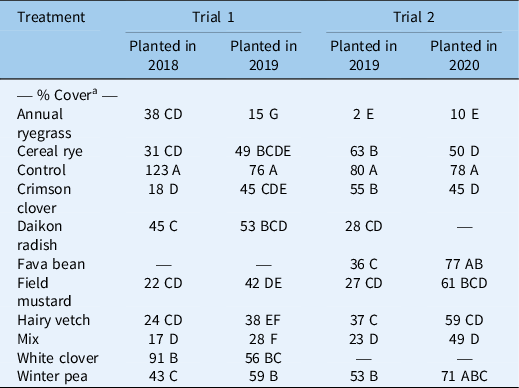
Overall weed cover in this study indicates the impact of different cover crop species on weed suppression. In all trials and years, the control treatment had the most weed cover, although in Trial 2 planted in 2020, fava bean and winter pea were no different from the control (Table 4). In Trial 1 planted in 2018, white clover suppressed weed cover about 25%, whereas other treatments suppressed weed cover from 65% to 87%, with daikon radish and winter pea being less suppressive than crimson clover and the mix, which had more than 80% weed suppression. In Trial 1 planted in 2019, overall weed cover was reduced in the control, white clover, and annual ryegrass treatments from the year before. All other weed covers were similar or increased in Trial 1 planted in 2019 compared with the 2018 planting. In Trial 1 planted in 2019, annual ryegrass reduced overall weed cover more than 80%. In Trial 2 planted in 2019, overall weed covers were similar to Trial 1 planted in 2019, with annual ryegrass again suppressing weed cover more than 80%. In Trial 2 planted in 2020, overall weed cover was similar to the previous year (P = 0.21). However, due to reduced cover crop competition and/or some weed species such as P. annua growing better in that season’s weather, total weed cover nearly doubled in treatments planted to fava bean, field mustard, hairy vetch, and the mix.
Visual estimate of total weed cover growing in cover crop experimental trials in Mount Vernon, WA.

a Values within a column with the same letter are similar (P > 0.05).
The species of cover crop is an important determiner of the amount of weed suppression that can be achieved (Osipitan et al. Reference Osipitan, Dille, Assefa, Radicetti, Ayeni and Knezevic2019). For example, grass cover crops will typically produce more biomass than broadleaf crops (Hayden et al. Reference Hayden, Brainard, Henshaw and Ngouajio2012; Osipitan et al. Reference Osipitan, Dille, Assefa, Radicetti, Ayeni and Knezevic2019; Ruffo and Bollero Reference Ruffo and Bollero2003). In this study, cover crops generally reduced weed biomass and cover compared with the no-cover control in both trials and years of our study, despite reduced cover crop biomass production in cover crops planted in 2019 and 2020. In particular, annual ryegrass produced a large quantity of biomass and effectively suppressed weeds during the study despite differences in weather conditions, making it a good cover crop candidate for western Washington if consistent weed suppression is the goal. A grass species cover crop such as annual ryegrass will tie up available nitrogen in the autumn, which is beneficial, as nitrogen is typically leached away in the wet cool winters in western Washington (Kuo et al. Reference Kuo, Sainju and Jellum1997; Odhiambo and Bomke Reference Odhiambo and Bomke2000, Reference Odhiambo and Bomke2001). In the first year of this study, cereal rye produced as much biomass as annual ryegrass (Figure 2); however, bird grazing by overwintering tundra swans (Cygnus columbianus Ord) and snow goose (Anser caerulescens L.) reduced cereal ryegrass biomass compared with annual ryegrass, making it a less desirable species to use in western Washington. Although annual ryegrass biomass is often greater, it is typically slower to release nitrogen back to the soil for the subsequent crop (Kuo et al. Reference Kuo, Sainju and Jellum1997; Odhiambo and Bomke Reference Odhiambo and Bomke2000, Reference Odhiambo and Bomke2001). Soil impacts of these cover crops on soil health and nutrients during the course of this study is ongoing, but the results of the first years of the two trials has been published (Una et al. Reference Una, McMoran, Seefeldt, Maupin, Myhre and Griffin-LaHue2022). Weed suppression by a cover crop is not viewed as the primary purpose for planting a cover crop, but it is possible that weed suppression will result in a reduction of the weed seedbank and weed populations. In this study, the winter annual weeds that were in the treatments generally flowered and produced seed before flail mowing occurred.
In trying to determine the best cover crops to use in western Washington to replace the brassica-based standard, the results of this weed-based study would indicate the planting of annual ryegrass or a mix that included annual ryegrass would result in consistent suppression of winter annual weeds and the best production of plant biomass. Because annual ryegrass is planted in the autumn and tilled under in early spring, seed production is prevented, which reduces the potential problem of weediness and herbicide resistance in this grass species. In the study, no volunteer annual ryegrass was identified. If the cover crop stand develops quickly, cereal rye, hairy vetch, and crimson clover would also result in >80% weed suppression (Figure 4A). The mixture in this study was consistently good in the first 2 yr of the study and matched the results of others comparing monocultures with mixtures (Baraibar et al. Reference Baraibar, Hunter, Schipanski, Hamilton and Mortensen2017; Smith et al. Reference Smith, Warren and Cordeau2020). An increased seeding rate of the mixture may enhance winter annual weed suppression, as increases in seeding rate will enhance biomass production and resultant weed suppression (Brennan et al. Reference Brennan, Boyd, Smith and Foster2009; Osipitan et al. Reference Osipitan, Dille, Assefa, Radicetti, Ayeni and Knezevic2019; Ryan et al. Reference Ryan, Curran, Grantham, Hunsberger, Mirsky, Nortensen, Nord and Wilson2011). If the primary goal of a cover crop is weed suppression, a mixture could be developed with different species that would have differential responses to weather. Given that some years would advantage some species over others, having some species that grow well when other do not based on the weather will result in consistent weed suppression, but only when the mixture is planted at a higher seeding rate. For example, Smith et al. (Reference Smith, Warren and Cordeau2020) reduced seeding rates of each species in the seed mix to plant the same number of plants proportionate to each monoculture species, with somewhat inconsistent results, whereas Baraibar et al. (Reference Baraibar, Hunter, Schipanski, Hamilton and Mortensen2017) used mixes that had more seed than in the monocultures, which resulted in more consistent weed suppression.
In western Washington, an alternative to brassica cover crops needs to be identified to prevent cross contamination, which results in early termination of the cover crop and disease spread from the brassica cover crop to the brassica crops grown for seed. The alternative cover crop would preferably produce more biomass and suppress weeds as well as the brassica cover crop. Over the 3 yr of this study, annual ryegrass and the mixture were as good as or better than the two brassica cover crops (field mustard and daikon radish) in biomass productivity and weed suppression. Future research should focus on improving the planting mix and determining a target seeding rate that will give consistently good weed suppression and biomass production.
Acknowledgments
Financial support for this research was provided by the Northwest Potato Research Consortium, Washington Potato Commission, and Puget Sound Seed Growers’ Association Northwest Agricultural Research Foundation. Additionally, this article is based upon work that is supported by the U.S. Department of Agriculture NIFA Hatch project 1014527. We would also like to thank Ron Dralle for his support on the WSU Mount Vernon NWREC research farm and Sylvi Thorstenson, Jessica Espy, and Noah Ray for their help with field and lab work. We would also like to thank the reviewers and associate editor for their suggestions and comments. No conflicts of interest have been declared.