Introduction
Psychotic experiences (PEs) are common (van Os and Linscott, Reference van Os and Linscott2012; van Os and Reininghaus, Reference van Os and Reininghaus2016), with an estimated lifetime prevalence of 7%, but transitory for most individuals (Linscott and van Os, Reference Linscott and van Os2013). However, PEs persist in around 20% and evolve into a psychotic disorder in about 7% (Hanssen et al., Reference Hanssen, Bak, Bijl, Vollebergh and van Os2005; Kaymaz et al., Reference Kaymaz, Drukker, Lieb, Wittchen, Werbeloff, Weiser, Lataster and van Os2012; Linscott and van Os, Reference Linscott and van Os2013; Calkins et al., Reference Calkins, Moore, Satterthwaite, Wolf, Turetsky, Roalf, Merikangas, Ruparel, Kohler, Gur and Gur2017). Recent findings also suggest that PEs frequently co-occur with symptoms of common mental disorders (i.e. depression, anxiety) (Varghese et al., Reference Varghese, Scott, Welham, Bor, Najman, O'Callaghan, Williams and McGrath2011; Wigman et al., Reference Wigman, van Nierop, Vollebergh, Lieb, Beesdo-Baum, Wittchen and van Os2012; Hartley et al., Reference Hartley, Barrowclough and Haddock2013; Fusar-Poli et al., Reference Fusar-Poli, Nelson, Valmaggia, Yung and McGuire2014; McGrath et al., Reference McGrath, Saha, Al-Hamzawi, Andrade, Benjet, Bromet, Browne, Caldas de Almeida, Chiu, Demyttenaere, Fayyad, Florescu, de Girolamo, Gureje, Haro, Ten Have, Hu, Kovess-Masfety, Lim, Navarro-Mateu, Sampson, Posada-Villa, Kendler and Kessler2016a; Bebbington and Freeman, Reference Bebbington and Freeman2017) and that the degree of co-occurrence may be influenced by exposure to socio-environmental risk (Guloksuz et al., Reference Guloksuz, van Nierop, Lieb, van Winkel, Wittchen and van Os2015; van Nierop et al., Reference van Nierop, Viechtbauer, Gunther, van Zelst, de Graaf, Ten Have, van Dorsselaer, Bak and van Winkel2015; Guloksuz et al., Reference Guloksuz, van Nierop, Bak, de Graaf, Ten Have, van Dorsselaer, Gunther, Lieb, van Winkel, Wittchen and van Os2016). In line with these findings, the polygenic risk score for schizophrenia has been shown to be associated with PEs and affective disturbances in relatives of individuals with psychotic disorder and comparison subjects (van Os et al., Reference van Os, van der Steen, Islam, Guloksuz, Rutten, Simons and Investigators2017) and developmental psychopathology in children and adolescents (Jones et al., Reference Jones, Stergiakouli, Tansey, Hubbard, Heron, Cannon, Holmans, Lewis, Linden, Jones, Davey Smith, O'Donovan, Owen, Walters and Zammit2016; Nivard et al., Reference Nivard, Gage, Hottenga, van Beijsterveldt, Abdellaoui, Bartels, Baselmans, Ligthart, Pourcain, Boomsma, Munafo and Middeldorp2017; Jansen et al., Reference Jansen, Polderman, Bolhuis, van der Ende, Jaddoe, Verhulst, White, Posthuma and Tiemeier2018). This was further supported by a considerable overlap of genetic liability and molecular neuropathology between psychotic disorders and affective disorders (Cross-Disorder Group of the Psychiatric Genomics, 2013a, b; Cheng et al., Reference Cheng, Chang, Chen, Tsai, Su, Li, Tsai, Hsu, Huang, Lin, Chen and Bai2017; Martin et al., Reference Martin, Taylor and Lichtenstein2018; Allardyce et al., Reference Allardyce, Leonenko, Hamshere, Pardinas, Forty, Knott, Gordon-Smith, Porteous, Haywood, Di Florio, Jones, McIntosh, Owen, Holmans, Walters, Craddock, Jones, O'Donovan and Escott-Price2018; Gandal et al., Reference Gandal, Haney, Parikshak, Leppa, Ramaswami, Hartl, Schork, Appadurai, Buil, Werge, Liu, White, Horvath and Geschwind2018; The Brainstorm Consortium, 2018). Thus, evidence suggests an extended and transdiagnostic psychosis phenotype with temporal and phenomenological continuity across developmental stages of psychotic and affective disorders and shared socio-environmental and genetic risk (van Os and Linscott, Reference van Os and Linscott2012; Reininghaus et al., Reference Reininghaus, Priebe and Bentall2013; Reininghaus et al., Reference Reininghaus, Bohnke, Hosang, Farmer, Burns, McGuffin and Bentall2016a; van Os and Reininghaus, Reference van Os and Reininghaus2016; Shevlin et al., Reference Shevlin, McElroy, Bentall, Reininghaus and Murphy2017).
Contemporary models of psychosis (Garety et al., Reference Garety, Kuipers, Fowler, Freeman and Bebbington2001; van Os et al., Reference van Os, Kenis and Rutten2010; Howes and Murray, Reference Howes and Murray2014; Howes et al., Reference Howes, McCutcheon, Owen and Murray2017) propose various risk factors and mechanisms involved in illness onset, including cognitive biases and deficits, but whether these factors are also associated with transdiagnostic phenotypes remains largely under-researched. The jumping to conclusions (JTC) reasoning bias describes the tendency to make hasty decisions based on insufficient information (Dudley et al., Reference Dudley, Taylor, Wickham and Hutton2016) and has been consistently found to occur more often in individuals with subclinical and clinical psychosis (Fine et al., Reference Fine, Gardner, Craigie and Gold2007; Ross et al., Reference Ross, McKay, Coltheart and Langdon2015; Dudley et al., Reference Dudley, Taylor, Wickham and Hutton2016; So et al., Reference So, Siu, Wong, Chan and Garety2016). Based on cognitive models (Garety and Freeman, Reference Garety and Freeman1999; Freeman, Reference Freeman2016), it has been suggested that the JTC bias is particularly involved in the formation and maintenance of delusional ideations (Fine et al., Reference Fine, Gardner, Craigie and Gold2007; Freeman and Garety, Reference Freeman and Garety2014), with some recent evidence supporting this assumption (Dudley et al., Reference Dudley, Taylor, Wickham and Hutton2016). Similarly, cognitive deficits have been demonstrated across severity levels of psychosis, which is considered a core finding supporting the neurodevelopmental hypothesis (Weinberger, Reference Weinberger1986; Murray and Lewis, Reference Murray and Lewis1988), with several studies focusing on decreased working memory performance (WMP) as a proxy for cognitive deficits (Conklin et al., Reference Conklin, Curtis, Katsanis and Iacono2000; Wood et al., Reference Wood, Pantelis, Proffitt, Phillips, Stuart, Buchanan, Mahony, Brewer, Smith and McGorry2003; Brewer et al., Reference Brewer, Francey, Wood, Jackson, Pantelis, Phillips, Yung, Anderson and McGorry2005; Lee and Park, Reference Lee and Park2005; Forbes et al., Reference Forbes, Carrick, McIntosh and Lawrie2009; White et al., Reference White, Schmidt and Karatekin2010; Barch and Sheffield, Reference Barch and Sheffield2014; Mollon et al., Reference Mollon, David, Morgan, Frissa, Glahn, Pilecka, Hatch, Hotopf and Reichenberg2016; Mollon and Reichenberg, Reference Mollon and Reichenberg2018; Mollon et al., Reference Mollon, David, Zammit, Lewis and Reichenberg2018).
In contrast, there have been inconsistent findings for the presence of both the JTC bias and decreased WMP in non-psychotic disorders. A recent meta-analysis found some evidence that the JTC bias was more likely in individuals with non-psychotic disorders (So et al., Reference So, Siu, Wong, Chan and Garety2016). However, effect sizes varied considerably across studies and those of low quality reported the strongest effects. After outliers were excluded from analyses, no effects for depression, anxiety disorders and obsessive–compulsive disorders were found. Similarly, studies investigating decreased WMP in those with non-psychotic disorders are mixed and the evidence differs largely across domains of psychopathology. There is evidence for decreased WMP in individuals with subclinical and clinical anxiety (Moran, Reference Moran2016), while findings for depression and mania appear to be more heterogeneous with some studies reporting a lowered (McGrath et al., Reference McGrath, Chapple and Wright2001; Rose and Ebmeier, Reference Rose and Ebmeier2006), and others a similar WMP (Larson et al., Reference Larson, Shear, Krikorian, Welge and Strakowski2005; Walsh et al., Reference Walsh, Williams, Brammer, Bullmore, Kim, Suckling, Mitterschiffthaler, Cleare, Pich, Mehta and Fu2007; Scult et al., Reference Scult, Paulli, Mazure, Moffitt, Hariri and Strauman2017) compared to controls.
Taken together, there is robust evidence that JTC bias and decreased WMP are associated with psychosis, but attempts to show similar associations in individuals with affective disturbances have led to mixed results. As there is evidence that affective disturbances and PEs frequently co-occur in general population and clinical samples, an important next step is to investigate whether the JTC bias and decreased WMP contribute to a transdiagnostic phenotype. It is reasonable to assume that risk factors and mechanisms proposed in contemporary models of psychosis (Garety et al., Reference Garety, Kuipers, Fowler, Freeman and Bebbington2001; van Os et al., Reference van Os, Kenis and Rutten2010; Howes and Murray, Reference Howes and Murray2014; Howes et al., Reference Howes, McCutcheon, Owen and Murray2017) extend to individuals with affective disturbances if they are accompanied by PEs, which may give rise to generalisability and specificity of recent findings.
Aims and hypotheses
The aim of the current study was to investigate associations of the JTC bias and decreased WMP with co-occurring affective disturbances and PEs in the general population. More specifically, we tested the following hypotheses: First, compared to individuals with neither affective disturbances nor PEs (group 1), the JTC bias is more likely to occur in those with sole presence of PEs (group 3) and in those with co-occurring affective disturbances and PEs [further stratified into moderate psychosis = 1–2 PEs (group 4); and high psychosis = 3 or more PEs or psychosis-related help-seeking behaviour (group 5)], but not in those with sole presence of affective disturbances (group 2). Second, decreased WMP is associated with an increased likelihood of reporting sole presence of affective disturbances (group 2), sole presence of PEs (group 3) and co-occurring affective disturbances and PEs (group 4 and 5). Third, there is evidence for a dose–response relationship, in which the JTC bias and decreased WMP are more likely to occur in those with affective disturbances as the level of PEs increases or individuals report psychosis-related help-seeking behaviour (comparing group 5 and 4).
Materials and method
Sample
Data were derived from the second Netherlands Mental Health Survey and Incidence Study (NEMESIS-2), a three-wave psychiatric epidemiological cohort study conducted to estimate the prevalence, incidence and course of psychiatric disorders in the Dutch general population. Based on a multistage, stratified random sampling of households, all respondents were interviewed at home with the Composite International Diagnostic Interview (CIDI) version 3.0 (Alonso et al., Reference Alonso, Angermeyer, Bernert, Bruffaerts, Brugha, Bryson, de Girolamo, Graaf, Demyttenaere, Gasquet, Haro, Katz, Kessler, Kovess, Lepine, Ormel, Polidori, Russo, Vilagut, Almansa, Arbabzadeh-Bouchez, Autonell, Bernal, Buist-Bouwman, Codony, Domingo-Salvany, Ferrer, Joo, Martinez-Alonso, Matschinger, Mazzi, Morgan, Morosini, Palacin, Romera, Taub and Vollebergh2004; Kessler and Ustun, Reference Kessler and Ustun2004; de Graaf, Reference de Graaf, Ormel, ten Have, Burger and Buist-Bouwman2008) and additional questionnaires. Inclusion criteria were: aged 18–65 years. Exclusion criteria were: insufficient command of the Dutch language. The first wave (T0) was performed from November 2007 to July 2009, with a total of 6646 persons interviewed (response rate 65.1%). This sample was representative for the Dutch general population although younger subjects were slightly under-represented (de Graaf et al., Reference de Graaf, Ten Have and van Dorsselaer2010). For the second wave (T1), performed from November 2010 to June 2012, all T0 respondents were approached. Of these, 5303 individuals were interviewed again (response rate of 80.4% with those deceased excluded). The attrition rate was not associated with 12-month prevalence of psychopathology at baseline (de Graaf et al., Reference de Graaf, van Dorsselaer, Tuithof and ten Have2013). From November 2013 to June 2015, the third wave (T2) was completed with 4618 persons who were interviewed a third time (response rate of 87.8% from T1 with those deceased excluded). Again, attrition rate was not associated with the 12-month prevalence of mental disorders at T1, except for alcohol and drug dependence and bipolar disorder (de Graaf, Reference de Graaf, van Dorsselaer, Tuithof and ten Have2015). The time between baseline and second follow-up was, on average, 6 years and 6 days. The study was approved by the Medical Ethics Review Committee for Institutions of Mental Health Care. After having been informed about the study aims, respondents provided written informed consent at each wave. The face-to-face interviews were carried out by trained interviewers, who were not clinicians, using a laptop computer. A more detailed description of the methodology is presented elsewhere (de Graaf et al., Reference de Graaf, Ten Have and van Dorsselaer2010; de Graaf et al., Reference de Graaf, ten Have, van Gool and van Dorsselaer2012).
Data collection
Socio-demographic characteristics and socio-environmental factors
Data on age, sex, level of education, urbanicity, ethnic minority status, cannabis use and childhood trauma were collected using a socio-demographic schedule, trauma questionnaire and the CIDI.
Working memory performance
At the second wave (T1), participants were asked to complete the digit-span task to assess WMP. The procedure and items were based on the Wechsler Adult Intelligence Scale (WAIS-III) (Wechsler, Reference Wechsler1997; Reference Wechsler2000). The digit-span task was divided into two parts, consisting of a forward (six items) and backward (six items) task condition. Both parts were separated by three unrelated interview sections. For each item, participants were asked to repeat two different sequences of digits, spanning from four to nine digits for the forward and three to eight digits for the backward condition. If at least one out of two sequences was repeated correctly, the interviewer moved to the next item. For each completed item, one digit was added to increase difficulty. Scores were based on the number of correct answers and up to four (forward condition) and two (backward condition) extra points. For study purposes, the sum score was computed and transposed to T0 and T2 as performance at T1 was considered to represent individuals’ trait cognitive ability.
JTC bias
As part of the third wave (T2), the beads task was completed to assess the presence or absence of the JTC bias. The beads task (Phillips and Edwards, Reference Phillips and Edwards1966) is an experimental task designed to measure individuals’ reasoning style under ambiguous conditions. Participants were shown two jars containing red- and blue-coloured beads in opposite ratios. In this study, the more difficult version of the beads task with a colour ratio of 60:40 beads was used to increase sensitivity to detect JTC bias in a general population sample. The jars as well as all instructions were presented on a computer screen. After both jars were shown and a training session was completed, participants were instructed that all beads are drawn consecutively from one jar and, once presented, are returned to the same jar. After each draw, participants were asked whether they want to make a decision from which jar the beads were drawn or if they would like to see another bead, with the possibility to see up to 10 beads before a decision had to be made. The order of presented beads was predetermined and the dominant colour presented in the training session selected at random. Again, the number of beads drawn at T2 was considered to represent individuals’ reasoning style and the values were transposed to T0 and T1. Consistent with previous studies (Dudley et al., Reference Dudley, Taylor, Wickham and Hutton2016), JTC bias was defined as making a decision based on two or fewer beads (So et al., Reference So, Siu, Wong, Chan and Garety2016).
Affective disturbances
Depression, anxiety and mania were measured at three time points using core items of the CIDI version 3.0. This measure uses a true–false response format asking for the prevalence of symptoms for various mental disorders, including depressive episode, social phobia, generalised anxiety disorder and manic episode (e.g. feeling fearful, depressed, experiences of a panic attack). All items are presented in Supplementary Table S1.
Psychotic experiences
Studies concluded that earlier versions of the CIDI are not reliable and valid measures for psychotic disorders (Andrews and Peters, Reference Andrews and Peters1998). Thus, a psychosis measure was constructed based on the section of psychotic symptoms in CIDI 1.1. The instrument consisted of 20 items asking for the lifetime prevalence of PEs (i.e. 15 delusional and five hallucinatory experiences). In case PEs were endorsed, participants were asked to state, on a four-point Likert scale, the frequency, distress and the impact of PEs on their daily life, including whether they had sought help for these experiences. Sum scores were calculated by adding reported PEs. More details are described elsewhere (van Nierop et al., Reference van Nierop, Viechtbauer, Gunther, van Zelst, de Graaf, Ten Have, van Dorsselaer, Bak and van Winkel2015) and used items are reported in Supplementary Table S1.
Grouping absence, presence and co-occurrence of affective disturbances and PEs
Individuals were grouped based on answers given on measures assessing depression, anxiety, mania and PEs. Five groups were generated representing the absence, sole presence or co-occurrence of affective disturbances and PEs: neither affective disturbances nor PEs (group 1); sole presence of affective disturbances (group 2); sole presence of PEs (group 3); co-occurring affective disturbances and PEs [further stratified into moderate psychosis = 1–2 PEs (group 4); and high psychosis = 3 or more PEs or psychosis-related help-seeking behaviour (group 5)].
Statistical analysis
All analyses were carried out using STATA version 13.1 (StataCorp., 2013). As the digit-span task and beads task were completed at T1 and T2, respectively, analyses were performed on samples with differing numbers of observations. First, socio-demographic characteristics (i.e. age, sex, education level) and socio-environmental factors (i.e. urbanicity, ethnic minority status, cannabis use and childhood trauma) were compared across groups using linear regression and χ2 tests as appropriate. Second, to investigate associations of JTC bias (binary variable) and WMP (continuous variable) with co-occurring affective disturbances and PEs, the MLOGIT command was used to fit multinomial logistic regression models. The CLUSTER option was used to compute cluster-robust standard errors to correct for clustering of data (i.e. up to three observations for each individual). Sum scores of the digit-span task were recoded that higher scores represent lower WMP and standardised (mean = 0, s.d. = 1). Lastly, relative risk ratios (RRRs) for group status by JTC bias and decreased WMP were compared using the Wald test. All models were adjusted for various a priori defined potential confounders. First, we adjusted for socio-demographic characteristics and socio-environmental factors and, in models with JTC bias as the independent variable, we also adjusted for WMP.
Results
Basic sample characteristics
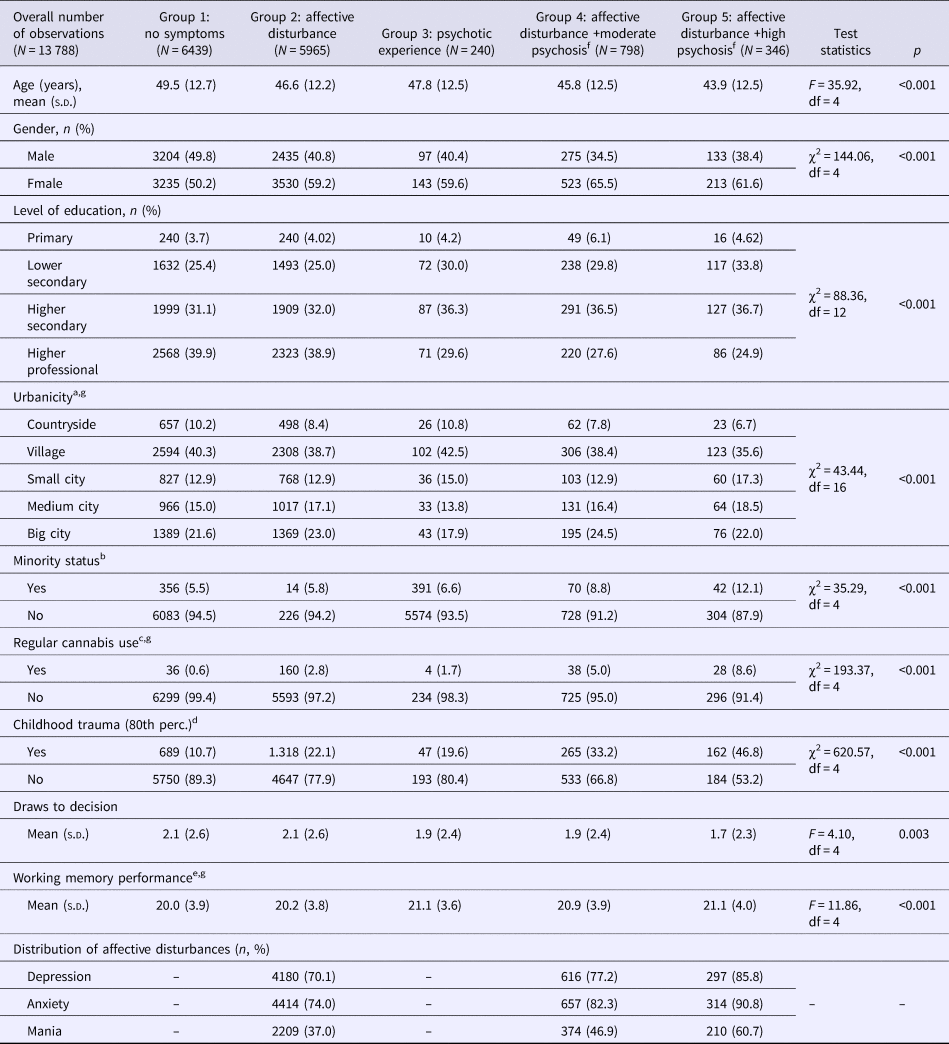
In total, the sample consisted of 4618 participants at the third wave. Of these, 4596 completed the beads task (99.5%) with 13 788 observations for all three time points. There were no differences between individuals who completed the beads task and those who did not with regard to socio-demographic characteristics and other variables. The sample characteristics are presented in Table 1. Overall, individuals who reported affective disturbances and/or PEs were more likely to be younger, female, less educated, more often from an ethnic minority group, to have used cannabis regularly at least once during lifetime, and to have experienced childhood trauma before the age of 16. There were considerable differences between those with sole presence of affective disturbances and co-occurring affective disturbances and PEs in terms of most sample characteristics and socio-environmental risk factors. Basic characteristics of the sample of individuals who completed the digit-span task at T1 are presented in Supplementary Table S2.
Basic characteristics of groups derived from 4596 participants

Data with an overall number of 13 788 observations from surveys of 4596 participants who completed all assessments at all three time points (T0, T1, T2), including the beads task.
a Defined as exposure to urban environment until the age of 16 years, classified based on Dutch classification data of population density: countryside (large distance to amenities), village (<25.000 inhabitants), small city (25 000–50 000 inhabitants), medium city (50 001–100 000 inhabitants) and larger cities (>100 000 inhabitants).
b Born in any other country than The Netherlands.
c Regular cannabis use was based on the section of Illegal Substance Use from CIDI 3.0. A pattern of use of once per week or more during lifetime (T0) or previous 3 years (T1, T2) were used as the cut-off score.
d Based on sum scores of items asking for five types of childhood trauma before the age of 16: two incidents or more of emotional neglect (i.e. not listened to, ignored or unsupported), physical abuse (i.e. kicked, hit, bitten or hurt with object or hot water), psychological abuse (i.e. yelled at, insulted, unjustly punished, treated, threatened, belittled or blackmailed) or one incidence or more of sexual abuse (i.e. any unwanted sexual experience) and peer victimisation (i.e. bullying). The childhood trauma sum score was dichotomised at the 80th percentile.
e Sum scores of the digit-span task (range 6–30) were recoded, such as high numbers indicate lower working memory performance and vice versa.
f Defined as: moderate psychosis, 1–2 psychotic experiences; high psychosis, 3 or more psychotic experiences or psychosis-related help-seeking behaviour.
g Number of missing values: urbanicity: 12 observations; cannabis use: 375 observations; working memory performance (digit-span task): 207 observations.
JTC bias and co-occurring affective disturbances and PEs
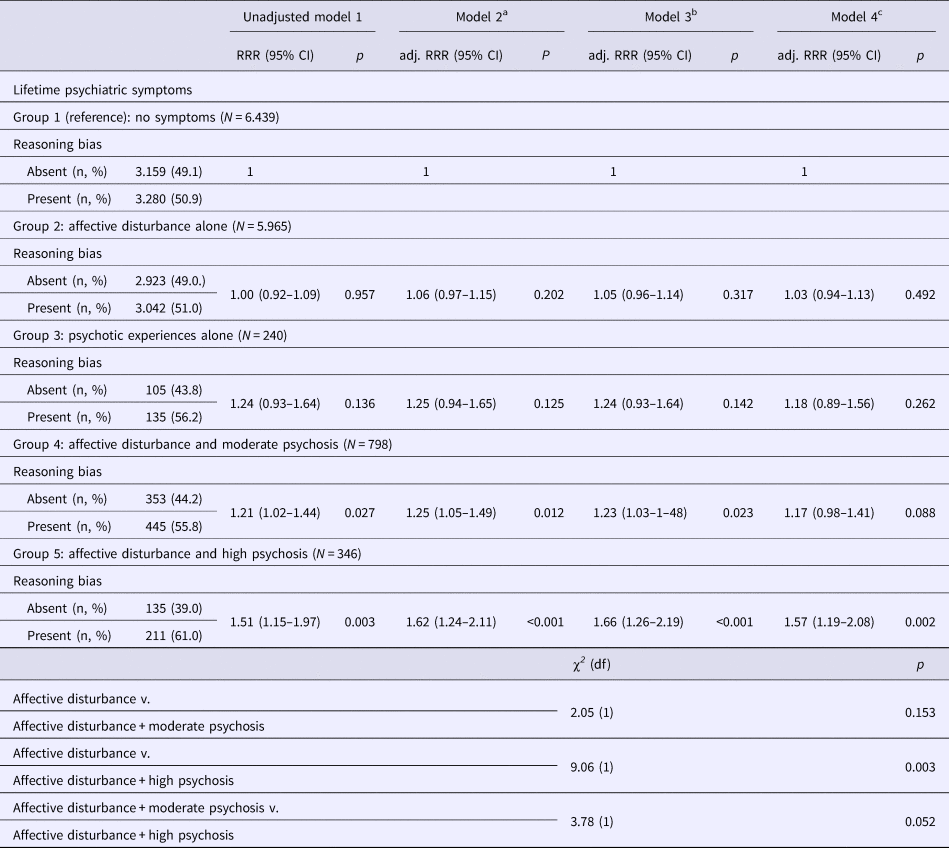
As shown in Table 2 and Fig. 1, there was evidence that, compared to individuals with neither affective disturbances nor PEs, JTC bias was more likely to be present in those with co-occurring affective disturbances and PEs (moderate psychosis: RRR = 1.23, 95% CI 1.03–1.48, p = 0.023; high psychosis: RRR = 1.66, 95% CI 1.26–2.19, p < 0.001), but not in those with sole presence of affective disturbances (RRR = 1.05, 95% CI 0.96–1.14, p = 0.317) and sole presence of PEs (RRR = 1.24, 95% CI 0.93–1.64, p = 0.142) after adjustment for age, gender, education level, urbanicity, ethnic minority status, cannabis use and childhood trauma. When we additionally adjusted for WMP, the associations were attenuated (moderate psychosis: RRR = 1.17, 95% CI 0.98–1.41, p = 0.088; high psychosis: RRR = 1.57, 95% CI 1.19–2.08, p = 0.002). When we compared associations across groups, we found no significant differences in group 2 v. group 4 (p = 0.153), whereas significant differences were apparent in the comparison of group 2 v. group 5 (p = 0.003) and group 4 v. group 5 (p = 0.052). Model fit statistics are provided in Supplementary Table S3.
Results on the association of JTC reasoning bias and decreased WMP with all groups. Note: RRRs and 95% CI are shown; RRRs, relative risk ratios; CI, confidence interval; JTC bias, jumping to conclusions reasoning bias; WMP, working memory performance; *p < 0.05, **p < 0.001; aadjusted for age, gender, level of education, urbanicity, minority status, cannabis use and childhood trauma, and in models with JTC as independent variable also working memory performance bcompared to individuals with neither affective disturbances nor psychotic experiences (reference group RRR = 1) cdefined as: moderate psychosis, 1–2 psychotic experiences; high psychosis, 3 or more psychotic experiences or psychosis-related help-seeking behaviour.

Results on the association of JTC reasoning bias with all groups and test for differences across groups

df, degrees of freedom; CI, confidence interval; RRR, relative risk ratio.
a Adjusted for socio-demographics (i.e. age, gender, level of education).
b Adjusted for socio-demographics and socio-environmental risk factors (i.e. urbanicity, minority status, cannabis use and childhood trauma).
c Adjusted for socio-demographics, socio-environmental risk factors and working memory performance.
WMP and co-occurring affective disturbances and PEs
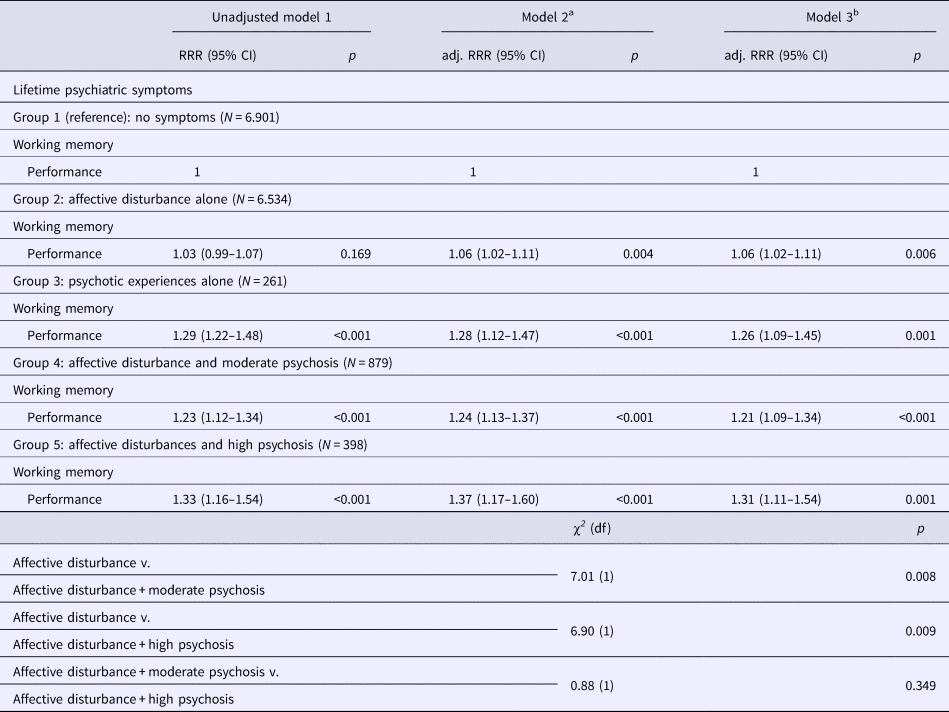
As shown in Table 3 and Fig. 1, we found evidence that decreased WMP was more likely in individuals with sole presence of, or co-occurring, affective disturbances and PEs (affective disturbances: RRR = 1.06, 95% CI 1.02–1.11, p = 0.006; PEs: RRR = 1.26, 95% CI 1.09–1.45, p = 0.001; co-occurring affective disturbances and moderate psychosis: RRR = 1.21, 95% CI 1.09–1.34, p < 0.001; co-occurring affective disturbances and high psychosis: RRR = 1.31, 95% CI 1.11–1.54, p < 0.001) compared to those with neither affective disturbances nor PEs, after adjusting for socio-demographic characteristics and socio-environmental factors. When we compared associations across groups, we found significant differences in group 2 v. group 4 (p = 0.008) and group 2 v. group 5 (p = 0.009), but not group 4 v. group 5 (p = 0.349). Model fit statistics are provided in Supplementary Table S3.
Results on the association of working memory performance with all groups and test for differences across groups

df, degrees of freedom; CI, confidence interval; RRR, relative risk ratio.
a Adjusted for socio-demographics (i.e. age, gender, level of education).
b Adjusted for socio-demographics and socio-environmental risk factors (i.e. urbanicity, minority status, cannabis use and childhood trauma).
Discussion
Main findings
This study investigated whether the JTC bias and decreased WMP are associated with a transdiagnostic phenotype of co-occurring affective disturbances and PEs in the general population. First, we found that the JTC bias was more likely to be present in individuals with co-occurring affective disturbances and PEs, but not in those with sole presence of affective disturbances or PEs. There was some attenuation of this association when we additionally adjusted for WMP. Second, decreased WMP was associated with an increased likelihood of reporting sole presence of and co-occurring affective disturbances and PEs. Third, there was some evidence of a dose–response relationship, as JTC bias and decreased WMP was progressively more likely to be present in individuals with affective disturbances as the level of PEs increased or psychosis-related help-seeking behaviour was reported, though some inconsistencies were observed for comparisons across groups.
Methodological considerations
The strength of the current study was that analyses were based on a large population-based cohort study. However, several methodological considerations should be taken into account before interpreting our findings. First, the number of individuals with JTC bias was greater than that reported in other studies (Dudley et al., Reference Dudley, Taylor, Wickham and Hutton2016). We assume that assessment length may have resulted in fatigue effects and decreased motivation, leading to hastier decisions independent from individuals’ reasoning style. However, this does not prevent us from inferring valuable insights given robust RRRs found in the current study. Second, the digit-span and beads task were assessed once during the study period and scores were considered to reflect trait cognitive ability and reasoning style. Ideally, tasks would have been completed at all three time points to calculate more robust estimates. However, assessment burden associated with the inclusion of both tasks at all three assessments was considered to be high and potential benefits comparably low, given reports of low variability for both the JTC bias (So et al., Reference So, Freeman, Dunn, Kapur, Kuipers, Bebbington, Fowler and Garety2012; Catalan et al., Reference Catalan, Simons, Bustamante, Olazabal, Ruiz, Gonzalez de Artaza, Penas, Maruottolo, Gonzalez, van Os and Gonzalez-Torres2015) and WMP (Eriksson et al., Reference Eriksson, Vogel, Lansner, Bergstrom and Nyberg2015) over time. Third, cross-sectional modelling of data derived from three waves did not allow for investigating temporality of JTC bias and decreased WMP with psychopathological outcomes. Future studies may employ longitudinal pathway analyses to further investigate the temporality of reported findings. Fourth, the transdiagnostic phenotypes of co-occurring affective disturbances and PEs were computed based on an observational and not a data-driven approach.
Comparison with previous research
We found that JTC bias is more prevalent in individuals who reported affective disturbances and PEs at least once during their lifetime compared to those who experienced neither affective disturbances nor PEs. This adds to recent findings of robust associations between JTC bias and psychosis (Fine et al., Reference Fine, Gardner, Craigie and Gold2007; Ross et al., Reference Ross, McKay, Coltheart and Langdon2015; Dudley et al., Reference Dudley, Taylor, Wickham and Hutton2016; So et al., Reference So, Siu, Wong, Chan and Garety2016) and suggests, for the first time, that JTC bias contributes to a transdiagnostic phenotype in the general population. This association, however, was found to be attenuated when we additionally adjusted for WMP, indicating that cognitive deficits may mediate, to a degree, the manifestation of reasoning style and its impact on mental health. This finding is in line with studies which have demonstrated altered neuropsychological functioning to be associated with JTC bias (Garety et al., Reference Garety, Joyce, Jolley, Emsley, Waller, Kuipers, Bebbington, Fowler, Dunn and Freeman2013; Falcone et al., Reference Falcone, Murray, Wiffen, O'Connor, Russo, Kolliakou, Stilo, Taylor, Gardner-Sood, Paparelli, Jichi, Di Forti, David, Freeman and Jolley2015; Gonzalez et al., Reference Gonzalez, Lopez-Carrilero, Barrigon, Grasa, Barajas, Pousa, Gonzalez-Higueras, Ruiz-Delgado, Cid, Lorente-Rovira, Pelaez and Ochoa2018). It has been suggested (Barch and Sheffield, Reference Barch and Sheffield2014; Freeman et al., Reference Freeman, Startup, Dunn, Cernis, Wingham, Pugh, Cordwell, Mander and Kingdon2014) that JTC bias may partly be explained by difficulties in keeping information in mind but more studies are warranted to further investigate the role of cognitive deficits as an alternative explanation of the association between JTC bias, affective disturbances and PEs. Echoing recent findings (So et al., Reference So, Siu, Wong, Chan and Garety2016), there was no evidence that the JTC bias was more likely to be present in individuals who reported lifetime affective disturbances but not PEs.
When looking at differences across groups, we found some evidence for a dose–response relationship as the JTC bias was more likely to occur in individuals with affective disturbances as the number of PEs increased or psychosis-related help-seeking behaviour was reported. While these results suggest some degree of specificity of JTC bias for psychosis (So et al., Reference So, Siu, Wong, Chan and Garety2016), some inconsistencies were observed. Critically, there was only weak evidence (at trend level) that JTC bias was more likely to be present in individuals with sole presence of PEs. This may be explained by potentially imprecise estimates as a result of the small number of observations in this group – the smallest of all (N = 240), which is a notable finding per se given psychosis has long been studied in isolation (Reininghaus et al., Reference Reininghaus, Bohnke, Hosang, Farmer, Burns, McGuffin and Bentall2016a).
Similarly, there was some, albeit less strong, evidence for a dose–response relationship for the association between decreased WMP and affective disturbances and PEs. Interestingly, individuals who reported both affective disturbances and PEs showed a greater decrease in WMP compared to those with affective disturbances but not PEs. However, there were, again, some inconsistencies in group comparisons for this dose–response relationship. The finding of decreased WMP in those with sole presence of and co-occurring affective disturbances and PEs suggest that, as has recently been noted (Millan et al., Reference Millan, Agid, Brune, Bullmore, Carter, Clayton, Connor, Davis, Deakin, DeRubeis, Dubois, Geyer, Goodwin, Gorwood, Jay, Joels, Mansuy, Meyer-Lindenberg, Murphy, Rolls, Saletu, Spedding, Sweeney, Whittington and Young2012; McGrath et al., Reference McGrath, Braaten, Doty, Willoughby, Wilson, O'Donnell, Colvin, Ditmars, Blais, Hill, Metzger, Perlis, Willcutt, Smoller, Waldman, Faraone, Seidman and Doyle2016b; Shanmugan et al., Reference Shanmugan, Wolf, Calkins, Moore, Ruparel, Hopson, Vandekar, Roalf, Elliott, Jackson, Gennatas, Leibenluft, Pine, Shinohara, Hakonarson, Gur, Gur and Satterthwaite2016; White et al., Reference White, Moore, Calkins, Wolf, Satterthwaite, Leibenluft, Pine, Gur and Gur2017), cognitive deficits may constitute a more broadly distributed vulnerability factor across various (transdiagnostic) psychopathological domains.
Overall, reported findings point to the need to further investigate whether psychological processes and mechanisms involved in the development and maintenance of psychosis extend to transdiagnostic phenotypes in both general population and clinical samples to overcome shortcomings of focusing only on psychosis and to further corroborate contemporary aetiological models (Reininghaus et al., Reference Reininghaus, Priebe and Bentall2013; Reininghaus et al., Reference Reininghaus, Bohnke, Hosang, Farmer, Burns, McGuffin and Bentall2016a). Studies that do not exclude but purposefully allow for comorbidities are now warranted to facilitate progress in research, treatment and aetiological models as well as dimensional and transdiagnostic approaches to psychopathology (Reininghaus et al., Reference Reininghaus, Priebe and Bentall2013; Caspi et al., Reference Caspi, Houts, Belsky, Goldman-Mellor, Harrington, Israel, Meier, Ramrakha, Shalev, Poulton and Moffitt2014; Kotov et al., Reference Kotov, Krueger, Watson, Achenbach, Althoff, Bagby, Brown, Carpenter, Caspi, Clark, Eaton, Forbes, Forbush, Goldberg, Hasin, Hyman, Ivanova, Lynam, Markon, Miller, Moffitt, Morey, Mullins-Sweatt, Ormel, Patrick, Regier, Rescorla, Ruggero, Samuel, Sellbom, Simms, Skodol, Slade, South, Tackett, Waldman, Waszczuk, Widiger, Wright and Zimmerman2017; Shevlin et al., Reference Shevlin, McElroy, Bentall, Reininghaus and Murphy2017) to achieve the goals set by the Research Domain Criteria (Insel et al., Reference Insel, Cuthbert, Garvey, Heinssen, Pine, Quinn, Sanislow and Wang2010).
Conclusion
Our findings suggest that JTC bias and decreased WMP may contribute to a transdiagnostic phenotype of co-occurring affective disturbances and PEs, with some evidence supporting specificity of JTC bias with psychosis. Future studies should further investigate specificity and generalisability of psychological processes and mechanisms to transdiagnostic phenotypes. Further, investigating putative mechanisms involved in the formation and maintenance of transdiagnostic phenotypes may be an important next step for the development of process-based treatment protocols (Ross et al., Reference Ross, Freeman, Dunn and Garety2011; Waller et al., Reference Waller, Freeman, Jolley, Dunn and Garety2011; Reininghaus et al., Reference Reininghaus, Priebe and Bentall2013; Moritz et al., Reference Moritz, Thoering, Kuhn, Willenborg, Westermann and Nagel2015; Reininghaus et al., Reference Reininghaus, Bohnke, Hosang, Farmer, Burns, McGuffin and Bentall2016a, Reference Reininghaus, Depp and Myin-Germeysb; Garety et al., Reference Garety, Ward, Freeman, Fowler, Emsley, Dunn, Kuipers, Bebbington, Waller, Greenwood, Rus-Calafell, McGourty and Hardy2017) to, ultimately, alleviate individual's mental health burden.
Supplementary material
The supplementary material for this article can be found at https://doi.org/10.1017/S0033291718002209
Financial support
NEMESIS-2 is conducted by the Netherlands Institute of Mental Health and Addiction (Trimbos Institute) in Utrecht. Financial support has been received from the Ministry of Health, Welfare and Sport, with supplementary support from the Netherlands Organization for Health Research and Development (ZonMw). These funding sources had no further role in study design; in the collection, analysis and interpretation of data; in the writing of the report; or in the decision to submit the paper for publication. U.R. is supported by a Veni grant from the Netherlands Organisation for Scientific Research (grant number 451-13-022). R.R. is supported by Dana Foundation David Mahoney program and CTSA (grant number UL1TR001863) from the National Center for Advancing Translational Science (NCATS), components of the National Institutes of Health (NIH), and NIH roadmap for Medical Research.
Conflict of interest
None.