Introduction
Weed management is essential in hazelnut orchards to reduce competition for water and nutrients, reduce pest habitat, and improve machine harvesting efficiency (Mennan et al. Reference Mennan, Bozoğlu, Başer, Brants, Belvaux, Kaya-Altop and Zandstra2020). Weed competition reduced yield by 30% in a mature hazelnut orchard (Kaya-Altop et al. Reference Kaya-Altop, Haghnama, Sarıaslan, Phillippo, Mennan and Zandstra2016); resource competition can be more detrimental to newly planted orchards. Weed competition is intensified with early weed emergence, prolonged weed–crop interaction, greater weed density, and weed species with intrinsic competitive strengths (Swanton et al. Reference Swanton, Nkoa and Blackshaw2015). The competition effect is also more pronounced in young trees and seedlings, with a long-term impact on tree growth reduction and yield, as reported in pecans (Carya illinoinensis L.) (Faircloth et al. Reference Faircloth, Patterson, Foshee, Nesbitt and Goff2007; Smith Reference Smith2011).
Hazelnut cultivated area is rapidly expanding in the United States, with bearing orchards reaching 24,000 ha in 2021, double the area of 2014 (USDA 2021). About 99% of the hazelnuts are grown in the Willamette Valley of Oregon. New orchards are expanding into fields previously cropped to vegetables or grasses grown for seeds like tall fescue [Schedonorus arundinaceus (Schreb.) Dumort.], perennial ryegrass (Lolium perenne L.), and annual ryegrass (Lolium perenne ssp. multiflorum). The fields are tilled, and dormant trees are planted during the mild winters with abundant rainfall. Although the fields are weed-free at planting, weeds quickly emerge, and species like Italian ryegrass frequently are resistant to multiple herbicides (Bobadilla et al. Reference Bobadilla, Hulting, Berry, Moretti and Mallory-Smith2021). Volunteer tall fescue or perennial ryegrass re-emerging in newly planted hazelnut orchards are difficult to control.
Chemical weed control is the primary method used in many hazelnut-growing regions (Mennan et al. Reference Mennan, Bozoğlu, Başer, Brants, Belvaux, Kaya-Altop and Zandstra2020; Moretti Reference Moretti2021). A standard weed management practice in hazelnuts is to apply a preemergence herbicide during the rainy season, followed by spring mowing, and two to three applications of postemergence herbicides during the spring or summer. The entire orchard is treated with a postemergence herbicide before harvest. Most herbicides registered for use in hazelnuts require that trees be at least 1 yr old before use (Moretti Reference Moretti and Peachey2022). No preemergence herbicide controlling regrowth of tall fescue or perennial ryegrass is available. Growers rely on repeated postemergence herbicides with selective herbicides like clethodim, nonselective glufosinate, and glyphosate. The risk of using postemergence herbicides includes the selection for herbicide-resistant Italian ryegrass (Bobadilla et al. Reference Bobadilla, Hulting, Berry, Moretti and Mallory-Smith2021) or severe crop damage if drifted. In addition to these problems, labor scarcity and cost also drive the need for new weed management options in newly planted hazelnuts.
The preemergence herbicides pronamide, pyroxasulfone, and S-metolachlor were evaluated for tolerance by hazelnut. Pronamide inhibits the microtubule assembly, and it is known to control perennial ryegrass (Demoeden Reference Demoeden1994; Horgan and Yelverton Reference Horgan and Yelverton2001) and Italian ryegrass in pre- and early postemergence (Anonymous 2021b). Pyroxasulfone and S-metolachlor are very-long-chain fatty acid inhibitors (HRAC 2022). Both herbicides are known to control glyphosate-resistant Italian ryegrass (Bond et al. Reference Bond, Eubank, Bond, Golden and Edwards2014). Pyroxasulfone resistance in Italian ryegrass has not been detected in the Willamette Valley (Bobadilla et al. Reference Bobadilla, Hulting, Berry, Moretti and Mallory-Smith2021). The objectives of this study were to evaluate the tolerance of newly planted hazelnut trees to pyroxasulfone, pronamide, and S-metolachlor applications and compare the efficacy of pyroxasulfone and pronamide to standard treatments.
Materials and Methods
Oregon’s Willamette Valley, where most US hazelnuts are cultivated, is a 240-km-long geographic region in the Pacific Northwest region with a mix of Mediterranean (Koppen Csb) and oceanic (Koppen Cfb) climatic influences. Mean air temperatures range from 2 to 4 C in the winter to 17 to 20 C in the summer. Annual rainfall is 1,200 mm and ranges from 910 mm in the lower elevations to over 1,600 mm in the foothills. Rain falls largely between October and May.
Treatment Application
In all studies, treatments were applied using a CO2-pressurized backpack sprayer calibrated to deliver 187 L ha–1 at 275 kPa. The spray boom was equipped with three TeeJet AI-11002 nozzles (TeeJet Technologies, Glendale Heights, IL) placed at 45 cm above the ground covering 1.5 m. Applications were directed toward the base of the trees as a uniform band consisting of a single pass to each side of the tree row for a total treated width of 3 m. The spray treatment contacted the approximate lower 20 cm of the tree trunks.
Hazelnut Tolerance to Pronamide, Pyroxasulfone, and S-Metolachlor
Three field studies were conducted between 2019 and 2020 in newly planted commercial orchards. The first study was conducted in Amity, OR (45.10° N, 123.31° W; 63 m elev) in a drip-irrigated orchard on a Woodburn silt loam (Soil Survey Staff 2022). The second study was in Canby, OR (45.02° N, 123.75° W; 70 m elev) under rainfed conditions on a Willamette silt loam. Both sites were planted with cv. ‘Wepster’ and ‘McDonald’ hazelnut spaced at 3 × 6 m and at a 50:50 mix, in which every other tree was one of these varieties. A third study was located in Corvallis, OR (44.45° N, 123.36° W; 89 m elev) in a hazelnut nursery on a Willamette silt loam under a micro-sprinkler system. The nursery was planted to cv. ‘Wepster,’ spaced at 1.5 × 1.5 m.
At each experimental site, pronamide, pyroxasulfone, and S-metolachlor were applied at the reference label rate, and at 2×, and 4× the reference rate (Table 1). The reference rates were based on rates approved for other tree crops. In addition, a weed-free treatment was included as a reference. Treatments were applied within days after transplanting, between March and May 2019, and repeated between February and March 2020.
Herbicides for hazelnut crop tolerance and weed control efficacy studies.

a Herbicide site-of-action group number according to the Weed Science Society of America (WSSA) and Herbicide Resistance Committee (HRAC) classification.
Italian Ryegrass Control
A field study was conducted in newly planted hazelnut orchards previously cropped with wheat (Triticum aestivum L.) and known to be infested with Italian ryegrass. The orchard was established in November 2020 in Aurora, OR (45.21° N, 123.93° W; 55 m elev), planted with cv. ‘PollyO’ spaced at 6 × 6 m and drip-irrigated. At 4 wk before planting, the entire field was treated with pendimethalin (2.1 kg ai ha–1).
The study compared single applications of pronamide (2.3 kg ai ha–1) and pyroxasulfone (0.24 g ai ha–1) at the reference rate, alone or in mixtures with pendimethalin (4.2 kg ai ha–1), simazine (4.5 kg ai ha–1), or isoxaben (1.1 kg ai ha–1), and an indaziflam (0.07 kg ai ha–1) treatment. One treatment consisted of one application of pronamide (2.3 kg ai ha–1) plus pyroxasulfone (0.24 kg ai ha–1) in a mixture followed by simazine plus isoxaben (4.5 + 1.1 kg ai ha–1) at 130 d after initial treatment (DAIT). A grower standard practice treatment was included as a reference (pendimethalin 4.26 kg ai ha–1).
Data Collection
Expected injury symptoms included chlorosis, leaf distortion, and growth stunting based on injuries reported in the herbicide symptoms image repository (UC IPM 2022). Visual estimates of crop injury and weed control were recorded on a 0 to 100% scale ranging from absence (0%) to complete (100%) injury or weed control. Crop injury was rated at 0, 30, 115, and 420 DAIT, depending on the site.
Crop safety was also inferred from tree biometric and chlorophyll content data. Tree trunk caliper measurements were taken at 300 DAIT (2019) and 600 DAIT (2020) at 0.5 m above ground level and later converted to trunk cross-sectional areas. Other tree biometric measurements included internode length, calculated from shoot length and node number data collected at 370 DAIT, tree canopy volume, estimated from tree height, width, and depth data obtained at 430 DAIT following Hill et al. (Reference Hill, King, Zollinger and Moretti2021). Tree cross-sectional areas were then compared across trial years to obtain an average percent increase from year 1 to year 2 for each treatment and site except for Amity (2020). Chlorophyll content was measured at 440 DAIT with a leaf chlorophyll content meter (CCM 300; Opti-Sciences, Hudson, NH), which uses chlorophyll fluorescence rather than absorption techniques to provide direct readouts of chlorophyll content in mg m–2 over a broad measuring range. Yield data were not quantified because of the juvenility of the trees included in the study.
Efficacy of Italian ryegrass and prickly lettuce (Lactuca serriola L.) control was visually assessed at 0, 29, 52, 91, 120, 154, and 184 DAIT. Weed ground coverage was evaluated as the percentage of green area covered by weeds using digital image analysis (Ali et al. Reference Ali, Streibig, Duus and Andreasen2013). In short, field images were recorded with a point-and-shoot camera (COOLPIX AW110; Nikon, Inc.) using automatic focal adjustment. The camera was held perpendicular to the soil surface at 1.2 m above the ground under daylight conditions, following the same assessment schedule as the other variables. Digital analysis of the images was performed using ImageJ software (Ferreira and Rasb Reference Ferreira and Rasb2012). The color threshold procedure segmented green pixels of the images using HSB values (0–255) as hue 46 to 120, saturation 0 to 255, and brightness 20 to 255. A subset of images was used for validation. Finally, the green pixels were quantified by the analyzed particle procedure relative to the total pixels. At 194 DAIT, weed weight was determined by harvesting, drying, and weighing the weeds growing in 0.25 m2 per plot. Weed weight data were transformed to weight reduction relative to the nontreated (%) before analysis.
Experimental Design and Data Analysis
The studies were designed as a randomized complete block with blocks placed on individual rows. There were four replicates in each study, three to four hazelnut trees per plot. The individual trees were treated as a subsample. Crop biometric measurements were collected from all plants and averaged for each experimental plot. Data were subjected to ANOVA using R (version 4.1.3) and RStudio (version 2022.02.1 build 461) (RStudio Team 2022). Experimental sites and evaluation timing were treated as fixed effects; treatments were considered fixed effects, and experimental blocks and their interactions were treated as random effects. Italian ryegrass and prickly lettuce percent control, weed coverage, weed biomass reduction, and crop injury were analyzed with the glmmTMB package (v. 1.1.3) by utilizing a generalized linear mixed model 1 with beta error distribution (Brooks et al. Reference Brooks, Kristensen, van Benthem, Magnusson, Berg, Nielsen, Skaug, Machler and Bolker2017). Leaf chlorophyll content, internode length, trunk cross-sectional area, and tree canopy volume data were log (x + 1) transformed and analyzed in a linear mixed-effect model with lmer function in the lme4 package (v. 1.1-29) (Kniss and Streibig Reference Kniss and Streibig2020). The emmeans package (v. 1.7.3) and the eemeans function with Sidak’s test (P ≤ 0.05) were used to separate treatment means when appropriate (Kniss and Streibig Reference Kniss and Streibig2020; Lenth Reference Lenth2019; Šidák Reference Šidák1967). Contrast tests were designed to compare pyroxasulfone-to pronamide-containing treatments and if the herbicide mixture would improve the performance of pyroxasulfone or pronamide based on weed biomass data. Contrast tests were performed using the emmeans package.
Results and Discussion
Hazelnut Tolerance to Pronamide, Pyroxasulfone, and S-Metolachlor
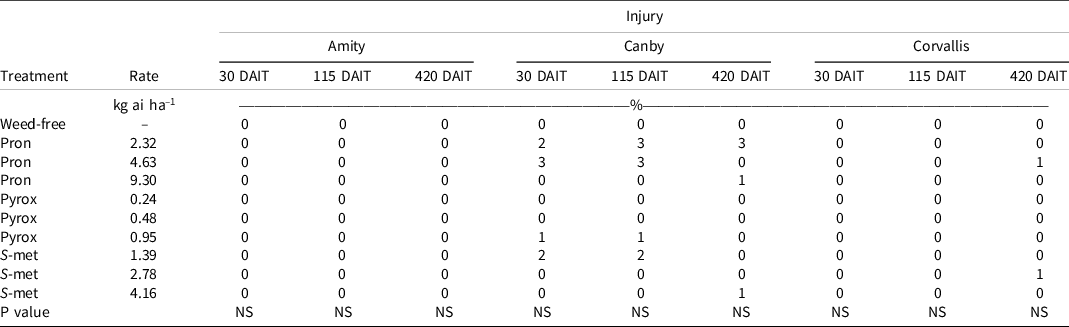
Significant effects of evaluation timing and experimental site were noted in all data analyzed, so data were further analyzed by experimental year and evaluation timing combination. Across all experimental sites and evaluations, hazelnut injury was below 3% (Table 2). Injury levels were similar to those recorded in the weed-free check. Pronamide at 2.30 to 9.30 kg ha–1 resulted in 0 to 1% injury in Amity and Corvallis. A slightly higher injury was noted in Canby, reaching 3% at 115 DAIT, but no further increase in injury levels was noted. Crop injury following treatment with pyroxasulfone at 0.24 to 0.95 kg ha–1 remained low throughout the evaluations, reaching a maximum value of 1% at Canby. No injury was noted at the Amity or the Corvallis site. Similarly, S-metolachlor treatments at 1.39 to 4.16 kg ha–1 resulted in meager (0–1%) damage to hazelnuts. Injury symptoms observed were mild leaf crinkling.
Hazelnut injury in response to basal banded applications of soil-applied herbicides in three newly planted, commercial orchards in Oregon. Treatments were applied in March–May 2019 and reapplied in February–March 2020. a

a Abbreviations: DAIT, days after initial treatment in 2019; NS, not significant (P > 0.05); Pron, pronamide; Pyrox, pyroxasulfone; S-met, S-metolachlor.
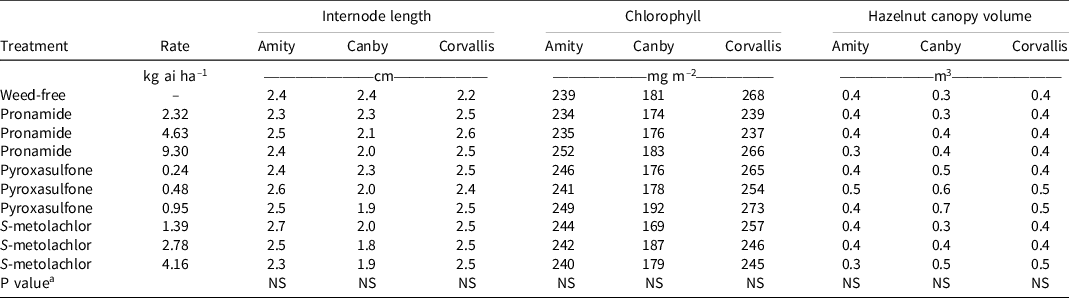
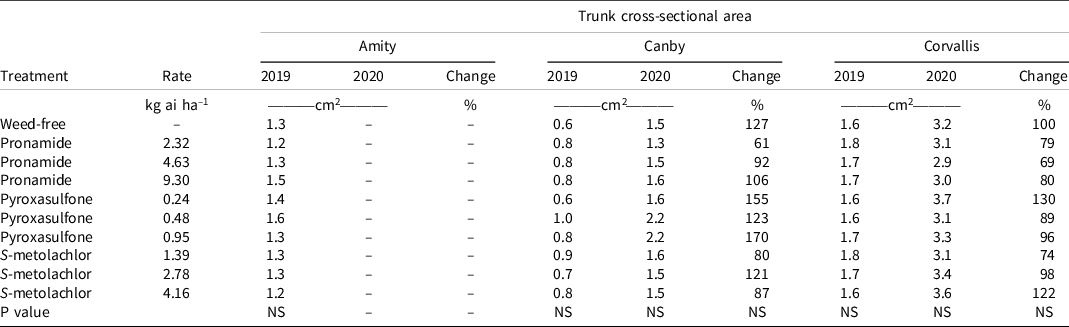
The elevated tolerance of hazelnut to pronamide, pyroxasulfone, and S-metolachlor herbicides was evidenced by the absence of treatment effects on plant growth. Treatments did not affect internode length at any experimental site (Table 3). Leaf chlorophyll content was also unaffected, with average values ranging from 169 to 192 mg m–2 in Canby, and 234 to 273 mg m–2 in Amity and Corvallis. Similarly, no differences among treatments in canopy volume and trunk cross-sectional areas (Tables 3 and 4, respectively) were observed at any site or year. Average trunk cross-sectional values ranged from 1.2 to 1.8 cm2 (2019) and 2.9 to 3.7 cm2 (2020) in Amity and Corvallis, whereas lower values ranging from 0.6 to 1.0 cm2 in 2019 and 1.3 to 2.2 cm2 in 2020 were measured in Canby. Nevertheless, percent increases in the cross-sectional area from the first to the second year were similar across sites.
Hazelnut internode length, leaf chlorophyll content, and canopy volume following basal banded applications of soil-applied herbicides in three newly planted, commercial orchards in Oregon. Treatments were applied in March–May 2019 and reapplied in February–March 2020.

a Abbreviation: NS, not significant (P > 0.05).
Hazelnut trunk cross-sectional area as affected by basal banded applications of soil-applied herbicides in three newly planted commercial orchards in Oregon. Treatments were applied in March–May 2019 and reapplied in February–March 2020.

Abbreviations: NS, not significant (P >0.05).
Italian Ryegrass Control
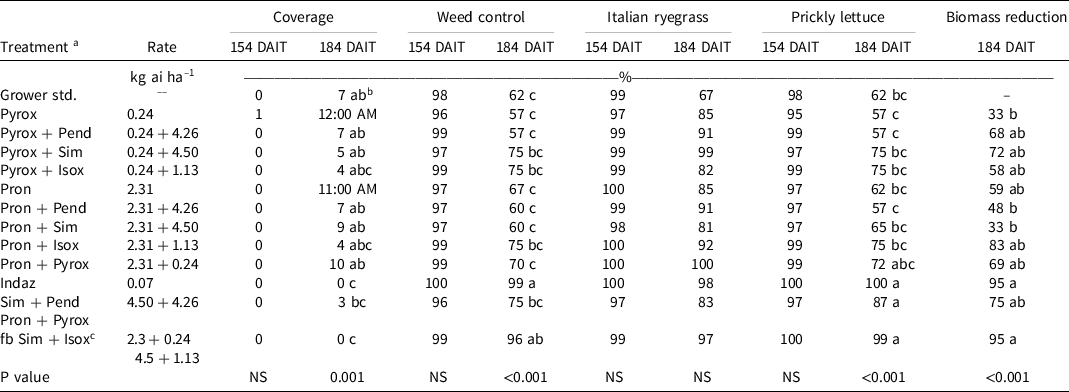
A significant effect of treatments and evaluation timing was observed for weed control and coverage, which were analyzed independently by each assessment timing. No weed emergence was observed for the first 120 DAIT, averaging 0% coverage and 100% control (data not shown). Weed emergence was first observed at 154 DAIT but averaged less than 1% weed coverage and 95.8% to 100% weed control with no differences among treatments (Table 5). Differences among treatments were noted only at 184 DAIT; weed coverage and control levels ranged from 0 to 12.2% and 57.5% to 98.8%, respectively (Table 5). The lowest weed coverage was provided by indaziflam (0.07 kg ai ha–1) or the sequential treatment with pronamide (2.3 kg ha–1) mixed with pyroxasulfone (0.24 kg ha–1) followed by simazine (4.5 kg ha–1) mixed with isoxaben (1.13 kg ai ha–1) at 130 DAIT. Importantly, none of the treatments resulted in crop injury (data not shown).
Weed ground coverage, control efficacy, and dry weight in response to basal-directed treatments of preemergence herbicides. Treatments were applied to a newly planted ‘PolyO’ hazelnut orchard in Aurora, OR, in 2021. Ratings were taken from 0 to 184 d after initial treatment (DAIT) in November 2021.

a Abbreviations: fb, followed by; Grower std, grower standard treatment was pendimethalin 4.26 kg ai ha–1; Indaz, indaziflan; Isox, isoxaben; NS, not significant (P >0.05); Pron, pronamide; Pyrox, pyroxasulfone; Sim, simazine.
b Means followed by the same letter within a column are not different based on Sidak’s significance test (P ≤ 0.05);
c The whole field was treated with pendimethalin at 2.34 kg ai ha–1 roughly a month before the beginning of this trial, bringing the total rate of pendimethalin to the maximum year allowance of 6.6 kg ai ha–1; Simazine + isoxaben were sprayed 130 d after the initial pronamide + pyroxasulfone treatment.
Control of Italian ryegrass and prickly lettuce followed the same trend as weed coverage and control, in which no differences were observed up to 154 DAIT (Table 5). No differences in Italian ryegrass control were observed among treatments ranging from 67% to 100%, but the grower standard treatment provided the lowest level of control. Prickly lettuce control was 87% or higher with pronamide plus pyroxasulfone, indaziflam, simazine plus pendimethalin, and the sequential treatment of pronamide plus pyroxasulfone followed by simazine plus isoxaben (Table 5). Indaziflam treatment or a pronamide plus pyroxasulfone followed by simazine plus isoxaben mixtures resulted in a 95% reduction in weed biomass. Pyroxasulfone and pronamide had a similar effect on weed biomass reduction with a mean difference of 8.4%, with a 95% confidence interval (CI) of 5.6% to 25.6% based on contrast analysis (t ratio = 0.255, P = 0.80). Pyroxasulfone used in mixtures reduced weed biomass by an extra 41.4%, CI of 16.6% to 100%, compared to pyroxasulfone alone. Pronamide performance was similar if used alone or in mixtures (P = 0.78).
This research is the first report of the response of hazelnut to pronamide, pyroxasulfone, and S-metolachlor. High tolerance to pronamide was expected, as this herbicide is currently registered (1.12 to 2.2 kg ai ha–1) for blackberry (Rubus L. subg. Rubus Watson), blueberry (Vaccinium corymbosum L.), raspberry (Rubus idaeus L.), and boysenberry (Rubus ursinus × Rubus idaeus), and others (Anonymous 2021b). In this study, hazelnuts have shown minimal to no injury up to 9.3 kg ai ha–1 of pronamide applied to newly transplanted fields (Tables 2–4). In the fall of 2021, a special local need authorization was issued allowing pronamide use in newly planted and nonbearing hazelnut orchards (Anonymous 2021a).
Tolerance to pyroxasulfone has been widely reported in annual crops (Kurtenbach et al. Reference Kurtenbach, Johnson, Gulden and Willenborg2019; McNaughton et al. Reference McNaughton, Shropshire, Robinson and Sikkema2014; Sikkema et al. Reference Sikkema, Soltani, Sikkema and Robinson2008) and in the propagation of sweet potatoes (Ipomea batatas L.) (Smith et al. Reference Smith, Jennings, Monks, Schultheis and Reberg-Horton2019). Hazelnuts displayed a high level of tolerance to pyroxasulfone applied shortly after transplanting. S-metolachlor tolerance was studied in crops like sugar beets (Beta vulgaris L.), dry beans (Phaseolus vulgaris L.), and strawberry (Fragaria × ananassa (Weston) Duchesne ex Rozier ssp. ananassa) (Boyd and Reed Reference Boyd and Reed2016; Lueck et al. Reference Lueck, Peters and Lystad2020; Sikkema et al. Reference Sikkema, Shropshire and Soltani2009). S-metolachlor reduced strawberry yield at 0.21 kg ha–1, but only in selected, tested strawberry varieties (Boyd and Reed Reference Boyd and Reed2016). S-metolachlor at 2.16 to 4.32 kg ha–1 negatively affected sugar beet stand and growth while not influencing yield (Peters et al. Reference Peters, Lueck and Carlson2019). Sugar beet tolerance to S-metolachlor is variety-dependent (Bollman and Sprague Reference Bollman and Sprague2008) and is reduced in soils with low clay and organic matter content (Lueck et al. Reference Lueck, Peters and Lystad2020). Hazelnut tolerates up to 4.16 kg ai ha–1 of S-metolachlor, showing little to no damage across cultivars tested. It is important to note that these studies were conducted only on silt-loam soils that often have organic matter levels above 3%. Silt-loam is the predominant soil texture in the Willamette Valley. Tolerance levels may differ under different soil conditions.
Pronamide (2.30 kg ha–1) and pyroxasulfone (0.24 kg ha–1) improved weed control (>85%) compared to grower standard alone (62%) (Table 5). Treatments containing pronamide or pyroxasulfone provided over 80% Italian ryegrass control (184 DAIT). Pronamide can also control tall fescue and perennial ryegrass (Anonymous 2021b), covering a gap in chemical weed control in young hazelnut orchards. The addition of pronamide or pyroxasulfone will help decrease Italian ryegrass infestation and most likely reduces the need for postemergence herbicides. These results agree with the previous report on the effective control of Italian ryegrass with pyroxasulfone (Hulting et al. Reference Hulting, Dauer, Hinds-Cook, Curtis, Koepke-Hill and Mallory-Smith2012). Indaziflam (0.07 kg ai ha–1) alone or a pronamide plus pyroxasulfone followed by simazine plus isoxaben application performed 130 d later resulted in complete control of Italian ryegrass and prickly lettuce. Indaziflam was the only treatment containing a single active ingredient controlling Italian ryegrass and prickly lettuce. Previous studies also reported indaziflam effectiveness on Italian ryegrass at rates as low as 0.03 kg ai ha–1 (Jhala et al. Reference Jhala, Ramirez and Singh2013). However, indaziflam cannot be used in newly planted hazelnut orchards, as it currently lacks registration for such.
Herbicide mixtures have been shown to delay selection for herbicide resistance when mixtures include multiple herbicide modes of action (Beckie and Reboud Reference Beckie and Reboud2009; Evans et al. Reference Evans, Tranel, Hager, Schutte, Wu, Chatham and Davis2016). Here, pyroxasulfone in mixture outperformed pyroxasulfone by 41% in biomass reduction. The benefit of an herbicide mixture was not observed with pronamide. However, preemergence mixtures, rotations, and sequential applications should be recommended to reduce weed populations and the need for postemergence herbicides in newly planted orchards. These practices will increase weed management costs and reduce the need for the use of postemergence herbicides in young orchards. These data presented confirm that pyroxasulfone, S-metolachlor, and pronamide can be safely used in newly planted hazelnuts, aiding in the control of problematic weeds.
Acknowledgments
The Oregon Hazelnut Commission supported this work. In addition, the authors would like to acknowledge the assistance of Christensen Farms, OO Agriculture LLC, and Birkemeyer Farms in hosting the studies and the support of the Oregon Department of Agriculture and Corteva for assistance in obtaining a new registration of pronamide in hazelnuts grown in Oregon. No conflicts of interest have been declared.