Implications
Alternatives for overcoming tail docking as a preventive measure against tail damage are needed. The current study showed that pens with undocked pigs that were provided with both straw and more space had the same risk of tail damage as pens with only tail-docked pigs. However, straw or more space alone did not decrease the risk of tail damage to the same level as tail docking. Thus, a combination of these two measures can help reduce the need for tail docking.
Introduction
One challenge of intensive pig production is the tendency of pigs to bite the tail of other pigs, resulting in serious tail damage. Tail damage caused by tail biting is both a welfare and economic problem due to its reported negative consequences including experienced stress and pain (e.g. Munsterhjelm et al., Reference Munsterhjelm, Brunberg, Heinonen, Keeling and Valros2013), decreased growth rate (e.g. Sinisalo et al., Reference Sinisalo, Niemi, Heinonen and Valros2012) and risk of infections that lead to carcass condemnations at slaughter (e.g. Valros et al., Reference Valros and Heinonen2004; Kritas and Morrison, Reference Kritas and Morrison2007). Further, it is considered a multifactorial problem, and many risk factors have been proposed and summarised (e.g. Schrøder-Petersen and Simonsen, Reference Schrøder-Petersen and Simonsen2001). According to the European Food Safety Authority (2007), raising pigs with undocked tails, without proper enrichment in the environment and at a too high stocking density, are some of the greater risk factors. The EU Council Directive 2008/120/EC, which establishes minimum standards for the protection of pigs, bans the use of routine tail docking due to its negative consequences, such as acute procedural pain (Valros and Heinonen, Reference Valros, Ahlström, Rintala, Häkkinen and Saloniemi2015; Herskin et al., Reference Herskin, Jensen, Jespersen, Forkman, Jensen, Canibe and Pedersen2016a), increased risk of infection (Valros and Heinonen, Reference Valros, Ahlström, Rintala, Häkkinen and Saloniemi2015) and the possibility for long-term pain due to the formation of neuromas in the tail stump (Herskin et al., Reference Herskin, Di Giminiani and Thodberg2015). Also, tail docking only treats the symptoms, not the causes, and does not prevent tail damage completely (e.g. Hunter et al., Reference Hunter, Jones, Guise, Penny and Hoste1999). However, tail docking has been shown to effectively reduce the prevalence of tail damage (e.g. McGlone et al., Reference McGlone, Sells, Harris and Hurst1990; Hunter et al., Reference Hunter, Jones, Guise, Penny and Hoste1999; Scollo et al., Reference Scollo, Di Martino, Bonfanti, Stefani, Schiavon, Marangon and Gottardo2013) and thus, tail docking is a preventive measure of tail damage still widely used in many EU countries (Bracke et al., Reference Bracke, Edwards, Geers, O’Connell, Pedersen and Valros2011). The EU Council Directive 2008/120/EC states that tail docking is allowed only when there is evidence of tail damage and when all other known preventive measures were applied without success. Thus, alternatives for overcoming tail docking as a preventive measure against tail damage are needed. The EU legislation encourages removing other known risk factors instead of tail docking as the best strategy to prevent tail damage caused by tail biting. Providing proper enrichment could be part of the solution. Recently, the European Commission has presented new recommendations for the type of enrichment used (European Commission, 2016). They recommend straw, together with for example hay and silage, as one of the enrichments that can stand alone because it possess all the necessary characteristics to be enriching for the pigs, including being edible, chewable, investigable and manipulable. Another possible solution could be to decrease the stocking density in the pen, which has been presented as one of the most important preventive factors by farmers in countries with both docked (Bracke et al., Reference Bracke, De Lauwere, Wind and Zonerland2013) and undocked pigs (Wallgren et al., Reference Wallgren, Westin and Gunnarsson2016). Several studies have investigated the preventive effect of tail docking, straw provision and lowered stocking density, but, to our knowledge, no previous study has investigated the relative effect of these preventive measures to tail damage caused by tail biting in a controlled randomised experiment. The aims of the current study was: (1) to investigate the temporal development of first incidence of tail damage during the finisher period, (2) to investigate the relative effect of three possible preventive measures against tail damage: tail docking, straw provision and lowered stocking density and (3) to investigate whether straw provision and lowered stocking density could replace tail docking as a preventive measure against tail damage. The hypothesis was that all three measures would reduce the risk of tail damage, but, from the current literature, it was not possible to pre-assume on the relative effect.
Material and methods
The present experiment was conducted from 2015 to 2016 in accordance with a protocol approved by the Danish Animal Experiments Inspectorate (Journal no. 2015-15-0201-00593).
Animals, housing and management
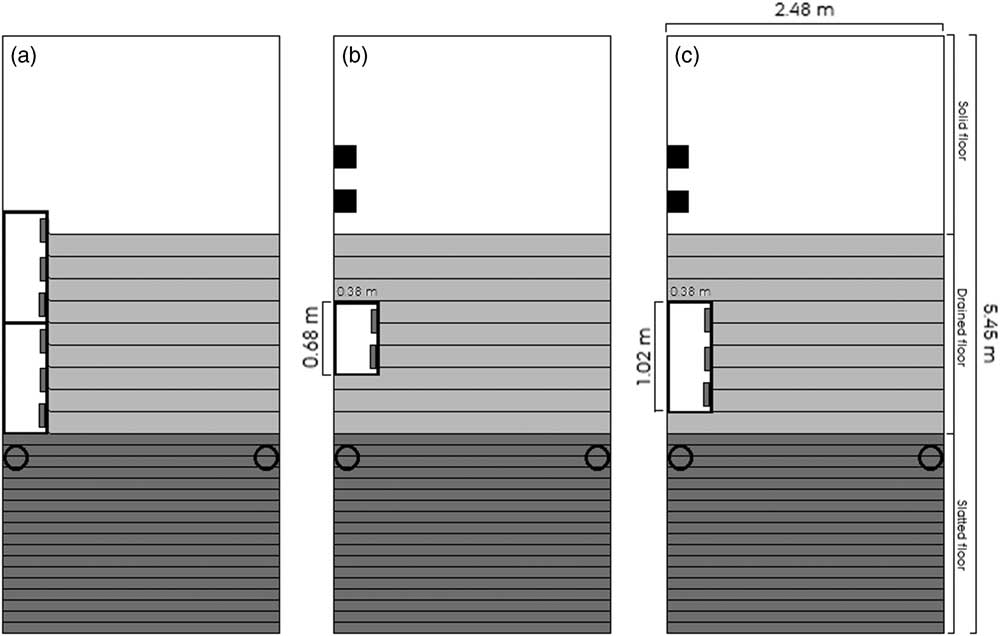
The experimental units were 112 pens with a total of 1624 finisher pigs (from 30 kg until slaughter). All pigs originated from the same herd raised according to Danish production standards and bred from dams of Danavl Yorkshire×Danavl Landrace, all inseminated with Danavl Duroc semen. The pens were divided between four batches (batches 1, 3 and 4: n=32 each; batch 2: n=16) running from June 2015 to November 2016. The experiment was conducted in the experimental stables at Department of Animal Science, Aarhus University, Denmark. The study included one weaner section (from 7 to 30 kg) and two finisher sections, each containing 16 identical pens. During batch 2, only one finisher section was used. Dimensions and designs of the pens can be seen in Figure 1.
Schematic drawing of the different pen designs used. Three different pen designs were used in the study: one for weaners (a), one for finisher pens with 1.21 m2/pig (b) and one for finisher pens with 0.73 m2/pig (c). All pens had the same outer dimensions. The location of water cups is indicated with a circle, whereas the location of wooden sticks in separate racks is indicated by solid black squares.

The weaner section
The pigs arrived after weaning with an average weight of 9.1±1.7 kg. At arrival, the pigs (n=2072 in total, n=518/batch) were divided between 14 weaner pens (n=37/pen) with seven pens containing pigs with docked tails and seven with undocked tails. Focus of the current study was on preventive measures against tail damage in the finisher period, and thus we wanted to avoid tail damage in the weaner period. To reduce the risk of tail damage in the weaner period, 25 g of straw per pig per day were given on the drained floor, 25 g of straw per pig twice per week were given on the solid floor, the space allowance of 0.34 m2/pig was above EU legislation (EU Council Directive 2008/120/EC), and pigs were allocated more feeding space than commonly used (2.04 m trough space equivalent to 5.5 cm trough space per pig; see Figure 1a). Further, the herd staff were instructed to react to early signs of tail damage in a pen (e.g. sucking on the tail of another pig). During the four batches, only five obsessive biters were identified and removed, and no tails with bleeding wounds were observed in the weaner period.
The finisher section
Pigs were transferred to their respective finisher pen at an average weight of 31.6±6.6 kg. The tails of all weaner pigs were examined to ensure that no pigs with damaged tails entered the finisher section. Mixing between pens occurred, but pigs were always moved with at least one other pig from the same weaner pen and pigs with undocked tails were not mixed with pigs with docked tails. A finisher pen included one dry-feeder with closed partitions between the feeding places. The amount of feeding space per pig was kept almost equal between the two stocking densities, and therefore the number of feeding places depended on the number of pigs in the pen (see the ‘Experimental design’ section). Furthermore, each finisher pen included two wooden sticks in separate racks (solid black squares in Figure 1b and c) as enrichment to ensure that all pens were in accordance with the legislation (EU Council Directive 2008/120/EC). In all sections, artificial light was on from 0530 to 1830 h (182 lx), and two small windows per section brought in light from the hallway. Windows supposed to bring in natural light were blocked due to video recordings. The room temperature was gradually decreased from 21°C to 17°C over the 10 weeks of the finisher period (SKOV A/S, Roslev, DK). Each morning, the climate in the sections was evaluated and adjusted according to the needs of the pigs by a parallel shift of the temperature curve of 0.5 to 1.5°C, up or down. Each pen included an automatically controlled shower system (SKOV A/S, Roslev, Denmark) above the slatted floor. The pigs were fed ad libitum with a commercial dry feed and the feeders were filled three times a day at 0300, 1000 and 1830 h. The general management was performed by the educated herd staff. Between 1000 and 1200 h, the general routine in the sections was performed including cleaning, straw provision (see below) and a general health check.
Experimental design
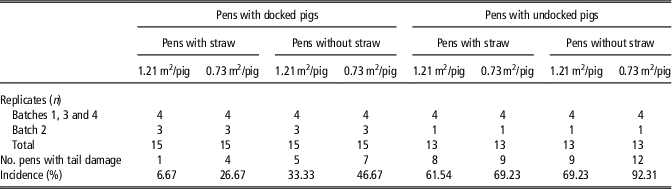
The finisher pens were randomly assigned to one level of each of three treatments: (1) docked tails (batches 1, 3 and 4: n=16; batch 2: n=12; total: n=60) v. undocked tails (batches 1, 3 and 4: n=16; batch 2: n=4; total: n=52; TAIL), (2) provision of straw (batches 1, 3 and 4: n=16; batch 2: n=8; total: n=56) v. no provision of straw (batches 1, 3 and 4: n=16; batch 2: n=8; total: n=56; STRAW) and (3) stocking density of 1.21 m2/pig (batches 1, 3 and 4: n=16; batch 2: n=8; total: n=56) v. 0.73 m2/pig (batches 1, 3 and 4: n=16; batch 2: n=8; total: n=56; STOCK). The number of pens with each treatment combination can be seen in Table 1. The pigs with docked tails were docked according to Danish legislation to half of the tail’s original length within the first 4 days after birth with a hot-iron cutter. Finisher pens provided with straw received 150 g of straw per pig per day on the solid floor. Finisher pens with a stocking density of 1.21 m2/pig included 11 pigs and one feeding place per 5.5 pigs (6.2 cm/pig; see Figure 1b), whereas finisher pens with a stocking density of 0.73 m2/pig included 18 pigs and one feeding place per six pigs (5.7 cm/pig; see Figure 1c).
The number of replicates in total and within batches, and the number and percentage of pens with first tail damage (incidence) for the three treatments allocated to finisher pens illustrated as eight treatment combinations.

Identification and definition of tail damage in finisher pens
Tail damage was identified through detailed scoring of each individual finisher pig tail every Monday, Wednesday and Friday by eight trained observers and was supported by daily pen level observations performed by the herd staff. An incidence of tail damage was recorded when at least one pig in a pen had a bleeding tail wound. A bleeding tail wound was defined as: the tail had one or more openings of the tissue, could vary from scratches to a shortened tail with a deep opening, and the tail had fresh blood on the surface from the opening with either a brown, dark red or red colour, which felt wet and resulted in exudate sticking to the finger. Tail scoring commenced when pigs entered the finisher section. It continued until the first incidence of tail damage in a pen, or ultimately (if there was no incidence) until pigs were sent for slaughter. Which finisher section the tail scoring started in switched every 2nd observation day. Blinding of observers was not possible because treatments were obvious.
Statistical analysis
All statistical analyses were performed in R Version 3.2.4. (R Core Team, 2016). To investigate the risk of tail damage both depending on whether it happened or not at pen level and when it happened during the finisher period, data were analysed using the package ‘survival’ for survival analysis (Therneau, Reference Therneau2015). A Cox regression assuming proportional hazards with right censoring was used, because the underlying baseline hazard function for tail damage was unknown and because some pens was never scored with tail damage. The survival object contained the information of whether a pen had an incidence of tail damage during the study period and which day during the study period the first incidence of tail damage occurred. Two different models were made. Model 1 tested the effect of the treatments and thus included the main effects TAIL, STRAW, STOCK and all possible interactions between the three. Model 2 tested whether the combination of straw provision and more space would be able to replace tail docking as a preventive measure against tail damage. Thus, model 2 only included data from two treatment combinations: (1) pens with undocked pigs, straw provided and stocking density of 1.21 m2/pig (n=13) and (2) pens with docked pigs, no straw provided and stocking density of 0.73 m2/pig (n=15); this was included in the model as a treatment variable with two levels. Both models further included the average introduction weight of the pen (the pigs were weighed at insertion to the finisher section) as a covariate and stratification for batch number. Both models were reduced according to a 5% significant level (P<0.05) where non-significant interactions were removed first and thereafter covariates and main effects. Differences are presented as hazard rate ratios (HRR) with connected 95% confidence intervals. Hazard rate ratios represent the risk of tail damage within a certain time interval; thus, a higher HRR means that a pen has a higher risk of tail damage and of tail damage happening earlier in the finisher period.
Results
Incidence of tail damage
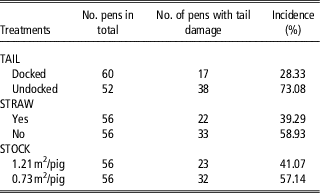
Out of the 112 finisher pens included, 55 was scored with tail damage as defined in this study. Divided between batches, tail damage was scored in 19 pens during batch 1 (n=32, 59%), six pens during batch 2 (n=16, 38%), 17 pens during batch 3 (n=32, 53%) and 13 pens during batch 4 (n=32, 41%). The number of pens scored with tail damage for the first time within each week of the study period can be seen in Table 2. The highest number of tail damage pens was seen in the 1st week and decreased with time. Number and percentage of tail damage pens divided between the three treatments TAIL, STRAW and STOCK can be seen in Table 3. A higher percentage of pens scored with tail damage was seen in pens with undocked pigs compared with pens with docked pigs, in pens with no straw provided compared with pens with straw provided, and in pens with high stocking density compared with pens with low stocking density. Number and percentage of tail damage pens divided between the eight treatment combinations can be seen in Table 1. The lowest percentage of pens scored with tail damage was seen for pens with pigs with docked tails, provided with straw and with lowered stocking density. When either of these characteristics were removed, the percentage of pens scored with tail damage increased and the highest percentage was seen for pens with neither of these characteristics.
Incidence of first tail damage within each week of the finisher period (weeks 1 to 10) presented as both the number of pens with first incidence of tail damage and the percentage of observations with first incidence of tail damage.

Percentage of pens with first incidence of tail damage in finisher pens divided between the three treatments

TAIL=tail length; STRAW=straw provision; STOCK=stocking density.
Model 1
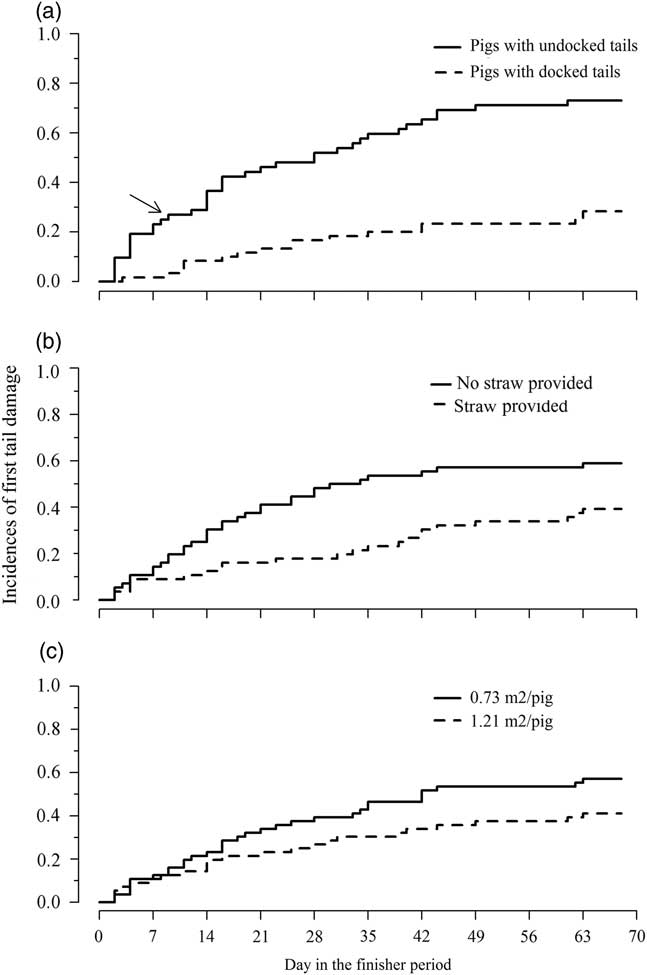
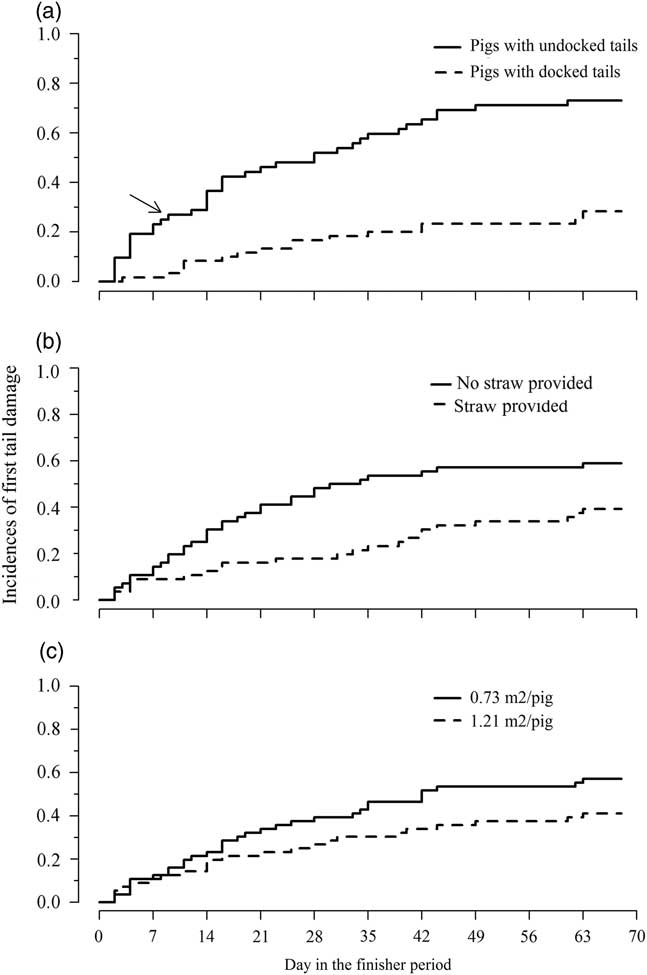
The hazard of first tail damage was 4.32-fold higher in pens where pigs’ tails were left undocked compared with pens with tail-docked pigs (HRR=4.32, 95% CI (2.40 to 7.77); P<0.001), whereas it was 2.22-fold higher in pens with no straw provided compared with pens with straw provided (HRR=2.22, 95% CI (1.28 to 3.86); P<0.01). No difference in hazard of first tail damage was seen between pens with different stocking densities (HRR=1.67, 95% CI (0.97 to 2.90); P=0.064). Cumulative incidence plots illustrating these results and the development of incidences of first tail damage over the finisher period are shown in Figure 2. No interactions were seen between any of the three treatments. However, the effect of tail docking was higher than the effect of straw provision (P<0.001).
Cumulative incidence plots of first tail damage in finisher pens divided between (a) pens with undocked (n=52) and docked pigs (n=60), (b) pens without (n=56) and with straw provided (n=56) and (c) pens with 0.73 m2/pig (n=56) and 1.21 m2/pig (n=56). Each small jump in the graphs as shown by the arrow indicates an incidence of first tail damage in a pen.
Model 2
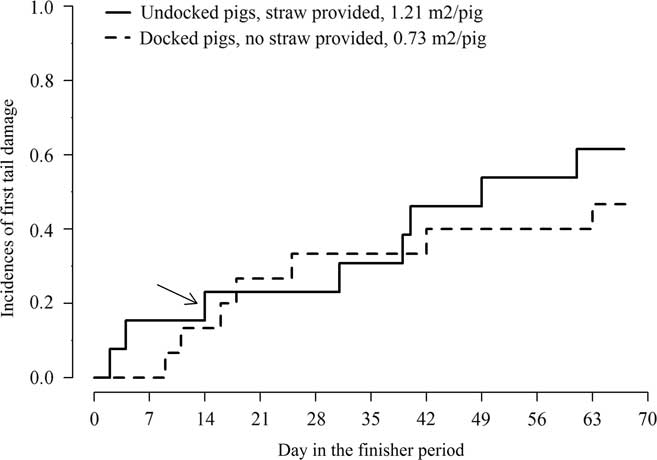
The treatment combination of pens with docked pigs, no straw provision and stocking density of 0.73 m2/pig had a similar hazard of first tail damage when compared with the treatment combination of pens with undocked pigs, straw provided and stocking density of 1.21 m2/pig (HRR=1.58, 95% CI (0.56 to 4.49); P=0.39). Figure 3 illustrates these results and the development of incidences of first tail damage over the finisher period for these two treatment combinations.
Cumulative incidence plot of first tail damage in finisher pens divided between the two treatment combinations: (1) pens with undocked pigs, straw provided and 1.21 m2/pig and (2) pens with docked pigs, no straw provided and 0.73 m2/pig. Each small jump in the graphs as shown by the arrow indicates an incidence of first tail damage in a pen.

Discussion
Incidence of tail damage
Tail damage was recorded in almost half of the pens included. This high prevalence can presumably be explained by the combination of a relatively mild tail damage definition and the very detailed tail scoring multiple times per week. Further, we only looked at the first incidence of tail damage at pen level. The focus was neither on whether a tail damage outbreak with many pigs with fresh tail wounds would develop nor if new incidences of tail damage developed later in the study period. Thus, our study probably also represents an underestimation of the actual prevalence of tail damage. A recent study by Lahrmann et al. (Reference Lahrmann, Busch, D’Eath, Forkman and Hansen2017) scored tail damage in undocked pigs (provided with straw daily, around 11 g/pig) from weaning until slaughter at a commercial farm. They found that 68% of all pens were scored with tail damage at least once, which corresponds well to the result of our study with 69% of pens with undocked pigs, straw provided and high stocking scored with tail damage. In comparison, Zonderland et al. (Reference Zonderland, Wolthuis-Fillerup, Van Reenen, Bracke, Kemp, Den Hartog and Spoolder2008) found a prevalence of tail damage in undocked pigs of 36% of weaner pens. In our study, the highest prevalence of first incidence of tail damage was seen already in the 1st week after introduction to the finisher unit. Hereafter, it seemed to decrease as the pigs grew older. This is in agreement with Lahrmann et al. (Reference Lahrmann, Busch, D’Eath, Forkman and Hansen2017) who saw a higher prevalence of tail damage in the first half of the finisher period (34% of pens from 30 to 60 kg and 13% of pens from 60 to 90 kg), and with Di Martino et al. (Reference Di Martino, Capello, Scollo, Gottardo, Stefani, Rampin, Schiavon, Marangon and Bonfanti2015) who found a peak in tail lesions in the beginning of the finisher period. At insertion to the finisher unit, the pigs experienced multiple stressors including a feed change, mixing with other pigs, and half of the pigs were no longer provided with straw. Multiple stressors have been shown to affect pigs in an additive way (e.g. Hyun et al., Reference Hyun, Ellis, Curtis and Johnson2005), and this might explain why many pens are scored with tail damage this early after insertion.
Effect of tail docking
In our study, tail docking was an effective preventive measure against tail damage with a more than 4-fold higher hazard of developing tail damage in pens with undocked pigs. This higher hazard represents both a higher relative risk of first tail damage but also the fact that tail damage is seen earlier in pens with undocked pigs. This preventive effect of tail docking has been shown in previous studies using abattoir (Hunter et al., Reference Hunter, Jones, Guise, Penny and Hoste1999) and survey data (Hunter et al., Reference Hunter, Jones, Guise, Penny and Hoste2001; Bracke et al., Reference Bracke, De Lauwere, Wind and Zonerland2013). Further, two experimental studies have found tail wounds only on undocked tails when comparing undocked and tail-docked pigs raised under the same environmental conditions (McGlone et al., Reference McGlone, Sells, Harris and Hurst1990; Lahrmann et al., Reference Lahrmann, Busch, D’Eath, Forkman and Hansen2017). Also, Di Martino et al. (Reference Di Martino, Capello, Scollo, Gottardo, Stefani, Rampin, Schiavon, Marangon and Bonfanti2015) found a more than 20-fold higher risk of tail lesions in undocked compared with docked finisher pigs in the production of heavy pigs under challenging conditions. However, Lahrmann et al. (Reference Lahrmann, Busch, D’Eath, Forkman and Hansen2017) did find tail damage remarks from the meat inspection at slaughter in docked pigs and other studies have also found tail damage in docked pigs (e.g. Hunter et al., Reference Hunter, Jones, Guise, Penny and Hoste1999; Scollo et al., Reference Scollo, Di Martino, Bonfanti, Stefani, Schiavon, Marangon and Gottardo2013; Di Martino et al., Reference Di Martino, Capello, Scollo, Gottardo, Stefani, Rampin, Schiavon, Marangon and Bonfanti2015). Thus, tail docking does not prevent tail damage completely. The relatively high level of tail damage scored in docked pens in our study may occur due to our detailed tail scoring multiple times per week.
Effect of straw provision
In our study, providing 150 g of straw per pig per day was also an effective preventive measure against tail damage with a more than 2-fold higher hazard of developing tail damage in pens with no straw provided. Again, this higher hazard represents both an earlier onset and higher relative risk of first incidence of tail damage in pens with no straw provided. Previous studies have also found a preventive effect of straw provision (Chambers et al., Reference Chambers, Powell, Wilson and Green1995; Moinard et al., Reference Moinard, Mendl, Nicol and Green2003) including experimental studies (Van de Weerd et al., Reference Van de Weerd, Docking, Day and Edwards2005; Zonderland et al., Reference Zonderland, Wolthuis-Fillerup, Van Reenen, Bracke, Kemp, Den Hartog and Spoolder2008; Camerlink et al., Reference Camerlink, Ursinus, Bijma, Kemp and Bolhuis2015). Van de Weerd et al. (Reference Van de Weerd, Docking, Day and Edwards2005) studied undocked finisher pigs and compared a straw-bedded system to a partly slatted system containing only a Bite Rite Tail Chew enrichment device (Ikadan System, Ikast, Denmark). They used the same tail damage definition as ours and found that tail damage was only seen in one out of the 12 straw-bedded pens, whereas tail damage was seen in all twelve partly slatted pens. Zonderland et al. (Reference Zonderland, Wolthuis-Fillerup, Van Reenen, Bracke, Kemp, Den Hartog and Spoolder2008) studied undocked weaner pigs with the same tail damage definition as ours and found that a small amount of straw provided twice daily was more preventive of tail damage than a chain or a rubber hose. Furthermore, Camerlink et al. (Reference Camerlink, Ursinus, Bijma, Kemp and Bolhuis2015) found a higher average tail damage score in enriched pens (also including straw as enrichment) compared with barren pens. Thus, it is a common understanding that straw provision is a preventive measure against tail damage in finisher pigs. When considering the many other positive effects related to straw such as increasing the expression of species-specific behaviour (Jensen et al., Reference Jensen, Herskin, Forkman and Pedersen2015), decreasing the expression of undesirable, harmful, social behaviour (e.g. Pedersen et al., Reference Pedersen, Herskin, Forkman, Jensen and Jensen2014), decreasing the risk of gastric ulceration (Di Martino et al., Reference Di Martino, Scollo, Gottardo, Stefani, Schiavon, Capello, Marangon and Bonfanti2013; Herskin et al., Reference Herskin, Thodberg and Jensen2016b) and an improved growth rate (Pedersen et al., Reference Pedersen, Herskin, Forkman, Halekoh, Kristensen and Jensen2015), it is easy to argue that straw or other enrichments with same abilities should be provided to finisher pigs. The amount of straw provided in the current study was chosen based on a judged experience with the capacity of the slurry system and to avoid manual cleaning of leftover straw. The slurry system used was mechanical scrapers underneath the slats, and this amount of straw was managed without blockings by running the scrapers at least once every day.
Effect of stocking density
Besides tail docking and straw, lowered stocking density as a preventive measure against tail damage was also investigated. Stocking density was reduced from 0.73 to 1.21 m2/pig by reducing group size from 18 to 11 pigs/pen on the same amount of total space. Thus, it is not possible to distinguish between the effect of group size and stocking density. We chose this method because this would be the practical method for lowering stocking density under farm conditions. In our study, lowered stocking density was not significantly effective as a preventive measure against tail damage although there was a trend towards reduced prevalence of tail damage with lowered stocking density. Previous studies show contradictory results. Two studies showed no relation between stocking density and tail damage with stocking densities ranging from 0.49 to 0.98 m2/pig (Kritas and Morrison, Reference Kritas and Morrison2004) and where two stocking densities of 1.0 and 1.5 m2/pig were compared (Cornale et al., Reference Cornale, Macchi, Miretti, Renna, Lussiana, Perona and Mimosi2015). Other studies found a relation between increased stocking density and increased risk of tail damage (Moinard et al., Reference Moinard, Mendl, Nicol and Green2003; Goossens et al., Reference Goossens, Sobry, Ödberg, Tuyttens, Maes, De Smet, Nevens, Opsomer, Lommelen and Geers2008; Scollo et al., Reference Scollo, Contiero and Gottardo2016), but all of these studies investigated stocking densities that were higher than the legislative demand. The stocking densities compared in the current study were both lower than the EU legislative demand of 0.65 m2/pig (EU Council Directive 2008/120/EC) and thus corresponds well to the results from previous studies. Thus, it is possible that stocking density is only important for the development of tail damage at densities higher than the legislative demand. This hypothesis also fits with the timing of the first incidences of tail damage. These mainly happened within the first half of the finisher period (43 out of 55 incidences) where stocking density might not play that big of a role yet.
Relative effect of the preventive measures
In the current study, both tail docking and straw provision were preventive measures against tail damage. Further, tail docking had a larger preventive effect than straw provision. Thus, straw of the current amount and frequency cannot replace tail docking as a preventive measure against tail damage. However, the effect of tail docking and straw provision was independent of each other. Thus, providing straw prevents tail damage, also in production systems with tail docking. Only one tail damage incidence was recorded in pens that had both docked pigs, straw provided and lowered stocking density, and, when changing either of these factors, the prevalence of tail damage increased. Further, when providing straw and lowering the stocking density in pens with undocked tails, these did not have a higher hazard of developing tail damage than pens with docked pigs that were not provided with straw or having a lowered stocking density. Thus, in our study the combination of straw provision and lowered stocking density was as preventive against tail damage as tail docking. This is also the model used in the Swedish production (with ban on tail docking) where they have a lower stocking density than stated by the EU directive (EU Council Directive 2008/120/EC) and where provision of straw or similar enrichment is normal practice (Wallgren et al., Reference Wallgren, Westin and Gunnarsson2016). These results indicate that combining multiple preventive measures might be the way to overcome the tail damage problem. We suggest, based on the results of the current study, that future research should focus on other risk factors for tail damage than the lack of enrichment material to find preventive measures which, in combination with biologically relevant enrichment, can replace tail docking as a preventive measure against tail damage.
In conclusion, finisher pens developed incidences of first tail damage mainly in week 1 and in the first half of the finisher period. Both tail docking to half of the tail’s original length and provision of 150 g of straw per pig per day were preventive against tail damage in finisher pigs, whereas lowered stocking density within the legislative demand did not show a similar effect. Further, tail docking was more preventive against tail damage than straw provision. However, the combination of straw provision and lowered stocking density was as preventive as tail docking. The results suggest that a combination of preventive measures against tail damage is necessary to reduce the risk of tail damage in undocked pigs to the same level as in docked pigs. This could be the way to avoid tail docking when trying to reduce the risk of tail damage.
Acknowledgements
The authors thank the many observers involved in the study including the technicians Betty Skou, Carsten Kjærulff Christensen, Birthe Houbak and John Misa Obidah and the student helpers Johanne Jespersen and Louise Bendixen. Also, thanks to the stable staff for their high level of collaboration. Further, the authors thank Leslie Foldager and Mikkel Boel for statistical assistance. The study was made possible by two grants from the Green Development and Demonstration Programme under the Ministry of Food, Agriculture and Fisheries, Denmark (project IntactTails j.nr. 34009-13-0743 and project StrawWell j.nr.: 34009-13-0736) and by a grant from the ERA-NET ANIWHA project FareWellDock (Danish grant no.: 3055-00001B).