Introduction
Following early learning models of obsessive–compulsive disorder (OCD) (Taylor, Abramowitz, McKay, & Cuttler, Reference Taylor, Abramowitz, McKay, Cuttler and Steketee2012), contemporary cognitive theories highlight the role of dysfunctional beliefs in the development and maintenance of OCD (Clark & Purdon, Reference Clark and Purdon1995; Salkovskis, Reference Salkovskis1985). These cognitive appraisal models propose that normal intrusions develop into highly distressing obsessions when a person perceives these intrusions as threatening and personally significant. Building on the work of Salkovskis (Reference Salkovskis1985), the Obsessive–Compulsive Cognitions Working Group (1997) identified six particular beliefs or patterns of beliefs that promote the dysfunctional appraisal of intrusions: inflated responsibility, thought-action fusion (TAF) and the over importance of thoughts, the need to control thoughts, the overestimation of threats, the intolerance of uncertainty, and perfectionism.
Of these dysfunctional beliefs, TAF is one of the most extensively studied (Berle & Starcevic, Reference Berle and Starcevic2005; Shafran & Rachman, Reference Shafran and Rachman2004). It pertains to the belief that (a) thinking about something increases its likelihood of occurring or (b) that thoughts are morally equivalent to actions (Rachman, Reference Rachman1993; Shafran, Thordarson, & Rachman, Reference Shafran, Thordarson and Rachman1996). Rachman (Reference Rachman1998) suggested that some OCD patients are particularly prone to experiencing a sense of inflated responsibility because they believe that the probability of a negative event occurring increases if they think about it. Consequently, they believe themselves to be responsible for the threat of the negative event and the reduction or removal of this threat. TAF is a highly reliable construct (Bailey, Wu, Valentiner, & McGrath, Reference Bailey, Wu, Valentiner and McGrath2014; Shafran et al., Reference Shafran, Thordarson and Rachman1996) that is associated with general OCD symptoms, specifically obsession and guilt (Rachman, Thordarson, Shafran, & Woody, Reference Rachman, Thordarson, Shafran and Woody1995; Taylor et al., Reference Taylor, Coles, Abramowitz, Wu, Olatunji and Timpano2010).
Despite the prevalence of promising cognitive theories for OCD, there is a surprising lack of neurobiological analyses of these cognitive models, including TAF. Only a few functional magnetic resonance imaging (fMRI) studies have investigated the intolerance of uncertainty (Krain et al., Reference Krain, Gotimer, Hefton, Ernst, Castellanos, Pine and Milham2008; Stern et al., Reference Stern, Welsh, Gonzalez, Fitzgerald, Abelson and Taylor2013) and heightened moral sensitivity (Harrison et al., Reference Harrison, Pujol, Soriano-Mas, Hernandez-Ribas, Lopez-Sola, Ortiz and Cardoner2012) components. Using a similar TAF-induction paradigm, one electroencephalography study reported increased beta frequency in the precuneus of individuals with high obsessive–compulsive (OC) traits (Jones & Bhattacharya, Reference Jones and Bhattacharya2014). An fMRI study demonstrated increased activity in the lingual gyrus, caudate nucleus, precuneus, and several areas of the frontal cortex (Lee et al., Reference Lee, Cha, Chung, Kim, Song, Chang and Lee2019). However, these two studies investigated non-clinical participants and only provided information regarding the localization of activated brain areas.
Another major criticism of OCD cognitive models is that they have largely ignored the mounting body of research highlighting the importance of neurobiological factors (Taylor et al., Reference Taylor, Abramowitz, McKay, Cuttler and Steketee2012). Likewise, the neurobiological correlates of dysfunctional beliefs need to be explained in the context of current neuroanatomical OCD models, such as the cortico-striato-thalamo-cortical (CSTC) (Graybiel & Rauch, Reference Graybiel and Rauch2000; Saxena & Rauch, Reference Saxena and Rauch2000; Saxena, Brody, Schwartz, & Baxter, Reference Saxena, Brody, Schwartz and Baxter1998) and amygdalo-cortical circuits (Milad & Rauch, Reference Milad and Rauch2012). However, no study has investigated OCD cognitive models at the level of brain network dysfunction.
Thus, the purpose of this fMRI study was to characterize the functional connectivity (FC) of neural circuits associated with the TAF cognitive model in OCD patients. Furthermore, it determined whether TAF-related OCD neuroimaging correlates overlap with current neuroanatomical models of OCD. TAF is a unique dysfunctional belief intermixed with distorted cognition, such as exaggerated responsibility and affective responses, including feelings of guilt or empathy (Shafran & Rachman, Reference Shafran and Rachman2004). Previous studies have revealed altered CSTC and affective circuits in OCD using different modalities during cognitive or affective tasks (Eng, Sim, & Chen, Reference Eng, Sim and Chen2015; Piras, Piras, Caltagirone, & Spalletta, Reference Piras, Piras, Caltagirone and Spalletta2013; Rasgon et al., Reference Rasgon, Lee, Leibu, Laird, Glahn, Goodman and Frangou2017). However, it is unclear how the CSTC and affective circuits interact. For example, the CSTC model has been modified to integrate limbic regions, such as the amygdala and insula, for emotional processing, a controversial OCD marker (Paul et al., Reference Paul, Beucke, Kaufmann, Mersov, Heinzel, Kathmann and Simon2019; Rasgon et al., Reference Rasgon, Lee, Leibu, Laird, Glahn, Goodman and Frangou2017; Thorsen et al., Reference Thorsen, Hagland, Radua, Mataix-Cols, Kvale, Hansen and van den Heuvel2018). The present fMRI study provides additional insight that can enhance our understanding of the interaction between the CSTC and affective circuits during various TAF conditions with different emotional intensities. Our previous fMRI study in healthy participants found that TAF-induction recruited crucial elements of the CSTC or affective circuits and this activity correlated with OC symptoms (Lee et al., Reference Lee, Cha, Chung, Kim, Song, Chang and Lee2019). Based on these observations, we hypothesized that TAF would alter FC between the CSTC and the affective circuits in OCD. We further predicted that the emotional intensity of the TAF task would induce differential FC patterns within the identified brain circuits.
Methods
Participants
Forty-one OCD patients (five females) and 47 health volunteers (one female; health controls (HCs)) aged between 18 and 35 years were recruited using local subway advertisements, an online bulletin board, and through the OCD clinic at Kyungpook National University Hospital. The Structured Clinical Interview for DSM-5 Disorders, Clinical Version was conducted for OCD patients to determine the presence of OCD and other comorbidities. HCs received a psychiatric interview. Participants were excluded if they suffered from a current comorbid Axis I diagnosis or existing psychiatry pathology in HCs, psychotic symptoms, mental retardation, neurological disease, or a history of head injury or medical illness with documented cognitive sequelae.
All interviews were completed by two experienced psychiatrists (S.W.L. and S.J.L.). All participants provided written informed consent according to the procedures approved by the Institutional Review Board of Kyungpook National University Hospital (2018-04-029). All procedures contributing to this work comply with the ethical standards of the relevant national and institutional committees on human experimentation and with the Helsinki Declaration of 1975, as revised in 2008.
Psychological measures
Clinical symptoms were assessed using the OC Inventory-Revised (OCI-R; Foa et al., Reference Foa, Huppert, Leiberg, Langner, Kichic, Hajcak and Salkovskis2002; Woo, Kwon, Lim, & Shin, Reference Woo, Kwon, Lim and Shin2010), Dimensional OC Scale (Abramowitz et al., Reference Abramowitz, Deacon, Olatunji, Wheaton, Berman, Losardo and Hale2010; Kim et al., Reference Kim, Kang, Kim, Jhung, Kim and Kim2013), and Beck Depression Inventory (Beck, Steer, Ball, & Ranieri, Reference Beck, Steer, Ball and Ranieri1996; Lee & Song, Reference Lee and Song1991). TAF, guilt, and responsibility were measured using the TAF Scale (Lee, Reference Lee2000; Shafran et al., Reference Shafran, Thordarson and Rachman1996), Guilt Inventory (Jones, Schratter, & Kugler, Reference Jones, Schratter and Kugler2000; Lee, Reference Lee2000), and Obsessive Beliefs Questionnaire-44 (Myers, Fisher, & Wells, Reference Myers, Fisher and Wells2008), respectively.
TAF-induction fMRI paradigm
Before the magnetic resonance (MR) scan, participants were asked to name two close and two neutral living persons (CP and NP, respectively) who were then used in the TAF paradigm. To balance the gender, we requested one male and one female name for each condition. The CPs and NPs were rated on a 1–10 scale of closeness, with respective averages of 17.4 ± 3.1 and 3.8 ± 2.4 for the OCD patients and 18.8 ± 2.1 and 3.9 ± 1.9 for the HCs, showing no significant group differences (p > 0.05). We used eight positive and eight negative statements (PS and NS, respectively). An example of the former is ‘I hope that [CP or NP] will win the lottery.’ An example of the latter is ‘I hope that [CP or NP] will soon be in a car accident.’ The full list of statements is provided in online Supplemental Table S1.
Our TAF fMRI paradigm included four conditions: PS/NP, PS/CP, NS/NP, and NS/CP. Each condition included four phases (online Supplemental Fig. S1). The name phase was first; the participants were asked to think about the CP or NP while looking at their name displayed on the screen for 4 s. The sentence phase was second. Participants were instructed to silently read the displayed PS or NS for 10 s. There were eight statements for each condition. The evaluation phase was third. Participants had 4 s to rate how badly or gladly they felt about the sentence on a four-point Likert scale, from 1 (very little) to 4 (very much), using the MR convertible button box. Finally, in the resting phase, they were asked to look at a cross on the center of the screen for 10 s. All participants were asked the 16 NSs, followed by the 16 PSs. The NPs and CPs were mixed in a pseudorandomized order within each statement type. The total running time of the TAF paradigm was 14 min 56 s (28 s for each trial × eight statements for each condition × four conditions). This TAF paradigm was adapted from a previous report (Rachman, Shafran, Mitchell, Trant, & Teachman, Reference Rachman, Shafran, Mitchell, Trant and Teachman1996) and modified for fMRI experiments (Lee et al., Reference Lee, Cha, Chung, Kim, Song, Chang and Lee2019).
MR imaging (MRI) data acquisition and preprocessing
All imaging data were acquired on a 3T 750w MRI scanner (GE Healthcare, Milwaukee, WI) using a 24-channel head coil. Structural brain data were acquired with a three-dimensional brain volume imaging sequence [repetition time (TR) = 8.5 ms, echo time (TE) = 3.2 ms, flip angle (FA) = 12, field of view (FOV) = 256 mm, and 1 mm isotropic resolution]. Functional data were acquired with an interleaved gradient-echo planer T2*-weighted sequence (TR = 2000 ms, TE = 30 ms, FA = 90, FOV = 230 mm, slice thickness = 4 mm, matrix size = 64 × 64, and voxel resolution = 3.6 mm × 3.6 mm × 4 mm). A statistical parametric mapping toolbox (SPM12; http://www.fil.ion.ucl.ac.uk/spm) was used for functional data preprocessing. Functional data were processed for slice timing, realigned, co-registered with the structural data, segmented, normalized to the Montreal Neurological Institute standard template space with a target resolution of 2 mm iso-voxel size, and smoothed with a Gaussian kernel (8 mm full-width at half maximum).
Multivoxel pattern analysis (MVPA) and FC analysis
The CONN FC toolbox (www.nitrc.org/projects/conn) was used for MVPA and region of interest (ROI)-to-ROI FC analysis (Whitfield-Gabrieli & Nieto-Castanon, Reference Whitfield-Gabrieli and Nieto-Castanon2012). The preprocessed smoothed and unsmoothed functional data were entered for analysis. The unsmoothed data were used for ROI-to-ROI FC analysis. Motion parameters were applied as first-level covariates. Linear motion parameters (for HCs, X = 0.022 ± 0.029 mm, Y = 0.009 ± 0.015 mm, Z = 0.181 ± 0.055 mm; for OCD patients, X = 0.007 ± 0.34 mm, Y = 0.023 ± 0.020 mm, Z = 0.155 ± 0.050) and rotational motion parameters (for HCs, pitch = 0.012 ± 0.037, roll = −0.013 ± 0.023, yaw = 0.050 ± 0.028 in degree; for OCD patients, pitch = 0.052 ± 0.047, roll = −0.016 ± 0.027, yaw = 0.002 ± 0.028 in degree) were estimated from the realignment processing. There were no significant group differences in linear motion parameters (X: p = 0.727; Y: p = 0.575; Z: p = 0.728) and rotational parameters (pitch: p = 0.502; roll: p = 0.916; yaw: p = 0.232).
The Artifact Detection Tools software package was used to identify outliers satisfying at least one of the following criteria: global signal threshold Z ⩾ 3.0, absolute subject motion threshold ⩾ 0.5 mm, absolute subject rotation threshold ⩾ 0.05 radians, scan-to-scan motion threshold ⩾ 1.0 mm, or scan-to-scan rotation threshold ⩾ 0.02 radians. The detected outliers were also used as covariates. The outlier ratio for mean volumes was 0.033 ± 0.005 in HCs and 0.042 ± 0.009 in OCD patients, with no significant group difference (p = 0.356). White matter and corticospinal fluid (CSF) principal components were applied as nuisance covariates for denoising. A low-pass filter (0.008–0.09 Hz) was applied to isolate low-frequency fluctuations.
MVPA was conducted for the entire multivariate pattern of pairwise connections between all voxels in the brain (Whitfield-Gabrieli & Nieto-Castanon, Reference Whitfield-Gabrieli and Nieto-Castanon2012) for each CP and NP sentence in the PS and NS TAF sessions. The MVPA was performed for functional activation during each condition (CP/NS, CP/PS, NP/NS, and NP/PS) to identify source ROIs to use in the ROI-to-ROI FC analysis. The activation maps for the four conditions are provided in online Supplemental Fig. 2. The MVPA reduced the dimensionality of the multivoxel pattern with principal component analysis and the effects of age and sex were controlled as covariates. Source ROIs were selected by running 5000 permutations to reduce Type I errors, then a height-level threshold of p < 0.001 was set and the cluster-level false discovery rate (FDR) was corrected to p < 0.05. ROI-to-ROI analysis was performed using the source ROIs from the MVPA process. Target ROIs were selected from the 132 ROIs in the default atlas of the CONN toolbox, which combines the cortical and subcortical areas from the FSL Harvard-Oxford atlas and the cerebellar areas of the AAL atlas (see conn/rois/atlas.info for details). Some of the target ROIs were excluded because they overlapped with our source ROIs in the connectivity analyses.
Statistical analysis
The FC differences between the OCD patients and HCs were tested within the CP and NP sentence trials in each TAF task (uncorrected height threshold p < 0.001; cluster-level FDR-corrected p < 0.05). Univariate analyses were performed for each trial with selected source ROIs to compare ROI FC. A multivariate analysis of variance (MANOVA) was applied with all selected source ROIs from each task to compare differences between groups by multivariate connectivity analysis in each task. For all second-level analyses, connectivity values were calculated and extracted as Fisher's Z-transformed values. The extracted connectivity values were then used in correlational analysis with the psychological measures. Statistical tests for correlation analysis were conducted using SPSS 22 (IBM Corp., Armonk, NY).
Results
Demographic and psychological information
The demographic variables for each group are presented in Table 1. We found no significant differences between the groups in terms of sex or education. However, OCD patients were older than HCs. The OCD patients demonstrated significantly greater TAF scores, OC symptoms, and depression symptoms (all p < 0.001). The OCI revealed mild to moderate levels of symptom severity in OCD patients. Thirteen patients (32%) were drug-naïve or had been drug-free for 3 months, whereas 28 patients (68%) were taking selective serotonin reuptake inhibitors, mostly escitalopram (24 patients; online Supplemental Table S2).
Demographic and psychological characteristics of subjects with and without OCD

a Likert scores from 1 to 10.
Behavioral data
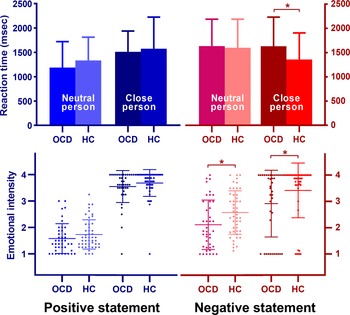
OCD patients exhibited a longer response time than the HCs in the NS/CP condition. However, there were no differences in the other three conditions. OCD patients also demonstrated lower emotional intensity than the control group in both NS TAF conditions, with no differences for the PS conditions (Fig. 1).
Results of behavioral data. Patients with OCD exhibited a longer response time in the NS/CP condition and lower emotional intensity in the NS/CP and the NS/NP conditions than did the healthy controls (HCs). There were no group differences in any variables in the other conditions.

Selection of ROIs based on MVPA
MVPA was conducted to select ROIs that might discriminate against the OCD patients from the HCs during the four TAF task conditions. Several areas of the frontal and temporal cortex, thalamus, insula, middle cingulate cortex (MCC), and precuneus were selected as ROIs in our analysis (FDR-corrected p < 0.05). ROI details are described in online Supplemental Table S3.
FC group differences under the conventional TAF condition
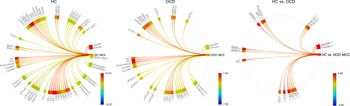
We hypothesized that the NS/CP condition would most likely evoke TAF because it is the most similar to conventional TAF experiments. Under this condition, both groups demonstrated significant FC from the identified ROIs to the visual association areas, including the lateral occipital cortices and fusiform gyri; components of the default mode network (DMN), including the precuneus; subcortical regions, including the thalamus and putamen; and affective processing regions, including the amygdala and insula (FDR-corrected p < 0.05, Fig. 2). However, in general, the OCD patients showed sparser brain FC patterns compared to the HCs. Moreover, functional interactions between the ROIs and brain hubs associated with affective information processing, including the cingulate gyrus, amygdala, and insula, were stronger in the HCs than in the OCD patients (FDR-corrected p < 0.05). Complete FC patterns for each condition are presented in online Supplemental Figs. S3–S6. Most of the significant FC differences were confirmed by MANOVA using F-tests (online Supplemental Fig. S7). Detailed effect sizes for these group differences are presented in online Supplemental Fig. S8.
FC for the midcingulate cortex. The FC for the midcingulate cortex (MCC) in OCD (left panel) and HC (middle panel) individuals in the NS/CP condition. OCD patients showed reduced FC with the hub regions associated with affective information processing, including the cingulate cortex and insula (right panel). Abbreviations (clockwise from the MCC) for the right panel: PT, planum temporale; PP, planum polare; PO, parietal operculum; CO, central opercular cortex; AC, anterior cingulate gyrus; SMA, supplementary motor cortex; SMG, supramarginal gyrus; SPL, superior parietal lobule; CG, central gyrus. A full list of abbreviations is provided in online Supplemental Table S4.

Characteristic FC patterns within affective or CSTC networks across the four TAF conditions
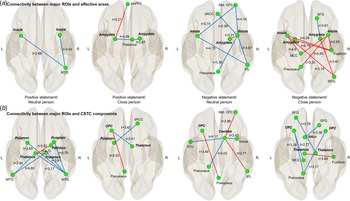
To narrow down the many significant FC results, we focused on the affective and CSTC networks to identify the possible neural circuitry underlying TAF. The affective network patterns are presented in Fig. 3a. Overall, scenarios with a PS or NP that produced relatively low TAF or affective conditions resulted in increased FC between the ROIs and the amygdala or insular regions in the OCD patients compared to the HCs (FDR-corrected p < 0.05). Notably, this pattern was dramatically reversed in the NS/CP condition, wherein the HCs showed greater FC between more brain region pairs than the OCD patients. These included the MCC–bilateral insula, right middle temporal gyrus (MTG)–right amygdala, right MTG–left insula, right insula–left precuneus, and right fusiform–bilateral insula connections (FDR-corrected p < 0.05).
FC to affective networks and CSTC tracts. In the conventional TAF condition (NS/CP), the HCs showed greater connectivity with affect-related brain regions, including the insula and amygdala (red or dashed lines), while OCD patients exhibited enhanced FC with CSTC tracts, including the thalamus, nucleus accumbens, and OFC (blue or solid lines). Identified (seed) ROIs are marked in bold and italics.

In contrast to the affective network, the ROIs identified in the NS/CP condition were highly connected to the CSTC loop components in OCD patients (Fig. 3b). Comparing the groups in the NS/CP condition revealed greater FC in the OCD patients in the left precuneus–bilateral orbitofrontal cortex (OFC), left superior frontal gyrus (SFG)–right thalamus, right SFG–left nucleus accumbens, and left OFC–left MCC connections, whereas the HCs had greater FC only in the left thalamus–right fusiform connection (FDR-corrected p < 0.05).
Relationship between FC and psychological measurements
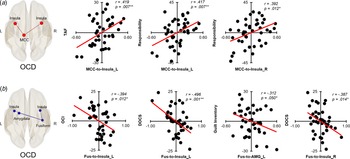
Within the OCD patients, the MCC–left insula FC was positively correlated with scores for TAF (r = 0.419, p = 0.007) and responsibility (r = 0.417, p = 0.007). The MCC–right insula connection was also positively correlated with responsibility (r = 0.392, p = 0.012). Furthermore, guilty feelings were negatively correlated with the right fusiform–left amygdala connection (r = −0.312, p = 0.05) and OC symptoms were negatively correlated with the right fusiform–insula connection (all p < 0.05; Fig. 4). However, no significant correlations were observed between FC and psychological measurements in the HC group. Note that the p values for the correlation analyses were not corrected. Fisher's r-to-z transformations revealed significantly different correlation strengths between the OCD patients and HCs for the MCC–left insula FC and TAF/responsibility, and the MCC–right insula FC and responsibility (all p < 0.05; online Supplemental Table S5).
Correlation between FC and psychological measures. In patients with OCD, the midcingulate cortex (MCC)–insula connection had a positive correlation with TAF and responsibility (A). The fusiform (Fus) gyrus–insula and fusiform (Fus) gyrus–amygdala (AMG) connections showed a negative association with OC symptoms and guilt, respectively (B).

Discussion
The conventional TAF condition (NS/CP) generated significant FC between the identified ROIs and visual association areas, DMN subregions, affective processing regions, and several subcortical structures in both groups, but sparser FC pairings were observed in the OCD patients compared to the HC group. Further analysis confined to the CSTC and affective networks demonstrated that, specifically in the NS/CP condition, OCD patients showed reduced ROI FC between affective regions and greater FC between CSTC components compared to the HCs. Moreover, the MCC–insula connection was positively correlated with TAF and responsibility in OCD patients. These findings suggest that abnormal engagement of affective and CSTC networks in OCD patients during TAF is context-dependent. To the best of our knowledge, this is the first study to investigate neural FC associated with TAF in OCD patients.
The behavioral data presented in this study revealed notable response differences evoked by the two NS TAF conditions in each group. The HCs had quicker responses and more consistently rated how bad they felt as ‘very much’ under the CP condition compared to the NP condition. This difference was not observed in OCD patients; their response times did not decrease and their emotional intensity ratings were broadly distributed, with 11 patients even rating how bad they felt as ‘very little.’ The patients may have had difficulty realistically accepting the uncomfortable, yet important, situation and were overly dependent on cognitive evaluation, resulting in delayed response time and low emotional intensity ratings. TAF may also underlie this coping response in an effort to prevent harm to others (Amir, Freshman, Ramsey, Neary, & Brigidi, Reference Amir, Freshman, Ramsey, Neary and Brigidi2001).
This study identified several important OCD-related brain regions, including several areas of the frontal and temporal cortex, anterior and mid-cingulate cortex, precuneus, insula, and thalamus. These are similar to regions identified in previous MVPA research on OCD patients, even though the tasks and imaging modalities differed. For example, two previous fMRI studies using an emotion-induction task revealed the OFC (Weygandt et al., Reference Weygandt, Blecker, Schafer, Hackmack, Haynes, Vaitl and Schienle2012) and middle temporal gyri (Fontenelle et al., Reference Fontenelle, Frydman, Hoefle, Oliveira-Souza, Vigne, Bortolini and Moll2018) as important OCD brain regions. The cingulate is the most consistently implicated region in MVPA studies that utilize features derived from functional data (Bruin, Denys, & van Wingen, Reference Bruin, Denys and van Wingen2019). In addition, the precuneus, the functional core of the DMN, has been identified as an important OCD-related region in resting-state (Takagi et al., Reference Takagi, Sakai, Lisi, Yahata, Abe, Nishida and Tanaka2017) and task-dependent (Shenas, Halici, & Cicek, Reference Shenas, Halici and Cicek2014) fMRI research.
One of the most intriguing findings in this study was that the conventional TAF condition (NS/CP) produced FC patterns that were distinct from the other three conditions in the OCD patients. In general, OCD patients showed reduced FC across most couplings in the conventional TAF condition compared to HCs, whereas FC differences between the two groups were less evident in the other conditions. In particular, the OCD patients exhibited weaker FC within the affective network and greater FC within the CSTC loop in the conventional TAF condition. Thus, patients with OCD may have difficulty in recruiting a tightly bonded affective network and may maintain or overuse the CSTC loop when they appraise a negative situation involving a CP. In fact, a recent fMRI study reported abnormal amygdala–prefrontal connectivity during the appraisal of symptom-related stimuli relative to generally aversive stimuli, supporting that affective OCD models can be integrated into the functional neuroanatomy of OCD (Paul et al., Reference Paul, Beucke, Kaufmann, Mersov, Heinzel, Kathmann and Simon2019). Our findings also suggest that patients with OCD may disproportionately rely on cognitive information and use fewer affective resources during scenarios that require TAF. In fact, the patients in this study exhibited delayed responses (i.e. obsessive slowness) and a broad range of emotional responses in the conventional TAF condition. This may suggest that they were analyzing the TAF situation involving a CP as deliberately as they would with an NP.
MCC–insula FC was significantly lower in the OCD patients compared to the HCs in the conventional TAF condition. It was also positively correlated with TAF and responsibility scores within the OCD patients. Our ROI representing the MCC was located in the posterior cingulate cortex (PCC) (Vogt, Reference Vogt, Vogt and Gabriel1993). The PCC, a core component of the DMN, is associated with the integration of self-referential judgment (Whitfield-Gabrieli et al., Reference Whitfield-Gabrieli, Moran, Nieto-Castanon, Triantafyllou, Saxe and Gabrieli2011; Whitfield-Gabrieli & Ford, Reference Whitfield-Gabrieli and Ford2012), whereas the anterior insula is a major hub for integrating interoceptive information (Kleckner et al., Reference Kleckner, Zhang, Touroutoglou, Chanes, Xia, Simmons and Barrett2017) and evaluating stimuli salience as a component of the salience network (SN) (Menon & Uddin, Reference Menon and Uddin2010). In line with our results, previous studies using resting-state fMRI analysis have reported reduced SN–DMN connectivity (Beucke et al., Reference Beucke, Sepulcre, Eldaief, Sebold, Kathmann and Kaufmann2014; Chen et al., Reference Chen, Li, Lv, Zhu, Wang, Meng and Li2018; Gursel, Avram, Sorg, Brandl, & Koch, Reference Gursel, Avram, Sorg, Brandl and Koch2018), indicating that the cognitive inflexibility associated with OCD may be related to SN dysfunction while engaging the task-positive central executive network and disengaging the task-negative DMN (Gursel et al., Reference Gursel, Avram, Sorg, Brandl and Koch2018). In addition, our results suggest that over-engagement of the impaired SN–DMN connection may paradoxically increase the TAF response in OCD patients, but not in HCs. We speculate that the SN may abnormally activate the DMN. In turn, this may excessively arouse self-referential emotions (Zinck, Reference Zinck2008), such as feelings of guilt, which are an important TAF component.
Conversely, the fusiform–insula and fusiform–amygdala FCs were negatively correlated with OC symptoms and guilt in this study. The fusiform gyrus and amygdala are structurally connected via the inferior longitudinal fasciculus (Amaral, Reference Amaral2002) and are functionally co-activated during emotional facial processing during direct observation of facial stimuli (Vuilleumier, Armony, Driver, & Dolan, Reference Vuilleumier, Armony, Driver and Dolan2001) and facial recollection (Fenker, Schott, Richardson-Klavehn, Heinze, & Duzel, Reference Fenker, Schott, Richardson-Klavehn, Heinze and Duzel2005). Thus, the connection with the fusiform gyrus may be related to processing the social or emotional context of the provided stimuli (Dziobek, Bahnemann, Convit, & Heekeren, Reference Dziobek, Bahnemann, Convit and Heekeren2010; Miyahara, Harada, Ruffman, Sadato, & Iidaka, Reference Miyahara, Harada, Ruffman, Sadato and Iidaka2013). In our study, the OCD patients demonstrated reduced FC in the affective network during the conventional TAF condition. However, OCD patients with increased emotional circuitry activation, such as fusiform–amygdala FC, reported lower OC symptoms and guilt. Taken together, we believe that excessive cognitive processing associated with the CSTC loop and aberrant affective responses associated with the affective network may lead OCD patients to become preoccupied with erroneous TAF beliefs.
These findings have several important implications. First, we believe that our cognitive TAF paradigm clearly demonstrated an imbalanced role of the CSTC and affective circuits in OCD functional neuroanatomy. Though previous studies have identified diminished amygdala–prefrontal connectivity during symptom-provoking stimuli (Paul et al., Reference Paul, Beucke, Kaufmann, Mersov, Heinzel, Kathmann and Simon2019) and emotion–regulation tasks (de Wit et al., Reference de Wit, van der Werf, Mataix-Cols, Trujillo, van Oppen, Veltman and van den Heuvel2015), our TAF paradigm has more practical applications because TAF statements are simple, straightforward, and less symptom-dependent (Lee et al., Reference Lee, Cha, Chung, Kim, Song, Chang and Lee2019). The appropriateness of stimuli used in fMRI research has long been a concern due to the heterogeneity of OCD. In particular, symptom-provoking stimuli can be too specific and less generalizable, whereas emotional regulation tasks face the opposite problem. Second, this study revealed context-dependent abnormal FC patterns in OCD patients, especially at the brain network level. In the positive TAF conditions, both groups exhibited similar behavioral and FC responses. However, the OCD patients showed distinct FC patterns in the negative TAF conditions, particularly in their appraisal of the NS/CP TAF scenarios. These dynamic FC changes indicate that the CSTC loop and affective circuit may have a more complicated connection in OCD. These results may partially explain the inconsistencies observed in emotional processing brain circuitry in OCD. Furthermore, they emphasize the need for a network-level understanding of OCD using appropriate stimuli for fMRI research. Third, these findings may assist in the development of a conceptual understanding of TAF. Dysfunctional TAF beliefs may result from impairments in recruiting affective brain networks. In the same context, our results suggest a biological mechanism for the ‘isolation of affect.’ This is a classical defense mechanism in OCD wherein emotion is detached from an idea, leaving the idea bland and emotionally flat when subject to psychoanalysis. This evidence also supports the idea that TAF may be more exaggerated under negative v. positive situations, so the initial elimination of positive items from the TAF scale was justified because they are less relevant to OCD (Shafran et al., Reference Shafran, Thordarson and Rachman1996). Moreover, our study found that the conventional TAF condition reduced FC in the OCD patients between the MTG, an important component of the semantic network (Binder, Desai, Graves, & Conant, Reference Binder, Desai, Graves and Conant2009) and the DMN (Raichle et al., Reference Raichle, MacLeod, Synder, Power, Gusnard and Shulman2001), as well as reduced affective network FC across the cingulate cortex, amygdala, and insula (online Supplemental Fig. S3). These results further support that OCD patients show detached emotional responses.
Despite the contributions described above, there are several limitations to our study. First, although one-third of the patients were drug-free during the experiment, we cannot completely exclude the possibility that medication affected our results (McCabe & Mishor, Reference McCabe and Mishor2011; Schaefer et al., Reference Schaefer, Burmann, Regenthal, Arelin, Barth, Pampel and Sacher2014). This small number of drug-naïve patients was not sufficient to reveal drug effects. Previous investigations of medication effects have been mixed, including no significant treatment effect observed, and are difficult to reconcile due to clinical and methodological diversity (van der Straten, Denys, & van Wingen, Reference van der Straten, Denys and van Wingen2017). Second, habituation effects in the present study could have weakened brain responses during the PS conditions, which always followed the NS conditions. However, we believe that the conventional TAF response is the primary condition necessary for understanding the biological mechanisms underlying cognitive distortion in OCD patients and that our results support this assumption. Third, our sample was predominately male, and their responses may not reflect the characteristics of female subjects. However, previous literature has found little evidence for differences in obsessive beliefs between the sexes, suggesting that these beliefs may not be dependent on demographic characteristics (Tripathi et al., Reference Tripathi, Avasthi, Grover, Sharma, Lakdawala, Thirunavukarasu and Reddy2018).
In conclusion, this study is the first to report FC differences between OCD patients and HCs using a cognitive model based on the TAF paradigm. Our TAF paradigm revealed different brain network recruitment in OCD patients. In particular, we observed a context-dependent imbalance in the engagement of the CSTC and affective networks. We believe that these results provide important biological insights by detailing a connection between cognitive distortion, brain network changes, and OCD symptoms.
Supplementary material
The supplementary material for this article can be found at https://doi.org/10.1017/S0033291720003980
Acknowledgements
We thanks to Mina Choi and members involved in BMRlab to support our experiments.
Financial support
This work was supported by the National Research Foundation of Korea (NRF) grant funded by the Korea government (MSIP) (NRF-2018R1A2B6007374).
Conflicts of interest
The authors declare that there is no conflict of interest.
Ethical standards
The present study was performed in agreement with the Declaration of Helsinki and its further amendments. The study is approved by the Institutional Review Board of Kyungpook National University Hospital (2018–04-029)