Introduction
Gestational depression is a common mental disorder and represents an important clinical and public health issue, increasing the risk of adverse outcomes for the mother and the newborn, including postpartum depression (PPD) and low birth weight (Pereira et al. Reference Pereira, Lovisi, Lima, Legay, de Cintra Santos, Santos, Thiengo and Valencia2011; Bauer et al. Reference Bauer, Pawlby, Plant, King, Pariante and Knapp2015). The prevalence of depression varies during pregnancy trimesters, according to the population, and according to the diagnostic tool used (Bennett et al. Reference Bennett, Einarson, Taddio, Koren and Einarson2004; Gavin et al. Reference Gavin, Gaynes, Lohr, Meltzer-Brody, Gartlehner and Swinson2005; Pereira et al. Reference Pereira, Lovisi, Lima, Legay, de Cintra Santos, Santos, Thiengo and Valencia2011). Banti et al. (Reference Banti, Mauri, Oppo, Borri, Rambelli, Ramacciotti, Montagnani, Camilleri, Cortopassi, Rucci and Cassano2011) evaluated 1066 Italian women and found a prevalence of 12.4% in three points during pregnancy (third, sixth and eighth month of pregnancy). A systematic review reported that around 20% of the pregnant women living in developing countries (including Brazil) are affected by depression during pregnancy (Pereira et al. Reference Pereira, Lovisi, Lima, Legay, de Cintra Santos, Santos, Thiengo and Valencia2011).
The literature concerning how serum polyunsaturated fatty acids (PUFAs) change throughout pregnancy has been poorly characterised. A recent study reveals a pattern of change characterised by an increase in the first period (1st to 2nd trimester) followed by a slight increase in the second period (2nd to 3rd trimester). The authors observed a tendency for concentrations to stabilise or for the rate of increase to slow between the second and third trimesters. The n-6/n-3 ratio showed a lower rate of increase from the 1st to the 2nd trimester compared with the rate in the second period (Pinto et al. Reference Pinto, Farias, Rebelo, Lepsch, Vaz, Moreira, Cunha and Kac2015).
Depressive disorders during pregnancy have a multifactorial aetiology and epidemiological studies find associations between demographic and psychosocial factors such as women's age, previous history of depression, marital status and unplanned pregnancy on gestational depression (Rich-Edwards, Reference Rich-Edwards2006; Pereira et al. Reference Pereira, Lovisi, Pilowsky, Lima and Legay2009; Räisänen et al. Reference Räisänen, Lehto, Nielsen, Gissler, Kramer and Heinonen2014). PUFAs intake has been associated with depressive symptoms in major depressive patients, but results on PPD are controversial (Grosso et al. Reference Grosso, Pajak, Marventano, Castellano, Galvano, Bucolo, Drago and Caraci2014a ). In fact, only recently the association between biomarkers of PUFAs consumption and occurrence of depression during pregnancy has been investigated (Das, Reference Das2008). The role of PUFAs is an active area of research in that they are hypothesised to modulate important monoamine neurotransmitters, such as serotonin and dopamine, which are involved in the neurophysiology of depression and others mental illness (Levant, Reference Levant2013; Su et al. Reference Su, Wang and Pae2013, Reference Su, Matsuoka and Pae2015). Moreover, n-3 and n-6 PUFAs have been hypothesised to exert anti- and pro-inflammatory actions, respectively, which may influence the inflammatory status characterising depressive disorders (Grosso et al. Reference Grosso, Galvano, Marventano, Malaguarnera, Bucolo, Drago and Caraci2014b ). In the current study, we hypothesised that the concentration of n-3 PUFAs are negatively associated with depressive symptoms while n-6 PUFAs are positively associated with depressive symptoms throughout pregnancy.
Recent studies have evaluated the association between the serum levels of PUFAs or the phospholipid fatty acids (FA) composition and depressive disorders during pregnancy; however, the results are contradictory and inconclusive (Rees et al. Reference Rees, Austin, Owen and Parker2009; Bodnar et al. Reference Bodnar, Wisner, Luther, Powers, Evans, Gallaher and Newby2012; Sallis et al. Reference Sallis, Steer, Paternoster, Davey Smith and Evans2014; Shiraishi et al. Reference Shiraishi, Matsuzaki, Yatsuki, Murayama, Severinsson and Haruna2015). Parker et al. (Reference Parker, Hegarty, Granville-Smith, Ho, Paterson, Gokiert and Hadzi-Pavlovic2014) evaluated 895 Australian women and found that, at the 36th week of pregnancy, depressed women presented significant lower concentrations of total n-3, docosahexaenoic acid (DHA), DHA plus eicosapentaenoic acid (EPA) and higher n-6/n-3 ratio, compared with those without depression. In contrast, Bodnar et al. (Reference Bodnar, Wisner, Luther, Powers, Evans, Gallaher and Newby2012) in a sample of 135 American women did not find any significant association between arachidonic acid (AA), DHA or EPA concentrations and major depressive disorder during pregnancy.
Considering the importance of maternal mental health and the high prevalence of depressive disorders during pregnancy, and the lack of consensus concerning their association with PUFAs, the aim of this study was to evaluate the association between maternal serum concentrations of n-3 and n-6 PUFAs and depressive symptoms in a group of Brazilian women followed throughout pregnancy.
Methods
Study protocol and design
This study is based on a prospective observational cohort of pregnant women, who were followed at a public health care centre, located in Rio de Janeiro, Brazil. Women were invited to participate in this study if they met the following eligibility criteria: (i) between 5 and 13 weeks of gestation at the time of enrolment; (ii) between 20 and 40 years of age; (iii) free from any known chronic diseases (other than obesity); (iv) residing in the study catchment area; and (v) intending to continue prenatal care in the public health centre. The study consisted of three follow-up waves: at 5–13 (baseline), 20–26 and 30–36 gestational weeks. A total of 299 pregnant women underwent screening between November/2009 and October/2011.
Women were excluded if they presented more than 13 gestational weeks (n = 15) at enrolment, were diagnosed with an infectious (n = 9) or non-communicable disease (n = 12), presented twin pregnancies (n = 4), reported a miscarriage in current pregnancy (n = 25), currently used antidepressants (n = 3), did not have depressive symptoms assessments in the first trimester or presented missing data for confounders variables at baseline (n = 12), and did not have information for FA at some point during pregnancy (n = 42). We also excluded outlier subjects based on the visual graphical analyses of the FA evaluated (n = 5). The sample at the baseline, after exclusions, was comprised of 172 healthy pregnant women.
In the second trimester, a subsample of 41 women identified as being at risk for PPD [as evidenced by a possible history of depression or by a score 9 on the Edinburgh Postnatal Depression Scale (EPDS) at the baseline] were invited to participate in a clinical trial nested within the main cohort. This sub-study aimed to test the efficacy of omega-3 supplementation during pregnancy to prevent depressive symptoms during the postpartum period. These women were randomly assigned after the second follow-up visit to receive gelatin capsules containing either omega-3 (fish oil) or placebo, composed by soybean oil, the most commonly used cooking oil in the Brazilian population (Levy et al. Reference Levy, Claro, Mondini, Sichieri and Monteiro2012). The capsules for the treatment group contained a total dosage of 1.8 g of omega-3 per day. Considering the main objective of the present study, we excluded from the third trimester analyses all women who received supplements, regardless of their treatment group. Detailed information on the analytical approach to cope with the clinical trial was extensively described in Teofilo et al. (Reference Teofilo, Farias, Pinto Tde, Vilela, Vaz, Nardi and Kac2014).
Depressive symptoms
The EPDS was administered by trained interviewers and was used to measure depressive symptoms during each pregnancy trimester. Cox et al. (Reference Cox, Holden and Sagovsky1987) developed the EPDS to investigate the depressive symptoms in the postpartum period. The instrument contains ten-items that inquire about the mother's mood in the past 7 days. Each item of EPDS has four answer options that are assigned a score from 0 to 3 (total scores range from 0 to 30). Murray & Cox (Reference Murray and Cox1990) validated this scale for use in pregnancy.
In Brazil, the EPDS was translated into Portuguese and validated in a sample of mothers from Pelotas, southern Brazil (Santos et al. Reference Santos, Matijasevich, Tavares, Barros, Botelho, Lapolli, Magalhães, Barbosa and Barros2007). These authors observed that the cut-off point ≥11 (83.8% of sensitivity and 74.7% of specificity) performed better for screening moderate and severe cases of PPD. Therefore, the depressive symptoms in the current study were dichotomised as EPDS scores <11 v. ≥11.
Fatty acids analysis
Fasting blood samples (5 ml) were collected by a technician during all three gestational trimesters using vacutainer tubes containing separator gel. Women were advised to fast for 12 h. After blood was drawn, samples were centrifuged for 5 min (5000 rpm) and serum was separated and stored at −80°C for approximately 2 years prior to analysis.
The serum samples were shipped in dry ice to the Section of Nutritional Neurosciences, Laboratory of Membrane Biochemistry and Biophysics of the National Institute on Alcohol Abuse and Alcoholism of the National Institutes of Health (NIH), where the FA composition of serum was determined. The FA composition was analysed by a trained technician using a high-throughput robotic direct methylation method coupled with fast gas-liquid chromatography developed and validated by the NIH. This method showed an inter-assay variance of <5%, as previously described (Masood & Salem, Reference Masood and Salem2007; Lin et al. Reference Lin, Salem, Wells, Zhou, Loewke, Brown, Lands, Goldman and Hibbeln2012).
The concentrations of n-3 [α-linolenic acid (18 : 3 n-3); EPA (20 : 5 n-3); docosapentaenoic acid (22 : 5 n-3; DPA) and DHA (22 : 6 n-3)] and n-6 PUFAs [linoleic acid (18 : 2 n-6); γ linolenic acid (18 : 3 n-6); eicosadienoic acid (20 : 2 n-6); eicosatrienoic acid (20 : 3 n-6); AA (20 : 4 n-6); docosatetraenoic acid (22 : 4 n-6); docosapentaenoic acid (22 : 5 n-6)] were expressed as absolute (μg/ml) values. The total n-6/total n-3 ratio was calculated.
Covariates assessment
A structured questionnaire was administered at baseline to collect the following information: age (years), schooling (years), previous history of depression (no/yes), marital status (married or stable partnership/single), smoking habit (no/yes), alcohol consumption (no/yes), monthly per-capita family income (American dollars), inter-partum interval (nulliparous and ≥48 months/<48 months) and planned pregnancy (no/yes). Possible previous history of depression was ascertained based on self-reported feelings of loss of interest/pleasure in almost all activities nearly every day for a period of two consecutive weeks.
The pre-pregnancy body mass index (BMI) was determined from self-reported pre-pregnancy weight and measured height at baseline. The height was collected in duplicate using a portable stadiometer (Seca Ltd., Hamburg, Germany). This measure was performed according to standardised procedures and was recorded by the trained interviewers (Lohman et al. Reference Lohman, Roche and Martorell1988).
Statistical analysis
Means and standard deviations (s.d.) (for continuous variables) and proportions (for categorical variables) were used to describe socioeconomic, demographic, and anthropometric characteristics in the baseline, and FA concentration, at each follow-up visit. Both analyses were stratified by depressive symptoms (<11 v. ≥11). Comparisons between groups were performed using Student's t test or χ 2 test for proportions.
We detected a potential correlation between the FA (time-dependent variables) and the binary response (depressive symptoms) in the exploratory analysis. We observed that the probability of depressive symptoms tended to decrease with increasing gestational age, while the FA concentration increased as pregnancy progresses. To evaluate the association between longitudinal serum FA concentration and depressive symptoms during pregnancy, we employed a random intercept logistic regression model, which considers the correlation structure between the measures in a same woman during time. The time-dependent variables (n-3 and n-6 FA) included in the model were decomposed into two terms to facilitate their interpretation. The parameter associated to the first term (x̄ 1i ) represents the variation ‘between’ individuals (with respect to the variation of the independent variable in a subject compared with another subject) and the parameter associated with the second term (x 1i −x̄ 1i ) the variation ‘within’ individuals (representing the effect of the independent variable variation within a subject on changes in depressive symptoms classification during pregnancy) (Lalonde et al. Reference Lalonde, Nguyen, Yin, Irimata and Wilson2013). In the first term, we calculated the mean FA values for each woman and in the second term we subtracted the FA concentration from their mean values. The parameters associated to the first and to the second terms were included in a same model. Univariate and adjusted random intercept logistic model were estimated for each FA.
To select potential confounders, we have considered the covariates mentioned above (covariates assessment section) based on their biological plausibility of having an association with the concentration of FA and depressive symptoms during pregnancy. These covariates were assessed using longitudinal univariate logistic regression models that included individual confounders and the outcome. The individual confounders with p-value <0.2 were included in the full model. The variables with p-value >0.05 were removed from the model in descending order of p-value.
Gestational age was considered as a time-dependent variable (variables that varied throughout pregnancy), while previous history of depression, planned pregnancy, pre-pregnancy BMI, marital status and inter-partum interval were considered as time-independent variables. These variables were statistically significant and kept in the final model. In additional analyses, we categorised EPDS as ≥12 and ≥13.
We compared key variables between women who participated in the entire study and those who were lost to follow-up. The Student's t test or the χ 2 test for proportion was used to assess patterns of loss to follow-up.
Statistical analyses were performed with Stata version 12.0 and R version 3.1. A p-value <0.05 was considered significant.
Results
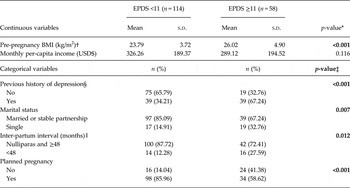
Baseline results revealed that women with depressive symptoms presented higher pre-pregnancy BMI [26.0 (s.d. = 4.9) v. 23.8 (s.d. = 3.7) kg/m2] compared with those without symptoms at baseline. We also observed a higher frequency of possible previous history of depression (67.2 v. 34.2%), single marital status (32.8 v. 14.9%), inter-partum interval <48 months (27.6 v. 12.3%) and unplanned pregnancy (41.4 v. 14.0%) in women with depressive symptoms compared with those without (Table 1). The prevalence of depressive symptoms at the first, second and third pregnancy trimesters were: 33.7% (n = 58/172), 18.9% (n = 32/169) and 17.4% (n = 24/138), respectively (data not shown).
Baseline characteristics of pregnant women with and without depressive symptoms followed at a public health centre in Rio de Janeiro, Brazil, 2009–2012

EPDS, Edinburgh Postnatal Depression Scale; s.d., standard deviation; BMI, body mass index; PUFAs , polyunsaturated fatty acids.
* p-value statistical significance based on Student's t test.
† Pre-pregnancy BMI was calculated based on the pre-pregnancy weight reported by the mother, at the study baseline.
‡ p-value statistical significance based on the χ 2 test.
§ Nine women did not have information about pre-pregnancy BMI – five in EPDS group <11 and four in the EPDS group ≥11.
‖ Three women did not respond to questions on the monthly per-capita income – three in EPDS group <11.
The significance of bold values is p < 0.05.
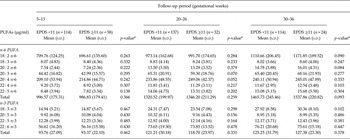
We did not find differences in means FA concentrations by depressive symptom classification, for each follow-up visit (Table 2).
Characteristics of pregnant women with and without depressive symptoms per waves of follow-up assessed at a public health centre in Rio de Janeiro, Brazil, 2009–2012

EPDS, Edinburgh Postnatal Depression Scale; s.d., standard deviation; PUFAs, polyunsaturated fatty acids.
* p-value statistical significance based on Student's t test.
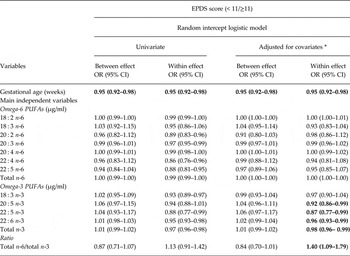
We observed a 5% decrease (95% CI: 0.92–0.98) in the odds of having depressive symptoms for each one-week increase in gestational age. The association between FA and depressive symptoms was attenuated after controlling for potential confounders. However, it remained statistically significant. As individual women progressed through pregnancy, higher concentrations of EPA (OR = 0.92; 95% CI: 0.86–0.99), DHA (OR = 0.96; 95% CI: 0.93–0.99), n-3 DPA (OR = 0.87; 95% CI: 0.77–0.99) and total n-3 (OR = 0.98; 95% CI: 0.96–0.99) were associated with a lower odds of depressive symptoms, while higher n-6/n-3 ratio was associated with a greater odds of depressive symptoms during pregnancy (OR = 1.40; 95% CI: 1.09–1.79). No associations were found between n-6 FA and the occurrence of depressive symptoms during pregnancy (Table 3).
Random intercept logistic model of n-6 and n-3 polyunsaturated FA and their associations with depressive symptoms measured prospectively in women followed at a public health centre in Rio de Janeiro, Brazil, 2009–2012

EPDS, Edinburgh Postnatal Depression Scale; PUFAs, polyunsaturated fatty acids.
* Adjusted for gestational age, previous history of depression, marital status, inter-partum interval, pre-pregnancy BMI and planned pregnancy, using logistic models with random intercept.
The significance of bold values is p < 0.05.
Note: In the first term, it was calculated the mean FA values for each woman and in the second term, it was subtracted the FA concentrations from their mean values.
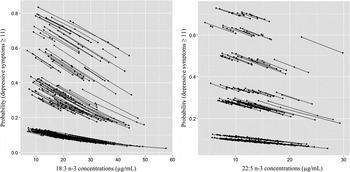
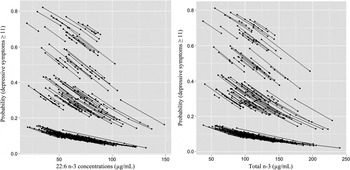
We detected a decrease in the probability of depressive symptoms as concentrations of n-3 FA (α-linolenic acid, DPA, DHA, total n-3) increased. We also observed a sharper decline for women with initial greater chance of depressive symptoms compared with those with lower chance of having these symptoms (Figs 1, 2).
Predicted probabilities of depressive symptoms according to 18:3 (α-linolenic) and 22:5 (docosapentaenoic) n-3 fatty acids concentrations in women followed at a public health center in Rio de Janeiro, Brazil, 2009–2012.
Note: Each line represents the estimated probability of depressive symptoms throughout pregnancy for each woman. The number of dots at each line corresponds to the number of observations throughout pregnancy.

Predicted probabilities of depressive symptoms according to 22:6 (docosahexaenoic) and total n-3 fatty acids concentrations in women followed at a public health center in Rio de Janeiro, Brazil, 2009–2012.
Note: Each line represents the estimated probability of depressive symptoms throughout pregnancy for each woman. The number of dots at each line corresponds to the number of observations throughout pregnancy.

In the analyses using the EPDS cut-offs ≥12 or ≥13 to classify the presence of depressive symptoms, we only found significant association for the term accounting for ‘within’ women variation. The DHA (OR = 0.96; 95% CI: 0.93–0.99), total n-3 (OR = 0.97; 95% CI: 0.95–0.99) and the n-6/n-3 ratio (OR = 1.37; 95% CI: 1.05–1.80) were significantly associated with depressive symptoms in the analysis using the EPDS cut-off ≥12. As for the cut-off ≥13, the n-6/n-3 ratio (OR = 1.40; 95% CI: 1.06–1.86) and the total n-3 (OR = 0.97; 95% CI: 0.95–0.99) were associated with depressive symptoms.
The final rate of loss to follow-up was 21.5% (37/172). The analysis of data from the study participants who were lost to follow-up showed no departure from randomness for any variables except for EPDS. Women who were lost to follow-up presented higher EPDS scores than those who remained in the study (online supplemental file Table S1), likely due to their participation in the clinical trial.
Discussion
The present study has three main findings. First, we observed that the pregnant women presented a high prevalence of depressive symptoms during pregnancy. Secondly, we observed that social, economic, nutritional and obstetric factors were strongly associated with depressive symptoms in our sample. Finally and more importantly, we observed that higher serum concentration of EPA, DHA, DPA and total n-3 were associated with lower odds of depressive symptoms when comparing the longitudinal change in the same individual during pregnancy, while the total n-6/n-3 ratio represented greater odds of depressive symptoms. Moreover, we observed that in women with depressive symptoms the negative association between DHA concentration and depressive symptoms was more pronounced. As far as we know, this is the first study that evaluated the association between repeated measures of FA and depressive symptoms in the same women during all pregnancy trimesters.
The present study has some limitations that should be addressed. The first is related to the loss to follow up, which is inherent to cohort studies. We observed a non-random loss to follow-up for women with EPDS score ≥11. The pregnant women were selected to participate in the clinical trial based on a possible past history of depression or EPDS score ≥9 in the baseline, which may explain the difference in EPDS scores between the women who completed the study and the loss to follow-up. Despite this potential bias, it is important to highlight the association found between n-3 PUFAs and depressive symptoms, which were observed even in healthy women with lower risk for depression. It is reasonable to think that our results are even stronger due to the loss of higher risk women. The second limitation is the potential for misclassification of the outcome. The EPDS is widely used by the majority of the studies around the world. Its wide use is a major advantage once enables the comparison of the current study with the previous ones, although this instrument has been considered prone to misclassification (Stuart et al. Reference Stuart, Couser, Schilder, O'Hara and Gorman1998; Gavin et al. Reference Gavin, Gaynes, Lohr, Meltzer-Brody, Gartlehner and Swinson2005; Husain et al. Reference Husain, Rahman, Husain, Khan, Vyas, Tomenson and Cruickshank2014). However, it is important to note that very few studies have investigated the EPDS sensitivity and specificity (Santos et al. Reference Santos, Matijasevich, Tavares, Barros, Botelho, Lapolli, Magalhães, Barbosa and Barros2007; Su et al. Reference Su, Chiu, Huang, Ho, Lee, Wu, Lin, Liau, Liao, Chiu and Pariante2007; Husain et al. Reference Husain, Rahman, Husain, Khan, Vyas, Tomenson and Cruickshank2014). A third limitation refers to the potential presence of residual confounding. We could not evaluate either FA concentrations or depressive symptoms prior to pregnancy, which did not allow us to measure the onset of depression nor the baseline FA profile. In contrast, there are important strengths in the present study especially with regard to the longitudinal assessment of FA status and depressive symptoms during pregnancy. Studies on depression during pregnancy with repeated measures and appropriate statistical analyses are scarce. The random intercept logistic regression model employed in the current study is appropriate as it accounts for the dependence between repeated observations and takes into consideration the longitudinal measure over pregnancy of both FA and depressive symptoms.
Pinto et al. (Reference Pinto, Farias, Rebelo, Lepsch, Vaz, Moreira, Cunha and Kac2015) have analysed PUFAs trends throughout pregnancy in a previous paper based on data from the same cohort. These authors observed that total n-6 and n-3 PUFAs and DHA concentrations increased significantly throughout pregnancy. The n-6/n-3 ratio trend revealed a lower rate of increase from the 1st to the 2nd trimester compared with the rate in the second period. The mean EPA concentrations were constant from the 1st to the 2nd trimester and decreased significantly from the 2nd to the 3rd trimester. A previous study of Stewart et al. (Reference Stewart, Rodie, Ramsay, Greer, Freeman and Meyer2007) found an increase in the FA composition during pregnancy (mean gestational weeks of 12.5, 26.1 and 35.5) in a sample of 47 healthy women. They observed a less evident rise at the end of gestation, which is in line with the pattern of change described in the study of Pinto et al. (Reference Pinto, Farias, Rebelo, Lepsch, Vaz, Moreira, Cunha and Kac2015). We did not detect differences in the mean PUFAs concentrations at each follow-up visit, stratifying by depressive symptoms classification. These findings are in accordance with the results from the random intercept logistic model, which identified a longitudinal association between PUFAs and depressive symptoms ‘within’ individuals.
We observed that each one-unit increase in EPA, DHA, DPA or total n-3 was associated with a 8.0, 4.0, 13.0 or 2.0% reduction in the odds of depressive symptoms when comparing the longitudinal change in the same individual during pregnancy, respectively, while one-unit increase in the total n-6/n-3 ratio represented a 40.0% greater odds of depressive symptoms. Other studies have evaluated the association of n-6/n-3 ratio and n-3 FA with depressive disorders, with mixed results and diversified methodological approaches (Su et al. Reference Su, Huang, Chiu, Huang, Huang, Chang and Pariante2008; Rees et al. Reference Rees, Austin, Owen and Parker2009; Bodnar et al. Reference Bodnar, Wisner, Luther, Powers, Evans, Gallaher and Newby2012; Sallis et al. Reference Sallis, Steer, Paternoster, Davey Smith and Evans2014; Shiraishi et al. Reference Shiraishi, Matsuzaki, Yatsuki, Murayama, Severinsson and Haruna2015). Rees et al. (Reference Rees, Austin, Owen and Parker2009) assessed n-3 and n-6 PUFAs in plasma phospholipids and found lower and statistically significant per cent of total n-3 and DHA and higher n-6/n-3 ratio in depressed women (n = 16) compared with non-depressed controls (n = 22), all in the third trimester of pregnancy. A cross-sectional study of Shiraishi et al. (Reference Shiraishi, Matsuzaki, Yatsuki, Murayama, Severinsson and Haruna2015) evaluated 329 women between 19 and 23 weeks’ gestation and identified a negative association between plasma concentrations of DHA and depressive symptoms. The results of both studies corroborate our findings. However, a longitudinal study with 135 pregnant women failed to find association between essential FA assessed in red blood cells (at approximately 20 weeks of gestation) and occurrence of major depressive disorder (at 20th, 30th and 36th week) (Bodnar et al. Reference Bodnar, Wisner, Luther, Powers, Evans, Gallaher and Newby2012). In that study, the FA were assessed only in the second trimester and a principal component analysis was used to obtain a factor score combining AA, EPA and DHA. This methodological approach and the presence of a unique measure of FA may explain the differences between this particular longitudinal study and our results.
The n-3 and n-6 FA participates in the same metabolic chain. Therefore, their anti- and pro-inflammatory actions, respectively, depend on the balanced amount of each FA precursor and/or product (Arterburn et al. Reference Arterburn, Hall and Oken2006). The estimated dietetic n-6/n-3 ratio for occidental populations varies between 10 : 1 and 20 : 1, which is incredible higher than the 4 : 1 ratio considered ideal for the major conversion of the α-linolenic acid (18 : 3 n-3) to DHA (Simopoulos, Reference Simopoulos2000; Da Rocha & Kac, Reference Da Rocha and Kac2012; Grosso et al. Reference Grosso, Pajak, Marventano, Castellano, Galvano, Bucolo, Drago and Caraci2014a , Reference Grosso, Galvano, Marventano, Malaguarnera, Bucolo, Drago and Caraci b ). In this context, the interest on the investigation of the n-6/n-3 ratio is guided by the described association between high n-6/n-3 ratio and raised concentrations of pro-inflammatory eicosanoids produced from the metabolism of AA, which favours the development of inflammatory diseases such as depression (Simopoulos, Reference Simopoulos2002; Kiecolt-Glaser et al. Reference Kiecolt-Glaser, Belury, Porter, Beversdorf, Lemeshow and Glaser2007; Da Rocha & Kac, Reference Da Rocha and Kac2012).
We have not identified studies that find associations between n-3 DPA and depressive disorders. However, Hamazaki et al. (Reference Hamazaki, Hamazaki and Inadera2013) found decreased n-3 DPA content in the post-mortem entorhinal cortex from patients with major depressive disorder (n = 15) compared with controls (n = 15). In addition, beneficial effects of this n-3 FA, e.g., reduced inflammation and increased neuroprotective effects in rats, have been reported (Kaur et al. Reference Kaur, Cameron-Smith, Garg and Sinclair2011), suggesting the need of experimental and observational studies in humans and pregnant women.
Our results suggest that the associations between increases in DHA and DPA content and reduction in depressive symptoms may represent a biologically plausible relationship because the association persists after control for a variety of potentially confounding variables. Other studies have investigated the neurobiological mechanisms underlying the association between low levels of PUFAs and depressive disorders (Shapiro et al. Reference Shapiro, Fraser and Séguin2012; Levant, Reference Levant2013). An extensive literature review suggested that alterations in the n-3 PUFAs status may be related to decreased activity of important neurotransmitters (serotonin and dopamine) and dysregulation in hypothalamic–pituitary–adrenal axis (Levant, Reference Levant2013). One possible mechanism may involve the brain-derived neurotrophic factor (BDNF). In an experimental study of 90-days of supplementation with fish-oil containing EPA and DHA, an antidepressant effect in adult rats was observed. Increased expression of BDNF and augmented concentrations of serotonin in the cortex and hippocampus were found (Vines et al. Reference Vines, Delattre, Lima, Rodrigues, Suchecki, Machado, Tufik, Pereira, Zanata and Ferraz2012). A recent review of Su et al. (Reference Su, Matsuoka and Pae2015) highlights the effect of omega-3 PUFAs treatment, not only considering the antidepressant therapy. The authors have mentioned the neuroprotective effect and the anti-inflammatory action achieved by the high fish intake. Levant et al. (Reference Levant, Ozias, Davis, Winter, Russell, Carlson, Reed and McCarson2008) found a decreased brain DHA content associated with reduced BDNF gene expression in rats after administration of α-linolenic acid-deficient diet. It has been proposed that the decrease in BDNF expression cause hippocampal atrophy and consequently impairs neurogenesis (Sheline et al. Reference Sheline, Wang, Gado, Csernansky and Vannier1996).
We found a high prevalence of depressive symptoms, especially at baseline. There are very few studies that evaluated depressive symptoms in early pregnancy (Banti et al. Reference Banti, Mauri, Oppo, Borri, Rambelli, Ramacciotti, Montagnani, Camilleri, Cortopassi, Rucci and Cassano2011; Bödecs et al. Reference Bödecs, Szilágyi, Cholnoky, Sándor, Gonda, Rihmer and Horváth2013). Bödecs et al. (Reference Bödecs, Szilágyi, Cholnoky, Sándor, Gonda, Rihmer and Horváth2013) investigated 503 Hungarian pregnant women with a mean of 8 weeks and reported a lower prevalence of depressive symptoms (19.9%) measured by the Beck Depression Inventory, when compared with our results. These authors used a different instrument to measure depressive symptoms compared with the one used in our study, which may, in part, explain the divergent findings. De Almeida et al. (Reference de Almeida, Nunes, Camey, Pinheiro and Schmidt2012) assessed low-income Brazilian pregnant women (n = 712) between the 16th and 36th week and revealed a prevalence of depressive symptoms (21.6%) similar to ours at the second trimester. Husain et al. (Reference Husain, Cruickshank, Husain, Khan, Tomenson and Rahman2012) assessed a sample of 714 British Pakistani women in the third gestational trimester who were screened with depressive symptoms by EPDS. These authors observed an EPDS of 12 or more for 36.6% of the women, i.e., higher in comparison with our results for the same gestational trimester.
In the present study, potential confounders at baseline were more frequent in women with depressive symptoms compared with those without these symptoms. Our findings are in line with the study of Pereira et al. (Reference Pereira, Lovisi, Pilowsky, Lima and Legay2009) that evaluated 331 Brazilian women in the third pregnancy trimester and found a positive association between previous history of depression and major depression disorder. In a Finnish cross-sectional study (n = 511 938), single marital status, previous history of depression and low socioeconomic status increased the chance of major depression during pregnancy (Räisänen et al. Reference Räisänen, Lehto, Nielsen, Gissler, Kramer and Heinonen2014). Our result also corroborates the study conducted in a rural zone of Southwestern Ethiopia (Dibaba et al. Reference Dibaba, Fantahun and Hindin2013). These authors observed that women who did not want the current pregnancy were more likely to report depressive symptoms during pregnancy. A longitudinal study also found a higher likelihood of gestational depression in women with high pre-pregnancy BMI, suggesting a risk of adverse outcomes for the mother and foetus (Bodnar et al. Reference Bodnar, Wisner, Moses-Kolko, Sit and Hanusa2009).
Conclusion
This prospective study found a high prevalence of depressive symptoms in low-income Brazilian pregnant women and highlighted the attention needed to cope with this serious public health problem that is often overlooked by public health practitioners. We observed that lower serum concentrations of DHA, EPA and n-3 DPA and a higher n-6/n-3 ratio were associated with greater odds of depressive symptoms when comparing the longitudinal change in the same individual during pregnancy. These results suggest that the n-3 FA may be involved in the pathophysiology of depression.
Observational and experimental investigations, with more heterogeneous populations and with larger samples, are still needed to confirm the observed associations and to evaluate and elucidate the aetiology of the depressive disorder and the biological effect of FA on the development of this mental disorder in pregnant women. In addition, our study and future investigations are essential, in long-term, to provide direction for the development of public policies focusing on primary prevention and treatment strategies that shall include humanisation of prenatal care and gestational planning combined with prenatal nutritional (dietetic) counselling.
Supplementary material
To view supplementary material for this article, please visit http://dx.doi.org/10.1017/S204579601500116X
Acknowledgements
We would like to thank the organisations that funded our research. TJPP received scholarship from the Carlos Chagas Filho Foundation for Research Support of Rio de Janeiro State (FAPERJ in the Portuguese acronym). AAFV, DRF and JL received scholarship from Brazilian Coordination for the Training of University Level Personnel (CAPES in the Portuguese acronym). GK received scholarship from National Council for Scientific and Technological Development (CNPq in the Portuguese acronym).
Author Contribution
Pinto TJP and Kac G formulated the research question, designed the study and wrote the protocol. Author Pinto TJP conducted the statistical analysis, and author Cunha GM provided substantial support for statistical analysis. Pinto TJP, Vilela AAF, Farias DR, Lepsch J, Vaz JS, Factor-Litvak P and Susser E assisted the literature searches and wrote the first draft of the manuscript. All authors contributed to and have approved the final manuscript.
Financial Support
This study was developed in partnership with the Institute of Psychiatry, Federal University of Rio de Janeiro (IPUB – UFRJ) and the Institute of Nutrition of the University of the State of Rio de Janeiro (UERJ) and received funding from the Research Foundation of the State of Rio de Janeiro (FAPERJ, grant number: E-26/111.400/2010, E_14/2010) and the National Council for Scientific and Technological Development (CNPq, grant number: 471196/2010-0).
Conflict of Interest
None.
Ethical Standards
The study protocol was approved by the Maternity Hospital Ethics Committee (Protocol number: 0023.0.361.000-08), by the Institute of Psychiatry (Protocol number: 0012.0.249.000-09), both from the Federal University of Rio de Janeiro, and the Ethics Committee of the Municipal Secretary of Rio de Janeiro city (Protocol number: 0139.0.314.000-09). All participants signed the informed consent about participation in the study.