Introduction
The death of a spouse in later life signifies a major transition period for older adults. In addition to the need for support directly relating to the grieving process, this transition may create deficits in intimacy and support across several different areas (Moore and Stratton Reference Moore and Stratton2002). Social support encompasses the supportive resources exchanged within one's social relationships (Williams, Barclay and Schmied Reference Williams, Barclay and Schmied2004). Of the three primary types of social support – emotional, instrumental and companionship (Rook Reference Rook1984) – instrumental support is of particular importance for ensuring that physical, financial and practical needs are met following spousal loss. Instrumental support is typically provided by members of the social network who assist, for example, with the roles and tasks previously performed by the deceased spouse (Lieberman Reference Lieberman1996; Utz et al. Reference Utz, Lund, Caserta and Devries2011). Within this social network, close family and friends commonly form an ‘inner circle’ (Antonucci et al. Reference Antonucci, Fiori, Birditt, Jackey, Freund, Lamb and Lerner2010; De Vries et al. Reference De Vries, Utz, Caserta and Lund2014; Kahn and Antonucci Reference Kahn, Antonucci, Baltes and Brim1980), with adult children often being the primary source of social contact and support in widowhood (Ha Reference Ha2010; Isherwood, King and Luszcz Reference Isherwood, King and Luszcz2012). This study, therefore, investigates the longitudinal trajectories of the exchange of instrumental support in parent–child relationships during widowhood in later life.
The focus on the exchange of instrumental support in this study highlights the reciprocal nature of support within intergenerational relationships. Reciprocity is a central tenet of both equity and social exchange theory (Lowenstein, Katz and Gur-Yaish Reference Lowenstein, Katz and Gur-Yaish2007). Gouldner (Reference Gouldner1960) hypothesised that reciprocity is a general societal norm in which the exchange of support between two social partners is expected to be balanced. In aged parent–child relationships, however, reciprocity is primarily viewed over the long term with balance in support exchange achieved across the lifecourse (Leopold and Raab Reference Leopold and Raab2011; Silverstein et al. Reference Silverstein, Conroy, Wang, Giarrusso and Bengston2002). Thus, Antonucci (Reference Antonucci, Binstock and George1990) has suggested the concept of a ‘support bank’, in which assistance provided to, and received from, social ties is monitored over a substantial period of time. By viewing familial support exchange in the longer term, assistance provided to older parents can be conceptualised as balancing the support received by children during their early years (Funk Reference Funk2012).
Furthermore, while social exchange theory posits that individuals seek to maximise rewards and minimise costs in their relationships with others, generalised norms of reciprocity are also recognised to influence support transfers in parent–child relationships in later life (Lowenstein, Katz and Gur-Yaish Reference Lowenstein, Katz and Gur-Yaish2007; Silverstein, Gans and Yang Reference Silverstein, Gans and Yang2006). According to these normative expectations, adult children have a responsibility to support their elderly parents and are therefore encouraged to repay the support provided to them by their parents earlier in life (Silverstein, Gans and Yang Reference Silverstein, Gans and Yang2006). In the face of declining parental health and transitional events such as widowhood, expectations of filial responsibility may lead to an increase in social support from children to their ageing parents. However, these obligations may be influenced by gender. Children provide greater support to mothers than fathers, and parental support is more typically provided by daughters than sons (Silverstein, Gans and Yang Reference Silverstein, Gans and Yang2006; Zarit Reference Zarit, Booth, Crouter, Bianchi and Seltzer2008).
While reciprocity in supportive social relationships needs to be viewed over the long-term, short-term reciprocity can also exist in relationships between older adults and their children (Funk Reference Funk2012; Leopold and Raab Reference Leopold and Raab2011). In particular, financial transfers continue to flow predominantly from parent to child in later life, whilst transfers in the form of time are provided from child to parent. Therefore, the short-term exchange of support can occur in tandem with longer-term reciprocity, assisting in easing ambivalence and feelings of dependency and burden which may be experienced in aged parent–child relationships (Leopold and Raab Reference Leopold and Raab2011).
Evaluations of social support in late-life widowhood have predominantly focused on the assistance received by the bereaved spouse rather than exploring the exchange of support, i.e. the support provided for others as well as that received by the widowed person from their social network (Brown et al. Reference Brown, Brown, House and Smith2008). Perceived and actual support received from the social network typically increases in the initial period following spousal bereavement, later returning towards pre-loss levels (Ha Reference Ha2008; Stroebe et al. Reference Stroebe, Zech, Stroebe and Abakoumkin2005; Utz et al. Reference Utz, Swenson, Caserta, Lund and deVries2014). A focus on the exchange of support, however, is important because there is emerging evidence of a relationship between the provision of social support and wellbeing in later life. The giving of support to family and friends has been associated with enhanced general wellbeing (Thomas Reference Thomas2010), lower levels of depressive symptomatology (Brown et al. Reference Brown, Brown, House and Smith2008; Silverstein, Chen and Heller Reference Silverstein, Chen and Heller1996) and recovery from bereavement-related symptoms (Hahn et al. Reference Hahn, Cichy, Almeida and Haley2011). The provision of social support to others in later life is hypothesised as providing the older person with a sense of purpose and greater intimacy within relationships, also leading to enhanced wellbeing (Silverstein, Chen and Heller Reference Silverstein, Chen and Heller1996). Furthermore, qualitative studies have highlighted that continuing reciprocity in social relationships is perceived by widowed older adults themselves as being important (Lopata Reference Lopata1996; Moore and Stratton Reference Moore and Stratton2002; van den Hoonaard Reference van den Hoonaard2001). Studies exploring social support in widowhood should therefore consider the exchange of support within the social network, rather than merely the receipt of social support by the widowed person.
Two previous longitudinal studies have examined the exchange of support within social networks in late-life widowhood (Guiaux, van Tilburg and van Groenou Reference Guiaux, van Tilburg and van Groenou2007; Ha et al. Reference Ha, Carr, Utz and Nesse2006). Guiaux, van Tilburg and van Groenou (Reference Guiaux, van Tilburg and van Groenou2007) explored the exchange of emotional and instrumental support by widowed mid-life and older adults within their social networks over a ten-year period. Instrumental support from the overall social network was found to start increasing prior to spousal bereavement, subsequently decreasing during the third year of widowhood. Conversely, support given to the social network declined prior to widowhood, increasing once more 2.6 years after spousal loss. Whilst Guiaux, van Tilburg and van Groenou also reported that instrumental support received from children increased, and support provided to children decreased, more than in other relationship types following widowhood, specific trajectories of change in support exchanged with different categories of relationships within the social network, e.g. children, were not explored. In contrast, the present study is specifically focused on the exchange of support in parent–-child relationships.
Ha et al. (Reference Ha, Carr, Utz and Nesse2006) meanwhile specifically examined the exchange of support between widowed parents and their adult children in late-life widowhood. Using data from the Changing Lives of Couples study, participants were initially interviewed whilst still married and, if spousal bereavement occurred during the study period, again at six months post-loss. Using a composite measure of support (incorporating emotional support, advice and instrumental support), widowhood was associated with increased levels of support given to parents and reduced support provided by widowed parents to their children. However, as only one post-loss interview was conducted with widowed participants at six months following spousal bereavement, the study could not assess longer-term trajectories of support exchange within families.
Adult children provide the vast majority of informal support received by widowed older adults, and contribute to their parent's ability to continue to successfully live alone in the community. In order to appreciate the particular support needs of older adults following spousal bereavement, it is important to understand how and why changes in time and material support exchange occur during the transition to widowhood. Despite the heightened importance of the parent–child relationship following spousal loss, there have been no previous studies examining longer-term trajectories of instrumental support exchange with children during late-life widowhood. With data available from five occasions over a 15-year period, this study provides an opportunity for an extended longitudinal investigation of the exchange of social support between late-life widowed men and women and their children. Thus, the current study was able to capture trajectories of change in instrumental support exchange in parent–child relationships from pre-loss through to early and later widowhood. Furthermore, in order to examine the association between marital status and levels of support exchanged with adult children, comparisons of trajectories of change between widowed and continuously married older adults were explored.
The construct of instrumental support used in previous studies of support exchange in late-life widowhood (Guiaux, van Tilburg and van Groenou Reference Guiaux, van Tilburg and van Groenou2007; Ha et al. Reference Ha, Carr, Utz and Nesse2006) has focused solely on time support (i.e. assistance with daily chores and errands). However, instrumental support involves two different types of transfers, material (or financial) and time support (Bianchi et al. Reference Bianchi, Hotz, McGarry, Seltzer, Booth, Crouter, Bianchi and Seltzer2008; Lennartsson, Silverstein and Fritzell Reference Lennartsson, Silverstein and Fritzell2010), and in later life, older adults may continue to support their children, primarily in the form of material transfers (Hoff Reference Hoff2007; Leopold and Raab Reference Leopold and Raab2011). Therefore, in order to fully explore reciprocity in parent–child relationships in widowhood fully, the exchange of both time and material support should be considered.
In summary, the focus of the current study was on reciprocity in social support, specifically regarding the exchange of time and material support in parent–child relationships during the transition to late-life widowhood. Two primary research questions and associated hypotheses were addressed. Firstly, we examined whether widowed and married older adults exhibit different levels of exchange of time and material support with children in later life. As spousal loss may lead to increased support needs, it was hypothesised that widowed older adults would receive more support from, and provide less support to, their children than their married peers (Hypothesis 1). Secondly, the study identified the trajectories and predictors of change in material and time support exchange in parent–child relationships during the transition to late-life widowhood. We hypothesised that support received from children would increase shortly before bereavement due to the support needs associated with spousal illness, and decrease following early widowhood once some adjustment had been made to spousal loss (Hypothesis 2a). Furthermore, it was expected that support provided to children would decrease prior to bereavement and increase in later widowhood (Hypothesis 2b).
Methods
Participants
Participants were drawn from the Australian Longitudinal Study of Ageing (ALSA). The ALSA is a population-based study which aims to enhance understanding of biological, social and psychological factors associated with age-related changes in the health and wellbeing of older people (aged 65 years and over). To date, 12 waves of data have been collected: seven major waves have comprised in-depth face-to-face interviews, clinical assessments and self-completed questionnaires; five further waves have utilised shorter telephone interviews. Data on the exchange of material and time support with children collected over the first five major waves (T1 = 1992–3, T3 = 1994–5, T6 = 2000–1, T7 = 2002–3, T9 = 2007–8) of the ALSA were used for the longitudinal analyses.
ALSA participants who, at baseline, were married and had at least one living child were included in the sample for this study (N = 1,266). The total baseline sample included 529 married couples; therefore the sample was comprised of 1,058 coupled participants and a further 208 respondents whose spouse was not also a participant in the ALSA. Participants were then divided into widowed and married sub-groups. The married sub-sample (N = 922) were continuously married throughout their participation in the ALSA. The widowed participant group was comprised of 344 participants who experienced spousal loss after baseline. Widowed participants had an average of 3.69 observations and married participants 2.27 observations each. As commonly seen in longitudinal research with older adults, sample attrition (primarily due to mortality) was high. At baseline (T1) therefore, N = 1,266; at T3, N = 1,032; at T6, N = 537; at T7, N = 349; and at T9, N = 169. In order to identify the potential impact of this attrition on results, the degree to which individuals who had participated in three or more waves (N = 565) differed at baseline from those with fewer observations (N = 701) was assessed. As may be expected, those with three or more observations were more likely to be younger and female, report better physical and psychological health, have good cognitive functioning and higher levels of education. These participants were also significantly more likely to have been subsequently widowed following baseline.
Dependent variables
As the purpose of the study was to examine changes within the amount of material and time support exchanged with children, composite measures were developed for each support domain.
Material support provided to children
In order to determine the level of material support parents gave to their children, participants were asked if they assisted their children by (a) giving gifts and (b) helping out with money. Each individual question was coded as never (0), rarely (1), sometimes (2) or often (3). A total score for material support given to children was calculated by summing the scores for the individual questions and could range from 0 to 6.
Material support received from children
To determine the level of material support participants received from their children, participants were asked if their children (a) gave them gifts (monetary and non-monetary) or (b) helped out with money. A total score for material support (range = 0–6) provided by children was calculated by summing the individual scores.
Time support provided to children
Participants were asked if they assisted their children by (a) helping out when someone is ill, (b) helping to keep house or fix things around the house, and (c) taking care or babysitting grandchildren. Each individual question was scored as above, with the composite score ranging from 0 to 9.
Time support received from children
The level of time support received from children was derived from questions asking participants if they received assistance with (a) shopping or errands, (b) keeping house or fixing things around the house, (c) the preparation of meals, (d) the provision of transportation, and (e) general help when they (or their spouse) was ill. Total scores for time support received from children could range from 0 to 15.
Predictor variables and covariates
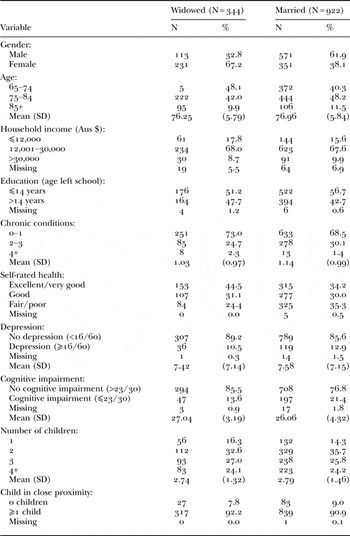
A number of variables identified in previous studies as having an association with support in widowhood were used as either predictor or control variables at different stages in the analyses. These included socio-demographic (gender, age, marital status, household income, education), physical health (number of chronic conditions, self-rated health), psychological health (cognitive impairment, depression) and social network (number of children, child living in close proximity, i.e. within one-hour travel time) variables. Gender, age and education (time-invariant predictors) were based on self-reported data at baseline. All other covariates were time-varying and measured at each of the five waves. The coding and baseline measures for these variables are presented in Table 1.
Descriptive statistics for widowed and married participants at baseline

Note: SD: standard deviation.
Statistical analysis
Multi-level modelling (MLM) was used to investigate longitudinal change in material and time support exchange in parent–child relationships in late-life widowhood. MLM enables (a) the number of observations to differ across participants, (b) occasions of measurement to vary in their timing, and (c) both fixed and random effects to be modelled (Hox Reference Hox2010; Raudenbush and Bryk Reference Raudenbush and Bryk2002). Fixed effects describe the average patterns of change which occur within a population, whilst random effects enable within- and between-person variance to be accounted for in the model. All the MLM analyses were conducted using the SPSS version 19.0 Linear Mixed Models program.
The longitudinal analyses exploring the exchange of time and material support with children were conducted in two distinct stages. A series of multi-level models were developed, firstly to ascertain whether widowed and married participants exhibited differing levels of instrumental support exchange with their children over time. The trajectories and predictors of material and time support exchanged in parent–child relationships during the transition to late-life widowhood were then explored. To attain the model of best fit, a deviance statistic (χ2) was calculated by comparing the log-likelihood statistic (−2LL) of the current model to that of the previous model (Singer and Willett Reference Singer and Willett2003). Pseudo R2 statistics explaining change in within-person (Level 1) and between-person (Level 2) variance were calculated following recommendations by Singer and Willett (Reference Singer and Willett2003).
Comparison of trajectories of change in support exchange for widowed and married participants
Using an unconditional growth model, the average linear rate of change over time in the exchange of support was initially modelled (Model 1A). A subsequent model (Model 2A) explored whether change in support was better represented using a quadratic function of time (Singer and Willett Reference Singer and Willett2003). The fixed effect of ‘Widowed status’ for each wave was then added into the final model (Model 3A) to compare the average levels of exchange of support for widowed and married participants over time. Dummy variables for marital status (married = 0, widowed = 1) were created for each occasion of measurement. This final model also controlled for socio-demographic, health and network variables in order to ascertain whether marital status was a significant predictor of material and time support exchanged with children in later life.
Trajectories and predictors of change in support exchange in the transition to widowhood
In order to explore instrumental support exchange across the transition to widowhood, a model containing the fixed and random effects of time was initially developed (Model 1B). ‘Time in study’ was centred on the point of widowhood (i.e. where time = 0 was the date of widowhood for each participant). Therefore, changes in support prior to and after widowhood could be identified. Support exchange trajectories for the average participant were formed by joining together the individual trajectories of study participants. As the time of widowhood varied for individuals across the duration of the study, some participants had a majority of observations prior to widowhood, others a majority after widowhood, and the remainder with a more even spread of observations. Hence we were able to observe average trajectories of support exchanged with children from 15 years pre-widowhood to 15 years post-widowhood. Fixed quadratic functions of time were then added to the model (Model 2B). Using the date of widowhood as a breakpoint, ‘Time before widowhood2’ and ‘Time after widowhood2’ were calculated at each wave (Guiaux, van Tilburg and van Groenou Reference Guiaux, van Tilburg and van Groenou2007). Predictors (fixed effects only) were added into the final model (Model 3B) to ascertain whether they held a significant association with levels of instrumental support during widowhood. These predictor variables were added individually into the model, beginning with the time-variant predictors (Hox Reference Hox2010), and were retained in the model if overall fit was improved.
Results
Descriptive statistics for the widowed and married participants at baseline are presented in Table 1. The distribution of men and women according to marital status varied. Males comprised the majority (61.9%) of the married sub-sample whilst females formed the majority (67.2%) of the widowed participants (χ2(1, 1266) = 84.14, p < 0.001, φ = 0.26). Small but significant differences were found at baseline between the widowed and continuously married participants. Widowed participants reported better self-rated health (χ2(5, 1262) = 26.58, p < 0.001, φ = 0.15), exhibited higher cognitive performance (t = −4.34 (809.24), p ⩽ 0.001) and were also younger (t = 2.73 (618.28), p = 0.006).
Comparison of trajectories of change in support exchange for widowed and married participants
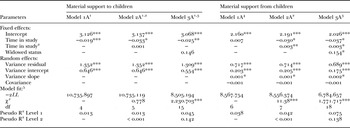
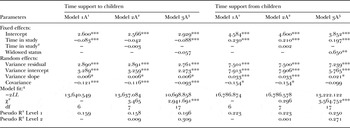
The multi-level models comparing trajectories of material and time support exchange with children for the widowed and married participants are reported in Tables 2 and 3, respectively.
The exchange of material support: comparison of widowed and married participants

Notes: N = 1,266. 1. Model includes the fixed effect of ‘Time in study’ only as model incorporating random effects failed to converge. 2. Model includes quadratic time in study (Time in study2) as a fixed effect. 3. Model includes the fixed effect of ‘Widowed status’ and controls for health, socio-demographic and network variables. 4. Model includes the fixed and random effects of ‘Time in study’. 5. Model fit is ascertained by a comparison of the current model with the previous model of best fit (using the value of the deviance statistic χ2). df: degrees of freedom, indicates the number of parameters used in the model.
Significance levels: * p < 0.05, ** p < 0.01, *** p < 0.001.
The exchange of time support: comparison of widowed and married participants

Notes: N = 1,266. 1. Model includes the fixed and random effects of ‘Time in study’. 2. Model includes quadratic time in study (Time in study2) as a fixed effect. 3. Model includes the fixed effect of ‘Widowed status’ and controls for health, socio-demographic and network variables. 4. Model fit is ascertained by a comparison of the current model with the previous model of best fit (using the value of the deviance statistic χ2). df: degrees of freedom, indicates the number of parameters used in the model.
Significance levels: * p < 0.05, ** p < 0.01, *** p < 0.001.
Material support exchange
The models of best fit examining material support exchange showed that at baseline the average participant provided more material support (γ = 3.068 units of support, p < 0.001) to their children than they received (γ = 2.026 units, p < 0.001). Although the level of material support given to children reduced slightly over time (γ = −0.025, p = 0.001), throughout the duration of the study parents continued to provide more material support than was received.
The longitudinal analyses also explored potential differences in material support exchanged with children between widowed and married participants. A significant difference in levels of material support received from children across time was found according to marital status (γ = 0.154, p = 0.026). Thus, average levels of material support provided by children in later life were greater for widowed parents compared to their married peers. In contrast, marital status (γ = 0.146, p = 0.111) was not found to be a significant predictor of material support provided to children in later life. The models of best fit examining material support provided to, and received from children accounted for 4.5% and 7.5% of within-person variance and 14.2% and 13.8% of between-person variance respectively.
Time support exchange
Contrary to the exchange of material support, parents received more time support from their children (γ = 3.852 units, p < 0.001) than they themselves provided in return (γ = 2.929 units, p < 0.001) at baseline. Over time, the levels of time support exchanged became increasingly divergent. By the end of the study period, parents gave only an average of 1.6 units of time support to their children, while receiving 6.8 units of support in return. After controlling for health, socio-demographic and network variables, widowhood in later life (γ = 0.650, p = 0.006) was found to be associated with greater levels of time support from children than being married. In contrast, no relationship was found between marital status and levels of time support provided to children (γ = −0.057, p = 0.671). The models of best fit examining time support given to, and received from children explained 19.6% and 25.0% of within-person variance and 30.9% and 27.1% of between-person variance respectively.
Trajectories and predictors of change in support exchange in the transition to widowhood
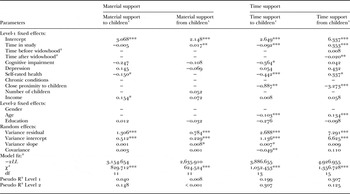
The results from the multi-level models of best fit comparing trajectories and predictors of material and time support exchange in parent–child relationships during the transition to widowhood are presented in Table 4.
The exchange of material and time support: trajectories and predictors of change in the transition to widowhood

Notes: N = 344. 1. Model gradually incorporates potential socio-demographic, health and social network predictors (as fixed effects); these were retained if model fit was improved. 2. Model fit is ascertained by a comparison of the current model with the previous model of best fit (using the value of the deviance statistic χ 2). df: degrees of freedom, indicates the number of parameters used in the model.
Significance levels: * p < 0.05, ** p < 0.01, *** p < 0.001.
Material support exchange
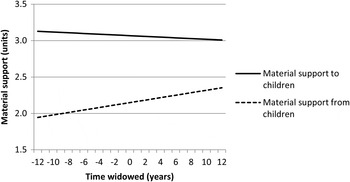
Controlling for the predictors in the model of best fit, the average participant gave 3.068 units (p < 0.001) of material support to their children at the time of widowhood. In contrast, material support received from children was lower (γ = 2.148, p < 0.001) at widowhood. Whilst material support from children increased (γ = 0.017, p = 0.009) with each year following spousal loss, widowed parents continued to provide more material support to their children than was received in return, even in later widowhood. Figure 1 shows the average trajectories of material support exchanged in parent-child relationships from 12 years pre-widowhood to 12 years post-widowhood (the range for which a reasonable number of observations, i.e. n > 25, were available in the data).
The exchange of material support in the transition to widowhood.

Parents with higher income (γ = 0.154, p = 0.026) and better self-rated health (γ = −0.150, p = 0.015) provided greater levels of material support to their children during the transition to widowhood. The model of best fit examining material support given to children accounted for 4.0% of within-person variance and 14.8% of between-person variance. Significant associations between material support received from children and the socio-demographic, health and social network status of their widowed parents were not identified, and therefore relatively little variance (at both Level 1 and 2) was explained by the predictors in this model.
Time support exchange
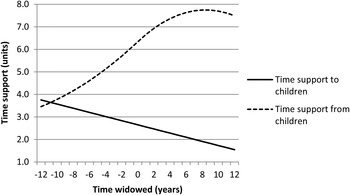
As shown in Figure 2, at the time of widowhood children provided their parents with considerably greater levels of time support (γ = 6.337, p < 0.001) than was received (γ = 2.649, p < 0.001). Time support from children continued to rise following spousal bereavement, reaching a peak in the eighth year of widowhood. In contrast, time support provided to children decreased (γ = −0.092, p < 0.001) throughout the transition to widowhood. Reciprocity in the exchange of time support was temporarily achieved 11 years prior to widowhood.
The exchange of time support in the transition to widowhood.

Close proximity to children (γ = −0.887, p = 0.001; γ = −3.273, p < 0.001), age at widowhood (γ = −0.103, p < 0.001; γ = 0.134, p < 0.001) and self-rated health (γ = −0.442, p < 0.001; γ = 0.337, p = 0.035) were found to be significant predictors of time support provided to and received from children during the transition to late-life widowhood. Cognitive impairment (γ = −0.564, p = 0.018) was also shown to be negatively associated with levels of time support provided to children. Thus, having at least one child living close by, being widowed at a younger age, and having good cognitive and self-rated health were associated with higher levels of time support given to children. In contrast, widowed parents who had a child in close proximity, were older when widowed and reported poorer self-rated health received more time support from their children. The models of best fit examining time support provided to, and received from children in widowhood accounted for 19.9% and 30.7% of within-person variance and 30.7% and 12.5% of between-person variance respectively.
Discussion
This study explored trajectories and predictors of change in instrumental support exchange, specifically material and time support, within parent–child relationships during late-life widowhood. In concurrence with previous research by Leopold and Raab (Reference Leopold and Raab2011), material support was shown to continue to flow predominantly from parent to child in later life, while time support becomes increasingly directed from the adult child to their elderly parent. Furthermore, although our hypothesis that widowhood would be associated with the receipt of higher levels of both time and material support from children (Hypothesis 1) was met, no significant differences were found between widowed and married participants in the amount of instrumental support provided to their children. Ha et al. (Reference Ha, Carr, Utz and Nesse2006) also found that widowed older adults, compared to their married counterparts, received higher levels of support from their children. However, in contrast to the current results, their study found that widows provide less support to their children than do married older adults. Interviews with widowed participants in that study were conducted at only six months following spousal loss. It may be expected that early bereavement is a time when widowed spouses are not called upon to provide support to others within the social network.
The current study, in contrast, explored trajectories of instrumental support exchange across a 15-year period, and highlights that older adults continue to provide support (particularly in the form of material assistance) to their adult children following spousal loss. Although widowed older adults appear to require additional support from their children following bereavement, there still remains an impetus for reciprocity within parent–child relationships. Continuity theory (Atchley Reference Atchley1989) proposes that older adults seek to maintain existing roles, relationships and behaviour patterns as they age. This study provides support for the notion that a predisposition for continuity in instrumental support exchange persists in parent–child relationships during late-life widowhood. Despite some variation in the pattern of exchange, short-term reciprocity was found to occur during the transition to widowhood due to an overall drive to maintain pre-existing norms in the flow of both material and time support from parent to child. Indeed, these norms of support exchange only appear to be transgressed when necessitated by a lack of geographical proximity, advancing age or perceived poor health.
The current study is the first examination to date of longer-term trajectories of material and time support exchanged with children during the transition to widowhood in later life. Widowhood is a process which occurs across time and is comprised of at least two discrete transitional periods: ‘pre-widowhood’ and ‘post-widowhood’ (Brown, House and Smith Reference Brown, House, Smith, Carr, Nesse and Wortman2006; van den Hoonaard Reference van den Hoonaard2001). We hypothesised that the level of support exchanged in parent–child relationships during widowhood would be influenced by these transitional periods (Hypotheses 2a and 2b). However, with the exception of time support received from children, the exchange of support followed a linear trajectory from pre- through to post-widowhood.
Widowed parents provided their children with greater levels of material support than was received throughout pre- and post-widowhood. In contrast, time support predominantly flowed from child to parent following spousal bereavement. Time support provided by children began to increase prior to spousal loss, reaching a peak in the eighth year of widowhood. While at this point support from children began to fall, levels of received support did not return to pre-loss levels. The decreasing levels of time support provided by adult children from the eighth year of widowhood may be reflective, however, not of lessening parental need, but of a movement from reliance on informal support to formal services. Hence heightened levels of formal support may be sought from this time to address increasing health and personal support needs associated with ageing in later widowhood.
Levels of instrumental support exchanged within the social network in late-life widowhood have previously been associated with pre-loss patterns of dependence, the close proximity of children, the size of the social network, educational attainment, gender and age (Bennett et al. Reference Bennett, Stenhoff, Pattinson and Woods2010; Guiaux, van Tilburg and van Groenou Reference Guiaux, van Tilburg and van Groenou2007; Ha et al. Reference Ha, Carr, Utz and Nesse2006). This study found that living in close proximity to a child, age at widowhood and self-rated health were significant predictors of the amount of time support both received from and provided to children following spousal bereavement. Furthermore, cognitive impairment was associated with the decreased giving of time support to children in late-life widowhood. Interestingly, physical and psychological wellbeing was not found to be predictive of time support received in widowhood. This suggests that the frequency of support received from children during late-life widowhood is more dependent upon the geographical proximity, age and perceived wellbeing of the widowed parent rather than their actual physical and psychological needs. In contrast, decrements in cognition and perceived health seem to be linked to diminished transmission of time support given to children, perhaps reflecting an erosion of the parents' ability to provide this support.
With respect to predictors of material support exchange in widowhood, widowed parents with higher incomes and better self-rated health were found to provide more financial support to their children. Meanwhile, material support received from children in widowhood was not significantly associated with parental characteristics such as socio-demographic factors, health, and number or proximity of children. Although somewhat counterintuitive, it seems that the level of material support received in widowhood is more dependent upon the child's ability and willingness to provide this type of support rather than on the specific needs or characteristics of the widowed parent.
In contrast to the findings of Ha et al. (Reference Ha, Carr, Utz and Nesse2006) that in very early bereavement widowed women exchange greater levels of instrumental support with their children than men, gender was not found to be associated with differential levels of time and material support in widowhood. The current cohort of older adults has typically followed traditional gendered roles during their lifecourse (Chambers Reference Chambers2005). As a consequence, older women may face particular difficulties with household maintenance tasks and financial management, and men with household chores following spousal loss (Utz et al. Reference Utz, Lund, Caserta and Devries2011). Although the types of time support that widowed men and women require and provide may differ, the actual amounts of instrumental support exchanged with children across the long-term transition to widowhood do not vary by gender.
The data on time and material support exchange was drawn from a population-based study of both married and widowed older men and women over a 15-year period, providing the longest exploration of social support in widowhood to date. The results of this study should, however, be interpreted in the context of several limitations. Timing between data collection was not uniform and varied between two to six years. The larger time intervals may have masked shorter-term fluctuations in the exchange of social support, particularly during the initial stages of widowhood. Also reports regarding the exchange of instrumental support with children in the ASLA were collected solely from the perspective of the older parent. Hence the findings of this study reflect the subjective parental appraisal of the exchange of support in parent–child relationships in later life. Ambivalence regarding support exchange and perceived dependence may be present in parent-child relationships during late-life widowhood (Ha and Ingersoll-Dayton Reference Ha and Ingersoll-Dayton2008; Talbott Reference Talbott1990). The degree to which participants were satisfied with the amount or type of support received or given, however, was unable to be examined. A composite measure was used in this study to determine levels of time support exchanged during the transition to late-life widowhood. This measure may not reflect potentially diverse instrumental support needs of male and female older widowed adults. Finally, although the statistical procedures used in the analyses account for attrition, it should be acknowledged that participants who remained in the study across several observations may be healthier and fitter than the general population, and therefore have less need for support.
The findings of this study may have important implications for future policy and practice. As shown in the analyses exploring the association between marital status and support exchange, norms of reciprocity regarding the giving of instrumental support in parent–child relationships continue in widowhood. Thus, when ability allows, parents continue to support their children with time, and especially, material assistance in late-life widowhood. While adult children may offer (and widowed parents accept) increasing levels of support either through altruism or as a means of repaying the parental assistance given to them earlier in life, short-term reciprocity also appears to be evidenced in the continued flow of support from parent to child. This drive for reciprocity in the social relationships of widowed older adults should be acknowledged and respected: it would, for example, influence the extent to which informal care can be provided (and received) as needs become more complex, and therefore the nexus between informal and formal care provision.
The study findings highlighted the increasingly extensive role that adult children play over time in the provision of instrumental support to their widowed parents. Thus, particular attention should be paid to the needs of children supporting their widowed parents following spousal loss. Appropriate support would enable these family members to continue to provide assistance, thus preventing increased reliance on formal care services. The study also found that widowed older adults who do not live in close proximity to a child were markedly disadvantaged in terms of levels of received time support. Thus, particular attention should be paid to widowed men and women who do not have access to informal avenues of support, and their care needs identified and addressed.
Acknowledgements
This work was supported by the Australian Research Council (DP-0879152). The ALSA was initially funded by a grant from the US National Institute of Health (grant number AG 08523-02), with additional funding from the South Australian government, Flinders University and other non-governmental organisations. Funding has subsequently been provided by the Australian Research Council (ARC-LP 0669272, ARC-LP 100200413, ARC-DP 130100428) and the National Health & Medical Research Council (NHMRC 229922).