Worldwide, many intensive care units (ICUs) routinely survey their ventilator-associated pneumonia (VAP) cases, central venous catheter–associated bloodstream infection (CVC-BSI) cases, and urinary catheter-associated urinary tract infection (CAUTI) cases to reduce these infections.Reference Rosenthal, Maki and Mehta1-Reference Fagan, Edwards, Park, Fridkin and Magill3 In neurosurgical ICUs but also in other surgical, interdisciplinary, or neurological ICUs, external ventricular drainage (EVD)–associated meningitis/ventriculitis is also a frequent and severe device-associated infection.Reference Lyke, Obasanjo, Williams, O’Brien, Chotani and Perl4,Reference Ramanan, Lipman, Shorr and Shankar5
To focus on this infectious entity, we decided to establish surveillance of EVD-associated meningitis/ventriculitis in German ICUs in 2008. All ICUs participating in the German national nosocomial infection surveillance system (KISS) with an expected relevant number of EVD devices were invited to observe not only the aforementioned commonly known device-associated infections but also EVD-associated meningitis/ventriculitis. Most of the neurosurgical ICUs agreed to participate, as did surgical, interdisciplinary, neurological, medical, cardiosurgical, burns, and pediatric ICUs with a considerable number of EVD device days.
In this study, we present the surveillance method, current reference data and subsequent risk factor analysis for EVD-associated meningitis/ventriculitis rates.
Methods
Surveillance of nosocomial device-associated infections in the ICU module of KISS is unit or ward based and always includes VAP, CVC-BSI, and CAUTI.Reference Gastmeier, Geffers and Brandt6 In addition, participating ICUs can optionally expand their surveillance of EVD-associated meningitis/ventriculitis. When the optional surveillance module EVD-associated meningitis/ventriculitis is carried out, the following data are included in ICU-KISS: (1) number of patient days with external ventricular drainage (EVD) allowing calculation of EVD device utilization rates by dividing the total number of EVD device days and the total number of patient days (multiplied by 100) and (2) number of cases of EVD-associated meningitis/ventriculitis to determine the EVD-associated meningitis/ventriculitis rate by dividing the total number of EVD-associated meningitis/ventriculitis cases and the total number of EVD device days (multiplied by 1,000).
Meningitis/ventriculitis is regarded as EVD associated if the EVD device was present within the 48-hour period before the first appearance of symptoms or specimen collection. EVD consists of an external ventriculostomy with consecutive insertion of a tube or a probe for either draining cerebrospinal fluid (CSF) or measuring intracranial/intraventricular pressure. Contact with CSF and CSF extraction is possible via intraventricular measurement. If the period between device removal and onset of infection is >48 hours, then the infection is to be considered EVD associated only for compelling reasons. Not included are ventriculoperitoneal shunts, subdural or epidural measurements, or intraparenchymal measurements with pressure probes directly in brain tissue without contact to CSF.
Definitions by the National Healthcare Safety Network (NHSN) system of the Centers for Disease Control and Prevention (CDC) are used to define meningitis/ventriculitisReference Horan, Andrus and Dudeck7: positive microbiology report from CSF cultures or a combination of clinical signs and anomalies in CSF consistent with meningitis.
Before starting the surveillance of EVD-associated infections, all persons in charge of surveillance in the corresponding ICUs were trained in diagnosing this new type of infections using case vignettes.Reference Schröder, Behnke, Gastmeier, Schwab and Geffers8 All ICUs were included in the analysis, if they participated for at least 1 month from 2008 to 2016 in ICU-KISS.
Regression analysis using generalized linear models (GLM) was performed to estimate the association of the number of EVD-associated infections with several risk factors and confounders. Adjusted incidence rate ratios (IRRs) with 95% confidence intervals (CIs) were calculated. We used negative binomial distribution in the models instead of Poisson distribution because the variance exceeds the mean, and overdispersion was observed. The log number of EVD days was treated as an offset in the model. The following ICU-associated risk factors and confounders were considered: hospital size (<400 to ≥400 beds), hospital type (university, academic teaching, or other), ICU type (neurosurgical, surgical, neurological, interdisciplinary, medical, cardiosurgical, burns, or pediatric), years of participation in KISS (≤3, >3), mean length of ICU stay (<50% to >50% quantile), EVD utilization rate as well as urinary catheter utilization rate, central venous catheter utilization rate and ventilator utilization rate as surrogate parameters for the frequency of manipulations on the patients (all device utilization rates at the >75% to <75% quantile). Interdisciplinary ICUs combine both medical and surgical cases. All variables were dummy coded and all parameters were included in the full model. First, all risk factors with P > .05 were excluded from the model in a stepwise approach. P values <.05 were considered significant. All analyses were performed with R version 3.0.3 software (R Core Team, 2013; R Foundation for Statistical Computing, Vienna, Austria) and SAS version 9.2 software (SAS Institute, Cary, NC).
Informed consent and ethical approval were not required because all data were anonymously generated and analyzed as part of infection prevention and control requirements and measures. The data analysis was conducted in accordance with the General Data Protection Regulation of 2016.
Results
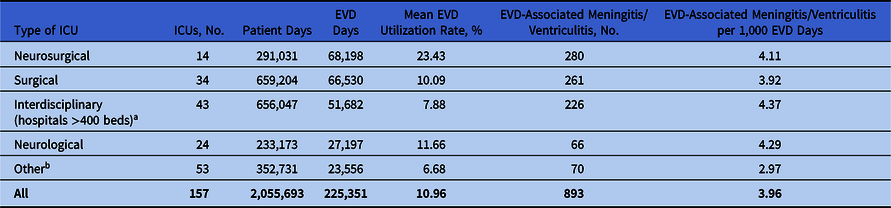
Among the 877 ICUs participating in ICU-KISS in the period from 2008 to 2016, a total of 157 ICUs provided information about EVD days and EVD-associated meningitis/ventriculitis. Table 1 shows the current reference data for the 157 ICUs that participated for EVD-associated meningitis/ventriculitis surveillance. The overall EVD-associated meningitis/ventriculitis rate per 1,000 EVD days was 3.96 with little variation between the various ICU types. The highest rates were recorded in interdisciplinary (in hospitals ≥400 beds) and neurological ICUs with 4.37 and 4.29 per 1,000 EVD days, respectively, followed by 4.11 for neurosurgical ICUs, 3.92 for surgical ICUs, and 2.97 for other ICU types. The overall mean EVD utilization rate was 10.96%. With regard to the different types of ICU, the mean EVD utilization rate differs greatly from 23.43% in neurosurgical ICUs to 11.66% in neurological ICUs and 10.09% in surgical ICUs. Interdisciplinary hospitals (≥400 beds) and other types of ICUs show the lowest mean EVD utilization rates, with 7.88% and 6.68%, respectively. The group of “other” ICU type comprises interdisciplinary ICUs in hospitals with <400 beds: medical, cardiosurgical, burns, and pediatric ICUs.
Reference Data 2008–2016: ICUs With Surveillance for EVD-Associated Meningitis or Ventriculitis

Note, ICU, intensive care unit; EVD, external ventricular drainage.
a Interdisciplinary ICUs combine both medical and surgical cases.
b The variable “other” ICU type comprises interdisciplinary ICUs in hospitals with <400 beds, medical, cardiosurgical, burns, and pediatric ICUs.
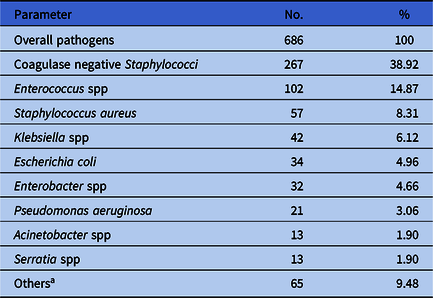
In the case of successful identification of a microorganism from clinical samples drawn when EVD-associated meningitis/ventriculitis was present, coagulase negative Staphylococci were the leading pathogens (38.92%) followed by Enterococcus spp (14.87%) and Staphylococcus aureus (8.31%) (Table 2).
Most frequent Pathogens Identified in Clinical Samples in Patients with EVD-Associated Meningitis/Ventriculitis
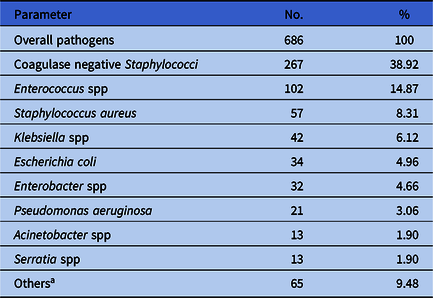
a Others include identified microorganisms other than the pathogens listed in this table with an individual occurrence of around 1% or less with regard to the overall pathogen count. Includes a whole range such as Corynebacterium, Bacillus, Micrococcus, Propionibacterium spp, Streptococcus spp, Haemophilus influenza, Morganella morganii, etc.
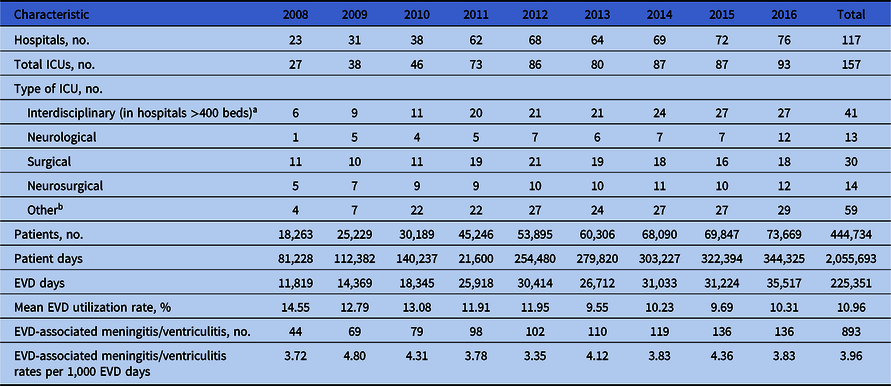
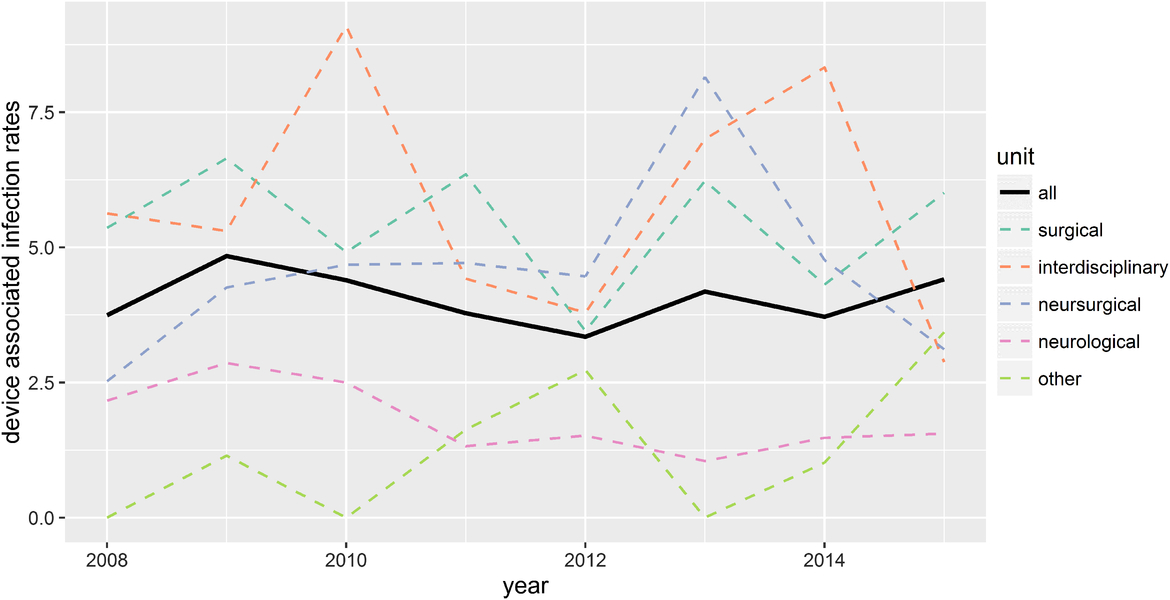
Starting with relatively few ICUs in 2008, the acceptance of and participation in the surveillance of EVD-associated meningitis/ventriculitis gradually grew over the years. In 2011, the number of actively participating ICUs had more than doubled and kept rising through 2016 (Table 3). The most relevant gain in participation was observed in neurological ICUs (5 ICUs in 2011 to 12 in 2016) and neurosurgical ICUs (9 in 2011 to 12 in 2016). These 2 types of ICU also show the highest percentage of current and ongoing participation: neurological ICUs (12 ICUs in 2016 with regard to 13 units of all participating neurological ICUs that reported at least 1 EVD day from 2008 to 2016) and neurosurgical ICUs (12 in 2016 of 14 units in total over time). For all participating ICUs, the mean EVD utilization rate remained at ~10% from 2013 onward, which is slightly less than the overall rate of 10.96%. The overall device-associated infection rate per 1,000 EVD days remained more or less stable at ~4, without any trend over time. The analysis shown in Fig. 1 includes all ICUs that either started surveillance of EVD-associated meningitis or ventriculitis in 2008 or later and continuously participated until 2016. With regard to the most recent time interval (2014–2016), the rates in neurosurgical and interdisciplinary ICUs seem to improve, coming from highs almost double that of the overall rate. The only type of ICU in which continuous participation in the surveillance module shows a decreasing trend as well as a relatively low rate in general was neurological ICU.
Data Overview of All Participating ICUs, With Surveillance for EVD-Associated Meningitis and Ventriculitis, 2008–2016

Note. ICU, intensive care unit; EVD, External ventricular drainage.
a ICUs combine both medical and surgical cases.
b The variable “other” ICU type comprises interdisciplinary ICUs in hospitals with <400 beds, medical, cardiosurgical, burns, and pediatric ICUs.
Development of EVD-associated infection rates. This analysis includes all ICUs that either started surveillance of EVD-associated meningitis or ventriculitis in 2008 or later and continuously participated until 2016.

In total, 893 EVD-associated meningitis/ventriculitis cases and 225,351 EVD days were included in our risk-factor analysis. The only risk factor for EVD-associated meningitis/ventriculitis revealed in multivariate analysis was a high EVD utilization rate above the 75th quantile (>13.87 %) (incidence rate ratio [IRR], 0.49; 95% confidence interval [CI], 0.29–0.83; P = .0008), whereas the patient’s stay in an ICU type other than neurosurgical, surgical, interdisciplinary (≥400 beds), or and neurological was shown to be a protective feature (IRR, 0.49; 95% CI, 2.50–5.09; P < .0001) (Table 4). Longer duration of participation in the surveillance system (>3 years) was not associated with lower EVD-associated meningitis/ventriculitis in our multivariate analysis.
Results of Multivariate Analysisa

Note. IRR, incidence rate ratio; CI, confidence interval; ICU, intensive care unit; EVD, external ventricular drainage.
a Only significant independent risk factors for EVD-associated meningitis/ventriculitis are shown.
b Interdisciplinary ICUs combine both medical and surgical cases.
Discussion
To our knowledge, in the study, we have described the largest database worldwide with regard to EVD-associated meningitis/ventriculitis based on >220,000 EVD days from >150 ICUs. With an overall value of 3.96 EVD-associated meningitis/ventriculitis per 1,000 EVD days, this device-associated infection rate is higher than other device-associated infection rates. For example, in KISS, in the subgroup of neurosurgical ICUs, the VAP rate is 3.73 per 1,000 ventilator days, and the CAUTI rate and the CVC-BSI rate are much lower at 2.27 and 0.51 per 1,000 corresponding device days.9
Compared to the literature, our study found much lower overall EVD-associated infection rates. However, most of the studies providing these data are single-center studies, which may have a special interest in this topic due to their rather high infections rates.Reference Arabi, Memish and Balkhy10-Reference Hagel, Bruns, Pletz, Engel, Kalff and Ewald14 In addition, a systematic review including data from a total of 35 studies identified much higher overall EVD-associated meningitis/ventriculitis rate of 11.4 per 1,000 EVD days.Reference Ramanan, Lipman, Shorr and Shankar5 When interpreting our rather low EVD-associated infection rate, one should also consider that traditional surveillance based on manual review of patient charts is vulnerable to overlooking relevant diagnostic findings and may result in lower infection rates compared with the use of an automated surveillance method for meningitis/ventriculitis, as demonstrated by van Mourik et al.Reference van Mourik, Troelstra and Berkelbach15
Most cultured organisms were gram positive (62.1%); staphylococci were the most common (47.2%), followed by Enterococcus spp (14,9%). In combination with gram-negative organisms (22.6%) and others (9.5%, including Corynebacterium, Bacillus, Micrococcus, Propionibacterium spp, Streptococcus spp, Haemophilus influenza, Morganella morganii, etc). These findings are analogous to those of other studies.Reference Hagel, Bruns, Pletz, Engel, Kalff and Ewald14,Reference Hoefnagel, Dammers, Ter Laak-Poort and Avezaat16,Reference Jamjoom, Joannides and Poon17 In the literature, an increase in the occurrence of gram-negative organisms in has been attributed to the use of antibiotic prophylaxis targeting gram-positive bacteria,Reference Martin, Zimmermann, Huynh and Polage18-Reference Alleyne, Hassan and Zabramski20 to the use of antimicrobially impregnated catheters,Reference Atkinson, Fikrey, Jones, Pringle and Patel21,Reference Bayston, Vera, Mills, Ashraf, Stevenson and Howdle22 and to prolonged hospitalization.Reference Martin, Zimmermann, Huynh and Polage18 Based on the surveillance method, we did not have access to individual patient data about these risk factors.
Also, an ICU type other than neurosurgical, surgical, interdisciplinary (>400 beds), or neurological was shown to be a protective factor in our multivariate analysis with regard to developing an EVD-associated meningitis/ventriculitis. Because the group of “other” ICUs mostly consists of interdisciplinary ICUs in small hospitals with <400 beds and, to a lesser extent, medical, cardiosurgical, burns, and pediatric ICUs, patients with an EVD might be not as severely ill and prone to an EVD-associated infection. However, we were unable to compare individual patient characteristics with regard to comorbidity and severity of illness and other risk factors like frequency of CSF sampling, location of EVD insertion (ie, ICU, operating room, or other), repeated insertions or duration of EVD. This shortcoming is a limitation underlying the surveillance method because the module ICU-KISS is unit or ward based. In this context, other data showed that an increased frequency of CSF sampling was a significant parameter associated with EVD-associated infection risk.Reference Hoefnagel, Dammers, Ter Laak-Poort and Avezaat16,Reference Jamjoom, Joannides and Poon17 The lack of data about EVD-associated meningitis or ventriculitis cases occurring after discharge from the ICU is an accompanying limitation, which might mask an actually higher overall EVD-associated infection rate.
High EVD utilization rate (above the 75th quantile) was a significant risk factor associated with increased infection rates. High EVD utilization rate could be a result of dealing with a rather special patient population being severely ill, necessitating EVD and thus over time having an increased risk of acquiring a device-associated infection. However, loose indications for EVD placement and removal could lead to unnecessarily high EVD utilization rates.
In our multivariate risk-factor analysis, we also investigated whether continuous participation in the surveillance system for a longer period of time (>3 years) was associated with a reduction of infection rates. However, this factor was not significant in our analysis and differed from our experience with VAP and CVC-BSI surveillance.Reference Schröder, Schwab and Behnke2,Reference Zuschneid, Schwab, Geffers, Rüden and Gastmeier23,Reference Zuschneid, Schwab, Geffers, Behnke, Rüden and Gastmeier24 Looking at all ICUs that either started surveillance of EVD-associated meningitis/ventriculitis in 2008 or later and continuously participated until 2016, the overall device-associated infection rate per 1,000 EVD days was ~4, without any downward trend over time. On the other hand, when investigating the surveillance effect on CAUTI, we detected an effect of surveillance not present before, including a large number of ICUs and a long observation period.Reference Gastmeier, Behnke, Schwab and Geffers25 Although the evidence has demonstrated that by applying appropriate infection control measures it is possible to decrease EVD-associated infections,Reference Leverstein-van Hall, Hopmans and van der Sprenkel12,Reference Scheithauer, Schulze-Steinen and Hollig13,Reference Chatzi, Karvouniaris and Makris26-Reference Camacho, Boszczowski and Freire28 other reasons for failure to reduce the infection rate in the previous studies might include a lower awareness of this entity and the lack of evidence-based guidelines on how to prevent EVD-associated infections compared with guidelines for the management of CVC, ventilators, and urinary catheters and the prevention of corresponding infections. In the light of the necessity of a comprehensive guidance for EVD management evidence-based guidance, documents have recently been produced on a national and local level.Reference Fried, Nathan and Rowe29-Reference Tunkel, Hasbun and Bhimraj32
Meningitis and ventriculitis are relatively frequent and severe complications of care associated with the use of EVD compared with other device-associated infection rates. Therefore, and because of the high morbidity and mortality of these infections, surveillance systems should include EVD-associated meningitis/ventriculitis at least in neurosurgical ICUs and other ICUs with a substantial number of EVD days. As recommended for the prevention of other device-associated infections, attention should be paid to strictly assess the indications for EVDs aiming to minimalize device utilization. Analogously, strict adherence to hand hygiene and asepsis are crucial when handling the device and taking care of these patients.
Acknowledgments
The authors thank all participating hospital in the framework of the German national nosocomial infection surveillance system and all healthcare professionals putting in many hours of work into the surveillance of EVD-associated meningitis/ventriculitis in intensive care units.
Financial support
No financial support was provided relevant to this article.
Conflicts of Interest
All authors report no conflicts of interest relevant to this article.