Introduction
Suicide is one of the leading causes of death in the 21st century, with almost one million people dying by suicide every year. In many countries, suicide rates are highest among those aged 70 years and older (Nock et al., Reference Nock, Borges and Ono2012). In the USA, for example, the suicide rate for this group is 17.4 per 100,000 in 2014 (compared to the global rate of 13.4). These rates swell to 54.3 to 100,000 among older white male adults over age 85 (CDC, 2014). The suicide rates among older adults in Israel are even higher, with rates close to 30 per 100,000 among older male adults over age 65 (Israeli Ministry of Health, 2014).
Although older adults’ suicide has become a critical public health problem, at least partially due to increased longevity, research on older adults’ suicide prevention is scarce, and there is a dearth of basic knowledge that could help reduce suicide rates among older adults (Duberstein and Heisel, Reference Duberstein, Heisel and Nock2014). Specifically, personal, interpersonal, and community factors have not been adequately addressed when seeking to explain the alarmingly high rates of older adults’ suicide world-wide.
The main known risk factors for older adults’ suicides are depression, physical illness, functional impairment, and loneliness (Duberstein and Heisel, Reference Duberstein, Heisel and Nock2014). However, Durkheim (Reference Durkheim, Spaulding and Simpson1951) had already asserted that suicide cannot be viewed and understood in isolation from the context of society and community. One of these context factors is the society's attitudes towards the suicide of the older adults. Attitudes towards suicide (ATTS) represent the degree of tolerance of the suicide act of a target person, ranging from unconditional condemnation to accepting and permissive attitudes towards suicidal behavior (Kodaka et al., Reference Kodaka, Poštuvan, Inagaki and Yamada2011).
Several studies have shown that society's attitudes towards older adults can explain differences in older adults’ suicide mortality (e.g. Yuryev et al., Reference Yuryev2010). When societies and communities view older persons’ suicide as a legitimate behavior, perhaps even perceiving it as unpreventable, it may influence suicide mortality of older adult members of these societies (Yuryev et al., Reference Yuryev2010). Thus, understanding the factors that facilitate various attitudes towards older adults’ suicide could be useful in suicide prevention and in providing effective interventions for this population. This study focused on two factors that may relate to ATTS of older adults, namely message framing and ageism. We will first address ageism as a factor affecting the public's attitudes towards older adults’ suicide, to be followed by the possible effect of message framing on attitudes towards older adults’ suicide.
The association between ageism and attitudes towards older adults’ suicide
Alongside the physical, psychological, and social role changes that older adults face, they are also forced to encounter a youth-oriented society with a high level of negative attitudes concerning older adults. Butler (Reference Butler1975) introduced the term ageism, referring to “a process of systematic stereotyping and discrimination against people because they are old” (p. 12). Ageism involves prejudice and discrimination, stereotypes and attitudes, and therefore, both cognitive and affective processes. Older people often face reduced social and economic opportunities, damage to self-esteem, and exacerbated physical health problems, to name only a few consequences of agist dynamics (North and Fiske, Reference North and Fiske2012).
Several studies have found that ageism among younger individuals might interfere with the social integration of older adults in their residential environment (Vitman et al., Reference Vitman, Iecovich and Alfasi2014). As social integration has been identified as a key factor in coping with old age, as it can alleviate the demoralizing sense of loneliness (Yeh and Lo, Reference Yeh and Lo2004), ageism can jeopardize older adults’ mental resilience and even their physical health (Allen, Reference Allenin press).
One of the potential hurtful implications of ageism is its association with attitudes of people, community, and society towards older adults’ suicide. Surprisingly, however, no study has previously examined this direct association, though some studies have examined indirect associations or related concepts. For example, Stillion et al. (Reference Stillion, White, Edwards and McDowell1989) investigated ATTS of individuals differing in gender and age, in terms of sympathy, empathy, and condonement. The findings demonstrated that older adult suicidal females received the least sympathy from participants, while young suicidal females received the most. These findings suggest that age and gender are variables contributing to understanding ATTS. Similar results were found in concepts related to suicide, such as euthanasia. Bevacqua and Kurpius (Reference Bevacqua and Kurpius2013) found that counseling students expressed much more support for a 77-year-old client seeking active euthanasia than for a 25-year-old client seeking the same. These differences suggest that ageism may impact attitudes, beliefs, and even clinical perceptions and treatment in life or death matters that may even lead to ethical violations.
The present study addressed this gap in the literature by examining the direct relation between ageism and attitudes towards older adults’ suicide, in terms of tolerance, preventability, and incomprehensibility. In light of the presented rationale, we hypothesized that people with high levels of ageism would have more tolerant attitudes towards older adults’ suicide.
The effect of framing on attitudes towards older adults’ suicide
Following Tversky and Kahneman (Reference Tversky and Kahneman1981), numerous studies have examined the effect of framing a message in positive or negative terms on persons’ judgments and decision making. Based on Tversky and Kahneman's (Reference Tversky and Kahneman1981) dictum, “losses loom larger than gains” (p. 456), Levin et al. (Reference Levin, Schneider and Gaeth1998) suggested that negatively framed messages are usually more successful in persuading individuals to act. Thus, information presented in terms of loss has more impact than when the same information is presented as a gain, because individuals experience losses more intensely than they do gains of similar absolute magnitude (Tversky and Kahneman, Reference Tversky and Kahneman1981).
The specific effect of message framing on attitudes towards older adults’ suicide has not been previously examined. However, findings from studies of related issues may contribute to constructing this study's hypotheses. One study examined the possible effect of framing of the same situation in terms of not prolonging life (positive framing) or ending life (negative framing) on people's attitudes towards euthanasia (Gamliel, Reference Gamliel2013). Participants presented with a euthanasia situation in terms of not prolonging the life of a terminally ill older adult (positive framing) accorded more support for euthanasia, relative to those presented with an identical situation, termed as ending his life (negative framing). Therefore, upon evaluating others’ euthanasia dilemma, people might be willing to waive the gain of not prolonging their life more readily than they would be willing to suffer the loss of ending their life, even though both formulations relate to the very same situation. Thus, we hypothesized that individuals would be more likely to be accepting of older adults’ suicide when the issue is presented positively, in terms of not prolonging life, than when it is presented negatively, in terms of ending life.
Ageism as a possible moderator of the effect of message framing on attitudes towards older adults’ suicide
The elaboration likelihood model (ELM; Petty and Cacioppo, Reference Petty, Cacioppo and Berkowitz1986) suggests that personal involvement with the relevant subject matter moderates people's cognitive processes, such that high-involved individuals utilize more systematic processing, whereas low-involved people utilize more heuristic processing, in which peripheral cues have more impact. Applying the ELM approach suggests that ageism might moderate the effect of message framing on attitudes towards older adults’ suicide: Individuals characterized by low level of ageism are probably more engaged and more involved with older adults, thus utilizing the central route of systematic information processing that would make them impervious to the manner in which the information is presented. In contrast, individuals characterized by high levels of ageism would likely be less involved with older adults, thus tending to utilize more peripheral route of heuristic cognitive processing, one that would increase their susceptibility to peripheral cues, such as message framing.
In sum, two studies were conducted. In the first study, we administered two self-report questionnaires, assessing ageism and attitudes towards older adults’ suicide. In the second study, we administered the ageism questionnaire, but replaced the ATTS questionnaire by questions based on a vignette that presented a suicide scenario of an older adult in one of two frames: a positive frame (not prolonging life) or a negative frame (ending life). Following the ELM approach, we hypothesized that ageism would moderate the effect of framing, such that only participants scoring high on ageism would reveal more permissive ATTS of an older adult when the message is framed positively (not prolonging life), in comparison to its being framed negatively (ending life).
Study 1
Method
Participants and procedure
The sample comprised 113 undergraduate students who participated in the study in a laboratory setting, as part of course requirements (M age = 23.9; SD age = 2.3; 90% were female). The study was approved by the authors’ Institutional Review Board, and was presented as dealing with attitudes towards older adults (aged 70 years and above).
Measures
Ageism:
We used the Fraboni Scale of Ageism (FSA; Fraboni et al., Reference Fraboni, Saltstone and Hughes1990) in order to measure agist attitudes and beliefs about older adults. The original scale's 29 items reflected three levels of prejudice on a 6-point Likert-type scale: antilocution (e.g. Many old people just live in the past), avoidance (e.g. It is best that old people live where they won't bother anyone), and discrimination (e.g. Old people should find friends their own age). Past research (Fraboni et al., Reference Fraboni, Saltstone and Hughes1990) has shown that the scale has adequate reliability (Cronbach's α = 0.86). In the present study, we used the scale's 24-item Hebrew version; five items from the original scale were not included, due to their incompatibility with the Israeli reality. For example, item 24 of the original scale (There ought to be special clubs set aside within sports facilities so that old people can compete at their own level) was excluded, since sports clubs are not common in Israel, and most respondents would have difficulty relating to such an item. The internal reliability (Cronbach's α) of the resultant 24-item ageism scale in this study was 0.82.
Attitudes towards suicide:
The questionnaire tapping ATTS was developed by Renberg and Jacobsson (Reference Renberg and Jacobsson2003) to assess multidimensional attitudes and beliefs toward suicide. Modifying this questionnaire for the current study's focus, we incorporated three of its five dimensions of suicide-related attitudes and beliefs: permissiveness, preventability, and incomprehensibility (Arnautovska and Grad, Reference Arnautovska and Grad2010). The original factors of avoidance of talking and unpredictability were not used in this study, as they are less related to older adults. Thus, the version used in this study included 18 of the 37 items of the 5-point Likert-type questionnaire. In order to address attitudes and beliefs toward the older adults, we incorporated one of two alternative phrases – old people or old person/s – within these 18 items. For example (the added words are in bold): An old person suffering from a severe, incurable disease expressing wishes to die, should get that help; Old people do have the right to take their own lives (both items are indicators of permissiveness); It is a human duty to try to stop an old person from dying by suicide; Suicides among old people can be prevented; (both items are indicators of preventability); Suicides among old people can never be justified; Committing suicide is among the worst thing to do to old persons’ relatives (both items measure incomprehensibility). The internal reliability (Cronbach's α) of the 18-item scale in this study was 0.88.
All participants were first presented with the 24 ageism items, followed by the 18 items assessing attitudes towards older adults’ suicide, with high values representing high ageism and permissive attitudes towards older adults’ suicide, respectively.
To examine the possible effect of message framing, we added two items to the 18-item modified ATTS questionnaire, framed either negatively or positively: Older adults have the right [to end/not to prolong] their lives. These negatively and positively framed items were positioned as the 8th and 20th items, respectively.
Data analysis plan
Pearson correlation coefficients will be calculated between indices of ageism and attitudes towards older adults’ suicide. Paired samples t-tests would compare participants’ answers to the two items framed either negatively or positively. All analyses will use SPSS 20 statistical software.
Results and discussion
Participants’ responses to the two framing questionnaires were averaged to form indices of ageism and attitudes towards older adults’ suicide. The respective means (and standard deviations) of these two indices were 2.65 (0.48) and 2.55 (0.58). The correlation between ageism and attitudes towards older adults’ suicide was statistically significant, r = 0.28, t(111) = 3.02, p = 0.003, 95% CI [0.10, .44]. This correlation was likely attenuated by the relatively small standard deviations of the two measures.
The means (and SDs) of the two added items, framed either negatively or positively (Older adults have the right to end [not to prolong] their lives), were 2.69 (1.20) and 3.02 (1.15), reflecting a difference of 0.28 SD (Cohen's d). A within-participants comparison revealed a statistically significant difference, t(112) = 3.70, p < 0.001. A closer examination of participants’ responses to these two items showed that 69 of the 113 participants responded to the two items identically. Of the remaining 44 participants, nine were more permissive towards older adults’ suicide in the negative, relative to the positive, framing, whereas 35 presented a reversed pattern. That is, the above mean difference is actually based on 44 of the 113 participants. Participants may have detected the identical contents of these two items that were presented in opposite framing, despite their being positioned as #8 and #20 in the questionnaire. Thus, while Study 1 provided preliminary evidence for a positive association between ageism and attitudes towards older adults’ suicide, examining the possible effect of framing on these attitudes requires a methodology that would obscure the identical nature of the two framed messages. In addition, the findings of Study 1 were based on a sample of young adult undergraduate students (predominately female), so that a more diverse sample would be needed to replicate and examine the generalizability of the findings. Study 2 was designed to address these concerns, using a between-participants experimental design.
Study 2
Methods
Participants
The sample comprised 266 participants (M age = 36.3; SD age = 14.6; 58% were female). Of the sample, 48% completed a high school education (reflective of the population average). About 25% reported average income, with the remaining participants distributed evenly between reporting above average and below average income. The participants were approached at three shopping centers by a female research assistant, and were asked to complete the paper-and-pencil questionnaire. Most approached individuals agreed to participate. The study was presented as dealing with the public's attitudes towards older adults (aged 70 and above). The participants were assured of the anonymity of their responses, all being encouraged to respond candidly. The study was approved by the authors’ Institutional Review Board.
Measures and procedure
The questionnaire comprised three main sections, presented to all participants in the following order: (1) a vignette concerning an old man, followed up by two closed questions; (2) the 24-item ageism questionnaire described in Study 1 (for Study 2, Cronbach's α = 0.76); and (3) demographic questionnaire (age, gender, education, and income).
The vignette: All participants were presented with the following text with a slight modification, according to the positive- or negative-framing manipulation at the conclusion of the paragraph. The vignette described several physical and social difficulties of an old man contemplating suicide:
Simon is an 84 year-old man, living in the city. Two years ago, Simon's wife, Rachel, died after an eight-year struggle with cancer and Parkinson's disease. Prior to her death, Simon dedicatedly attended to his wife, and now that she is gone, he spends most of his time alone. Many of his close friends have passed away, and his children live far from him. Six months ago, Simon fell while walking in the street, broke his hand, and suffered a head injury. Since then, Simon fell and injured himself four additional times. His children pleaded with him that he be thoroughly examined, in order to determine the cause of these falls. The doctor's diagnosis indicated that the repeated falls were caused by balance abnormalities related to Simon's age, recommending the use of a walking cane. Simon's children urged him to move to a retirement home and scheduled a meeting for him there. Simon returned from the meeting depressed and sad. He did not want to leave his home and share what is left of his life with strangers and sick people. This series of events has affected Simon's health. He experiences insomnia almost nightly, he feels tired and lethargic during the days. He's lost his appetite and has lost weight. The thought that he cannot manage his own life has led him to feel worthless, and he has stopped leaving his home, even for only essential errands. Gradually, Simon began thinking about death more and more frequently. He considered [not prolonging/ending] his life, until he decided to actually do it. He bought several packages of sleeping pills, using a prescription he received from the doctor for his insomnia. At night, Simon took a large number of sleeping pills for the purpose of dying.
After reading the text, all participants were requested to turn the page, where they were presented with two questions on a 6-point Likert-type scale, framed either positively or negatively, ranging from 1 (Not at all) to 6 (To a very high degree): (1) To what extent do you sympathize with Simon's decision [not to prolong/to end] his life? (2) To what extent do you think that Simon's decision [not to prolong/to end] his life is the right decision for him? In both questions the manipulation (the text in the brackets above) was presented in bold fonts. Participants were randomly assigned to either the positive (n = 132) or negative (n = 134) framing condition.
Data analysis plan
Participants’ responses to the vignette were analyzed using a moderation analysis (Hayes, Reference Hayes2012), predicting the responses from framing, ageism, and their interaction.
Results and discussion
Participants’ responses to the two follow-up questions were highly correlated, r = 0.59, t(264) = 11.81, p < 0.001. Analyzing the two items separately resulted in similar patterns. In order to increase the robustness of the findings and decrease the effect of random errors, the two items were averaged to form an index of ATTS of the older adult, where high values represent more permissive attitudes.
As in Study 1, the ageism index was calculated as the average of the 24 responses from the ageism questionnaire. The respective means (and SDs) of the index of attitudes toward suicide of the older adult and the ageism index were 2.89 (1.34) and 2.79 (0.47). A comparison of these values with those in Study 1 revealed that substituting the questionnaire with the vignette substantially expanded the variability of the attitudes towards older adults’ suicide.
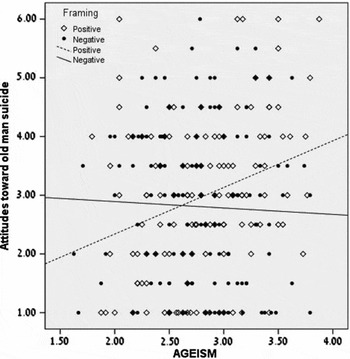
Figure 1 presents the regression lines associating ageism and ATTS of the older adult for the positive- and negative-framing conditions. Figure 1 shows the positive association between ageism and attitudes towards the older adult suicide for the positive-framing condition, r = 0.28, t(130) = 3.38, p = 0.001, 95% CI [0.12, 0.44], and the lack of association between these variables for the negative-framing condition, r = −0.04, t(132) = −0.43, p = 0.67, 95% CI [−0.21, 0.14].
The regression lines indicate the relationship between ageism and attitudes towards suicide of an older adult for the positive- and negative-framing conditions (N = 266).

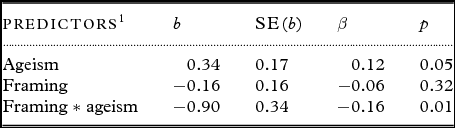
Figure 1 shows that the hypothesized more permissive ATTS of the older man in the positive- versus the negative-framing conditions, were found among high-ageism participants. A reverse pattern was found for low-ageism participants. In order to examine the statistical significance of these findings, we carried out a moderation analysis (using Hayes, Reference Hayes2012), with the results summarized in Table 1. Framing and ageism did not predict ATTS of the older adult, beta values of −0.06, 0.12, t(262) = −1.00, 1.96, p = 0.32, 0.05, respectively. The interaction, however, did reflect a statistically-significant prediction, beta value of −0.16, t(262) = −2.60, p = 0.01.
Summary of the moderation analysis for predicting attitudes towards suicide of an older adult male from ageism, framing, and their interaction (after centering the variables) [N = 266]

1 R = 0.21.
General discussion
This study is the first to examine the direct relation between ageism and attitudes towards older adults’ suicide. The findings of Study 1 showed a positive correlation between ageism and attitudes towards older adults’ suicide, when both variables were measured by conventional self-reporting questionnaires: The more agist the participants, the more permissive they were towards older adults’ suicide. Replacing the ageism self-reporting questionnaire with two questions relating to a specific vignette in Study 2 resulted in a similar correlation for the positive farming of older adults’ suicide in terms of not prolonging life. Permissive attitudes towards older adults’ suicide are consistent with previous findings relating to public attitudes towards older people as dispensable and useless members of society (Levy and Banaji, Reference Levy, Banaji and Nelson2004). In addition, such permissive attitudes are also consistent with one aspect of ageism that relates to a belief that teenage suicide is more tragic than elderly suicide. The latter statement is actually reflected in an item of the FSA (Fraboni et al., Reference Fraboni, Saltstone and Hughes1990).
Previous studies found similar relationships when tapping related issues (e.g. Stillion et al., Reference Stillion, White, Edwards and McDowell1989; Bevacqua and Kurpius, Reference Bevacqua and Kurpius2013). However, the current research is the first to show the direct positive association between attitudes towards older adults’ suicide and ageism. This finding indicates that high ageism may shape and facilitate views on extreme behaviors, such as self-harm and suicide. From the social perspective of suicide prevention, ageism can be seen as a risk factor for more permissive suicide attitudes, as peoples’ attitudes towards older adults may influence suicide mortality of older adult members (Yuryev et al., Reference Yuryev2010). Thus, our results demonstrate the importance of combating ageism on both educational and social levels.
Critically, however, we did not find a positive relation between ageism and attitudes towards older adults’ suicide when it was framed negatively as ending life. This finding could have several possible explanations. One explanation relates to the different cognitive processes that might accompany positive and negative framing. The feeling-as-information theory argues that sad moods may foster a systematic processing style whereas happy moods may foster a processing style relying more on general knowledge structures, accompanied by less focused attention (Schwarz, Reference Schwarz, Van Lange Kruglanski and Higgins2012).Similarly, it may be that negative framing fostered a systematic processing style whereas positive framing may have fostered less-focused attention. These differential cognitive processes may have been related to the finding of a positive association between ageism and attitudes towards older adults’ suicide when the latter was framed positively, and an absence of this association when it was framed negatively.
Furthermore, we found that ageism moderated the effect of message framing on attitudes towards older adults’ suicide: Only participants scoring high on ageism expressed more permissive ATTS of an older adult when the message was framed positively (not prolonging life) relative to its being framed negatively (ending life). Note that both framing manipulations of not prolonging life and ending life related to a single, identical vignette of an older adult. These results are consistent with previous research that found more favorable attitudes towards euthanasia when a situation was framed positively, such as not prolonging life, in comparison to the same situation presented in the complementary, negative frame of ending life (Gamliel, Reference Gamliel2013).
The moderating effect of ageism on the effect of message framing on attitudes towards older adults’ suicide is consistent with the ELM (Petty and Cacioppo, Reference Petty, Cacioppo and Berkowitz1986): high-ageism individuals were more susceptible to peripheral cues, such as message framing, whereas low-ageism individuals were not. Thus, high-ageism, but not low-ageism, individuals were more permissive regarding older adults’ suicide when presented with the positively framed message of not prolonging life, as compared to being presented the very same message, but framed negatively, in terms of ending life. These results are consistent with the loss aversion accounts offered for framing effects: Individuals are more willing to waive the gain of not prolonging life than they are willing to suffer the loss of ending life, even though the terms relate to the very same situation (Tversky and Kahneman, Reference Tversky and Kahneman1981).
This moderating role of involvement on the effect of message framing is also consistent with previous findings in other contexts, in which highly involved individuals were less susceptible to the effect of message framing, relative to less involved people, who were more affected by the message's peripheral cues (e.g. Dardis and Shen, Reference Dardis and Shen2008). Thus, our research contributes to the current literature, suggesting that individuals characterized by low involvement in certain issues may be more susceptible to contextual effects, even with respect to attitudes towards issues of life and death.
Practical implications
The findings of this study have several practical implications. First, the association found in this study between ageism and attitudes towards older adults’ suicide further reinforces the importance of implementing interventions to reduce ageism, which in turn, could enhance the general well-being of older adults, as well as their feeling of competency, social cohesion, and belongingness (Braithwaite, Reference Braithwaite and Nelson2002). Second, considering the media's considerable influence on the public's attitudes towards older adults’ suicide, the manner in which suicide incidents is reported is critical. Reporting such incidents using a negative framing of ending lives, rather than positive terms of not prolonging life, may reduce the public's tolerance of such acts, which may, in turn, influence older adults’ suicide rates (Yuryev et al., Reference Yuryev2010).
Third, acknowledging that message framing has a role in forming attitudes towards older adults’ suicide can help in educating the public regarding the prevention of suicide among older adults. Using negative framing of older adults’ suicide rather than positive framing in public health initiatives, such as gatekeeper training programs, lectures, brochures, and information leaflets, may lessen tolerant ATTS, especially among those less involved with this issue.
Limitations and future research
This research demonstrated the moderating role of ageism in the effect of message framing on attitudes towards older adults’ suicide. The two studies have several limitations that suggest possible future research. One limitation is that the variability of ageism in the two studies, as well as the variability of the attitudes toward older adults’ suicide in Study 1, were all relatively low (SDs of about 0.5 on 5-point and 6-point Likert-type scales). The low variability restricted the possibility of detecting associations between the variables in this research. Future studies should aim for more heterogeneous samples with respect to these variables; we anticipate that the associations in such samples would be stronger than those found in the current research.
Future research could also examine the generalizability of the possible effect of message framing on people's ATTS of younger age groups. If such an effect would be established, the possible moderation of other variables could be examined. The current research suggests examining the possible moderation of variables that distinguish between groups characterized by different levels of involvement in the studied issue. Future studies may also seek other possible moderators, previously suggested for effects of framing, such as higher cognitive ability and need for cognition (e.g. LeBoeuf and Shafir, Reference LeBoeuf and Shafir2003). As these two variables may be correlated with ageism, future research could include such measures as covariates in the analyses.
It is important to note here that ageism is inseparably linked with cultural influences (Cuddy et al., Reference Cuddy, Norton and Fiske2005). Western cultures adhere to more youth-oriented societies and hold negative attitudes regarding older adults. Studies examining ageism in Israel have demonstrated that agist attitudes are quite prevalent among Israeli Jews (Bodner et al., Reference Bodner, Bergman and Cohen-Fridel2012) and that the general patterns of ageism in Israel are similar to those of other European countries (Abrams et al., Reference Abrams, Russel, Vauclair and Swift2011). Thus, this study's conclusions and implications could be generalized to other Western societies, despite our focus on Israeli society. Future research could examine a cross-cultural sample (e.g. Israeli Arab) in order to understand the specific relationship between ageism and ATTS in traditional societies as well.
This research integrated a phenomenon from the domain of judgment and decision making, namely, message framing, with the psychological-sociological understanding of ageism as an adverse social attitude, to provide a framework to examine attitudes towards older adults’ suicide. We hope that this research will encourage others to integrate the widely studied judgment and decision-making processes with research on issues of suicide prevention, for the purpose of saving lives.
Conflict of interest
None.
Description of authors’ roles
Both authors designed the study, supervised the data collection, carried out the statistical analysis, and wrote the paper.
Acknowledgments
The authors wish to thank Noy Nishri for her help in data collection.