Introduction
The standard operative treatment of otitis media with effusion (OME) consists of myringotomy and grommet insertion. Following myringotomy, a proportion of middle ears will be found to contain no fluid – i.e. to be a ‘dry tap’. A dry tap has been reported to occur in between 131 and 34 per centReference Black, Sandeson and Freeland2 of myringotomies.
Selection of patients for operative treatment of OME is based on the clinical history, otoscopic examination of the tympanic membrane, audiometry and tympanometry (measurement of the middle-ear compliance). There is no method that provides 100 per cent sensitivity and specificity in the diagnosis of ‘glue ear’. The findings of myringotomy are often taken as the final arbiter of whether or not there is a middle-ear effusion, but this too is doubtful. It is known that nitrous oxide diffuses into the middle ear during the course of anaesthesia.Reference Drake-Lee, Casey and Ogg3 Gas can also be forced up the eustachian tube by positive pressure mask ventilation, and this may displace a middle-ear effusion away from the tympanic membrane, resulting in an apparently dry tap. This may not be true in children with glue ear.Reference Drake-Lee and Casey4
There are many studies assessing factors that may help predict the persistence of glue ear in an out-patient setting,Reference Gordon, Grunstein and Burton5, 6 or predict the need for grommets insertion.Reference Kogan, Overpeck and Hoffman7 However, few published studies have addressed the question of whether a dry tap is likely to be due to resolution of the disease itself or to an artefact caused by induction of anaesthesia.
The finding of a dry tap presents the surgeon with a dilemma – whether or not to insert a grommet. This question has a direct impact on the number of unnecessary procedures conducted, along with the associated out-patient follow-up workload. There are measurable sequelae of grommets insertionReference Daly, Hunter and Lindgren8, Reference Hoffman, Thompson and Burke9 which should be avoided unless there is a proven need for the procedure. There are, of course, also measurable effects of untreated glue ear.Reference Kacmarynski, Levine and Pearson10 This means that a surgeon needs to have some idea of the probable category of dry ear each particular case falls into.
This study needs to be viewed in the context of a health system that has a significant, but variable, waiting time for surgical procedures. This means that there is frequently sufficient time for the disease to resolve of its own accord.
We therefore decided to look more closely at dry taps in our patient population, addressing in particular the following aspects.
Aims
Our aims were as follows: firstly, to determine the proportion of dry taps at myringotomy in our patient population; secondly, to determine which factors were predictive of a dry tap; thirdly, to assess the effect of anaesthesia on the distribution of fluid within the middle ear; fourthly, to estimate the proportion of dry taps that were due to natural resolution of the glue ear, and the proportion related to the induction and maintenance of anaesthesia; and fifthly, to perform a multivariate analysis to determine the combination of factors most predictive of a dry tap.
Materials and methods
Inclusion criteria
We included children (i.e. younger than 17 years old) undergoing myringotomy for symptomatic glue ear, under the care of Carl Watson (Senior author), between June 1993 and March 1999. The decision to operate was based on the presence of one or more of the following criteria: hearing loss exceeding 20 dB in the better hearing ear, taken over a four-frequency average of 0.5, 1, 2 and 4 KHz; for younger children, a loss in the better hearing ear in excess of 45 dB on free field audiometry; a history of speech delay; an otoscopic appearance of otitis media with effusion (OME); tympanometric findings in keeping with OME; and a period of ‘watchful waiting’11 undertaken for three months prior to surgical intervention.
Exclusion criteria
The exclusion criteria comprised failure to obtain a tympanometry trace due to: an uncooperative patient; a poor seal; wax occluding the meatus; or technical problems with the tympanometer.
Tympanometry
Middle-ear compliance was determined using a hand-held tympanometer immediately before the induction of anaesthesia and immediately before myringotomy. The tympanometer measured from +200 to −300 daPa and produced both graphical and numerical results. The tympanometric findings were recorded using Fiellau-Nikolajsen's classification.Reference Fiellau-Nikolajsen12 Tympanograms in which a peak was evident were classified as either type A (normal pressure, +200 to −99 daPa), type C1 (negative pressure, −100 to −199 daPa) or type C2 (negative pressure, −200 to −300 daPa). Tympanograms in which no peak, or a flat curve, was evident were classified as type B (negative pressure, below −300 daPa).
Audiometric data were not collected for the study, because the relevant medical records were held at three different hospitals, limiting access.
Anaesthetic
Most anaesthetics were administered by the same consultant anaesthetist, using a standard technique (i.e. intravenous induction followed by intubation and spontaneous respiration, not using a laryngeal mask or face mask). However, after the first 199 patients, the inhalational agent was changed from halothane and nitrous oxide to enflurane. This change was made for clinical reasons, but fortuitously allowed comparison of the two agents. The anaesthetic technique was otherwise identical.
Procedure
A myringotomy was performed. If no middle-ear fluid was immediately evident, then a suction tip was introduced into the middle ear for not less than 15 seconds. The findings at myringotomy were recorded as ‘glue on incision’, ‘glue on aspiration’ or ‘no glue’.
The seasons were recorded as follows. Winter was defined as the months December, January and February, spring as March, April and May, summer as June, July and August, and autumn as September, October and November.
Statistical analysis
Univariate analyses were performed to identify factors influencing a dry tap. The following factors were evaluated: pre-induction impedance tympanometry result, post-induction impedance tympanometry result, patient's age, season, type of anaesthetic and clinic-to-theatre delay. The chi-square test was used to assess differences in proportions.
The same factors were used as independent variables in a series of exploratory logistic regression analyses in which the dependent variable was the existence or otherwise of a dry tap. Tympanometry results were represented as the occurrence or otherwise of a type B tympanogram. All of the unilateral data were included; however, to ensure statistical independence, data for one ear only (chosen at random) were included from each patient with bilateral data.
Results and analysis
During the study period, 750 children underwent myringotomy. Of these, 280 met the inclusion criteria and were thus entered into the study (age range 10 months to 16 years; median five years; interquartile range four to 6.75 years). Fifty-six unilateral and 448 bilateral myringotomies were performed. The total number of myringotomies was thus 504.
In 56 cases, tympanometry could only be obtained from one ear prior to anaesthesia, due to one or more exclusion criterion. These cases have thus been labelled unilateral, even though the patients underwent bilateral surgery.
None of the study patients had grommets inserted for recurrent acute otitis media.
The patients of a consultant colleague were also initially included in the study for a few weeks. However, following this consultant's decision to carry out routine pre-operative audiometry and tympanometry on children who had been on a waiting list, no more of these patients were recruited into the study. This decision was taken to prevent any potential bias caused by the pre-operative reassessment.
Proportion of dry taps
The overall proportion of dry taps at myringotomy was 18 per cent (89/504). Of these, 7 per cent were bilateral.
Pre-induction tympanometry
Only 1 per cent (3/287) of patients had bilateral type A tympanograms at pre-induction tympanometry; all three of these patients had bilateral dry taps at operation. These patients' waiting times to operation were one, two and 15 months. A policy of tympanometry on all patients at admission would have reduced our dry tap rate from 7 to 6 per cent. A policy of admission tympanometry on all patients waiting over three months would have detected only one patient.
Age
Age was not found to have any effect on the dry tap rate.
Seasonal factors
Whilst there was a lower percentage of dry taps in winter operations, no statistically significant difference in the dry tap rate was found between seasons (chi-square, p = 0.433).
Waiting time to operation
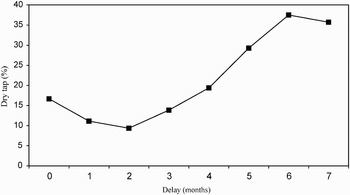
The longer a patient waited, the more likely they were to have a dry tap, as shown in Figure 1.
Dry tap rate vs delay to operation.

Effect of anaesthetic agent
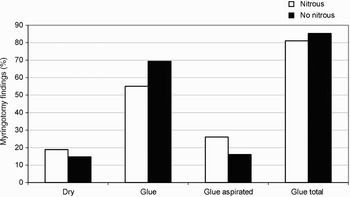
There was no significant difference in the dry tap rate, comparing nitrous oxide and enflurane anaesthesia (chi-square, p > 0.25). Age, delay to operation and season of operation were similar for both anaesthetic groups. However, there was a statistically significant difference (chi-square, p < 0.006) in whether glue was found at myringotomy or on aspiration, depending on the anaesthetic agent used. In cases in which enflurane was used, glue was more frequently apparent at myringotomy (as opposed to following aspiration), compared with cases in which nitrous oxide was used. This is shown in Figure 2.
Myringotomy findings related to anaesthetic agent.

Middle-ear compliance measurements before and after induction of anaesthesia, compared with findings at myringotomy
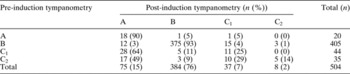
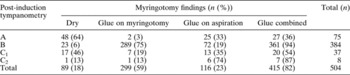
The changes noted in pre- versus post-induction tympanometry are shown in Table I.
Changes in tympanometry findings following anaesthetic induction

Figures in parentheses are percentages of each row.
Of particular note is the finding that type A and B tympanograms were much more likely to remain unchanged by anaesthetic induction (90 and 93 per cent, respectively) than were types C1 (25 per cent) and C2 (14 per cent) tympanograms.
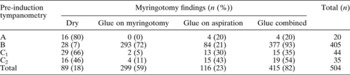
The relationships between pre- and post-anaesthetic tympanometry findings and myringotomy findings are shown in Tables II and III.
Myringotomy findings related to pre-induction tympanometry result

Figures in parentheses are percentages of each row.
Myringotomy findings related to post-induction tympanometry result

Figures in parentheses are percentages of each row.
It is interesting that glue was found in four (20 per cent) of the ears with a type A tympanogram pre-induction.
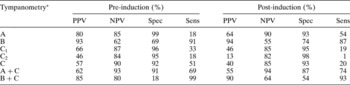
From the above Tables, a number of statistical values indicating the usefulness of our tympanometry can be derived. These are shown in Table IV.
Tympanometry statistics

The rates for types B and B + C relate to prediction of glue, whereas all others relate to prediction of a dry tap. *Unilateral ears, n = 280. PPV = positive predictive value; NPV = negative predictive value; Spec = specificity; Sens = sensitivity
Aspiration vs myringotomy alone
Glue was found at myringotomy alone in 59 per cent of procedures. When aspiration of the middle ear was performed with the sucker tip in the middle ear for 15 seconds, an extra 23 per cent of ears were found to contain glue.
Multivariate analysis
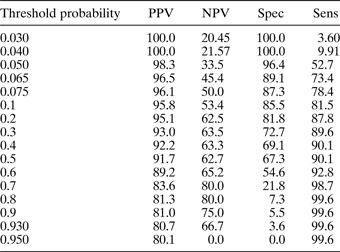
The best combination of factors predicting a dry tap was a type B pre-induction tympanogram, a type B post-induction tympanogram and a delay to operation (Table V). None of the other factors assessed was significant when added to the above set. The resulting logistic regression equation) predicts the probability of a dry tap; however, in order to make an actual prediction it is necessary to specify a threshold probability. Prediction statistics were computed over the range of threshold probability from zero to one and are presented in Table VI. These statistics have been expressed in relation to middle-ear fluid prediction rather than dry tap prediction, in order to allow comparison with the statistics for type B tympanograms alone in Table IV. At a threshold probability of 0.4, the statistics are close to those for pre-induction tympanometry in Table IV. As the threshold increases from 0.4, the sensitivity increases but specificity rapidly falls until virtually all ears are being classified as having fluid. For threshold values less than 0.4, the specificity improves at the expense of sensitivity, both exceeding 80 per cent at a threshold of 0.2.
Logistic regression analysis predicting a dry tap: 3 factors

CI = 95 per cent confidence interval
Statistics for prediction of middle-ear fluid: 3-factor logistic regression equation

PPV = positive predictive value; NPV = negative predictive value; Spec = specificity; Sens = sensitivity
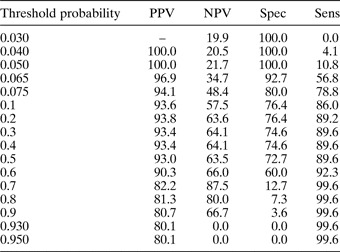
Another logistic regression equation was derived which contained only the pre-induction tympanogram result and the delay to operation (Table VII). This was performed because post-induction tympanogram information was not as useful as expected. The corresponding prediction statistics are shown in Table VIII. The values nearest to those for pre-induction tympanometry alone (Table IV) occur between the threshold values 0.5 and 0.6.
Logistic regression analysis predicting a dry tap: 2 factors

CI = 95 per cent confidence interval
Statistics for prediction of middle-ear fluid: 2-factor logistic regression equation

PPV = positive predictive value; NPV = negative predictive value; Spec = specificity; Sens = sensitivity
Discussion
The proportion of dry taps in all myringotomies (18 per cent; Tables II and III) was similar to that found in previous studies, although towards the lower end of the range (13–34 per cent).Reference Rees and Freedland1, Reference Jardine, Maw and Coulton13,Reference Shaw, Stark and Gannaway14
There was a general seasonal trend in the dry tap rate. It was lowest in spring and gradually increased through summer and autumn to a maximum in winter; however, this trend did not reach statistical significance. Zielhuis et al. Reference Zielhuis, Heuvelmans-Heinen and Rach15 showed that seasonal factors do affect the spontaneous resolution rate, with an increased spontaneous resolution of mild disease in the summer. The lack of significant seasonal variation in our own study may be due to the differences in our patients' ages, the climate, and patients' initial indications for surgery.
The dry tap rate showed an initial fall in the two months following listing for operation, and then rose. After four months, the dry tap rate rose above that found in operations performed within the first month, and it continued to rise to around 40 per cent at six months (Figure 1). Beyond this point, the number of patients in each group became too small to have any real significance. Our data do not enable us to explain why a child waiting less than one month should often have a dry tap. It appears that glue ears initially worsen, before tending to spontaneously resolve when left for longer. Overall, the data are compatible with those of other studies, which have shown an increasing resolution of glue ear with longer waiting times.Reference Lim16, Reference Maw and Parker17
The use of nitrous oxide anaesthesia did not have any overall effect on whether glue was found. However, where glue was present, nitrous oxide anaesthesia did seem to change its location within the middle ear. Significantly more patients who were anaesthetised using nitrous oxide were found to have glue on prolonged aspiration rather than at myringotomy. This would seem to suggest that the glue, whilst still present, had been moved away from the tympanic membrane. This fits well with the findings from a number of other studies,Reference Drake-Lee, Casey and Ogg3, Reference Drake-Lee and Casey4, Reference Singh and Kirk18–Reference Koivunen, Alho and Uhari20 which have demonstrated that nitrous oxide diffuses into the middle ear. However, this would require an air–fluid interface within the middle ear for the nitrous oxide to diffuse across. Logically, it should therefore be more common in patients with type C tympanograms, in whom this interface is most likely to exist. This is borne out by our data, in that a significantly higher proportion of type C pre-induction tympanograms changed to type A post-induction, compared with type B pre-induction tympanograms (57 vs 3 per cent; chi-square test, p < 0.0001).
The implication of these findings is that whilst diffusion of nitrous oxide into the middle ear may cause glue to be overlooked it need not do so, provided that care is taken to ensure that the ear is definitely dry, by allowing sufficient time for aspiration – 15 seconds in our study. Placing the sucker tip in the middle ear results in significantly fewer ears being classified as dry taps than myringotomy alone; however, care must be taken to avoid injury to middle-ear structures. This may partially account for the previous dispute over whether nitrous oxide influences the dry tap rate or not, as well as helping to explain the threefold variation in dry tap rates in published studies.
The derived values for the usefulness of tympanometry are broadly in agreement with previously published figures.Reference Finitzo, Friell-Patti and Chinn21,Reference Watters, Jones and Freeland22
The question of whether the presence of a dry tap at myringotomy can be ascribed to the anaesthetic agent requires a qualified answer. If all ears with a pre-induction type B tympanogram are expected to have glue at myringotomy, then the answer is that 7 per cent have changed (if those ears with type C tympanograms are included, then 15.1 per cent have changed). However, 6 per cent of ears with type B tympanograms post-anaesthetic turned out to be dry taps, as did 46 per cent of type C1 ears and 13 per cent of type C2 ears (40 per cent when combined). This makes it difficult to know what proportion of ears with pre-anaesthetic type B and C tympanograms would have been dry anyway, even without the anaesthetic. The percentage of ears with pre-induction type B and C tympanograms which were dry taps equals the percentage that were genuinely altered by the induction of anaesthesia, plus the percentage in which the type B or C curve was not due to the presence of glue. We know the first value (15.1 per cent in our data), and we also know the last value (as this is the percentage of patients with a post-induction type B or C curve who had a dry tap (9.5 per cent)). Subtracting the latter from the former gives the percentage of ears genuinely altered by anaesthesia (15.1 − 9.5 = 5.6 per cent). Applying this logic to the type B tympanogram ears alone, the 7 per cent dry tap rate in pre-induction type B ears comprises 6 per cent false readings from the tympanometer plus 1 per cent altered by anaesthesia.
If this logic is extended to the other pre-induction groups, Table IX can be produced.
Dry taps resulting from anaesthesia

* Column 2 − column 4.
A type C tympanogram is obviously not predictive of a middle ear full of fluid, and does not usually predict significant hearing loss (average 17.4 dB).Reference Watters, Jones and Freeland22 However, the percentage of type C tympanogram ears in which glue was found (40–60 per cent) is significant. This also suggests that, if using pre-operative tympanometric screening, the finding of a type C2 tympanogram, and probably also a type C1 tympanogram, should not be the sole basis for postponing surgery. We have therefore included type C tympanograms in Table X. The figures in this Table fit with the findings discussed above, in that the air in the middle ear, predicted by a type C tympanogram, more readily enables diffusion of anaesthetic into the middle ear. This, in turn, is more likely to lead to a dry tap or glue found at aspiration rather than on myringotomy. This is borne out by our actual study data. This implies that, in a patient with a type C tympanogram in whom a dry tap is found, there is a significant chance that this finding may have been caused by the anaesthetic; therefore, if one was planning to insert a grommet, one should go ahead and do it.
Likelihood of unnecessary intervention with time

Mth = months
The evidence that the dry tap rate rises quite dramatically with increasing time to operation should qualify the above. At two months' delay, the dry tap rate was only 9.3 per cent, rising to 30 per cent at five months and to almost 40 per cent at six months. The only explanation we can find for this is natural resolution of the effusion. It would therefore seem that time to surgery should also be a factor in the decision as to whether or not to insert a grommet.
The actual proportion of patients not requiring a grommet will be higher than this, as the initial level of 15 per cent includes some patients who have been misdiagnosed with otitis media with effusion, due to false tympanometry or a difficult history, otoscopy or audiometry. The most accurate technique for predicting middle-ear fluid is a tympanogram, which has a false positive rate of 4 per cent.Reference Kazanas and Maw23 As history, otoscopy and audiometry are all less predictive of middle-ear fluid than this, 4 per cent may be taken as an approximation of the maximum misdiagnosis rate. The likelihood of grommet insertion being an unnecessary intervention increases with time. Table X shows the figures for the period of this study.
• The standard operative treatment of otitis media with effusion consists of myringotomy and grommet insertion
• This study was designed to assess factors contributing to the presence of a ‘dry tap’
• During the study period, 750 children underwent myringotomy. Data were prospectively gathered from 280 children meeting the inclusion criteria. The dry tap rate was 18 per cent
• Dry taps have been previously reported as occurring in 13–34 per cent of myringotomies
• A small proportion of dry taps were due to the anaesthetic (6 per cent for all abnormal (non type A) tympanograms)
• The best combination of factors predicting a dry tap was non type B tympanogram and delay to operation
Multivariate analysis shows that factoring in the post-induction tympanogram and the delay to operation can improve the overall accuracy of dry tap prediction, beyond using a pre-induction tympanogram. It is an unexpected finding that a post-induction tympanogram, which may be falsely altered by anaesthesia, improves the chance of predicting a dry tap. In the real world, it is a little late to be deciding whether to perform a myringotomy after the patient has been anaesthetised. Therefore, we cannot recommend the use of post-induction tympanometry in a non-trial setting.
Conclusion
In our population, the proportion of dry taps at myringotomy was 18 per cent. A pre-operative type B tympanogram was a strong indication of not finding a dry tap at surgery. Tympanometry findings are frequently changed by induction of anaesthesia in patients with a type C tympanogram, but not so often in those with a type B tympanogram. The proportion of dry taps due to anaesthetic is 6 per cent for all abnormal (i.e. non type A) tympanograms. Multivariate analysis showed that the best combination of factors for predicting a dry tap was a non type B tympanogram and a delay to operation.
Acknowledgements
The authors would like to acknowledge Mr RW Ruckley for allowing his patients to be included in the study. We would also like to thank the former Northern Regional Health Authority for their help in providing a research grant for purchase of the tympanometer.