Introduction
Anthropogenic driven global climate change has jeopardised biodiversity resulting in the range shifts or extinction of fauna and plant (Anderegg et al. Reference Anderegg, Hicke, Fisher, Allen, Aukema, Bentz, Hood, Lichstein, Macalady, Mcdowell, Pan, Raffa, Sala, Shaw, Stephenson, Tague and Zeppel2015, Millennium Ecosystem Assessment 2005, Yates et al. Reference Yates, Elith, Latimer, Le maitre, Midgley, Schurr and West2010). Global climate change-forced range shifts have been reported for many species over the last 30 years (Román-Palacios & Wiens Reference Román-Palacios and Wiens2020). Presently, species across forest ecosystems are shifting and declining at an alarming rate owing to unprecedented climate change (Larsen et al. Reference Larsen, Brehm, Navarrete, Franco, Gomez, Mena, Morales, Argollo, Blacutt and Canhos2011).
Not all species have responded to climate change in the same way (Chhetri et al. Reference Chhetri, Gaddis and Cairns2018). For example, limited dispersal ability exacerbates the negative impacts of climate change on plant species and reduces their adaptive capacity (Dagnino et al. Reference Dagnino, Guerrina, Minuto, Mariotti, Médail and Casazza2020). Mountain endemic plants are more prone to the impacts of climate change since they have a narrow ecological niche and occur in a narrow geographic range (Essl et al. Reference Essl, Staudinger, Stöhr, Schratt-Ehrendorfer, Rabitsch and Niklfeld2009, Trew & Maclean Reference Trew and Maclean2021). The resilience of a given species due to climate change is highly associated with its distribution range size (Purvis et al. Reference Purvis, Gittleman, Cowlishaw and Mace2000). The range is highly sensitive to anthropogenic pressure and general climate change scenarios for species that are naturally restricted to narrow habitats. Therefore, vulnerability of a plant species to extinction is closely associated with its habitat range size and range shift performance (Purvis et al. Reference Purvis, Gittleman, Cowlishaw and Mace2000) and identification of range size of suitable habitats of a species is important for designing appropriate management plan (Fourcade et al. Reference Fourcade, Engler, Rödder and Secondi2014).
To this end, spatial model algorithms are useful to understand the current and future distribution of plant species. Several modelling tools are commonly applied in conservation biology to predict the impact of climate change on species distribution (Elith et al. Reference Elith, Graham, Anderson, Dudik, Ferrier, Guisan, Hijmans, Huettmann, Leathwick, Lehmann, Li, Lohmann, Loiselle, Manion, Moritz, Nakamura, Nakazawa, Overton, Peterson, Phillips, Richardson, Scachetti-pereira, Schapire, Sobero´n, Williams, Wisz and Zimmermann2006, Elith & Leathwick Reference Elith and Leathwick2009, Norris Reference Norris2014, Yackulic et al. Reference Yackulic, Chandler, Zipkin, Royle, Nichols, Campbell grant and Veran2013). For example, species distribution model (SDM) software is frequently used for mapping potential suitable habitats of native species whose populations are declining in their natural habitat (Elith et al. Reference Elith, Graham, Anderson, Dudik, Ferrier, Guisan, Hijmans, Huettmann, Leathwick, Lehmann, Li, Lohmann, Loiselle, Manion, Moritz, Nakamura, Nakazawa, Overton, Peterson, Phillips, Richardson, Scachetti-pereira, Schapire, Sobero´n, Williams, Wisz and Zimmermann2006). Moreover, SDM tools assist in conservation planning particularly in identifying conservation sites (Gaston Reference Gaston1996, Hamid et al. Reference Hamid, Khuroo, Charles, Ahmad, Singh and Aravind2019, Phillips & Dudik Reference Phillips and Dudik2008). Although several ecological models have been established and applied in conservation biology, the maximum entropy (MaxEnt) model is superior in predicting rare and endangered plant species with accuracy (Phillips et al. Reference Phillips, Anderson and Schapire2006).
In the developing countries of sub-Saharan Africa, the synergistic effects of continuing habitat degradation and climate change are severely threatening biodiversity (Perrings & Halkos Reference Perrings and Halkos2015, Serdeczny et al. Reference Serdeczny, Adams, Baarsch, Coumou, Robinson, Hare, Schaeffer, Perrette and Reinhardt2016). In the face of a species diversity crisis, continuous evaluation of species realised niche through statistical model prediction is quite important for successful conservation (Austin Reference Austin2006). Therefore, the present study aims to undertake model prediction analysis of two most commonly used spice plant species in Ethiopia, Piper capense and Aframomum corrorima which are naturally growing in forests as an understorey.
P. capense is an endemic plant of East Africa found especially distributed in wet highlands of the region (Avril Reference Avril2011) and A. corrorima is an endemic to Ethiopia. P. capense and A. corrorima are aromatic plant species belonging to the families of Piperaceae and Zingiberaceae, respectively (Lock Reference Lock1976). Both of these species have an overlapping distribution and are naturally occurring in moist Afromontane forest (MAF) of southern and southwest Ethiopia from 1350 to 2400 m a.s.l. (Debebe et al. Reference Debebe, Dessalegn and Melaku2018, Kifelew Reference Kifelew2014). Outside Ethiopia, P. capense is also commonly traded in North Africa where it was assumed to be introduced by Arab merchants from Ethiopia through spice trading routes (Avril Reference Avril2011, Agize & Zouwen Reference Agize and Zouwen2016).
Both species are economically important and used for preparing different traditional dishes of Ethiopia and are known for their distinct aroma (Getasetegn & Tefera Reference Getasetegn and Tefera2016, Jansen Reference Jansen1981). Seeds of A. corrorima are used as a tonic, carminative and purgative drug because of their essential oil contents with typical aroma (Jansen Reference Jansen1981). Its vegetative parts (pods, leaves, rhizomes and flowers) have been reported to be widely used as traditional medicine especially in southern Ethiopia (Engels et al. Reference Engels, Hawkes and Worede1991, Eyob et al. Reference Eyob, Martinsen, Tsegaye, Appelgren and Skrede2008). A. corrorima plays an important role in household income generation and unemployment reduction as it is traded throughout almost the country and also exported to different countries including Sudan, northeast Africa, Arabia and India (Hibistu Reference Hibistu2020).
Currently, the moist Afromontane evergreen forest of Ethiopia, the natural habitats of this studies’ focal species, is suffering from ongoing human-induced degradation (Shumi et al. Reference Shumi, Rodrigues, Schultner, Dorresteijn, Hanspach, Hylander, Senbeta and Fischer2019). Encroachment of settlements, deforestation due to agricultural expansion, firewood collection, charcoal production and other livelihood activities have been reported in this forest (Gole et al. Reference Gole, Feyera, Kassahun and Fite2009, Tadese et al. Reference Tadese, Soromessa, Bekele and Meles2021). Coffee shade agroecosystem historically slows down total deforestation compared to annual-crop production system (Hylander et al. Reference Hylander, Nemomissa, Delrue and Enkosa2013). But intensive coffee management is still degrading forest biodiversity by simplifying the forest structure and clearing understorey grown herbs and shrubs.
We have investigated two species, P. capensis and A. corrorima, naturally growing as understorey herbs. These species are currently restricted to MAFs of south and southwest parts of the country, and we expect that a shift in habitat ranges may occur due to the ongoing global climate change. Here, we hypothesise that (1) the spatial and elevational shifts in distributions of the potentially suitable habitats of both species occur outside their current ranges under future climate change scenarios Representative Concentration Pathway (RCP) 4.5 and RCP 8.5 and (2) the magnitude of range shifts of these species is more pronounced under RCP 8.5 than RCP 4.5.
Methods
Study system
The study was extrapolated to the entire territory of Ethiopia, which extends from 3o24ʼ−14o 53ʼ N to 32o 42−48o12ʼ E with the intention of assessing and predicting suitable habitats for these species in the entire country and recommending appropriate conservation action. According to the Geospatial Information Agency of Ethiopia, the total area of Ethiopia is 1.13 × 10⁶ square km with an altitudinal range from 124 to 4560 m a.s.l.
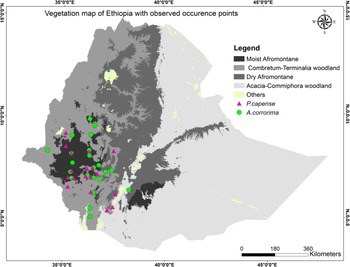
Historically, vegetation of Ethiopia has been classified in several ways, but, recently, Friis et al. (Reference Friis, Demissew and Breugel2010) have classified it into 12 potential vegetation types. The two focal species have historical and current distribution in MAF, Combretum-Terminalia woodland (CTW) and to a lesser extent in Dry Afromontane Forest (DAF) (Figure 1). The future prediction of the distribution of these species has also shown that they will occur in Acacia-Commiphora woodland (ACW) to a least extent. Considering the 12 vegetation types where these species do not occur may simply complicate the map of the spatial model. As a result, we have adopted the five major ecosystems of Ethiopia (EFCCC 2017, Table 1) to map suitable habitats of P. capense and A. corrorima.
The observed occurrences of P. capense and A. corrorima in relation to the vegetation ecosystems

The 5 major ecosystems of Ethiopia based on the 12 potential vegetation types of Friis et al. (Reference Friis, Demissew and Breugel2010)

Data collection
Species occurrence data
The data on the geographic locations of P. capense and A. corrorima were collected from field surveys, the National Herbarium of Ethiopia, Addis Ababa/University, the Global Biodiversity Information Facility (http://www.gbif.org) database and published literatures. We used herbarium specimens and an online database with a clear record of geographic coordinates and rejected specimens without clear records of coordinates. For coordinates recorded without error, we used only records of specimens collected in 1980s (recently) since the quality of location data generally declines with specimen age (Bloom et al. Reference Bloom, Flower and DeChaine2018, Murphey et al. Reference Murphey, Guralnick, Glaubitz, Neufeld and Ryan2004). We used the text-only locality description on herbarium specimens to track the direction and verify the location through field survey, and we recorded the location of the species by GPS keeping the error below 1000 m. We used ArcGIS and Google Earth for mapping the locations before field surveys. Moreover, misidentification and duplicate occurrences were checked by cross-checking with different sources. For this study, 60 occurrences for P. capense and 74 for A. corrorima were collected and used for training and testing the MaxEnt modelling algorithm.
According to van Proosdij et al. (Reference van Proosdij, Sosef, Wieringa and Raes2016), MaxEnt model performance increases with increasing the number of presence observations (sample size) under constant prevalence and decreases with increasing prevalence under constant sample size. However, the lower limits to produce nonrandom models range from 14 for narrow-ranged to 25 for widespread species (van Proosdij et al. Reference van Proosdij, Sosef, Wieringa and Raes2016, Støa et al. Reference Støa, Halvorsen, Stokland and Gusarov2019) which suggests the present sample is adequate.
Environmental variables
Bioclimatic variables (Bio1-Bio19) were downloaded from Worldclim database (www.worldclim.org/bioclim) at spatial resolutions of 30 arc seconds (∼1km) which uses interpolation based on observed representative data over the period from 1950 to 2000 (Hijmans et al. Reference Hijmans, Cameron, Parra, Jones and Jarvis2005). Elevation, topographic position index (TPI) (combined indices for slope, aspect and altitude) and solar radiation index (SRI) were predictor variables used for modelling in the current study. The TPI is an important factor for natural resource distribution through constraining hydrological processes and soil moisture (Loritz et al. Reference Loritz, Kleidon, Jackisch, Westhoff, Ehret, Gupta and Zehe2019, Mukherjee et al. Reference Mukherjee, Mukherjee, Garg, Bhardwaj and Raju2013). It has been used as a decisive factor for projective vegetation modelling (Kumar et al. Reference Kumar, Verdin and Greenlee2000). SRI is another parameter selected for this study, and it is theoretically proportional to the amount of direct solar radiation striking arbitrarily oriented earth’s surface as a function of its aspect, slope and latitude (Keating et al. Reference Keating, Gogan, Vore and Irby2007).
Downscaled global climate model data from Coupled Model Intercomparison Project Phase 5 (CMIP 5) (IPCC Fifth Assessment Report, AR5) were used to predict the potential habitat distribution (geographical range expansion, contraction or range shift) of the species based on two future climate change scenarios. Intergovernmental Panel on Climate Change (IPCC) adopted four RCPs from greenhouse gas concentration trajectories, which were reported in the 5th assessment Report of the IPCC 2014. The IPCC used range reports of forcing levels linked with emission scenarios in different published literatures for the RCP adoption (IPCC 2008). The four RCPs are RCP2.6, RCP4.5, RCP6.0 and RCP8.5 (named after the potential radiative forcing value in 2100) relative to the pre-industrial values (+2.6, +4.5, +6.0 and +8.5 W/m2, respectively) (Weyant et al. Reference Weyant, Azar, Kainuma, Kejun, Nakicenovic, Shukla, Rovere and Yohe2009). RCP 2.6 scenario is the one with the lowest GHG emission (a likely average global temperature increase of 0.3–1.7 °C at the end of the century), RCP 4.5 and RCP 6.0 intermediates, whereas RCP 8.5 is the most extreme scenario with the highest GHG emission expected (a likely global temperature increase of 2.6–4.8 °C at the end of the century) (IPCC 2008). We used four climate change year/RCP-scenario combinations from CMIP 5 as future climate change variables for the species modelling in this study. The four combinations were 2050/RCP 4.5, 2050/RCP 8.5, 2070/RCP 4.5 and 2070/RCP 8.5, where the years 2050 and 2070 were considered average GHG emissions for the years 2041–2060 and 2061–2080, respectively. Finally, the environmental variables were processed to the same spatial resolution of 30-second latitude/longitude (ca.1 km2 at ground level), georeferenced and converted to Ascii files.
Data analysis
Before running the model, the multicollinearity of the 22 predictor variables was cross-checked using Pearson‘s pairwise correlation matrix analysis (Supplementary Material Table S1). For this purpose, SDMtoolbox (version: 2.4) was applied in the ArcGIS platform, and finally, only 11 variables that weakly correlated (i.e., r ≤ 0.70, as per the default in MaxEnt software) were included in the model (Table 2).
Eleven environmental variables used for the prediction modelling of habitat suitability distributions

The differences in elevational shifts of the habitat suitability categories (i.e., the pixel values extracted were used as response variables) under current and future climatic scenarios were tested using an independent t-test within R statistical programme (version: 4.1.0., R Core Team 2021). Moreover, three environmental variables, namely elevation, SRI and TPI, the values of which do not vary across the climatic scenarios, were used to statistically analyse their effect on the different categories of habitat suitability using a linear model in R statistical programme. Here, following a backward selection approach, we stopped at the final model with lowest AIC and higher adjusted R 2 .
Model selection and simulation
After characterising the data and environmental variables, MaxEnt modelling software (v3.4.4) was used for modelling the distributions of suitable habitats of the study species. As P. capense and A. corrorima occur in moist habitats under the shade of forest trees, clearance of forest understorey for Arabica coffee has threatened their local abundance and distributions across MAFs. Therefore, their realised habitats are restricted and small in size in Ethiopia. Modelling the distribution of range-restricted species is challenging for modelling software because of their sensitivity to sample size (Ardestani et al. Reference Ardestani, Tarkesh, Bassiri and Vahabi2015, Phillips et al. Reference Phillips, Dudík and Schapire2004). MaxEnt is less sensitive to sample size and models the distribution of range-restricted species with high accuracy (Khanum et al. Reference Khanum, Mumtaz and Kumar2013, Phillips et al. Reference Phillips, Anderson and Schapire2006) and better fit to our data. The basic principle of the SDM algorithms is to relate the present occurrence data of the species to environmental layers to produce maps of probability of occurrence (suitable habitats) through space and time in the user-defined landscapes (Elith et al. Reference Elith, Phillips, Hastie, Dudík, Chee and Yates2011, Kearney & Porter Reference Kearney and Porter2009).
Modelling procedure and performance evaluation
The five ecosystems (Table 1) were digitised using ArcGIS (v.10.5). The average of habitat suitability distribution map (MaxEnt output) was clipped by extracting by mask tool by using the area of each of the 5 ecosystems as a masking feature. Then the clipped features were reclassified into habitat suitability classes for the current and future climate change scenarios for both species. This was done to evaluate the species’ current distribution and predicted potential range shifts under RCP 4.5 and RCP 8.5 scenarios for 2050 and 2070 in association with vegetation ecosystems.
For the model simulation, the random test percentage was fixed to be 25, that is, allowing MaxEnt to withhold 25% of the presence data to be used randomly to evaluate the model performance and keeping aside 75% for training the model (Phillips et al. Reference Phillips, Anderson and Schapire2006). MaxEnt was set to run the model 10 times and then average the results from all models created (Choudhury et al. Reference Choudhury, Deb, Singha, Chakdar and Medhi2016). MaxEnt was set to maximum iterations = 500, convergence threshold = 0.00001, a maximum number of background points = 10,000, replicate run type = subsample, linear and quadratic binary features (Peng et al. Reference Peng, Cheng, Hu, Mao, Xu, Zhong, Li and Xian2019), output format = logistic (Antúnez et al. Reference Antúnez, Suárez-mota, Valenzuela-encinas and Ruiz-aquino2018). The Jackknife test was used to evaluate the relative contribution of each predictor variable in the modelling (Phillips et al. Reference Phillips, Dudík and Schapire2004). After running the model, we classified the output in ArcGIS based on their band categories and classes as highly suitable area (0.85–1), suitable area (0.69–0.85), moderately suitable area (0.54–0.69), less suitable area (0.38–0.54) and unsuitable area (0–0.38).
The model’s power of predicting the species distribution was measured by area under the curve (AUC) value which is obtained from receiver-operating characteristic (ROC) (Phillips et al. Reference Phillips, Anderson and Schapire2006). AUC is a threshold-independent index that measures the ability of the MaxEnt model to discriminate background into a high probability of presence from absence in the modelling algorithm. The value of AUC ranges from 0 to 1 and AUC = 0.5 corresponds to random prediction and AUC < 0.5 shows even worse than random prediction (Phillips et al. Reference Phillips, Dudík and Schapire2004). AUC values were rated as poor (0.5–0.6), fair (0.6–0.7), good (0.7–0.8), very good (0.8–0.9) and excellent (AUC>0.9) (Swets Reference Swets1988) and AUC ≥ 0.9 shows a robust model. In this study, AUC of ROC was found to be 0.961 ± 0.17 and 0.948 ± 0.009 for P. capense and A. corrorima, respectively. The AUC values which were significantly far from the standard set for random prediction (AUC0.5) and close to 1 indicated that MaxEnt model could predict the locations of potentially suitable habitats for both species with high accuracy.
The average AUC value for predicting the distribution of P. capense and A. corrorima under climate change scenarios was also found to be between 0.943 and 0.967. Since the AUC values of all the future years/scenario cases were higher than 0.90, the model was robust enough to discriminate the background into presence and absence classes for these species with high accuracy.
Results
Species distribution modelling
The results of the spatial SDMs analyses showed that precipitation of the driest quarter (Bio17) and SRI have significantly contributed to the distribution modelling of the two species (Table 3). Precipitation seasonality (coefficient of variation) (Bio 15) and precipitation of coldest quarter (Bio 19) contribute most to the distribution of A. corrorima. The result of the jackknife test of variable importance also confirmed that Bio17 and SRI had the highest gain when used in isolation followed by Bio 19 and Bio 15. TPI and mean diurnal range (mean of monthly max. and min. temp.) (Bio 2) appeared to have the most information that is not present in the other variables, therefore, decreases the gain the most when it is omitted in both the species.
Estimates of relative contributions of environmental variables to the MaxEnt modelling

Habitat suitability mapping under current climate scenario (1970−2000)
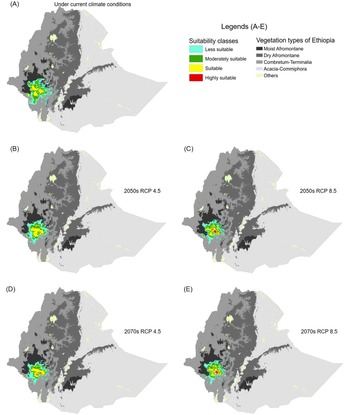
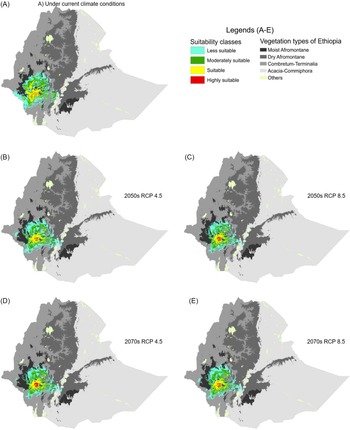
Under the current climate, the distributions of the different categories of habitat suitability (i.e. less suitable, suitable, moderately suitable and highly suitable) of both P. capense and A. corrorima were concentrated in moist Afromontane forest and CTW vegetation types which are dominantly found in southwest and West of Ethiopia including Kefa, Ilubabor and Wollega floristic regions. The model prediction showed that only 3.35% of the total area of Ethiopia is modelled to lie between ranges from highly suitable areas to less suitable areas for P. capense (Figure 2). For A. corrorima, only about 5.56% of the total area of Ethiopia lies between highly suitable and less suitable habitats (Figure 3).
Maps of spatial suitable habitats of P. capense in relation to vegetation ecosystems: current climate scenario (A), and future 2050 (B and C) and 2070 (D and E) periods with 4.5 and 8.5 RCP scenarios

Maps of spatial suitable habitats of A. corrorima in relation to vegetation ecosystems: current climate scenario (A), and future 2050 (B and C) and 2070 (D and E) periods with 4.5 and 8.5 RCP scenario

Predicting habitat suitability distribution under future climate change scenarios
Under the future climate scenario, the distributions of different categories of habitat suitability of both P. capense and A. corrorima were also consistently shown to lie mainly in MAF, CTW and wooded grassland.
The model prediction showed that only 2.75% of the total areas of Ethiopia is modelled to lie between ranges from highly suitable areas to less suitable areas for P. capense in 2050s under RCP 4.5. Similarly, only 2.43% (in the 2050s under RCP 8.5), 2.56% (in 2070s under RCP 4.5) and 2.45% (in 2070s under RCP 8.5) were shown to lie between different categories of habitat suitability for P. capense, respectively.
For A. corrorima, future model prediction showed that only 5.23% of total areas of Ethiopia is modelled to lie between ranges from highly suitable areas to less suitable areas in 2050s under RCP 4.5. Similarly, only 4.3% (in the 2050s under RCP 8.5), 4.55% (in 2070s under RCP 4.5) and 2.45% (in 2070s under RCP 8.5) were shown to lie between different categories of habitat suitability for A. corrorima, respectively. The comparative relative area among different categories of suitable habitat shows a decreasing trend from less suitable areas to highly suitable areas at each year per scenario (Figures 4 & 5). Moreover, the result of the linear model analyses indicated that the TPI has significantly affected all the four habitat categories of both species (P < 0.001, Tables 4 and 5).
Graph showing a comparative summary of predicted relative suitable area for P. capense under current climate condition and future climate scenario

Graph showing a comparative summary of predicted relative suitable area for A. corrorima under current climate condition and future climate scenario

The linear model analysis of the elevation, solar radiation index and topographic position index for the four habitat suitability categories of P. capense

The linear model analysis of the elevation, solar radiation index and topographic position index for the four habitat suitability categories of A. corrorima

The pattern of the habitat suitability categories by vegetation types and along elevational gradients
Piper capense
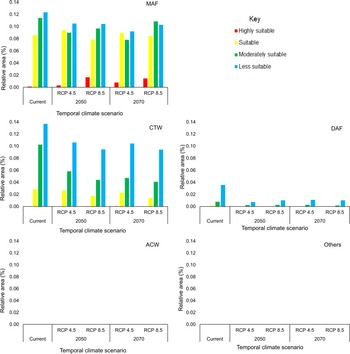
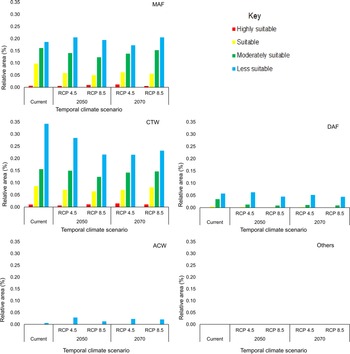
The relative proportion of the distribution of highly suitable habitat of P. capense is absent under current conditions in MAF and in all DAF, CTW, ACW and others under both current and future climate change scenarios (Figure 6). Whereas the trend of the distribution of the highly suitable habitat is similar in MAF under both current and future climate scenarios, less suitable, suitable and moderately suitable show similar pattern in MAF and CTW but occur only in low proportion in DAF and totally non-existent in ACW and others vegetation types (Figure 6).
The relative area (%) of the distribution of the habitat suitability of P. capense in relation to the vegetation types of Ethiopia

Aframomum corrorima
The relative proportion of the distribution of highly suitable habitat of A. corrorima shows a similar pattern across current and future climate scenarios in MAF and CTW but does not occur in DAF, ACW and others under both current and future climate change scenarios (Figure 7). Under both current and future climate change scenarios, less suitable, suitable and moderately suitable show similar patterns in MAF and CTW, but only less suitable and moderately suitable categories occur in low proportion in DAF, and only less suitable habitat appears with a very low proportion in ACW and all categories are non-existent in others vegetation types (Figure 7).
The relative area (%) of the distribution of the habitat suitability of A. corrorima in relation to the vegetation types of Ethiopia

The elevational range of suitable habitats of P. capense was predicted to be lower in future climate change scenarios of both 2050s and 2070s when compared with the current climate condition (1970–2000). The result of the independent sample t-test showed a significant variation in elevation shifts between the current (mean elevation: 2057 ± 161) and future climate change scenario of 2050 (RCP 4.5, mean elevation: 1967 ± 109 for P. capense, P < 0.001, Table 6). On the other hand, the elevational range of suitable habitats of A. corrorima was predicted to be higher in future climate change scenarios of both 2050s and 2070s when compared with the current climate condition (1970–2000). The result of the independent sample t-test also showed a significant variation in elevation shifts between the current and all future years per climate scenario, except 2070sRCP 8.5 for A. corrorima (P < 0.001, Table 6).
The independent sample t-test of the elevational range shift between the current and future climate scenarios of the suitable habitats of P. capense and A. corrorima under the coming 2050 and 2070 year points.

Discussion
The potential suitable habitats of plant species are distributed as functions of environmental or climate-related ecological variables. Understanding such geographic distributions for indigenous flora is critically important for designing conservation strategies in this face of climate change. Here, we show the distributions of the potential suitable habitats of P. capense and A. corrorima forest spices under current and two future climate change scenarios (i.e. RCP 4.5 and RCP 8.5 by 2050 and 2070) in relation to the major vegetation types of Ethiopia and elevational range shifts. Interestingly, in line with our hypothesis, our prediction model showed that there are spatial and elevational shifts in distributions of the potential suitable habitats of P. capense and A. corrorima forest spices outside their current ranges under the future climate change scenarios (RCP 4.5 and RCP 8.5 of 2050 and 2070). These distributions are largely occurring in MAF and CTW ecosystems (Figures 2 & 3). Below, we discuss the factors driving the distributions of the suitable habitats with the climate scenarios and the patterns of the distributions in relation to the vegetation types and elevational gradients.
The distributions of the suitable habitats under current climate scenario (1970–2000)
The model output showed that, among 11 environmental variables included in the model, precipitation of the driest quarter (Bio17) and SRI are the significant predictors for both P. capense and A. corrorima distributions. This result agrees with the previous findings that reported the intensity of solar radiation is one of the key factors affecting growth and distribution and influencing the photosynthetic capacity of the plants (Teramura Reference Teramura1983; Madronich et al. Reference Madronich, Mckenzie, Björn and Caldwell1998). Moreover, the effect of precipitation of the driest quarter (Bio17) on shaping distribution ranges of some species was also denoted by Gebrewahid et al. (Reference Gebrewahid, Abrehe, Meresa, Eyasu, Abay, Gebreab, Kidanemariam, Adissu, Abreha and Darcha2020).
The distributions of different categories of suitable habitats (i.e. less suitable, suitable, moderately suitable and highly suitable) under current climate for P. capense and A. corrorima are predicted to occur in MAF and CTW vegetation types which are mainly found in Kefa, Ilubabor and Wollega floristic regions of southwest and West of Ethiopia. In this regard, previous studies also indicated that these forest spice plants are naturally occurring in southwest and west floristic regions (Agize & Zouwen Reference Agize and Zouwen2016, Debebe et al. Reference Debebe, Dessalegn and Melaku2018, Kifelew Reference Kifelew2014). However, the probabilities of occurrences are in range-restricted areas that, currently, only 3.4% and 5.6% of total areas of Ethiopia belongs to range of less suitable areas to highly suitable areas for P. capense and A. corrorima, respectively. This narrow geographic range of distribution may indicate that these species are vulnerable to climate change (Purvis et al. Reference Purvis, Gittleman, Cowlishaw and Mace2000).
Besides impacts of climate change, topographic features (e.g. elevational gradients) and anthropogenic effects may determine the level of vulnerability of these forest spice plants (Elsen et al. Reference Elsen, Monahan and Merenlender2020). Especially, anthropogenic factors have severely threatened plant species diversity in Ethiopia (Aerts et al. Reference Aerts, Hundera, Berecha, Gijbels, Baeten, Van Mechelen, Muys and Honnay2011). The natural habitats of P. capense and A. corrorima have been highly fragmented due to extensive commercial coffee-tea plantations (Desalegn & Beierkuhnlein Reference Desalegn and Beierkuhnlein2010). Moreover, illegal settlements and deforestation due to agricultural expansion, firewood collection and charcoal production are other human factors responsible for the degradation of the habitats of the spice species (Gole et al. Reference Gole, Feyera, Kassahun and Fite2009, Tadese et al. Reference Tadese, Soromessa, Bekele and Meles2021). For example, the shade tree species of the spice species, such as Prunus africana and Cordia africana in the MAF of southwestern Ethiopia, have been overexploited and deforested for coffee-tea plantation expansion.
In this study, the distribution of P. capense and A. corrorima is predicted to shift along altitudinal gradients as the function of climate change. In agreement with this, some earlier studies reported the distribution shifts has been occurring along elevational gradients in mountainous regions (Chen et al. Reference Chen, Hill, Ohlemüller, Roy and Thomas2011, Elsen et al. Reference Elsen, Monahan and Merenlender2020) and this will cause shifts in niches (González-Moreno et al. Reference González-Moreno, Diez, Richardson and Vilà2015).
The distributions of the suitable habitats under future climate scenarios (2050 and 2070)
The prediction model indicates that the vegetation ecosystems of southwest and west Ethiopia will be refugia for P. capense and A. corrorima in the coming 2050s and 2070s under both climate scenarios. Here, the general trend of the model output from the current to 2070s shows that global warming tends to determine the highly suitable areas of both P. capense and A. corrorima even if declines at a high GHG emission scenario (RCP 8.5) of 2070s for both species. In this regard, comparatively, P. capense showed more range expansion with global warming than A. corrorima showing the species-specific response to climate change (Chhetri et al. Reference Chhetri, Gaddis and Cairns2018, Jensen Reference Jensen2003). In agreement with this, Cao et al. (Reference Cao, Prince, Small and Goetz2004) also reported that global warming promotes distribution range expansion of some plant species.
According to the model, the future possible occurrences of highly suitable habitats of both the species, mainly under RCP 8.5 scenario, are outside the current adaptive ranges under a current condition (Figures 4 and 5). This scenario unequivocally shows that species shift their geographic ranges following climate change (Chen et al. Reference Chen, Hill, Ohlemüller, Roy and Thomas2011). However, the species may either occupy the realised niches after facing the stresses from global warming or may persist and adapt to the climate change rather than shifting their geographic ranges (Carlin et al. Reference Carlin, Bufford, Hulme and Godsoe2021, Jezkova et al. Reference Jezkova, Jaeger, Oláh-Hemmings, Jones, Lara-Resendiz, Mulcahy and Riddle2016).
The distributions of suitable habitats in relation to vegetation types and elevational gradients
There is no distribution of highly suitable habitat for P. capense under current conditions in all five vegetation types, but it is predicted to be in MAF under the future scenario (Figure 6). Whereas the trend of less suitable, suitable and moderately suitable shows similar pattern in MAF and CTW but occurs only in low proportion in DAF and is totally absent in ACW and other vegetation types. These patterns illustrate that MAF and CTW vegetation types are the major ecosystems to be prioritised for conservation of P. capense.
As regards A. corrorima, the distribution of different suitability categories (from less suitable to highly suitable habitat) shows a similar pattern in both MAF and CTW. However, highly suitable areas are not found in DAF, ACW and other vegetation types. Only a low proportion of less and moderately suitable areas appeared to be in DAF and ACW, while none in others vegetation types (Figure 7). As can be inferred from the prediction, MAF and CTW are currently the main habitats for these forest spices and will also be refugia under the climate change. In general, the habitat distributions of these spices coincide and MAF and CTW ecosystems will be potential natural habitats in the face of climate change.
The elevational range of suitable habitats of P. capense was predicted to be lower in future climate change scenario of 2070s when compared with the current climate condition (1970–2000). However, there is a significant variation in elevation shifts between the current (mean elevation: 2057 ± 161) and future climate change scenario of 2050 (RCP 4.5, mean elevation: 1967 ± 109) for P. capense (Table 4). A similar trend was also reported by Crimmins et al. (Reference Crimmins, Dobrowski, Greenberg, Abatzoglou and Mynsberge2010) that a significant range shift towards the lower elevations was observed for certain plant species. Such shifts can be expected under climate change scenarios if the prediction models indicate increases in precipitation and competition due to anthropogenic influences (Crimmins et al. Reference Crimmins, Dobrowski, Greenberg, Abatzoglou and Mynsberge2010, O’Sullivan et al. Reference O’Sullivan, Ruiz-Benito, Chen and Jump2021). However, range shifts towards higher elevation is generally expected under future global warming (Chen et al. Reference Chen, Hill, Ohlemüller, Roy and Thomas2011, Elsen et al. Reference Elsen, Monahan and Merenlender2020).
The elevational range of suitable habitats of A. corrorima was predicted to be higher in future climate change scenarios of 2050s and 2070s when compared with the current climate condition (1970–2000). Here, there is a significant variation in elevational range shifts of the suitable habitat for A. corrorima between the current and future climate scenarios except for 2070s (RCP 8.5) (Table 6). This trend shows that the distribution of the suitable habitats of A. corrorima is affected by elevation more than P. capense under future climate change scenarios. It is clear that moisture, solar radiation and atmospheric pressure are associated with elevational gradient and thus may affect the physiological activities of plants (Chhetri et al. Reference Chhetri, Gaddis and Cairns2018). In this connection, the present study indicated that TPI has significant impacts on the distribution of suitable habitats for these forest spice species. This effect was due to the fact that topographic position may limit species distribution through altering of soil moistures and general hydrological processes (Loritz et al. Reference Loritz, Kleidon, Jackisch, Westhoff, Ehret, Gupta and Zehe2019). Moreover, the previous study from southern Ethiopia denoted that the net loss of species richness is projected due to range shifts towards higher elevation and in this case endemic plants, herbs and ferns could be more vulnerable (Kreyling et al. Reference Kreyling, Wana and Beierkuhnlein2010). In this aspect, A. corrorima is a range-restricted endemic Afromontane plant species endemic to Ethiopia. Endemic plants are sometimes associated with a specialised environmental niche and have low adaptive capacities, and these species-specific characteristics may increase their vulnerability to climate change (Catford et al. Reference Catford, Vesk, Richardson and Pyšek2012). The more geographic range-restricted the plant species is, the more it is vulnerable to climate change and extinction (Lucas et al. Reference Lucas, González-Suárez and Revilla2019, Dagnino et al. Reference Dagnino, Guerrina, Minuto, Mariotti, Médail and Casazza2020).
Agricultural expansion is the main driver of habitat loss in the face of the climate change in Ethiopia (Elsen et al. Reference Elsen, Monahan and Merenlender2020). Therefore, maintaining ecological corridors in the agricultural landscape, for example, along elevational gradients and riparian areas, may enhance the adaptive probabilities of the species to climate change including in mountainous regions (Nogués-Bravo et al. Reference Nogués-Bravo, Araújo, Romdal and Rahbek2008, Gregory et al. Reference Gregory, Spence, Beier and Garding2021).
Conclusion
The outputs of the prediction models showed that MAF and CTW vegetation types in southwest Ethiopia are currently the main suitable area for both P. capense and A. corrorima forest spices and will be expected to remain suitable during 2050 and 2070 under RCP 4.5 and RCP 8.5 future climate scenarios. Both of these species share common suitable areas in which precipitation of driest quarter (Bio17) and SRI were found to be significant predictor variables of their distributions. These forest spice species are range-restricted and also the prediction models indicated that there are range shifts along elevational gradients. Habitat connectivity (corridors) between lowlands and highlands may assist the migrations towards the suitable habitats. Moreover, assisted migration could also be one of the strategies to reduce the impacts of anthropogenic pressure from these species in the face of climate change. Along with this, area demarcation and regular monitoring may be important to reduce the impacts of human encroachments for agricultural expansions. In conclusion, the present study highlights the importance of taking into account the scenarios of the impacts of climate change in designing conservation strategies for these forest spice species.
Supplementary material
For supplementary material accompanying this paper visit https://doi.org/10.1017/S0266467422000104
Acknowledgements
We thank Addis Ababa and Wollega Universities for their financial supports. Our thanks also go to Prof. Ib Friis and Prof. Sebsebe Demissew for allowing us to use a shape file of vegetation type of Ethiopia.
Declaration of competing interest
We declare that there is no competing interest.