I. INTRODUCTION
Some of his famous contemporary colleagues, such as François Divisia (Reference Divisia1953), Erik Lundberg (1969),Footnote 1 Jan Tinbergen (Reference Tinbergen1974), Lawrence Klein (1998), Zvi Griliches (Reference Griliches, Griliches and Intriligator1986), and Edmond Malinvaud (Reference Malinvaud1998), recognized Ragnar Frisch as a key actor in the history of economic thought in the twentieth century for the diversity of his work but also for his active role in initiating and supporting the institutional and scientific development of a new branch of economics; i.e., econometrics. His methodological and theoretical contributions were very diverse and various. This explains why Frisch, at the same time, can be seen as the founder of macrodynamics (restricting ourselves to mention Klein [Reference Klein1953] or Arrow [Reference Arrow1960]), or as the initiator on the microeconomic analysis on the Engel curves stability (Leser Reference Leser1963), or the pioneer of the econometric methodology to estimate simultaneous equations of production functions (Marschak and Andrews Reference Marschak and Andrews1944; Hoch Reference Hoch1962; Mundlack 1963).
The scientific activities of Frisch have been analyzed, then, through different histories of economic thought: history of structural modeling; history of time analysis; history of business cycles and macroeconomics; history of national accounts; history of Econometrica and of the International Econometric Society; history of price index; history of economic planning; history of identification issues, etc.
This fragmentary way of picturing Frisch’s work by both historians of econometrics and economists overshadows the coherence of his scientific agenda. Moreover, it does not allow the relating of his methodological and theoretical innovations to the various influences that frame his scientific program. There is a need to identify these various references to previous or contemporary works, not only to understand the coherence of his scientific contributions, but also to identify and underline the innovative aspects of his work.
If we turn to what appears as his most innovative contribution to economics and econometrics—the development of macrodynamics in response to business cycles issues—it is important to understand that the 1933a model is Frisch’s exploration of two questions: one, methodological (decomposition of time series and identification of trends); and the other, theoretical (the causes of the cycles). Frisch’s model certainly allows the reconciliation of economic theory’s attachment to the concept of equilibrium and the enduring nature of economic imbalances. The challenges to economics raised by the cycles in the 1920s to 1930s were underlined by historians of econometrics, notably Morgan (1990) and Armatte (Reference Armatte1995).Footnote 2 Indeed, Frisch’s model, by distinguishing the impulse phenomena and those of propagation, restored the concept of equilibrium as the cornerstone of the economic analysis, and put it in the forefront in business cycles analysis: fluctuations in economic activities occurred regarding an equilibrium position—the economic system’s being able to absorb random shocks and then to return back to its equilibrium position. Nonetheless, the 1933a model is more than a circumstantial response to issues raised by time series analysis. From our point of view, this model is the result of more than five years of Frisch’s investigation of the nature and origin of cycles (Frisch Reference Frisch1927b), and of his desire to produce a comprehensive theory of cycles. We aim to understand the development of this model concerning the accelerator principle by tracking the influences on his research, and how he appropriately explains business cycles in terms of reinvestment cycles.Footnote 3 Then, it is a matter of understanding Frisch’s choice of a theory of cycles in terms of production of capital goods. Since this aspect of Frisch’s work is often neglected by historians of economic thought, we are focusing in this paper on his successive formalizations of the ‘accelerator principle.’
After briefly exploring the principal characteristics and major results of the rocking horse model, we will relate his analysis of business cycles, in terms of leads and lags in the production of capital goods, to American Institutionalism. Indeed, the debate between John Maurice Clark and Frisch in 1931 on the balance between reinvestment and net investment appears as the obvious reference. More specifically, this investigation will clarify the way Frisch reformulated the accelerator principle and the reasons for his emphasis on the role of the depreciation rate in understanding the turning points of cycles. But we will show that Frisch was previously and mainly inspired by the Norwegian approaches to business cycles that could explain why the production of capital goods and reinvestment are at the heart of economic oscillations—reinvestment cycles being damped cycles. Already, the goal of this 1927 investigation was to conclude that damped cycles emerge if the mechanism is not subject to random net investments.
II. THE ROCKING HORSE MODEL OR THE INVENTION OF MACRODYNAMIC MODELING
There is no doubt in my mind that the most important paper in Frisch’s impressive bibliography is his paper on “dynamic economics” in the Cassel Festchrift (1933).[Footnote 4] I cannot imagine a course of lectures in macroeconomics that would omit significant consideration of that paper. For me it is simply a favorite, and for many it is his most celebrated work. There are problems in that paper, at the levels of specification and empirical measurement, but the conceptual contribution was overwhelming—to look at the dynamics of the macroeconomy in terms of an internal mechanism related to economic response characteristics and an external mechanism related to random shocks (Lawrence Klein 1998, p. 483).
First, we must briefly present the nature of the impulse-propagation model and, more precisely, the three equations involved in the propagation system. This presentation is driven by questioning the reasons for Frisch’s attachment to the definition of damped cycles, as well as those for his choice of the accelerator as the explanatory principle of the 1933a model.
The Model and Its Results
As Morgan (1990) and Le Gall (1994) demonstrated, Frisch’s attachment to the concept of equilibrium led him to distinguish between impulse phenomena and those of propagation, to take into account the irregular movements of the economic system over time. The system of propagation describes how the economic system, left to its own devices, produces damped oscillations and tends towards a position of equilibrium after experiencing an external shock. The repetition of shocks explains that the system could not return to its initial position of equilibrium. Although Frisch’s model has been taught in macroeconomics—as Lawrence Klein stresses—we will briefly review the three equations that serve as a mechanism for propagation of cycles within the economic system.
The Three Equations of the Cassel Model
Frisch defines the three following equations where the three main variables are y, the production of capital goods started in the considered year; x, which represents national consumption (also named by Frisch as the national income because he assumes that there is no savingFootnote 5); and z, which represents the ongoing production of capital goods:
(1)
 $y_t = mx_t + \mu \dot x_t $, i.e., the production of capital goods or total investment. The latter is a function of net investment (or new investment) and of reinvestment or replacement investment. The replacement investment represents the production of capital goods that allows consumption to be kept at the same level, and the net investment represents the production of capital goods allowing for the increase in demand of consumption goods to be met. This equation is based on the accelerator principle.
(2)
$\dot x = c - \lambda (rx + sz)$ is the equation of encaisse désirée that accounts for variations of consumption, also named by Frisch the “consumption equation.” This equation indicates that an increase of consumption goods faces the rigidity of the money supply when cash needs increase. The latter is composed of two elements: a demand for cash to buy consumption goods; and a demand for cash to buy capital goods. This equation implicitly assumes that the price system is rigid. Frisch does not make the assumption explicitly, but it is implicit in his description of monetary brakes due to the rigid supply of money. This implicit assumption should be understood by the attachment of Frisch to Wicksell’s monetary theory and more especially to the role of the banks in the determination of the supply of money and their delayed reactions to market forces.(3)
$\varepsilon \dot z_t = y_t - y_{t - \varepsilon } $ is the equation that explains that the increase of the stock of capital goods is measured by the difference between the completed production and the ongoing production of capital goods. This difference is mainly explained by the time lag between the variations of the growth rate of consumption (that is followed by an increase of the production of capital goods in order to meet the increasing demand of consumption goods) and the actual realization of this new investment. The explanation relies on the delays in the production of capital goods, as showed by Aftalion (Reference Aftalion1909, Reference Aftalion1927).Footnote 6



Frisch’s model relies on a number of hypotheses, and one of the most important is that the production of consumer goods is entirely depleted each year.Footnote 7 The assurance of the presence of prospects does not consider the existence of stocks of consumer goods at the end of the period, but, instead, sees a continual flow of consumer goods consumed on a regular basis.Footnote 8
When Frisch’s Reference Frisch and Frisch1933a article was released, the production of capital goods played an essential role in his explanation of fluctuations in economic activity.
The Accelerator Principle
As Chipman stresses (1998, pp. 88–89), the stock of capital goods comprises the central element of the mechanism of the propagation of cycles. To study the annual production of capital necessary for a particular economy, Frisch applied the demonstration already developed during the debate with Clark in the Journal of Political Economy (Frisch Reference Frisch1931a). The stock of capital Z is comprised of capital goods necessary for the production of consumer goods (hx), and those necessary for the production of capital goods (ky), with h and k representing the respective rates of depreciation of branches of production of consumer goods and capital goods. The annual capital production will be determined, thus, by the growth of this capital stock.Footnote 9 The annual growth rate of the capital stock is described in the following formula:
(4)
$\dot Z = y - (hx + ky)$.

For simplicity’s sake, Frisch defined a stationary state as the point of reference, allowing for the annual production of capital to be achieved. Here, the stationary condition is zero growth of the total stock of capital; that is,  $\dot Z$=0. Thus, in the stationary state, stationary levels of production of consumer goods and production goods are defined in the following formula: y = hx + ky, which may also be written as y = mx, with
 $m = {h \over {1 - k}}$. The level of capital goods depends on the level of consumption, considering the rate of depreciation (or of ‘use’)—the equivalent of an amortization rate—of capital goods.
The Equation of the “Encaisse Désirée”
The second equation, (2), retraces Frisch’s hypotheses about the constraints affecting the growth of consumption, which, in turn, has a significant impact on investment. Indeed, in returning to the acceleration equation, we readily see that net investment results from variations in consumption. Frisch, claiming that the latter must be explained, puts forward a strong hypothesis and suggests that there are monetary brakes—to use the expression employed in his macrodynamic courses at the University of Oslo in 1934—on the growth of consumption, related to the rigidities of the banking and financial system. The idea is the following: when the economy is an expansion phase and, consequently, when the production of consumer goods and capital goods is increasing, the encaisse désirée (cash needs) also increases. Faced with this increase in demand for cash for transaction purposes, the money supply is rigid, due to institutional constraints, and cannot adapt to the growth in demand for liquidity engendered by the expansion of trade in consumer goods and investment. This tension between the increased need for cash and the rigid money supply (whether high or low), under the implicit hypothesis of price rigidity, counteracts economic expansion and creates a counter-cyclical effect. On that point, we can see how influential Wicksell was for Scandinavian economists and Frisch in particular. He argues that, since it is impossible to satisfy the need for liquidity, consumers will have to forego certain purchases, and this explains why the rate of growth in consumption decreases when the tension is too strong. The inverse mechanism is at play during periods of economic recession.
The desired reserves are defined as the sum of the need for liquidity/cash for consumption purposes plus the need for cash for investment; that is
(5) w = rx + sy,
where x designates the level of effective consumption and y the level of total investment. These levels are expressed, respectively, in quantities of consumer goods produced and traded, and in quantities of capital goods produced and exchanged. These two levels are designated by coefficients that reflect their relative weight in the overall demand for liquidity/cash. The second equation of the propagation system shows that growth in consumption is a function of the difference between the supply of available liquidity; that is, c, and the demand for liquidity/cash, represented by the equation of cash needs (equation [5]). The coefficient λ represents the effect of “reining-in”that the economy experiences; that is, that it combines the negative effects on the growth of consumption and, consequently, on the expansion of the economic system, effects that are related to the inelasticity of the monetary authorities’ reactions.Footnote 10
The Equation for Production Delays
The latter equation takes into account the necessary delays for the production of capital goods. The production of capital goods in progress includes goods newly produced, goods whose production has started, and goods that will be completed over the next periods. Thus, capital goods whose production started in the previous periods, and which are to be completed at the start of the period under consideration, will be added to the stock of capital goods in the current period. The growth in production of capital goods results from the difference between the production of capital goods whose production starts in the period under consideration and those whose production started before, during the preceding periods.
Damped Cycles
The resolution of this system ends with the description of damped cycles; that is, the description of an economic system tending towards equilibrium.
The 1933a model shows econometricians and economists how to build a macrodynamic model according to the methodological requirements and ambitions as defined already at the start of his scientific career in 1926 (1926a, 1926b).Footnote 11 But, at this point, without enough developed calibration techniques and without access to satisfactory statistical data, Frisch prefers to postulate the value of structural parameters that he defined.Footnote 12 Also, he appreciates the guessed value of structural parameters by considering whether they are a good approximation of reality, as reflected in some statistical series.Footnote 13 For this, he will be criticized by his contemporaries, as is emphasized by Morgan (1990) and Lawrence Klein (1998), and this will distinguish him from Tinbergen (1936).
The resolution of this system by Holme and Thorbjörnsen, Frisch’s assistants at the University of Oslo, gives rise to three cycles of different durations, of eight and a half, three and a half, and 2.2 years.Footnote 14 Thus, depending on the initial conditions, the propagation mechanism engenders damped oscillations.Footnote 15 These three cycles describing the propagation system are damped.Footnote 16
Frisch already proclaimed in 1927, while investigating the relationships between net or primary investment and reinvestment, his double attachment to equilibrium and to an intrinsically stable economic system.
Impulse Phenomena Related to Investment
Once Frisch was able to provide an explanation for the propagation phenomena via the production of capital goods, he still had to explain the nature of random shocks to the economic system and, thus, the persistence of the erratic oscillations observed. The linear propagation system described by Frisch absorbs cumulative shocks through a weighting process. Regarding the explanation of the nature of these shocks, it clearly appears that Frisch wants to remain within the framework of free and forced oscillations he developed in his review of Johann Åkerman’s thesis in 1928 (Frisch Reference Frisch1931b). Consequently, he eliminates non-economic shocks related to war, social movements, meteorological effects on harvests, etc., that explain forced oscillations or, as to say, exogenous factors.
The accelerator principle being at the center of his analysis of the propagation mechanism, Frisch then logically turns to factors that could directly affect the production of capital goods. He adopts the Schumpeterian innovations as the origin of the impulses:
Schumpeter has emphasized the influence of new ideas, new initiatives, the discovery of new technical procedures, new financial organizations, etc., on the course of cycles. He insists in particular on the fact that these new ideas accumulate in a more or less continuous fashion, but are put into practical application on a larger scale only during certain phases of the cycles. It is like a force that is released during these phases, and this force is the source of energy that maintains the oscillations (Frisch Reference Frisch and Frisch1933a, p. 183).
While he explicitly borrows Schumpeter’s idea, he also credits Einar EinarsenFootnote 17 with this notion of accumulation of technical innovations, as we will later show. These shocks were defined as major variations in net investment that, in turn, brought about variations in overall investment. In Frisch’s model, the variable at play here is  $\dot x_t $. This idea had already been formulated by Frisch in the lectures he gave at the Poincaré Institute a year earlier.Footnote 18 He referred back to the analogy developed then between the accumulation of technical innovations and the image of the watermill fed by a spillway, while integrating it this time with that of a pendulum.
The Obvious Influence on the Choice of the Accelerator Principle and Time Lags—American Institutionalism
The article published by Frisch in 19933a is clearly an attempt to answer the key question that drove the debates and researches in business cycles analysis in the twenties and early thirties: How can the turning points in business cycles be explained?
The answer proposed by Frisch was to relate units of investment, both reinvestment and net investment, to dampened cycles. Furthermore, the study of the relative weight of these two components of overall investment sheds light on its variations over time. More precisely, it is the accelerator principle that allows rendering the way in which these two elements interact when net (or new) investment is a function of the growth (or shrinkage) of consumption. It is this principle that enables Frisch to understand how consumption and investment interact in a dynamic process and then generate economic cycles. Frisch’s Reference Frisch and Frisch1933a explanation of cycles based on the accelerator principle and the production of capital is not made by chance or due to a desire to produce an elegant argument. If the choice of the accelerator is rooted in Frisch’s reformulation of the Norwegian understanding of the production of capital and reinvestment cycles, the precise formulation of the acceleration equation and the explanation of the turning points have to be sought in the debate between Frisch and J.M. Clark in the Journal of Political Economyin 1931–32. And this formulation will later inspire Paul Samuelson in 1939.
As shown in Dupont-Kieffer (Reference Dupont-Kieffer2001, and ch. 2 in 2003), Frisch was very concerned by methodological preoccupations, as bridging empirical measurement and theoretical measurementFootnote 19 of economic activities and fluctuations. His underlying intention, while turning to business cycles, was to differentiate his econometric modeling from American institutionalism empiricism. But, in addition, this confrontation gave him the opportunity to define more precisely his conceptions of time, money, and the economic system. And then we concluded that he established a theory of business cycles in reference and in opposition to Wesley Clair Mitchell’s work; i.e., based on analytical time (versus historical time in Mitchell’s), and on a mechanism moving around its equilibrium position (versus the cumulative changes generated by a monetary economy). Notably, Frisch kept from Mitchell’s theoretical interpretations an approach to business cycles in terms of leads and lags. In our view, the formulation of the third equation (3) of the model reflects Mitchell’s theoretical propositions.
Mitchell gave great importance to investment expenditures in explaining fluctuations in economic activity. Mitchell observed that the volume of activity in construction and industries of production goods varies to a greater extent than in other industries; this leads him to conclude that investment appears to be a potentially crucial factor in the development of cycles. But to understand the change in direction of the economy—specifically, the lag between the turning points of the consumption curve and those of investment—one must then introduce a time factor.
Investment expenditures, or, rather, the time gap between the moment of the decision (decision-making process) and the moment of the implementation of the investment decision (actual expenditures), play a central role in the causal pattern that emerges from Mitchell’s empirical generalizations. The third equation of Frisch’s impulse-propagation model emphasized especially the role of delays in the production of capital goods in explaining changes in activity level, as in Mitchell.
Mitchell observes that the contraction of investments determined at T and put into effect at T+1 leads to limited opportunities for sectors producing capital goods. This limitation is first reflected in the amount of stocks and then in reduced production. This then spreads to all sectors producing consumer goods through a mechanism known, since the publications of Kahn (Reference Kahn1931) and Keynes (1936), as the “multiplier effect.”
Reduced production lowers revenues in all sectors of the national economy. This is how Mitchell explains the passage from a growth phase to one of depression. In Mitchell’s explanatory model, one may think that agents are unaware of the impact of their decision until it is acted upon.
Indeed, at the aggregate level, the time lag between decisions and investment expenditures is such that current investment expenses depend on earlier decisions. And the latter themselves depend on previous revenue from various determinants of investment. It is, therefore, not contradictory to suppose that an increase in revenue may lead to a lessening of investment decisions at a level that would be incompatible with the current level of revenue. The explanation is, then, that the latter is associated with the current level of investment expenses, and not with the level of investment decisions. This additional delay is added to the time lags intervening between the reactions of different variables, and produces a system capable of reversing trends and, thus, completing a cycle—growth succeeds depression and so on.
Mitchell referred to what can be qualified as an “accelerator principle” to explain greater fluctuations in industries producing capital goods compared to those of other industrial sectors. In the absence of new investment at the national level, these industries are content to produce whatever will ensure replacement investment in other sectors. Then, when the entrepreneurs of these sectors anticipate a rise in demand at the national level, the production in construction sectors and that in equipment industries explodes because other industrial sectors increase their demand of capital goods for both replacement and expansion investment. This drives Mitchell to conclude that variations in investment can explain turning points in cycles.
It seems to us that Frisch found in Mitchell’s work a confirmation of his conclusions regarding explanations of cycles, conclusions stemmed by Frisch’s reformulations of the Norwegian theories focused on reinvestment. In other words, Frisch adopted the concept of an hysteresis between investment decisions and their ultimate completion—i.e., investment expenditures—as a basic element of the accelerator principle. Mitchell identifies the origin of this time lag in the delay between investment decisions and acting on these decisions—that is, investment expenditures relative to these decisions—because “the work of construction and installation of equipment takes months, indeed years” (Mitchell 1913, p. 485).
But it was John Maurice Clark and not Wesley Clair Mitchell who directly inspired him in his formulation of the accelerator principle and his focus on the depreciation rate. More precisely, Clark had referred back to Mitchell’s conclusions about connecting investment and consumption, but he provided his own interpretation of the causal link between the acceleration of consumption and the production of capital goods. To Frisch, it appeared that Clark’s conclusions were erroneous, not only because his system was undetermined (an equation with two unknown variables), but especially because it neglected the role of replacement investment or “reinvestment” in the whole process.
Frisch’s critique of Clark’s analysis focuses mainly and firstly on the depreciation rate; and this mirrors the importance given to reinvestment cycles in the development of the global investment. This focus has to be understood as the follow-up of Frisch’s reformulation of the Norwegian approach of business cycles based on replacement investment, based on the two articles of 1927 (1927a, 1927b). But the debate with Clark in 1931 drove him to state his own reformulation of the accelerator principle. The presentation in 1931 is simplified compared to 1927, due to the assumption of a unique rate of depreciation for both consumption goods and capital goods. But the main argument about the explanatory role of investment in the turning points of business cycles is kept.
Frisch’s critique of Clark starts with a mathematical rewriting of Clark’s proposal: let’s make z the actual consumption by unit of time, w the production of capital goods by unit of time, and Wthe stock of capital goods for any point of time. These three variables are functions of time. For simplicity and clarity purposes, Frisch suggests two assumptions:
1st assumption: the actual consumption z (consumer-taking) is strictly equal to the production of consumption goods; that means all the production is consumed and there is no saving. Therefore, the production of consumption goods is proportional to the quantity of available capital goods, i.e., to the stock W of capital goods available at the point of time t. Then Frisch can write:
 $$W = kz,$$
where kis a constant.
2nd assumption: the production of capital necessary for replacement purposes is calculated by the use of the depreciation rate, which is proportional to the existing stock of capital W.Frisch writes the relation as follows:
 $$u = hW,$$
where his the depreciation rate of capital goods, which is assumed to be a constant in this presentation.
These two assumptions allow Frisch to describe the variation rate of the stock of capital goods from a time perspective (Frisch 1931d, p. 648); that is, to deal with the variations as a derivative of the first order:
 $$ \dot W= w - u.$$
Thus, in relation to equation (1), Frisch can write:
 $$ \dot W = k\dot z$$
where  $\dot z$represents the growth rate of actual consumption.
This new formulation of the growth of the stock of capital can be used in equation (4), and then u can be expressed as a function of z in reference to equations (1) and (2), and then Frisch gets the following relation:
 $$ k\dot z= w-hkz.$$
Frisch then can write the production of capital goods as:
 $$ w = k(hz + \dot z).$$
Frisch then shows that the production of capital goods is related to consumption and its growth. The rate of growth of the production of capital goods is then given by:
 $$ \dot w = k(h\dot z + \ddot z).$$
According to equation (6), two elements constitute the production of capital goods: the production of capital goods for replacement purposes; and the production of capital goods to meet growing needs due to the expansion of economic activity. In other words, gross investment is composed of two components: on the one hand, replacement investment, a function of the depreciation rate and expressed here as proportional to the actual consumption of the considered time period z; and, on the other hand, net investment that is proportional to the variation rate of the actual consumption of the considered time period. Frisch is very clear; this definition of gross investment results in the simplification of the argument by the statement of the two above assumptions. And he reminds us that the simplification is suggested by Clark himself. But Frisch succeeds in showing, within the framework of these two assumptions, that replacement investment depends on the “size”—i.e., on the volume of actual consumption—while net investment depends on the variations of the actual consumption.
Frisch’s goal is to prove the need to consider the two components of gross investment in order to draw the relevant theoretical conclusions about the mechanisms at play in the turning point of business cycles. In short, the production of capital goods is subject to two kinds of forces. In order to understand and to predict the evolution of gross investment and of the turning points of business cycles, it is necessary to identify the relative weight of these two forces, and this weighting depends mostly on the depreciation rate.
Frisch’s criticisms of Mitchell and Clark are not only methodological, in suggesting modeling, but mainly theoretical, in advancing his own formulation of the relation between the production of consumption goods and the production of capital goods. The debate he had with Clark in 1931 allows him to clarify a simplified version of the accelerator principle compared to his development of 1927. The latter version then inspired him to come up with the Cassel Model two years later.
But, we want to emphasize in this paper that Frisch’s emphasis on investment movements as explanatory factors for variations in activity levels has to stem from the fact that he adopted the Norwegian theories on turning points in business cycles, and, more precisely, on reinvestment cycles.
III. THE INFLUENCE OF THE SCANDINAVIAN ECONOMY ON THE FRISCHIAN UNDERSTANDING OF THE ORIGIN OF CYCLES
The influence of Einar Einarsen and of Kristian Schønheyder is explicitly made by Frisch, either in the 1933a article (p. 33 about Einarsen and p. 16 about Holme and Theobjørsen) or in the 1927a article (about Schønheyder). These two authors have a complete theory of the business cycle revolving around the process of reinvestment. What is at stake for us is to show that Frisch came to business cycles analysis not only through time series analysis but also through his adoption of the accelerator principle at the core of the explanation of cycles. While Frisch does not wholeheartedly accept Norwegian theories on the production of capital goods, he is sufficiently influenced by them to propose, though the mathematical reformulation of Schønheyder’s work, an explanation of cycles based on the following two elements: 1) the existence of damped cycles; and 2) making reinvestment cycles the focus of the propagation system and, in so doing, making net investment the origin of impulses shocking the economic system.
A Brief Overview of Norwegian Theories of the Business Cycle
The key influence on the 1933a model was that of Einar Einarsen (Reference Einarsen1904) and Kristian Schønheyder (Reference Schønheyder1927), who specifically identified reinvestment cycles as the principal cause of fluctuations in economic activity. This influence is explicitly present in 1927 in the release of Frisch’s article on “The Relations between Primary Investment and Reinvestment” (1927a). He then not only adopts but also makes his own this emphasis on the relative weight of net investments and replacement investments. This previous work influenced by Norwegian economists explains his criticism of Clark with respect to the role of replacement investment and the depreciation rate in explaining turning points in cycles. It also explains his development of a theory of cycles revolving around the production of capital goods, and his own econometric formulation of the accelerator principle already stated by neoclassical economists.
Einar Einarsen
Thus, the propagation system in the impulse-propagation models is based on the accelerator principle, and delays in production largely explain cycles. This idea was already present when Frisch wrote, in the work of Aftalion (Reference Aftalion1909, Reference Aftalion1927), Mitchell (1913), or Clark (1917), and with the Norwegian, Einar Einarsen, who uses delays in the production of capital goods in Gode og Daarlige Tider (1904) to explain the successive phases of recession and expansion of economic activity. At the start of the twentieth century, this work was an essential reference for Scandinavian economists,Footnote 20 such as Wicksell, Schønheyder,Footnote 21 Johan Einarsen, Oskar Jaeger, and especially Frisch. If Frisch refers explicitly to Aftalion for the introduction of time lags, he was deeply and mainly influenced by a Norwegian economist, Einar Einarsen, who wrote a key work in ScandinaviaFootnote 22 on business cycles as already underlined by Andvig (Andvig Reference Andvig1985, p. 89, n 1).
The process of reinvestment is key, as the length of the cycle is determined by the life expectancy of capital goods. While new investments are concentrated in time—that is, they may be generated by the accelerator mechanism—and equipment has an identical life expectancy, the process of replacement or renewal will be similarly concentrated in time. The growth in replacement or renewal investments may induce an overall economic growth if this increase in capital needs occurs during a period of depression.
From Einarsen’s propositions, Frisch got two key elements for his own understanding of the causes of the cycles, as exposed in the rocking horse model: on the one hand, the link between the duration of cycles and the time necessary for the production of capital; and, on the other hand, the need to take into account the weight of replacement investments in the evolution of gross investment. These elements shape the building of the impulse-propagation model.
Kristian Schønheyder
While Einar Einarsen’s impact is important, the most influential for Frisch’s ultimate studies on reinvestment cycles is Kristian Schønheyder,Footnote 23 who directly inspired Frisch’s first publication, in 1927,Footnote 24 on the role of the production of capital goods in the development of business cycles. Frisch returns to the question posed a few months earlier by the latter; that is, the identification of the time structure of replacement investment of an initial investment made up of goods of varying durability.
The year 1927 can appear as the turning point of Frisch’s investigation of the business cycles. As often underlined by the history of economic thought and especially Morgan, Andvig, Le Gall, Armatte, the rocking horse model did not start from scratch, and stems from previous work, started in 1927b, by Frisch on the time series and equilibrium concept. On this point, too, the Scandinavian influence was great, and especially that of Wicksell. As shown by Andvig (Reference Andvig1978, Reference Andvig1981), Le Gall (1994), and Louça (Reference Louça2001), Frisch borrows from WicksellFootnote 25 the analogy of the rocking horse. Yet, he adapts some Wicksellian conceptions of money, with respect to the quantity perspective, as well as that of capital definition, especially the decomposition of capital goods in different goods of different life spans, an idea also developed by Schønheyder.
From 1923 on, Schønheyder maintained that fluctuations of aggregate reinvestment—variations in the level of aggregate replacement investment—were the principal cause of business cycles. In his 1927 article, he proposes two, main, analytical hypotheses in order to study and define reinvestment cycles. The first stipulates that, during an initial period, investments take place over a relatively short period. The second contends that the durability of investments (i.e., of capital goods) is concentrated in an average term. These assumptions were adopted by Frisch when developing his own explanation of the relations between the initial investment and reinvestment; note that this work is presented by Frisch himself as a mathematical formalization of Schønheyder’s theory on reinvestment cycles:
Dr. Schønheyder asked me some time ago to provide a mathematical formulation of his new theory of crisis. … I have, however, noted a single point, the theoretical content which lends itself to illustration only with difficulty by simple numerical examples, and the mathematical analysis of which might therefore be of some interest. This refers to a point which several authors have touched upon in their study of cyclical movements on the economic system, i.e., the relationship between a given primary investment and the reinvestment which is necessary to maintain the concrete capital goods being produced by the given primary investment (Frisch Reference Frisch1927a, p. 117).
The stated objective is the mathematical formulation of the process of reinvestment: “The purpose of the following analysis is only to clarify this relationship, not to investigate the consequences for the general theory of crises which can be drawn from it” (Frisch Reference Frisch1927a, p. 117).
Nonetheless, it very rapidly became apparent that modeling Schønheyder’s theory of cycles allowed him to appropriate its powerful theoretical explanation of cycles based on the production of capital goods. The 1927 analysis may be understood as laying the microeconomic groundwork for Frisch’s cycle, as put forward in the rocking horse model.
Frisch’s Reinterpretation of Norwegian Business Cycle Theories in 1927
Frisch’s firm position on the dampening of reinvestment cycles as an explanation of cycles emerges from this article, “The Relations between Primary Investment and Reinvestment.”Footnote 26 We give here an extended and detailed analysis of Frisch’s paper for two reasons: first, the paper was written in Norwegian and not easily accessible to non-speaking Norwegian historians; and, second, we want to analyze, step by step, his appropriation of the reinvestment concept and his first own reformulation of the accelerator principle. He recommends complementing this theoretical analysis with statistical studies to further explore the nature of the relationship between reinvestment cycles and net investments that intervene stochastically in the reinvestment processes. In his opinion, this complementary theoretical and statistical research would allow for the development of a general theory of crises (Frisch Reference Frisch1927a, p. 141). While it is clear that Frisch does not take a full stand on the origin of business cycles, this article constitutes his first confrontation with an economic, and not purely statistical, formulation of cyclical movements affecting economic activity. So, we observe that during this investigation of time series analysis, a strong attachment to stability and the convergence of reinvestment cycles towards a stationary condition emerges. In our view, this first study of cycles, concomitant with that of the analysis of time series, explains his subsequent commitment to placing the production of capital at the heart of cycles, as well as his belief in the intrinsic stability of the economic system (1931a, 1931b, 1933a).
An Investment Defined by its “Structure by Age.”
Let us return to Frisch’s demonstration of the link between net investment, which he characterizes as “initial investment,” and replacement investment, termed “reinvestment.” Frisch turns to a unimodal structure, and chooses to study the case where each new investment is composed of a collection of capital goods of varying durability. Frisch’s example shows an investment comprised of a good of each type of durability (a good with an expected life of a year, a good with a life span of two years, etc.). Thus, when an investment takes place at a certain point in time, the capital stock that results is then characterized by a given structure—technology and durability—that will remain unchanged over time; i.e., during the process of reinvestment (Frisch Reference Frisch1927a, p. 118). Two complementary hypotheses emerge: first, a price system that allows for the possible aggregation of capital goods of different types and of different life spans thus provides homogeneity to a heterogeneous mass of capital goods; and, second, “each capital good once created by a primary investment will always be renewed when its life expectancy comes to an end” (Frisch Reference Frisch1927a, p. 121).
Given these hypotheses, the problem is to explain the evolution over time of the reinvestment engendered by an “initial investment”; that is, to study how the cost of entirely replacing the collection of goods that comprise this primary investment evolves over time. To deal with the issue of determining the aggregate level of investment in time following a primary investment, Frisch considers the need to distinguish two phenomena at work in the processes of reinvestment: distribution and repetition. Footnote 27 The phenomenon of distribution studies how the renewal of the primary investment is spread over time: what would be the scale of reinvestment when the initial investment was renewed for the first time? … for the second time? etc. According to Frisch, the phenomenon of repetition must explain the way in which successive renewals of “the primary investment” accumulate over time. It is worth noting that Frisch focuses on the idea that only the age structure of this initial investment matters, and, to simplify his proof, he assumes that this investment is comprised of a single good for each type of durability: a good that would last a year, one with a two-year life, etc. He acts as if each of these goods of varying durability costs the same, and he does not seem to envisage that a good with a life of twenty years would be more expensive than one that would last a year, and that, as a consequence, the respective costs of their replacement would not be equivalent. His investigation is based, therefore, on the implicit hypothesis that all the goods comprising the initial investment cost the same.
In terms of repetition, the “reinvestment” curve shows the effects on overall reinvestment of investments required to replace successive primary investments. Distribution is concentrated on the evolution over time of the “reinvestment” generated by a single “primary investment” intervening at the point in time t. Repetition reflects the evolution of the overall reinvestment generated by net investments taking place at different points in time.
Here, we will not enter into the details of the mathematical argument and will limit ourselves to displaying the principal stages of his reasoning that allow him to conclude with the dampening of cycles of reinvestment. It then becomes clear that it is possible to suggest, based on the mechanism describing the existence of irregular cycles, when the process of reinvestment is “hurt” by new investments.
The Distribution
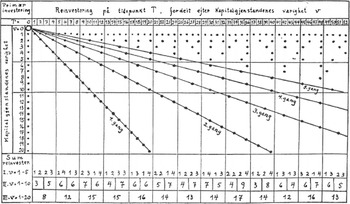
To disentangle the forces at work, Frisch decides to focus primarily on relations between an initial investment comprised of different capital goods, with different life spans. In Figure 1, Frisch attempts to depict the link between a new investment and the reinvestment that it will generate:
The link between a primary investment and investments necessary for its renewal (Source: Frisch Reference Frisch1927a, p. 123).

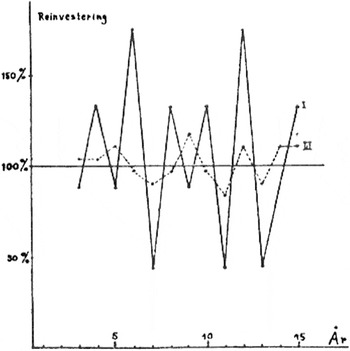
In the left-hand column, the technical composition of the primary investment considered is described in terms of goods of different lifespans: there is a capital good of a one-year lifespan, a good with a two-year lifespan, etc., up to a good with a twenty-year lifespan. Horizontally, we may see the goods that must be renewed in the periods according to their durability: thus, the good with a one-year lifespan must be renewed every year; this is why there are points for each year on the first line. Reading the figure vertically, then, allows us to learn how many capital goods comprising the initial investment must be replaced each year. Thus, the first year, only one element must be replaced; the second year, two; the third year, again two elements, etc. To determine the level of reinvestment for the four first years, we count the number of points for the three cases superimposed for this lapse of time; that is, eight points in total. The oblique lines bring together all the points corresponding to the same period of reinvestment. For example, the first oblique line links all the points where each good comprising the primary investment was replaced for the first time. Each right oblique line serves as a base to construct a distribution curve indicating the scale of the reinvestment for a particular period. On the basis of these data borrowed from Schønheyder, Frisch constructs two curves: that of the level of the aggregate reinvestment in volume per year, or overall reinvestment engendered by an initial investment each year; and that of the average reinvestment, the reinvestment being weighted by the structure by age of the initial investment. Thus, from this, he can conclude that the cycle of reinvestment is irregular (Figure 2).
Total reinvestment engendered by a primary investment whose composition is unimodal (Source: Frisch Reference Frisch1927a, p. 126).

The average reinvestment curve—that is, the level of reinvestment weighted by the structure by age of the initial investmentFootnote 28—although more damped, also presents this irregular aspect of cycles.
Yet, to understand how this reinvestment is distributed over time, we must not look at the annual amount of reinvestment seen in Figure 1 at the bottom of each column. We must seek to understand the cycle of reinvestment, starting not from the annual amount for the replacement of goods comprising the annual investment, but from the moment when the primary investment was entirely renewed for the first time, the second time, etc. For this reason, we must concentrate on the oblique lines of Figure 1 and not on the vertical lines. The oblique lines in the first figure show that the reinvestment curves are increasingly damped as the periodicity rises:
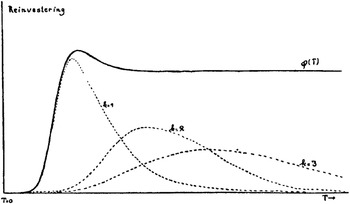
The reinvestment process gives rise to successive waves of “reinvestment” increasingly damped over time: the curve representing the total amount of goods that must be renewed for the third time (k=3) is flatter than the curve representing all the goods that must be replaced for the first time (k=1) (Figure 3).
The partial distribution curves over time of the reinvestment following a primary investment (Source: Frisch Reference Frisch1927a, p. 133).

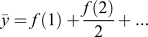
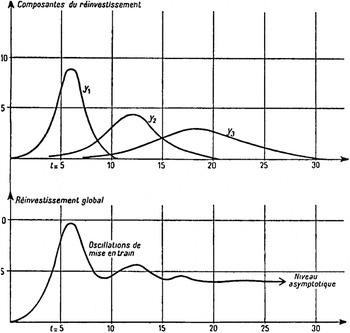
We observe that reinvestment is increasingly damped over time, to the extent that the component elements of the initial investment must be replaced. We see in Figure 3 that overall reinvestment resulting from an initial investment at a certain point t tends towards a constant level. Indeed, to the extent that the primary investment must be renewed, each iteration gives rise to a wave of reinvestment, increasingly damped in volume. Overall reinvestment engendered by this initial investment is represented by the sum of these successive waves of reinvestment. The demonstration proposed in 1927 allows us to conclude that there is asymptomatic damping of the reinvestment considered from the angle of the distribution of reinvestment over time, according to the durability of goods, as the figure proposed in 1963 (Figure 4) more clearly illustrates.
The phenomenon of distribution that affects total reinvestment (Source: Frisch Reference Frisch1963, p. 296).

The overall reinvestment curve is deduced from the cumulative total of reinvestment curves (Figure 5). In contrast, one must change perspective when the question becomes that of the variation in volume of the initial investment over time:
The effect of repetition on reinvestment (Source: Frisch Reference Frisch1927a, p. 143).

Beyond the distribution phenomenon, we study a given investment relative to a single year with the hypothesis that the capitalist structure of this investment is defined by the given distribution of the durability of goods. Through the phenomenon of repetition, we study how the primary investment varies over time (Frisch Reference Frisch1927a, p. 120).
Repetition
The phenomenon of repetition studied as total reinvestment evolves over time, following the succession of primary investments; that is, following, over time, distribution curves of successive primary investments. Frisch is much less clear on this point, and, furthermore, he does not pursue this in his macrodynamic courses in 1927 or in 1934, or in his 1963 work. The reinvestment curve showing repetition displays the effects on overall reinvestment of investments necessary to replace successive primary investments. Distribution is concentrated on the evolution over time of the reinvestment generated by a single primary investment intervening at point t. Repetition phenomenon is related to the evolution of overall reinvestment generated by net investments intervening at different points in time. In this case, it is no longer a question of studying reinvestment of a net investment comprised of capital goods of varying durability, but of studying
the variation in the annual reinvestment which results when the annual primary investment consists of certain kind of capital objects (with the same durability), e.g. only steel hammers, and when the size of the primary investment varies according to time, e.g. when 10 steel hammers are invested in 1916, 220 steel hammers in 1917, etc. This last phenomenon I call the repetition phenomenon (Frisch Reference Frisch1927a, p. 120).
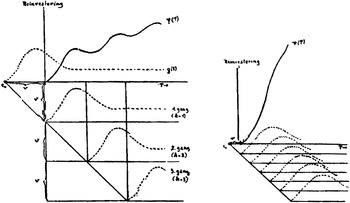
To highlight this phenomenon of repetition, Frisch must pose the hypothesis of a unique durability of goods comprising the primary investments studied. This is why the partial “reinvestment” curves—that is, those resulting from the phenomenon of distribution and that are, consequently, damped—are all identical, but taken forward over time. The overall reinvestment curve studied from the perspective of reinvestment, which links different reinvestment curves to primary investments occurring at different moments, is not, in this case, damped:
The overall reinvestment curve links the peaks of reinvestment curves, as it appears as a straight line in the two figures above. Very obviously, Frisch only considers curves corresponding to the partial distribution curve of the first period, those that result from successive net investments. This analysis allows us to consider the following fact: when the durability of capital goods invested is fixed, according to the hypothesis that these goods are reinvested when they arrive at their expiry date, reinvestment is a trajectory that rises over time. Then, it is possible to deduce, as Frisch did in his macrodynamics lectures, that primary investments intervening in a stochastic manner engender non-damped cycles:
With the repetition phenomenon, the reinvestment curve will not approach a constant level as with the distribution phenomenon as time passes. On the contrary the reinvestment curve will largely increase with them. The reinvestment will contain a secular movement which constantly elevates the level around which the possibility of periodical fluctuations occurring takes place (Frisch Reference Frisch1927a, p. 144).
The Combination of Distribution and Repetition
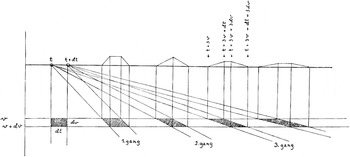
An understanding of the relations between the primary investment and reinvestment is based on combining the two effects: distribution and repetition (Figure 6). The demonstration is, again, rather cursory, but the conclusion remains the same: reinvestment cycles are damped over time. The phenomenon of distribution has a greater impact than that of repetition. Let us re-examine Frisch’s 1927 figure as a principal demonstration.
The evolution of overall reinvestment under the combined effect of distribution and repetition (Source: Frisch Reference Frisch1927a, p. 146).

At time t, there is an investment in a collection of capital goods, whose durability is distributed according to the first vertical column. This investment is repeated at t+dt. This time, the primary investment is not simply represented by the vertical columns, but by the zone that is twice hachured, in the rectangle dt/dv, the latter representing the level of investment for the primary period defined by t and dt. Successive reinvestments necessary to maintain the primary investment at a constant level are illustrated by the trapezoids that are hachured only once. Here, the phenomenon of distribution can be read on the oblique lines, and the repetition on the interval between two reinvestments of the same durability or structure by age can be read on the bases of each trapezoid constituting a constant level of goods invested. One must consider the trapezoids inscribed above the axis of time to see the volume of overall reinvestment shown by the combination of repetition and of distribution. Thus, we observe that overall reinvestment is increasingly damped and less important in volume.
The first problem studied in the model of 1927 was to know how the volume of a replacement investment (given by its aggregate value through a pricing system) is distributed over the course of time. The principal result obtained by Frisch to characterize the distribution can be summarized thus: if the structure of durability is unimodal and regular, the process of replacement will follow a damped sinusoidal trajectory and will finally reach a stationary state. The second problem broached was then to know how to deduce the aggregate reinvestment curve, starting from a particular temporal path of a new investment. The result is rather simple: if the original investment follows a sinusoidal movement, then reinvestment will follow the same movement, but the latter will be more damped.
The Analysis of Reinvestment at the Disaggregated Level as the Foundation of Macrodynamics in Frisch’s Cycle
The presentation of Frisch’s first model of reinvestment appeared quite limited or even hasty. He supposes that a process of net investments would be added to this process of reinvestment. Any new investment is a perfectly autonomous process. Andvig (Reference Andvig1985) sees here an erratic process, foreshadowing the concept of impulses. We will consider that, while Frisch also refers to an erratic process, this does not constitute the core of his explanation. Although the process of reinvestment is activated by exogenous shocks, occurring by chance, it is characterized by a unimodal time structure of capital, and thus generates damped fluctuations, since the phenomena of distribution play a bigger role than those of repetition. Then, we understand his insistence in the debate with Clark on knowledge of the time structure of investment. In the 1933a model, the depreciation rate is uniform and represents an average. However, it is clear that the phenomena of repetition can explain the cumulative cycles of reinvestment and submit the economic system to irregular cycles. Here, with respect to the phenomena of repetition at work in reinvestment cycles, we find a forerunner of 1933 impulses or, more directly, of the distinction between free oscillations and forced oscillations proposed by Frisch in 1928 (issued in Frisch Reference Frisch1931b).
Indeed, reinvestment cycles accumulate. The irregular effect will be even stronger when investments intervene in a stochastic fashion. At the time, Frisch considered that the development of a theory of cycles based on reinvestment cycles laid the groundwork for future statistical and theoretical investigations. As we have already stressed, Frisch was then convinced that the regular and complete cyclical components of the overall cycle could be discovered, thanks to a statistical analysis of time series. Nonetheless, the assumption of erratic and non auto-correlated investments was difficult to accept for various theoreticians of business cycles.Footnote 29 In the conclusion of his study on cycles of reinvestment, Frisch considers that this analysis of the cumulative nature of cycles could be extended to all branches of economic activity, thanks to statistical investigation: the essence of the cyclical phenomenon being thus understood, it would be transposable to the aggregate level.
Thus, the development of the rocking horse model begins in all seriousness in 1927. This consists of a concomitant reflection on the statistical approach and on the theoretical perspective on components of business cycles. Frisch not only draws upon the quantitative approach of statistical economists to break down time series and from this discern a pattern of cycles in the form of sinusoidal curves of varying size and duration, but he also refers to the content of their more theoretical economic propositions to explain turning points of cycles.
IV. CONCLUSION
Frisch made his own the analyses, on the one hand, of Einarsen and of Schønheyder, and, on the other hand, of the American institutionalists, Clark and Mitchell, when building up the 1933a macrodynamic model.
By a ‘process of appropriation,’ we mean that which led Frisch to analyze the coherence of their arguments to use the most relevant elements to suggest a theoretical explanation based on the production of capital goods. This is no longer only a case of bringing out the time series of cycles of different duration that characterize economic activity and of putting forward the turning points, but also of providing some indication of why and how the activity level turns around. This research on the origin of cycles has taken as its principal foundation theories developed on reinvestment cycles by his peers in Norway. It is clear to us that Frisch looked at the work of Einarsen and of Schønheyder to identify the conjunction of cycles of damped reinvestment and of the succession of net investments as an explanation of the enduring nature of cycles perturbing the economic system. Therefore, propagation phenomena could describe a damped movement, and impulse phenomena could explain that the economic system does not return to its position of equilibrium.
The idea of seeing reinvestment cycles disturbed by primary investments was embryonic in his 1927 explanation of the phenomena of repetition. The latter, though not developed in detail, remain a key element of the approach to the microeconomic fundamentals of cycles, developed by Frisch the same year as his analysis examining time series. Also, we should not be surprised by Frisch’s choice of Schumpeter-type impulses. This 1927 article on reinvestment cycles clarifies his choice of the accelerator as the explanatory principle for turning points in cycles. This choice is explicitly proclaimed in his debate with Clark in 1931 and 1932. This debate allowed him to clarify his definition of the accelerator principle, and this clarification is at the origin of the construction of the 1933a system of propagation. It enabled Frisch to speak of the way a particular system could consider the mechanism at work in the turning points of cycles. The idea of a causal relation between the acceleration of the rate of growth and the production of capital goods is not new; what is new is the way of modeling this notion and of being able then to combine it with an investment multiplier. It is in working on this task, referring explicitly to the research of Frisch, of Clark, and of Mitchell, that Lundberg (Reference Lundberg1937) and, later, Samuelson (Reference Samuelson1939a, Reference Samuelson1939b) could offer their versions of the accelerator principle.
Starting from his knowledge of business cycles, Frisch was able to take a stand in favor of the use of this scientific understanding of fluctuations in activity to be able to precisely regulate them and restore the economic system to its position of equilibrium.