LANGUAGE CONTACT AND WORD-ORDER VARIATION
In the literature on language variation in contact settings, there are more and more frequent discussions on whether phenomena that could be easily explained as the result of language contact are indeed motivated by other factors (cf., among others, Poplack & Levey, Reference Poplack, Levey, Auer and Schmidt2010; Thomason, Reference Thomason, Filppula, Klemola and Paulasto2009). Within this discussion, we might distinguish between two types of approaches. Approaches of the first type are empirically oriented, include huge amounts of corpus data, and use quantitative methods to analyze them. These approaches allow the researcher to account for both contact and noncontact factors without any bias. They mainly arise within the framework of variationist sociolinguistics (cf., Labov, Reference Labov1972). Some examples of this type of approach to the study of contact-induced features in morphosyntax are the papers by Mougeon, Nadasdi, and Rehner (Reference Mougeon, Nadasdi and Rehner2005) and Poplack, Zentz, and Dion (Reference Poplack, Zentz and Dion2012); see also Poplack (Reference Poplack, Adamou and Matras2021) for a general overview.
Approaches of the second type are typologically oriented, and are used, for instance, to reveal the range of shared features motivated by language contact in large linguistic areas (e.g., Aikhenvald & Dixon, Reference Aikhenvald and Dixon2007; Hickey, Reference Hickey2017; Matras, McMahon, & Nigel, Reference Matras, McMahon and Nigel2006; Muysken, Reference Muysken2008; Nichols, Reference Nichols1992). Such approaches distinguish cross-linguistically common phenomena, for which language-internal explanations can be suggested, from phenomena that are rarer or nontypical for a given language family. For the latter, it is more plausible to assume a pure contact motivation (e.g., Dahl, Reference Dahl, Haspelmath, König, Oesterreicher and Raible2001:1457; Heine & Nomachi, Reference Heine, Nomachi, Robbeets and Cuyckens2013:77). On the other hand, established typological patterns supported by more general functional (cognitive) motivations are reported to be borrowed and diffused more easily (e.g., Aikhenvald, Reference Aikhenvald, Aikhenvald and Dixon2007:31) and are not likely to be replaced by more rare patterns in a contact situation (e.g., Campbell, Reference Campbell and Fisiak1997:51). Bickel (Reference Bickel and Hickey2017) discussed both sides of the interplay between cross-linguistic universals and areal (contact-influenced) patterns in terms of “functional and event-based triggers” of language change.
The two approaches are rarely combined. One exception is represented by the framework of dialect (or sociolinguistic) typology (cf., for example, Kortmann, Reference Kortmann2004; Röthlisberger & Szmrecsanyi, Reference Röthlisberger, Szmrecsanyi, Brunn and Kehrein2019), which, however, concentrates mostly on English varieties. This paper contributes to the discussion on contact-induced versus noncontact-induced linguistic variation by relying on both approaches for the study of a specific topic, that is, word-order variation in genitive noun phrases in the contact-influenced variety of Russian spoken in Daghestan.
Although syntactic changes usually start at an intense stage of contact, word order is one of the linguistic features said to be more easily borrowed (Thomason, Reference Thomason2001:70-71; Thomason & Kaufman, Reference Thomason and Kaufman1988:74-76). In some cases, language contact does not lead to the emergence of a new word-order pattern but to the reinforcement of a pattern that already exists in the target language as a marginal one (Heine, Reference Heine, Siemund and Kintana2008:55). Nevertheless, most previous investigations on contact-induced word-order variation in the world's languages focus on variation at the sentence level (as in the examples listed in Heine [Reference Heine, Siemund and Kintana2008:34-35] and Thomason & Kaufman [Reference Thomason and Kaufman1988:55]). Those dealing with variation within the noun phrase are definitely less numerous, though some consider word-order variation in noun phrases with a genitive modifier, including in contact varieties of Slavic languages (see Sussex [Reference Sussex, Comrie and Corbett1993] on émigré Polish, and Leisiö [Reference Leisiö2000, Reference Leisiö2001] on two varieties of Finnish Russian; see also some considerations in Suleymanov [Reference Suleymanov, Schmidt-Brücken, Schuster and Wienberg2016] on Baku Russian).
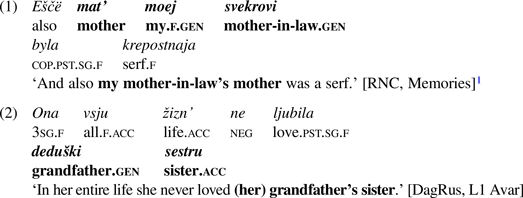
As for the variety of Russian spoken in Daghestan, one of the most prominent syntactic features is the contact-induced shift to left branching in some constructions, including noun phrases with a genitive modifier (Daniel, Dobrushina, & Knyazev, Reference Daniel, Dobrushina and Knyazev2010:85-86). Whereas in monolinguals’ Russian the neutral and most frequent word order in noun phrases is N+GEN (“postpositive” or “right” genitive), in Daghestanian Russian the opposite order GEN+N (“prepositive” or “left” genitive) often occurs, as in (1) and (2).

The frequent occurrence of cases like (2) in Daghestanian Russian could be explained in terms of syntactic calquing from the speakers’ first languages (L1s), all featuring a neutral GEN+N order in noun phrases (Testelec, Reference Testelec and Siewierska1998:274), as shown in (3), from the Andalal dialect of Avar.

However, the GEN+N pattern does not occur equally in all types of noun phrases in Daghestanian Russian and correlates with several lexicosemantic and formal features of both the head and the genitive modifier. This cannot be straightforwardly explained as the result of L1 influence.
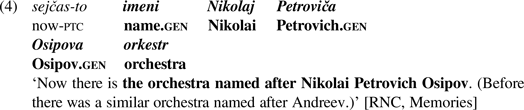
Moreover, there are deviations from the basic word order in monolinguals’ Russian too, which makes the picture far less trivial than it could look at first sight. Examples of the GEN+N pattern in monolinguals’ Russian are often associated with a specific information structure and have a marked intonation pattern, as in (4): the prepositive genitive modifier takes the phrasal accent (Zemskaja, Reference Zemskaja1987:151).Footnote 2

Therefore, we cannot assume that the occurrence of nonstandard word order in Daghestanian Russian is purely a matter of calquing from the speakers’ L1s, as it is often taken for granted in studies on similar phenomena in other contact situations. Our quantitative corpus-based investigation of noun phrases with a genitive modifier in Daghestanian Russian as compared to monolinguals’ Russian points to several factors inducing the occurrence of nonstandard word order, contact being only one of the components involved.
In this paper, we first illustrate our corpus-based analysis of noun phrases with a genitive modifier in the speech of bilinguals from Daghestan and discuss the impact of different parameters based on statistical analyses. Then we compare bilinguals’ and monolinguals’ speech, based on data from Russian monolinguals’ spoken texts. In the final sections we summarize and discuss our findings also in light of some cross-linguistic considerations and draw our conclusions.
NOUN PHRASES WITH A GENITIVE MODIFIER IN DAGHESTANIAN RUSSIAN: DATA SELECTION AND ANNOTATION
Following Daniel et al. (Reference Daniel, Dobrushina and Knyazev2010), we use the term “Daghestanian Russian” to refer to the variety of Russian spoken in Daghestan. Although we are aware of the fact that Daghestanian Russian is actually a set of varieties which diverge from one another depending on the speaker's place of origin, L1, year of birth, etc., we will employ this term to refer to the set of these varieties as a whole. For this specific study, it seems particularly convenient to adopt this notion because the phenomenon under investigation is apparently found in all varieties of Russian spoken in Daghestan.
In the Republic of Daghestan, over forty indigenous languages are spoken. Most of them belong to the Nakh-Daghestanian (East-Caucasian) family, but there are also three Turkic languages (Kumyk, Nogai, and Azerbaijani), and one Iranian language (Tat). Over the last few decades Russian has become the interethnic lingua franca of the region (Dobrushina & Kultepina, Reference Dobrushina and Kultepina2021). Nowadays it is either a second language (L2)—it is certainly so for most inhabitants of the mountain villages—or the urban vernacular spoken as an L1 by those younger people who were born in towns (Daniel & Dobrushina, Reference Daniel and Dobrushina2010; Daniel et al., Reference Daniel, Dobrushina and Knyazev2010). As a result of the intense contact with local languages, Daghestanian Russian has developed a number of features at different levels: phonetics, morphology, syntax, and the lexicon (Daniel & Dobrushina, Reference Daniel and Dobrushina2010, Reference Daniel and Dobrushina2013; Daniel et al., Reference Daniel, Dobrushina and Knyazev2010).
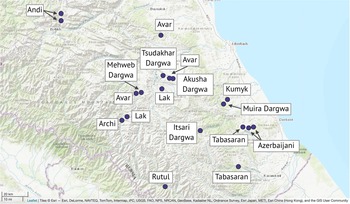
The data used in this study were taken from the Corpus of Russian spoken in Daghestan (Dobrushina, Daniel, von Waldenfels, Maisak, & Panova, Reference Dobrushina, Daniel, von Waldenfels, Maisak and Panova2018), which contains a collection of sociolinguistic interviews with inhabitants of rural areas of highland Daghestan for whom Russian is an L2. Most of them learned Russian at school, they are currently fluent in Russian, but use their ethnic language to a greater extent. The interviews were collected in the 2000s in fieldwork trips to nineteen villages in which thirteen languages are spoken, see Figure 1.
Speakers’ L1s in the DagRus corpus: geographical distribution.Footnote 3

At the moment of data extraction, the corpus contained about 186,000 words. First, we extracted all examples that had been tagged by the morphological parser embedded in the corpus (TreeTagger) as nouns in the genitive (2,412 occurrences). Then we selected those examples in which the genitive was part of a noun phrase (798 occurrences). We further excluded noun phrases whose heads show syntactic and semantic features that make them closer to other constituent types and that are realized with different syntactic structures in the speakers’ L1s. Such occurrences include:
– nouns semantically similar to numerals (e.g., kuča deneg.gen ‘a lot of money’), and other “quantitative” constructions (e.g., kusok zemli.gen ‘a piece of earth’);Footnote 4
– constructions with a prepositional function (e.g., v storonu morja.gen ‘seaward, lit. to the side of the sea’);
– examples featuring a predicative noun as their head (e.g., okončanie instituta.gen ‘graduation, lit. the completion of the institute’).
We also excluded conventionalized expressions (e.g., kandidat nauk.gen ‘Candidate of Sciences [PhD]’) because, due to their “frozen” status, they are less sensitive to word-order variation.Footnote 5 We were left with 482 examples, 103 of which exhibited a left genitive (21.4%).
If the occurrence of nonstandard word order in Daghestanian Russian was purely a matter of syntactic calquing from the speakers’ L1s, we would expect left genitives to be uniformly represented in our data, because the GEN+N order is the unmarked option in the languages of Daghestan. However, our data show asymmetrical distribution in different contexts, and factors other than contact are needed to account for this asymmetry.
Thus, we analyzed our data according to a number of parameters, each of which is discussed in the rest of this section.
Sociolinguistic parameters
Each example in our corpus was tagged according to the following features: the speakers’ L1 and place of birth, year of birth, gender, and level of education.
The data come from forty speakers, twenty-six men and fourteen women, born in nineteen different villages and speaking thirteen different L1s. L1s can be clustered into five genetic groups: (1) Avar-Andic (Avar, Andi); (2) Dargwa (Akusha, Itsari, Mehweb, Muira, Tsudakhar); (3) Lak; (4) Lezgic (Archi, Rutul, Tabasaran); and (5) Turkic (Azerbaijani, Kumyk). The first four groups can be further clustered into a single group representing the Nakh-Daghestanian language family and compared to the languages belonging to the Turkic family. This parameter was taken into account to exclude diverging behaviors of speakers of different L1s. However, since the basic word order in the noun phrase is the same for all Nakh-Daghestanian and Turkic languages, we did not expect any remarkable difference.
Concerning the speaker's year of birth, we compared occurrences produced by younger and older speakers, that is, born before and after 1950. We chose 1950 as a watershed because it was starting from the end of the fifties that school education in highland Daghestan became more consistent for all children, including girls, and the first Russian teachers started to come to rural schools (Daniel & Dobrushina, Reference Daniel and Dobrushina2013:188; Dobrushina, Reference Dobrushina2008:133). As a result, in this period the number of Russian speakers increased sharply: more than 90% of the inhabitants of highland Daghestan born after 1950 speak Russian (Dobrushina, Kozhukhar, & Moroz, Reference Dobrushina, Kozhukhar and Moroz2019).
We checked the parameter “Education” by relying on the simple expectation that people with a higher degree of education might have higher proficiency in Russian, use it more actively, and be more aware of what is considered to be “standard.”
The parameter “Gender” was included because in highland Daghestan women are usually less mobile, have a lower level of education and preserve a more traditional lifestyle. This implies that they probably use Russian less actively than men.
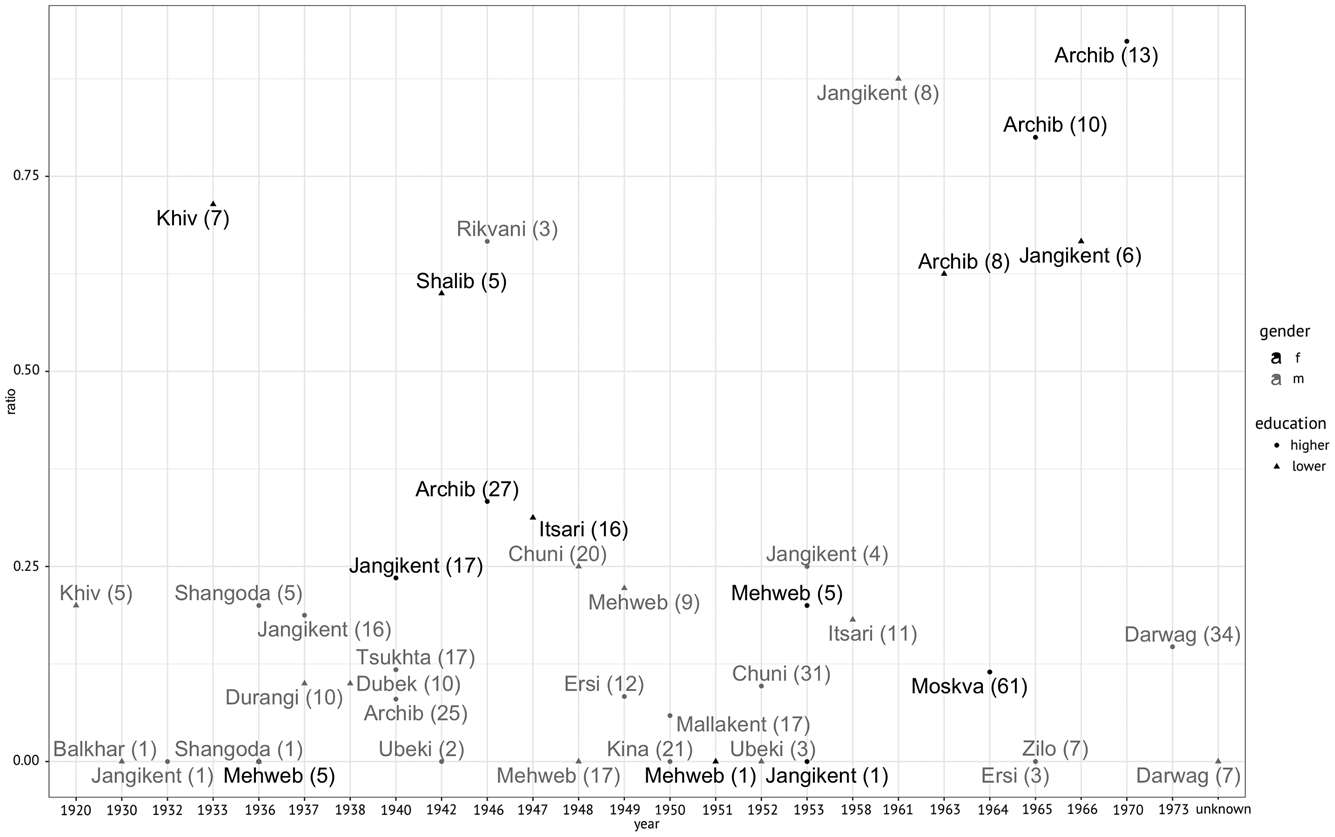
In Figure 2, we show the general distribution of sociolinguistic parameters (excluding L1). Each point on the plot represents a speaker, the label indicates their place of birth, while the shape illustrates their level of education. The figures in brackets correspond to the total number of genitive noun phrases uttered by the speaker. The distribution of the points along the horizontal axis is determined by the speakers’ year of birth, whereas their position along the vertical axis indicates the percentage of uses of prepositive genitives.
Ratio of prepositive genitives across speakers in the DagRus corpus by demographic features of the speakers: year of birth, gender and education (within parentheses are number of genitives produced).

The most striking effect is seen for a number of speakers from Jangikent and Archib. We assume that this result might be explained simply in terms of idiosyncratic behaviors of individual speakers. Since there are no other visible correlations with place of birth and no particular expectations, this parameter was not included in the analysis.
Lexicosemantic features of the genitive modifier
In previous literature on genitive noun phrases, it was pointed out that the position of the genitive modifier along scales involving features such as animacy, referentiality, and individuation is relevant for the occurrence of different constructions (e.g., Koptjevskaja-Tamm, Reference Koptjevskaja-Tamm2002:158; Lander, Reference Lander and Floricic2010:250-51). Specifically, nouns that are higher in such scales are more likely to behave in a special way due to their ability to function as better “anchors” (cf., Koptjevskaja-Tamm, Reference Koptjevskaja-Tamm2002), that is, as elements serving as reference points (cf., Langacker, Reference Langacker1993) and helping the hearer identify the referent of the head.
Thus, we checked for such features as possibly relevant factors. First, we tagged our data according to the parameter “Lexical class,” which includes four classes distributed along the extended animacy scale: proper names (human referents) > kinship terms > other human referents > nonhuman referents.Footnote 6 We annotated proper names and kinship terms separately because we expected that nouns placed on the left edge of the animacy scale would play a key role in the occurrence of left genitives. We were particularly interested in checking kinship terms, because in Daniel et al. (Reference Daniel, Dobrushina and Knyazev2010:85) it is mentioned that “left branching genitive chains that name relatives” are especially common in Daghestanian Russian. Moreover, most of the studies discussing word-order variation at the noun-phrase level (Friedman, Reference Friedman2003; Leisiö, Reference Leisiö2000, Reference Leisiö2001; Suleymanov, Reference Suleymanov, Schmidt-Brücken, Schuster and Wienberg2016; Sussex, Reference Sussex, Comrie and Corbett1993) point, more or less explicitly, to the occurrence of this type of variation in cases in which kinship semantics is involved. However, in most cases, no thorough discussion of this phenomenon is provided, and such observations have not been supported by statistical analyses.
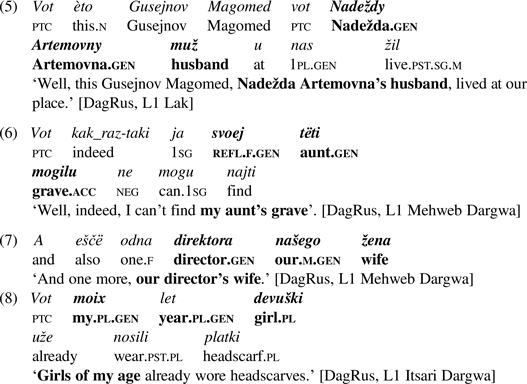
Examples (5) to (8) illustrate each possible value of the parameter “Lexical class,” namely proper names (5), kinship terms (6), other human referents (7), and nonhuman referents (8).Footnote 7

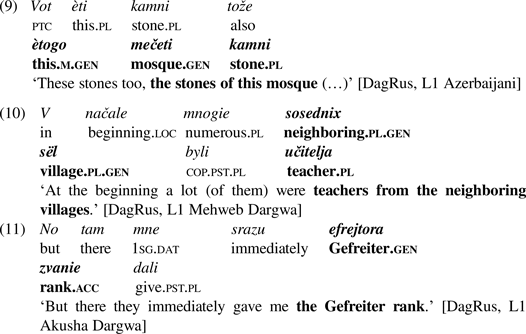
Second, we considered the parameter “Referentiality” and tagged the genitive nouns in our database based on the classification provided in (Padučeva, Reference Padučeva1985:83-102) for Russian, that is, according to whether they denote a definite (9), indefinite (10), or nonspecific (11) referent; see also (Haspelmath, Reference Haspelmath1997:31-52) for a similar cross-linguistically oriented classification.

Finally, we tagged our data according to the parameter “Individuation,” that is, according to whether the noun in the genitive denotes a singular object, a plural object, a nonquantized mass, or an abstract entity (nonobject).
Lexicosemantic features of the head
As pointed out by Koptjevskaja-Tamm (Reference Koptjevskaja-Tamm2002:148), the semantics of the head noun usually determines the relation expressed within genitive noun phrases. Naccarato, Panova, and Stoynova (Reference Naccarato, Panova and Stoynova2020) provided a detailed analysis of genitive noun phrases in Daghestanian Russian based on the semantic relation between the head noun and the genitive modifier (e.g., possessive, kinship, part-whole relations, and others, for a total of twenty-five relations). The analysis demonstrated that the most relevant opposition for predicting the occurrence of left genitives is kinship relations versus other relations.
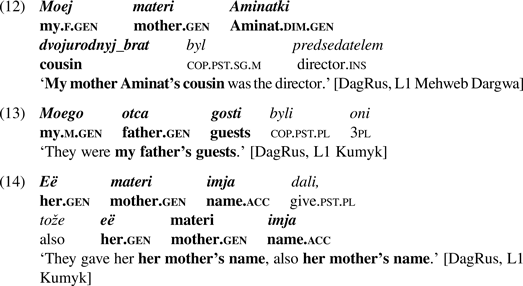
Thus, provided that kinship relations are fully determined by the semantics of the head noun (kinship terms), we do not discuss semantic relations as a separate parameter, and we analyze the data according to the lexical class of the head noun, similarly to what was done for the genitive modifier. Specifically, we classified the head constituent into the following classes: kinship terms (12), other human referents (13), and nonhuman referents (14).

Length of the genitive modifier and the head
As a possibly relevant factor affecting word order, we took into account the length of both the genitive modifier and the head constituent (one-word versus multiword); see (12) for examples of a multiword modifier (moej materi Aminatki ‘my mother Aminat's’) and a multiword head (dvojurodnyj brat ‘cousin’). As observed in previous research, speakers tend to place heavier (i.e., longer) elements after lighter (i.e., shorter) ones (Hawkins, Reference Hawkins1994:291-93; Wasow, Reference Wasow1997). Therefore, we might expect longer heads to be more frequently postposed to their genitive modifiers, and longer genitives to be more frequently postposed to their heads. This expectation is also partly supported by the fact that one of the rare exceptions to the general tendency to left branching in some Daghestanian languages is constituted exactly by heavy genitive modifiers, which can sometimes be postposed to their heads (see, e.g., Kazenin [Reference Kazenin, Kibrik, Tatevosov and Eulenberg1996:150-151] on Godoberi).
Discourse-related factors
Deviations from the standard word order in the noun phrase might occur for discourse-related reasons. These might have to do with: (1) the givenness/newness of the information uttered (cf., the given-before-new principle); and (2) the specific information structure of a certain utterance (i.e., the need to topicalize or focalize certain elements in a phrase or sentence) (see, for example, Siewierska [Reference Siewierska, Jacobs, von Stechow, Sternefeld and Vennemann1993] on both factors).
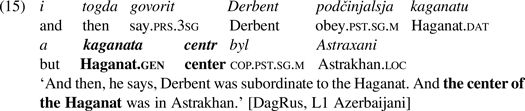
Checking the parameter “Givenness,” we were especially interested in cases including a given genitive and a new head, as in (15), because, according to the given-before-new principle, this kind of information structure should trigger the GEN+N order. All other possibilities (new genitive + given head, new genitive + new head, given genitive + given head) were expected to lead to the N+GEN order.

Turning to information structure, we mentioned in the introductory section that in monolinguals’ Russian, prepositive genitives might appear due to the need to focus the genitive modifier, which takes phrasal accent in such uses, as in example (4) above. However, in this case we are probably dealing with a different syntactic structure. Focused genitives are not simply preposed to their heads but are dislocated to the left periphery of the clause (cf., [10] above). While annotating the data, we were not always able to differentiate between these two types of constructions. It is likely that some of the genitives annotated as left genitives in the DagRus sample are, in fact, left-dislocated and motivated by information structure, similarly to those found in monolinguals’ Spoken Russian.
NONSTANDARD WORD ORDER IN DAGHESTANIAN RUSSIAN: RESULTS AND SIGNIFICANCE OF THE PARAMETERS OBSERVED
Left genitives in Daghestanian Russian: descriptive statistics
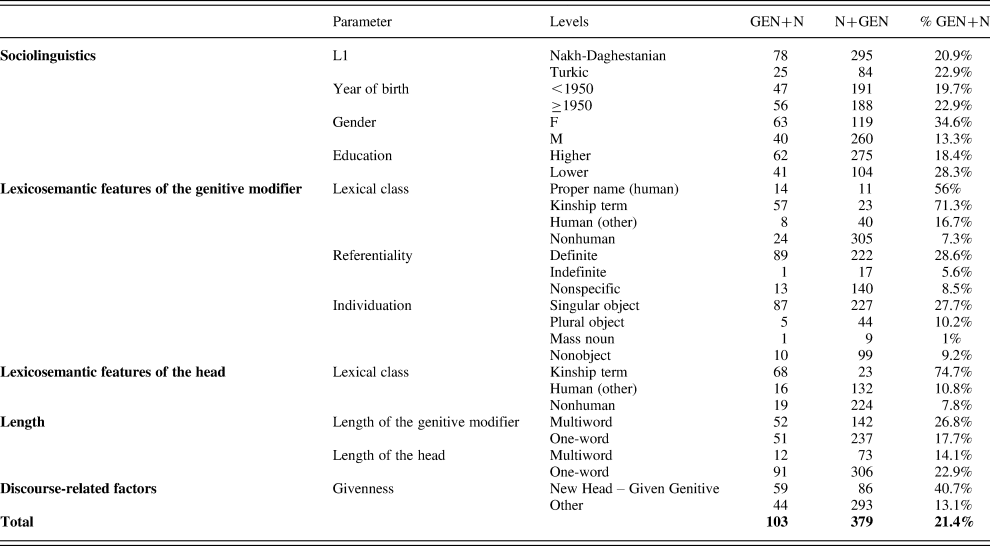
The results of the annotation process are summarized in Table 1. For each of the parameters considered, we calculated the percentage of left genitives on the total number of occurrences.
Parameters examined and the position of the genitive modifier

As regards sociolinguistic parameters, we found a higher percentage of left genitives for female speakers and for speakers with a lower level of education (cf., Figure 2). Neither L1Footnote 8 nor year of birth show a visible effect.
Turning to the lexicosemantic features of the genitive modifier, we see that all parameters seem to affect, to a greater or lesser extent, the word order in the noun phrase. As regards the lexical class of the genitive modifier, we may note that: (1) genitives denoting human referents are more likely to be preposed than those denoting nonhuman referents, and (2) the rate of left genitives is much higher for kinship terms and proper names than for other human referents. Left genitives are especially favored when the genitive is a kinship term, while for proper names the percentage is lower.Footnote 9 The data on referentiality show that definite nouns are more frequently preposed to their heads compared to other nouns. Finally, regarding the parameter “Individuation,” we found that nouns denoting singular objects are more frequently preposed as compared to those denoting plural objects and masses. Nonobject nouns are also rarely preposed to the head. In the logistic model described below, we reduced the levels for the parameters “Referentiality” and “Individuation” to a binary outcome (i.e., definite versus nondefinite and singular versus nonsingular respectively).
As for the lexicosemantic features of the head, the data show that kinship terms (i.e., heads of noun phrases expressing a kinship relation) favor left genitives, whereas no notable difference is observed between other human referents and nonhuman referents. Therefore, in the logistic model, we reduced the possible outcomes for this parameter to kinship versus nonkinship.
The length of both the genitive modifier and the head affect, to some extent, the occurrence of a specific word order. Contrary to our expectations, multiword modifiers occur in the left position more frequently than one-word modifiers. As for the length of the head, left genitives more often occur in the presence of head constituents made up of a single word, while they occur less frequently when the head includes some modifiers.
Finally, concerning givenness, Table 1 shows that the percentage of examples with left genitives is visibly higher when the genitive modifier is given and the head is new, which confirms our expectations.
Some of the above-mentioned factors are logically connected to each other, so we might expect that the frequency asymmetries shown in Table 1 in fact represent the effect of a smaller set of factors. Heads with kinship semantics frequently co-occur with genitive modifiers also having kinship semantics (e.g., ‘my mother's mother’). Referentiality, individuation, and givenness also interplay with the semantics of the genitive modifier: proper names and kinship terms tend to be definite, singular, and given. The parameter “Length” might be nonindependent as well. The high frequency of prepositive multiword genitive modifiers could be related to their co-occurrence with the class of kinship terms, which are often modified by possessive adjectives (moej. gen materi. gen mat’ ‘my mother's mother’). Finally, education might correlate with gender.
Binomial logistic regression
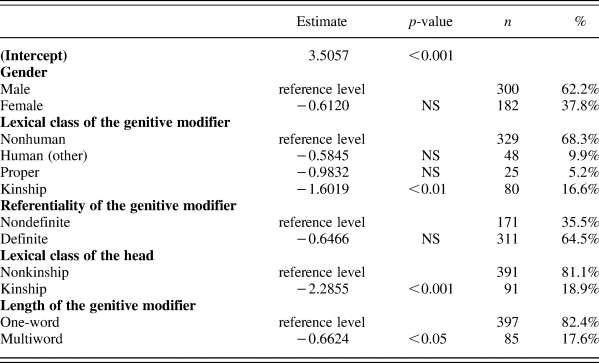
As the main statistical method, we used mixed-effects binomial logistic regression (Baayen, Reference Baayen2008:241-302; Levshina, Reference Levshina2015:171-98).Footnote 10 All the parameters listed in Table 1 were included in the model as fixed effects, that is, explanatory variables, whose effect has to be measured. We also included information about the speaker as a random effect to take into account possible idiosyncrasies. The results presented in Table 2 include the optimal model that was obtained after removing the predictors that did not contribute to improving the model. Given that p-values alone do not constitute a sufficient reason to remove a variable from the model (Levshina, Reference Levshina2015:267), we resorted to AIC (Akaike Information Criterion) comparison, that is, we compared the AIC of the model including all predictors and of other models lacking one of the predictors, and removed (one at a time) the predictors whose presence in the model increased the AIC value (i.e., year of birth, givenness, L1, individuation of the genitive modifier, education, length of the head).
Binomial logistic regression: The optimal model predicting GEN+N

For each of the parameters included, in the column “Estimate” a negative coefficient boosts the chances of left genitives, whereas positive coefficients boost the chances of right genitives. The first estimate belongs to the intercept and gives us the estimated log odds of the outcome when all predictors are at their reference levels (Gender: Male, Lexical class of the genitive modifier: Nonhuman, Referentiality of the genitive modifier: Nondefinite, Lexical class of the head: Nonkinship, Length of the genitive modifier: One-word). The predictors including p-values lower than 0.05 are “Lexical class of the genitive modifier” and “Lexical class of the head,” both showing that kinship semantics boosts the chances of getting a left genitive, and “Length of the genitive modifier,” showing that the chances of a left genitive to occur are significantly higher when the genitive has some modifiers.
Random forest
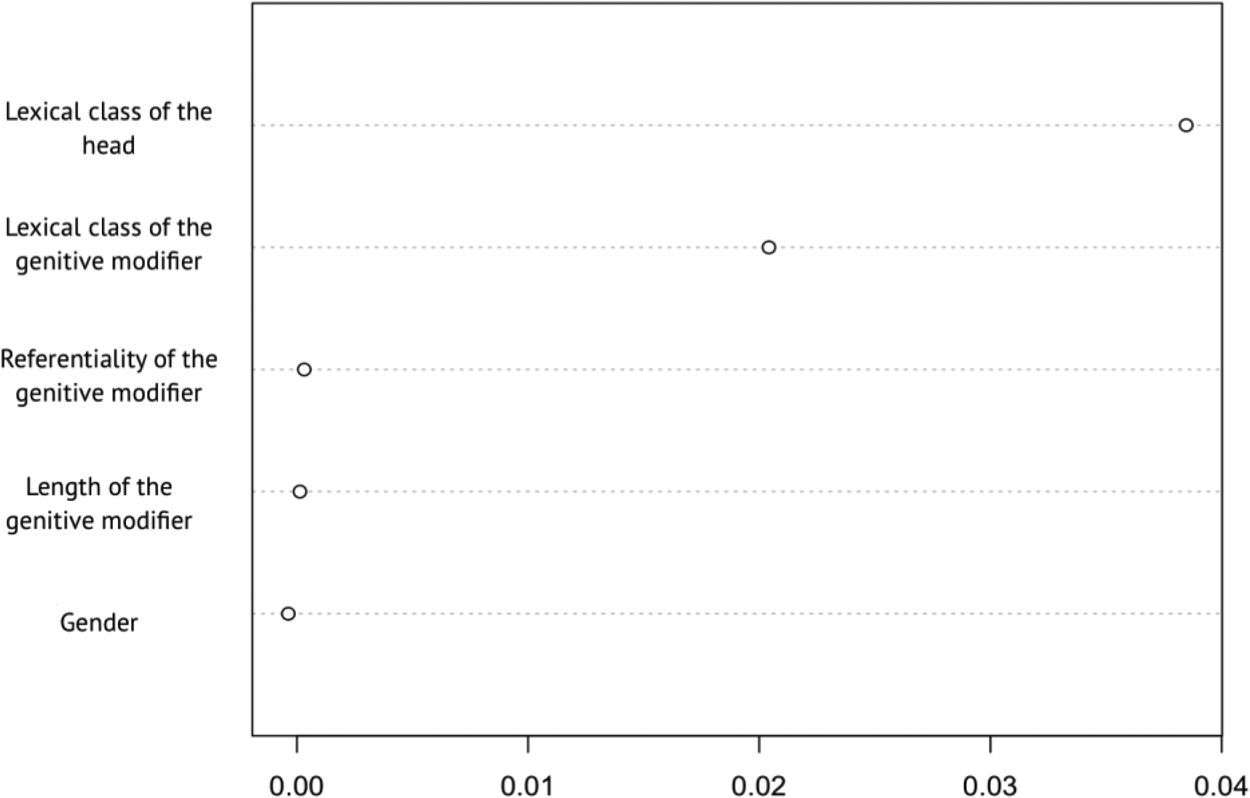
For the final set of predictors, in addition to the logistic regression analysis, we implemented a random forest method,Footnote 11 which is particularly useful when the number of observations is relatively small, but the number of predictors is large (Levshina, Reference Levshina2015:291-300; Tagliamonte & Baayen, Reference Tagliamonte and Baayen2012), as in our case. Random forests (and conditional inference trees, out of which random forests are grown) are based on a recursive binary splitting of the data, which partitions the input data into increasingly homogeneous subsets, and help determine whether a variable is a useful predictor. The importance measure of each variable is averaged over many conditional trees. The model represented in Figure 3 includes all the predictors from the optimal logistic regression model in Table 2. The predictors in the rightmost part of the chart are those whose impact in the model proved to be stronger.
Random forest: Conditional importance of variables (number of trees = 1,000).

According to the results shown in Figure 3, the predictor that best discriminates the data is the lexical class of the head, followed by the lexical class of the genitive modifier. The other predictors are found in the leftmost part of the chart, which is a sign of their lower strength.
In general, these results are comparable to those of the logistic regression analysis, as the same variables were found to be the most relevant according to both analyses. Overall statistical computations confirmed our expectation that left genitives in Daghestanian Russian are semantically determined and, precisely, that kinship semantics is a crucial factor in these respects, further supporting the idea put forth in the description of Daghestanian Russian by Daniel et al. (Reference Daniel, Dobrushina and Knyazev2010:85-86). More precisely, we showed that the lexical class of both the head and the genitive modifier individually contribute to the choice of a specific word order. We also found that other factors make their own smaller contribution, too. These are referentiality and length of the genitive modifier, and the speaker's gender.
NOUN PHRASES WITH A GENITIVE MODIFIER IN MONOLINGUALS’ SPEECH
To understand the extent to which nonstandard word order in Daghestanian Russian is determined by language contact, we looked at the production of noun phrases with a genitive modifier in the speech of Russian monolinguals and compared these data with our Daghestanian data.
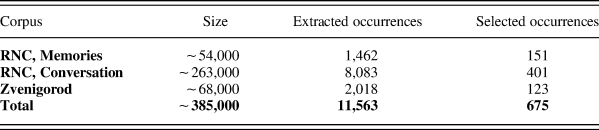
The monolinguals’ Russian data were retrieved from three oral text collections, which are more or less comparable to that of the DagRus corpus in terms of size, text types, and genres (Table 3). Two collections come from the Spoken Subcorpus of the RNC (see http://ruscorpora.ru/old/en/search-spoken.html). These are a collection of oral texts produced by Muscovites about their memories (Vospominanija o prošlom, cf., Kitajgorodskaja & Rozanova, Reference Kitajgorodskaja and Rozanova1999) and a manually compiled collection of oral texts tagged in the RNC as “Conversation.” The third collection is the Corpus of Russian spoken in Zvenigorod (Moscow Oblast), which was created ad-hoc for this study (Panova, Reference Panova2020, see http://lingconlab.ru/zvenigorod/).Footnote 12 We selected relevant occurrences from these texts following the same procedure as for the Daghestanian data, and we were left with 675 examples, which is comparable to the Daghestanian sample.
Monolinguals’ Russian corpora: size, extracted and selected occurrences

We annotated the resulting sample according to the parameters that proved to be relevant for the Daghestanian data.Footnote 13 As we expected, the total number of left genitives in the monolinguals’ Russian sample is much smaller than in the DagRus sample: only nineteen out of 675 examples (2.8%) contain prepositive genitives, as in (16).Footnote 14

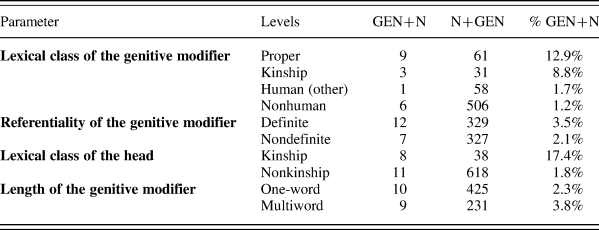
We did not conduct the same statistical analysis as for the DagRus data due to the small number of left genitives found in the sample. However, the preliminary results summarized in Table 4 show that the attested frequency asymmetries are similar to those observed for the DagRus data.
Monolinguals’ Russian: position of the genitive modifier according to parameters relevant for Daghestanian Russian

Although the length and referentiality of the genitive modifier do not show any effect, the lexical class of both the head and the genitive modifier significantly affect the choice of a specific word order. Heads with kinship semantics are more likely to take prepositive genitive modifiers compared to other types of heads.Footnote 15 Genitive modifiers constituted by kinship terms and human proper names are also more likely to be preposed.Footnote 16 Thus, the strongest predictors of left genitives are the same in both varieties.
SUMMARY AND DISCUSSION
Summary of the results obtained
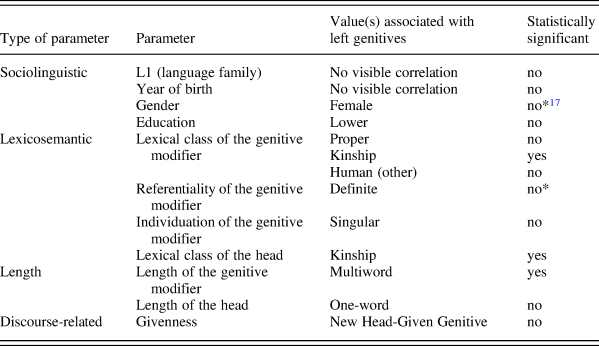
In this paper, we showed that genitive modifiers in Daghestanian Russian tend to be preposed to their heads, which gives rise to the same word-order pattern as in the speakers’ L1s. Remarkably, this tendency does not equally affect all types of genitive noun phrases. We showed that the position of the genitive modifier is determined by sociolinguistic parameters, lexicosemantic and formal features of the noun phrase. The results are summarized in Table 5.
Daghestanian Russian: summary of the results

Left genitives tend to be more frequent in texts produced by female speakers and speakers with a lower level of education. With respect to linguistic factors, preposition of the genitive correlates with lexicosemantic features of both the head and the genitive modifier. Specifically, left genitives and their heads frequently belong to the class of kinship terms. Left genitives are often definite and, to a large extent, refer to countable singular objects. In addition, they are frequently multiword. By contrast, the head of a prepositive genitive is usually a one-word constituent (i.e., it has no other modifiers). Preposition of the genitive also correlates with givenness: left genitives are more frequent in noun phrases in which the referent of the genitive modifier is given and the referent of the head is new. Some of these factors seem to be logically connected to each other. Statistical analysis reduces the list of relevant factors to a smaller number of parameters that are enough to predict the position of the genitive modifier (see the rightmost column in Table 5). These parameters affect word order in the noun phrase to different extents, and their impact could be represented in the hierarchy shown in (17).
(17) lexical class of the head > lexical class of the genitive modifier > length of the genitive modifier > referentiality of the genitive modifier > speaker's gender
The comparison with monolinguals’ Russian showed that left genitives in Daghestanian Russian are significantly more widespread than in monolinguals’ Russian (21.4% versus 2.8%). However, the most relevant factors for the occurrence of left genitives in Daghestanian Russian appeared to be relevant for monolinguals’ Russian too.
Word-order variation within the noun phrase: a more general perspective
The results of our study generally agree with findings concerning other varieties of contact-influenced Russian. Suleymanov (Reference Suleymanov, Schmidt-Brücken, Schuster and Wienberg2016:18-19), in his discussion of left-branching genitive constructions in Baku Russian (which is geographically close to Daghestanian Russian), provided several examples of this phenomenon, and in all of them either the head or the genitive modifier is a kinship term. In analyzing possessive adjectives and genitives in two varieties of Finland Russian, Leisiö (Reference Leisiö2000, Reference Leisiö2001) explicitly says that the order “modifier-head” is common when the modifier is a “specific personal possessor, usually a kinship term or proper name” (Leisiö, Reference Leisiö2000:308) and appeals to such notions as familiarity, relationality, givenness, as well as to the empathy hierarchy (DeLancey, Reference DeLancey1981).
Comparable factors determine synchronic splits and diachronic shifts in the marking of genitive noun phrases in noncontact settings too. For example, a methodologically similar study (Szmrecsanyi, Reference Szmrecsanyi, Börjars, Denison and Scott2013) on the competition between the s-genitive and the of-genitive in English concludes that language-internal conditioning factors are the following: genitive relation (ownership versus other relations), possessor animacy, possessum length and possessor thematicity (cf., also Szmrecsanyi, Biber, Egbert, & Franco, Reference Szmrecsanyi, Biber, Egbert and Franco2016). In her study on Ancient Greek, Viti (Reference Viti2008) showed that word-order variation in genitive noun phrases is regulated by such parameters as semantic relation between the head and the genitive (kinship versus part-whole, material and content, measure), as well as animacy, humanness, individuation, and topicality of the genitive modifier.
Word-order variation in Daghestanian Russian: possible explanations
Some of the parameters that turned out to be relevant for word-order variation in Daghestanian Russian can be explained by appealing directly to word-order processing considerations.
As we saw, the most relevant factor triggering the occurrence of left genitives is kinship semantics of the head of the noun phrase and, consequently, the semantic relation between the head and the genitive modifier. A possible explanation lies in the processing easing that left-branching constructions can bring about when discussing kinship relations. A head with kinship semantics is “anchored” by relating it to a genitive modifier that serves as a reference point for identifying its referent (cf., Hawkins [Reference Hawkins1991:411] on “anchoring” terminology). It is compelling to believe that it might be easier for the speaker to start with the anchor, that is, the item that is closest to him/her and, possibly, to his/her interlocutor. Within this view, word order would iconically reflect the proximity/familiarity of the speaker and the addressee with the referents mentioned in the noun phrase (i.e., “left” = “more familiar,” see also Leisiö [Reference Leisiö2001:106-107]). This is especially relevant for complex chains of kinship relations with several genitive modifiers (such as moego.gen brata.gen ženy.gen mat’ ‘my brother's wife's mother’).
The parameter “Givenness” can be explained in a similar way. The fact that given genitive modifiers tend to be preposed to new heads seems to reflect the general given-before-new principle, which can help the addressee understand the flow of information coming next.
The last parameter specifically associated with word order is the length of the genitive modifier. The general cross-linguistic tendency is that heavy modifiers are more prone to postposition. Our data do not follow this principle: in Daghestanian Russian multiword (heavy) genitive modifiers tend to be preposed instead. It appears that the left multiword genitive modifiers attested in our sample do not form a homogenous class, and their frequent preposition may have different motivations. Typical examples are genitive chains (materi.gen brata.gen ‘of (my) mother's brother’), genitives with possessive pronouns (moej.gen sestry.gen ‘of my sister’) and deictic markers (ètogo.gen čeloveka.gen ‘of this person’), genitive modifiers expressing age characteristics (požilogo.gen vozrasta.gen ‘of old age’), proper names (Šaxmara.gen Omaroviča.gen ‘of Shahmar Omarovich’). Some of these uses might be motivated by the factors of definiteness and kinship semantics, while others need further research (see also endnote 2 on preposed multiword genitive modifiers denoting qualities in monolinguals’ Russian).
The other parameters, that is, the lexical class and referentiality of the genitive modifier, cannot be directly explained in terms of word-order processing. They are often mentioned in studies discussing the mechanisms lying behind similar splits (albeit not strictly related to word order) in noncontact situations. These can be specific mechanisms responsible for splits in possessive noun phrases (cf., Koptjevskaja-Tamm, Reference Koptjevskaja-Tamm2002), or more general ones, regulating different types of splits in argument encoding. The cluster of these parameters is associated with such general notions as animacy, agentivity, individuation, empathy, topicality, in proposed hierarchies such as the “empathy hierarchy” (DeLancey, Reference DeLancey1981; Kuno & Kaburaki, Reference Kuno and Kaburaki1977), “hierarchy of inherent lexical content” (Silverstein, Reference Silverstein and Dixon1976), “activity scale” (Moravcsik, Reference Moravcsik1978), “extended animacy hierarchy” (Croft, Reference Croft2003:130), “individuation properties” (Hopper & Thompson, Reference Hopper and Thompson1980), “topicality hierarchy” (Lander, Reference Lander and Floricic2010) (see also Filimonova [Reference Filimonova2005] and Haude & Witzlack-Makarevich [Reference Haude and Witzlack-Makarevich2016] for an overview of such hierarchies). The results of our study show that most of the features characterizing left genitive modifiers occupy higher positions along such hierarchies.
Word order is indirectly connected to contexts associated with higher/lower position on such semantic hierarchies through the notion of anchoring, which was already employed above to explain the first cluster of parameters. Anchors, which tend to be preposed to their heads, occupy high positions along the hierarchies (Koptjevskaja-Tamm, Reference Koptjevskaja-Tamm2002).
However, if anchoring was the only mechanism regulating word-order choice, we would expect a strong effect caused by the presence of relational nouns—other than kinship terms—as heads (e.g., body parts, group members, etc.). Given their property of expressing a relation with some other entity, relational nouns grammatically require the expression of this entity as an anchor for their understanding. However, the data do not demonstrate any substantial difference between relational nouns and nonrelational nouns.Footnote 18 Moreover, a closer look at the lexical class of each head noun in our corpus demonstrates that the class of kinship terms is actually the only group of relational nouns strongly correlating with the occurrence of left genitives.Footnote 19
In a contact situation, the motivations behind word-order variation discussed above might be enhanced by language-external factors. We suppose that, in the environment of highland Daghestan to which our data belong, kinship semantics pertains to the topics usually discussed in L1 and not in Russian. Moreover, lexical items belonging to this domain are allegedly learned at an early stage of L1 acquisition. Therefore, L1 influence in this domain might be stronger than in other contexts (see, e.g., Aikhenvald [Reference Aikhenvald, Aikhenvald and Dixon2007:30] on the “communicative salience” of kinship terms, which makes this lexical group more prone to contact-induced changes).
CONCLUSION
In this paper, we presented a quantitative corpus-based investigation of noun phrases with a genitive modifier in the contact variety of Russian spoken in Daghestan. Such phrases are characterized by a frequent GEN+N word order, which is not typical of monolinguals’ (i.e., noncontact) varieties of Russian.
The results of our study contribute to the more general discussion on the contact versus noncontact nature of grammatical changes observed in contact settings. As discussed in the introductory section, in recent literature it has been pointed out that contact is often invoked to explain changes that rather result from a more complex combination of factors. In some cases, contact merely reinforces certain language-internal tendencies that are better explained in terms of more general underlying functional (cognitive) mechanisms. Word-order variation in Daghestanian Russian has proved to be another example of such nontrivial cases for which contact influence alone is not a sufficient explanation.
In this paper, we showed that contact influence manifests itself in the unexpectedly high frequency of the nonstandard word-order pattern GEN+N attested in Daghestanian Russian, but not in the factors regulating its occurrence. Word-order variation in the Russian speech of Daghestanian bilinguals is determined by a set of parameters that have been recognized as cross-linguistically relevant for the occurrence of similar morphosyntactic splits—not necessarily involving word order—in noncontact situations, as discussed above. Some of these factors proved to be relevant for the choice of the GEN+N word-order pattern in monolinguals’ Russian too, although in monolinguals’ varieties this phenomenon is extremely infrequent. At the same time, it is important to stress that in the languages of Daghestan, word order in noun phrases is not regulated by the factors discussed in our study.
Thus, the constraints regulating word order in Daghestanian Russian can indeed be formulated without appealing to language contact, although contact might be seen as a factor enhancing the observed variation.
As a follow-up to the analysis presented in this paper, it would be interesting to consider left-branching constructions in Daghestanian Russian from the point of view of language prescriptivism, that is, to check the hypothesis that the expansion of the GEN+N word-order pattern might also be connected to the fact that Daghestanian Russian is relatively free from the pressure of prescriptive norms. If so, this process might be attributed to language “natural development” in the sense of Chambers (Reference Chambers and Kortmann2004), and the choice of the GEN+N pattern in certain pragmatically salient positions might be considered as a “vernacular universal” (Filppula, Klemola, & Paulasto, Reference Filppula, Klemola and Paulasto2009). The latter term reflects the more general hypothesis that the grammar of such nonnormalized varieties is more affected by universal cognitive-based principles than that of a normalized standard language.
Evidence supporting or rejecting this hypothesis could be obtained through the comparison of our Daghestanian data with the data of monolinguals’ Russian dialects, which are also free from prescriptive norms but are not affected by language contact (at least at the synchronic stage). According to our preliminary observations, the GEN+N pattern is indeed quite widespread in monolinguals’ Russian dialects: in the available corpora of dialectal Russian,Footnote 20 the genitive modifier is preposed to its head on average in 18% of the cases.
As shown in Thomason (Reference Thomason, Filppula, Klemola and Paulasto2009), contact-induced change is often hardly distinguishable from vernacular universals, and the case of word-order variation discussed in this paper provides a good illustration of this claim. A deeper investigation of the factors conditioning the occurrence of nonstandard word order in monolinguals’ dialectal varieties of Russian, as well as in bilinguals’ varieties of Russian other than those spoken in Daghestan, might be the topic of future research. This could help better understand the complicated interaction of contact influence and language natural development in the field of word-order variation.
ACKNOWLEDGMENTS
A preliminary version of the paper was presented at the “Various Dimensions of Contrastive Studies” conference (University of Silesia in Katowice, October 21–22, 2019). Subsequent versions of the paper were presented in Moscow during seminars organized at the National Research University Higher School of Economics and at the Moscow State University. We would like to thank our colleagues at the Linguistic Convergence Laboratory (National Research University Higher School of Economics) for useful discussion and valuable advice, in particular Nina Dobrushina, Michael Daniel, and Yury Lander for constant consultations during the preparation of the paper, Ilya Schurov, George Moroz, Ezequiel Koile, Olga Lyashevskaya, and Anna Klezovich for their help with statistical computations. We would also like to thank Nina Dobrushina, Peter Arkadiev, and Samira Verhees, who read a preliminary version of the paper and provided us with insightful suggestions. Irina Khomchenkova and Polina Pleshak contributed to the annotation and discussion of the monolinguals’ Russian data. Finally, we would like to thank four anonymous reviewers for Language Variation and Change, whose comments significantly contributed to improving the paper. The article was prepared within the framework of the HSE University Basic Research Program.