After the Great East Japan Earthquake occurred on March 11, 2011, mental health care teams were dispatched from all over Japan to the affected area.Reference Suzuki and Kim 1 In Japan, after a disaster, mental health care teams consisting of such professionals as psychiatrists, nurses, psychiatric social workers, and administrators are dispatched to affected areas. They perform outreach in affected communities such as shelters or temporary houses or set up temporary psychiatric clinics and respond to the mental health needs of those affected. According to the National Information Center of Disaster Mental Health, 2 50 teams consisting of 3307 staff were dispatched after the Great East Japan Earthquake to the affected municipalities in northeastern Japan (ie, municipalities in Iwate, Miyagi, and Fukushima prefectures).
To build consensus on disaster response among the Japanese mental health community, various efforts have been taken; such efforts include development of an academic society, trainings of professionals, and development of national guidelines.Reference Kim 3 , Reference Kim 4 Before the Great East Japan Earthquake, we conducted systematic consensus building among experts of disaster mental health by gathering their experience-based opinions.Reference Suzuki, Fukasawa and Nakajima 5 We conducted the present study using similar methods to include experiences of the Great East Japan Earthquake. The aim of the present study is to build consensus on the appropriateness of disaster mental health activities by phase among members of the mental health community working in the affected areas. We focused on the early stages of the disaster, that is, the first 3 months after the disaster.
Methods
Participants
We recruited mental health or community health professionals working in the heavily damaged areas of Iwate, Miyagi, and Fukushima prefectures in eastern Japan with the cooperation of experts from the prefectural mental health and welfare centers or universities who served as a focal point soon after the Great East Japan Earthquake. We planned to recruit both the local health professionals in the affected areas who hosted support teams and the mental health professionals dispatched from outside.
As for local professionals who hosted dispatched teams, we recruited mainly local civil servants from mental health and welfare centers, health care centers, or municipal governments. To recruit professionals dispatched from outside, we asked organizations that had dispatched mental health care teams to the affected area to introduce those staff who had engaged in support activities in the affected area in March or April 2011 in a variety of specialties. We required these candidates to decide for themselves whether to participate in the study and to answer questions based on their own opinions even if their recruitment was through a parent organization. In addition, we also recruited a member of an academic network (a special committee on the Great East Japan Earthquake of the Japanese Society for Traumatic Stress Studies) and several psychiatrists from local medical institutions. They were a purposive sample. Finally, 131 of them consented to participate in our survey.
Delphi Process
The Delphi process is a method of systematic consensus building among experts.Reference Linstone and Turoff 6 In the Delphi process, participants are asked to answer questions and comment on these questions over 2 or more rounds. After each round, they are given feedback consisting of summary statistics and anonymous comments of other participants from the previous round, which allows them to reconsider and change their answers in the following round. Through this iterative process, the range of experts’ answers is expected to decrease and their opinions to converge. This method is often used in the health care field to create guidelines when there is insufficient evidence to make decisions.Reference Bisson, Tavakoly and Witteveen 7 , Reference Kelly, Jorm and Kitchener 8
We asked our participants to rate the appropriateness of the survey items on a 5-point Likert scale (1=highly inappropriate, 3=neither appropriate nor inappropriate, 5=highly appropriate) with a “do not know” option. We also asked them to comment on each item in order to collect their thoughts based on their own experiences. We repeated this process 3 times using the online survey tool Survey Monkey (http://jp.surveymonkey.com/; Palo Alto, CA) and provided them feedback on the results of the previous round. Summary statistics (ie, mean scores and the percentage of participants who rated each score) and a summary of participants’ comments for each item were distributed by e-mail and also inserted beneath each item in successive rounds so that participants could reconsider their ratings based on them. To summarize the participants’ comments, the authors read all of them and categorized them according to their contents. After the adequacy of the categorization was checked among the authors, 200- to 600-character summaries were made for each item. Giving careful consideration to the possibility that feedback on the summaries might affect participants’ responses in a successive round, we did not exclude minority opinions.
Through this process, items in which ≥80% of participants scored ≥4 were determined as having achieved positive consensus among the participants and were eliminated from the third round. We also eliminated items in which ≤50% of participants scored ≥4 in both the first and second rounds because we thought participants’ comments were saturated and there was a low possibility of gaining positive consensus. We started the first round in November 2012 and ended the third round in March 2013.
Survey Items
We focused on the first 3 months after the disaster occurred and divided this time period into 3 phases: immediate aftermath, acute phase, and midphase. We defined the phases as follows:
-
1. Immediate aftermath: a phase of confusion where information is limited and the whole picture of a disaster is not grasped. Depending on the scale of the disaster, it can persist for hours or even days.
-
2. Acute phase: a phase where usual psychiatric services are interrupted by damage to medical institutions or transportation in the affected area. Many residents stay in shelters and basic livelihood support is provided collectively. Depending on the scale of the disaster, it persists for days or even months after the end of the immediate aftermath.
-
3. Midphase: a phase where medical institutions and transportation in the affected area begin to recover. Residents leaving the shelters resume their lives in temporary houses or homes of their own and support is provided individually. Although midphase is difficult to distinguish from the acute phase, it begins weeks or even months after a disaster.
We sought consensus building on the appropriateness of disaster mental health activities in each phase. Twenty-four items on disaster mental health activities often taken in the affected area reported in this article are presented in Table 1. In addition, we requested that participants give their gender, age, specialty, and prior experiences working in a disaster area. We also asked about the positions they were engaged in after the Great East Japan Earthquake (ie, working as local staff serving their own routine practice, working as local staff serving special support activities, or working as a professional dispatched from outside).
Analysis
We reported the proportion of participants scoring ≥4 (ie, appropriate or highly appropriate) for each item in each round. We also reported feedback comments for some items, especially for those with a score that changed substantially in a successive round. All statistics were generated using Stata 12.0 for Windows (StataCorp LP, College Station, TX).
Ethical Considerations
The study protocol was reviewed and approved by the Ethics Committee of the National Center of Neurology and Psychiatry. Upon starting the survey, written informed consent was obtained by post or by e-mail from all participants.
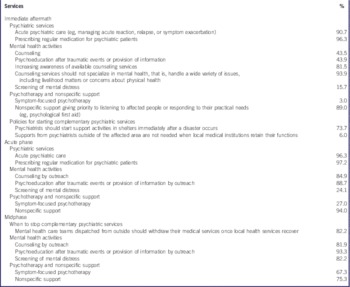
Proportion of Participants Who Gave Positive Consensus (≥4) for Each Item in the Last Round

Results
Participants
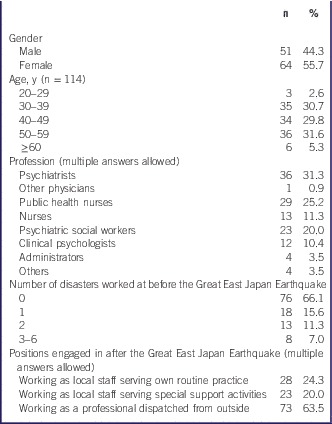
Table 2 presents participants’ sociodemographic characteristics, prior experiences working in a disaster area, and the position they were engaged in after the Great East Japan Earthquake. The panel of 115 respondents in the first round consisted of 42 professionals from the affected area and 73 professionals dispatched from outside. Two-thirds of them had no experience working in a disaster area before the Great East Japan Earthquake. The number of participants in the first, second, and third rounds was 115, 109, and 102, respectively.
Participants’ Sociodemographic Characteristics, Prior Experience Working in a Disaster Area, and Position After the Great East Japan Earthquake (n=115).

Proportion of Positive Consensus for Each Item
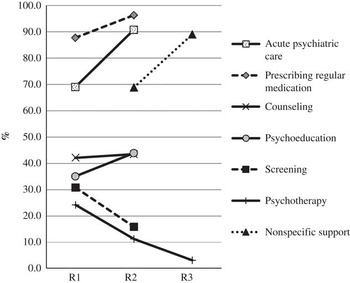
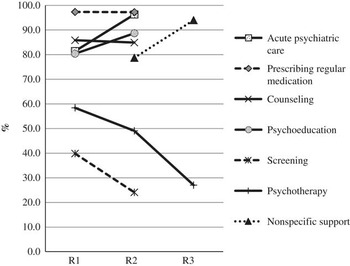
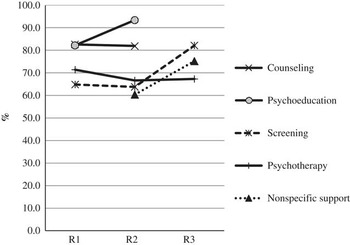
Figures 1–3 present changes in the proportion of participants who gave positive consensus (≥4) through the rounds for each disaster mental health activity in each phase and Table 1 shows the final results for all items.
Proportion of Participants Who Gave Consensus for Each Item in the Immediate Aftermath of a Disaster in Each Round of the Delphi Process

Proportion of Participants Who Gave Consensus for Each Item in the Acute Phase of a Disaster in Each Round of the Delphi Process

Proportion of Participants Who Gave Consensus for Each Item in the Midphase of a Disaster in Each Round of the Delphi Process

Immediate Aftermath
Psychiatric Services
The proportion of participants who gave positive consensus for the importance of acute psychiatric care (eg, managing acute reaction, relapse, or symptom exacerbation) in the immediate aftermath of a disaster was 69.0% in the first round. Participants’ comments included opinions that agreed with or illustrated situations requiring it, although some comments assigned a low priority to it (eg, few people need or require such services, or people assigned a higher priority to other problems such as securing safety, responding to physical health needs, or ensuring a basic livelihood). Participants were asked to reassess the importance of acute psychiatric care after receiving feedback on summary statistics and these comments. The proportion of participants who gave positive consensus in the second round increased to 90.7% and it gained consensus.
A large proportion of participants gave positive consensus for the importance of prescribing regular medication for psychiatric patients in both the first and second rounds and it gained consensus.
Mental Health Activities
Counseling for the general population (without history of psychiatric disorder) affected by the disaster and psychoeducation after traumatic events or provision of information in the immediate aftermath of a disaster did not gain consensus.
A number of comments indicated that although counseling and psychoeducation were not needed, or that members of the mental health community were too busy to engage in such activities, it is important to set up counseling services and increase awareness of contact information to broadly inform affected people that these services are available if needed. In addition, a number of comments indicated the importance of ensuring that counseling services not specialize in mental health issues. Based on these comments, we generated 2 items on the importance of increasing awareness of available counseling services among affected people and on the importance of ensuring that counseling services do not specialize in mental health, that is, setting up counseling services that handle a wide variety of issues, including livelihood matters or concerns about physical health in which mental health services are given if needed. These items gained consensus (Table 1).
The importance of screening for mental distress in the general population did not gain consensus.
Psychotherapy and Nonspecific Support
As for the importance of psychotherapy provided by psychiatrists or psychologists, the proportion of participants who gave positive consensus was low in the first round. Although there were comments recognizing the importance of psychotherapy, a number of comments indicated that conditions during the confusion of a disaster did not permit it, or that its priority was low compared to providing livelihood support or caring for physical health. Some comments indicated that the definition of “psychotherapy” was vague.
We asked the question again in the second round after clarifying the definition of “psychotherapy” as “psychotherapy with treatment aims provided by psychiatrists or psychologists.” However the comments still indicated a diverse understanding of the term “psychotherapy.” Therefore, we rewrote the definition as “psychotherapy focused on psychopathology provided by psychiatrists or psychologists” in the third round. The proportion of participants who gave positive consensus decreased even more, and it did not gain consensus.
Meanwhile, a number of comments endorsed a nonspecific approach that gives priority to listening to affected people or providing practical supports such as psychological first aid. Based on these comments, we generated a new item on the importance of support not intended to treat symptoms such as psychological first aid. The proportion of participants who gave positive consensus in the second round was 68.8%, and their comments seemed to indicate that participants varied in their understanding of the concept of psychological first aid or its supporting methods. Therefore we rewrote the explanation for nonspecific support as “support not focused on psychopathology (eg, psychological first aid)” and asked the question again in the third round, where it gained consensus.
Policies for Starting Complementary Psychiatric Services
Because we collected a number of first-round comments that insisted upon the need for psychiatrists in the affected area soon after a disaster occurs, we generated a new item in the second round on the need for psychiatrists to begin support activities outside medical institutions such as shelters immediately after a disaster occurs. The proportion of participants who gave positive consensus was 56.5%. Some comments indicated certain activities requiring psychiatrists in the immediate aftermath of a disaster, such as handling a person with dementia who is disturbed in a shelter, providing psychiatric practices in general hospitals with no psychiatrists, or establishing a temporary psychiatric clinic in a shelter when existing psychiatric institutions had stopped functioning. On the other hand, other comments denied the need for psychiatrists working outside of an institution, stating, for example, that local psychiatrists are too busy rebuilding routine work in their own institutions to actively involve themselves outside and it is sufficient for them to resume their routine work. We asked the question again in the third round, where although the proportion of participants who gave positive consensus increased, it did not gain consensus.
Because we obtained a number of comments suggesting the role of psychiatrists entering from outside in the immediate aftermath of a disaster is to supplement the functions of the local psychiatric institutions deteriorated by the disaster, we generated a new item about the appropriateness of a policy asserting that psychiatrists outside are not needed when local medical institutions retain their functions. The proportion of participants who gave positive consensus was extremely low (Table 1).
Acute Phase
As for psychiatric services, acute psychiatric care and prescribing regular medication for psychiatric patients as activities of mental health care teams in the acute phase of a disaster gained consensus. For mental health activities, counseling and psychoeducation after traumatic events or provision of information gained consensus, but screening of mental distress in a general population did not. For psychotherapy and nonspecific support, the contents of the comments were about the same as those obtained for the immediate aftermath of a disaster. After the same amended explanations as in the previous phase were applied, psychotherapy did not gain consensus and nonspecific support gained consensus.
Midphase
When to Stop Complementary Psychiatric Services
In the first round, 41.1% of participants gave positive consensus for the policy that mental health care teams should withdraw from medical services when local health services recover. A number of comments required continuation of team support even after the recovery of local health services. For example, one local staff member said that the workload of local medical institutions increases because of the acceptance of patients transferred from affected institutions and that it is difficult to take over activities of mental health care teams. Some participants indicated various needs that arise during this period, such as the disparity in recovery among affected people or alcohol problems. Comments also indicated the role of mental health care teams, such as community outreach that local institutions cannot manage or support for exhausted local staff.
We added an explanation to clarify our intention that mental health care teams should shift their role to health care activities or support for local staff as needed. The proportion of participants who agreed with this policy increased to 62.3% in the second round. Most comments basically endorsed this policy, although some comments indicated concern that if outside supports continue as long as needs exist, their support will never end and local staff will not be able to look ahead to future activities. After the question was asked again in the third round, it gained consensus (Table 1).
Mental Health Activities
Counseling and psychoeducation or provision of information gained consensus. The proportion of participants who gave positive consensus for mental distress screening was 64.9% in the first round and 63.8% in the second round. A number of comments described the prerequisite for or methods of its implementation; for example, screening should be followed by reporting results for the residents or follow-up for those identified as high risk, or should be implemented as part of the community health care activity of the local municipalities.
Based on these comments, we added a sentence in the third round as follows: “A follow-up system should be set up before implementation and be sure to give residents feedback on the results after implementation.” The proportion of participants who gave positive consensus increased to 82.2% and it gained consensus.
Psychotherapy and Nonspecific Support
In the first round, 71.4% of participants gave positive consensus for psychotherapy. Their comments recognized the need for psychotherapy, for example, stating that some people require psychotherapy once their livelihood stabilizes. Some comments that disapproved of psychotherapy indicated that it is better to start counseling casually on issues such as physical health or livelihood in conjunction with community health care activities or case work rather than focusing on psychological symptoms in a structured meeting.
As for nonspecific support, although some comments agreed that it is important, for example, stating that it is basic support and is applicable and useful in any phase of a disaster, other comments indicated that it is inappropriate for cases with apparent psychiatric symptoms and that an important midphase disaster skill is to recognize such cases. As we did in previous phases, we rewrote the definitions for psychotherapy and nonspecific support in successive rounds. Although the proportion of participants who gave positive consensus was relatively high for both, they did not gain consensus.
Discussion
The importance of complementary psychiatric services such as acute psychiatric care and prescribing regular medication for psychiatric patients gained positive consensus in the immediate aftermath and acute phase of a disaster. Mental health activities such as counseling and psychoeducation after traumatic events or provision of information gained consensus in the acute phase and midphase, and screening of mental distress gained consensus in the midphase of a disaster.
Complementary Psychiatric Services
In the immediate aftermath of a disaster, acute psychiatric care and prescribing regular medication gained positive consensus. Although the policy that psychiatrists should start support activities in shelters immediately after a disaster occurs did not gain consensus, the proportion of participants who gave consensus was relatively high, and the proportion of participants who gave consensus for the policy that psychiatrists from outside are not needed when the local medical institutions retain their functions was extremely low at 6.0%.
Although there were some concerns that bringing outside support into the affected area immediately after a disaster exacerbates confusion, our results seem to indicate that because of the increase of disaster-related needs and damage to local staff, outside support to continue psychiatric services is needed even when local institutions retain their functions, especially in a massive disaster.
Counseling and Psychoeducation After Traumatic Events or Provision of Information
In this study, although setting up and publicizing counseling services gained consensus in the immediate aftermath of a disaster, counseling and psychoeducation after traumatic events or provision of information gained consensus after the acute phase of a disaster.
As far as we know, no studies have assessed the effectiveness of providing information about psychological issues after a disaster. Although studies that assess the effectiveness of providing a self-help booklet following a traumatic injury did not indicate its effectiveness as a preventive strategy to ameliorate posttraumatic stress disorder (PTSD),Reference Turpin, Downs and Mason 9 , Reference Scholes, Turpin and Mason 10 a study for people with symptoms of acute stress disorder indicated high subjective ratings for the usefulness of the self-help booklet, especially for the sections on psychological sequelae and coping strategies.Reference Scholes, Turpin and Mason 10 Existing guidelines on disaster mental health describe the need to set up a counseling hotline for people who seek emotional supportReference Kim 3 , 11 and to publicize it widely at an early stage.Reference Kim 3 Guidelines also describe the need to deliver information to the public concerning common psychological changes in postdisaster situations, helpful coping, and when and where to seek help.Reference Kim 3 , 11 , Reference Te Brake, Dückers and De Vries 12
Although according to a literature review, no psychological intervention can be recommended to prevent PTSD in individuals exposed to a traumatic event,Reference Roberts, Kitchiner and Kenardy 13 setting up counseling services or providing information about psychological issues to ameliorate distress or to bring comfort seemed to be widely accepted as one of the activities of disaster mental health care. The results of this study seemed to indicate that counseling services should be set up at an early stage of a disaster, and after confusion settles down, educational services regarding psychological reactions to trauma and how to manage them should be started.
Screening of Mental Distress
Screening of mental distress gained consensus only in the midphase of a disaster. Mental distress screening apparently should be started after the mental health community and affected residents regain their calm and a follow-up system for those at high risk is prepared.
Although existing guidelines developed in Europe 11 , Reference Te Brake, Dückers and De Vries 12 do not recommend screening, Japanese guidelinesReference Kim 3 recommend screening to determine psychiatric diagnoses or identify individuals with severe symptoms or high-risk individuals as an activity about 1 month after a disaster. Our previous studiesReference Suzuki, Fukasawa and Nakajima 5 , Reference Fukasawa, Suzuki and Nakajima 14 also showed that Japanese experts recognize the need for postdisaster screening.
Although as far as we know no studies have assessed the effectiveness of population-wide screening for postdisaster mental distress, a brief screening instrument has shown excellent prediction of PTSDReference Brewin, Rose and Andrews 15 and practical utilization.Reference Brewin, Fuchkan and Huntley 16 In Japan, each administrative district has allocated public health nurses to take charge of residents’ health, and after a disaster, they do outreach to all residents’ houses for health checks. In such a systematic approach, population-wide screening by well-designed instruments might be useful. In addition, the expected role of postdisaster mental distress screening in Japan seemed not only to identify high-risk people but also to educate people by providing information and encourage them to manage their own mental health.
Psychotherapy and Nonspecific Support
Although psychotherapy focused on psychological symptoms did not gain consensus in all 3 phases, the proportion for the midphase of a disaster was relatively high at 67.3%. On the other hand, a nonspecific approach such as psychological first aid 17 , 18 gained consensus in the immediate aftermath and acute phase but not the midphase of a disaster, although the proportion of participants giving agreement was relatively high at 75.3%. A nonspecific approach seems to be appropriate as an initial response, but over time the need for it decreases as high levels of expertise and response to psychological symptoms increase.
Existing guidelinesReference Kim 3 , 11 , Reference Te Brake, Dückers and De Vries 12 recommend a nonspecific approach that gives priority to practical needs as an initial response, although some reservations exist about the effectiveness of the psychological first aid module.Reference Te Brake, Dückers and De Vries 12 Concerning psychotherapy, Japanese guidelines prohibit psychological debriefing and encourage natural recovery.Reference Kim 3 Guidelines developed in Europe 11 , Reference Te Brake, Dückers and De Vries 12 recommend trauma-focused cognitive behavioral therapy for individuals with acute stress disorder or severe acute PTSD within the first month of a disaster. Evidence also indicates its effectiveness.Reference Roberts, Kitchiner and Kenardy 13
Psychotherapy did not gain consensus in this study seemingly for the following reasons: doubts about the capacity to prepare an appropriate place and system for psychotherapy given the limited resources immediately after a disaster, its priority level in the whole disaster response, and availability of specialists skilled in psychotherapy. In Japan as of this writing, psychologists’ disaster responses are mainly in the educational field rather than in the medical field and their role in mental health care teams remains unclear. These contexts seemed to hinder a positive consensus on psychotherapy among our participants consisting of health care professionals.
Some limitations of this study require careful interpretation. Although we tried to recruit both local professionals and professionals dispatched from outside with a variety of expertise, we used a purposive sample. Also, given that the focus of this study was to consolidate the lessons learned from the Great East Japan Earthquake and that two-thirds of our participants had no prior experience working in a disaster setting, some of the results might not apply to a future disaster setting. However, these findings are beneficial as reference material.
Conclusions
Based on this study, expert consensus on disaster mental health seems to indicate that continuation of psychiatric services should be given priority in the immediate aftermath and mental health activities can begin in later phases.
Acknowledgments
We would like to express our thanks to all participants in the Delphi process for their invaluable feedback.
Funding
This study was funded by Health and Labour Science Research Grants for Research on Health Security Control and Comprehensive Research on Disability Health and Welfare from the Ministry of Health, Labour and Welfare, Japan.