Implications
When unfamiliar pigs are mixed together they show aggressive behaviour such as fighting. We found that when pigs of above average aggressiveness are mixed onto the truck pre-slaughter, then at slaughter they have more scratches on their skin (indicating fighting) are more stressed (higher cortisol in blood plasma) and have less acidic meat 24 h after slaughter than mixed groups of lower aggressiveness pigs or unmixed groups. When group composition was not controlled, skin injuries at slaughter were associated with stress but not meat quality. Overall, genetic factors and stress levels affected meat quality.
Introduction
The management of pigs in the pre-slaughter period has an impact on their welfare (Warriss, Reference Warriss1998), and stress at this time can result in changes to muscle chemistry and consequently meat quality (reviewed by Terlouw et al., Reference Terlouw, Arnould, Auperin, Berri, Bihan-Duval, Deiss, Lefevre, Lensink and Mounier2008).
Prior to slaughter, pigs are usually mixed with unfamiliar animals when they are loaded onto a truck for transport, and again on arrival at the slaughterhouse lairage. In these situations, aggressive behaviour such as fighting, attacking and chasing occurs. The aggression is provoked both by mixing unfamiliar pigs and by moving pigs to a new location (Marchant-Forde and Marchant-Forde, Reference Marchant-Forde and Marchant-Forde2005).
Aggressive behaviour in pigs is also thought to be influenced by stable individual differences between pigs within a population in their propensity to show aggression (D’Eath, Reference D’Eath2004; Terlouw et al., Reference Terlouw, Porcher and Fernandez2005). This aggressive temperament (or ‘aggressiveness’) is thought to be affected by developmental (D’Eath and Lawrence, Reference D’Eath and Lawrence2004; D’Eath, Reference D’Eath2005) and genetic (Turner et al., Reference Turner, Roehe, D’Eath, Ison, Farish, Jack, Lundeheim, Rydhmer and Lawrence2008 and Reference Turner, Roehe, Mekkawy, Farnworth, Knap and Lawrence2009) factors. Measures of temperament including response to an unfamiliar object or aggression in an earlier food competition test have been shown to predict aggression at mixing pre-slaughter and ultimate meat pH (Terlouw et al., Reference Terlouw, Porcher and Fernandez2005; Terlouw and Rybarczyk, Reference Terlouw and Rybarczyk2008). However, the effect of aggressive temperament on aggression, stress and meat quality at slaughter have not been studied before and this was our aim in this study.
Aggressive temperament was measured by mixing pigs at approximately 10 to 11 weeks of age into new groups, balancing for weight and unfamiliarity. Under these conditions, change in skin lesion scores from before until 24 h after mixing can be used to indicate the involvement in aggressive behaviour (Turner et al., Reference Turner, Farnworth, White, Brotherstone, Mendl, Knap, Penny and Lawrence2006 and Reference Turner, Roehe, D’Eath, Ison, Farish, Jack, Lundeheim, Rydhmer and Lawrence2009). At slaughter, to compare extremes, we included groups mixed for transport and slaughter, which contained pigs of varying degrees of aggressiveness and also groups in which there was no mixing, in which minimal aggression was expected (Lebret et al., Reference Lebret, Meunier-Salaun, Foury, Mormede, Dransfield and Dourmad2006). To allow comparison with an example of a commercial situation, we also studied slaughter batches in which mixing group composition was uncontrolled.
Genetic background is known to influence all of the variables of interest here, namely aggression (Turner et al., Reference Turner, Roehe, D’Eath, Ison, Farish, Jack, Lundeheim, Rydhmer and Lawrence2008 and Reference Turner, Roehe, Mekkawy, Farnworth, Knap and Lawrence2009), stress reactivity (Désautés et al., Reference Désautés, Bidanel, Milan, Iannuccelli, Amigues, Bourgeois, Caritez, Renard, Chevalet and Mormède2002; Mormède et al., Reference Mormède, Courvoisier, Ramos, Marissal-Arvy, Ousova, Désautés, Duclos, Chaouloff and Moisan2002) and meat quality (Pommier et al., Reference Pommier, Pomar and Godbout1998; Foury et al., Reference Foury, Devillers, Sanchez, Griffon, Le Roy and Mormede2005 and Reference Foury, Geverink, Gil, Gispert, Hortos, Furnols, Carrion, Blott, Plastow and Mormede2007). As such, the influence of sire and dam line composition and genotype at the halothane locus (ryanodine receptor 1, RYR1) were analyzed.
To assess physiological parameters indicative of stress at slaughter, we collected a blood sample at exsanguination and measured cortisol, glucose, lactate and creatine kinase (CK). These variables reflect different aspects of the psychological and physical aspects of the stress experienced by each pig. Meat quality was measured by means of pH at 3, 6 and 24 h, drip loss over 48 h and meat lightness and colour. Although reported in many previous studies, we also analyzed the expected relationships between stress and meat quality measures in our sample of pigs. Finally, production data including carcass weight, lifetime daily gain, fat depth, muscle thickness and lean content were also collected routinely at the slaughter house so these were also analyzed, since they were expected to be effected by genetic line and, although not by treatment.
Material and methods
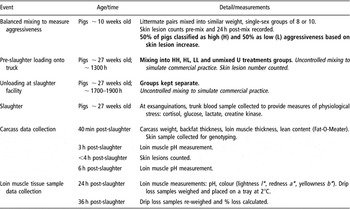
An outline of the material and methods is shown in Table 1.
Outline of material and methods

Events common to pig in all eight mixing batches are shown in normal type, events unique to the four structured mixing batches are shown in bold type and events unique to the four unstructured mix batches are shown in italics.
Animals
The subjects of this study were 286 castrated male and 298 female finishing pigs (n = 584), reared commercially on slatted floors at a commercial farm in Schleswig-Holstein, Germany. These pigs were from eight batches destined for slaughter at different times over a period of 13 months. They were the progeny of sows from six crosses derived from the Landrace, Large White and Duroc breeds. Sires were 11 boars from three Pietrain lines. All were heterozygous carriers of the susceptible allele at the locus (Pommier et al., Reference Pommier, Pomar and Godbout1998; Gispert et al., Reference Gispert, Faucitano, Oliver, Guardia, Coll, Siggens, Harvey and Diestre2000). Individual pigs were identified by eartags fitted at weaning.
Balanced mixing to measure aggressiveness
At 69.5 (±8.4) days of age (mean ± s.d.), pigs were moved from littermate groups in weaned accommodation to new pens at which point they weighed 25.0 (±5.8) kg (mean ± s.d.). Before mixing, pigs were weighed and fresh (red) skin lesions were counted, dividing the body into front (head, neck, shoulders and front legs), middle (flanks and back) and rear (rump, hind legs and tail) sections (Turner et al., Reference Turner, Farnworth, White, Brotherstone, Mendl, Knap, Penny and Lawrence2006). Pigs were then moved to new pens and mixed into new single-sex groups of eight (31 groups) or ten (eight groups) consisting of littermate pairs, and minimizing weight variation in the new group (population weight range = 30.1 kg (12.0 to 42.1 kg); within group mean (±s.d.) weight range = 8.75(± 3.22) kg. Twenty-four hours after mixing skin lesions were again counted. Weight (D’Eath, Reference D’Eath2002) and unfamiliarity (Puppe, Reference Puppe1998) are important determinants of aggression in pigs. By mixing so as to standardize them, the intention was to reduce their influence, so increasing the role of aggressive temperament in determining, which pigs are involved in aggressive behaviour. Skin lesion change pre- to post-mixing could then be used as an indicator of involvement in aggressive behaviour (Turner et al., Reference Turner, Farnworth, White, Brotherstone, Mendl, Knap, Penny and Lawrence2006 and Reference Turner, Roehe, D’Eath, Ison, Farish, Jack, Lundeheim, Rydhmer and Lawrence2009). Pigs in each mixed group were ordered by the change in total skin lesions: half of the pigs in each group (those with the most lesions) were designated as high aggressiveness (H; mean ± s.e. total skin lesion change = 114.1 ± 10.2) and the remaining half as low aggressiveness (L; lesion change = 26.4 ± 3.2). Pigs remained in these rearing groups until reaching slaughter weight. One week before slaughter, pigs were given slap-marks enabling identification of individuals.
Pre-slaughter
In four of the slaughter batches, referred to as ‘structured mix’ batches, pigs were assigned to one of four mixing treatments based on their aggressiveness (n = 69, 63, 64 and 75; 132 male pigs and 139 female pigs, n = 271). For each newly mixed group in the HH treatment, four H pigs from one rearing group were mixed with four H pigs from another rearing group of the same sex (mean ± s.e. total skin lesion change in the earlier balanced mix = 138.7 ± 13.9). HL groups each consisted of four H (lesion change = 64.8 ± 7.9) and four L (lesion change = 41.8 ± 8.0) pigs from different rearing groups, and LL groups had four L pigs from each of two rearing groups (lesion change = 19.2 ± 2.4). Finally, for the ‘unmixed’ treatment (U) rearing groups with intermediate levels of skin lesions (lesion change = 47.6 ± 6.2) were left as they were. Since batch effects are common in studies involving transport and slaughter (Brown et al., Reference Brown, Warriss, Nute, Edwards and Knowles1998), the four treatments were each represented by two groups of pigs (one male and one female) in each slaughter batch (eight groups per treatment in total).
On the day before slaughter, pigs were fed their normal ration for the last time in the morning, resulting in a 20 to 24 h fast before slaughter. Skin lesions were counted before pigs were loaded onto a truck. Pigs were mixed into their treatment groups, as they were loaded. The truck was equipped with internal partitions to keep groups separate, and treatment groups were allocated at random to these pens. Once loading was completed, the truck departed at approximately 1300 h and began a 270 km journey to a commercial slaughter facility, arriving at 1700 to 1900 h. On arrival at lairage, pigs were unloaded, maintaining group composition until slaughter and again the allocation of treatments to pens was random.
In four further batches of pigs, referred to as ‘unstructured’, mixing of groups occurred at loading onto the truck and at lairage in an uncontrolled way, typical of commercial practice (n = 71, 73, 67 and 60). In addition, three groups of pigs were mixed in an unstructured way in three of the batches, which otherwise had structured mix groups (n = 15, 13 and 14). These were included with and analyzed with the unstructured mix data (unstructured mix total 154 male pigs, 159 female pigs, n = 313). For the ‘unstructured’ groups, pigs were removed from their pens and moved en masse into the truck, and again at lairage, with no control of which animals were in each pen. Although allocation of animals to pens at transport and lairage was not controlled, it was recorded (except in one slaughter batch).
Pigs were accommodated overnight at the slaughter facility at commercial stocking density in lairage pens with fully slatted floors and a drinker. Although aggressive behaviour was not systematically observed, opportunities for aggressive interactions began from when pigs were mixed at loading so could have occurred at loading, during transport and at lairage.
Slaughter tissue collection
Slaughter took place when pigs had reached approximately 110 kg liveweight. At this stage they were 190.3 ± 8.0 days old (mean ± s.d.). The next morning at between 0600 and 0800 h, pigs were moved from lairage pens to the slaughter line in a random order. They were stunned by means of CO2 gas. At exsanguination, a 50 ml sample of trunk blood was collected from each pig in a plastic tube containing 1 ml of 0.5 M EDTA and was stored on ice until plasma preparation, after which they were stored at −80°C. After evisceration, carcasses were halved and stored in a chiller at 4°C. A skin tissue sample was collected from the middle of the back to provide a DNA sample to determine the genotype of each pig at the receptor locus. Pig identity was tracked throughout by using ear tags and slap marks and a number was written on the carcass before it went into the chiller. As an extra check, the order of pigs on the line was noted at key stages.
Physiological stress parameters
Glucose, lactate and CK activity were measured with a clinical biochemistry automate (COBAS-MIRA Plus, Roche Diagnostics, Meylan, France). The intra- and inter-assay CVs (%) were 1.63 and 3.03 for glucose, 1.17 and 2.81 for lactate and 1.04 and 1.44 for CK respectively. Cortisol levels were measured with the automated analyzer Centaur (Siemens Healthcare Diagnostics S.A.S, Saint Denis, France) using a kit designed for human serum and that we validated for pig serum. The intra- and inter-assay CVs (%) were 3.4 and 8.0, respectively.
Carcass and meat quality measurements
Carcasses were weighed 40 min after slaughter, and backfat thickness, loin muscle thickness and lean content were measured using a Fat-O-Meater model FOM S71 with a S 87 probe (SFK Technology A/S, Herlev, Denmark), and lean content was calculated as (%). Skin lesions were counted on both halves of the carcass within 4 h of storage in the chiller as described for live pigs, and the pre-loading lesions were subtracted to give the change in skin lesions during the transport to slaughter period. The genotype was determined using a Hin6I-PCR-RFLP. The polymorphic site (SNP c.1843C > T) was amplified in a 20 μl PCR reaction containing 100 ng genomic DNA isolated from the skin sample according to standard phenol-chloroform extraction protocols, 0.2 μM each forward (5′-tccagtttgccacaggtcctacca) and reverse primer (5′-ATTCACCGGAGTGGAGTCTCTGAG), respectively, 0.2 mM dNTP and 0.5 U SupraTherm Taq-polymerase (Ares Biosciences, Köln, Germany). The temperature profile included initial denaturation at 95°C for 3 min, followed by 45 cycles of denaturation at 95°C for 15 s, annealing at 62°C for 60 s, extension at 72°C for 60 s and one cycle of final extension at 72 °C for 5 min. To detect the SNP c.1843C > T, 10 μl of the amplified DNA were digested using 10 U Hin6I enzyme (Fermentas, St. Leon-Rot, Germany) overnight according to manufacturer recommendations, and the resulting RFLP was analyzed on 2% ethidium bromide stained agarose gel. Pigs were either homozygous for the resistant allele at the locus (NN), or were heterozygous carriers (Nn, having one copy of the susceptible and resistant alleles).
Loin muscle (M. longissimus dorsi) was used for meat quality measurements. The pH was measured from the carcass in the chiller at 3 and 6 h using a portable pH metre (pH-star CPU pistol, Matthaus, Am Leinawald 30, D-04603, Klausa, Germany). Twenty-four hours after slaughter, the carcass was butchered and loin tissue was collected for measurement of ultimate pH, colour (lightness, l*; redness, a*; and yellowness, b* values using a spectrophotometer Minolta CR 300). Drip loss was determined by removing two pieces of meat (each 2 cm thick) from the loin and weighing them (mean total weight = 260.2 ± 32.5 g). These were stored on a tray at 2°C for 48 h before re-weighing. Drip loss percentage was calculated by expressing the change in weight as a percentage of the original weight.
Statistical methods
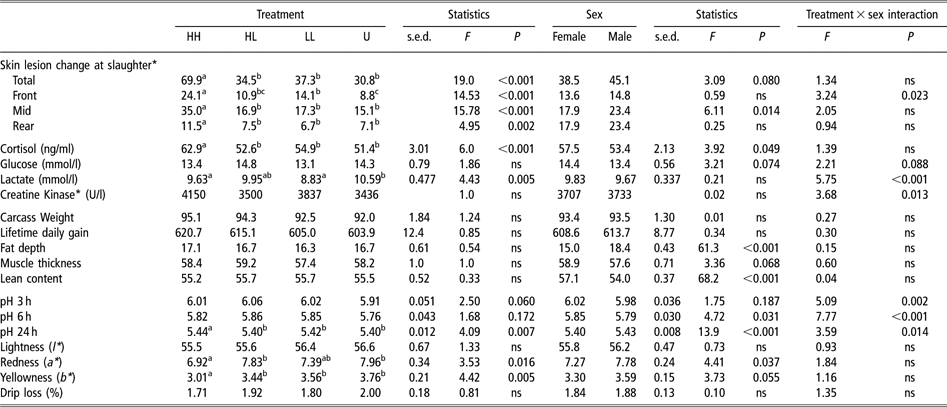
Linear mixed models were fitted using REML in Genstat (11th Edition, VSN International Ltd). After model fitting, the distributions of residual values were checked for normality. Log10 transformations were required for skin lesion data and CK. For data from the structured mix batches (n = 271, but n = 253 for analysis due to missing data), measured variables relating to skin lesions, physiology, performance and carcass characteristics and meat quality at slaughter were examined in two series of models. Treatment and sex and their interaction were fitted as fixed effects with slaughter batch as a random effect, carcass weight was fitted as a covariate random effect for analysis of lesions but was found to have little effect (Table 2). In a separate series of models to look at genetic factors, treatment, genotype, sire and dam line composition were fitted as fixed effects (too few combinations were available to fit the interaction of sire and dam line composition), with slaughter batch as a random effect (Table 3). Where significant effects were found, least significant differences (LSD) were calculated to determine where the differences between groups lay.
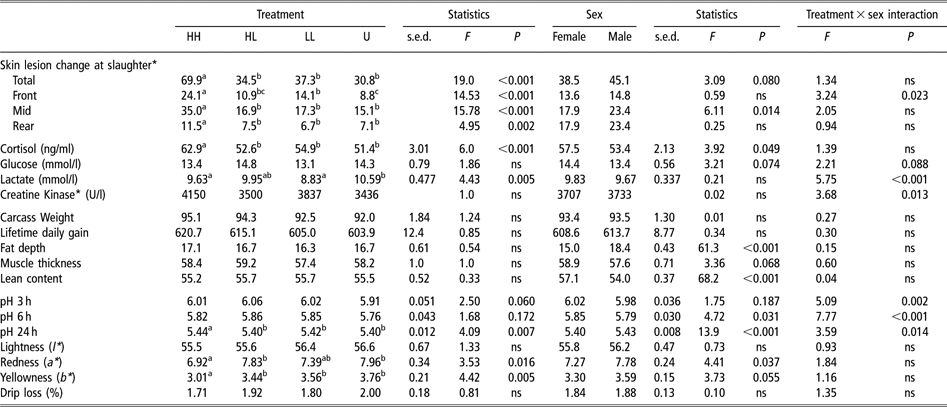
Predicted means of measured variables at slaughter relating to skin lesions, physiological stress, performance and carcass characteristics and meat quality, by treatment and sex for structured mix batches
ns = non-significant.
These were generated by a linear mixed model, which fitted treatment, sex and treatment × sex as fixed effects, and slaughter batch as a random effect.
s.e.d. = highest standard error of the difference between any two groups. Superscripted letters indicate where differences lie. Treatments sharing a letter do not differ from each other.
*Data for lesion change at slaughter and creatine kinase are back-transformed means (since these variables were Log10 transformed before analysis). s.e.d. cannot be shown for these.
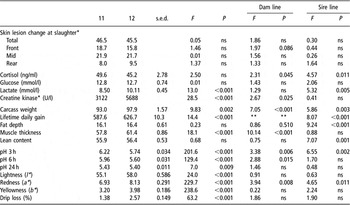
Predicted means of the effect of genotype on measured variables at slaughter relating to skin lesions, physiological stress, performance and carcass characteristics and meat quality in structured mix batches

ns = non-significant.
Statistics (F ratio and P-value) indicating significant effects of sire and dam line composition are also reported.
11 = homozygous resistant, 12 = heterozygous carrier. These were generated by a linear mixed model, which fitted treatment, dam line composition, sire line composition and as fixed effects and slaughter batch as a random effect. Treatment means and effects were similar to those shown in Table 2 so are not shown again here. s.e.d. = highest standard error of the difference between any two groups.
*Data for lesion change at slaughter and creatine kinase are back-transformed means (since these variables were log10 transformed). s.e.d. cannot be shown for these.
**This model failed to converge when dam line composition was included with slaughter batch as a random effect so this term was left out.
For data from the unstructured mix batches, we first investigated, which variables were associated with slaughter lesions. Using Pearson’s correlations, we looked for associations between carcass lesions and a number of possible predictors, including lesions from the balanced mix at 10 weeks of age, group size and proportion of unfamiliar pigs in the group in transport, and group size and proportion of unfamiliar pigs in the group at lairage (where familiarity was based on being in the same pen on the farm). In addition, we used linear mixed models to investigate the hypothesis that skin lesions would be associated with physiology, performance and carcass characteristics and meat quality at slaughter. Lesions (as a covariate), sex and their interaction were fitted as fixed effects, with slaughter batch as a random effect.
To look at the relationship between physiological stress parameters and measures of meat quality, data from structured and unstructured mixes were combined. Two approaches to analyzing this data were used: (i) physiological stress parameters in the blood plasma at slaughter were simply correlated with measures of meat quality using Pearson’s correlation coefficient. (ii) In addition, the effect of each physiological stress parameter on meat quality after adjusting for other factors affecting meat quality was modelled using linear mixed models. In a series of models, each meat quality measure was fitted as the response variate, with each physiological stress parameter in turn being fitted as the explanatory variate. Sex, sire and dam line composition and genotype were fitted as additional explanatory variates, but any or all of these were removed from the final model if their influence did not approach statistical significance (i.e. P < 0.1). Structured/unstructured type of mix was fitted as a fixed effect (but was never significant) and slaughter batch was fitted as a random effect.
Throughout the results, only effects, which are statistically significant at P < 0.05 are discussed unless clearly stated otherwise.
Results
Structured mixes – treatment effects
There was no difference between treatments in the number of pigs having the Nn genotype (χ 2 = 4.19, d.f. = 3, non-significant; HH 19/63, 30.2%; HL 12/61, 19.7%; LL 20/65, 30.8% and U 23/64, 35.9%).
Skin lesion change at slaughter
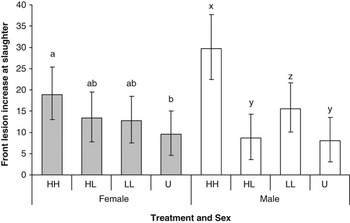
The pre-slaughter mixing treatment had a significant effect on skin lesion change at slaughter in all body locations and overall (Table 2), in that the HH treatment had more than the other mixed treatments (HL and LL) and the unmixed treatment (U). Additionally, front lesions were fewer in the U groups than in LL. Males had more ‘middle’ lesions than females. For front lesions, there was a sex by treatment interaction (Figure 1), the main feature of which was the greater number of lesions on male HH pigs.
Graph showing the mean increase in front lesions at slaughter (change from pre-transport lesion counts and carcass lesion counts) by sex and treatment. Pigs were mixed for transport and slaughter into groups of eight depending on their aggressiveness (defined as high, H or low, L based on skin lesions received in earlier mix). These groups contained 4H pigs mixed with 4H pigs from another group (HH), or 4H pigs mixed with 4L pigs (HL), or 4L pigs mixed with 4L pigs (LL) or were left unmixed (U). There was a significant main effect of mixing treatment (HH greater than all others, U lower than LL), and a significant sex × treatment interaction. Within treatment, there were no significant differences between the sexes with the exception of HH (P < 0.05). Treatment groups within sex, which have different letters (a, b, x, y, z) are significantly different at P < 0.05. Data shown are back-transformed from estimated means generated by a linear mixed model on Log10 transformed data, which also included slaughter batch as a random effect. Error bars show the 95% CIs, also back-transformed to the original scale.

Skin lesion change at slaughter was not significantly affected by dam and sire line composition or genotype (Table 3).
Physiological stress parameters at slaughter
Plasma cortisol levels were significantly higher in the HH pigs than the other treatments, and were also significantly higher in females (Table 2). Levels of lactate were significantly higher in unmixed pigs than in the HH and LL treatments, and showed a sex by treatment interaction: for males, levels of lactate were higher for unmixed pigs (11.4 mmol/l) than the other three treatments (HH = 9.1; HL = 9.0; and LL = 9.2 mmol/l), while for females, lactate levels were lower for LL pigs (8.4 mmol/l) than the other three treatments (HH = 10.2; HL = 10.9; U = 9.8 and s.e.d. = 0.67 mmol/l). There was also a sex by treatment interaction for CK: there were no treatment differences among females (HH = 4064, HL = 4315; LL = 3141 and U = 3428 U/l), but for males, levels of CK were lower for HL pigs (2845 U/l) than for LL (4699 U/l) and HH (4227 U/l) with U pigs having intermediate levels (3451 U/l).
When genetic effects were modelled, there were a number of effects on stress physiology (Table 3). Levels of cortisol were significantly affected by dam line composition, cortisol and lactate levels differed between sire lines, and heterozygous carriers of the susceptible genotype had higher levels of lactate and CK. After adjusting for genetic effects, CK showed a non-significant tendency to be lower in unmixed pigs than in HH or LL mixed pigs (HH = 4757, HL = 4226, LL = 4510 and U = 3484 U/l; F = 2.33, P = 0.075).
Carcass characteristics
Treatment did not affect carcass characteristics (Table 2). Males had greater fat depth and lower lean content than females. Dam line composition affected carcass weight and muscle thickness (Table 3). Sire line affected carcass weight, lifetime daily gain, fat depth and lean content. Heterozygous carriers of the susceptible allele at the locus had greater carcass weights, lifetime daily gain and muscle thickness than homozygous resistant pigs.
Meat quality
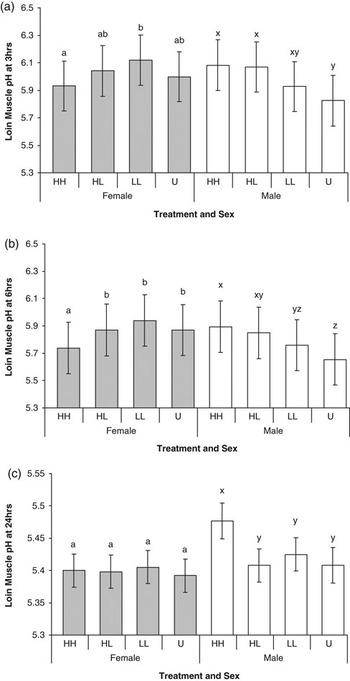
HH treatment pigs had meat with lower redness (a*), lower yellowness (b*) and higher pH at 24 h than other treatments (Table 2).
Results for pH at all time points were complicated by significant sex effects and sex by treatment interactions. Figure 2 shows predicted means for pH at 3, 6 and 24 h from linear mixed models. In females, pH at 3 and 6 h was generally lowest in the HH group but group differences are no longer evident by 24 h. In males, 3 and 6 h pH was highest in the HH and HL pigs, and lowest in U pigs, but by 24 h, the HH group had higher pH than all others. In fact, comparing all of the treatment and sex combinations, the HH males had higher pH at 24 h than all others. There was a main effect of sex on pH (Table 2). At 3 and 6 h, females had higher values, while at 24 h males had higher values, suggesting that pH fell more quickly in females.
Graphs showing predicted means of loin muscle pH by treatment and sex at (a) 3 h, (b) 6 h and (c) 24 h after slaughter. Predicted means were generated by a Linear Mixed Model, which fitted treatment, sex and treatment × sex as fixed effects, and slaughter batch as a random effect. Error bars indicate the 95% CIs. Treatments within each sex sharing a letter are not significantly different from each other at P < 0.05. HH = all high aggressiveness pigs mixed, HL = high aggressiveness pigs mixed with low aggressiveness pigs, LL = all low aggressiveness pigs mixed, U = unmixed (see Figure 1 legend).

Genotype affected a number of aspects of meat quality. The pH at 6 h was different depending on dam line composition, while pH at 3 h and redness differed depending on both dam and sire line composition (Table 3). All measured aspects of meat quality were significantly affected by the genotype. When compared with the homozygous resistant pigs, heterozygous carriers of the susceptible allele had lower pH at all time points, lighter, redder and yellower meat, and higher drip loss (Table 3).
Unstructured mixes
Causes of skin lesions
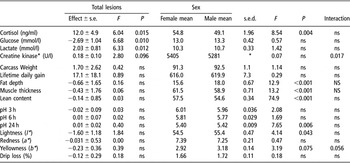
In the unstructured mix batches, skin lesions on the carcass at slaughter (in any body location or in total) were not associated with pig temperament (as measured by skin lesion change in any body region or the total at the balanced mixing at 10 weeks). Total skin lesions at slaughter were also not associated with group size at transport or with the proportion of unfamiliar pigs in the group at transport. Pigs in large groups at transport had more mid lesions (r = 0.125, P = 0.049) but fewer rear lesions (r = −0.158, P = 0.013). Pigs in large groups at lairage had more lesions in total (r = 0.125, P = 0.048), and particularly at the rear (r = 0.306, P < 0.001), and pigs with a greater proportion of unfamiliar pigs in the group at lairage had more lesions in total (r = 0.139, P = 0.028) and in the middle of their body (r = 0.149, P = 0.018). These correlations, although significant were very weak, with the exception of the relationship between lairage group size and rear lesions. In unstructured mixes, it appears that neither the measures of pig temperament we used, nor descriptions of the mixing situation were good predictors of skin lesions at slaughter.
Skin lesions as predictors of physiological stress parameters and meat quality
Levels of cortisol and lactate in blood plasma at slaughter were significantly higher, and levels of glucose significantly lower in pigs with more lesions in total (Table 4). Plama CK levels showed a non-significant tendency to be higher for pigs with more lesions. There was no statistically significant relationship between total lesions and any other variable. Sex significantly affected several variables (Table 4): females had higher levels of cortisol, muscle thickness and lean content, but lower fat depth, pH at 24 h and meat lightness (l*).
Effects of total skin lesions and sex on physiological stress parameters, performance and meat quality in the unstructured mix batches

ns = non-significant.
Results were generated by using REML to fit linear mixed models, fitting total lesions, sex and their interaction as fixed effects and batch as a random effect. Interaction terms were not significant, so were dropped from the models. Estimated effects ± s.e. are given for the effect of skin lesions, and means are given for sex effects.
Relationships between physiological stress parameters and meat quality for all pigs
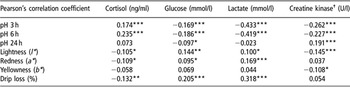
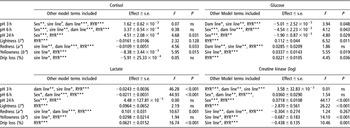
Physiological parameters indicative of stress at slaughter showed a number of associations with meat quality. Higher levels of plasma cortisol at slaughter were significantly associated with higher pH at 3 and 6 h, lower lightness and redness of meat and lower drip loss, but all correlations were very weak (Table 5). When other factors affecting meat quality were included in a linear mixed model, the ability of cortisol to explain the remaining variation in meat quality was different: High cortisol was associated with higher pH at 24 h, and lower redness and yellowness of meat (Table 6).
Correlation matrix for all pigs showing the relationship between physiological stress parameters at slaughter and meat quality measures

*P < 0.05, **P < 0.01, ***P < 0.001.
†Creatine kinase data were log transformed before analysis.
For all pigs, effect of physiological stress parameters at slaughter (cortisol, glucose, lactate and creatine kinase) on meat quality variables, estimated fitting linear mixed models by REML

RYR = ryanodine receptor 1; ns = non-significant.
Structured/unstructured was fitted as a fixed effect, slaughter batch as a random effect. Sex, dam line composition, sire line composition and genotype were fitted and then dropped from the model if not significant or almost significant (P < 0.1).
Significance for other fitted model terms is indicated by †P < 0.1, *P < 0.05, **P < 0.01, ***P < 0.001.
Levels of plasma glucose at slaughter were significantly but weakly associated with a number of meat quality variables. It was negatively associated with pH at all time points, and positively associated with lightness, redness and drip loss (Table 5). These relationships were also found after other factors affecting meat quality were fitted to a linear mixed model, except that there is now a significant positive relationship between glucose and yellowness of meat rather than redness, and a significant positive association with drip loss was found (Table 6).
Levels of plasma lactate at slaughter were significantly and moderately correlated with three meat quality variables: high levels of lactate were associated with low pH at 3 and 6 h and with high drip loss. There were weak but significant positive associations between lactate levels and meat lightness and redness (Table 5). After other factors affecting meat quality were fitted, these relationships remained except for the link between lactate levels and meat lightness (Table 6).
Plasma CK levels were weakly associated with low pH at 3 and 6 h, a high pH at 24 h and meat, which had low lightness and low yellowness. After other factors affecting meat quality were fitted to the model, higher levels of CK were associated with higher pH at 24 h, lower lightness, lower yellowness and lower drip loss (Table 6).
Discussion
In structured mixes, mixing groups of pigs rather than not mixing them had surprisingly little effect on skin lesions or indeed on any measured variable. This may reflect the fact that moving animals to a new environment (the transport truck and then the lairage) may provoke some aggression even among familiar animals (Barton Gade, Reference Barton Gade2008), possibly because of the effect of stress on social memory (Held et al., Reference Held, Mendl, Laughlin and Byrne2002).
When pigs of above average aggressiveness (HH) were mixed, however, this resulted in greater numbers of skin lesions in all locations at slaughter than the other three treatments (this was particularly true of males). Although designated as ‘H’ these pigs were not unusually aggressive, they simply represented the upper half of the normal range. Groups consisting mainly of pigs of above average aggressiveness would be quite likely to be formed by chance. Damage caused by fighting can result in an economic loss for producers due to carcass downgradings (Faucitano, Reference Faucitano2001). Prediction of pre-slaughter mixing behaviour by observations of earlier aggression on farm was previously reported by (Terlouw et al., Reference Terlouw, Porcher and Fernandez2005). Other on-farm studies have suggested that aggressive temperament in pigs is stable over periods of months (Janczak et al., Reference Janczak, Pedersen and Bakken2003; D’Eath, Reference D’Eath2004). In contrast, in the unstructured mixes, pig temperament (measured by the earlier response to mixing) was not predictive of skin lesions at slaughter. Apparently, under the commercial-style unstructured mix conditions; the effect of pig temperament on aggression was lessened by situational factors that we did not control. Of these, group size and proportion of unfamiliar pigs in the group at lairage showed a weak association with skin lesions at slaughter, although most of the variation in skin lesions remains unexplained.
We used four different measures of physiological stress, which each reflect different aspects of physical and psychological stress. These physiological measures are influenced by several factors such as stress intensity (transport time, Brown et al., Reference Brown, Knowles, Edwards and Warriss1999a; Perez et al., Reference Perez, Palacio, Santolaria, Acena, Chacon, Gascon, Calvo, Zaragoza, Beltran and Garcia-Belenguer2002a and Reference Perez, Palacio, Santolaria, Acena, Chacon, Verde, Calvo, Zaragoza, Gascon and Garcia-Belenguer2002b; lairage time, Warriss et al., Reference Warriss, Brown, Edwards and Knowles1998a) and genetics (Perez et al., Reference Perez, Palacio, Santolaria, Acena, Chacon, Gascon, Calvo, Zaragoza, Beltran and Garcia-Belenguer2002a; Foury et al., Reference Foury, Geverink, Gil, Gispert, Hortos, Furnols, Carrion, Blott, Plastow and Mormede2007).
In line with previous studies (Warriss and Brown, Reference Warriss and Brown1985; Fernandez et al., Reference Fernandez, Meunier-Salaün and Mormède1994; Gispert et al., Reference Gispert, Faucitano, Oliver, Guardia, Coll, Siggens, Harvey and Diestre2000; Terlouw et al., Reference Terlouw, Porcher and Fernandez2005), high levels of plasma cortisol at slaughter were linked with high levels of aggression: cortisol was higher in the HH treatment (which had the highest lesions), and was also positively associated with the total number of skin lesions among the unstructured mix pigs. Cortisol levels when pigs are mixed reflect the psychological stress of encountering unfamiliar animals and of aggressive behaviour as well as increased physical activity.
Glucose was unaffected by treatment in the structured mixes, but was negatively correlated with total lesions in unstructured mixes. This was unexpected, contrasting with earlier findings showing an increase in plasma glucose associated with fighting (Fernandez et al., Reference Fernandez, Meunier-Salaün and Mormède1994) or with skin lesions (Warriss and Brown, Reference Warriss and Brown1985). This decrease of plasma glucose may reflect the exhaustion of glycogenic stores at the time of slaughter, due to the combination of social encounters and food restriction.
CK is a muscular intracellular enzyme, which indicates muscle damage resulting from high levels of physical activity (Warriss et al., Reference Warriss, Brown, Knowles, Edwards, Kettlewell and Guise1998c; Perez et al., Reference Perez, Palacio, Santolaria, Acena, Chacon, Gascon, Calvo, Zaragoza, Beltran and Garcia-Belenguer2002a and Reference Perez, Palacio, Santolaria, Acena, Chacon, Verde, Calvo, Zaragoza, Gascon and Garcia-Belenguer2002b; Foury et al., Reference Foury, Geverink, Gil, Gispert, Hortos, Furnols, Carrion, Blott, Plastow and Mormede2007). CK showed a non-significant tendency (P = 0.075) to be lower in unmixed pigs than mixed pigs in the structured mixes and also showed a non-significant tendency (P = 0.096) to increase with the number of lesions in unstructured mix pigs. While not statistically significant, these findings are in line with reported positive associations between CK and aggression indicated by skin damage (Warriss et al., Reference Warriss, Brown, Gade, Santos, Costa, Lambooij and Geers1998b; Gispert et al., Reference Gispert, Faucitano, Oliver, Guardia, Coll, Siggens, Harvey and Diestre2000) and higher levels of CK in mixed than unmixed groups (Barton Gade, Reference Barton Gade2008).
Meat quality can be affected by stress pre-slaughter. Stress over a prolonged period can result of the depletion of muscle glycogen resulting from physical exercise (Warriss and Brown, Reference Warriss and Brown1985; Terlouw et al., Reference Terlouw, Porcher and Fernandez2005), which can be exacerbated by psychological stress resulting in increased catecholamine secretion (Fernandez et al., Reference Fernandez, Meunier-Salaün and Mormède1994). Glycogen breakdown results in post-mortem acidification of the meat (Fernandez and Tornberg, Reference Fernandez and Tornberg1991), so its absence results in meat with a higher ultimate pH, and in extreme cases this process can result in dark firm dry (DFD) meat.
Our finding that the HH group (which had greater numbers of skin lesions presumably resulting from aggressive behaviour during transport and lairage) had higher meat pH after 24 h corresponds with a number of previous studies (Warriss and Brown, Reference Warriss and Brown1985; Fernandez et al., Reference Fernandez, Meunier-Salaün and Mormède1994; D’Souza et al., Reference D’Souza, Dunshea, Leury and Warner1999; Terlouw et al., Reference Terlouw, Porcher and Fernandez2005; Terlouw and Rybarczyk, Reference Terlouw and Rybarczyk2008). A significant sex by treatment interaction for pH at 24 h was characterized by male HH pigs having higher pH than all others. Since the male HH pigs also had the highest lesions at the front (known to result from fighting, Turner et al., Reference Turner, Roehe, D’Eath, Ison, Farish, Jack, Lundeheim, Rydhmer and Lawrence2009), this finding is consistent (compare Figures 1 and 2c). Other authors have noted the effect of mixing-induced aggression pre-slaughter are more pronounced in males (Brown et al., Reference Brown, Knowles, Edwards and Warriss1999b).
As well as elevated pH, low levels of muscle glycogen reserves pre-slaughter can result in meat having a darker colour (lower l*, a* and b* values) and lower drip loss (Terlouw et al., Reference Terlouw, Porcher and Fernandez2005), and lead to an increased risk of DFD meat. A number of other studies (Warriss and Brown, Reference Warriss and Brown1985; D’Souza et al., Reference D’Souza, Dunshea, Leury and Warner1999; Gispert et al., Reference Gispert, Faucitano, Oliver, Guardia, Coll, Siggens, Harvey and Diestre2000) have found that aggression or skin lesions were associated with the prevalence of DFD meat. In this study, HH pigs had numerically the lowest values for drip loss and lightness (l*) but these were not significant. However, redness (a*) and yellowness (b*) were significantly lower in the HH pigs. Taken together with changes in pH at 24 h, HH pigs showed a number of changes in their meat in the direction of DFD meat, however, DFD meat was not a problem in our study.
Unexpectedly, in unstructured mixes, there were no relationships between skin lesions at slaughter and any measure of meat quality, unlike in various published studies (Warriss and Brown, Reference Warriss and Brown1985; D’Souza et al., Reference D’Souza, Dunshea, Leury and Warner1999; Gispert et al., Reference Gispert, Faucitano, Oliver, Guardia, Coll, Siggens, Harvey and Diestre2000). However, this aspect of our study took place under commercial conditions where other (unmeasured) factors influence any relationship between aggression and meat quality.
Increased muscle metabolic activity at the moment of slaughter can result in pale, soft, exudative (PSE) meat, characterized by a rapid early fall in pH. Corresponding with this, we found that overall, low pH at 3 and 6 h after slaughter were strongly correlated with high lactate (Hambrecht et al., Reference Hambrecht, Eissen, Nooijen, Ducro, Smits, den Hartog and Verstegen2004). High lactate levels in blood plasma correspond with high levels in muscle (Hambrecht et al., Reference Hambrecht, Eissen, Newman, Smits, den Hartog and Verstegen2005). Lactate is an acute indicator of stress rising rapidly in response to stressful events (Warriss et al., Reference Warriss, Brown, Edwards and Knowles1998a), and plasma lactate at slaughter is elevated by stressful events immediately such as rough handling (Hemsworth et al., Reference Hemsworth, Barnett, Hofmeyr, Coleman, Dowling and Boyce2002; Hambrecht et al., Reference Hambrecht, Eissen, Newman, Smits, den Hartog and Verstegen2005). Lactate can increase during aggressive behaviour in response to physical exercise and catecholamine release (Warriss and Brown, Reference Warriss and Brown1985; Fernandez et al., Reference Fernandez, Meunier-Salaün and Mormède1994) and in one study lactate was associated with more skin lesions at slaughter (Gispert et al., Reference Gispert, Faucitano, Oliver, Guardia, Coll, Siggens, Harvey and Diestre2000).
In our study there was a marked sex by treatment interaction in both lactate and in early pH (at 3 and 6 h). Lactate was higher and pH was lower in mixed females than in unmixed (consistent with earlier reports that skin damage is associated with low early pH, Warriss et al., Reference Warriss, Brown, Gade, Santos, Costa, Lambooij and Geers1998b). In males, the opposite was found: lactate was lower and early pH higher in mixed than in unmixed. It is possible that these differences may relate in some way to different timing of stressful events in the different sex groups. In the unstructured mixes, high plasma lactate at slaughter was associated with more skin lesions, possibly because aggression could continue right up until slaughter in unstructured mixes in which pigs were re-mixed on arriving at lairage.
The well known effects of (Pommier et al., Reference Pommier, Pomar and Godbout1998; Perez et al., Reference Perez, Palacio, Santolaria, Acena, Chacon, Gascon, Calvo, Zaragoza, Beltran and Garcia-Belenguer2002a) were replicated here. When heterozygous carriers were compared with resistant animals, they had superior performance as indicated by higher lifetime daily gain and carcass weight and greater muscle thickness, but also had higher levels of lactate (an acute stress measure) at slaughter. Lactate is an indicator of glycogen breakdown, which occurs faster in Nn pigs due to higher intracellular calcium levels. The effect of genotype on meat quality were also as expected, with carriers having characteristics linked with PSE meat: the meat appeared lighter, and also more red and yellow in colour, with higher drip loss and lower pH at all time points.
There were effects of the genetic line of pigs on a wide variety of measured variables, with both dam and sire line composition affecting lifetime daily gain and carcass weight, pH at 3 h and redness. Dam line composition affected muscle depth, while sire line affected fat depth. These differences very likely reflect the different selection pressures placed on these different lines by the breeding company. Sex also had widespread effects on most measures in both structured and unstructured mixes, affecting skin lesions, cortisol, fat depth, lean content and meat pH and colour.
Conclusions
Under controlled conditions, mixing pigs of above average aggressiveness was unexpectedly a more important determinant of aggression, stress and meat quality than mixing pigs, reinforcing the value of the concept of animal temperament. Avoiding mixing at transport and lairage would be a valuable way to improve animal welfare, and would result in less carcass damage (which can carry an economic penalty for the producer). Taking our results together with other findings, it may also result in improved meat quality. Although in our study, direct effects of aggression on meat quality under uncontrolled ‘commercially normal’ conditions could not be detected due to extraneous intervening variables. Other than avoiding mixing, genetic selection to reduce aggressiveness (Turner et al., Reference Turner, Roehe, D’Eath, Ison, Farish, Jack, Lundeheim, Rydhmer and Lawrence2009) might have a more general affect, reducing mixing aggression and stress throughout life.
Although we saw some changes in muscle chemistry associated with acute and chronic stress, neither PSE nor DFD meat were a problem in our study. Optimizing meat quality can be a careful balancing act. From a commercial perspective, some depletion of glycogen reserves pre-slaughter is desirable as it can result in a reduced risk of PSE (but an increased risk of DFD if taken too far Warriss et al., Reference Warriss, Brown, Edwards and Knowles1998a). However, an appropriate time spent in lairage is perhaps a more consistent way to achieve this than mixing pigs (Fernandez and Tornberg, Reference Fernandez and Tornberg1991; Warriss et al., Reference Warriss, Brown, Edwards and Knowles1998a).
Acknowledgements
This study was part-funded by sixth Research Framework Programme of the European Union European Commission as part of the SABRE (Cutting-Edge Genomics for Sustainable Animal Breeding) Integrated Project. SAC matched funding was provided by the Rural and Environment Research and Analysis Directorate of the Scottish Government. PIC, FBN and INRA provided their own matched funding. Peter Andresen kindly allowed us to use his pigs and farm.