Introduction
Eastern Europe, in the past five decades, has seen relatively little in terms of terrorist attacks. The recent Russian invasion of Ukraine has, however, placed a new spotlight on the region and new questions and concerns about conflicts, insurgencies, terrorism, and war are being posed. Reference Gannon, Gartzke, Lindsay and Schram1
The 2020 Global Terrorism Index (GTI), a ranking system of nations according to terrorist activity, ranked two Eastern European countries into the “medium” terrorism impact zone: Ukraine (36th) and Russia (39th). 2 The remaining countries were either ranked into the “very low” or “no impact” zone. The emerging field of Counter-Terrorism Medicine (CTM) studies and discusses the health impacts associated with global mitigation, preparedness, and response to intentional man-made attacks. Reference Tin, Hart and Ciottone3 It also includes analyses of terrorist attacks within specific world regions to allow region-specific counter-terrorism strategies. Reference Tin, Barten, De Cauwer, Mortelmans and Ciottone4
This study provides an epidemiological description of all terrorism-related fatalities and injuries in Eastern Europe sustained from 1970 – 2019. These data are deemed essential for improvement in the mitigation of and preparedness for terrorist attacks in Eastern Europe.
Methods
Data collection was performed using a retrospective database search through the Global Terrorism Database (GTD). This database is open-access with publicly available data collection methodology utilizing artificial intelligence that identifies events from news media around the world on a daily basis and is confirmed by human evaluation of the events by the National Consortium for the Study of Terrorism and Responses to Terrorism (College Park, Maryland USA). The GTD defines terrorist attacks as: “The threatened or actual use of illegal force and violence by a non-state actor to attain a political, economic, religious, or social goal through fear, coercion, or intimidation.” The GTD database does not include acts of state terrorism. The GTD contains no personal identifiers for victims and links specific events to open-source news articles.
The GTD was searched using the internal database search functions for all events which occurred in Eastern Europe from January 1, 1970 - December 31, 2019. Years 2020 and 2021 were not yet available at the time of the study. Countries classified under Eastern Europe by the GTD for the study period include: Albania, Belarus, Bosnia- Herzegovina, Bulgaria, Croatia, Czechoslovakia, Czech Republic, East Germany, Estonia, Hungary, Kosovo, Latvia, Lithuania, Macedonia, Moldova, Montenegro, Poland, Romania, Russia, Serbia, Serbia- Montenegro, Slovak Republic, Slovenia, Soviet Union, Ukraine, and Yugoslavia. Primary weapon type, primary target type, country where the incident occurred, and number of total deaths and injuries were collated.
Results were exported into an Excel spreadsheet (Microsoft Corp.; Redmond, Washington USA) for analysis. Ambiguous events (this field is only systematically available with incidents occurring after 1997) were excluded when there was uncertainty as to whether the incident met any of the criteria for GTD inclusion as a terrorist incident. Attacks met inclusion criteria if they fulfilled the following three terrorism-related criteria, as set by the GTD.
These criteria are determined within the database and not by the authors:
-
- Criterion I: The act must be aimed at attaining a political, economic, religious, or social goal.
-
- Criterion II: There must be evidence of an intention to coerce, intimidate, or convey some other message to a larger audience (or audiences) than the immediate victims.
-
- Criterion III: The action must be outside the context of legitimate warfare activities (ie, the act must be outside the parameters permitted by international humanitarian law, particularly the admonition against deliberately targeting civilians or non-combatants).
Results
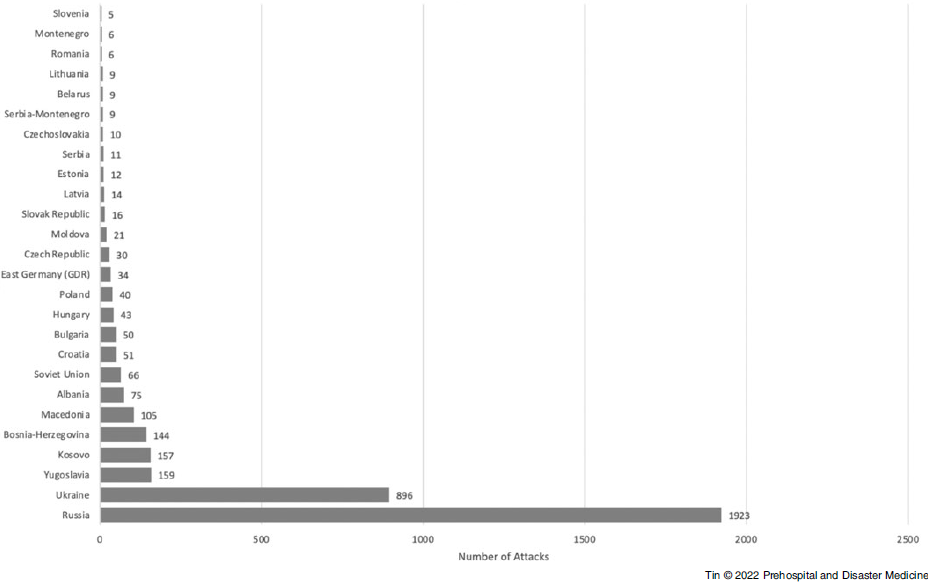
In total, 3,901 terrorist attacks were identified in the study period inflicting 5,391 deaths and wounding 9,538 persons. This equated to 1.38 deaths and 2.45 injuries per event. Of all attacks in that region, 49.3% occurred in Russia and 23.0% of attacks occurred in Ukraine (Figure 1).
Attacks by Country (Eastern Europe 1970-2019).

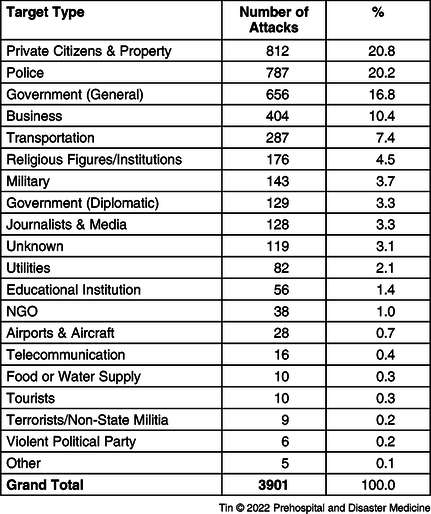
Private citizens and property were targeted in 20.8% of attacks, closely followed by police as targets in 20.2% (Table 1).
Breakdown of Attacks by Target Type

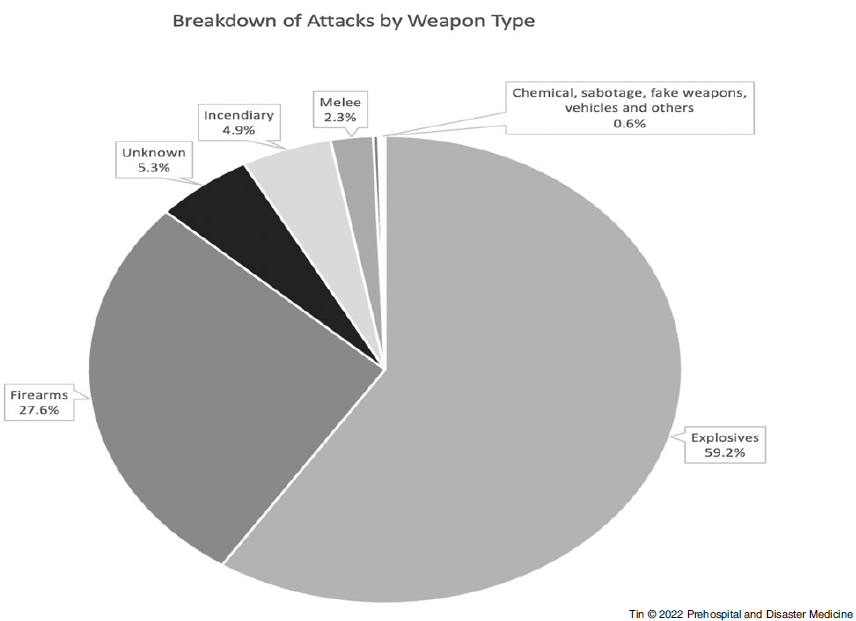
Explosives were the most commonly used weapon types in 59.2% of all attacks in the region, followed by firearms in 27.6% (Figure 2).
Breakdown of Attacks by Weapon Type.

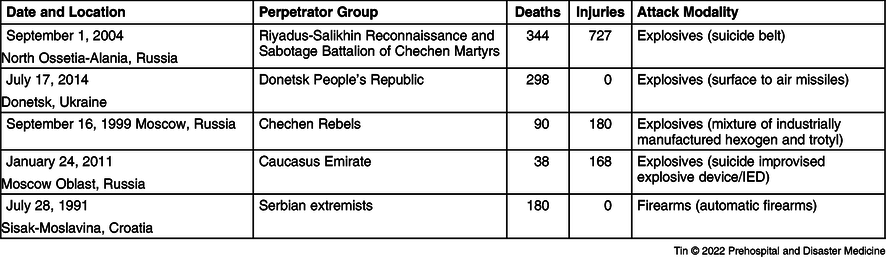
The highest casualty toll attributed to a single terrorism event was recorded in Russia in 2004: 344 died and 727 were injured after a group of 30+ Chechen and Ingush rebels armed with suicide bomber belts seized a school in Beslan, holding 1,200 children, parents, and teachers hostage in the school gym. The 2014 downing of a Malaysian Airlines aircraft MH17 over Ukraine by a surface-to-air missile inflicted the second highest terrorism-related casualty toll in the region with 298 deaths (Table 2).
Top 5 Highest Casualty Tolls

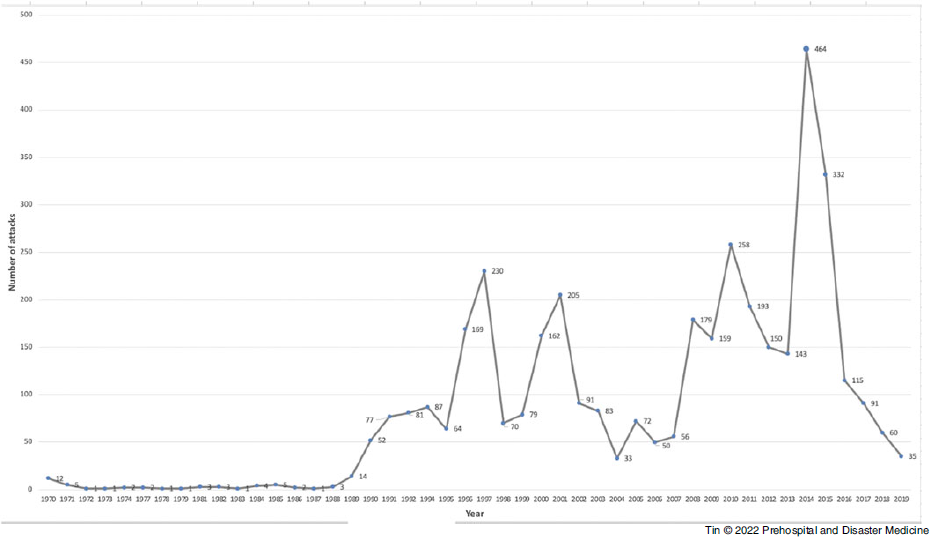
Terrorist attacks sharply declined since the peak in 2014, but there has been an overall uptrend of attacks since the 1970s (Figure 3).
Number of Total Attacks in Eastern Europe, by Year (1970-2019).

Discussion
Eastern Europe is the world region that is intertwined between Western Europe and Central Asia. The Byzantine cultural influence and the Eastern Orthodox church have played a prominent role in its history. In fact, the East-West schism in 1054ad resulted in cultural unity and resistance of the Orthodox East to the Catholic (and later also Protestant) West, which dominated Europe for many centuries. Reference Okey5,Reference Bideleux and Jeffries6
After the Second World War (1939-1945), Eastern Europe was delineated as European countries liberated from Nazi Germany and then occupied by the Soviet army. All the countries in Eastern Europe adopted communist modes of control by 1948. The geopolitical tensions between the United States, Russia, and their respective allies eventually resulted in the Cold War, which lasted more than four decades. Although the Cold War ended in the late 1980s, the troubled aftermath continues today. Reference Okey5,7 The breakdown of state control in a number of areas formerly ruled by communist governments produced new civil and ethnic conflicts. Of these, the Chechen wars, Yugoslav wars, Dagestan war, and the on-going Russo-Ukrainian war are among the most important post-Soviet conflicts. Reference Mykhenko8–Reference Käihkö10
Amidst the military conflict and political turmoil currently engulfing Eastern Europe, the region has also been heavily affected by the COVID-19 pandemic: the reluctance to get vaccinated is relatively high, and its health care systems were already highly vulnerable pre-pandemic. As of December 2021, coronavirus deaths in Eastern Europe topped over one million, pushing health care systems in the region to the brink of failure with documented infrastructure breakdowns (such as increased incidences of hospital fires due to outdated infrastructure and increased oxygen requirements) as well as staffing shortages and burnout. Reference Wood, Hailwood and Koutelos11–Reference Than and Lopatka13 This raises concerns over the surge capacities of Eastern European health care institutions against terrorist events, acts of extremist violence, and renewed regional conflicts.
Compared to world-wide attack methodologies, the use of explosives as a primary attack modality was relatively high in Eastern Europe (59.2% in Eastern Europe versus 48.8% Global), while firearm use was similar (27.6% versus 26.77%). Reference Tin, Margus and Ciottone14 Although the majority of perpetrators of terrorist attacks were listed by the GTD as “unknown” in Eastern Europe, six percent were attributed to Chechen rebels. Of note, the Beslan school siege, the event with the highest death and injury toll in this analysis, was also perpetrated by Chechen rebels. The first and second Chechen war occurred from 1991-1996 and 1999-2009, respectively, coinciding with the first three peaks of incidence frequency in Figure 3. Reference Askerov, Brooks and Tchantouridze15
The fourth peak coincides with the onset of the on-going Russo-Ukrainian war. A high-profile attack which caught the attention of international media during this latter conflict was the downing of Malaysian Airlines flight MH17, the deadliest airliner shoot-down incident to date. Reference Tharoor16,Reference Sengupta and Kramer17
Attacks on health care institutions, though historically rare, remain a focal point of discussion amongst CTM specialists. Reference Cavaliere, Alfalasi, Jasani, Ciottone and Lawner18 Previous studies found four terrorist attacks against Emergency Medical Services (EMS) in Eastern Europe from 1970 through 2019 (two percent of 184 world-wide attacks) and 13 terrorist attacks against hospitals in the region (three percent of 454 world-wide attacks). Reference Ulmer, Barten and De Cauwer19,Reference Schmeitz, Barten and van Barneveld20 During the Russo-Ukrainian war, over one-third of the hospitals and clinics in the Donbas region of Ukraine had been damaged or destroyed from early 2014 through 2017. Reference Buckley, Clem and Herron21
Chechen separatists’ suicide bombing attacks in 2010 on Moscow’s transport system, a combination that is particularly lethal, ISIL’s 2017 St Petersburg Metro bombing, and the escalation of the Russo-Ukrainian conflict in early 2022 are all causes for concern for modern-day Russia and the surrounding region’s health care systems. Reference Tin, Barten, Cauwer and Ciottone22
The potential impacts of cyberattacks are of particular concern. In 2017, the global NotPetya cyberattack primarily targeted Ukraine and impacted numerous companies and institutions, including multiple Ukrainian and US hospitals, US pharmaceutical company Merck, and a Ukrainian nuclear powerplant. Reference Hattersley-Gray23 Though more research is needed, there is increasing evidence ransomware attacks on hospital systems are elevating mortality rates. 24
On January 14, 2022, a cyberattack took down several of Ukraine’s government websites, including the State Emergency Services, the body tasked with carrying out state policy in the sphere of protection of population and territory in emergency situations, and emergency prevention and response. Reference Lapatina25
Limitations
The GTD is a comprehensive record of documented global terrorist events. It is maintained by the National Consortium for the Study of Terrorism and Responses to Terrorism and is the basis for other terrorism-related measures, such as the GTI. Reliance wholly on the GTD is partially mitigated by confirmation with other lay sources, and searches for other online searches, but if there are incidents not reported in the GTD, this could limit the accuracy of the findings. Using pre-existing databases such as the GTD as a data source also inherently introduces potential challenges such as miscoding errors or data entry errors. Furthermore, the lack of a universally agreed-upon definition of the term terrorism can create inconsistencies between databases in the labelling of such events. Clear and detailed documentation of terrorist events is further hindered by restrictions on reporting, the lack of independent corroboration, and the lack of transparency within certain government sources. Infrastructure needed to report, detect, and investigate terrorism events is lacking in many parts of the world leading to potential under-reporting of events. Even today, censorship is wide-spread in Russia, ranking 150 out of 180 countries in the 2021 Press Freedom Index. 26 Other low-ranking countries include Belarus (158) and Bulgaria (112).
In 2012, Arnold, et al proposed what they termed a broader “universal and public” definition of terrorism: “The intentional use of violence, real or threatened, against one or more non-combatants and/or those services essential for or protective of their health, resulting in adverse health effects in those immediately affected and their community, ranging from a loss of well-being or security to injury, illness, or death.” Reference Arnold, Ortenwall and Birnbaum27
With the rise of non-state armed groups resorting to acts of terrorism, the International Committee of the Red Cross (ICRC; Geneva, Switzerland) emphasizes “a crucial difference, in legal terms, exists in that armed conflict is a situation in which certain acts of violence are considered lawful and others unlawful, while any act of violence designated as ‘terrorist’ is always unlawful.” 28 Terrorism not only violates international humanitarian law, it can also have devastating impacts on communities and individuals. The United Nations General Assembly, 76th Session in October 2021 affirmed “the importance of seeking concrete solutions to mitigate the rise in terrorism, but also recognized its ability to impeded established humanitarian action, such a medical activities and engagement with all humanitarian actors.” 29
Conclusion
From 1970 through 2019, 1.94% of all terrorist attacks occurred in Eastern Europe, inflicting a total of 5,391 deaths and 9,538 injuries. Of these, 72.3% occurred in Russia and Ukraine. Terrorist attacks sharply declined since the peak in 2014, but there is an overall uptrend of attacks since the 1970s. Compared to global trends of attack methodologies in the same study period, the incident use of explosives as a primary attack modality was relatively high (59.2% in Eastern Europe versus 48.8% Global). Firearm use was similar (27.6% versus 26.77%).
Conflicts of interest
The authors declare no conflict of interest.