1 Introduction
Schwa ([ə]) has been traditionally characterized as a mid central vowel exhibiting a neutral, targetless vocal tract configuration and thus no well-defined lingual constriction (Heffner Reference Heffner1950: 107–108; Kenyon Reference Kenyon1950: 201–202, and see more recent studies in the next paragraph). In accordance with this phonetic characterization, phonological accounts view this vowel as featureless (Oostendorp Reference Oostendorp1995). In acoustic theory of speech production studies, schwa has been modeled by a uniform vocal tract cross-sectional area, which results into a spectrum envelope with intensity peaks at 500 Hz, 1500 Hz and 2500 Hz and, therefore, F1 and F2 frequencies located somewhere around the center of the vowel space (Fant Reference Fant1960, Stevens Reference Stevens2000). Moreover, schwa is generally associated with the unstressed syllable position and emerges through a diachronic process called vowel reduction (Crosswhite Reference Crosswhite2001, Silverman Reference Silverman, Marc, Ewen, Hume and Keren2011). When unstressed, peripheral vowels are reduced (mostly in specific conditions such as in colloquial and fast speech), and, thus, shorten and fail to achieve their characteristic lingual or labial constriction target. At a first stage of the phonetic vowel reduction process, articulatory undershoot causes the vowel formant frequencies to drive towards the center of the vowel space; the resulting spectral change may be larger or smaller depending on factors such as peripheral vowel phoneme, consonantal context, rate of speech, word class and frequency of occurrence, and speaker (see e.g. van Bergem & Koopmans-van Beinum Reference Bergem and Koopmans-van Beinum1989 and van Bergem Reference Bergem1993 for Dutch, Koopmans-van Beinum Reference Koopmans-van1992, and Mooshammer & Geng Reference Mooshammer and Geng2008 for German). At a later stage, vowel reduction becomes phonologized such that reduced vowels of variable quality turn to a single mid central vowel which, therefore, differs categorically from the quality of the vowels intended by the speaker. As a result of this sound change, the phonological contrast between two or more vowel phonemes is neutralized into a mid central vowel, as in Eastern Catalan where /e ɛ a/ reduce systematically to [ə] in unstressed position and therefore tonic monosyllabic nominal roots such as /mez/ ‘month’, /pɛz/ ‘weight’ and /pas/ ‘footstep’ are realized with schwa when stress is shifted to the tonic suffix /ɛt/ in the derived words [məˈzɛt] ‘little month’, [pəˈzɛt] ‘little weight’ and [pəˈsɛt] ‘little footstep’. Unstressed schwa should not be considered to be the outcome of vowel reduction when it does not alternate with one or more stressed vowels, as in the case of the Catalan words [əˈi] ‘yesterday’ and [dəˈma] ‘tomorrow’.
Phonetic data on unstressed schwa reveal much consonant-dependent variability in the second formant (F2), which may extend from frequencies close to those for back rounded vowels to the ones for front vowels, and a less variable F1, which exhibits typically the frequency range of a mid vowel (English: Kondo Reference Kondo1994, Flemming Reference Flemming and Donka2009; Dutch: Koopmans van Beinum Reference Koopmans-van1992, van Bergem Reference Bergem1994; Majorcan Catalan: Recasens & Espinosa Reference Recasens and Espinosa2006a). A high degree of sensitivity to the consonantal coarticulatory effects is consistent with this vowel being especially short and with the undershoot process referred to above. In view of the large degree of variability involved, schwa has been considered to have no target at all (Bates Reference Bates1995), or else to exhibit a weak mid vowel target, which is consistent with this vowel’s relative stability regarding F1 and thus oral opening degree (Browman & Goldstein Reference Browman, Goldstein, Robert and Gerard1992, Kondo Reference Kondo1994). Also in apparent support of the weak target option, available X-ray data reveal the presence of some postdorsal narrowing for unstressed schwa in Bulgarian (Tilkov Reference Tilkov1970) and English (Gick Reference Gick2002, Gick et al. Reference Gick, Min Kang and Whalen2002, McDougall Reference McDougall, Sallyanne and Marija2003).
The present study deals with several aspects about schwa occurring in stressed syllables in languages that have stress (including languages that have stress and tone), i.e. languages in which schwa does not result or fails to result from a stress-dependent reduction process. In tone languages (as found, for example, in the Bantu, Chadic, Niger-Congo, Sino-Tibetan and Tai-Kadai language families), syllables have an inherent pitch contour which may be used for distinguishing words with the same segmental characteristics, and differs from the attributes of stress, which are not only fundamental frequency but segmental duration and intensity as well (Eady Reference Eady1982). Regarding the term for naming the vowel of interest, and based on several considerations made so far, ‘full schwa’ will be preferred to other terms throughout this study, namely, ‘stressed schwa’, which may only be used for languages which have stress, and ‘unreduced schwa’, which is problematic since it may also apply to instances of unstressed schwa not generated through vowel reduction.
In principle, a stressed or prominent syllable is a relatively unnatural site for schwa to occur. Indeed, the availability of unstressed schwa to the exclusion of stressed schwa is widespread in the world’s languages, as exemplified by languages and dialects as diverse as Eastern Landais Gascon (Ronjat Reference Ronjat1930–1941), Gheg Albanian (Demiraj Reference Demiraj, Giacalone and Paolo1998: 612–613), Montana Salish and Coeur d’Alene (Flemming et al. Reference Flemming, Peter and Thomason2008) and Armenian (Dum-Tragut Reference Dum-Tragut2009). The fact, however, is that schwa may also be found in stressed position as any other stressed vowel, as exemplified by Balearic Catalan where [ə] is not only the systematic allophone of /e ɛ a/ in unstressed syllables but also occurs in stressed syllables as in the case of the words [kəˈzətə] ‘little house’ and [ˈpəɾə] ‘pear’. A number of languages and dialects may impose, however, quality- and/or quantity-based restrictions on the presence of schwa in stressed syllables. Thus, in several Austronesian, Uralic and Salishan languages schwa shows up in stressed position provided that the other vowels in the same word are central or short, while in Ladin and other Romance dialects stressed schwa is likely to appear in closed syllables and proparoxytones where vowels are especially short (see also Section 5).
The present investigation is a descriptive characterization of available data on several aspects of full schwa in the world’s languages supplemented with further analysis but involving no new data collection. The first research issue is the frequency of occurrence of full schwa in vowel inventories (Section 2.1). Data on the presence of schwa have been gathered from articles, book monographs and databases such as UPSID (Maddieson Reference Maddieson1984), PHOIBLE (Moran et al. Reference Moran, Daniel and Ricard2014) and P-base (Mielke Reference Mielke2008). A general problem with these information sources is that they are not always explicit about: (a) whether schwa occurs in unstressed or stressed position in languages having stress; (b) whether this vowel is actually mid central or else more anterior/posterior or higher/lower in the vowel space. As to issue (a), the present study will verify as accurately as possible the existence of schwa in stressed syllables by exploring the stress patterns of stress languages, and also in unreduced syllables in languages lacking stress. Thus, for each language or dialect taken into account, we have made sure not only that schwa occurs in the vowel inventory but also that it is explicitly referred to as a stressed vowel and/or appears as such in phonetic transcriptions available in the reference sources. When stress is not clearly present in the language, we apply the criterion stated in Section 2.2 for determining the presence or absence of full schwa. As to issue (b), the criterion for considering a vowel of a particular quality as full schwa is described in Section 2.1. Succinctly, we have considered as suitable candidates those instances of full schwa which are transcribed as [ə], or else as [ə] or as [ɤ] or, less so, as [Ʌ] depending on the literature source.
Sections 3 through 5 deal with the phonetic characteristics of full schwa in the world’s languages. Section 3.1 will evaluate whether this vowel qualifies as mid central, and if this label may be assigned to vowel variants which have been transcribed not only as schwa but as mid back unrounded as well. For this purpose, we will carry out an analysis of the formant frequency values of full schwa, including those vowel entities which have been represented both as schwa and as mid back unrounded in the literature, and of the position of these vowel variants relative to the peripheral mid vowels in vowel space. It should be kept in mind in this respect that the formant frequency values for schwa produced by male speakers are expected to occur around 500 Hz (F1) and 1500 Hz (F2), which correspond to the resonances of a 17.5 cm long vocal tract with no tongue constriction (Fant Reference Fant1960); the mid back unrounded vowels [Ʌ] and [ɤ], on the other hand, are articulated with a pharyngeal constriction and exhibit a lower F2 at about 1200–1300 Hz, and a higher F1 for [Ʌ] (620 Hz) than for [ɤ] (450 Hz) (Bladon & Fant Reference Bladon and Fant1978).
Another relevant topic to be addressed in Section 4.1 is whether the phonetic realization of the mid central vowel is conditioned by that of other peripheral mid vowels, which may change in number from one language to another. In this respect, Schwartz et al. (Reference Schwartz, Boë, Vallée and Abry1997b) have claimed that schwa does not interact with peripheral vowels and, in particular, that the distribution of the peripheral vowels in the vowel system should not be affected by the presence or absence of the mid central vowel. An analysis of spectral data from 555 vowel inventories carried out by Becker-Kristal (Reference Becker-Kristal2010) shows a more complex picture. He finds that an increase in the number of central vowels contributes to a greater vowel system dispersion; in particular, an increase from one to more central vowels causes the distance between the peripheral front unrounded and back rounded vowels to increase in the horizontal (F2) dimension. More crucially for the present investigation, in languages with a single central vowel, its position relative to the peripheral vowels in the vertical (F1) dimension turns out to be near-high or higher-mid, at a level distinctly lower than the highest vowel but higher than any other level; moreover, the central vowel in question shows a large F1 spread ranging from 350 Hz and 650 Hz. In languages with multiple central vowels differing in height, on the other hand, those vowels are more or less evenly spaced vertically, and the F1 values of the highest central vowel range between about 300 Hz and 400 Hz and, therefore, vary less than in the case of the only central vowel of other languages. Another relevant finding reported in Becker-Kristal’s study is that non-peripheral vowels happen to be slightly more advanced than the midpoint of the F2 span between the front and back peripheral vowels and, therefore, are closer to the former than to the latter. The present investigation differs in important respects from Becker-Kristal’s in that it explores the position in vowel space of schwa instead of one or more central vowels irrespective of their quality. It is indeed the case that, as indicated more explicitly in Section 2.1, in languages with a single central vowel this vowel may have different qualities, ranging, for example, from [ɨ]-like to [ə]-like, which suggests that some previous quality identification needs to be made before working on its placement within the vowel space and on its spectral variability.
The paper also deals with changes in the spectral properties and spectral variability of full schwa as a function of factors such as vowel length in languages opposing short and long vowels, syllable type (open, closed), word position (initial, final, medial) and stress (stressed, unstressed). These aspects will be looked into in Section 3.2. The assumption behind the contribution of all these factors is that the longer and more prominent articulatorily, the more full schwa should depart from the central position in vowel space and approach the expected realization of a back unrounded vowel. More postdorsal narrowing at the pharynx and greater tongue predorsum lowering ought to result in a higher F1, and also in a lower F2 in so far as this formant is inversely related to front cavity size (for the inverse relationship between the F2 frequency and the size of the cavity located in front of the back lingual constriction for low and back rounded vowels, see Fant Reference Fant1960: 121). Consequently, a higher F1 and a lower F2 ought to be found in the case of vowels which are long vs. short in languages with distinctive vowel length, and also of those vowels which occur in open vs. closed and in stressed vs. unstressed syllables, and at the word edges than word medially. Some support for this expectation is found in data for shorter vs. longer realizations of French unstressed schwa taken from a radio broadcast news database showing a lower F2 for the longer productions (1426 Hz) than for the shorter ones (1484 Hz) (Bürki et al. Reference Bürki, Fougeron, Gendrot and Frauenfelder2011). Unfortunately there are no articulatory data available on the effect of these factors on the tongue and jaw configuration for full schwa with perhaps one exception, i.e. X-ray data for Bulgarian revealing no clearcut differences in tongue body position and postdorsal constriction narrowing between schwa in stressed vs. unstressed syllables (Tilkov Reference Tilkov1970).
The present investigation will also look into whether full schwa exhibits greater contextual variability in F2 than in F1 (Section 3.3), and into differences in formant frequency dispersion between this vowel and mid peripheral vowels and unstressed schwa (Section 4.2). If more constricted, the expected trend is for full schwa to be less variable acoustically than unstressed schwa. Moreover, if the formant frequency values for full schwa turn out to be highly variable, different IPA symbols in addition to [ə], and mostly [ɤ] or [Ʌ], could in principle be used for its phonetic representation (see Apiluck Reference Apiluck1996 regarding the use of the two symbols [ɤ] and [ə] for transcribing this stressed vowel in citation and continuous speech in Thai, respectively). As to the relationship between the spectral dispersion for schwa and the adjacent vowels in vowel space, data from the literature suggest that such a relationship may exist. Thus, the presence of a stressed mid central vowel in Majorcan Catalan but not in other Catalan dialects appears to cause mid back peripheral vowels to be less spectrally variable in the former dialect than in the latter (Recasens & Espinosa Reference Recasens and Espinosa2006a).
In addition to the spectral dimension, the duration, and to a lesser extent intensity characteristics of full schwa vis-à-vis other system vowels will also be dealt with in the present study. In particular, we will investigate whether this vowel is as long and intense as peripheral vowels differing in height and appearing in stressed position, or else as short and weak as unstressed central vowels including unstressed schwa (Section 6).
This paper is based both on descriptive and formant frequency and duration data for full schwa in specific languages taken from the literature. The number of studies for each language has been kept to a minimum given the large amount of languages and dialects subjected to analysis (110). Moreover, the experimental data correspond generally to male speakers simply because, with a few exceptions, acoustic data for female subjects are not reported in the studies at our disposal.
2 Vowel inventories and stress patterns
2.1 Vowel inventories
Table 1 lists in alphabetical order a sample of 110 languages and dialects which have been reported to have full schwa and the language families those languages belong to. The third and fourth columns report the corresponding vowel inventories and stress patterns. The bibliographical references where the vowel systems have been taken from are reported in Appendix A. These languages may be grouped genetically (Austroasiatic, Austronesian, Indo-Aryan, Koreanic, Mongolic, Niger-Congo, Sino-Tibetan, Tai-Kadai, Turkic, Uralic) or areally (Amazonian/Tupí, Australian, N. American Indian, Papuan). In some cases subdivisions of language families are mentioned instead: Albanian, Caucasian, Celtic, Germanic, Iranian, Romance, Slavic (Indo-European); Bantu (Niger-Congo); Chadic, Semitic, Cushitic (Afro-Asiatic).
Vowel systems and stress patterns for languages and dialects with full schwa. In specific languages vowels may be specified as long and/or short (Vː, V), as +ATR and —ATR (ATR = Advanced Tongue Root), and according to whether they occur in open or closed syllables. The stress patterns are coded (1) for fixed stress, (2) for unpredictable stress, (3) for movable and predictable stress, and (4a), (4b) and (4c) for the tonal, unknown stress pattern and rhythmic stress options. N. = northern, C. = central, S. = southern; op. syll. = open syllable; cl. syll. = closed syllable. In Paicĩ, Australian English, British English and Bulgarian, the symbol ɜ stands for schwa. See the body of the text and Appendix A for more information.

Vowel inventories include information about whether vowels: are phonologically short and long (V/V:), long (V:) or short (V) in languages exhibiting distinctive vowel length; are specified for a positive or negative ATR (Advanced Tongue Root) value in languages where schwa alternates with the low vowel harmonically (Nen, Degema, Ikposo); occur in open syllables with thus no consonant in coda position or else in syllables checked by at least one coda consonant (Chinese). In the vowel inventories, schwa may be transcribed occasionally as [⁜] (Paicĩ, English, Bulgarian) and nasal vowels are not included. Vowels enclosed within parentheses are infrequent (e.g. [ɔ] in Sanuma), appear mostly in loanwards (e.g. [쀆] occurs in English loanwards in Hindi and [o] in Persian loanwards in Taleshi), or else have allophonic status (e.g. [ɛ] and [ɔ] in Javanese, [i], [e], [o] and [u] in Sharwa).
In a few languages appearing in Table 1 the vowel of interest, which is represented as [ə], has also been transcribed as [ɤ] or, less so, as [Ʌ] in studies from the literature. This indicates that full schwa and mid back unrounded vowels may turn out to be very close acoustically presumably since they differ essentially regarding postdorsal constriction size and degree of tongue predorsum height, i.e. in principle, the front dorsum should occupy a lower position for a mid back vowel than for schwa. In some of these languages one or the other phonetic symbols have been used depending on scholar and even by the same scholar: Wa ([ə], Svantesson Reference Svantesson1993; [ɤ], Watkins Reference Watkins2002); Scottish Gaelic ([ə], Gillies Reference Gillies, Ball and Nicole2009: 236; [ɤ], Ladefoged et al. Reference Ladefoged, Ladefoged, Turk, Hind and Skilton1998); Romanian ([ə], Chitoran Reference Chitoran2001; [Ʌ], Renwick Reference Renwick2014); Chantyal ([ə], [Ʌ], Noonan Reference Noonan, Graham and Randy2003); Bulgarian ([ə], Sabev Reference Sabev2015 or [⁜], Andreeva et al. Reference Andreeva, Barry and Koreman2013; [ɤ], Ternes & Vladimirova-Buhtz Reference Ternes and Vladimirova-Buhtz1999); Thai ([ə], Abramson Reference Abramson1962, Apiluk 1996; [ɤ], Tingsabadh & Abramson Reference Tingsabadh and Abramson1999). In some other languages and dialects, i.e. Iaai, Nias, Paicĩ, Ngwe and Vöru and Mulgi Estonian, the vowel of interest, which is also often transcribed as [ɤ], has been or may be qualified as central or centralized based on its spectral characteristics (see references in Appendix A and formant frequency values in Table 2).
F1 and F2 frequencies in Hz for stressed schwa in a subset of the languages listed in Table 1. When available, information is provided about whether formant frequencies belong to long or short vowels and the contextual environments where vowels occur. See the body of the text and Appendix B for more information.

Table 1 includes a few more languages in which the vowel under study may be assigned a phonetic symbol other than [ə]: the presence of [ɤ] in Baarin and Daghur is in contrast with the use of the symbol [ə] for the close Mongolic languages Bonan, Chakhar and Buriad (see Svantesson et al. Reference Svantesson, Tsendina, Karlsson and Franzén2005: 146 and the corresponding references in Appendix A); in Awngi the only central vowel available may be realized as [ɨ] or [ə] depending mostly on syllabic factors (Joswig Reference Joswig2010: 19), while in Margi and Makaa [ə] may correspond to a high central vowel too (Heath & Heath Reference Heath and Heath1982, Maddieson Reference Maddieson1987); in European Portuguese the two central vowels are often represented as [ɨ] and [ɐ] in spite of the fact that the formant frequency values for the latter may be more appropriate for a mid central vowel (see Table 2), and a lowered variant of schwa is also found in Kurdish (McCarus Reference McCarus, Kaye and Daniels1997) and Digor Ossetic (Testen Reference Testen, Kaye and Daniels1997).
We have not included in Table 1 those languages where the vowel of interest is transcribed regularly as [ɤ] or [Ʌ] and shows formant frequencies which are most appropriate for a mid unrounded vowel. This is so for Vietnamese ([ɤ]; Kirby Reference Kirby2011, Emerich Reference Emerich2012), Standard Estonian ([ɤ]; Eek & Meister Reference Eek and Meister1998, Asu & Teras Reference Asu and Teras2009) and Nepali ([Ʌ]; Lohagun Reference Lohagun2018) even though in all these languages the vowel may show eventually a central realization in running speech (see Khatiwada Reference Khatiwada2009 regarding Nepali). We have also not taken into consideration those languages in which the only central vowel is [ɨ] since this vowel may not only be central but also fairly front, i.e. its F2 may rise up to 1859 Hz in Anong and 1950 Hz in Sakurabiat, and is somewhat higher than expected, i.e. its F1 ranges between 350 Hz and 450 Hz across languages (Becker-Kristal’s corpus; see Appendix B). A similar lack of homogeneity regarding F2 also applies to other central vowels such as [ɵ]. In particular, we have not included Cantonese where, among the short vowels, [ɐ] has formant values similar to those for [a], and [ɵ] exhibits an F1 about 550 Hz and an F2 about 1200 Hz (Zee Reference Zee, Maria Josep, Daniel and Joaquín2003), and Chuvash due to the uncertain spectral nature of its schwa-like lax vowels commonly represented as ĕ and ă (Clark Reference Clark, Lars and Csató1998: 434–435).
The vowel inventories presented in Table 1 reveal that, in addition to schwa, languages may show other central vowels in a stressed or prominent position. Schwa may co-occur mostly with high [ɨ] (Hup, Sanuma, Battambang Khmer, Car Nicobarese, Madurese, Sundanese, N. Welsh, Sharwa, Kashmiri, Cheju, Mono, Sepik, Yessan-Mayo, European Portuguese, Romanian, Amharic, Tangut, Thai, Selkup, Udmurt), and much less often with [ʉ] (Ao), [ɵ] (Bonan) and [ɐ] (Kabardian, Ngwe, Cangnan Min Chinese, Shangai Chinese). Occasionally there are two central vowels in addition to schwa: [ɨ ɘ] (Apinajé, Paicĩ), [ʉ ɐ] (Australian English, Pumi), [ʉ ɵ] (Tatar), [ɨ ɐ] (Nganasan). The co-occurrence of schwa with back unrounded vowels is also worth mentioning in view of the articulatory and acoustic similarity involved when the back unrounded vowels are also mid. Schwa may co-occur with one or more back unrounded vowels, and either no other central vowel ([ɯ], Wa, Scottish Gaelic, Kurdish, Akha; [ɤ], Standard Chinese; [Ʌ], British English RP; [ɯ Ʌ], Kensiu, Korean; [ɯ ɤ Ʌ], N. Khmer) or one or more central vowels ([ɨ ɤ], Car Nicobarese, Madurese; [ɨ Ʌ], Cheju; [ɯ ɐ], Cangnan Min Chinese; [ɤ ɐ], Shangai Chinese; [ɨ ɘ Ʌ], Apinajé; [ɯ Ʌ ɐ], Ngwe).
Overall, without considering the vowels appearing within parentheses in Table 1, full schwa is found most frequently in languages with 7 vowels (19) and with 6, 8 and 9 vowels (17 languages for each condition), followed by languages with 4 and 10 vowels (11 languages for each condition). This appears to be in line with the frequency of occurrence of optimal vowel systems and with the prediction that the mid central vowel should appear in vowel inventories with at least six vowels (Schwartz et al. Reference Schwartz, Boë, Vallée and Abry1997a).
2.2 Stress patterns
In order to verify that schwa occurs in stressed or prominent syllables, the languages listed in Table 1 have been grouped according to the following four stress patterns (see fourth column): languages with fixed stress (identification number 1), languages with lexically conditioned stress (2), languages with predictable but movable stress (3), and tone or register-tone languages (4a), languages with an unclear stress pattern (4b) and rhythmic languages (4c). The stress patterns for a considerable number of languages are based on the information provided by van der Hulst, Goedemans and van Zanten (Reference Hulst, Goedemans and van Zanten2010) and van der Hulst, Hendriks and van de Weijer (2008) and the references listed in Appendix A, and occasionally by other references not mentioned in the appendix. It needs to be understood that these patterns may reflect reality in a simplified way; indeed, stress placement often depends on several factors, and scholars may hold different views on the stress patterns available in the individual languages.
Identifying stressed schwa in languages with fixed or lexical stress (scenarios 1 and 2) is not problematic. In the case of scenario 1, stress always falls on the same syllable, most typically on the initial or final syllable of the word or the stem, as in Chechen and Taleshi Persian, respectively. Regarding scenario 2, stress placement varies with lexical item, and its identification may be retrieved from descriptive studies and dictionaries. Scenarios 3 and 4 are harder to account for.
As to the languages with predictable but movable stress (3), the stress position can be predicted though it is not fixed but dynamic (and thus falls on different word syllables) and conditioned by syllable weight (Gordon Reference Gordon2006). According to the syllable weight criterion, syllables may be heavy or light depending on vowel quality (i.e. on whether the vowel nucleus is lower or higher or else peripheral or non-peripheral), on vowel length (i.e. on whether the vowel is long or short, as in some Modern South Arabian languages; Lonnet & Simeone-Semelle Reference Lonnet, Simeone-Semelle, Kaye and Daniels1997) and on syllable type (i.e. on whether the vowel occurs in closed or open syllables, as in Kabardian; Gordon & Applebaum Reference Gordon and Applebaum2010). As explained in some detail in Section 5, in a considerable number of languages of class (3) schwa counts as short and takes stress only in special circumstances. A word needs to be said about Slovene which, in spite of being a pitch-accent language, is classified as a stress language exhibiting pattern (3) in Table 1. The reason for assigning pattern (3) to Slovene is that its vowels are considered to be stressed or unstressed (Petek et al. Reference Petek, Šuštaršič and Komar1996, Jurgec Reference Jurgec2005). Only when stressed, syllables are assigned an acute or a circumflex tone; more specifically, since vowel length is also distinctive in the language, stressed vowels are classified as long, with either the circumflex or acute tone, or short (Jurgec Reference Jurgec2005). Other pitch-accent languages such as Serbo-Croatian and Swedish are not included because they have no full schwa in their vowel system inventories.
Table 1 also reports tone languages (4a) and languages which have rhythmic stress or stress in alternating syllables (4c). Group (4b) includes Upper Bal Svan, Cheju and Upper Chehalis, whose stress status is largely unknown mainly because of the absence of relevant research on the subject. In languages of these groups, the availability of schwa in a prominent syllable may be inferred from its presence in monosyllables endowed with full semantic content or in longer words whose syllables have schwa as the only vowel nucleus, or else from its participation in the short/long vowel contrast (i.e. /ə/–/ə;/). Overall, the languages with patterns 4a, 4b and 4c represent about a 30% of the total number of languages of Table 1, and justify the use of the term ‘full schwa’ instead of ‘stressed schwa’ throughout the present study.
A note needs to be added about languages whose stress pattern has been assigned a question mark or else exhibit more than one stress pattern in Table 1. Some scholars believe that languages of the Indo-Aryan family have stress rules, albeit complex, which often depend on syllable weight (see for example Misra Reference Misra1967: 17–18 for Hindi; and Shackle Reference Shackle1972 for Punjabi), while others think that, if available, stress position cannot be determined with certainty (Ohala Reference Ohala1999); in particular, some experimental data for Gujarati have shown modest acoustic evidence in favor of fixed word initial stress, while the subjects put to test turned out not to have consistent stress intuitions (Bowers, Reference Bowers2019). As to the Mongolic languages, most but not all scholars consider that stress is found systematically on the first syllable of the word (see Svantesson et al. Reference Svantesson, Tsendina, Karlsson and Franzén2005: 96–97 for a summary). Another relevant case is that of Mandarin Chinese which, differently from other tone languages of the Sino-Tibetan family, appears to be endowed with inherent lexical stress, though the exact nature of this prosodic characteristic is unclear (Peng et al. Reference Peng, Chan, Tseng, Huang, Lee, Beckman and Sun-Ah2005). Finally, in the case of the Sepik language family, the stress pattern appears to vary between fixed (1) and variable (3) depending on the language taken into consideration (van der Hulst et al. Reference Hulst, Goedemans and van Zanten2010: 735–736).
3 Vowel quality
3.1 General spectral characteristics
In order to account for the spectral implementation of full schwa, we present in Table 2 data on the first (F1) and second (F2) formant frequency values for this vowel. Appendix B reports the bibliographical references where the formant values presented in Table 2 have been taken from, as well as the number and gender of the speakers who took part in the acoustic recordings. Data correspond to a single speaker or to averages across speakers of a subset of the languages listed in Table 1, and are coded with the same language number. All language groups are represented except for Amazonian, Australian, Chadic and Papuan. Data for a few languages are lacking for specific reasons; thus, for example, no formant frequency data have been found for /ə;/ in Korean, and /ə/ in Arrernte is endowed with a large spectral variability (Tabain & Breen Reference Tabain and Breen2011). Whenever possible, Table 2 provides information about whether formant frequencies correspond to long or short schwa in vowel systems where vowel length is distinctive, and about other contextual and lexical details. If preceded by ‘ca.’, the vowel formant frequencies have been inferred from F1 × F2 plots and therefore are approximate (Taleshi Persian, Cheju, Cangnan Min Chinese). The formant frequency values were obtained from words produced in isolation or in a carrier sentence and, less often, from stretches of continuous speech. They belong to male subjects since, for the most part, the monographs listed in Appendix B report data for male speakers only; in the case of Taleshi Persian and Bulgarian, however, the formant frequency values have been averaged across genders given that, as indicated in the appendix, the number of male and female speakers was relatively large in this case.
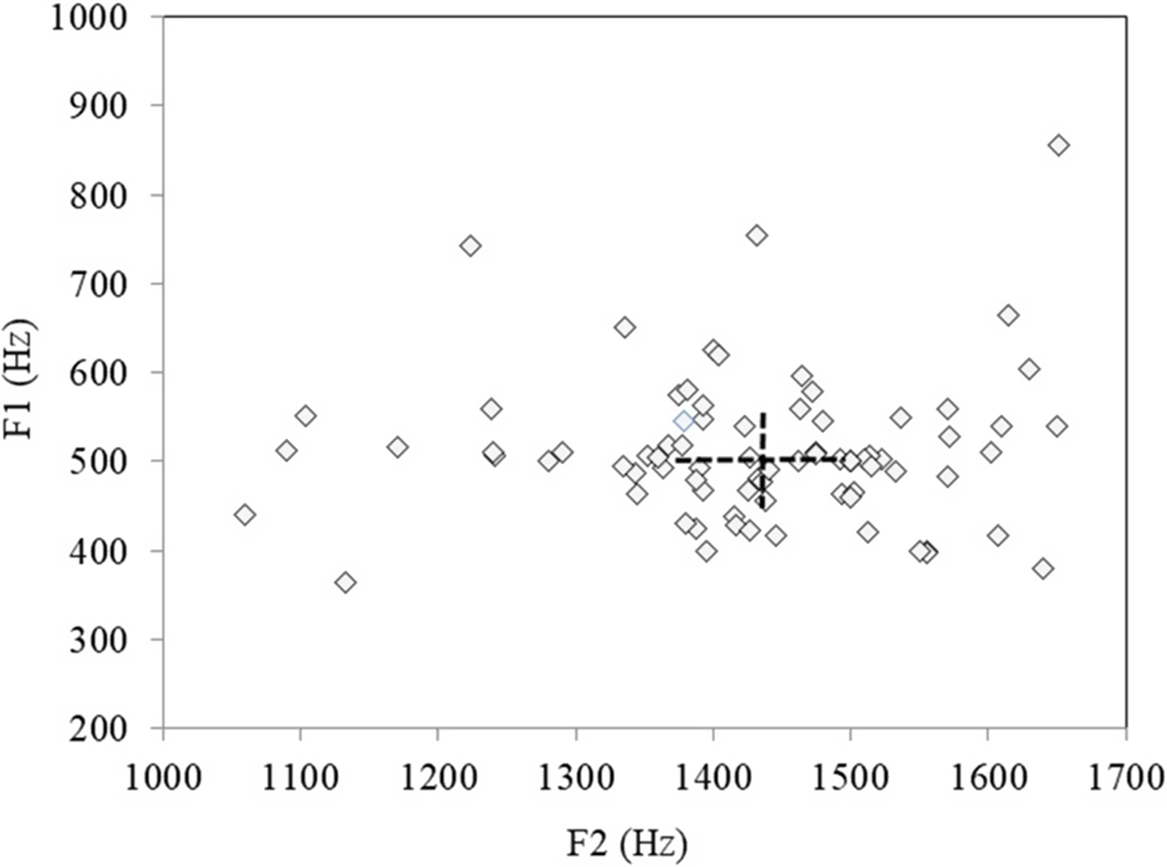
Figure 1 displays all F1 × F2 frequency values appearing in Table 2. The mean formant frequencies occur where the two discontinuous lines overlaid on the data points cross, and the corresponding standard deviation values equal the length of these lines. According to Figure 1, the F1 frequency ranges conform to the initial expectation in that they take place between about 400 Hz and 600 Hz, and thus happen to be centered around a frequency of 500 Hz (see Section 1). The mean F1 value across the data sample is 511.6 Hz and the standard deviation 81.5 Hz. As to F2, most values lie between 1300 Hz and 1500 Hz and are therefore found somewhat below the expected frequency of 1500 Hz, though still far apart from the 1200–1300 Hz range for mid back unrounded [ɤ] and [Ʌ]. The mean F2 amounts to 1428.2 Hz and the corresponding standard deviation to 128.5 Hz.
F1 × F2 frequencies in Hz for full schwa presented in Table 2. The mean F1 and F2 values and the corresponding standard deviations are indicated by the discontinuous lines.

3.2 Spectral change as a function of duration-related factors
It was hypothesized in the Section 1 that there could be a relationship between the spectral characteristics of full schwa and vowel duration in languages where vowel length is distinctive. If so, in comparison to long schwa, short schwa should exhibit a higher F2 and a lower F1, and thus a somewhat more centralized and thus less posterior schwa realization. This hypothesis was not confirmed by the formant frequency data for languages with short and long vowels (see Table 2). Only Battambang Khmer shows, as expected, a higher F2 for short vs. long schwa, though F1 is not higher for the long vs. short cognate, but the reverse. Essentially, small or no differences in F1 or F2 were found to occur between long and short schwa in N. Khmer, Chakhar, Thai and Vöru Estonian, and, contrary to the initial hypothesis, F2 happened to be higher for long schwa than for short schwa in Ndut.
Spectral differences as a function of vowel duration may also be associated with word and syllable position: vowels are expected to be shorter word medially than word initially and finally, and in closed vs. open syllables. Word position may account for why there is schwa instead of [ɤ] in non-initial syllables in the Inner Mongolic languages Baarin, Buriad, Chakhar and Daghur (Svantesson et al. Reference Svantesson, Tsendina, Karlsson and Franzén2005: 157), and why final lengthening prevents stressed schwa from occurring word finally in several languages: Welsh (Awbery Reference Awbery, Ball, Nicole and Jones1984); Hindi (Misra Reference Misra1967: 17); Malay (Clynes & Deterding Reference Clynes and Deterding2011); Balinese and Indonesian, where word syllable-final schwa is replaced by [ɨ] in open syllables (Ward Reference Ward1973: 28); Besemah and Moloko, where word syllable-final schwa becomes [a] in closed syllables and across the board, respectively (Gordon et al. Reference Gordon, Ghushchyan, McDonnell, Rosenblum, Shaw and Steve2012, Gravina Reference Gravina2014: 101–102). Differences in phonetic realization as a function of syllable type occur in Mandarin or Standard Chinese where the longer and more constricted vowel [ɤ], with a lower F1 and F2 frequency, is found in open syllables, and the shorter and less constricted vowel [ə], with higher formant frequencies more appropriate for a mid central vowel, occurs in syllables checked mostly by a nasal consonant (see Table 2, and Svantesson Reference Svantesson1984, Lee & Zee Reference Lee and Zee2003). As to Shangainese, F2 data in Table 2 indicate, however, that both /ɤ/ and /ə/ may be quite central in open syllables, and F1 data for /ə/ that it could be transcribed as [ɐ] as acknowledged in the literature (Chen Reference Chen2008).
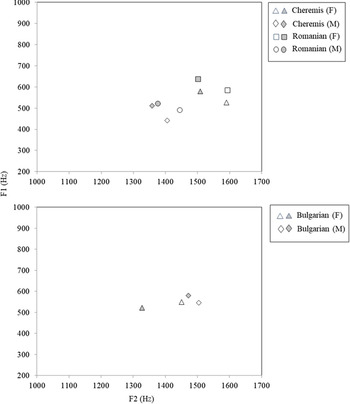
In agreement with our initial predictions (see Section 1), a trend has been observed for stressed schwa to be not only longer and more prominent but also more posterior than unstressed schwa, and therefore to exhibit a higher F1 and a lower F2. In other words, if the back of the tongue approaches the mid or low pharyngeal wall to a greater extent for stressed schwa than for unstressed schwa, then one would expect the former to resemble /ɔ/ or /a/ more than the latter. Indeed, this difference holds in Cheremis and Romanian according to phrase-final data from Lehiste et al. (Reference Lehiste2005) and also to data from Renwick (Reference Renwick2014) plotted in Figure 2 (top graph). Also in Gheg Albanian, unstressed schwa has been reported to have an F2 frequency at about 1500 Hz and the more [ɒ]-like stressed cognate a lower F2 at about 1200–1400 Hz (6M; Granser & Moosmüller Reference Granser and Moosmüller2001). As revealed by Figure 2 (bottom graph), in Bulgarian, stressed schwa has a lower F2 but not necessarily a higher F1 than unstressed schwa according to data taken from Sabev (8F; 2015) and Andreeva et al. (8F, 12M; 2013). Available descriptions agree with these formant frequency values in pointing to the possible realization of schwa as [Ʌ] under stress and as [ə] otherwise in Nooksack (Galloway Reference Galloway, Eugene and Bill1983: 87), and as [a] in the stressed position in Arrernte (Breen & Dobson Reference Breen and Dobson2005).
F1 × F2 frequencies for unstressed schwa (empty symbols) and stressed schwa (filled symbols) in several languages. Top panel: Languages showing a higher F1 and a lower F2 for stressed vs. unstressed schwa. Bottom panel: Data for Bulgarian where stressed and unstressed schwa differ in F2 but not in F1. M = male speakers, F = female speakers.

3.3 Spectral variability
Another salient characteristic of stressed schwa is its considerable spectral variability. Acoustic variability for vowels may occur as a function of factors as diverse as contextual segment, position, stress, speech rate and speaker (see Chapters 3 and 4 of Hardcastle et al. Reference Hardcastle, John and Gibbon2010 for supporting evidence).
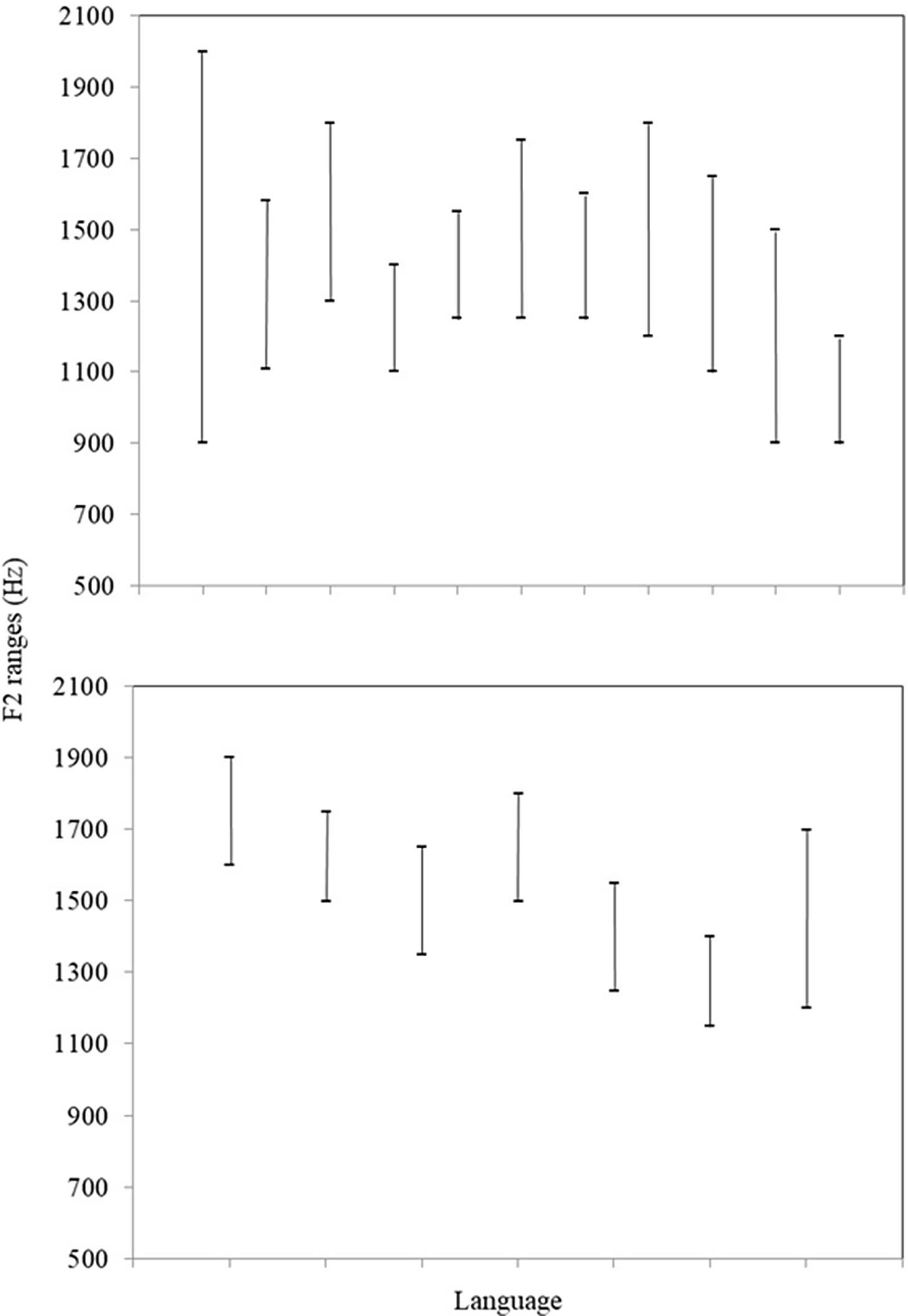
The effect of contextual variability is apparent in a study on Majorcan Catalan vowels produced by 5 male speakers. Stressed schwa was found to exhibit a high F2 frequency range with values between 1250 Hz next to labials and dark /l/ and the trill /r/ and 1500–1600 Hz next to other alveolars and to palatals, which turned out to be comparable to the F2 variability degree for /u/ and greater than that for the other stressed vowels produced in the same contextual conditions (Recasens & Espinosa Reference Recasens and Espinosa2006a). F2 frequency ranges for other languages have been plotted in Figure 3, and the corresponding bibliographical references where these data have been taken from are given in Appendix C, which also reports whether the vowel productions belong to male and/or female subjects and the number of subjects. The effect of context should be apparent in cases where the vowel was produced in different consonantal contexts (Paiwan, Cheju), in several words (Romanian, Mundurukú) or in long speech samples (Albanian, Javanese, Indonesian, Mono), while in cases where different tokens of a single word were recorded the vowel’s F2 variability should probably be attributed to speaker-dependent differences for the most part (Enganno, as well as Khonoma Angami, where the F2 data corresponds to a weighted average of F2 and F3 minus F1).
Approximate F2 frequency ranges in Hz for full schwa in languages and dialects where they exceed (top) or not (bottom) the F2 frequency ranges for all or most of the other system vowels. Top graph, from left to right: Albanian, Enganno, Iaai (F), Iaai (M), Javanese, Indonesian, Mono, Romanian (F), Romanian (M), Khonoma Angami (F), Khonomna Angami (M). Bottom graph, from left to right: Paiwan (F), Paiwan (M), N. Taleshi, C. Taleshi, S. Taleshi, Cheju, Mundurukú.

In the languages displayed in the top graph of Figure 3, the F2 frequency ranges vary between about 300 Hz and 1000 Hz, and exceed those for all or most of the other system vowels in the language. Large F2 ranges for Wa (Watkins Reference Watkins2002) and Madurese (Cohn & Lockwood Reference Cohn and Lockwood1994) have not been included because precise formant frequency data for these languages are not provided by the literature sources. In languages plotted in the bottom graph of Figure 3, on the other hand, a smaller F2 frequency spread generally around 300 Hz happens to be comparable to, and thus not larger than, that for the other vowels of the phonological system. This scenario is also at work for /ɤ/ in open syllables in Taiyuan Chinese (Xia & Hu Reference Xia and Hu2016) and Shangainese (Svantesson Reference Svantesson1989, Chen Reference Chen2008).
These spectral variability data are consistent with descriptions about the allophones and dialectal realizations of full schwa. Indeed, just to mention a few examples, this vowel has been reported to vary a great deal as a function of segmental context, mostly in anteriority degree, in Sharwa (Gravina Reference Gravina2014: 136); Gilaki (Rastorigueva et al. Reference Rastorigueva, Kerimova, Mamedzade, Pireiko and Edel’man2012: 8–9); Cheremis (Lehiste et al. Reference Lehiste2005: 87–89) and Moksha (Estill Reference Estill, Stefan and Tomi2010). Variability also involves the height dimension and thus F1 whenever the vowel realizations range from [Ʌ]/[ə] to [ɨ], as reported for Balinese (Ward Reference Ward1973: 28); Amharic (Iwatsuki Reference Iwatsuki2012) and Macedonian dialects (Friedman Reference Friedman2001: 10). Also in Makaa (Heath & Heath Reference Heath and Heath1982: 16); Margi (Maddieson Reference Maddieson1987) and Wadu Pumi (Daudey Reference Daudey2014: 50), [ɨ]-like realizations occur next to (alveolo)palatals and other consonants involving front tongue body raising, and [ə]-like realizations in other segmental contexts.
A high degree of articulatory and acoustic variability for the vowel under study is available in languages exhibiting a small number of vowel phonemes (see Table 1). This is the case for Arrernte, Kabardian and several Austronesian languages where the contextual allophones cover a large portion of the vowel space (Foley Reference Foley1986: 49–50; Colarusso Reference Colarusso1988, Choi Reference Choi1991, Breen & Dobson Reference Breen and Dobson2005), and also for several Salishan languages where the vowel has been reported to be realized as [ə], [ɪ], [ʊ], [Ʌ], [ɑ] and [ɔ] depending on consonantal context (Bessell Reference Bessell1998, Nolan Reference Nolan2017: 24).
The context-dependent articulatory and acoustic variability for full schwa may be restricted by the number of central vowels, as indicated by the relatively small degree of F2 variability for the vowel of interest in Paicĩ (Gordon & Maddieson Reference Gordon and Maddieson2004) and Cangnan Min Chinese (Hu & Ge Reference Hu and Ge2016). Moreover, as expected, F2 variability is less for full schwa than for reduced schwa in unstressed position in languages such as Lekwungen (Nolan Reference Nolan2017: 91) and Cheremis (Lehiste et al. Reference Lehiste2005: 71–81).
4 Vowel space
4.1 Position
This section investigates the extent to which, based on the formant frequency values listed in Table 2, the spectral characteristics of full schwa may change with vowel inventory size by looking at the placement of this vowel with respect to the mid peripheral vowels (excluding [쀆]) in the F1 × F2 space. This analysis has been carried out separately for those languages and dialects showing 2 mid vowels (one mid front unrounded vowel and one mid back rounded vowel), 3 mid vowels (two front unrounded vowels and one back rounded vowel, or vice versa) or 4 mid vowels (two mid front unrounded and two mid back rounded vowels). Overall, there were 16 languages and dialects with 2 mid vowels, 10 with 3 mid vowels, and 14 with 4 mid vowels. The languages with 2 mid vowels are coded with numbers 1, 16, 19, 21, 24, 29, 32, 36, 44, 51, 85, 86, 94, 98, 105 and 106 in Tables 1 and 2; they include Kabardian (29) which, in spite of having essentially 3 vowels, shows often [e;] and [o;] as surface realizations of underlying diphthongs (Gordon & Applebaum Reference Gordon and Applebaum2010). The languages with 3 mid vowels are coded 7, 15, 40, 43, 57, 62, 63, 65, 67 and 95; they include Babine (67) where [ɛ] occurs often after fortis consonants, and Wolof (65), for which no formant values are reported for short /o/ in Calvet (Reference Calvet1966). Finally, languages with 4 mid vowels are coded 8, 10, 22, 25, 31, 33, 47, 59, 61, 64, 79, 82, 101 and 102.
Several aspects about this vowel material need to be mentioned in the case of languages where vowel length is distinctive. The general criterion has been to compare schwa with peripheral vowels of equal length. Thus, in the case of languages where vowels, including schwa, may be short and long, the data subject to analysis correspond to the long vowels (Battabang Khmer, N. Khmer, Chakhar, Ndut, Estonian, Thai); however, due to restrictions imposed by the available data material, formant values were analyzed for the short vowels (Scots Gaelic) or for a mixture of long and short vowels (Iaai). As to those languages in which schwa was always short and the peripheral vowels could be long and/or short, schwa was compared with the short peripheral vowels (N. Welsh, Afrikaans, Wolof) with some exceptions: we took into account the data for long peripheral vowels whenever some relevant peripheral vowels happened to be only long (Slovene), and those for a mixture of long and short vowels whenever peripheral vowels differing in quantity also differed in quality (S. Welsh) or due to restrictions imposed by the literature reports (Eton). As to languages where schwa can occur only in closed syllables, the peripheral vowels correspond to the open syllable condition which is where mid vowels are found (Shangai Chinese).
Whenever possible, we have averaged data from different studies in order to achieve more representative formant frequency values after normalizing them according to the procedure described below. In some cases averaging has been carried out across male speakers’ productions, as reported by the studies enclosed within parentheses: Wa (Svantesson Reference Svantesson1993, Watkins Reference Watkins2002), Sundanese (van Zanten & van Heuven Reference Zanten and van Heuven1984, Yusuf Reference Yusuf1993), Afrikaans (Taylor & Uys Reference Taylor and Uys1988, Botha Reference Botha1996), Maithili (Yadav Reference Yadav1984, Jha Reference Jha2001), Romanian (Teodorescu Reference Teodorescu1985, Renwick Reference Renwick2014), Bulgarian (Lehiste & Popov Reference Lehiste and Popov1970, Tilkov Reference Tilkov1970, Andreeva et al. Reference Andreeva, Barry and Koreman2013), Vöru Estonian (Parve Reference Parve2000, Teras Reference Teras, Maria Josep, Daniel and Joaquín2003, Reference Teras2004). In four instances, we have averaged data for males (M) and those for females (F) not given in Table 2 and thus not plotted in Figure 1: Madurese (1M, 1F; Cohn & Lockwood Reference Cohn and Lockwood1994), Marathi (5M, 5F; Shinde et al. Reference Shinde, More, Sonawane, Pawade and Kulkarni2017), Shangainese (3M, 10F; Chen Reference Chen2008) and Cheremis (4M, 4F in Lehiste et al. Reference Lehiste2005, and 2F in Estill Reference Estill2012). Data for English RP male speakers have been taken from Wells (Reference Wells1963).
Formant frequencies values were normalized in order to be able to carry out the relevant comparisons, and given the fact that speakers differ in vocal tract size whether they belong to the same sex or, even more clearly, to different sexes. The normalization procedure was performed as follows: we first computed the F1 distances between each vowel and /a/ (i.e. the vowel with the highest F1) and the F2 distances between each vowel and /i/ (i.e. the vowel with the highest F2); then we calculated the percentages of each F1 distance over the maximal F1 distance available (that for /a/–/i/) and those of each F2 distance over the maximal possible F2 distance (that for /i/–/u/). Thus, for example, an F1 percentage of 75% for a given vowel means that F1 for this vowel is located at three quarters of the /a/–/i/ space below F1 for /a/, and thus at one quarter above F1 for /i/. On the other hand, an F2 percentage of 33% for a given vowel means that F2 for this vowel is closer to /i/ than to /u/, i.e. one third of the /i/–/u/ space away from /i/ and two thirds away from /u/.
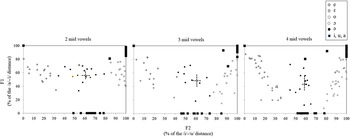
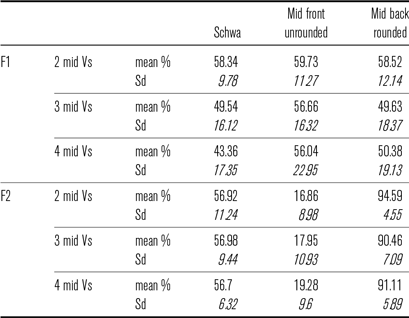
Figure 4 shows the normalized F1 × F2 data for groups of languages with 2, 3 and 4 mid vowels. In each graph, the F1 × F2 frequencies for /i/, /u/ and /a/ (represented in large filled squares) occur at the upper left corner, upper right corner and F1 baseline, respectively. The data points inside the graphs correspond to mid front unrounded and mid back rounded vowels, and to full schwa. Analogously to Figure 1, the mean F1 × F2 values for schwa are located where the two discontinuous lines cross and the standard deviation for each formant is indicated by the length of the lines. The actual mean formant frequencies for schwa and the mid front unrounded and mid back rounded vowels, together with the corresponding standard deviations, are given in Table 3.
Position of stressed schwa and mid vowels in F1 × F2 space in languages with 2 (left), 3 (middle) and 4 (right) mid vowels. The cross-language mean F1 and F2 values and the corresponding standard deviations are indicated by the discontinuous lines. Y-axis: Percentages over the F1 distance between /a/ and /i/; X-axis: percentages over the F2 distance between /i/ and /u/.

F1 and F2 distance percentages for stressed schwa, and for the mid front unrounded and back rounded vowels, relative to the (maximal) F1 distance between /a/ and /i/ and the (maximal) F2 distance between /i/ and /u/. Percentages and standard deviations are provided across languages for vowel systems with 2, 3 and 4 mid vowels.

Two main trends can be observed in Figure 4 regarding the location of full schwa in vowel space. First, there appears to be a relationship between the position of schwa along the F1 dimension and the number of mid vowels. In systems with 2 mid vowels (leftmost graph), schwa occupies a mid high position at about 60% of the /a/–/i/ distance, respectively. Moreover, also in this case the F1 for full schwa tends to be aligned with F1 for the mid peripheral vowels, which include /ɛ/ and/or /ɔ/ in addition to /e/ and /o/. Given that F1 is positively associated with degree of vowel opening, what this means is that schwa is articulated with a more open oral cavity in language systems with mid high and mid low vowels than in systems endowed with only mid high vowels.
F2 for full schwa, on the other hand, happens to be fairly equidistant from F2 for mid front and mid back vowels. This fairly equidistant relationship becomes apparent through inspection of the three discontinuous vertical lines located at the mean F2 for the 2, 3 and 4 vowel systems in the three graphs of Figure 4. As indicated in Table 3, schwa is found at about 57% of the F2 distance between /i/ and /u/ irrespective of whether vowel systems have 2, 3 or 4 mid vowels. Moreover, this percentage indicates a position somewhat closer to the area occupied by the mid back unrounded vowels than to that for the mid front unrounded vowels, which is in accordance with the absolute F2 values appearing in Figure 1. Posterior realizations of schwa, which correspond to the rightmost data points in the graphs of Figure 4, belong mostly to Austronesian and Indo-Aryan languages (Iaai, Javanese, Madurese, Sundanese, Gujarati, Maithili, Marathi, Urdu).
4.2 Variability
Judging from the standard deviations reported in Table 3, both F1 and F2 for full schwa appear to be affected by the number of peripheral vowels also regarding formant frequency dispersion.
The F1 frequencies for full schwa are more disperse in larger vs. smaller vowel systems, i.e. they spread over 10%, 16% and 17% of the distance between /a/ and /i/, respectively. In particular, the F1 spread occurs towards higher F1 frequencies. Thus, taking the 50% /a/–/i/ distance as reference, F1 occurs above this distance in 14 out of 16 languages in 2 mid vowel systems, and below this frequency in 10 out of 14 languages in 4 mid vowel systems. Languages with 3 mid vowels show an intermediate scenario, i.e. 5 languages above and 5 languages below the 50% /a/–/i/ distance in question. It may thus be concluded that the F1 dispersion for schwa keeps a direct relationship with F1 dispersion for the mid peripheral vowels, which is certainly greater in vowel systems with more vs. less mid vowels.
Regarding F2 variability, the standard deviation values in Table 3 indicate a decrease in the spread of the F2 frequency values for full schwa as the number of mid vowels in the language system increases, i.e. over 11% (2 mid vowels), 9% (3 mid vowels) and 6% (4 mid vowels) of the distance between /i/ and /u/. Such a decrease may be associated with the fact that mid front and mid back vowels lie somewhat further apart in 2 mid vowel systems than in systems with 3 and 4 mid vowels; indeed, the separation between the mean F2 averaged across mid back and mid front vowels is 77.7%, 72.51% and 71.83% of the /i/–/u/ distance in languages with 2, 3 and 4 mid vowels, respectively.
In sum, there appears to be a trend for F1 but not F2 for full schwa to increase with the number of mid peripheral vowels, and for the F1 and F2 variability for full schwa to increase with the mid vowels spread along the F1 and F2 dimensions, respectively. We will return to these findings in the Section 6.
5 Duration
Full schwa has been reported to be not only highly variable spectrally but also short. In a considerable number of the languages and dialects which set in contrast long and short vowels listed in Table 1, stressed schwa counts as short: Eton, Chechen, Kabardian, Welsh, Afrikaans, Luxembourgish, Punjabi, Sinhalese, Urdu, Kurdish, Bonan, Wolof, C. Alaskan Yupik, N. Lushootseed, Slovene. In other languages schwa may be both short and long: Battambang and N. Khmer, Budai Rukai, Iaai, Karo Batak, Makaa, Upper Bal Svan, Scottish Gaelic, Kashmiri, Baarin and Chakhar Mongolian, Ndut, Halkomelem, Upper Chehalis, Thai, Estonian dialects, Selkup. Moreover, in Korean stressed schwa counts as long but not as short even though this restriction does not seem to occur in the Hamgyŏng, Kyŏngsang and Cheju dialects (Yeon Reference Yeon and Nicolas2012, and see Table 1).
The inherent short quality of full schwa in languages with distinctive vowel length is in accordance with Figure 5, showing that this vowel is as short as high vowels (and thus shorter than low and mid vowels) or the shortest of all stressed vowels in the vowel system. Figure 5 presents duration data for full schwa and for high, low and mid peripheral vowels, in different languages, most of which are listed in Table 2. The bibliographical references for these vowel durations, and whether they correspond to male and/or female speakers, may be found in Appendix D.
Duration of stressed schwa and peripheral vowels relative to the longest vowel in the vowel system. Graphs correspond to languages where vowel length is not distinctive (top graph), and to languages with distinctive vowel length in which schwa counts as short (bottom graph, left) or as long (bottom graph, right). Top graph, from left to right: Wa, Besemah, Javanese, Madurese, Deg Xinag, Lushootseed, Saanich, Sliammon, Portuguese, Majorcan Catalan, Amharic, Ao, Lotha, Nagamese, Bulgarian, Mundurukú, Cheremis, Moksha. Bottom graph, short vowels: Battambang Khmer, Iaai, N. Welsh, S. Welsh, Slovene, Thai. Bottom graph, long vowels: Battambang Khmer, Iaai, Thai.

The values presented in the graphs of Figure 5 do not correspond to absolute durations but to duration values relative to the duration of the longest vowel, which is often but not always /a/; thus, a 40% for a given vowel means that its duration amounts to 40% of the duration of the longest vowel in the vowel system. This normalization procedure is justified by the fact that vowel duration is affected by speech rate and other factors. Indeed, a given vowel may be shorter in one language than in another not because of inherent differences in vowel duration but because speakers of the one language may have produced it faster than speakers of the other.
Figure 5 has two graphs. The top graph plots duration values for languages without distinctive vowel length. Vowel durations in this graph reveal that schwa is clearly the shortest vowel of the vowel system (Besemah, Javanese, Madurese, Des Xinag, Lushootseed, Sliammon, Amharic, Ao, Nagamese, Mundurukú, Cheremis), or as short as one or the two high vowels (Wa, Saanich, Portuguese, Majorcan Catalan, Lotha, Bulgarian, Moksha). We may add Arrernte, where schwa is shorter than /ɐ/ (Tabain & Breen Reference Tabain and Breen2011), and Shangainese, where /ɤ/ is as long as many of the other vowels occurring in open syllables, while /ə/ (103.5 ms) is as short as or shorter than the other vowels /ɐ/ (111 ms), /ʏ/ (114.5 ms), /ɪ/ (129 ms) and /ʊ/ (123.5 ms) occurring in closed syllables (10F, 3M; Chen Reference Chen2008). A partial exception appears to be Romanian where, even though shorter than /a/, stressed schwa has been reported to be longer than mid /e/ and /o/ (Estill Reference Estill, Stefan and Tomi2010).
The lower graph presents data for languages where vowel length is distinctive. Data for short vowels show again a trend for schwa to be the shortest vowel (Iaai, Welsh) or one of the shortest (Battambang Khmer, Slovene); Thai appears to be exceptional in this respect. This trend also holds for long vowels in Battambang Khmer but not in Iaai or in Thai.
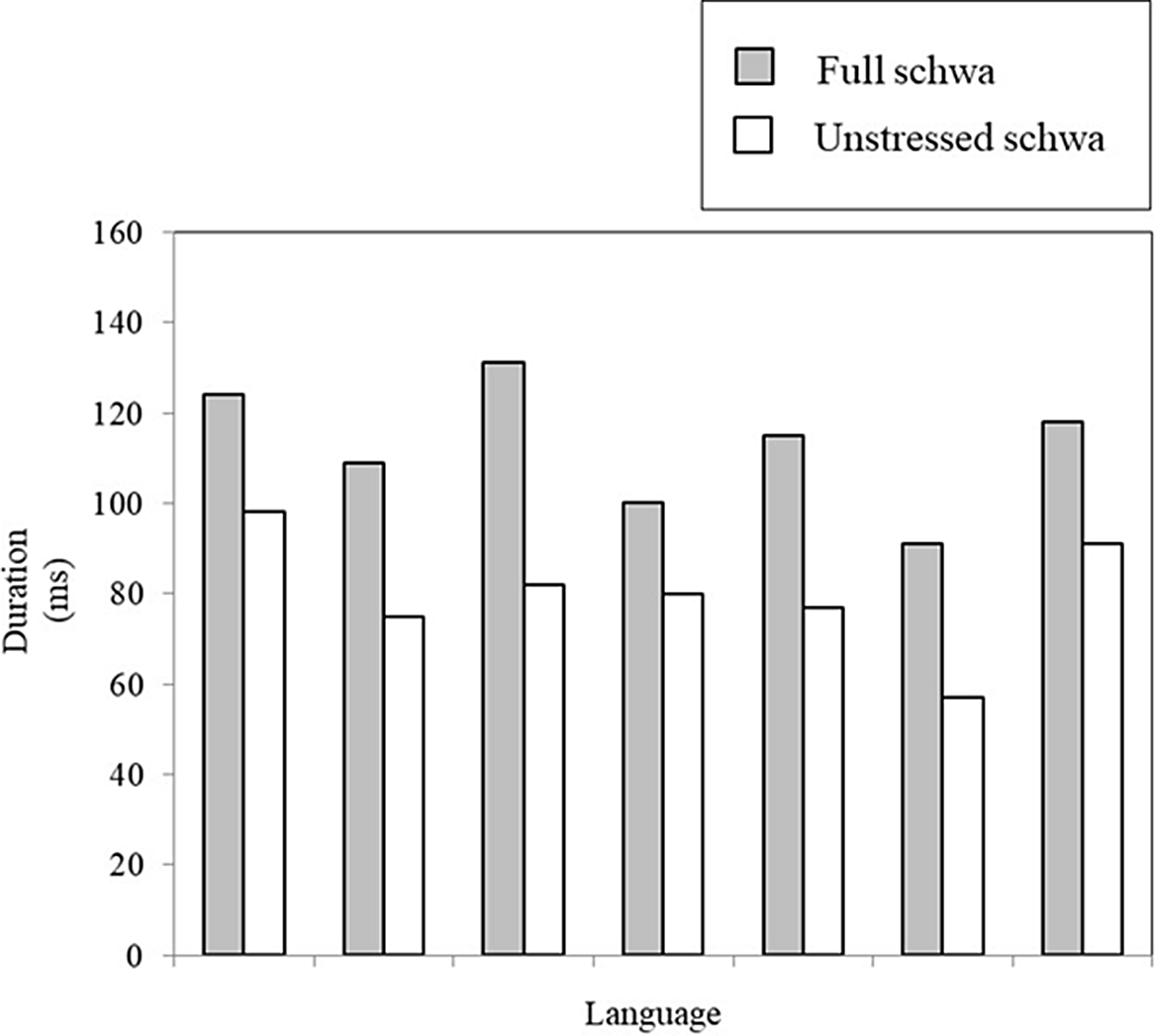
As expected, full schwa tends to be somewhat longer than unstressed schwa. This duration difference may be seen for several languages in Figure 6 (though not for Klallam; Montler Reference Montler1998). The data plotted in the figure correspond essentially to isolated words in Lekwungen (Nolan Reference Nolan2017: 61); Bulgarian (Sabev Reference Sabev2015) and Moksha (Estill Reference Estill, Stefan and Tomi2010), words in carrier sentences in Sliammon (Blake & Shahin Reference Blake and Shahin2008) and Cheremis (Lehiste et al. Reference Lehiste2005: 104–105), reduplicated forms in Saanich (Leonard, unpublished) and narratives in Lushootseed (Barthmaier Reference Barthmaier1998).
Duration values for stressed schwa (filled bars) and unstressed schwa (unfilled bars) in a subset of languages. From left to right: Lekwungen, Luhootseed, Saanich, Sliammon, Bulgarian, Cheremis, Moksha.

Moreover, a short duration for full schwa may co-occur with a lower intensity level than the one available for the other vowels in the language system, as revealed by data for Lekwungen (Nolan Reference Nolan2017: 70); Sliammon (Blake & Shahin Reference Blake and Shahin2008), and Besemah, Javanese and Kwak’wala (Gordon et al. Reference Gordon, Ghushchyan, McDonnell, Rosenblum, Shaw and Steve2012). It should be kept in mind, however, that there are insufficient data to consider the vowel intensity characteristics to be conclusive.
Several phonological aspects are concomitant with the short duration of the schwa vowel of interest. One of them is the reluctance to receive stress in a number of languages where stress position is predictable but movable, and therefore belong to group (3) in Section 2.2. This is so for several Salishan languages (Czaykowska-Higgins & Kinkade Reference Czaykowska-Higgins, Dale Kinkade, Czaykowska-Higgins and Dale Kinkade1998: 15), Digor Ossetic (Testen Reference Testen, Kaye and Daniels1997: 727), and the following Austronesian and Uralic languages: Gayo (Eades & Hajek Reference Eades and Hajek2006), Karo Batak (van der Hulst et al. Reference Hulst, Goedemans and van Zanten2010: 704); Malay (Blust Reference Blust2013: 251); C. Paiwan (Chen Reference Chen2006: 80–83); Cheremis, Nganasan (Vaysman Reference Vaysman2009: 24–40, 62–63); Moksha (van der Hulst et al. Reference Hulst, Hendriks and Weijer2008: 451). In particular, in a subset of these languages schwa gets stressed only if the other vowels in the word are high and/or non-peripheral. In these circumstances, stressed schwa often happens to be the vowel nucleus of the leftmost syllable in the word in Salishan and Uralic languages, and of the rightmost syllable in Austronesian languages (also in Digor Ossetic and Kwak’wala). Consistent with its short duration, there is also a trend for stressed schwa to appear in closed syllables, as in Ladin dialects and in dialects from Northern Italy (Recasens Reference Recasens2019), Madurese (Davies Reference Davies2010: 24), Amerindian languages from North America such as Upper Chehalis (Kinkade Reference Kinkade and Dale Kinkade1998: 206); and Hakha Lai, in addition to the other short vowels /ɪ ɛ o ʊ/ and in alternation with the long cognate /a;/ in open syllables (Peterson Reference Peterson, Graham and Randy2003: 410).
6 Discussion
The present investigation has been concerned with the spectral and duration characteristics of full schwa across the world’s languages. Whether appearing in a stressed syllable or in a non-reduced syllable in languages lacking stress, full schwa has been reported to occur in at least one hundred languages from a varied array of language families, a finding which is quite remarkable since schwa is supposed to be associated essentially with unstressed syllables. Inspection of the vowel system inventories indicates that the vowel of interest may co-occur with other central vowels, mostly high unrounded, and/or with back unrounded vowels as well.
Spectral data for full schwa in several languages reported in the literature confirm that its F1 and F2 frequency values occur typically within the 400–600 Hz and 1300–1500 Hz ranges, and reveal that its F1 is closer than its F2 to the prototypical formant frequencies for a mid central vowel (F1 = 500 Hz, F2 = 1500 Hz). A cross-language F2 of 1428 Hz (see Section 3.1) may be associated with more postdorsal retraction and a lower predorsum position than in the case of unstressed schwa. In fact, judging from available phonetic transcriptions, full schwa and back unrounded [ɤ] are prone to be confused, which points to the articulatory and acoustic affinity between the two vowel productions. Regarding the discrepancy between the F2 values for full schwa reported in this study and the canonical 1500 Hz, this may be due to the fact that schwa modeling has been based on a variant of unstressed schwa involving no constriction narrowing anywhere in the vocal tract, which appears not to be a realistic approach for estimating the spectral characteristics of full schwa. Thus, if, as reported by some literature studies (see Section 1), the production of unstressed schwa involves some active tongue body lowering and backing and even some postdorsal constriction at the pharynx, it may be assumed that these articulatory characteristics ought to be even more blatant for the more prominent stressed schwa cognate.
The present study reveals that formant frequency values for full schwa may vary with several factors which are closely related to changes in duration at the syllable and word levels: since vowel shortening is likely to result in more reduced productions, the vowel outcome is expected to be more centralized the shorter it is, and conversely more [ɤ]-like the longer it happens to be. This relationship has not been found to hold for short vs. long schwa in languages with contrastive vowel length, a finding which is reminiscent of studies showing that vowels do not need to be shorter to become more centralized, and conversely that changes in duration may not necessarily be accompanied by changes in spectral implementation (Koopmans-van Beinum 1992, van Son & Pols 1990), or else that duration alone is not likely to determine vowel formant undershoot (Moon & Lindblom Reference Moon and Lindblom1994). There are, however, some indications coming from descriptive data on allophonic distribution that the relationship in question holds as a function of syllable type (vowels happen to be longer in open vs. closed syllables) and of word position (vowel are longer word initially and finally than word internally). Another relevant factor is stress in so far as shorter realizations in syllables devoid of stress ought to result into a greater degree of centralization. A comparison between stressed and unstressed schwa realizations in several languages has revealed the expected higher F1 and lower F2 frequencies for schwa in stressed vs. unstressed syllables.
The formant frequencies of full schwa were also found to vary with the number of mid vowels in vowel systems. More specifically, the vowel of interest turned out to be higher in systems with 2 mid vowels (essentially /e o/) than in systems with 4 mid vowels (and thus /e o ɛ ɔ/), its position falling somewhere in between in systems with 3 mid vowels (one front and two back ones, or vice versa). There appears then to be a fairly symmetrical relationship between height degree for full schwa and for mid vowels. This finding in in accordance with a considerable F1 spread reported by Becker-Kristal (Reference Becker-Kristal2010) in languages with a single central vowel. Other cases of symmetry in the realization of vowels and consonants have been mentioned in the literature. Regarding vowels, F2 for high and mid high vowels tends to vary in the progression English > Spanish > Greek (Bradlow Reference Bradlow1995). As to consonants, a trend has been noted for the (alveolo)palatal oral stop allophone [c] of /k/ and the (alveolo)palatal nasal phoneme /ɲ/ to share the same closure location in Majorcan Catalan, i.e. the two consonants may be articulated as alveolopalatal or as plain palatal depending on the speaker (Recasens & Espinosa Reference Recasens and Espinosa2006b). What our data show is that, at last at the phonetic implementation level, there may be an interaction in the height dimension between schwa and those peripheral vowels which lie closest to it in vowel space.
Interestingly, while F1 for full schwa adapted to mid peripheral vowel height, F2 turned out to be quite equidistant with respect to the F2 values for mid front and mid back vowels (though slightly more posterior than more anterior), and did not change across 2, 3 and 4 vowel systems, presumably since the distance between front unrounded and back rounded vowels is not much affected by the number of mid vowels. While these absolute formant frequency data correspond to male speakers, it is believed that the choice of female subjects would not have resulted into significant higher F2 frequency values for full schwa in comparison to those of front and back vowels since F2 for the latter vowels would have also been somewhat higher than those for male subjects. A cross-language trend for central vowels to be slightly fronted in Becker-Kristal (Reference Becker-Kristal2010: 163) may have been due to the fact that he took all possible non-peripheral vowels into consideration, including those which are rather front and could thus be transcribed as [ɨ], while only the formant frequency data for full schwa have been subject to investigation in the present study.
Another relevant finding regarding the formant frequency characteristics of full schwa concerns spectral variability, which in the present study has been shown to occur as a function of consonantal context, stress and the number of mid vowels in the vowel system. Contextual variability as a function of consonantal context renders F2 highly variable not only in the case of unstressed schwa (as reported in many studies; see for example Kondo Reference Kondo1994 for English) but of full schwa as well. In both cases, strong coarticulatory effects exerted by consonants produced with very different vocal tract configurations such as palatals and dark /l/ or labials cause schwa to exhibit fairly high and low F2 frequency values, respectively. Consonantal effects along the height dimension and thus in F1 frequency have also been noted, especially in languages with relatively small vowel systems. In addition, in spite of exhibiting a high degree of spectral variability, data for several languages indicate that full schwa may be somewhat less variable than unstressed schwa.
A trend was also observed for F1 to be more variable and for F2 to be less variable as the number of mid vowels in the language system increases. These dispersion data were related to the frequency spread of F1 and F2 for the mid vowels in question and, in particular, to a larger F1 spread when both mid high and mid low vowels are available, and to a shorter F2 distance between mid front and mid back vowels in the same circumstances. This finding cannot be easily integrated within the dispersion theory framework. Dispersion theory for vowels predicts that an increase in the number of vowels in the language vowel inventory ought to cause an expansion of the maximal range between peripheral vowels and of the overall vowel system (Liljencrants and Lindblom Reference Liljencrants and Lindblom1972), and adjacent vowels to approach each other, thus becoming less distinct (Flemming Reference Flemming2002). Moreover, a trend towards compensation between the formant frequency ranges for the language system vowels has been found to hold, e.g. shorter F1 distances between adjacent lower vowels in some Catalan dialects vs. others tend to co-occur with larger distances between pairs of higher vowels (Recasens & Espinosa Reference Recasens and Espinosa2006a). The dispersion phenomenon that we observe in the present investigation seems to be in line with these general principles in the case of the F2 spread for full schwa, which happens to increase the further apart mid front and mid back vowels stay from each other. None of those principles seem to operate, however, in the case of F1. An increase in F1 dispersion for schwa in tandem with an increase in F1 dispersion for mid peripheral vowels seems to be accounted for most properly by a symmetry effect, which matches the one reported for the F1 absolute values referred to above.
In sum, placement and variability for full schwa appears to run in parallel with respect to the same properties for mid peripheral vowels. Whether obeying dispersion or symmetry principles, schwa placement and variability appear to depend to a greater or lesser extent on the number and arrangement of the peripheral vowels in the vowel system. It is not only that the number of central vowels causes the distance between the front and back peripheral vowels to increase (Becker-Kristal Reference Becker-Kristal2010) but that the reverse influence, i.e. that of peripheral on non-peripheral vowels, is also at work.
In the present study, full schwa has also been reported to be as short as or shorter than high vowels, and to also exhibit a low intensity level at least in a few languages. It remains unclear why full schwa should be so short (and presumably so weak regarding intensity) given that, since vowel duration for vowels differing in height is directly correlated with tongue height and jaw opening degree (Lindblom Reference Lindblom1967, Lehiste Reference Lehiste1970), it ought to be longer than high and mid high vowels. A concomitant factor with this specific behavior appears to be the lack of a well-defined constriction location, which may also explain why the vowel is so variable regarding tongue fronting as a function of consonantal context and other factors. Thus, in so far as a well-defined constriction does not have to be achieved, the tongue body configuration for schwa does not need to be especially constrained and the vowel is not required to exhibit a distinctive duration. A short duration accounts for why full schwa may have a more restricted distribution than peripheral vowels: stressed schwa is often treated as short in languages where vowel length is phonological, and is prone to occur in (shorter) closed vs. (longer) open syllables, in longer vs. shorter words, and whenever all vowels in the word are either central and/or short.
In principle, all the spectral and duration characteristics of full schwa just reviewed should not strictly mean that this vowel is devoid entirely of a characteristic lingual configuration. Indeed, it has been suggested that full schwa may be implemented through some active postdorsum backing and even the formation of a postdorsal constriction at the pharynx. These characteristics could be compatible with the notion that schwa has a minimal articulatory target rather than no target at all (Browman & Goldstein Reference Browman, Goldstein, Robert and Gerard1992), and therefore that its production involves some active back dorsum control and thus a less variable tongue postdorsum than tongue predorsum configuration. This articulatory property is in accordance with differences in spectral variability and presumably in tongue retraction for schwa as a function of segmental duration induced by factors such as stress and perhaps syllable and word position. In other words, if schwa has a minimal articulatory target, this is likely to occur in the case of full schwa rather than in that of reduced schwa.
The phonetic characteristics of full schwa reported in this paper are relevant for understanding some patterns of sound change which deserve to be explored in the future. Thus, segmental duration appears to play a role in the generation of stressed schwa in so far as, as exemplified next, its vowel source is often short high, mostly if front, and mid high front. (It is a well-known fact that high and mid high vowels are shorter than mid low and low vowels in language systems.) Regarding the high vowel source, stressed schwa comes from the Proto-Slavic jers ĭ and ŭ in several Slavic languages, as in NW. Bulgarian dialects, and only from ŭ in Standard Bulgarian where ĭ has yielded a mid front vowel (dən/den <*dĭn ‘day’, sən < *sŭn ‘dream’; Vaillant Reference Vaillant1950: 128; Carlton Reference Carlton1990: 303). On the other hand, Latin stressed /e/ has yielded stressed schwa in dialects of several Romance languages such as Balearic Catalan, dialects of Occitan, Ladin Rhaetoromance and Piedmontese (e.g. Balearic [ˈpəɾə] from Latin /ˈpeɾa/ PĬRA ‘pear’). Moreover, in some of these dialects this sound change has occurred in positions favoring segmental shortening, i.e. syllables checked by consonants and Latin proparoxytones (Piedmontese [ˈsək;a] from /ˈsek;a/ ‘dry, fem. sing.’, [ˈvəd;e] from /ˈvideɾe/ ‘to see’; Recasens Reference Recasens2019).
A limitation of the present survey is the different tasks and phonetic environments from which the formant frequency and duration data have been reported, the diversity of spectral measurement methods that have been used, and the language-dependent differences in sample size and number and typology of subjects. As to future directions, the tongue, jaw and lip configuration for full schwa in different contextual and positional conditions should be analyzed, and the ways in which this vowel variant differs from unstressed schwa also at the articulatory level ought to be evaluated. Finally, as pointed out in the preceding paragraph, attention needs to be paid to the ways in which the phonetic characteristics of full schwa may account for its genesis from stressed peripheral vowels, and also to which peripheral vowels full schwa may give rise to through sound change.
Acknowledgments
This research has been supported by projects PGC2018-096877-B-I00 from the Spanish government and 2017SGR34 from the Catalan government.
Appendix A
Bibliographical references for the vowel system inventories presented in Table 1. References are preceded by the language codes listed in the table.
[1] Moosmüller & Granser (Reference Moosmüller and Granser2006); [2] Cunha de Oliveira (Reference Cunha de Oliveira2005: 60); [3] Epps (Reference Epps2008: 42); [4] Sakel (Reference Sakel2004: 17); [5] Dworecka (Reference Dworecka2013: 23); [6] Breen & Dobson (Reference Breen and Dobson2005); [7] Wayland (Reference Wayland1998); [8] Thomas & Wanna (Reference Thomas and Wanna1988); [9] Sidwell (Reference Sidwell, Paul and Mathias2014); [10] Watkins (Reference Watkins2002: 50); [11] Ward (Reference Ward1973: 18); [12, 16] Gordon et al. (Reference Gordon, Ghushchyan, McDonnell, Rosenblum, Shaw and Steve2012); [13, 23] Chen (Reference Chen2006: 231, 69); [14] Eades & Hajek (Reference Eades and Hajek2006); [15] Maddieson & Anderson (Reference Maddieson and Anderson1994); [17] Adelaar (Reference Adelaar and Blust1981); [18] Bishop (Reference Bishop1996); [19] Davis (2010: 29); [20, 24] van Zanten & van Heuven (Reference Zanten and van Heuven1984); [21] Catford (Reference Catford and Richard1988); [22] Gordon & Maddieson (Reference Gordon and Maddieson2004); [25] van der Velde (Reference Velde2008: 15); [26] Heath & Heath (Reference Heath and Heath1982: 6); [27] Boyd (Reference Boyd2015: 23); [28] Nichols (Reference Nichols, Kaye and Daniels1997: 945); [29] Gordon & Applebaum (Reference Gordon and Applebaum2010); [30] Tuite (Reference Tuite1998); [31] Gillies (Reference Gillies, Ball and Nicole2009: 236); [32, 33] Mayr & Davies (Reference Mayr and Davies2011); [34] Maddieson (Reference Maddieson1987); [35] Gravina (Reference Gravina2014: 136); [36] Prinsloo (Reference Prinsloo2000), Donaldson (Reference Donaldson1993: 2); [37] Cox & Palethorpe (Reference Cox and Palethorpe2007); [38] Roach (Reference Roach2004); [39] Gilles & Trouvain (Reference Gilles and Trouvain2013); [40] Mistry (Reference Mistry, Kaye and Daniels1997: 657); [41] Ohala (Reference Ohala1983, Reference Ohala1999); [42] Koul (Reference Koul, George and Jain2003); [43] Yadav (Reference Yadav, George and Jain2003: 525); [44] Pandharipande (Reference Pandharipande, George and Jain2003: 789); [45] Shackle (Reference Shackle1972: 642–643); [46] Gair (Reference Gair, George and Jain2003: 858); [47] Nakhat & Rabea (Reference Nakhat and Rabea2003); [48] Testen (Reference Testen, Kaye and Daniels1997: 722); [49] Lecoq (Reference Lecoq and Rüdiger1989: 304); [50] McCarus (1997: 696, Reference McCarus and Gernot2009: 591); [51] Robson & Tegey (Reference Robson, Tegey and Gernot2009: 723); [52] Paul (Reference Paul2011: 43–44); [53] Cho et al. (Reference Cho, Jun, Jung and Ladefoged2001); [54] Lee (Reference Lee1999); [55, 58] Svantesson et al. (Reference Svantesson, Tsendina, Karlsson and Franzén2005: 144, 150); [56] Hugjiltu (Reference Hugjiltu and Janhunen2003: 327); [57] Iivonen & Harnud (Reference Iivonen and Harnud2005); [59] Kari (Reference Kari2007); [60] Capo (Reference Capo1991: 24); [61] Anderson-Starwalt (Reference Grace2008: 120); [62] Olson (Reference Olson2001: 40); [63] Gueye (Reference Gueye1986); [64] Ladefoged (Reference Ladefoged1968); [65] Unseth (Reference Unseth2009); [66] Miyaoka (Reference Miyaoka2012: 38); [67] Hargus (Reference Hargus, Sharon and Keren2005: 397); [68] Galloway (Reference Galloway1977: 2); [69] Gordon et al. (Reference Gordon, Ghushchyan, McDonnell, Rosenblum, Shaw and Steve2012); [70] van Eijk (Reference Eijk2011: 2); [71] Urbancyck (Reference Urbancyck2001); [72] Leonard (Reference Leonard2006: 7); [73] Dyck (Reference Dyck2004: 37); [74] Kinkade (Reference Kinkade1963: 6); [75, 76, 77, 78] Foley (Reference Foley1986: 47–54); [79] Cruz-Ferreira (Reference Cruz-Ferreira1999); [80] Stich (Reference Stich1998: 67); [81] Gartner (Reference Gartner1879: 3); [82] Bibiloni (Reference Bibiloni1983); [83] Dauzat (Reference Dauzat1897: 4); [84] Parry (Reference Parry, Martin and Mair1997: 239); [85] Chitoran (Reference Chitoran2001: 9); [86] Leslau (Reference Leslau, Kaye and Daniels1997: 419); [87] Hetzron (Reference Hetzron and Kaye1997: 482), Joswig (Reference Joswig2010: 3); [88] Lonnet & Simeone-Semelle (Reference Lonnet, Simeone-Semelle, Kaye and Daniels1997: 364); [89] Katsura (Reference Katsura1970); [90] Coupe (Reference Coupe2003: 40); [91] Hu & Ge (Reference Hu and Ge2016); [92] Noonan (Reference Noonan, Graham and Randy2003: 316); [93] Daudey (Reference Daudey2014: 47); [94] Blankenship et al. (Reference Blankenship, Ladefoged, Bhaskararao and Chase1993); [95] Chen & Gussenhoven (Reference Chen and Gussenhoven2015); [96] Lee & Zee (Reference Lee and Zee2003); [97] Hwang-Cherng (Reference Hwang-Cherng, Graham and Randy2003: 604); [98] Andreeva et al. (Reference Andreeva, Barry and Koreman2013); [99] Stone (Reference Stone, Bernard and Corbett1993: 763); [100] Friedman (Reference Friedman2001: 10); [101] Priestly (Reference Priestly, Bernard and Corbett1993: 391); [102] Abramson (Reference Abramson1962: 3); [103] Picanço (Reference Picanço2005: 13); [104] Conklin (Reference Conklin2015: 18–19); [105] Vaysman (Reference Vaysman2009: 61); [106] Teras (Reference Teras2004); [107] van der Hulst et al. (Reference Hulst, Hendriks and Weijer2008: 451); [108, 109] Helimski (Reference Helimski and Daniel1998: 483); [110] Csúcs (Reference Csúcs and Daniel1998: 280).
Appendix B
Bibliographical references for the vowel formant values presented in Table 2, and number and gender (M, male; F, female) of the speakers who recorded the speech material subject to acoustic analysis. References are preceded by the language codes listed in Table 1. A good number of formant values reported in the table may be found in the Becker-Kristal’s vowel corpus at http://phonetics.linguistics.ucla.edu/research/BeckerVowelCorpus.xlsx.
[1] Moosmüller & Granser (Reference Moosmüller and Granser2006), 3M; [7] Wayland (Reference Wayland1998), 1M; [8] Thomas & Wanna (Reference Thomas and Wanna1988), 1M; [10a] Watkins (Reference Watkins2002), 11M; [10b] Svantesson (Reference Svantesson1993), 1M; [15] Maddieson & Anderson (Reference Maddieson and Anderson1994), 1M; [16, 24a] van Zanten & van Heuven (Reference Zanten and van Heuven1984), 5M, 4M; [19] Cohn & Lockwood (Reference Cohn and Lockwood1994), 1M; [21] Catford (Reference Catford and Richard1988), 1M; [22] Gordon & Maddieson (Reference Gordon and Maddieson2004), 5M; [23] Chen (Reference Chen2006), 3M; [24b] Yusuf (Reference Yusuf1993), 4M; [25] van der Velde (Reference Velde2008), 1M; [29a] Gordon & Applebaum (Reference Gordon and Applebaum2010), 5M; [29b] Choi (Reference Choi1991), 3M; [31] Ladefoged et al. (Reference Ladefoged, Ladefoged, Turk, Hind and Skilton1998), 7M; [32, 33] Mayr & Davies (Reference Mayr and Davies2011), 10M, 10M; [36a] Prinsloo (Reference Prinsloo2000), 17M; [36b] van der Merwe et al. (Reference Merwe, Groenewald, van Aardt, Tesner and Grimbeek1993), 10M; [36c] Taylor & Uys (Reference Taylor and Uys1988), 1M; [36d] Botha (Reference Botha1996), 11M; [37] Watson et al. (Reference Watson, Jonathan and Evans1998), 20M; [38a] Hawkins & Midgley (Reference Hawkins and Midgley2005), 20M; [38b] Wells (Reference Wells1963), 25M; [38c] Deterding (Reference Deterding1997), 5M; [40] Dave (Reference Dave1968), 3M; [43a] Jha (Reference Jha2001), 1M; [43b] Yadav (Reference Yadav, George and Jain2003), 1M; [44] Shinde et al. (Reference Shinde, More, Sonawane, Pawade and Kulkarni2017), 5M; [47] Nakhat & Rabea (Reference Nakhat and Rabea2003), 5M; [51] Ivanov (Reference Ivanov2001), 5M; [52a, 52c] Paul (Reference Paul2011), 1M, 1M; [52b, 52d] Khalili (Reference Khalili2016), 47M/F, 54M/F; [53] Cho et al. (Reference Cho, Jun, Jung and Ladefoged2001), 8M; [57a] Iivonen & Harnud (Reference Iivonen and Harnud2005), 1M; [57b] Svantesson (Reference Svantesson1985), 1M; [59] Fulop et al. (Reference Fulop, Ethelbert and Ladefoged1998), 6M; [61] Anderson-Starwalt (Reference Grace2008), 3M; [62] Olson (Reference Olson2001), 1M; [63] Gueye (Reference Gueye1986), 1M; [64] Ladefoged (Reference Ladefoged1968), 1M; [65] Calvet (Reference Calvet1966), 1M; [67] Hargus (Reference Hargus2007), 4M; [79] Delgado Martins (Reference Delgado Martins1964–1973), 8M; [82] Recasens & Espinosa (Reference Recasens and Espinosa2006a), 5M; [85a] Renwick (Reference Renwick2014), 3M; [85b] Teodorescu (Reference Teodorescu1985), 3M; [86] Messele (Reference Messele2007), 6M; [90] Basu et al. (Reference Basu, Basu, Khan, Pal, Roy, Basu, Dipti Misra, Rajeev and Anil Kumar2016), 5M; [91] Hu & Ge (Reference Hu and Ge2016), 5M; [94] Blankenship et al. (Reference Blankenship, Ladefoged, Bhaskararao and Chase1993), 4M; [95] Chen, Reference Chen2008, 3M; [96] Zee & Lee (Reference Zee and Lee2001), 10M; [98a] Tilkov (Reference Tilkov1970), 2M; [98b] Andreeva et al. (Reference Andreeva, Barry and Koreman2013), 8F/12M; [98c] Lehiste & Popov (Reference Lehiste and Popov1970), 1M; [101] Jurgec (Reference Jurgec2005), 5M; [102a] Abramson (Reference Abramson1962), 1M; [102b] Apiluck (Reference Apiluck1996), 5M; [103] Picanço (Reference Picanço2005), 3M; [104] Conklin (Reference Conklin2015), 1M; [105] Lehiste et al. (Reference Lehiste2005), 4M; [106a, 106c] Teras (Reference Teras, Maria Josep, Daniel and Joaquín2003, Reference Teras2004), 3M, 1M; [106b] Parve (Reference Parve2000), 1M.
Appendix C
Bibliographical references for the formant ranges presented in Figure 3, and number and gender (M, male; F, female) of the speakers who recorded the speech material subject to acoustic analysis. References are preceded by the language codes listed in Table 1, or by language names not included in the table.
[1] Granser & Moosmüller (Reference Granser and Moosmüller2001), 1M; [Enganno] Yoder (Reference Yoder2011), 6M/2F; [15] Maddieson & Anderson (Reference Maddieson and Anderson1994), 3F/2M; [16, Indonesian] van Zanten & van Heuven (Reference Zanten and van Heuven1984), 5M, 13M; [23] Chen (Reference Chen2006), 3F/3M; [52] Paul (Reference Paul2011), 1M; [53] Cho et al. (Reference Cho, Jun, Jung and Ladefoged2001), 8M; [62] Olson (Reference Olson2001), 1M; [85] Renwick (Reference Renwick2014), 14F/3M; [3]; [94] Blankenship et al. (Reference Blankenship, Ladefoged, Bhaskararao and Chase1993), 2F/4M; [103] Picanço (Reference Picanço2005), 3M.
Appendix D
Bibliographical references for the vowel duration data presented in Figure 5, and number and gender (M, male; F, female) of the speakers who recorded the speech material subject to acoustic analysis. References are preceded by the language codes listed in Table 1, or by language names not included in the table.
[7] Wayland (Reference Wayland1998), 1M; [10] Watkins (Reference Watkins2002), 11M; [12, 16] Gordon et al. (Reference Gordon, Ghushchyan, McDonnell, Rosenblum, Shaw and Steve2012), 2F/2M, 2M; [15] Maddieson & Anderson (Reference Maddieson and Anderson1994), 3F/2M; [19] Cohn & Lockwood (Reference Cohn and Lockwood1994), 1M/1F; [32, 33] Mayr & Davies (Reference Mayr and Davies2011), 10M, 10M; [Deg Xinag] Hargus (Reference Hargus2010), 5F/3M; [71] Barthmaier (Reference Barthmaier1998), 1F; [72] Leonard (unpublished), 2M; [Sliammon] Blake & Shanin (2008), 1F; [79] Delgado Martins (Reference Delgado Martins1964–1973), 8M; [82] Recasens (unpublished), 5M; [86] Iwatsuki (Reference Iwatsuki2012), 1M; [90, Lotha, Nagamese] Basu et al. (Reference Basu, Basu, Khan, Pal, Roy, Basu, Dipti Misra, Rajeev and Anil Kumar2016), 5M, 5M, 5M; [98] Andreeva et al. (Reference Andreeva, Barry and Koreman2013), 8F/12M; [101] Petek et al. (Reference Petek, Šuštaršič and Komar1996), 2M; [102] Abramson (Reference Abramson1962), 2M; [103] Picanço (Reference Picanço2005), 3M; [105] Estill (Reference Estill2012), 2F; [107] Estill (Reference Estill, Stefan and Tomi2010), 3F.